

⭐⭐⭐⭐✬ 4.5 / 5
One-liner: The inside story of how Robert Iger transformed Disney from a struggling legacy brand into the most powerful entertainment company on the planet — told with humility, clarity, and hard-won leadership wisdom.
Best for: Leaders navigating transformations, aspiring executives, anyone fascinated by the Disney empire, and readers who learn best from real stories rather than abstract frameworks.
Reading time: ~4.5 hours (272 pages)
Difficulty to apply: Low — the principles are universal even though the scale is extraordinary.
The Ride of a Lifetime in one minute
Robert Iger took over a Disney that had lost its way and rebuilt it into the most valuable entertainment company in history — and this book reveals exactly how he thought through every decision. From acquiring Pixar, Marvel, Lucasfilm, and 21st Century Fox to launching Disney+ and opening Shanghai Disneyland, Iger distills fifteen years of CEO-level leadership into ten clear principles. What makes this memoir remarkable is its honesty: Iger admits his doubts, explains his mistakes, and shows how the same qualities — optimism, courage, focus, and decisiveness — apply whether you are running a global empire or leading a small team.
Key takeaways
- Optimism is a leadership multiplier: People follow leaders who believe things can get better. Iger argues that optimism is not delusion — it is the pragmatic belief that problems have solutions if you work at them.
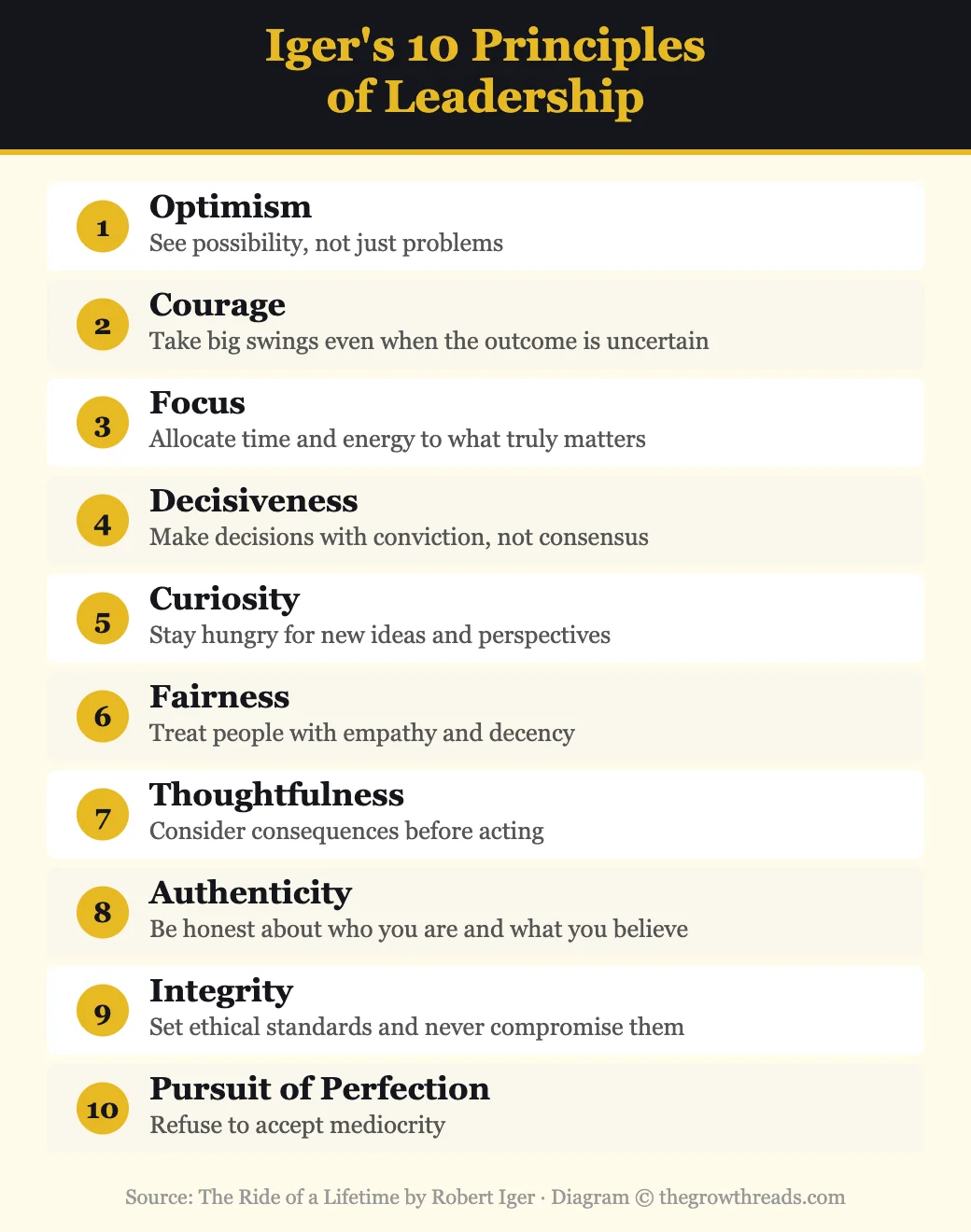
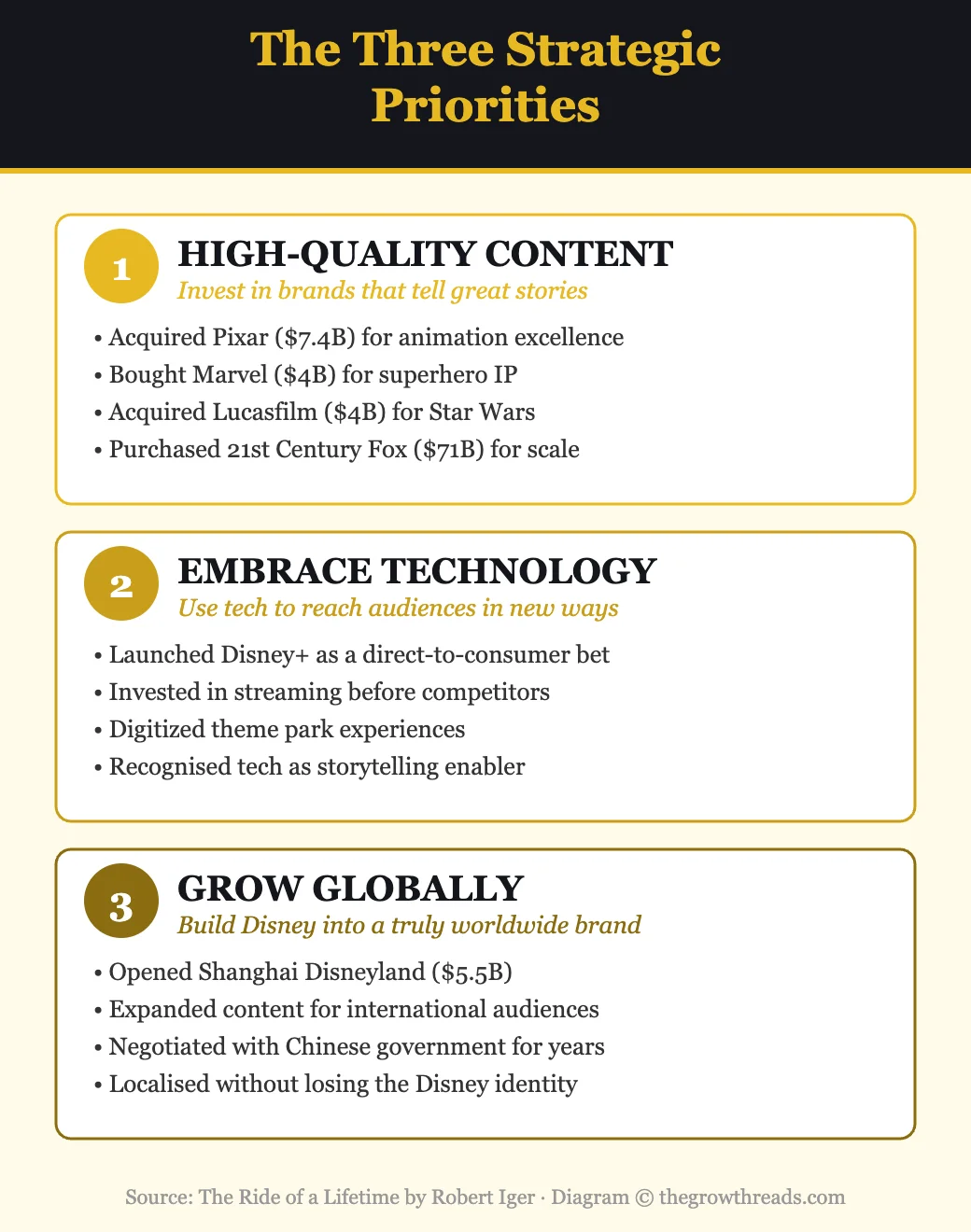
- Three strategic priorities are enough: When Iger became CEO, he narrowed Disney’s strategy to three pillars: high-quality branded content, technology as enabler, and global expansion. Everything else was secondary.
- Respect the people and culture you acquire: The Pixar acquisition worked because Iger let Ed Catmull and John Lasseter keep running it their way. Imposing Disney’s bureaucracy would have killed what made Pixar valuable.
- Courage means taking big swings before the outcome is certain: Every major acquisition was a risk. Marvel had never made its own movie. Star Wars had an uncertain future. Fox was a $71 billion bet on streaming. Iger took each one because the strategic logic was sound, not because success was guaranteed.
- Decisiveness matters more than consensus: Iger made decisions quickly and communicated them clearly. Chronic indecision breeds anxiety in organisations. A wrong decision made with conviction is often better than no decision made with endless deliberation.
- Innovation requires cannibalization: Disney+ competed directly with Disney’s own lucrative licensing deals. Iger accepted that disrupting yourself is better than being disrupted by someone else.
- Fairness and decency are strategic advantages: Treating people well — including competitors, regulators, and employees — creates trust and goodwill that compound over years.
- Pursue perfection but accept that you will never reach it: The relentless pursuit of quality — not perfection itself — is what drives excellence. Mediocrity is the only real failure.
- Know what you do not know: Iger had no technology background, but he surrounded himself with people who did and listened carefully. Great leaders close their knowledge gaps through humility, not pretence.
- Your legacy is the next generation of leaders: Iger spent significant energy identifying and developing future leaders within Disney, knowing that no transformation outlasts its creator unless the culture carries it forward.
What is The Ride of a Lifetime about?
The Ride of a Lifetime is Robert Iger’s memoir of his fifteen years as CEO of The Walt Disney Company, sharing the leadership principles, strategic decisions, and bold acquisitions — Pixar, Marvel, Lucasfilm, and Fox — that transformed Disney into the world’s most powerful entertainment brand.
About the author
Robert Iger grew up in a modest family on Long Island, New York, and began his career at ABC as a studio supervisor making minimum wage. He spent two decades climbing through the ranks of ABC and then Capital Cities/ABC, surviving corporate mergers and political maneuvering. When Disney acquired ABC in 1996, Iger continued rising through Disney’s hierarchy, eventually being named CEO in 2005 — a choice that surprised many who had expected an external hire. Over the next fifteen years, he orchestrated four of the largest media acquisitions in history and launched Disney’s streaming strategy. He stepped down as CEO in 2020, returned briefly in 2022, and is widely regarded as one of the most transformative media executives of the twenty-first century. Explore all Robert Iger book summaries →
Key concepts at a glance
| Concept | What it means | Use it when |
|---|---|---|
| Three Strategic Priorities | Content quality, technology adoption, global expansion | Setting company direction — simplify to three pillars max |
| Innovate or Die | Disrupt yourself before someone else does | Your current model is profitable but technology is shifting |
| Respect the Acquisition | Preserve the culture and leadership of what you buy | Integrating teams, companies, or departments |
| Optimism as Strategy | Realistic belief that problems have solutions | Leading through uncertainty or crisis |
| Decisiveness Over Consensus | Make decisions quickly; indecision creates anxiety | A team is stuck waiting for direction |
| Pursuit of Perfection | Relentless quality standards, not actual perfection | Reviewing work — ask “can this be better?” one more time |
| Fairness Compounds | Treating people with decency builds long-term trust | Negotiations, conflicts, or difficult conversations |
| Legacy Is People | Your impact outlasts you only through the leaders you develop | Succession planning, mentoring, team building |
Part 1: Learning — from the bottom to the boardroom
Iger begins not with Disney but with his early career at ABC, working grueling hours as a studio supervisor on sets. He describes the formative influence of Roone Arledge, the legendary ABC Sports and News president, who taught him that quality is not negotiable — if a broadcast could be better, it was not ready to air. This standard became the foundation of Iger’s own leadership philosophy.
The narrative moves through his rise at Capital Cities/ABC, where he learned to navigate corporate politics and the complexities of mergers. When Disney acquired ABC in 1996, Iger found himself inside a company that was struggling creatively. Michael Eisner’s final years as CEO were marked by boardroom battles, a failed acquisition of Comcast, and a public conflict with Roy Disney. Iger watched all of this closely, filing away lessons about what not to do as a leader.
The key insight from this period is that great leaders are forged by proximity to both excellence and dysfunction. Iger learned ambition from Arledge and caution from watching Eisner’s later missteps. He resolved that if he ever ran Disney, he would lead with humility, focus on a few clear priorities, and avoid the insularity that had trapped his predecessor.
Part 2: Leading — the three strategic priorities and the Pixar bet
When Iger became CEO in 2005, his first move was radical simplicity. He narrowed Disney’s sprawling strategy to three priorities: invest in high-quality branded content, use technology as an enabler rather than a threat, and grow globally. Every major decision for the next fifteen years was filtered through these three pillars.
The first big test was Pixar. Disney’s own animation studio had been producing flops while Pixar, under Steve Jobs and Ed Catmull, was creating masterpiece after masterpiece. The relationship between the two companies was deteriorating — Jobs had publicly broken off negotiations with Eisner. Iger’s first act as incoming CEO was to call Jobs, repair the relationship, and begin discussions about an acquisition.
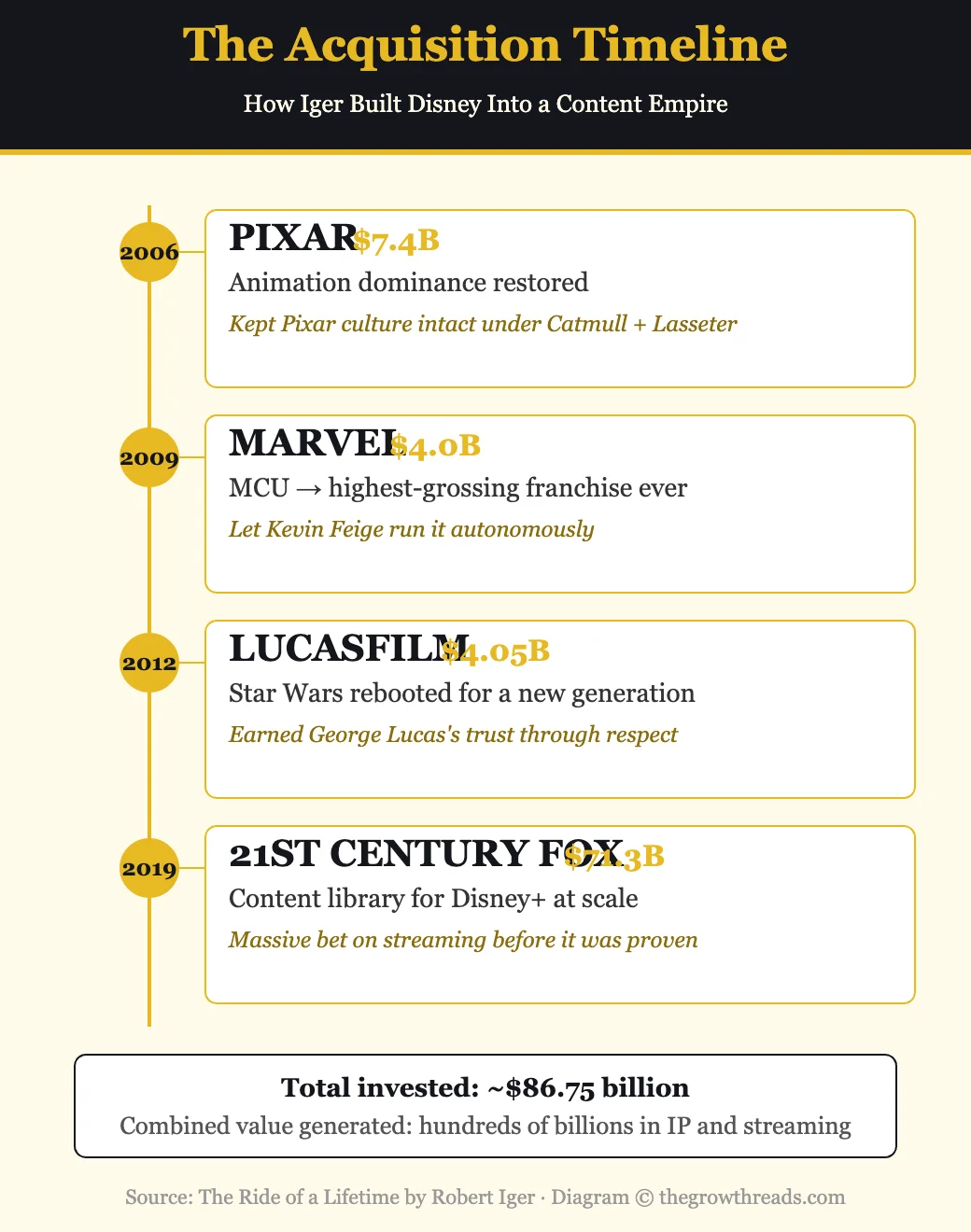
The $7.4 billion deal was controversial. Disney had never spent that much on an acquisition. But Iger understood something critical: you cannot buy creativity and then impose bureaucracy on it. He promised Catmull and Lasseter that Pixar would retain its culture, its Emeryville campus, and its creative independence. He even moved Disney Animation under Pixar’s leadership rather than the reverse. The result was a revitalized animation division that produced hits like Frozen, Moana, and Zootopia alongside Pixar’s continued excellence.
Part 3: Building — Marvel, Lucasfilm, Fox, and the global bet
Emboldened by the Pixar success, Iger applied the same acquisition playbook to three more transformational deals. In 2009, he acquired Marvel Entertainment for $4 billion — a price that seemed steep for a comic book company but proved to be one of the greatest bargains in entertainment history. The Marvel Cinematic Universe went on to generate over $29 billion at the global box office. Iger’s insight: let Kevin Feige run the creative side with minimal interference from Disney’s corporate structure.
In 2012 came Lucasfilm for $4.05 billion. Iger had to earn the personal trust of George Lucas, who was not merely selling a business but handing over his life’s work. The negotiations required extraordinary sensitivity — Lucas needed to believe that Disney would be a worthy steward of Star Wars. Iger flew to Skywalker Ranch multiple times, listened patiently, and made promises he intended to keep.
The biggest and riskiest deal was the 2019 acquisition of 21st Century Fox for $71.3 billion. This was not primarily about Fox’s film studio — it was about content volume. Iger was already planning Disney+ and knew that a streaming service needed an enormous library to compete with Netflix. The Fox acquisition gave Disney control of franchises like Avatar, The Simpsons, and National Geographic, along with thousands of hours of content.
In parallel, Iger spent years negotiating the construction of Shanghai Disneyland — a $5.5 billion project that required navigating Chinese government bureaucracy, cultural sensitivities, and complex business partnerships. The park opened in 2016 and reached profitability faster than any other Disney theme park in history.
Part 4: Navigating — lessons in integrity, succession, and legacy
The final section of the book is the most personal. Iger describes the emotional weight of leading through crises — the Pulse nightclub shooting in Orlando (near Disney World), the alligator attack at a Disney resort, and the #MeToo revelations that brought down key Disney executives. In each case, he returned to the same principle: lead with empathy first, then act with decisiveness.
He reflects on the challenge of succession — one of the most difficult problems in corporate leadership. Iger delayed his retirement multiple times, which he acknowledges created uncertainty and frustration among potential successors. He is candid about the tension between knowing when to leave and being unwilling to hand over something you care about deeply.
The closing chapters return to his ten principles of leadership, now illustrated by fifteen years of high-stakes application. The most resonant is his belief that authenticity is non-negotiable: pretending to know things you do not know, projecting confidence you do not feel, or performing a version of leadership that is not genuinely yours — all of these erode trust over time. Iger’s leadership style was quiet, thoughtful, and deliberate in an industry that often rewards showmanship. The results speak for themselves.
Who is The Ride of a Lifetime best for — and who should read something else first?
This book is ideal for leaders navigating organizational transformation, executives making high-stakes strategic decisions, and anyone who learns best from narrative rather than theory. It is one of the best business memoirs of the past decade because Iger balances storytelling with genuinely useful leadership principles.
If you are looking for a step-by-step leadership framework rather than a memoir, start with Good to Great or The Making of a Manager. If you are more interested in startup leadership than corporate transformation, Shoe Dog by Phil Knight covers similar ground from a founder’s perspective.
Questions to reflect on
- What are your three strategic priorities right now — and are you truly filtering every major decision through them?
- Is there an area of your work or life where you need to “acquire” something valuable and resist the urge to change it into your image?
- When was the last time you made a courageous decision — one where the outcome was uncertain but the strategic logic was sound?
- Do you lean toward decisiveness or consensus? What has that tendency cost you?
- If you stepped down from your current role tomorrow, would the culture and leadership you have built sustain the mission without you?
🔥 Ready to learn from Disney’s greatest CEO?
Get Robert Iger’s hard-won leadership lessons from fifteen years of transforming the world’s most iconic entertainment company.
How to apply The Ride of a Lifetime (7-day plan)
- Day 1 — Define your three priorities: Write down the three things that matter most in your current role or project. If you have more than three, force yourself to cut until only three remain.
- Day 2 — Audit your decisions: Review the last five significant decisions you made. How many were filtered through your three priorities? Redirect any that were not.
- Day 3 — Practice decisiveness: Identify one decision you have been postponing. Make it today. Communicate it clearly to everyone affected.
- Day 4 — Lead with optimism: In every meeting and conversation today, consciously frame challenges in terms of solutions rather than problems. Notice how people respond.
- Day 5 — Protect something you value: Identify one team, process, or creative effort in your organisation that is working well. Make a deliberate decision to protect it from unnecessary interference.
- Day 6 — Have the courage conversation: Identify one big idea or strategic shift you have been hesitating on. Write down the case for and against it. If the strategic logic is sound, commit to moving forward.
- Day 7 — Invest in your successor: Spend thirty minutes mentoring someone who could eventually take on more responsibility. Share one lesson from your own experience that you wish someone had taught you earlier.
Frequently asked questions
Is The Ride of a Lifetime worth reading?
Yes — it is one of the best business memoirs published in the last decade. Unlike many CEO books that read like vanity projects, Iger writes with genuine humility and self-awareness. The leadership principles are universal enough to apply at any scale, and the behind-the-scenes stories of the Pixar, Marvel, and Lucasfilm acquisitions are fascinating even if you have no interest in Disney specifically. The audiobook, narrated by Iger himself, is particularly good.
What are Robert Iger’s leadership principles?
Iger identifies ten: optimism, courage, focus, decisiveness, curiosity, fairness, thoughtfulness, authenticity, integrity, and the relentless pursuit of perfection. He does not present these as abstract ideals — each one is illustrated through specific decisions and moments from his tenure. The most actionable are focus (narrowing to three priorities), decisiveness (making calls quickly), and courage (taking calculated risks before outcomes are certain).
What companies did Robert Iger acquire at Disney?
Iger led four transformational acquisitions: Pixar Animation Studios in 2006 for $7.4 billion, Marvel Entertainment in 2009 for $4 billion, Lucasfilm in 2012 for $4.05 billion, and 21st Century Fox in 2019 for $71.3 billion. Each acquisition was driven by his first strategic priority — high-quality branded content — and each succeeded in part because Iger preserved the creative culture and leadership of the acquired company rather than imposing Disney’s corporate structure.
What is the main lesson from The Ride of a Lifetime?
The central lesson is that great leadership requires both strategic clarity and human decency. Iger’s success was not just about making smart deals — it was about building trust, treating people fairly, maintaining optimism through uncertainty, and having the courage to make bold decisions before the outcomes were guaranteed. Strategy without character is fragile; character without strategy is aimless. Iger shows how to combine both.
How does The Ride of a Lifetime compare to Shoe Dog?
Both are outstanding business memoirs, but they cover very different phases of company building. Shoe Dog by Phil Knight is about founding Nike from scratch — the chaos, near-bankruptcies, and scrappy early years of a startup. The Ride of a Lifetime is about leading an established empire through transformation — making massive strategic bets while managing a 200,000-person organisation. Read Shoe Dog for founder energy and entrepreneurial grit. Read Iger for corporate leadership and strategic vision.
Is this book only useful for CEOs and executives?
Not at all. While the scale of Iger’s decisions is extraordinary (billion-dollar acquisitions, global theme parks), the principles are portable. Focus on three priorities, make decisions with conviction, respect the people and culture you work with, and lead with optimism — these apply whether you are managing a team of five or a company of fifty thousand. The book is valuable for anyone in a leadership role at any level.
What should I read after The Ride of a Lifetime?
For more on the creative culture Iger protected, read Creativity, Inc. by Ed Catmull — it tells the Pixar story from the inside. For a leadership framework to systematize Iger’s instincts, try Good to Great by Jim Collins. For another outstanding CEO memoir with complementary lessons, Shoe Dog by Phil Knight and Trillion Dollar Coach by Eric Schmidt cover very different but equally valuable leadership territory. All are covered in our leadership book summaries.
Related summaries
- Creativity, Inc. by Ed Catmull — the Pixar culture that Iger was so careful to preserve
- Shoe Dog by Phil Knight — another world-class business memoir, from the founder’s side
- Good to Great by Jim Collins — the research behind what separates great companies from good ones
- The Innovator’s Dilemma by Clayton Christensen — the theory behind Iger’s willingness to cannibalize Disney’s own business
More leadership book summaries: The Best Leadership Books of All Time