

★★★★☆ 4.0/5
One-liner: The most important question in leadership is not how you lead — it is why you lead, and most leaders get the answer wrong.
Best for: Current and aspiring leaders who want to honestly examine whether they are leading for the right reasons — and what to do differently if they are not.
Reading time: ~3 hours (192 pages)
Difficulty to apply: Low to moderate — the concepts are simple but require uncomfortable self-honesty.
The Motive in One Minute
Most leadership problems are not about skill — they are about motive. Patrick Lencioni argues that leaders fall into one of two categories based on why they sought leadership in the first place. Responsibility-centered leaders see leadership as an obligation to serve the people and the organization — they embrace the difficult, unglamorous tasks that come with the role. Reward-centered leaders see leadership as a prize — they enjoy the status, compensation, and authority but avoid the uncomfortable duties that actually make leadership effective. Lencioni identifies five specific tasks that reward-centered leaders neglect — managing people, running meetings, confronting issues, communicating repeatedly, and having hard conversations — and shows how this avoidance cascades into organizational dysfunction. The book, told partly through a leadership fable, is a mirror that forces every leader to ask: am I doing this for the right reason?
Key Takeaways
- Your motive for leading determines your effectiveness: Responsibility-centered leaders embrace the hard parts of the role; reward-centered leaders avoid them, creating dysfunction throughout the organization.
- Leadership is a responsibility, not a reward: The title, compensation, and status are byproducts of the role, not the reason for taking it. When leaders treat them as the goal, performance suffers.
- Five critical tasks get neglected: Managing direct reports, running effective meetings, confronting uncomfortable issues, communicating repetitively, and having difficult conversations are the tasks reward-centered leaders most often avoid.
- Avoiding feedback destroys teams: When leaders avoid giving honest performance feedback, underperformers stay, high performers leave, and the entire team’s standards erode.
- Meetings are where leadership happens: Leaders who dismiss meetings as beneath them miss the primary venue where decisions are made, conflicts are resolved, and alignment is built.
- Repetitive communication is not optional: Great leaders say the same things over and over until the message is internalized. Saying it once is not communication — it is announcement.
- Confronting issues is an act of caring: Avoiding difficult conversations is not kindness — it is selfishness disguised as empathy, because it prioritizes the leader’s comfort over the team’s wellbeing.
- Self-awareness is the first step: Honestly assessing your own motives — without defensiveness — is the prerequisite for every other improvement in your leadership.
What Is The Motive About?
The Motive examines why leaders lead — distinguishing between responsibility-centered leaders who embrace the hard duties of leadership and reward-centered leaders who avoid them. Through a leadership fable and practical framework, Lencioni identifies five critical tasks that define effective leadership and shows how neglecting them causes organizational dysfunction.
About the Author
Patrick Lencioni is the founder of The Table Group, a management consulting firm specializing in organizational health, and one of the most widely read business authors in the world. His books, including The Five Dysfunctions of a Team, The Ideal Team Player, and Death by Meeting, have sold millions of copies and shaped how organizations think about teamwork and leadership. Lencioni’s signature approach combines business fables with practical models, making complex organizational dynamics accessible to leaders at every level. He has consulted with executives at Fortune 500 companies, professional sports organizations, and government agencies. Explore all Patrick Lencioni book summaries →
Key Concepts at a Glance
| Concept | What It Means | Use It When |
|---|---|---|
| Responsibility-Centered Leadership | Leading because you feel an obligation to serve the team and organization | You want to anchor your leadership in the right motivation |
| Reward-Centered Leadership | Leading for status, compensation, or authority rather than service | You notice yourself avoiding uncomfortable leadership tasks |
| The Five Omissions | Managing people, meetings, conflict, communication, and hard conversations | You want to identify which leadership duties you may be neglecting |
| Leadership as Duty | Treating the hard parts of leadership as non-negotiable obligations | You need a framework for embracing rather than avoiding discomfort |
Part 1: The Two Motives
Lencioni structures the first half of the book as a leadership fable — a story about two CEOs whose contrasting approaches reveal the impact of motive on organizational performance. Through this narrative, he establishes the central distinction between responsibility-centered and reward-centered leadership.
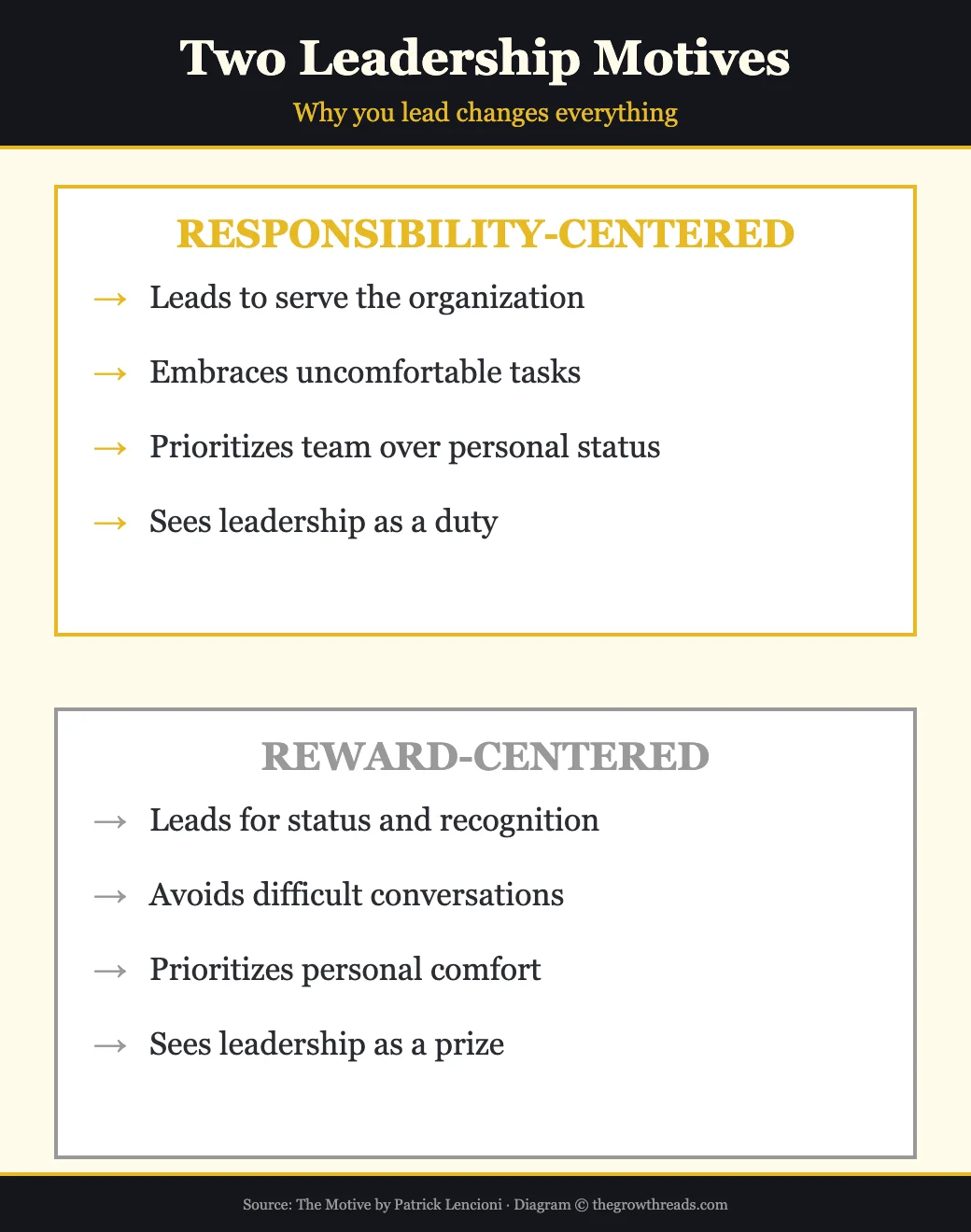
Responsibility-centered leaders see leadership as a duty to serve others. They did not seek the role primarily for the title, the corner office, or the compensation — they accepted it because they believed they could help the organization and its people succeed. When these leaders face an uncomfortable task, their instinct is to lean in rather than avoid it, because they understand that the hard parts of leadership are where the value is created.
Reward-centered leaders, by contrast, sought leadership as a destination. They wanted the status, the autonomy, and the recognition that come with a senior title. When the role requires them to do something uncomfortable — giving tough feedback, running tedious meetings, addressing interpersonal conflict — their instinct is to delegate it, ignore it, or rationalize why it is not really their job. This avoidance compounds over time, creating organizations where problems fester, accountability erodes, and high performers quietly disengage.
Part 2: The Five Omissions
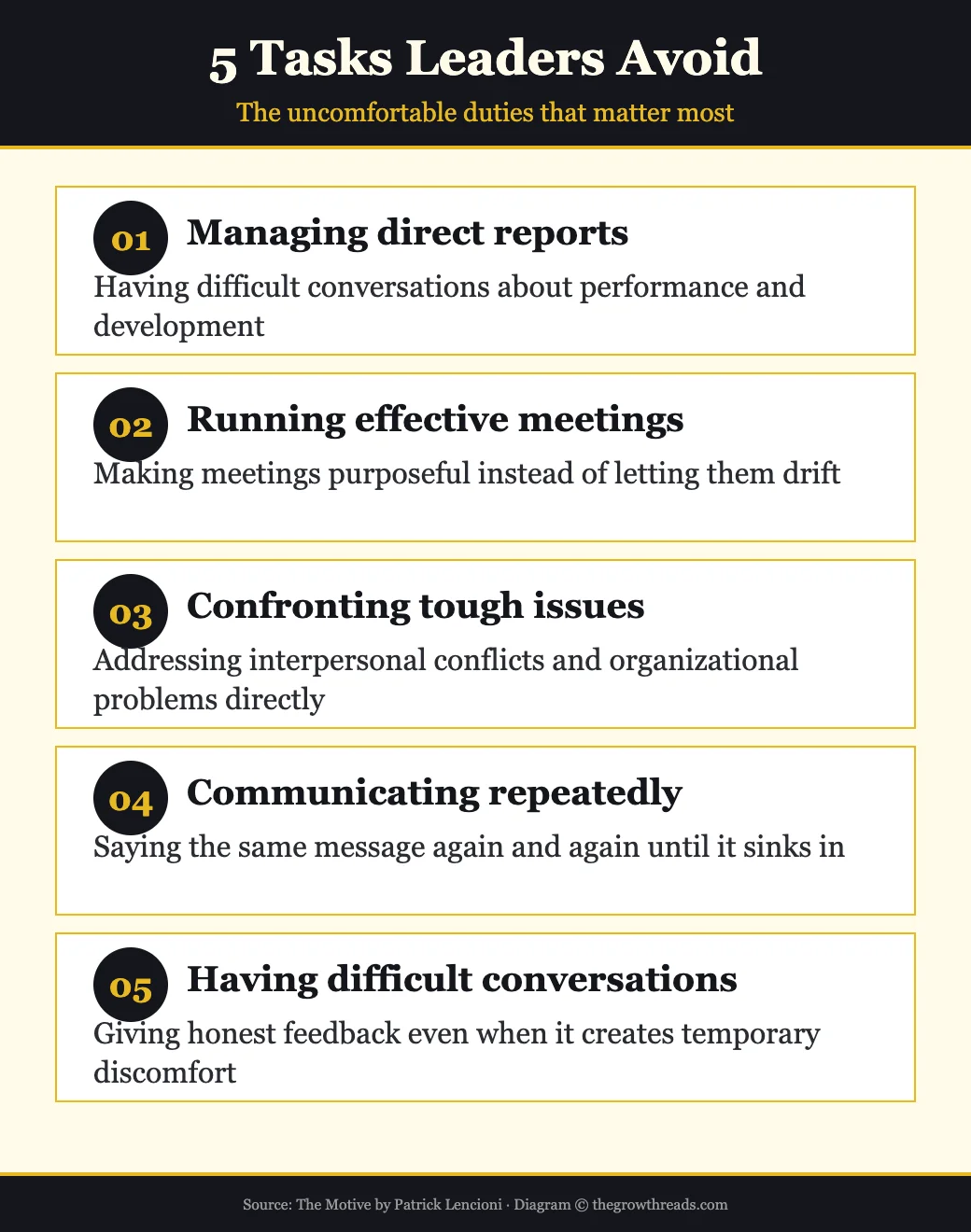
The second half of the book identifies five specific leadership tasks that reward-centered leaders consistently avoid. The first is managing direct reports — having real conversations about performance, providing coaching, and addressing underperformance directly. Many leaders treat their direct reports as autonomous peers rather than people who need guidance, accountability, and honest feedback. This abdication disguised as empowerment allows poor performance to persist.
The second omission is running effective meetings. Lencioni argues that meetings are the primary activity of leadership — the venue where decisions get made, conflicts get resolved, and alignment gets built. Leaders who dismiss meetings as bureaucratic waste or delegate them to subordinates are abdicating one of their most important responsibilities.
The third is confronting difficult issues — organizational problems, interpersonal tensions, and strategic disagreements that everyone sees but no one addresses. The fourth is communicating key messages repeatedly, not just once. And the fifth is having uncomfortable conversations — the direct, honest exchanges about behavior, performance, and expectations that most leaders would rather avoid.
Part 3: The Self-Assessment
Lencioni closes with a challenge: look honestly at your own motives. He acknowledges that most leaders have a mix of both motives — pure responsibility-centered or pure reward-centered leadership is rare. The question is which motive dominates your daily decisions, especially when the work gets uncomfortable.
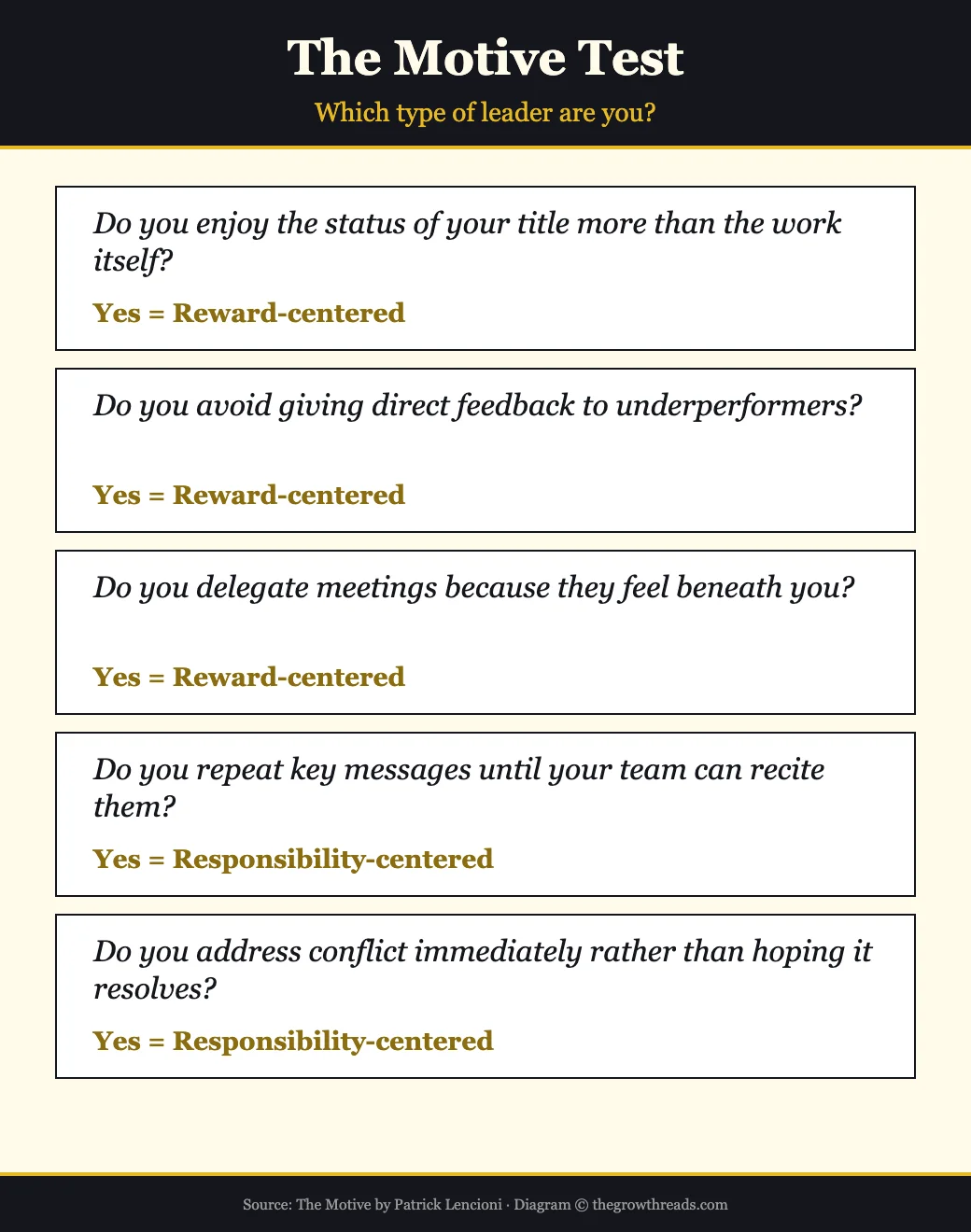
The diagnostic is straightforward. Do you find yourself avoiding any of the five tasks? Do you rationalize that avoidance with phrases like “my people are adults” or “I hired smart people so I shouldn’t have to micromanage”? Do you enjoy the perks and visibility of leadership more than the actual work of developing people and driving results? An honest yes to any of these suggests that reward-centered tendencies are influencing your leadership more than you might like to admit.
The solution is not to feel guilty but to make a conscious choice. Lencioni argues that understanding your motive is the prerequisite for change. Once you see the pattern, you can choose to embrace the uncomfortable tasks rather than avoid them — not because they are enjoyable but because they are the essence of what leadership actually requires.
Who Is The Motive Best For — and Who Should Read Something Else First?
The Motive is a must-read for anyone in a leadership role — especially those who suspect they might be avoiding the uncomfortable parts. It is short, direct, and the fable format makes it an easy read. It is also excellent for leadership development programs and executive coaching conversations.
If you are looking for a more comprehensive framework for building team health, start with Lencioni’s The Five Dysfunctions of a Team. If you want specific techniques for having the difficult conversations Lencioni describes, Crucial Conversations provides the tactical playbook.
Questions to Reflect On
- What originally motivated you to seek a leadership role — and has that motivation changed?
- Which of the five omissions do you most often avoid, and what excuse do you use?
- If you removed the title, compensation, and status from your current role, would you still want the job?
- When was the last time you had a genuinely uncomfortable conversation with a direct report about their performance?
- Do the people you lead experience you as someone who serves them or someone they serve?
🔥 Ready to Lead for the Right Reasons?
Discover whether your leadership motive is helping or hurting your team — and what to do about it.
How to Apply The Motive (7-Day Plan)
- Day 1 — Honest self-assessment: Rate yourself honestly on each of the five tasks. Where do you lean in, and where do you avoid?
- Day 2 — Have one hard conversation: Identify one direct report who needs honest feedback and deliver it today. Be specific, kind, and direct.
- Day 3 — Run a purposeful meeting: Take your next meeting and give it a clear purpose, a defined outcome, and genuine engagement. No phones, no multitasking.
- Day 4 — Confront one avoided issue: Name one problem your team knows about but no one discusses. Raise it in your next team interaction.
- Day 5 — Repeat a key message: Identify your team’s most important priority and communicate it three times today through different channels.
- Day 6 — Ask for feedback on your leadership: Ask two trusted colleagues whether they experience you as responsibility-centered or reward-centered. Listen without defending.
- Day 7 — Write your leadership commitment: Draft a one-paragraph statement of why you lead and what uncomfortable tasks you commit to embracing going forward.
Frequently Asked Questions
What is the main idea of The Motive?
The central argument is that leadership effectiveness depends more on why you lead than how you lead. Responsibility-centered leaders embrace the uncomfortable duties of leadership because they see the role as service. Reward-centered leaders avoid those duties because they see the role as a prize. This distinction explains why some leaders build thriving teams while others, despite having similar skills, create dysfunction.
What are the five tasks reward-centered leaders avoid?
Managing direct reports with real coaching and accountability, running purposeful and engaging meetings, confronting uncomfortable organizational issues, communicating key messages repeatedly rather than once, and having difficult one-on-one conversations about performance and behavior. These five tasks are the duties that most reward-centered leaders rationalize delegating or ignoring entirely.
Is The Motive a business fable?
Partly. Like Lencioni’s other books, The Motive uses a narrative fable in the first half to illustrate the concepts — in this case, a story about two CEOs with contrasting motives. The second half provides a direct, practical framework for self-assessment and application. The fable format makes the ideas accessible and memorable, though readers who prefer pure nonfiction can skip to the model section.
How do I know if I am reward-centered?
Key indicators include avoiding performance conversations with direct reports, viewing meetings as a waste of time, preferring to work on strategy rather than people issues, enjoying the status of the title more than the daily work, and rationalizing avoidance with phrases like “I trust my team to handle it.” Most leaders have elements of both motives; the question is which dominates your behavior when leadership gets uncomfortable.
Can you shift from reward-centered to responsibility-centered?
Yes. Lencioni argues that awareness is the hardest step — once you honestly see your motives, you can choose to act differently. The shift requires deliberately leaning into the uncomfortable tasks rather than avoiding them. It is not about changing your personality but about changing your relationship with the hard parts of leadership. Start with the five tasks and commit to doing one uncomfortable thing each day.
How does The Motive connect to The Five Dysfunctions of a Team?
The Five Dysfunctions focuses on what makes teams break down — absence of trust, fear of conflict, lack of commitment, avoidance of accountability, and inattention to results. The Motive explains why leaders allow those dysfunctions to persist: reward-centered leaders avoid the uncomfortable interventions needed to fix them. Reading The Motive first explains why the leader is the root cause of most team dysfunction.
Is The Motive worth reading if you have read other Lencioni books?
Yes. While Lencioni’s other books focus on team dynamics, organizational health, and meeting structure, The Motive addresses a more fundamental question: are you leading for the right reason? It is the foundational book in his framework — the one that explains why leaders do or do not implement the advice in his other works. At 192 pages, it is also his shortest and most direct book.
Related Summaries
- The Five Dysfunctions of a Team by Patrick Lencioni — the companion guide to building team health.
- Leaders Eat Last by Simon Sinek — why the best leaders put others first.
- Crucial Conversations — the tactical guide to the hard conversations Lencioni describes.
- Best Leadership Books — our complete guide to leading effectively.