

⭐⭐⭐⭐✬ 4.4 / 5
One-liner: A masterclass in reading danger signals and trusting your intuition — from the nation’s leading threat-assessment expert.
Best for: Anyone who wants to better understand human violence, trust their gut instincts, and recognize predatory behavior before it escalates.
Reading time: ~8 hours (352 pages)
Difficulty to apply: Low to medium — the core skill is learning to listen to signals you already receive.
The Gift of Fear in One Minute
Your intuition is the most powerful safety tool you own — and you have been trained to ignore it. Gavin de Becker, who has spent decades assessing threats to public figures, corporations, and ordinary citizens, argues that true fear is a survival signal honed by evolution. Unlike anxiety or worry, which are about imagined futures, genuine fear is always a response to something happening in the present moment. De Becker identifies specific pre-incident indicators — behavioral cues like forced teaming, charm offensives, and refusing to accept “no” — that reliably predict violence. The book teaches readers to distinguish true fear from manufactured worry, trust the body’s alarm system, and take practical steps to stay safe.
Key Takeaways
- True fear is a gift: Real fear is a survival signal that tells you danger is present right now. It is always in response to something — never vague or chronic.
- Worry is not fear: Chronic worry and anxiety are about imagined scenarios, not present danger. They drain energy without protecting you.
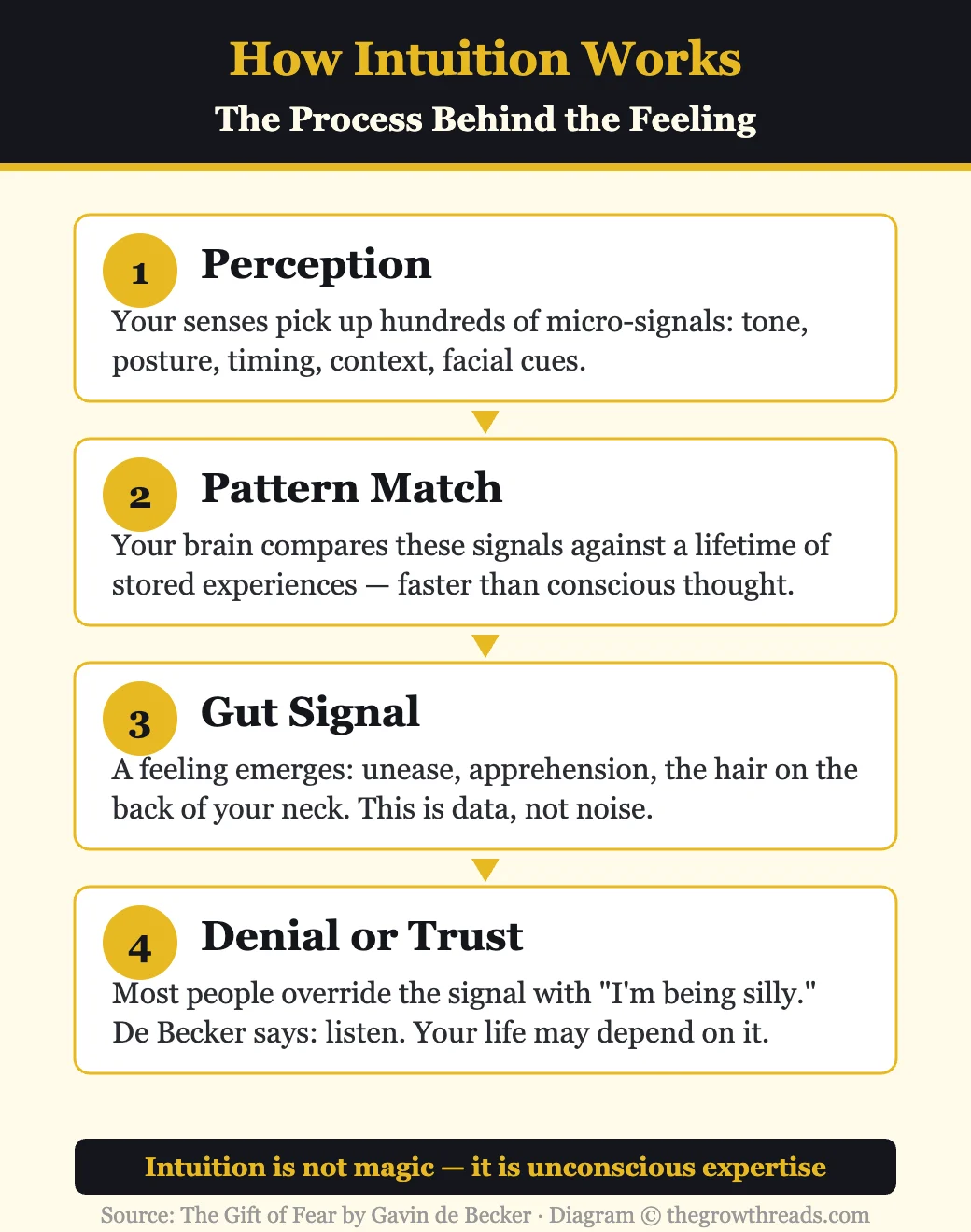
- Intuition is unconscious expertise: Your gut feeling is not magical — it is your brain processing hundreds of micro-signals faster than your conscious mind can follow.
- Denial is the enemy: The biggest obstacle to personal safety is the refusal to accept that danger exists. “It won’t happen to me” is the most dangerous sentence.
- There are seven pre-incident indicators: Forced teaming, charm, too many details, typecasting, loan sharking, unsolicited promises, and discounting “no” are reliable predictors of predatory intent.
- “No” is a complete sentence: When someone refuses to accept your no, that itself is a danger signal. Persistence after rejection is a form of control.
- Niceness is not goodness: Charm is a verb, not a trait. People who work hard to appear trustworthy are often the ones who should not be trusted.
- Violence is predictable: Contrary to popular belief, violence is almost never random. It follows a process with detectable warning signs at every stage.
- The media amplifies wrong fears: News coverage creates fear of rare events (plane crashes, stranger abductions) while obscuring far more common threats (domestic violence, acquaintance assault).
- Trust yourself before trusting others: You are the expert on your own experience. If something feels wrong, it almost certainly is.
What Is The Gift of Fear About?
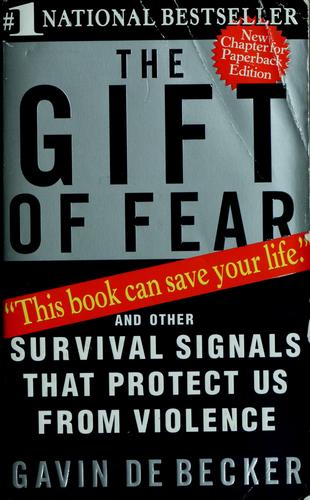
The Gift of Fear teaches readers to recognize the behavioral signals that precede violence and to trust their intuitive responses to danger. Drawing on decades of threat assessment work, Gavin de Becker shows that fear is a survival signal — not a weakness — and that learning to distinguish true fear from chronic worry is essential for personal safety.
About the Author
Gavin de Becker is widely regarded as the nation’s leading expert on predicting and managing violence. His firm advises government agencies, major corporations, and public figures on threat assessment. He has served on the Presidential Advisory Board and helped develop the MOSAIC threat assessment system used by the U.S. Supreme Court Police, the U.S. Capitol Police, and hundreds of other agencies. His work bridges clinical psychology, criminal behavioral analysis, and practical security — giving him a uniquely grounded perspective on how violence actually unfolds. Explore all Gavin de Becker book summaries →
Key Concepts at a Glance
| Concept | What It Means | Use It When |
|---|---|---|
| True fear | A survival signal triggered by present danger, always in response to something real | You feel a sudden, sharp sense that something is wrong |
| Unwarranted fear | Chronic worry or anxiety about imagined futures that drains energy without protecting | You notice you are anxious but cannot identify a specific, present threat |
| Pre-incident indicators (PINs) | Seven behavioral cues that reliably predict predatory or violent intent | Someone’s behavior feels off and you want to understand why |
| Forced teaming | Using “we” language to create an artificial sense of shared purpose or closeness | A stranger acts as if you are already in a relationship |
| Loan sharking | Offering unsolicited help to create a sense of obligation | Someone insists on helping you when you did not ask |
| Discounting “no” | Refusing to accept your refusal — the single most important signal of controlling intent | Anyone persists after you have clearly declined |
| MOSAIC | A threat assessment system that evaluates combinations of factors to predict violence risk | You need a structured framework for assessing a specific threat |
Part 1: The Anatomy of Intuition
De Becker opens with a harrowing case study: a woman named Kelly who survived a violent assault because, at a critical moment, she trusted a feeling she could not explain. Her conscious mind was telling her the man was being helpful. Her body was screaming that something was wrong. She listened to the body — and it saved her life.
This case frames the book’s central argument. Intuition is not a mystical sixth sense. It is a cognitive process — the brain’s ability to detect patterns and anomalies faster than conscious thought can follow. When you get a “gut feeling” about someone, your brain has already processed hundreds of micro-signals: tone of voice, timing, body language, context, word choice. The feeling is the conclusion delivered before the analysis arrives.
De Becker argues that we have been systematically trained to distrust this system. Social politeness, the desire not to seem rude, and the fear of being wrong all conspire to make us override our survival instincts. The result is that many people sense danger clearly but talk themselves out of acting on it — often with devastating consequences.
Part 2: The Seven Survival Signals
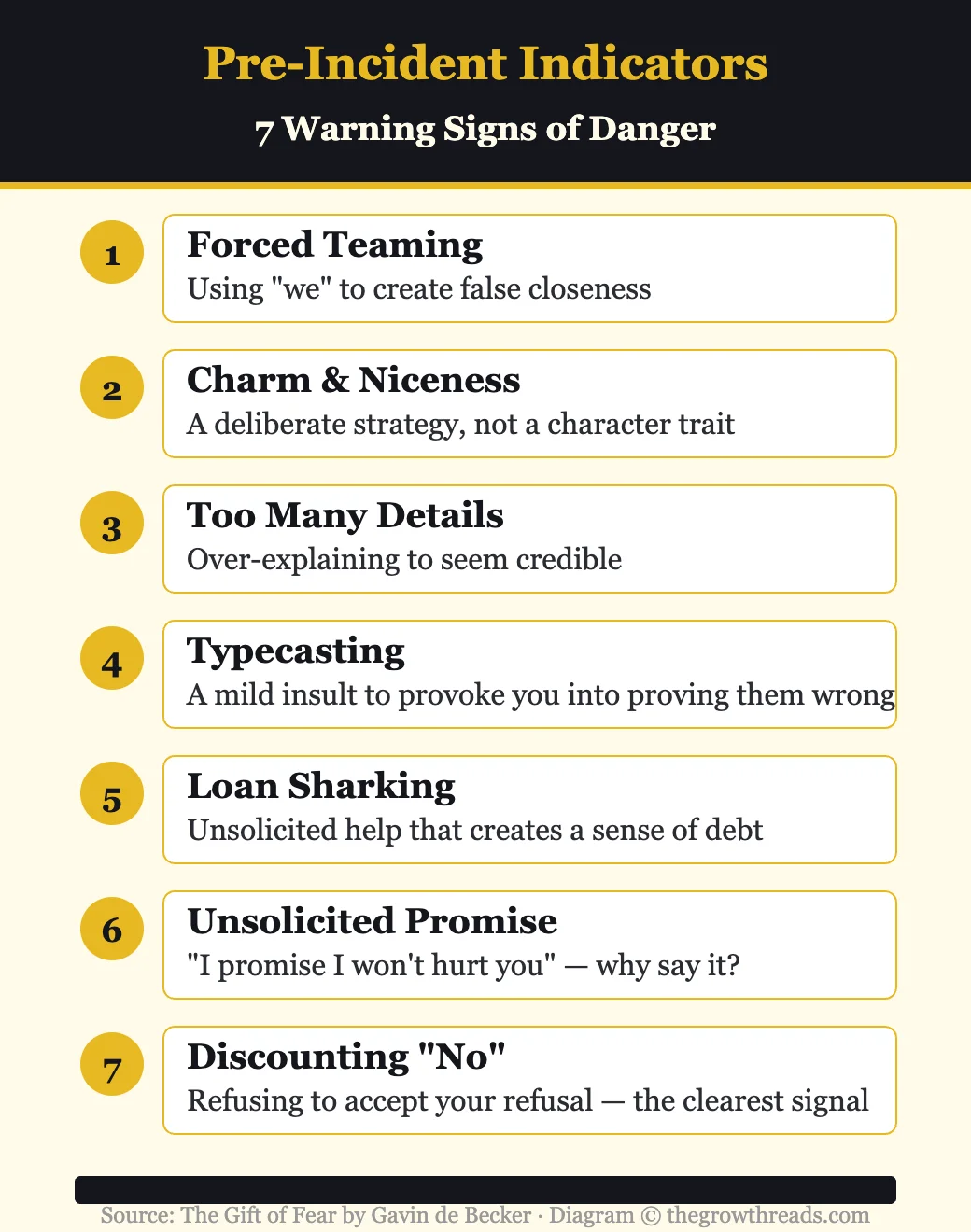
The book’s most actionable section identifies seven pre-incident indicators (PINs) that commonly precede predatory violence. These are behavioral strategies used by people who intend harm, and learning to recognize them transforms vague unease into specific, actionable awareness.
Forced teaming is the use of “we” language to create a false sense of partnership (“We’re in the same boat here”). Charm and niceness are deliberate strategies — charm is something a person does, not something they are. Too many details signal that someone is working to appear credible rather than simply being credible. Typecasting is a slight insult designed to make you prove the attacker wrong (“You’re probably too stuck-up to accept help”). Loan sharking means offering unsolicited favors to create a sense of debt. The unsolicited promise is a red flag precisely because it is unnecessary — “I promise I won’t hurt you” raises the question of why that thought was on their mind. And discounting “no” — refusing to accept your refusal — is the single most reliable indicator of controlling or predatory intent.
De Becker emphasizes that these signals are most dangerous in combination. Any one of them might be innocent. But two or three together, especially from a stranger, should activate your full attention.
Part 3: True Fear vs. Manufactured Fear
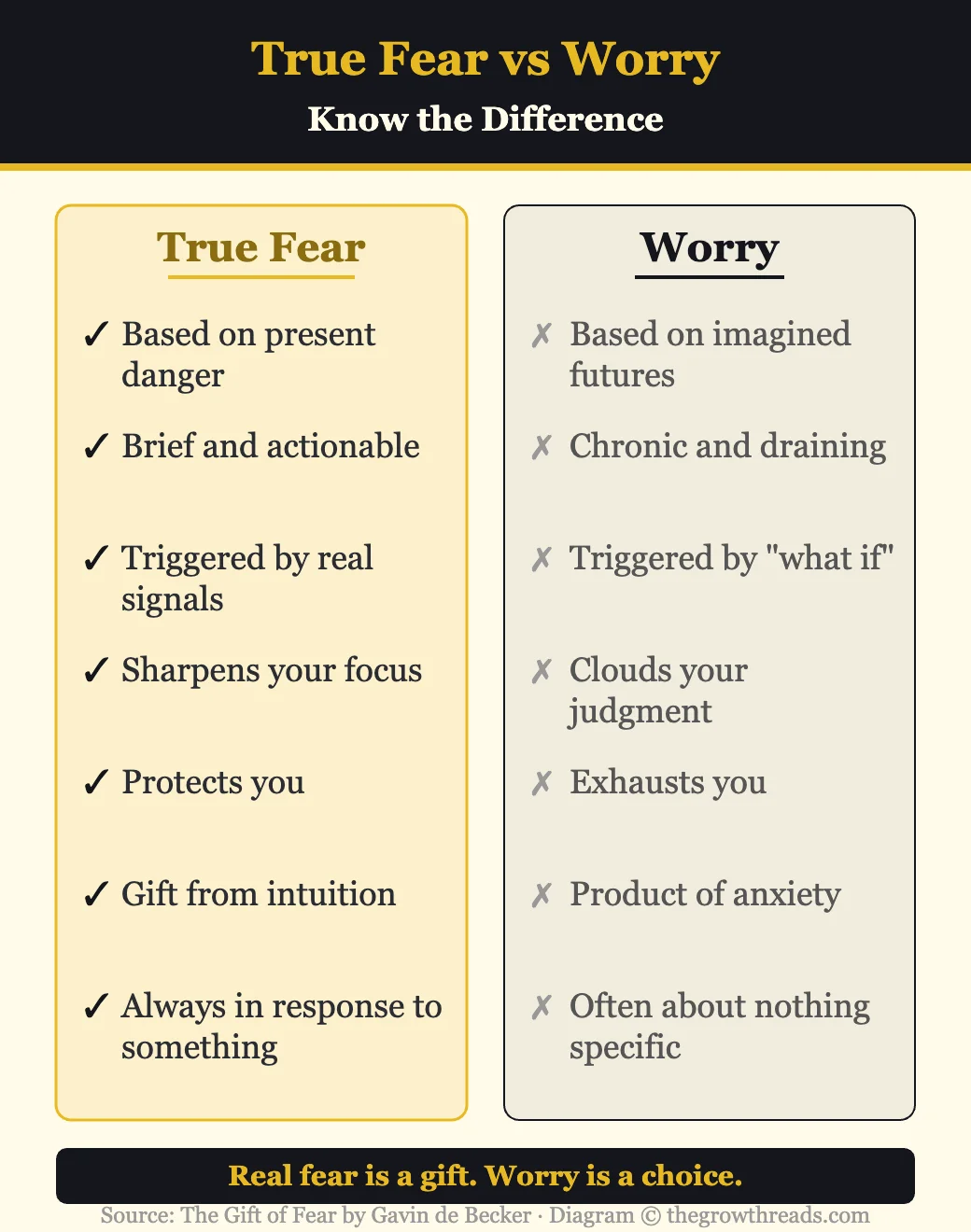
One of the book’s most important distinctions is between true fear and what de Becker calls unwarranted fear — the chronic, low-grade anxiety that pervades modern life. True fear is always a response to something happening now: a sound, a look, a behavior, a situation. It arrives suddenly, delivers its message, and dissipates once you act. Unwarranted fear, by contrast, is about imagined futures: “What if someone breaks in?” “What if that person follows me?” It is chronic, exhausting, and paradoxically makes you less safe by consuming the very attention you need to detect real threats.
De Becker argues that the media plays a significant role in amplifying unwarranted fear. Nightly news and crime coverage create a distorted picture of risk, making rare events (stranger abductions, serial killers) feel ubiquitous while obscuring far more common dangers (domestic violence, acquaintance assault). The result is a population that worries constantly about the wrong things while ignoring or normalizing the actual threats in their own lives.
The practical implication is liberating: if you feel true fear, act on it immediately. If you feel chronic worry, examine it — but do not let it run your life. Learning to tell the difference is, in de Becker’s view, the single most important safety skill you can develop.
Part 4: Violence, Stalking, and Domestic Threats
The later chapters apply de Becker’s framework to specific threat categories. His analysis of stalking is particularly powerful: he explains why engaging with a stalker — even to say “leave me alone” — resets the clock and reinforces the behavior. The counterintuitive advice: complete disengagement is the only strategy that works, because any response (positive or negative) teaches the stalker that persistence produces contact.
His chapters on domestic violence challenge common misconceptions. De Becker explains why victims stay, why they often know they are in danger but cannot act, and why the most dangerous moment in an abusive relationship is the point of leaving. He provides a structured threat assessment for evaluating lethal risk, drawing on the same methodology his firm uses to protect public figures.
The book also addresses workplace violence, threats against public figures, and how to evaluate anonymous threats. De Becker’s consistent message throughout: violence is a process, not an event. It follows a predictable sequence with warning signs at every stage — if you know what to look for and trust yourself to see it.
Who Is The Gift of Fear Best For — and Who Should Read Something Else First?
This book is essential for anyone who wants to improve their personal safety awareness — particularly women, college students, human resources professionals, and anyone who works with the public. It is equally valuable for therapists, counselors, and social workers who help clients navigate threatening situations.
If you are interested in the psychology of persuasion and manipulation more broadly, start with Influence by Robert Cialdini. If you want to understand the neuroscience of fear and emotional processing, pair this with Emotional Intelligence by Daniel Goleman. For a deeper dive into why humans misjudge risk, see Thinking, Fast and Slow.
Questions to Reflect On
- Can you recall a time when your gut told you something was wrong, but you talked yourself out of it? What happened?
- How much of your daily fear is true fear (a response to present danger) versus worry (about imagined futures)?
- Have you ever encountered any of the seven pre-incident indicators — forced teaming, charm offensives, loan sharking, or someone discounting your “no”?
- In what situations do you prioritize politeness over personal safety?
- How has media coverage shaped what you fear — and does it match your actual risk profile?
🔥 Ready to trust your survival instincts?
Learn to recognize danger signals and reclaim the life-saving power of real fear.
How to Apply The Gift of Fear (7-Day Plan)
- Day 1 — Audit your signals: For one day, notice every moment your body sends a signal — a tightened stomach, raised hackles, the urge to move away from someone. Write down three of them.
- Day 2 — Separate fear from worry: Review your current anxieties. Label each one as “true fear” (response to something present) or “worry” (about an imagined future). Notice the ratio.
- Day 3 — Learn the seven PINs: Memorize the seven pre-incident indicators. Review one interaction from the past where something felt off and identify which PINs were present.
- Day 4 — Practice saying no: In a low-stakes situation today, practice declining something clearly and without apology. Notice how it feels and how the other person responds.
- Day 5 — Evaluate your media diet: Track how much of the news you consume focuses on rare, dramatic threats versus common, everyday risks. Consider adjusting your intake.
- Day 6 — Conduct a safety review: Walk through your daily routines (commute, parking, office) and identify one area where you could improve situational awareness.
- Day 7 — Trust and act: Make a commitment: the next time you feel genuine unease about a person or situation, you will act on it first and analyze it later. Write this commitment down.
Frequently Asked Questions
What is the main message of The Gift of Fear?
The main message is that true fear is a survival signal that should be trusted, not suppressed. Gavin de Becker argues that your intuition has evolved to detect danger signals — subtle behavioral cues like forced teaming, charm, and refusing to accept “no” — and that overriding these signals with politeness or denial puts you at risk. The book teaches readers to distinguish genuine fear (which is always a response to present danger) from unwarranted worry (which is about imagined futures), and to act on real fear immediately.
What are the seven pre-incident indicators?
De Becker identifies seven behavioral cues that commonly precede predatory violence: (1) Forced teaming — using “we” to create false closeness; (2) Charm and niceness — a strategy, not a trait; (3) Too many details — over-explaining to seem credible; (4) Typecasting — a mild insult to make you prove them wrong; (5) Loan sharking — unsolicited help that creates debt; (6) The unsolicited promise — raising the very concern they claim to dismiss; and (7) Discounting “no” — the clearest signal of controlling intent. Any two or three together, especially from a stranger, warrant full attention.
How is true fear different from anxiety?
True fear is a response to present danger — it is triggered by something happening right now (a sound, a behavior, a situation) and it produces a clear, actionable signal. It arrives suddenly, delivers its message, and fades once you act. Anxiety, by contrast, is about imagined futures: “what if” scenarios that may never materialize. Anxiety is chronic, vague, and exhausting. De Becker argues that anxiety actually impairs safety by consuming the attentional resources needed to detect genuine threats.
Is violence really predictable?
Yes, according to de Becker. Violence is almost never truly random — it is a process with detectable signals at every stage. Before most acts of violence, there are warning behaviors: escalation of threats, boundary violations, obsessive focus on a target, and pre-incident indicators like those described in the book. De Becker’s firm has assessed thousands of cases, and the consistent finding is that the signals were present but overlooked, rationalized, or denied. The key is learning to see the process rather than waiting for the event.
What does de Becker say about stalking?
De Becker’s advice on stalking is counterintuitive: complete disengagement is the only effective response. Any contact with a stalker — even to say “stop” or “leave me alone” — resets the clock and reinforces the behavior. If a stalker contacts you 40 times and you respond on the 41st, they learn that persistence produces results. De Becker recommends documenting everything, seeking professional threat assessment, and having all communication handled through a third party such as an attorney.
Why does de Becker say niceness is a red flag?
De Becker draws a crucial distinction between niceness and goodness. Niceness is a social strategy — something a person does deliberately to create a favorable impression. Goodness is a character quality that does not require performance. When someone works unusually hard to appear charming, helpful, and trustworthy — especially a stranger in a context where such effort is unnecessary — it often signals that they need your guard down for a specific reason. This does not mean every nice person is dangerous, but it means charm should be evaluated as a tactic rather than accepted as a character reference.
Is The Gift of Fear still relevant today?
Absolutely. While the book was first published in 1997, its core insights about human behavior, intuition, and threat assessment are timeless — they are based on evolutionary psychology and decades of case data, not current events. The pre-incident indicators, the distinction between true fear and worry, and the advice about trusting your instincts are as applicable today as they were when the book was written. De Becker’s MOSAIC threat assessment system continues to be used by law enforcement agencies and corporations nationwide.
Related Summaries
- Thinking, Fast and Slow by Daniel Kahneman — the neuroscience behind the two systems of thinking that underpin intuition.
- Influence by Robert Cialdini — the psychology of persuasion and how people are manipulated into compliance.
- Emotional Intelligence by Daniel Goleman — how the brain processes fear and why emotions sometimes override rational thought.
- The 48 Laws of Power by Robert Greene — strategic deception and charm as power tools, seen from the other side.
📚 Explore more in our Best Psychology Books pillar page.