

★★★★★ (4.5/5) — A clinical psychologist reframes anger from a problem to be managed into a signal to be understood, with decades of family-systems insight behind every page.
Best for: Anyone who either swallows their anger to keep the peace or vents it repeatedly without anything ever changing.
Reading time: ~13 min summary (book: ~6–7 hrs)
Difficulty to apply: Moderate — the ideas are simple, but changing a long-standing relationship pattern takes real practice
The Dance of Anger in one minute
Anger isn’t the problem — what you do with it is. Harriet Lerner, a clinical psychologist writing from a family-systems perspective, argues that most people mishandle anger in one of two ways: they swallow it to preserve harmony, or they vent it loudly and repeatedly without anything actually changing. Both approaches treat anger as something to discharge rather than as information. Lerner’s alternative is to use anger as a signal that something in a relationship pattern needs to shift, then to act on that signal calmly, clearly, and consistently — even when the people around you resist the change, which they usually will at first.
Key takeaways
- Anger is a signal, not a flaw: it’s information that something in a relationship or situation needs your attention.
- Suppressing anger doesn’t resolve it: swallowing conflict to keep the peace usually means losing track of your own needs, a pattern Lerner calls “de-selfing.”
- Venting isn’t the same as changing: repeating the same angry confrontation without altering your own behavior keeps the pattern exactly as it was.
- Relationships run on patterns, not incidents: a single fight is rarely the real story — it’s usually one beat in a much older, repeating dance.
- Triangles diffuse tension without resolving it: pulling a third person into a two-person conflict feels like relief but avoids the actual issue.
- Pursuers and distancers feed each other: the harder one partner chases closeness, the harder the other tends to retreat.
- Overfunctioning trains underfunctioning: taking over someone else’s responsibilities repeatedly teaches them to do less, not more.
- An “I position” beats blame: stating your own beliefs and limits, without accusing the other person, is far more likely to produce real change.
- Backlash is normal, not a sign of failure: people resist when a stable pattern shifts, and that resistance is often proof the change is real.
- Change requires staying the course: one calm, clear stance repeated consistently outperforms a single dramatic confrontation.
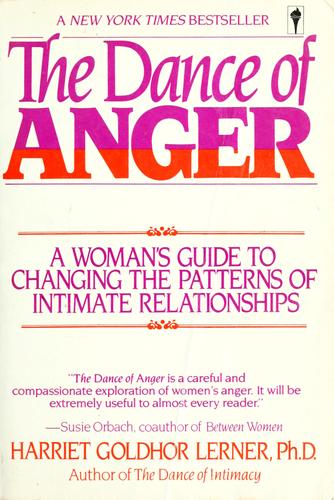
What is The Dance of Anger about?
The Dance of Anger is Harriet Lerner’s guide to understanding anger as useful information rather than a problem to suppress or vent, showing how repeating relationship patterns — triangles, pursuit and distance, overfunctioning and underfunctioning — keep people stuck, and how a calm, clearly stated position can break the pattern for good.
About the author
Harriet Lerner is a clinical psychologist who spent over two decades on staff at the Menninger Clinic, one of the most respected psychiatric institutions in the United States, where she specialized in women’s psychology and family relationships. Trained in family-systems theory, she approaches anger and conflict not as isolated personal failings but as patterns that emerge from the structure of a relationship itself — which is why her advice focuses on changing your own part in the pattern rather than trying to change the other person directly. The Dance of Anger, published in 1985, became a foundational text in relationship psychology and was followed by several related books, including The Dance of Intimacy and The Dance of Connection. Lerner continues to write and speak about relationships, anxiety, and family dynamics.
Key concepts at a glance
| Concept | What it means | Use it when |
|---|---|---|
| De-selfing | Giving up your own beliefs, needs, or opinions to preserve harmony in a relationship | Noticing you’ve stopped voicing what you actually think or want |
| Venting vs. changing | Discharging anger repeatedly without altering the behavior that keeps causing it | Realizing the same argument keeps happening with no real resolution |
| Triangles | Pulling a third person into a two-person conflict instead of resolving it directly | Noticing you vent about a conflict to others instead of addressing it |
| Pursuer-distancer dynamic | One partner seeks closeness while the other seeks space, each intensifying the other | Recognizing a chase-and-retreat pattern in a close relationship |
| Overfunctioning-underfunctioning | One person takes on excess responsibility, training the other to take on less | Noticing you always “handle it” so the other person never has to |
| The “I position” | Stating your own beliefs, feelings, and limits without blaming the other person | Trying to change a pattern without starting a fight |
| Backlash | Predictable resistance from others when you change a long-standing pattern | Preparing yourself emotionally before making a real change |
Part 1: Why We Get Anger Wrong
Lerner opens by naming two failure modes that look opposite but share the same flaw. The first is what she calls the “nice lady” pattern: swallowing anger, avoiding conflict, and prioritizing everyone else’s comfort over your own needs. Over time, this doesn’t eliminate the underlying tension — it just buries it, often at the cost of the person’s own sense of self. Lerner has a specific term for this erosion: de-selfing, the slow process of giving up your own beliefs and needs to keep a relationship stable.
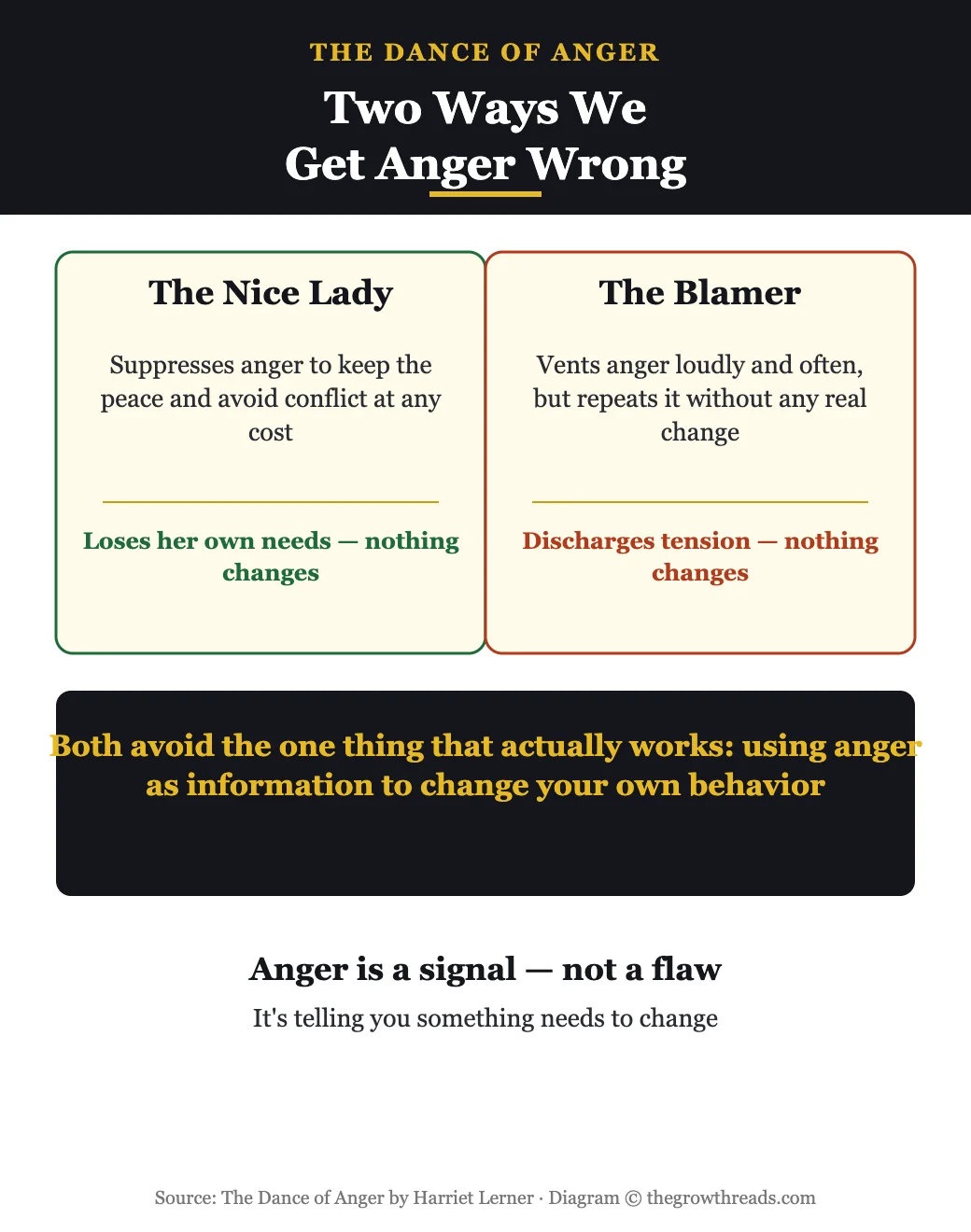
The second failure mode is the mirror image: venting anger openly and often, but in a way that never actually changes anything. Lerner is careful to distinguish this from healthy anger expression — the issue isn’t that the anger is expressed, it’s that expressing it becomes the entire strategy. The same fight happens again next month, with the same script, because venting discharges tension without addressing the pattern that produced it in the first place.
Both patterns, Lerner argues, mistake anger for the end of the story rather than the beginning of one. Anger that’s swallowed or anger that’s merely vented both skip the step that actually matters: using the feeling as a signal to examine what needs to change, in the relationship or in your own behavior within it.
TGR Note: If the “nice lady” pattern sounds familiar, Not Nice is an excellent companion — it goes deep on the people-pleasing habits that often sit underneath swallowed anger.
Part 2: The Patterns That Keep Us Stuck
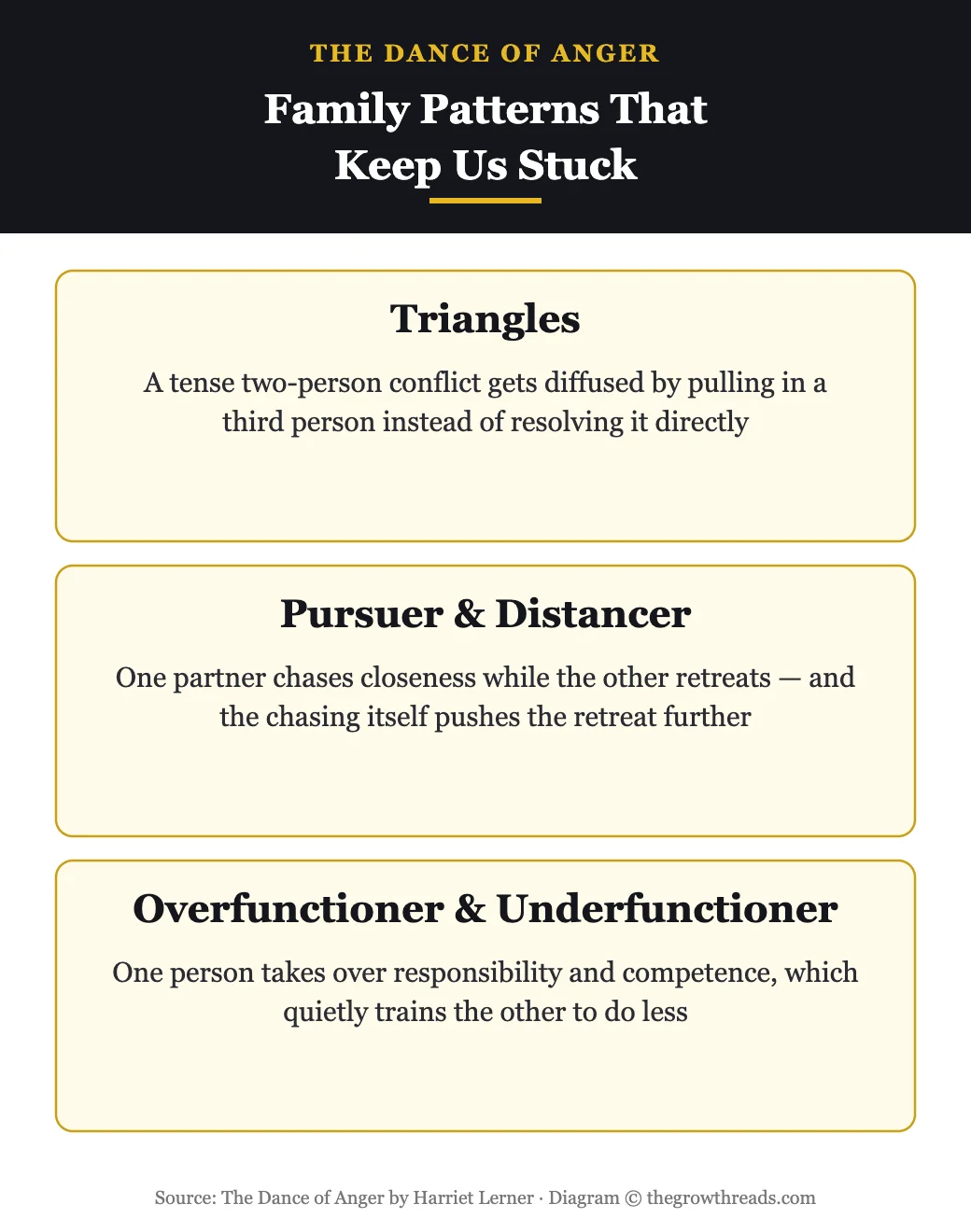
Drawing on family-systems theory, Lerner identifies several specific patterns that keep relationships stuck, each of which feels personal but is actually structural — meaning it depends on both people’s roles, not just one person’s character. The first is the triangle: when tension rises between two people, it’s common to pull in a third person — a friend, a parent, a sibling — as a way of relieving pressure without resolving the original conflict. It feels like relief, but the underlying issue between the original two people remains untouched.
The second is the pursuer-distancer dynamic, often seen in romantic relationships. One partner wants more closeness and pushes for connection; the other wants more space and pulls back. The uncomfortable insight is that each response intensifies the other — the harder the pursuer chases, the harder the distancer retreats, and the harder the distancer retreats, the harder the pursuer chases. Neither person is simply “wrong”; they’re locked in a self-reinforcing loop.
The third is overfunctioning and underfunctioning — a dynamic that shows up constantly in families and workplaces alike. One person consistently steps in, takes charge, and handles things; the other, often without meaning to, learns that they don’t need to. Over time, the overfunctioner becomes exhausted and resentful, while the underfunctioner becomes less capable and less confident, and both blame the other for a dynamic they’re both maintaining.
TGR Note: The pursuer-distancer pattern is central to attachment theory as well — Attached explains the anxious-avoidant version of this same dynamic in more depth.
Part 3: Anger as Information, Not Ammunition
The turning point in the book is a reframe: anger is data, not a weapon. When you feel angry, Lerner argues, the productive question isn’t “how do I express this forcefully enough” or “how do I make this feeling go away” — it’s “what is this feeling telling me needs to change?” Sometimes the answer is about the other person’s behavior. Often, uncomfortably, it’s about your own role in a pattern you’ve been maintaining without realizing it.
This leads to the book’s central practical tool: the “I position.” Instead of framing a grievance as an accusation (“you always ignore me”), an I position states your own experience, belief, or limit clearly and without blame (“I need us to talk about this before Friday, or I’ll need to make the decision without you”). The distinction matters because accusations invite defensiveness, while clear personal statements are harder to argue with and easier to act on.
Lerner is careful to note that an I position isn’t a magic script that resolves conflict painlessly. It’s a way of staying grounded in your own beliefs and limits while allowing the other person to respond however they will — including badly. The goal isn’t to control their reaction; it’s to be clear and consistent regardless of it.
TGR Note: For the practical mechanics of stating a clear position without triggering a defensive reaction, Nonviolent Communication pairs extremely well with this chapter.
Part 4: Expecting Backlash and Staying the Course
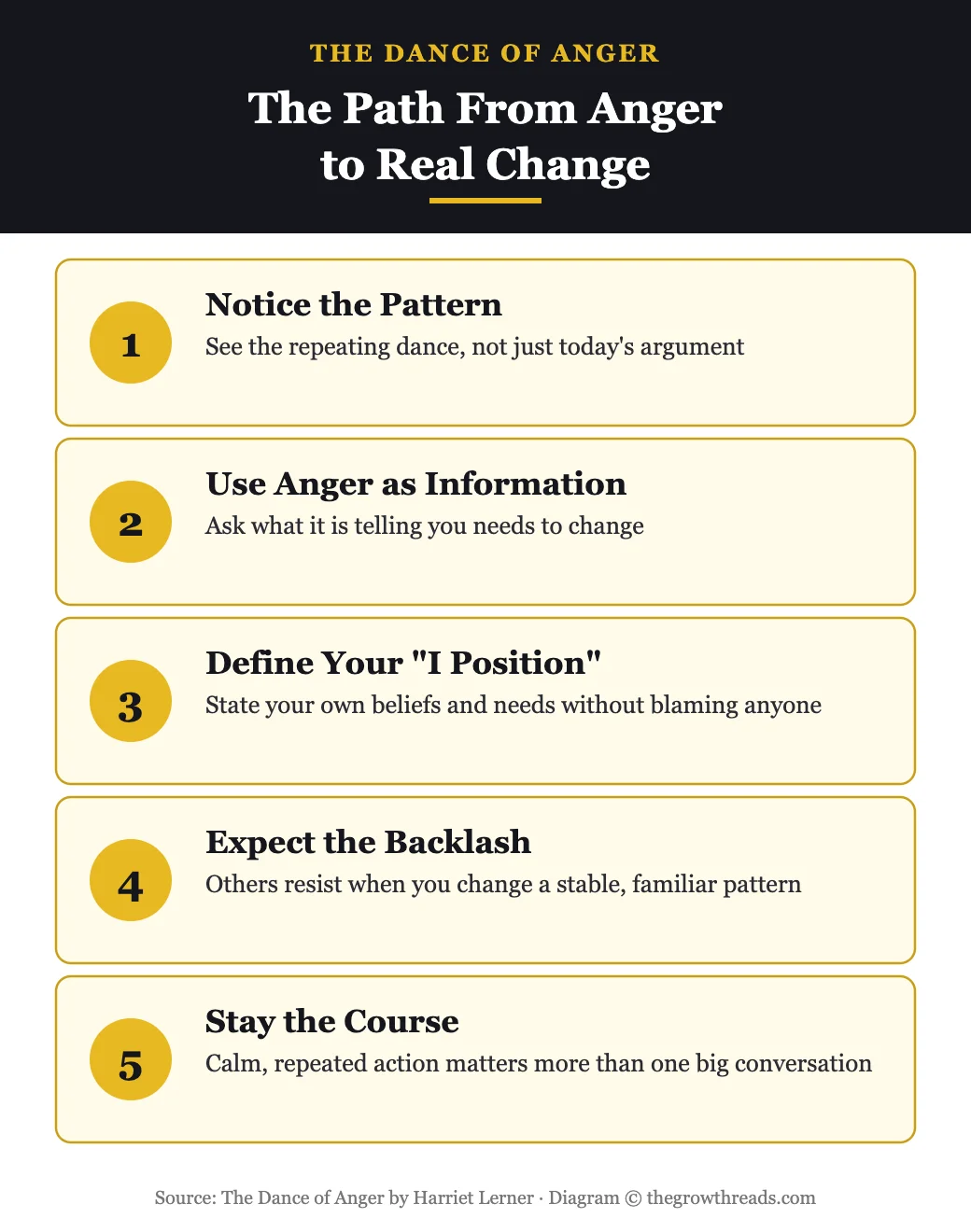
One of the book’s most practically useful — and most reassuring — ideas is that backlash is normal. When you change your part of a long-standing pattern, the people used to that pattern will typically push back, sometimes harder than before, in an unconscious effort to restore the old, familiar equilibrium. Lerner’s point is that this resistance isn’t evidence that the change is wrong or that you should abandon it — it’s often a sign that the change is real and is disrupting a system that had settled into a stable, if unhealthy, shape.
Because of this, Lerner emphasizes that meaningful change rarely comes from one dramatic conversation. It comes from calmly, repeatedly holding the same clear position over time, even through pushback, until the new pattern becomes the new normal. This reframes patience not as passivity but as the actual mechanism of change — the willingness to stay steady through the discomfort of a system readjusting around you.
The book closes by tying anger back to self-respect: learning to use anger well isn’t about becoming angrier or more confrontational, it’s about becoming clearer about who you are and what you need, and being willing to hold that ground even when it’s uncomfortable for the people around you.
TGR Note: If holding a clear position under pressure is the skill you want to build next, Crucial Conversations offers a detailed, step-by-step framework for exactly that.
Who is The Dance of Anger best for — and who should read something else first?
This book is best for anyone who recognizes themselves in one of the two failure modes — chronically swallowing conflict or repeatedly venting without change — and wants to understand the relationship pattern underneath it, not just the individual argument in front of them.
If your pattern leans toward chronic people-pleasing specifically, Not Nice goes deeper on that root cause. If the pattern shows up mainly as a pursuer-distancer dynamic in a romantic relationship, Attached explains the attachment-theory version of the same loop. And if you want concrete scripts for difficult conversations once you’ve identified your pattern, Crucial Conversations is the natural next step.
Questions to reflect on
- Do you tend to swallow anger to keep the peace, or vent it without much changing afterward?
- Is there a recurring argument in your life that’s really the same pattern repeating, not a new disagreement each time?
- Do you ever bring a third person into a conflict instead of addressing it with the person directly involved?
- Where in your life are you overfunctioning — or underfunctioning — for someone else?
- What would an honest “I position” sound like for the conflict that’s been bothering you most?
🔥 Ready to change the pattern, not just the argument?
Grab a copy of The Dance of Anger and start using anger as the signal it was always meant to be.
How to apply The Dance of Anger (7-day plan)
- Day 1 — Name your default pattern: Identify whether you typically swallow anger or vent it, and in which relationship it shows up most.
- Day 2 — Spot a triangle: Notice one instance this week where you vent about a conflict to someone other than the person actually involved.
- Day 3 — Map a pursuer-distancer loop: Identify one relationship where a chase-and-retreat pattern plays out, and name both roles honestly.
- Day 4 — Check your overfunctioning: Notice one task you’ve taken over for someone else that they could reasonably handle themselves.
- Day 5 — Draft an “I position”: Write one sentence stating your own need or limit on a current conflict, without blaming the other person.
- Day 6 — Deliver it calmly: Say your I position out loud to the person involved, and notice your urge to soften or take it back.
- Day 7 — Expect and tolerate backlash: If the reaction is resistance, remind yourself that’s normal, and hold your position without escalating.
Frequently asked questions
Is The Dance of Anger only for women?
The book is written with women’s experiences and relationships as its central lens, reflecting both Lerner’s clinical focus and the original subtitle, “A Woman’s Guide to Changing the Patterns of Intimate Relationships.” That said, the underlying concepts — de-selfing, triangles, pursuer-distancer dynamics, overfunctioning and underfunctioning, and the “I position” — describe patterns that show up in relationships of any gender combination, and many readers outside the original target audience have found the framework directly useful in their own relationships and families.
Is this book about controlling or suppressing anger?
No — that’s actually the opposite of Lerner’s argument. She’s explicit that suppressing anger is one of the two failure modes the book addresses, not the goal. The book’s central message is that anger should be used as information about what needs to change, expressed clearly through a calm, non-blaming “I position,” rather than either bottled up or discharged repeatedly without producing any actual change in the underlying pattern.
Does the book require both people in a relationship to participate?
No, and this is one of its most practical strengths. Because Lerner works from a family-systems perspective, her core argument is that changing your own part of a pattern changes the pattern itself, even if the other person never reads the book or agrees anything needs to change. You can’t control someone else’s behavior, but you can change your consistent response to it, which shifts the whole dynamic over time.
Who is Harriet Lerner?
Harriet Lerner is a clinical psychologist who spent over two decades at the Menninger Clinic, specializing in women’s psychology and family relationships from a family-systems perspective. The Dance of Anger, published in 1985, became a foundational relationship psychology text and led to a series of related books, including The Dance of Intimacy and The Dance of Connection. She continues to write and speak on relationships, anxiety, and family dynamics.
What is an “I position” exactly?
An “I position” is a way of stating your own beliefs, feelings, or limits clearly, without blaming or accusing the other person. Instead of “you never help around here,” an I position sounds more like “I need us to split this differently going forward.” The distinction matters because accusatory statements tend to trigger defensiveness, while clear personal statements are both harder to argue with and easier to act on consistently.
Why does the book emphasize that backlash is normal?
Because many people abandon a healthy change the moment they encounter resistance, mistaking that resistance for proof they’ve made a mistake. Lerner’s family-systems framing suggests the opposite: pushback often signals that a real, meaningful shift is disrupting a stable pattern that the people around you had grown used to. Expecting backlash in advance makes it easier to stay calm and consistent through it, rather than retreating back into the old pattern at the first sign of friction.
What’s one practical takeaway from the book?
If you take just one idea from the book, make it this: the next time you feel angry in a relationship, pause before either swallowing it or venting it, and ask what the feeling is telling you needs to change — in the situation or in your own behavior within it. Then state that need as a clear, non-blaming “I position,” and expect to have to repeat it calmly more than once before the pattern actually shifts.
Related summaries
- Not Nice — the people-pleasing habits that often sit underneath swallowed anger
- Attached — the attachment-theory version of the pursuer-distancer dynamic
- Nonviolent Communication — practical language for stating needs without blame
- Crucial Conversations — a step-by-step framework for holding difficult conversations
See all our best relationship books →
How we analyze books: Every TGR summary is built from a full read of the book, cross-checked against the author’s interviews and published research, then structured into a practical, apply-it-this-week format. Read our full methodology.