

⭐⭐⭐⭐✦ 4.2 / 5
One-liner: A no-nonsense formula for building wealth: Focus on earning power, practice Stoicism with spending, let Time compound, and Diversify everything.
Best for: Young professionals, mid-career earners, and anyone who wants a blunt, practical framework for financial security without get-rich-quick fantasy.
Reading time: ~5 hours (272 pages)
Difficulty to apply: Moderate — the concepts are simple but require sustained behavioral change, especially around spending discipline.
The Algebra of Wealth in one minute
Wealth is not about getting rich — it is about achieving financial security so that money stops being a source of stress. NYU professor and serial entrepreneur Scott Galloway distills decades of business experience, financial research, and personal mistakes into a four-variable formula: Focus (find your talent and ride a growth sector), Stoicism (spend far less than you earn), Time (start investing early and let compounding work), and Diversification (spread risk across asset classes). Galloway argues that the biggest obstacle to wealth is not income but behavior — particularly the tendency to spend on status signaling rather than building assets. The book is equal parts financial guide, career advice, and behavioral wake-up call.
Key takeaways
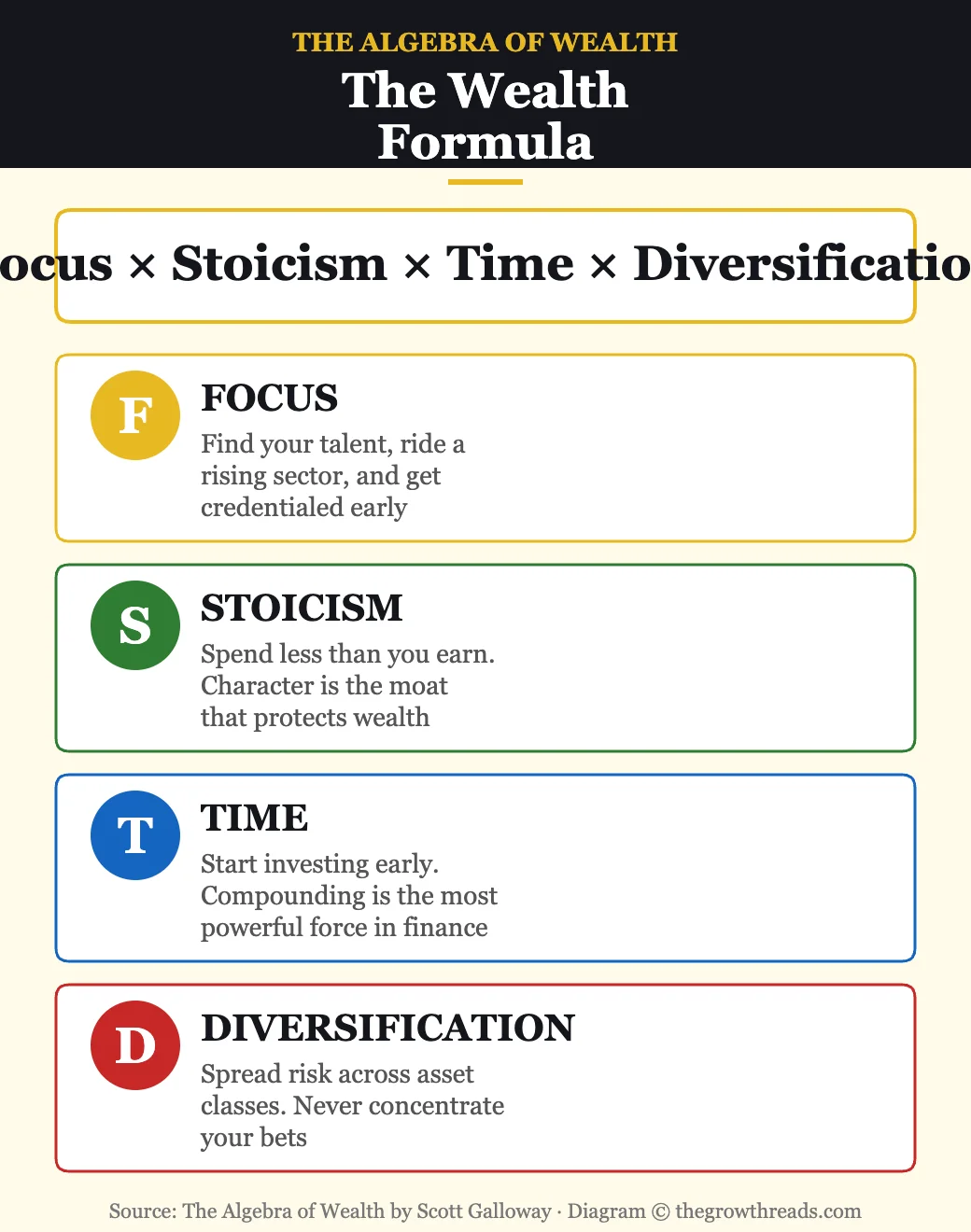
- Wealth = Focus × Stoicism × Time × Diversification: All four variables must be positive for the equation to work. Weakness in any one element undermines the others.
- Follow the money early, follow your passion later: In your twenties, optimize for earning potential and credentials. Passion follows mastery and financial stability, not the other way around.
- Stoicism is the most controllable variable: You cannot fully control your income, market returns, or timing — but you can always control what you spend.
- Status spending is a wealth tax on insecurity: Every luxury purchase is a bet that other people’s opinions are worth more than your financial security.
- Time is the cheat code: Starting to invest at 22 versus 32 can mean the difference of millions by retirement, even with identical savings rates, because compounding is exponential.
- Diversification is free insurance: Never concentrate your wealth in one stock, one asset class, or one income stream. Diversification is the only free lunch in finance.
- Get credentialed, then get to work: A degree from a recognized institution is an asymmetric bet — high upfront cost but disproportionately high lifetime return.
- Economic security changes everything: Financial stability reduces stress, improves relationships, enables risk-taking in career, and creates the freedom that people mistakenly chase through consumption.
- Character compounds like interest: Discipline, integrity, and emotional regulation are not just virtues — they are financial strategies that pay dividends over decades.
- The tax code rewards the patient: Long-term capital gains, retirement accounts, and tax-advantaged vehicles are built for people who think in decades, not quarters.
What is The Algebra of Wealth about?
The Algebra of Wealth is a personal finance and career strategy book by NYU professor Scott Galloway that presents a four-variable formula for financial security. Drawing on economic research, behavioral psychology, and his own successes and failures, Galloway shows how to maximize earning potential through Focus, build wealth through Stoic spending habits, harness the exponential power of Time through early and consistent investing, and protect gains through Diversification across asset classes.
About the author
Scott Galloway is a professor of marketing at NYU Stern School of Business, a serial entrepreneur who has founded nine companies (including L2 and Section4), and a bestselling author. His previous books The Four and The Algebra of Happiness established him as one of the most candid voices in business. He hosts the popular podcasts Pivot (with Kara Swisher) and Prof G. Known for his blunt delivery and willingness to share his own financial mistakes — including nearly going bankrupt in his thirties despite a high income — Galloway brings credibility through vulnerability rather than perfection. Explore all Scott Galloway book summaries →
Key concepts at a glance
| Concept | What it means | Use it when |
|---|---|---|
| The wealth formula | Focus × Stoicism × Time × Diversification = Financial security | You want a complete framework, not isolated tips |
| Focus (career capital) | Finding talent, riding growth sectors, getting credentialed | You are choosing a career path or considering a pivot |
| Stoicism (spending) | Spending far less than you earn; character over charisma | You earn well but save poorly or chase status |
| Time (compounding) | Starting early and letting exponential growth work | You are debating whether to invest now or wait |
| Diversification | Spreading risk across asset classes and income streams | You are concentrated in one stock, job, or sector |
| Status tax | Luxury spending as a tax on insecurity | You are about to buy something to impress others |
| Asymmetric bets | Investments with capped downside and uncapped upside | You are evaluating education, career moves, or investments |
Part 1: Focus — building earning power
Galloway opens with the variable most people underestimate: your ability to earn. He argues that the single most important financial decision you make is not what to invest in but what career to pursue and how to position yourself within it.
His advice is deliberately contrarian. Rather than “follow your passion,” he prescribes “follow the money — especially early.” Passion, he argues, is a luxury you earn after achieving financial stability and career mastery. Most people have their causation backward: they think passion leads to great work, when in fact mastery leads to passion (echoing Cal Newport’s research on career capital).
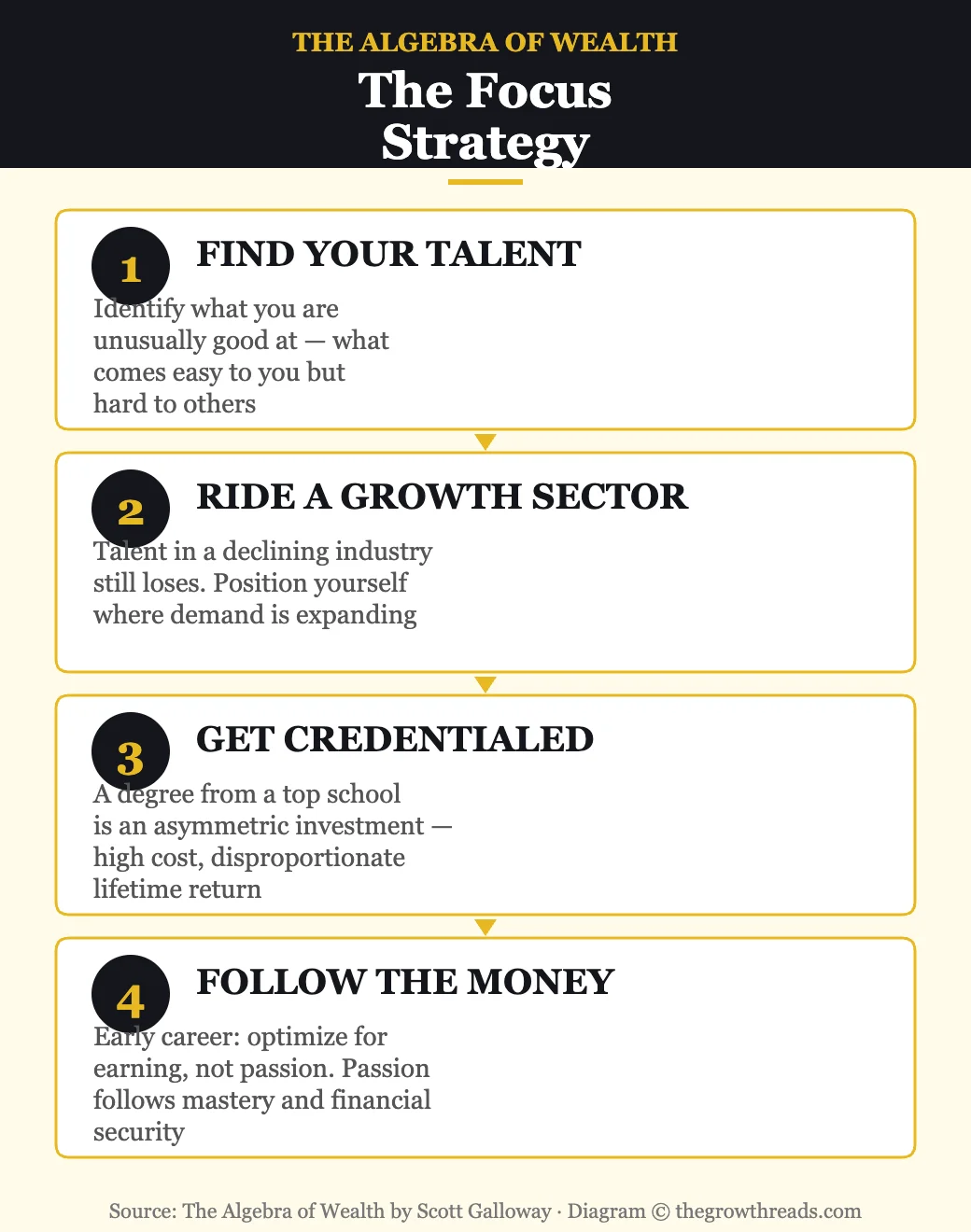
The Focus strategy has three components. First, find your talent — identify what you are unusually good at, what comes naturally to you but seems difficult to others. Second, ride a growth sector — even exceptional talent in a declining industry leads to stagnation. Position yourself where demand is expanding and AI is creating leverage rather than replacement. Third, get credentialed — Galloway makes a controversial but data-backed argument that attending the best university you can get into remains one of the highest-return investments available, particularly for students from non-wealthy backgrounds who benefit most from the signaling and network effects.
He acknowledges this advice is not universally popular but argues the data is clear: lifetime earnings correlate more strongly with educational credentials and sector choice than with raw intelligence or effort. The most talented person in a dying industry will be outearned by an average person in a growing one.
Part 2: Stoicism — the spending discipline
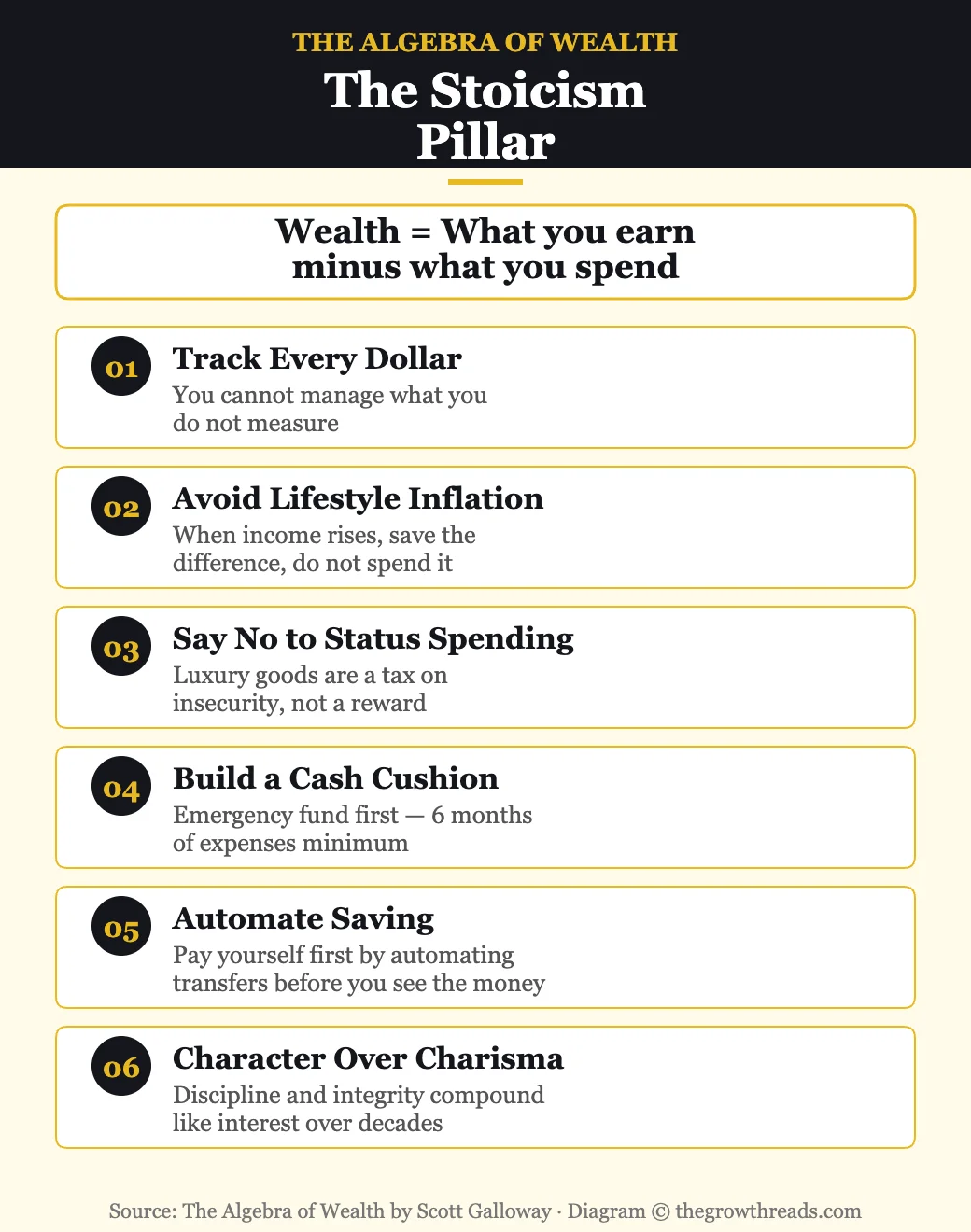
The most emotionally charged section of the book deals with spending. Galloway argues that Stoicism — defined here not as philosophical indifference but as disciplined gap between earning and spending — is the most controllable variable in the wealth equation and the one where most people fail.
He is characteristically blunt about the culprit: status spending. Every premium car, designer brand, and luxury vacation is a “tax on insecurity” — a bet that other people’s admiration is worth more than your financial freedom. Galloway shares his own history of status spending during his thirties, when he earned over $1 million per year and nearly went bankrupt because his spending always expanded to match (and exceed) his income.
The practical framework is straightforward: track every dollar, automate savings before you see the money, build six months of emergency reserves, avoid lifestyle inflation when income rises, and use the “72-hour rule” (wait three days before any non-essential purchase over $200). He emphasizes that these are not deprivation tactics but freedom strategies — every dollar not spent on impressing others is a dollar compounding toward financial independence.
Galloway also introduces the concept of character as a financial asset. Discipline, integrity, and emotional regulation compound over decades just like money does. People with strong character attract better business partners, negotiate from positions of strength, and avoid the impulsive decisions that destroy wealth. Character, he argues, is the moat that protects what Focus and Time build.
Part 3: Time and Diversification — the compounding machine
The final two variables work together: Time provides the runway, and Diversification provides the safety net that allows you to stay invested long enough for compounding to work its magic.
On Time, Galloway presents the standard but still mind-bending compounding math. An investor who starts at 22 and contributes $500/month at a 7% annual return will have roughly $1.4 million by 62. The same investor starting at 32 — just 10 years later — will have only about $680,000. The early investor contributed only $60,000 more in total but ended up with twice the wealth. The lesson: time is the single most valuable asset a young person has, and it is the one asset that cannot be recovered once spent.
He prescribes a simple investment approach: maximize tax-advantaged accounts (401k, IRA) first, invest primarily in low-cost index funds, and rebalance annually. He is explicitly anti-stock-picking for non-professionals, citing decades of evidence that even professional fund managers fail to beat index funds consistently over long periods.
On Diversification, Galloway goes beyond the standard “don’t put all your eggs in one basket.” He argues for diversification across four dimensions: asset classes (stocks, bonds, real estate, cash), geography (domestic and international), time (dollar-cost averaging rather than lump-sum timing), and income streams (salary, investments, side ventures, real estate). The goal is to build a financial architecture that can survive any single shock — job loss, market crash, industry disruption, or health crisis.
He closes with the concept of economic security as the foundation for everything else. Financial stability reduces cortisol, improves relationships, enables career risk-taking, and creates the breathing room for creativity and purpose. The irony, Galloway notes, is that the freedom people chase through consumption is actually built through its opposite — discipline and patience.
Who is The Algebra of Wealth best for — and who should read something else first?
This book is ideal for professionals in their twenties and thirties who earn decent money but struggle to build wealth — the “high income, low net worth” pattern. It is also valuable for anyone who has never had a clear financial framework and wants a complete system rather than scattered tips. Parents will find it useful as a guide for the financial conversation they wish they had with their own children.
If you want a deeper dive on the psychology of money decisions, start with The Psychology of Money by Morgan Housel. For a more detailed investing playbook, The Simple Path to Wealth by JL Collins is the best companion. And if you want the FIRE movement perspective, Your Money or Your Life by Vicki Robin goes further on redefining the relationship between money and life energy.
Questions to reflect on
- Which of the four variables — Focus, Stoicism, Time, or Diversification — is your weakest right now, and what one action could strengthen it this month?
- How much of your spending in the last month was driven by genuine need versus status signaling?
- If you had started investing 10 years earlier than you did, where would you be financially today? What is stopping you from acting as if the next 10 years matter just as much?
- Is your current career positioned in a growing or declining sector — and are you building skills that will increase in value?
- What would change in your life if money stopped being a source of stress — and how close are you to making that happen?
🔥 Ready to build the algebra of your wealth?
Get Scott Galloway’s blunt, practical formula for financial security at any income level.
How to apply The Algebra of Wealth (7-day plan)
- Day 1 — Calculate your gap: Add up last month’s after-tax income and total spending. What is the percentage saved? If it is under 20%, identify one spending category to cut.
- Day 2 — Audit your status spending: Review your last 30 days of purchases. Mark each as “need,” “genuine want,” or “status/impression.” Be honest about the third category.
- Day 3 — Automate first: Set up an automatic monthly transfer from checking to a savings or investment account. Even $100/month starts the compounding clock.
- Day 4 — Assess your Focus: Write down: what am I unusually good at? Is my sector growing or shrinking? Am I building skills that will be more valuable in 5 years?
- Day 5 — Check your diversification: List every asset you own (savings, investments, property, crypto, employer stock). If more than 30% is in any single asset, plan how to rebalance.
- Day 6 — Implement the 72-hour rule: For any non-essential purchase over $200, add it to a “waiting list” and revisit in 72 hours. Notice how many items you no longer want.
- Day 7 — Write your wealth equation: Rate yourself 1–10 on each variable (Focus, Stoicism, Time, Diversification). Identify the lowest-scoring variable and commit to one specific improvement this month.
Frequently asked questions
What is the main idea of The Algebra of Wealth?
The main idea is that financial security comes from a four-variable formula: Focus (maximizing earning power through talent, sector choice, and credentials), Stoicism (spending far less than you earn), Time (starting early and letting compounding work), and Diversification (spreading risk across asset classes and income streams). All four must be positive for the equation to produce wealth. Galloway argues the biggest obstacle is behavior, not income.
What does Galloway mean by Stoicism?
Galloway uses Stoicism not in the full philosophical sense but as a label for spending discipline — maintaining a large gap between what you earn and what you spend. He argues that status spending (luxury goods, premium brands, lifestyle inflation) is a “tax on insecurity” that destroys wealth. Stoic financial behavior means tracking every dollar, automating savings, avoiding lifestyle inflation, and building character as a long-term financial asset.
Should you follow your passion according to Galloway?
Not early in your career. Galloway argues that you should “follow the money first, follow your passion later.” His reasoning: passion typically follows mastery and financial security, not the other way around. In your twenties and thirties, optimize for earning potential by building skills in growing sectors and getting strong credentials. Once you have financial stability and deep expertise, you will find that passion naturally develops around what you have mastered.
What investing approach does the book recommend?
Galloway recommends a simple, evidence-based approach: maximize tax-advantaged retirement accounts first, invest primarily in low-cost index funds, avoid individual stock picking, dollar-cost average consistently, and rebalance annually. He is explicitly anti-stock-picking for non-professionals, citing decades of data showing that even professional fund managers rarely beat index funds consistently over long periods. The key is starting early and staying invested.
How does The Algebra of Wealth compare to The Psychology of Money?
Both books emphasize behavior over strategy as the key to financial success. Morgan Housel’s The Psychology of Money explores the emotional and psychological forces behind money decisions through historical stories and behavioral insights. Galloway’s book is more prescriptive — it provides a specific four-variable formula and concrete career advice. Housel helps you understand why you make bad money decisions; Galloway tells you exactly what to do instead. They complement each other well.
Is this book relevant outside the United States?
The core principles — earn more than you spend, invest early and diversify, build career capital in growing sectors — are universal. However, some specific advice (401k strategies, US tax advantages, American university economics) is US-centric. International readers will need to adapt the tax and retirement vehicle advice to their own systems, but the behavioral framework and wealth formula apply regardless of geography. The psychological insights about status spending and compounding are culturally universal.
Who should not read The Algebra of Wealth?
This book is not ideal for readers who already have a sophisticated investment strategy and are looking for advanced portfolio theory. It is also not the right fit if you are seeking a get-rich-quick approach — Galloway is explicitly anti-speculation and pro-patience. People who find blunt, opinionated writing off-putting may prefer the gentler tone of books like The Psychology of Money. And those deeply opposed to the value of traditional education may find Galloway’s credential-focused career advice frustrating.
Related summaries
- The Psychology of Money by Morgan Housel — The behavioral science complement to Galloway’s formula.
- The Simple Path to Wealth by JL Collins — The definitive guide to index fund investing.
- The Millionaire Next Door by Thomas Stanley — The research proving most millionaires live below their means.
- So Good They Can’t Ignore You by Cal Newport — The career capital theory behind Galloway’s Focus variable.
Explore more: 📚 Best Money Books