

★★★★☆ 4.3 / 5
One-liner: A ruthlessly practical system for compressing annual goals into 12-week sprints that make complacency impossible.
Best for: Entrepreneurs, sales professionals, and goal-setters who consistently start strong but lose momentum by Q3.
Reading time: ~4 hours (208 pages)
Difficulty to apply: Moderate — the system is simple but demands weekly discipline and honest self-scoring.
The 12 Week Year in one minute
Most people fail their annual goals not because the goals are wrong, but because twelve months feels like forever. Brian P. Moran and Michael Lennington argue that annualized thinking breeds complacency — there is always next quarter to catch up. Their solution: redefine a “year” as 12 weeks. In that compressed window, every week matters, procrastination becomes visible immediately, and urgency replaces drift. The book lays out five disciplines (Vision, Planning, Process Control, Measurement, and Time Use) plus three principles (Accountability, Commitment, and Greatness in the Moment) that together form a complete execution system. The result, Moran claims, is that people accomplish more in 12 weeks than most do in 12 months — not by working harder, but by working with a system that makes execution unavoidable.
Key takeaways
- Annualized thinking is the enemy: A 12-month horizon gives you permission to procrastinate. Shortening your execution cycle to 12 weeks eliminates the comfortable buffer that kills urgency.
- Execution, not knowledge, is the bottleneck: Most people already know what to do. The gap is between knowing and doing — the 12-week framework closes that gap by design.
- Vision drives everything: Without a compelling long-term vision and a mid-term (three-year) picture, your 12-week plan has no anchor and no emotional fuel.
- A 12-week plan replaces annual planning: You pick only 1–3 critical goals and break each into specific weekly tasks. If it is not on this week’s plan, it does not get done.
- Score your execution weekly: Calculate the percentage of planned tasks you actually completed. Eighty-five percent or higher is the threshold for being on track.
- Lead indicators matter more than lag indicators: Track the activities you control (calls made, pages written) not just the outcomes (revenue, weight lost).
- Strategic time blocks are sacred: Protect at least three hours per day for the work that moves your plan forward — no email, no interruptions.
- Accountability is ownership, not punishment: True accountability means you own the outcome regardless of circumstances. It is not something done to you — it is a mindset.
- Commitment means no escape clauses: When you are truly committed, you do not create backup plans that give you permission to quit.
- Greatness in the moment: Results come from consistently doing the right thing right now — not from heroic bursts at the deadline.
What is The 12 Week Year about?
The 12 Week Year is a productivity and execution system that replaces traditional annual planning with focused 12-week cycles. Each cycle acts as a compressed “year,” forcing clarity on top priorities, demanding weekly accountability, and creating the urgency needed to consistently execute at a high level.
About the author
Brian P. Moran is the founder and CEO of The Execution Company, a consulting firm dedicated to helping leaders and entrepreneurs close the gap between what they know and what they do. Before launching his own firm, Moran held management and executive positions at UPS, PepsiCo, and Northern Automotive, giving him a front-row view of why organizations stall. His co-author, Michael Lennington, is an MBA-trained consultant who has implemented the 12-week system across companies in the US, Europe, Asia, and the Middle East. Together, they have coached thousands of individuals and teams on execution effectiveness, and their framework has become a staple in sales organizations and entrepreneurial circles worldwide. Explore all Brian P. Moran book summaries →
Key concepts at a glance
| Concept | What it means | Use it when |
|---|---|---|
| 12-Week Year | Redefining your execution cycle from 12 months to 12 weeks | You lose momentum after the first quarter of an annual plan |
| Vision | A compelling picture of your ideal future that fuels daily action | You need a reason to push through discomfort |
| 12-Week Plan | 1–3 goals broken into specific weekly tasks for the cycle | You have too many priorities and none get done |
| Weekly Scorecard | A percentage score of planned tasks actually completed | You want honest, objective feedback on your execution |
| Strategic Time Block | 3+ protected hours daily for plan-critical work | Reactive tasks and meetings eat your productive time |
| Accountability Partner | A peer who reviews your scores and calls out gaps | You tend to let yourself off the hook when no one is watching |
| Lead vs Lag Indicators | Tracking activities you control vs outcomes you want | You feel helpless waiting for results without knowing if you are on track |
| Greatness in the Moment | Choosing the uncomfortable but necessary action right now | You catch yourself rationalizing why today is not the right time |
Part 1: The case against annual thinking
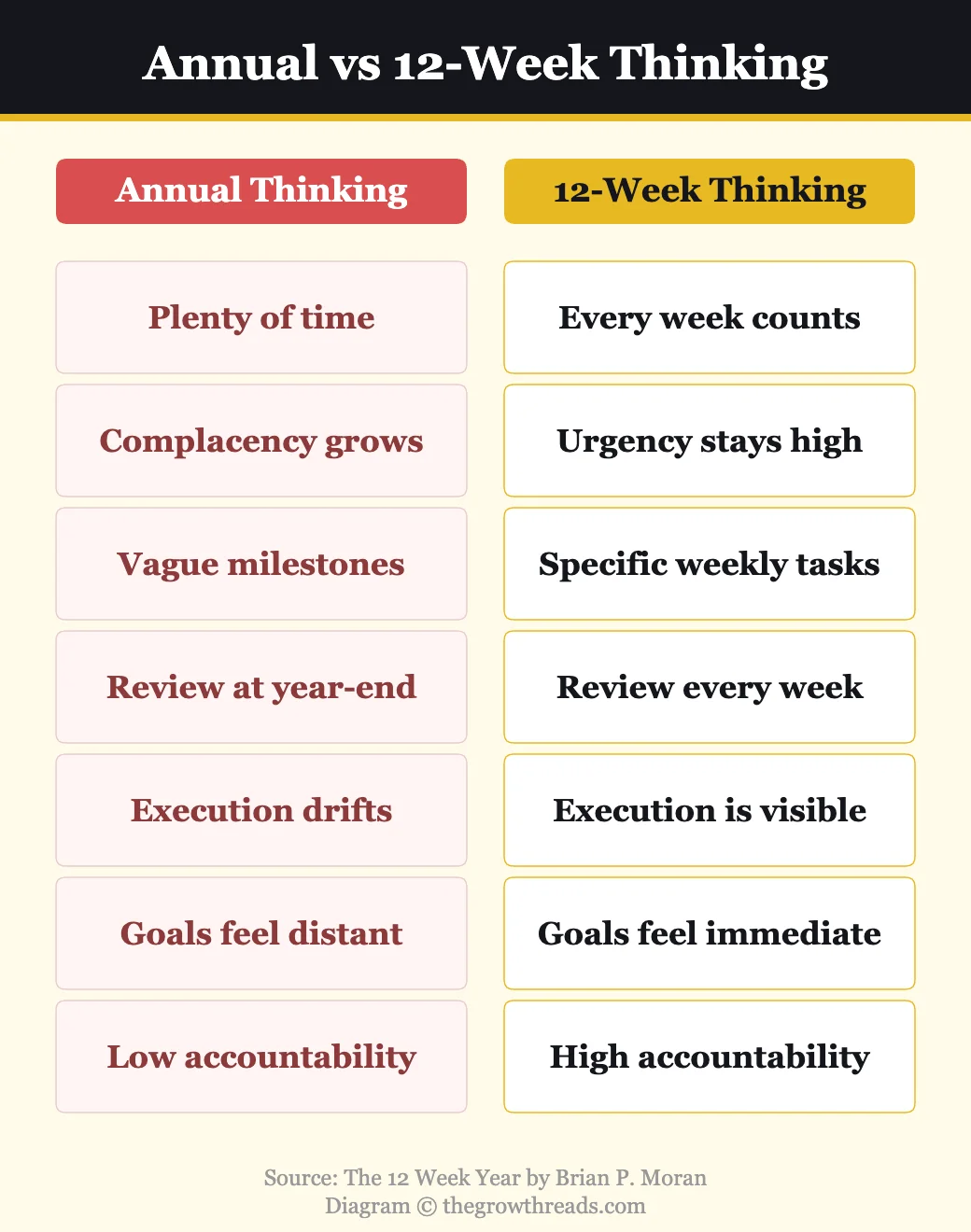
Moran opens with a statistic that should sting: most New Year’s resolutions are abandoned by February. He argues this is not a willpower problem — it is a system problem. Annual plans give you 365 days, and that abundance of time creates a false sense of safety. In January you feel motivated, by March you are behind, and by October you are cramming to salvage the year. The execution curve of most organizations follows the same pattern: a burst of energy at the start, a middle-of-the-year slump, and a frantic year-end push.
The root cause, Moran contends, is periodization — a concept borrowed from athletic training. Just as elite athletes train in focused blocks rather than year-long grinds, professionals should execute in short, intense cycles. Twelve weeks is long enough to achieve meaningful progress but short enough that every single week matters. There is no “I will catch up next month” when you only have twelve weeks to begin with.
He also introduces the idea of the “execution gap” — the space between what you know you should do and what you actually do. Knowledge is rarely the bottleneck. Most smokers know smoking is harmful; most salespeople know they should prospect daily. The 12-week framework is designed specifically to close this gap by making avoidance visible and costly.
Part 2: The five disciplines of execution
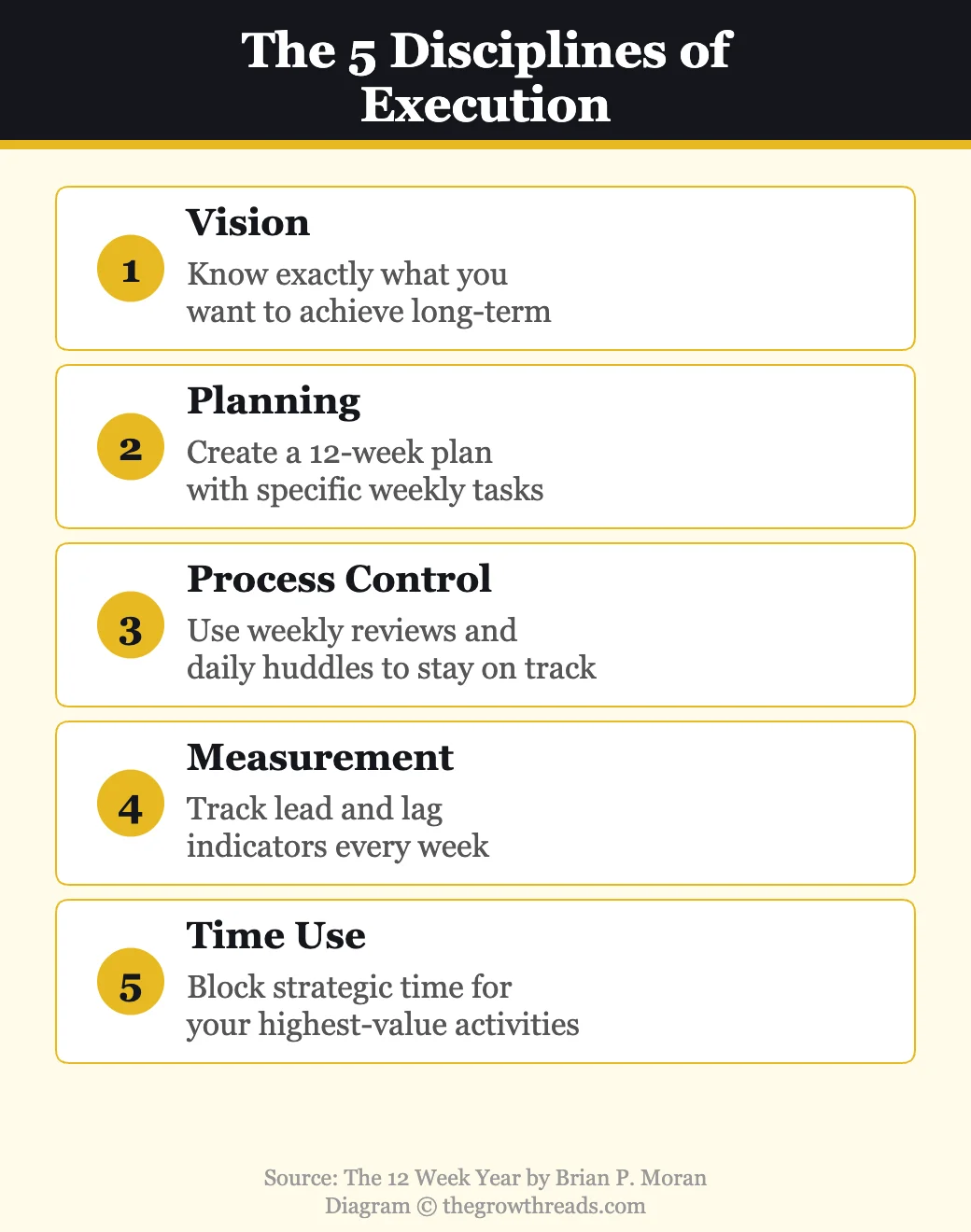
The heart of the book is a five-discipline framework that Moran has refined through decades of consulting. Each discipline builds on the previous one, creating a system where gaps in execution become immediately visible.
Discipline 1: Vision. Moran insists on two layers of vision — a long-term (10+ years) aspirational picture and a mid-term (three-year) vision that is more specific and tangible. The long-term vision provides emotional fuel; the three-year vision provides enough concreteness to build plans from. Without vision, he argues, you are just completing tasks without knowing why they matter.
Discipline 2: Planning. A 12-week plan is not a to-do list. It starts with 1–3 goals for the cycle, each with specific tactics (the actions that drive the goal) broken into weekly tasks. The key constraint is ruthless prioritization — if everything is important, nothing is. Each week, you should be able to look at your plan and know exactly which 2–3 tasks will move the needle.
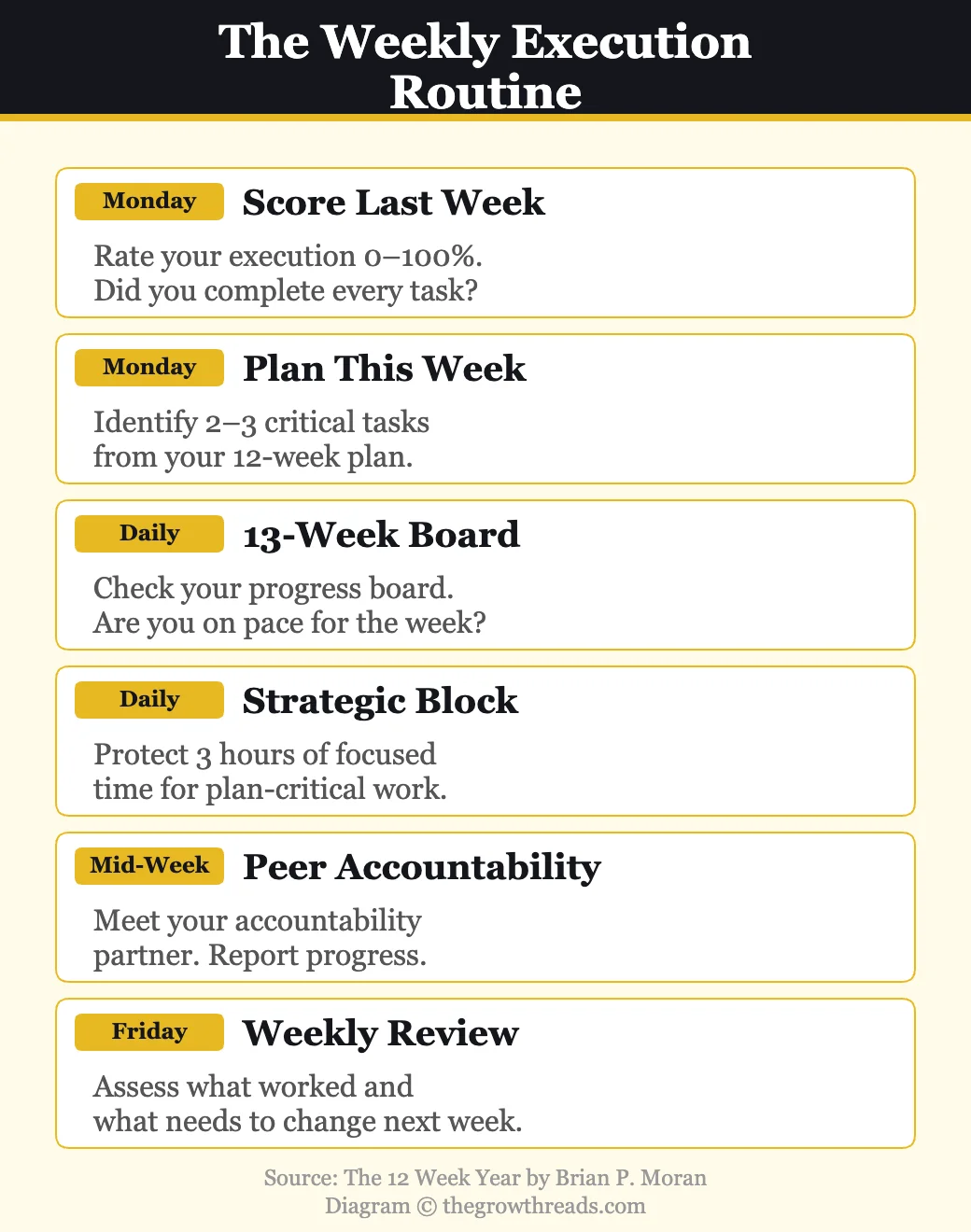
Discipline 3: Process Control. This discipline introduces weekly accountability meetings (WAMs) and daily huddles. The WAM is a structured peer meeting where each participant reports their weekly score, states what they will accomplish next week, and identifies obstacles. Daily huddles are brief check-ins (under 15 minutes) to keep the team aligned.
Discipline 4: Measurement. Moran distinguishes between lead and lag indicators. Lag indicators are outcomes (revenue, weight, grades) — useful but backward-looking. Lead indicators are the activities you control that drive those outcomes (prospecting calls, workouts, study sessions). The weekly scorecard tracks your lead indicators: what percentage of your planned tasks did you complete? Eighty-five percent execution is the threshold for being “on track.”
Discipline 5: Time Use. The final discipline is about protecting your most productive hours. Moran recommends three types of time blocks: strategic blocks (3+ uninterrupted hours for plan-critical work), buffer blocks (30–60 minutes for email and administrative tasks), and breakout blocks (3+ hours away from work for recovery). The strategic block is non-negotiable — it is where the real work of your 12-week plan happens.
Part 3: The three principles
Behind the five disciplines sit three principles that Moran calls the emotional and psychological foundation of the system.
Accountability. Moran redefines accountability as personal ownership, not external pressure. Being accountable does not mean someone watches over you and punishes failure. It means you see yourself as the author of your results — including the ones you do not like. When something goes wrong, the accountable question is not “Who did this to me?” but “What did I do (or not do) that contributed to this?” This reframe is powerful because it shifts control back to you.
Commitment. Real commitment, Moran argues, has four keys: a strong desire for the outcome, specific actions tied to the commitment, willingness to maintain the commitment in the face of emotional shifts, and most importantly — no back door. When you keep an escape route (“If this does not work by April, I will try something else”), you are not truly committed. You are negotiating with yourself.
Greatness in the Moment. This principle addresses the daily reality of execution. Grand visions and detailed plans are meaningless if, in the moment of choice, you pick the comfortable option. Greatness is not about a single heroic act — it is about consistently choosing the uncomfortable but necessary action right now. Do you make the prospecting call or check social media? Do you write the next chapter or reorganize your desk? Each moment is a vote for or against your 12-week goals.
Part 4: Putting the system into practice
The final section of the book is a hands-on implementation guide. Moran walks through setting up your first 12-week year step by step, starting with writing your vision documents (both long-term and three-year), then building your 12-week plan, then establishing your weekly scoring routine.
He provides templates for the weekly scorecard, the 12-week plan layout, and the Weekly Accountability Meeting agenda. The WAM follows a specific structure: each person takes two minutes to report their score, share one thing they learned, and state their commitments for the coming week. No advice-giving during reports — just transparent sharing.
Moran emphasizes that the first 12-week cycle is a learning cycle. Your scores will likely be low (many first-timers score 40–60 percent execution in week one), and that is normal. The system is designed to reveal how much planned work you actually avoid. By week four or five, most practitioners begin to see their scores climb as the feedback loop tightens — you plan more realistically, you eliminate low-value tasks, and you start protecting your strategic time blocks.
The “13th week” is a transition period between cycles: one week to celebrate wins, reflect on lessons, and build the next 12-week plan. This built-in recovery and planning week prevents burnout and ensures each new cycle starts with a fresh, intentional plan rather than leftover momentum.
Who is The 12 Week Year best for — and who should read something else first?
This book is ideal for anyone who has struggled with the long middle stretch of annual goals — entrepreneurs who start ten projects and finish three, sales professionals who hit their numbers in December but coast through summer, and self-improvement enthusiasts who abandon systems after the novelty fades. The framework is especially powerful for solopreneurs and small teams who need a lightweight execution system without enterprise software.
If you have never set structured goals before, you might benefit from starting with Atomic Habits to build daily consistency first, then layering the 12-week framework on top. If you are already executing well but want to eliminate distractions, Essentialism or The ONE Thing may be a stronger fit. And if your challenge is more about deep focus than planning, Deep Work by Cal Newport is the better starting point.
Questions to reflect on
- If you only had 12 weeks to achieve your most important goal, what would you stop doing immediately?
- What is your current weekly execution score — if you honestly tracked every planned task, what percentage would you complete?
- Where in your schedule could you carve out a three-hour strategic block tomorrow?
- Do you have an accountability partner, or are you relying entirely on self-discipline?
- When you fall behind on a goal, do you typically recommit or quietly lower the bar?
🔥 Ready to accomplish more in 12 weeks than most do all year?
Get The 12 Week Year and build a system that makes execution unavoidable.
How to apply The 12 Week Year (7-day plan)
- Day 1 — Write your vision: Spend 30 minutes writing a vivid three-year vision covering your career, health, relationships, and finances. Be specific about what your life looks like when things are going well.
- Day 2 — Pick your one goal: Choose the single most important goal you could achieve in the next 12 weeks. Write it as a measurable outcome (e.g., “Generate 15 qualified leads” not “Do more marketing”).
- Day 3 — Build your 12-week plan: Break your goal into 3–4 tactics, then assign specific tasks to each of the 12 weeks. Every week should have 2–3 concrete actions.
- Day 4 — Set up your scorecard: Create a simple spreadsheet or notebook page where you will track your weekly execution percentage (tasks completed ÷ tasks planned × 100).
- Day 5 — Block your time: Schedule your first strategic time block (3 hours, no interruptions) and your buffer blocks (30–60 minutes for email and admin) for next week.
- Day 6 — Find an accountability partner: Ask one colleague, friend, or family member to be your Weekly Accountability Meeting partner. Share your goal and your week-one tasks with them.
- Day 7 — Execute week one: Follow your plan. At the end of the day, score yourself on the tasks you completed. Do not adjust the plan — adjust your effort.
Frequently asked questions
Is The 12 Week Year worth reading?
Yes, especially if you have a history of setting ambitious annual goals and fading by midyear. The framework is simple enough to implement immediately, and the weekly scoring mechanism provides a feedback loop that most goal-setting systems lack. It is particularly effective for sales professionals, entrepreneurs, and anyone who thrives under structured urgency. The concepts are not revolutionary, but their packaging into a complete execution system is what makes the book valuable.
How is The 12 Week Year different from regular quarterly planning?
Standard quarterly planning treats a quarter as 25 percent of a larger annual cycle — if Q1 goes poorly, there are still three quarters to recover. The 12 Week Year treats each cycle as a complete “year” with its own vision, plan, scorecard, and finish line. This psychological reframe creates urgency because there is no next quarter to fall back on. Each 12-week cycle is followed by a one-week reset, making it a self-contained execution sprint rather than a segment of a longer plan.
What is the 85% execution rule in The 12 Week Year?
Moran found that individuals and teams who execute at least 85 percent of their planned weekly tasks consistently achieve their 12-week goals. Below 85 percent, results become unreliable — too many critical tasks are being skipped or postponed. The 85 percent threshold accounts for the reality that some weeks have genuine disruptions, while still maintaining a high enough standard that you cannot coast. Your weekly score is simply: tasks completed divided by tasks planned, times one hundred.
Can you use The 12 Week Year for personal goals, not just business?
Absolutely. While Moran’s examples lean toward sales and business performance, the framework works for any measurable goal: fitness targets, writing projects, learning a new skill, or improving relationships. The key requirement is that your goal can be broken into weekly actionable tasks and scored objectively. Personal goals often benefit even more from the framework because they lack the external accountability that workplaces provide — the weekly scorecard fills that gap.
What happens during the 13th week?
The 13th week is a built-in transition period between 12-week cycles. You use it to celebrate wins (no matter how small), reflect on what worked and what did not, assess whether your vision still feels right, and build your next 12-week plan. Moran is adamant that you should not skip this week — without it, you risk rolling unexamined habits and stale goals into the next cycle. Think of it as a strategic pause that prevents the burnout and drift that annual thinking creates.
How many goals should you set for a 12-week cycle?
Moran recommends one to three goals per cycle, with a strong preference for fewer. If you are new to the system, start with just one goal. The power of the framework comes from concentration — spreading your energy across five or six goals recreates the exact problem that annual planning has. Each goal should have three to four tactics (strategies for achieving it) and each tactic should generate specific weekly tasks. If your plan has more than 15 tasks per week, you have too many goals.
How does The 12 Week Year compare to Atomic Habits?
The two books operate at different levels. Atomic Habits is about building daily behaviors through identity change, habit stacking, and environment design — it focuses on the micro level of making actions automatic. The 12 Week Year is about strategic execution — picking the right goals, planning weekly tasks, and scoring your follow-through. They complement each other well: use Atomic Habits to build the daily routines that support your 12-week plan, and use the 12-week framework to ensure those habits serve a larger, time-bound objective.
Related summaries
- The ONE Thing by Gary Keller — the focusing question that identifies your highest-leverage weekly task.
- Essentialism by Greg McKeown — the disciplined pursuit of less, applied to how you choose your 12-week goals.
- Deep Work by Cal Newport — the case for strategic time blocks and distraction-free focus.
- Atomic Habits by James Clear — build the daily systems that make 85 percent execution automatic.
📚 Explore more: Best Productivity Books · Best Self-Help Books