

★★★★☆ 4.0 / 5
One-liner: A relentless, high-energy argument that the only way to guarantee success is to set targets ten times bigger and take ten times more action than everyone else.
Best for: Entrepreneurs, salespeople, and ambitious professionals who need a mindset reset from playing it safe to operating with maximum intensity.
Reading time: ~5 hours (240 pages)
Difficulty to apply: Low conceptually, high in practice — the ideas are simple but demand sustained extreme effort that most people underestimate.
The 10X Rule in one minute
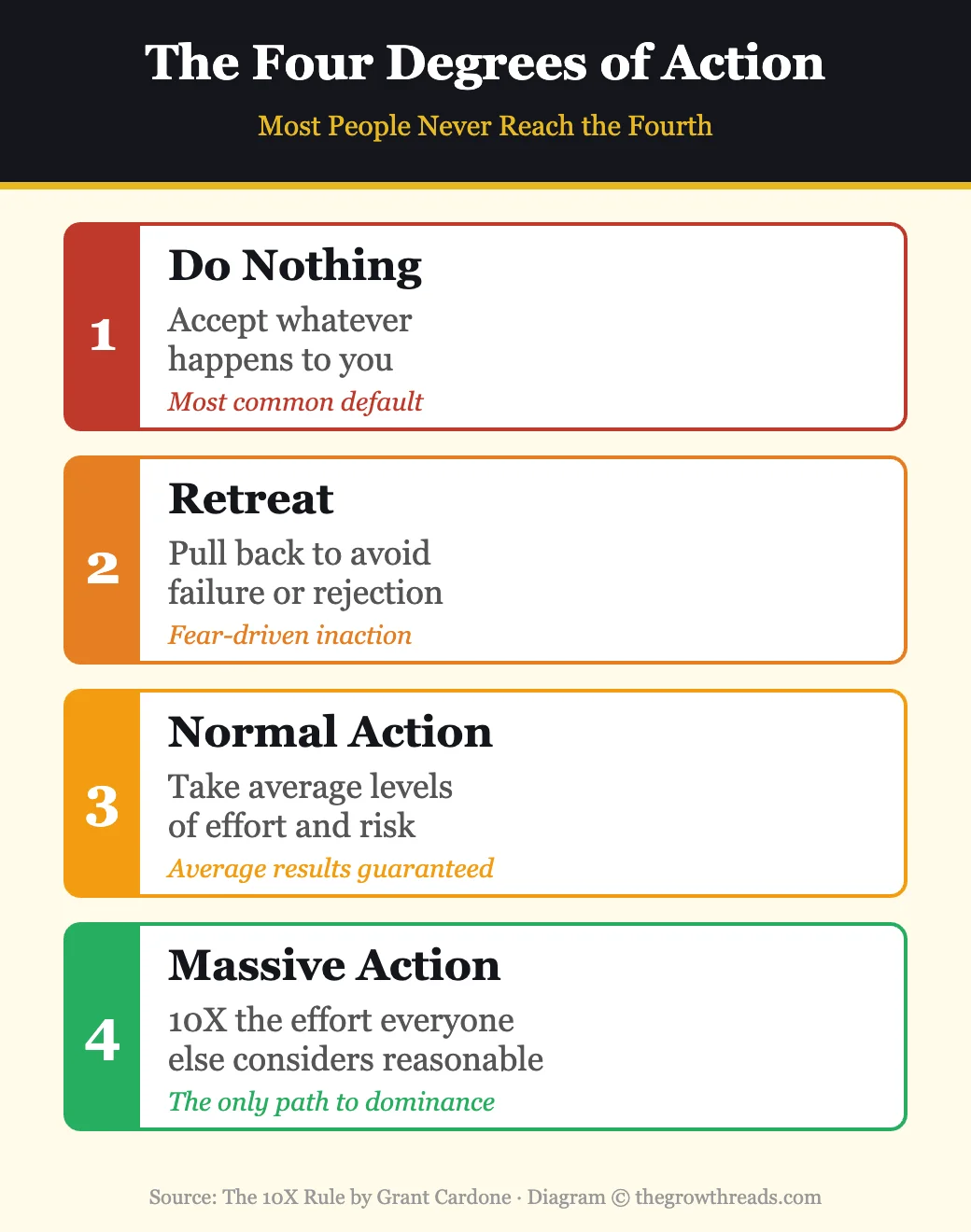
Whatever you think you need to do to succeed, multiply it by ten — that is the 10X Rule. Grant Cardone argues that most people fail not because they set the wrong goals but because they set goals that are too small and take levels of action that are far too average. The 10X Rule has two parts: first, set targets ten times greater than what you initially think you want; second, take ten times the amount of action you think is necessary to achieve those targets. Cardone identifies four degrees of action — doing nothing, retreating, taking normal action, and taking massive action — and argues that only the fourth degree produces extraordinary results. The book is a sustained argument against mediocrity, average thinking, and the comfort zone, written with the intensity of a sales coach who has built multiple businesses from scratch.
Key takeaways
- 10X your targets AND your actions: Setting big goals without massive action produces frustration; massive action toward small goals produces underachievement. Both must be multiplied by ten simultaneously.
- There are four degrees of action: Most people operate at the first three levels (do nothing, retreat, or take normal action). Only the fourth degree — massive action — creates extraordinary results.
- Success is your duty: Cardone reframes success from a luxury or an option to an ethical obligation — to yourself, your family, and your community. This eliminates the option of not trying.
- Average is a failing formula: The middle class, middle effort, middle ambition — “average” is the most dangerous target because it guarantees mediocrity and is unsustainable in competitive markets.
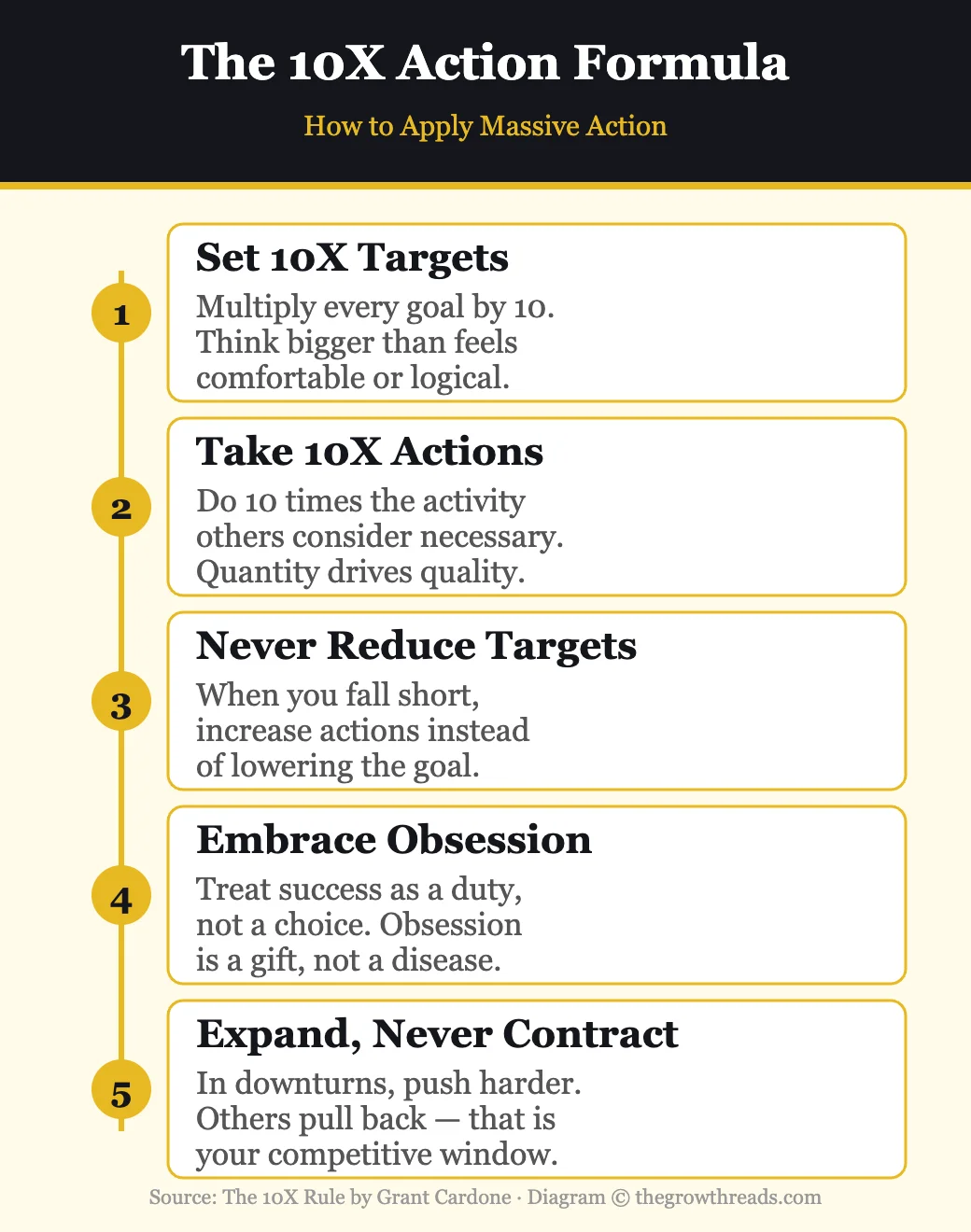
- Never reduce the target: When you fall short of a goal, the instinct is to lower the target. Instead, increase the amount of action. The goal was right; the effort was insufficient.
- Fear is an indicator to act: If something frightens you, it means you should move toward it, not away from it. Fear signals growth territory, and action is the cure for fear.
- Competition is irrelevant at 10X: When you operate at ten times the activity level of everyone else, you stop competing and start dominating. You create a category of one.
- Success is not limited: Cardone rejects the zero-sum mindset. There is no finite amount of success — your achievement does not diminish anyone else’s potential.
- Obsession is a gift: Society pathologizes obsession, but Cardone argues that all great achievers were obsessed with their goals. Obsession provides the energy to sustain 10X effort.
- Expand in contraction: When markets contract and competitors pull back, that is precisely when you should push hardest. Downturns are the biggest windows of opportunity.
What is The 10X Rule about?
The 10X Rule is a business and personal development book by Grant Cardone that argues the biggest reason people fail is because they underestimate both the goals they should set and the effort required to achieve them. Cardone prescribes setting targets ten times larger and taking ten times more action than average, presenting this “massive action” approach as the only reliable path to success in any competitive endeavor.
About the author
Grant Cardone grew up in Lake Charles, Louisiana and struggled with drug addiction in his early twenties before getting clean at 25 and throwing himself into sales. Starting with nothing, he built a career in automotive sales training, then expanded into real estate, eventually building a portfolio valued at over $4 billion. He is the founder of Cardone Enterprises, Cardone Capital, and the 10X Growth Conference, one of the largest business conferences in the world. Known for his intense, unapologetic communication style, Cardone has authored multiple bestsellers including Sell or Be Sold and Be Obsessed or Be Average. His social media following exceeds 40 million across platforms, making him one of the most visible figures in the sales and entrepreneurship space. Explore all Grant Cardone book summaries →
Key concepts at a glance
| Concept | What it means | Use it when |
|---|---|---|
| The 10X Rule | Set targets 10 times greater and take 10 times more action than you think necessary | Your current goals feel achievable but uninspiring |
| Four degrees of action | Do nothing, retreat, normal action, or massive action — only the fourth produces extraordinary results | You want to diagnose why you are stuck at average results |
| Success as duty | Reframe success from optional to obligatory — an ethical responsibility to yourself and others | You catch yourself making excuses or lowering expectations |
| Domination mindset | Stop competing and start dominating your space through overwhelming activity | You are matching competitors instead of lapping them |
| Never reduce the target | When falling short, increase actions rather than lowering goals | You are tempted to revise a goal downward after a setback |
| Fear equals go | Fear signals the direction you should move toward, not away from | You are avoiding a phone call, meeting, or decision because it scares you |
| Expand in contraction | Push hardest when markets and competitors are pulling back | The economy slows down and your instinct is to cut budgets |
| Omnipresence | Be everywhere — so well known that prospects think of you first and always | You want to build a personal brand or market leadership |
Part 1: The 10X framework — why average fails
Cardone opens with a deceptively simple observation: most people who set goals and work toward them still fail, not because they lack talent or discipline but because they dramatically underestimate both the target and the effort required. He argues that the standard advice — set realistic goals, make a reasonable plan, work hard — produces standard results, which in a competitive world means mediocrity or worse.
The 10X Rule is presented as a mathematical correction. If you want to earn a million dollars, set a target of ten million and take ten times the action you think is necessary. The reasoning is partly practical (markets, competitors, and unforeseen obstacles will consume much of your effort) and partly psychological (massive targets create massive motivation, while realistic goals produce comfortable complacency). Cardone argues that people who 10X their targets and effort may not always hit the full 10X, but they consistently outperform those who aimed for 1X.
He introduces the concept of “average” as the most dangerous word in achievement. Average income, average effort, average ambition — these are not sustainable positions because they require constant energy to maintain while providing no buffer against downturns, competition, or disruption. The only safe position, Cardone argues, is dominance — being so far ahead that competitors become irrelevant.
Part 2: The mindset of 10X operators
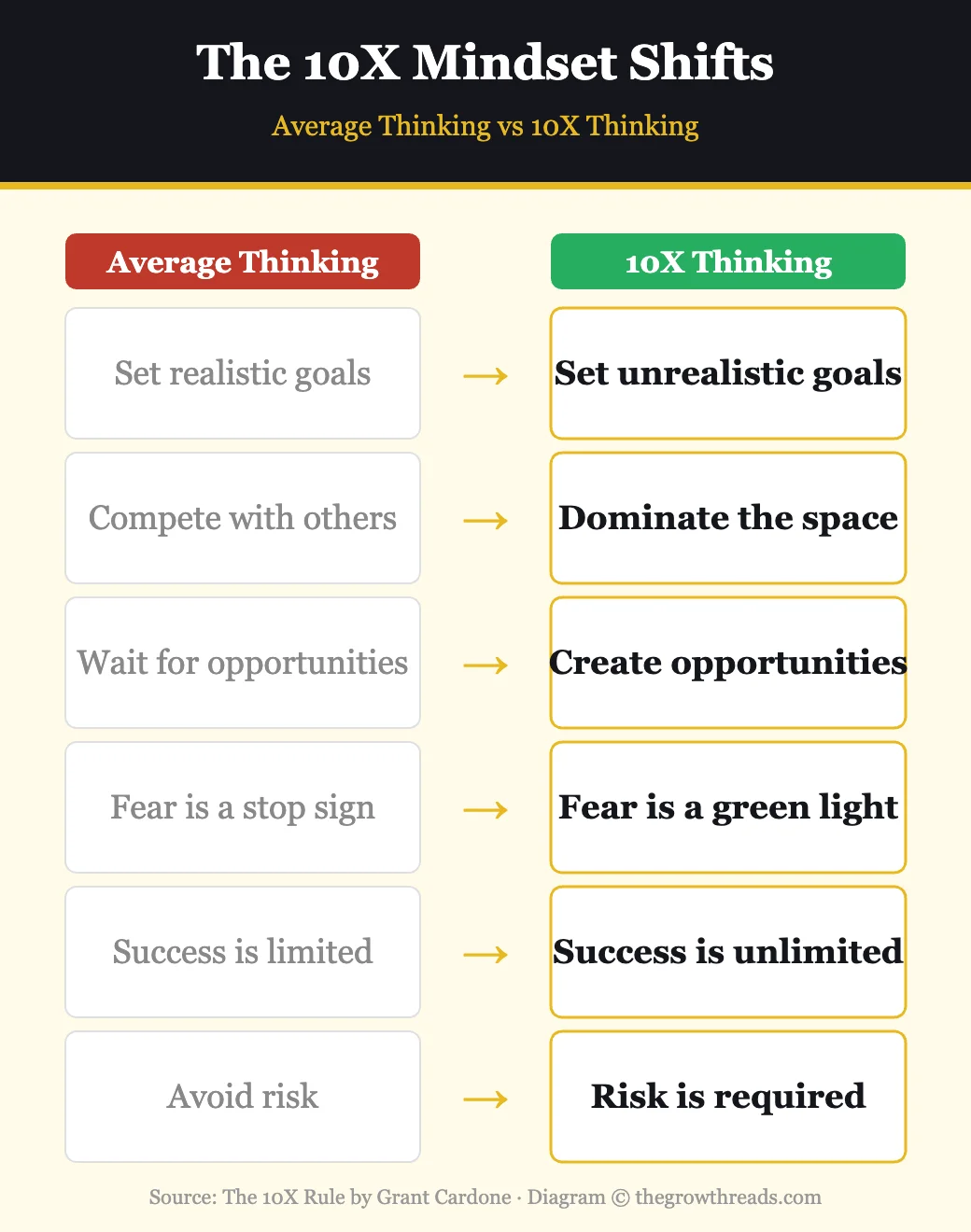
The middle section shifts from strategy to psychology. Cardone argues that 10X performance requires a fundamentally different relationship with several concepts most people take for granted. The first is fear: while conventional wisdom says to manage or minimize fear, Cardone treats it as a directional signal. Whatever you are afraid of doing — that cold call, that pitch, that investment — is precisely what you should do next. He argues that the time to act is when you feel the most fear, because fear indicates proximity to growth and opportunity.
The second mindset shift concerns success itself. Cardone rejects the common framing of success as a luxury, a matter of luck, or a finite resource that some people get and others don’t. He reframes it as a duty — an ethical obligation to maximize your potential for the benefit of your family, employees, community, and future self. This reframing eliminates the psychological permission to quit, coast, or settle, because failing to pursue success becomes a form of negligence rather than a personal preference.
The third shift involves the relationship between time and results. Cardone argues that most people vastly overestimate how long things should take and vastly underestimate what they can accomplish in a concentrated burst of massive action. He advocates compressing timelines aggressively — if a project normally takes a year, ask what it would take to do it in 90 days — and using the intensity of a compressed deadline to force creative problem-solving and eliminate wasted time.
Part 3: Applying 10X in practice
The final section translates the 10X philosophy into daily execution. Cardone’s prescription starts with goal-setting: write down your targets, multiply each by ten, then list the actions required to achieve the 10X version. He is insistent that written goals must be reviewed daily and that the action list must be executed with urgency. If your normal plan includes making ten sales calls per day, the 10X plan requires one hundred. If your marketing strategy involves posting on social media three times per week, the 10X version requires posting three times per day.
Cardone addresses the common objection that this is unsustainable by arguing that it becomes self-sustaining through momentum. Massive action creates massive results, which creates massive motivation, which fuels more massive action. The hardest part is the beginning — once the flywheel is spinning, the energy required to maintain 10X output is less than the energy required to restart after a period of average effort.
He dedicates significant attention to what he calls “omnipresence” — the strategy of being so visible, so active, and so well-known in your market that you become the default choice. This means showing up at every event, being active on every relevant platform, following up with every prospect multiple times, and producing content relentlessly. The goal is not to be liked by everyone but to be known by everyone. Obscurity, Cardone argues, is a bigger threat than criticism.
The book closes with chapters on building a 10X team, managing your time at 10X intensity, and handling the criticism that inevitably comes from operating at a level that makes others uncomfortable. Cardone’s advice on criticism is characteristically blunt: if no one is criticizing you, you are not doing enough. The people who achieve at 10X levels always attract pushback because their intensity threatens the comfort of those operating at average levels.
Who is The 10X Rule best for — and who should read something else first?
The 10X Rule is best for entrepreneurs, salespeople, and professionals in competitive fields who suspect they are operating below their potential and need an aggressive mindset shift. It is particularly effective for people who set goals and work toward them but consistently fall short, and for those going through a career transition or business launch where intensity of effort is the primary differentiator. Cardone’s writing style is repetitive and high-energy — it reads like a motivational speech — which works well for some readers and grates on others.
If you prefer a more measured, research-based approach to high performance, start with our High Performance Habits summary by Brendon Burchard. If your challenge is not motivation but focus — knowing what to work on rather than how hard to work — our Essentialism summary by Greg McKeown provides the counterbalance. And if you want to understand the psychology of sustained effort without the sales-coach intensity, our Grit summary by Angela Duckworth provides the academic research behind perseverance.
Questions to reflect on
- When you set your most recent important goal, did you estimate the required effort based on what was comfortable or what was actually necessary to dominate?
- Which of the four degrees of action — doing nothing, retreating, normal action, or massive action — best describes your default operating mode right now?
- If you multiplied your biggest current goal by ten, what would change about your daily actions and priorities?
- What are you currently avoiding because of fear — and what would happen if you treated that fear as a signal to act immediately?
- Are you currently trying to compete with others in your field, or are you operating at a level where competition becomes irrelevant?
🔥 Ready to 10X your results?
Warning: this book will make your current goals feel embarrassingly small.
How to apply The 10X Rule (7-day plan)
- Day 1 — 10X your biggest goal: Write down your single most important goal for the next 12 months. Now multiply it by ten. Write the 10X version on a card you will see every morning. This is your new target.
- Day 2 — Audit your activity level: Track every work-related action you take today — calls made, emails sent, meetings booked, content created. At the end of the day, multiply each number by ten. That is your 10X daily target.
- Day 3 — Take massive action: Pick the single highest-impact activity from your audit (usually prospecting, outreach, or content creation) and do ten times your normal volume today. Don’t worry about quality — volume first.
- Day 4 — Confront one fear: Identify the action you have been avoiding because it makes you uncomfortable — the difficult conversation, the ambitious pitch, the public commitment. Do it today before noon.
- Day 5 — Compress a timeline: Take a project or goal you have been giving yourself months to complete. Ask: “What would it take to finish this in one week?” Create the compressed plan and start executing immediately.
- Day 6 — Build omnipresence: Post on every social media platform you have. Send ten outreach messages to people in your industry. Follow up with every open lead or conversation. Make yourself impossible to ignore today.
- Day 7 — Never reduce the target: Review your week. Where did you fall short of 10X? Instead of lowering the goal, write down three additional actions you can take next week to close the gap. Commit to them publicly.
Frequently asked questions
Is The 10X Rule just about working harder?
Not entirely, though effort is the centerpiece. Cardone argues that both the magnitude of your goals and the volume of your actions must be multiplied by ten. Working harder toward a small goal still produces small results. The book is about the combination of massive ambition and massive effort — the two are inseparable in Cardone’s framework. He also addresses mindset shifts around fear, time, competition, and success that go beyond simple effort.
Won’t 10X effort lead to burnout?
Cardone addresses this directly by arguing that burnout is caused not by working too hard but by working without results. When massive action produces massive results, the results themselves fuel continued motivation and energy. He also distinguishes between sustained high effort toward meaningful goals (energizing) and grinding through meaningless tasks (draining). That said, the book would benefit from more discussion of recovery, health, and sustainable pacing — these are not Cardone’s primary concerns.
Is the 10X approach realistic for everyone?
Cardone would say the question itself reveals average thinking — asking whether something is “realistic” is a way of giving yourself permission to aim low. His counterargument is that 10X targets are not predictions; they are directional forces. Even if you only achieve 5X by aiming at 10X, you are still five times ahead of where you would be with a “realistic” 1X target. The approach works best for entrepreneurs, salespeople, and anyone in a field where effort and activity volume directly correlate with results.
How is The 10X Rule different from hustle culture?
Cardone would reject the comparison, arguing that “hustle culture” is associated with unfocused busyness, while the 10X Rule is about strategic domination through overwhelming activity directed at clear targets. However, critics would note the similarities: both prioritize effort quantity, intensity, and relentless execution. The key distinction is that Cardone insists on 10X targets alongside 10X effort — without massive goals, massive effort is just burnout-prone busywork.
What are the best books to pair with The 10X Rule?
For the productivity architecture to sustain 10X output, pair it with Essentialism by Greg McKeown (to ensure you are 10X-ing the right things) and The ONE Thing by Gary Keller (to identify your highest-leverage activity). For the habit systems to make massive action automatic, Atomic Habits by James Clear is essential. And for the long-term perseverance mindset, Grit by Angela Duckworth provides the research-backed psychology of sustained effort.
Does The 10X Rule apply outside of business?
Cardone frames the book primarily for business and career contexts, but the underlying principles — set bigger targets, take more action, embrace discomfort, never reduce goals — apply to fitness, relationships, creative pursuits, and personal development. The intensity may need to be calibrated differently (10X in relationships is not about doing ten times more but about caring ten times more deeply), but the mindset of refusing to accept average in any domain is universally applicable.
Is The 10X Rule still relevant in 2026?
More relevant than ever. In an era of AI automation and increasing competition, Cardone’s argument that average effort produces average results (which are increasingly insufficient) has been validated by market dynamics. The professionals and businesses that thrive in 2026 are overwhelmingly those operating at levels of intensity, visibility, and output that would have seemed excessive a decade ago. The specific tactics may evolve, but the principle of massive action as a competitive advantage is timeless.
Related summaries
If The 10X Rule energized you, these summaries explore complementary approaches to ambition, habits, and high performance:
- High Performance Habits by Brendon Burchard — a research-backed framework for sustained excellence that balances Cardone’s intensity with structured habits.
- Essentialism by Greg McKeown — the editorial counterbalance: focus your 10X energy on fewer, more important things.
- The Compound Effect by Darren Hardy — how small, consistent actions compound into massive results over time.
- The ONE Thing by Gary Keller — identify the single most leveraged activity, then give it disproportionate effort.