

★★★★☆ 3.9/5 — A short, research-grounded guide that reframes procrastination as an emotion problem, not a character flaw.
Best for: Chronic procrastinators who’ve already tried willpower and better planning without lasting success.
Reading time: ~2.5 hrs to read (about 120 minutes)
Difficulty to apply: Easy — the book is concise and the strategies are simple to start immediately.
Solving the Procrastination Puzzle in one minute
Procrastination isn’t a time management problem — it’s an emotion management problem. That’s the core insight behind Timothy Pychyl’s Solving the Procrastination Puzzle: when you delay a task, you’re not failing to plan your time well, you’re managing a negative feeling about that task in the moment, at the cost of your future self. Drawing on two decades of research, Pychyl breaks down why procrastination happens and offers concise, practical strategies for interrupting the cycle — starting with the surprising finding that self-forgiveness, not self-discipline, is often the fastest way out.
Key takeaways
- Procrastination is mood repair, not laziness: delaying a task is an attempt to escape how it makes you feel right now.
- The task doesn’t have to be hard to be avoided: boredom, frustration, and anxiety are enough to trigger avoidance.
- Relief is temporary, cost is real: the mood boost from avoiding fades, but the task and its consequences remain.
- Self-forgiveness reduces future procrastination: guilt about past delay tends to fuel more delay, not less.
- Momentum follows action, not the other way around: motivation usually shows up after you start, not before.
- Break tasks down until the next step is small: shrinking the first action reduces how aversive it feels.
- Implementation intentions help: deciding exactly when and where you’ll start makes follow-through more likely.
- Deadlines alone don’t fix the underlying issue: without addressing the emotional trigger, procrastination just resurfaces on the next task.
- Chronic procrastination has real costs: research links it to increased stress, poorer health behaviors, and lower wellbeing over time.
- Awareness of the pattern is the first step: noticing the mood-repair impulse in the moment makes it easier to interrupt.
What is Solving the Procrastination Puzzle about?
Solving the Procrastination Puzzle explains procrastination as a way of managing negative emotions about a task, not a failure of time management or willpower. Timothy Pychyl draws on decades of research to explain why delay happens and offers concise, evidence-based strategies — including self-forgiveness and shrinking the next step — for breaking the cycle.
About the author
Timothy A. Pychyl is a psychologist and one of the world’s leading researchers on procrastination, having studied the topic for more than two decades at Carleton University. He founded the Procrastination Research Group and has published extensively on the psychological roots of chronic delay, moving the field’s understanding away from procrastination as a time-management failure and toward its real driver: short-term emotion regulation. Solving the Procrastination Puzzle distills that research into a short, accessible guide aimed at readers rather than academics. Alongside his academic work, Pychyl also hosted the long-running iProcrastinate podcast, translating research findings into practical conversations — a background that shows in the book’s clear, jargon-free explanations of what can otherwise be fairly technical psychological research. Explore all Timothy A. Pychyl book summaries →
Key concepts at a glance
| Concept | What it means | Use it when |
|---|---|---|
| Mood repair | Procrastination as an attempt to escape a negative feeling about a task, right now. | You notice you’re avoiding something that isn’t actually difficult. |
| Self-forgiveness | Letting go of guilt about past procrastination to reduce the shame that fuels more of it. | You’re stuck in a cycle of guilt over repeated delay. |
| The next action | Shrinking a task until the very next step feels small enough to not be aversive. | A task feels too big or vague to start. |
| Implementation intentions | Deciding in advance exactly when and where you’ll begin a task. | You keep intending to start something but never actually do. |
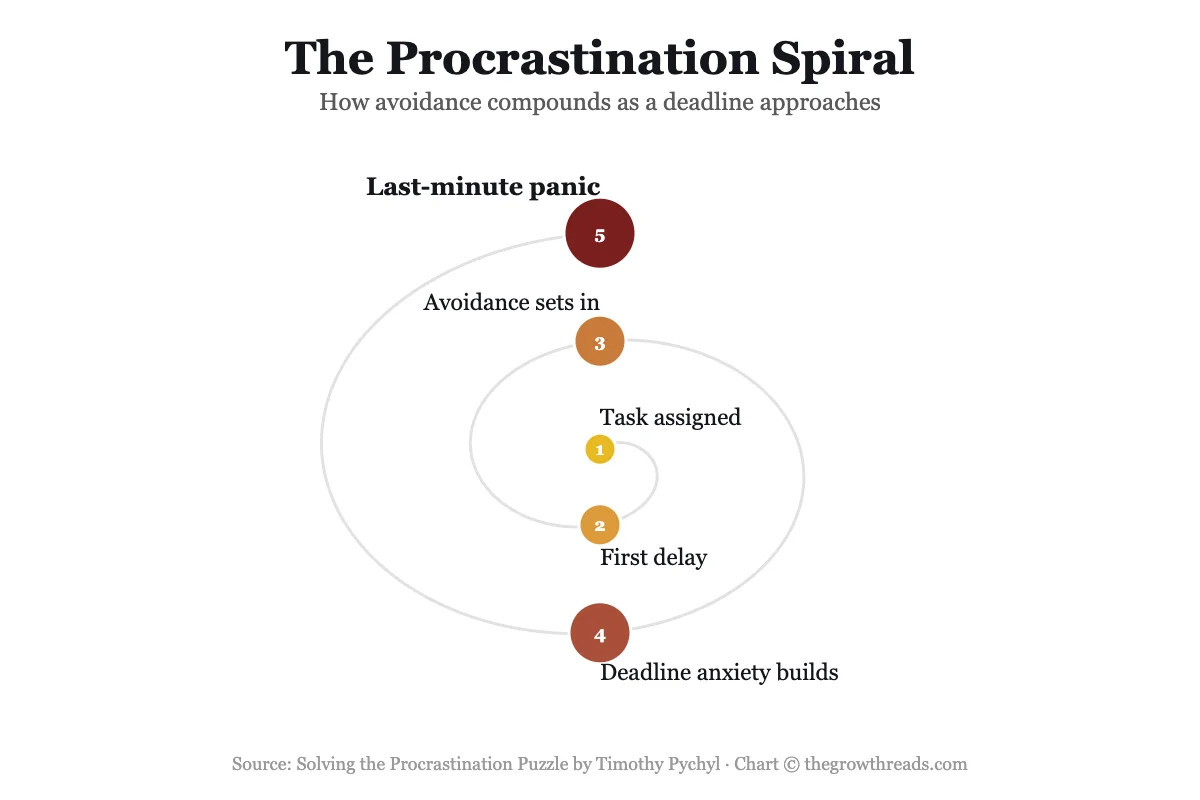
| The procrastination spiral | How avoidance compounds as a deadline approaches, with anxiety rising the longer a task is delayed. | You want to understand why last-minute panic feels so much worse than starting early. |
Part 1: Why we really procrastinate
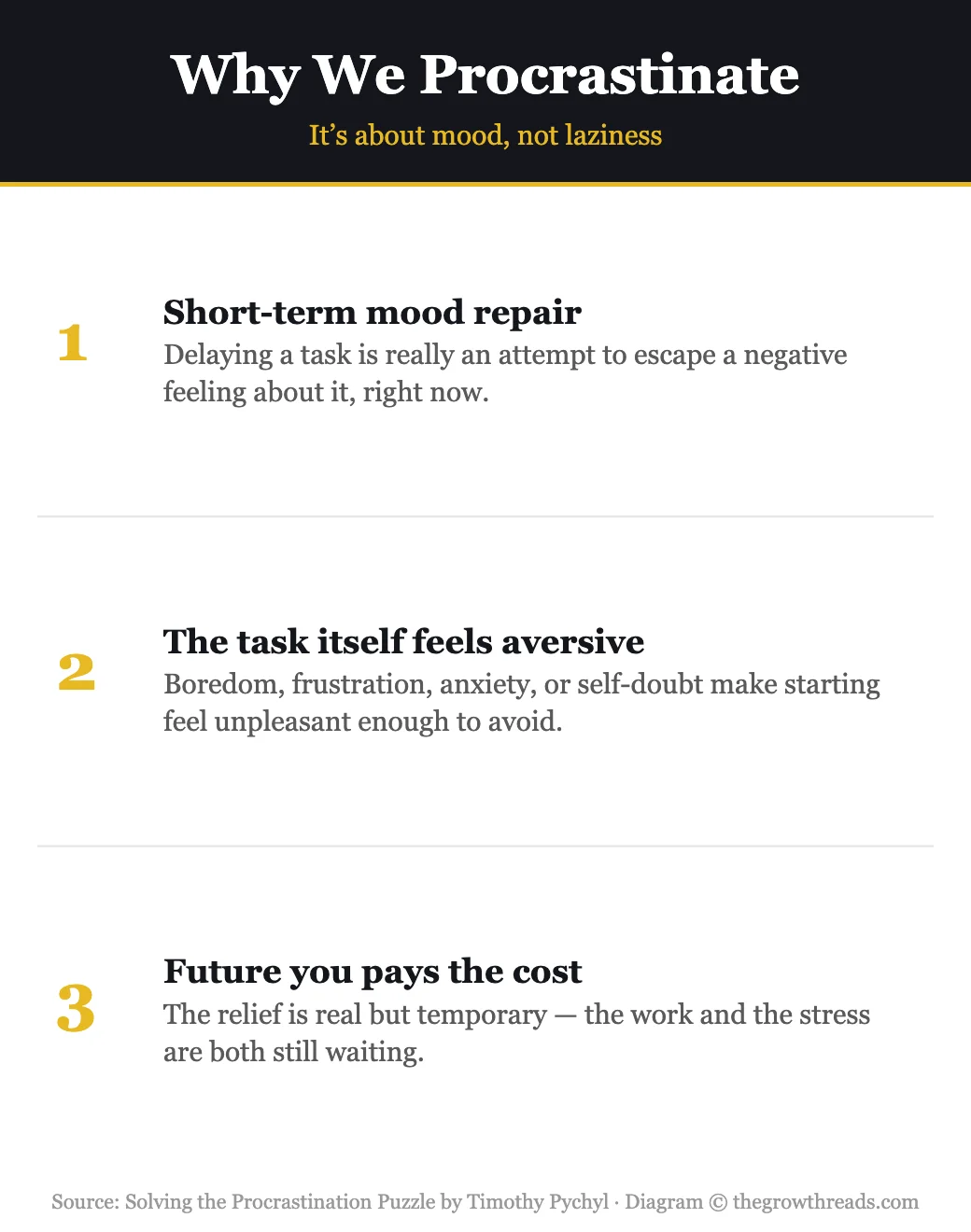
Pychyl opens by dismantling a common misconception: that procrastination is fundamentally about poor time management or laziness. His research points to something else entirely — procrastination is what happens when a task triggers a negative emotion (boredom, frustration, anxiety, self-doubt) and delaying it becomes a way to regulate that feeling in the short term. The task doesn’t need to be objectively hard. It just needs to feel unpleasant enough, right now, for avoidance to seem like the easier choice — which is why people just as often procrastinate on simple errands as on genuinely difficult projects.
This reframing matters because it changes where the real work needs to happen. Better calendars and stricter deadlines don’t address an emotional trigger — which is why so many planning-based fixes for procrastination fail to stick. Pychyl’s research draws on the broader psychological literature on emotion regulation, showing that the same short-term coping mechanisms people use to manage stress, boredom, or anxiety in other areas of life show up in how they handle their to-do list. Seen this way, procrastination isn’t a productivity failure at all — it’s a completely ordinary, if ultimately costly, way of managing an uncomfortable feeling.
TGR Note: This mood-repair framing pairs well with Laziness Does Not Exist, which makes a related case that what looks like laziness is usually something else entirely — often burnout, fear, or a genuine barrier rather than a lack of effort or discipline.
Part 2: The loop that keeps procrastination going
Because avoidance provides real, if temporary, relief, it gets reinforced — which is part of why procrastination is so hard to break through willpower alone. You avoid the uncomfortable task, your mood improves briefly, and that improvement teaches your brain that avoidance works. Meanwhile the task itself hasn’t gone anywhere, and the deadline keeps getting closer, adding guilt and pressure on top of whatever made the task aversive in the first place.
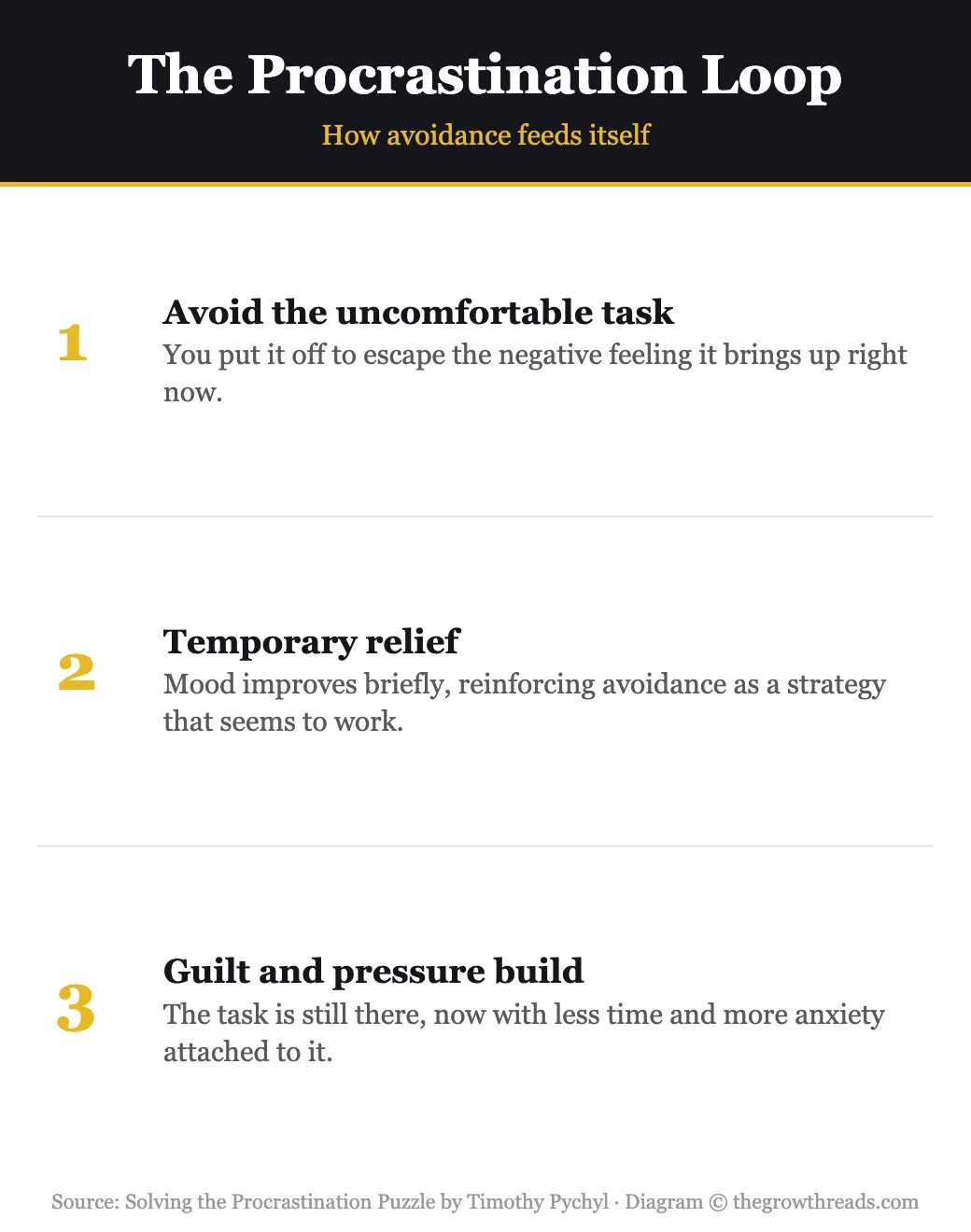
Left unaddressed, this loop tends to escalate the closer a deadline gets — early, low-stakes delay gradually turns into genuine anxiety and, often, a last-minute scramble that’s far more stressful than simply starting earlier would have been. The irony Pychyl highlights is that the eventual scramble to finish under pressure often costs far more emotional energy than the original task ever would have — the avoidance doesn’t save effort overall, it just relocates it to a worse moment, with less time and higher stakes.
TGR Note: The escalating pressure of delay is also central to Do It Today, which focuses specifically on interrupting procrastination at the moment it starts, before the loop has a chance to compound.
Part 3: Self-forgiveness, not self-criticism
One of the more counterintuitive findings Pychyl covers is that self-criticism after procrastinating tends to make future procrastination more likely, not less. Guilt and shame create exactly the kind of negative emotional state that triggers more avoidance. Self-forgiveness — genuinely letting go of the guilt about a past delay — breaks that cycle, freeing up the emotional bandwidth needed to actually start the next time.
This doesn’t mean lowering standards or making excuses. It means separating the fact of having procrastinated from a harsh judgment about your character, so the next attempt isn’t already weighed down by shame before it begins. Pychyl points to studies where students who forgave themselves for procrastinating on a first exam were less likely to procrastinate on the next one — a finding that runs directly counter to the common assumption that guilt is what keeps people motivated to do better.
Part 4: Getting unstuck
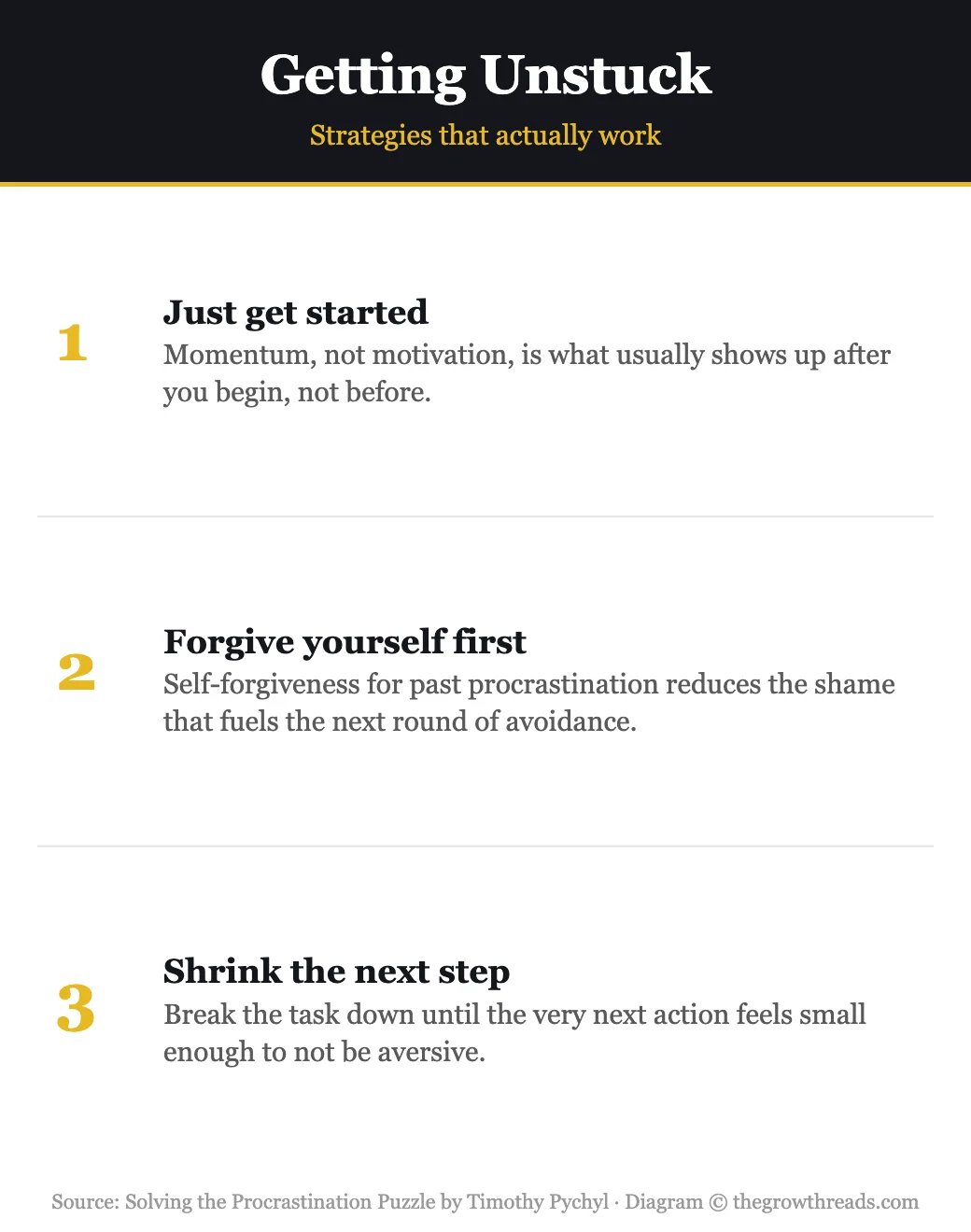
The book’s practical core is a set of specific, low-effort strategies for interrupting procrastination in the moment, chosen deliberately for how little activation energy they require — a deliberate choice, since anything too demanding risks becoming one more thing to procrastinate on. Just starting — even on a tiny piece of a task — tends to generate the motivation people mistakenly wait for before beginning. Shrinking the next action until it no longer feels aversive makes that first step realistic. And implementation intentions, deciding in advance exactly when and where you’ll start, remove the ambiguity that otherwise leaves room for avoidance to creep back in. Pychyl also emphasizes that these strategies work best in combination rather than in isolation — self-forgiveness clears the emotional residue from past delay, a smaller next step lowers the barrier to starting, and a concrete implementation intention removes the decision-making moment where avoidance usually wins.
TGR Note: The idea of shrinking a task until the next step feels manageable connects closely to Finish What You Start, which focuses on the follow-through side of the same challenge — staying with a task once you’ve actually begun it.
Who is Solving the Procrastination Puzzle best for — and who should read something else first?
This book is best for chronic procrastinators who’ve already tried better planning and willpower without lasting success, and who want to understand the emotional root of the pattern instead. Because it’s short and research-dense rather than story-driven, it also suits readers who want the evidence behind the advice, not just the advice itself. If your issue is more about staying focused once you’ve started than getting started in the first place, Procrastinate on Purpose offers a more systems-based complement. If you suspect what looks like procrastination might actually be burnout or overwhelm, Laziness Does Not Exist is worth reading first.
Questions to reflect on
- What’s a task you’re currently avoiding, and what negative feeling might be driving that avoidance?
- Can you recall a recent time you delayed something and then felt guilty about it — did that guilt make it easier or harder to start?
- What would the smallest possible first step on your most-avoided task look like?
- Is there a task where you keep intending to start “later” without ever deciding exactly when?
- How would treating yourself with self-forgiveness, rather than self-criticism, change your relationship with an unfinished task?
🔥 Ready to stop the cycle?
Grab a copy of Solving the Procrastination Puzzle and start breaking the loop today.
How to apply Solving the Procrastination Puzzle (7-day plan)
- Day 1: Identify one task you’re currently avoiding and name the specific feeling it triggers.
- Day 2: Practice self-forgiveness for one instance of past procrastination instead of criticizing yourself for it.
- Day 3: Break your avoided task down until the very next step feels small and unintimidating.
- Day 4: Set an implementation intention: decide the exact time and place you’ll start tomorrow.
- Day 5: Just begin — spend five minutes on the task without judging whether it’s “enough.”
- Day 6: Notice one moment of avoidance in real time and name it as mood repair rather than laziness.
- Day 7: Reflect on which strategy — self-forgiveness, shrinking the task, or implementation intentions — helped most this week.
Frequently asked questions
What is the main idea of Solving the Procrastination Puzzle?
The main idea is that procrastination is fundamentally an emotion regulation problem, not a time management or character issue. Timothy Pychyl argues that delaying a task is an attempt to escape a negative feeling about it in the moment, and that effective solutions have to address that emotional trigger rather than just better scheduling.
Why does self-forgiveness help with procrastination?
Research cited in the book found that guilt and self-criticism after procrastinating tend to increase future procrastination, because they create more negative emotion for the brain to want to escape. Self-forgiveness breaks this cycle by removing the shame that otherwise fuels the next round of avoidance.
Is procrastination a sign of laziness?
No — Pychyl’s research reframes procrastination as an emotional coping mechanism rather than laziness or a lack of discipline. Tasks that trigger boredom, frustration, or anxiety are avoided as a way to manage that feeling in the short term, even when the person fully intends to do good work eventually.
What are implementation intentions?
Implementation intentions are specific plans that state exactly when and where you’ll take an action — for example, “I’ll write the first paragraph at my desk at 9am tomorrow” rather than a vague intention to “get to it soon.” Deciding this in advance removes the ambiguity that otherwise leaves room for avoidance.
How is this different from other time management advice?
Most time management advice assumes the problem is planning or prioritization. Pychyl’s research-based approach instead targets the emotional trigger behind the delay itself, using strategies like self-forgiveness and task-shrinking that address why a task is being avoided rather than just when it’s scheduled.
Does chronic procrastination have real consequences?
Yes — the book cites research linking chronic procrastination to increased stress, worse health behaviors, and lower overall wellbeing over time. The short-term relief that avoidance provides is real, but the cumulative cost of repeated delay tends to outweigh it.
Who should read Solving the Procrastination Puzzle?
It’s best suited to chronic procrastinators who have already tried standard time-management fixes without lasting success and want to understand the emotional root of the pattern. Its concise, research-grounded format also makes it a fast, practical read for anyone wanting quick, evidence-based strategies.
Related summaries
- Procrastinate on Purpose: The Focus Funnel for Multiplying Your Time
- Do It Today: Beat Procrastination with One Simple Rule
- Laziness Does Not Exist: The Myth Behind the Laziness Lie
- See all the best productivity books
How we analyze books: Every TGR summary is built from a close read of the book’s core arguments, cross-checked against the author’s other published work and interviews, and organized around what you can actually do differently this week. Read our full methodology.