

★★★★★ 4.5/5 — Do It Today reframes procrastination as a meaning and momentum problem, not a scheduling one — and gives you a simple, repeatable way to just start.
Best for: Chronic procrastinators who already own plenty of productivity systems but still can’t get moving
Reading time: ~18 minutes (book: ~3.5 hours, 182 pages)
Difficulty to apply: Easy — the core idea is one sentence: do it today
Do It Today in one minute
Procrastination isn’t a time-management failure — it’s a disconnect between you and the task in front of you. Darius Foroux, a Dutch writer known for essays on productivity and stoicism, built Do It Today around a single uncomfortable observation: most people who struggle to get things done already own several planners, apps, and productivity books. Their problem was never a lack of systems. It’s a lack of connection to the work itself, compounded by fear of failure, perfectionism, and the quiet comfort of “I’ll start tomorrow.”
The book’s answer isn’t a complicated framework — it’s a mindset shift toward immediate, imperfect action, backed by habits that make that action sustainable: self-discipline, physical energy, working during your peak hours, and building in real rest. Foroux draws openly on stoic philosophy throughout, treating “do it today” less as a productivity hack and more as a discipline for taking ownership of your one, limited life.
Key takeaways
- Procrastination is disconnection, not disorganization: you delay work you don’t feel connected to, no matter how well it’s scheduled.
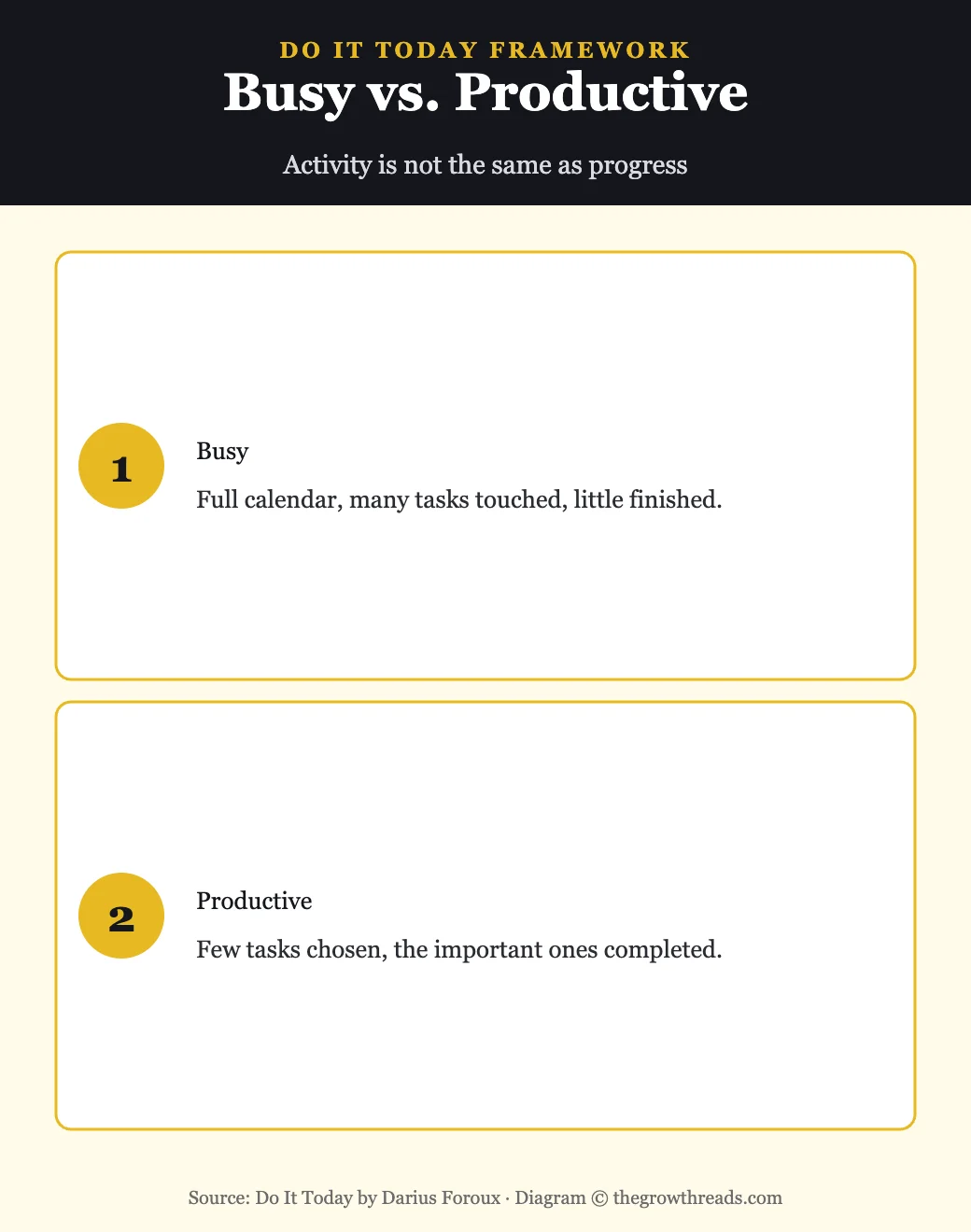
- Busy is not the same as productive: touching many tasks and finishing few is activity without progress.
- Motivation follows action, not the other way around: starting — even badly — generates the motivation that waiting for inspiration never does.
- Break big goals into small, startable pieces: overwhelm is often just a goal that hasn’t been broken down enough yet.
- Consistency beats intensity: small daily action compounds faster than occasional bursts of heroic effort.
- Self-discipline is a practiced skill: showing up on the plan even without motivation is what separates doers from planners.
- Protect your peak hours: do your hardest, most important work when your energy and focus naturally peak.
- Rest is strategic, not optional: built-in recovery is what makes consistency sustainable rather than a burnout cycle.
- Perfectionism is procrastination in disguise: waiting for the “right” conditions is often just fear wearing a productive-sounding excuse.
- The imperative is simple on purpose: “do it today” is deliberately not a system, so there’s nothing complicated to abandon when life gets busy.
What is Do It Today about?
Do It Today is Darius Foroux’s guide to overcoming procrastination by treating it as a problem of meaning and momentum rather than scheduling. It argues that immediate, imperfect action — supported by self-discipline, energy management, and strategic rest — beats any productivity system for actually getting meaningful things done.
About the author
Darius Foroux is a Dutch author, podcaster, and entrepreneur known for writing extensively on productivity, habits, and stoic philosophy through his popular blog and newsletter. Before turning to writing full-time, he worked in finance and ran his own business, experiences he frequently draws on for the practical, no-nonsense tone that runs through his books. Do It Today, first published in 2018 and later revised in 2022, became one of his best-known works and has been translated into multiple languages, reflecting a global appetite for straightforward, unfussy advice on beating procrastination. Foroux has since written several more books blending productivity with stoic thinking, including Think Straight and The Stoic Path to Wealth. Explore all Darius Foroux book summaries →
Key concepts at a glance
| Concept | What it means | Use it when |
|---|---|---|
| Disconnection | Procrastination rooted in a task feeling meaningless or disconnected from your goals | You keep avoiding a task despite having time for it |
| Busy vs. productive | The difference between touching many tasks and finishing the important ones | Your days feel full but nothing meaningful gets completed |
| Action before motivation | Starting generates motivation; waiting for motivation rarely produces starting | You’re stuck waiting to “feel ready” before beginning |
| Self-discipline | Showing up on the plan regardless of mood | Motivation is unreliable but the work still needs doing |
| Peak hours | The window each day when your energy and focus are naturally highest | Deciding when to schedule your hardest, most important work |
| Strategic rest | Deliberate recovery built into the routine, not earned after burnout | Sustaining consistency over months, not just one good week |
| Perfectionism as procrastination | Waiting for ideal conditions is often fear in disguise | You keep delaying a launch, draft, or decision for “one more revision” |
Part 1: Why We Actually Procrastinate
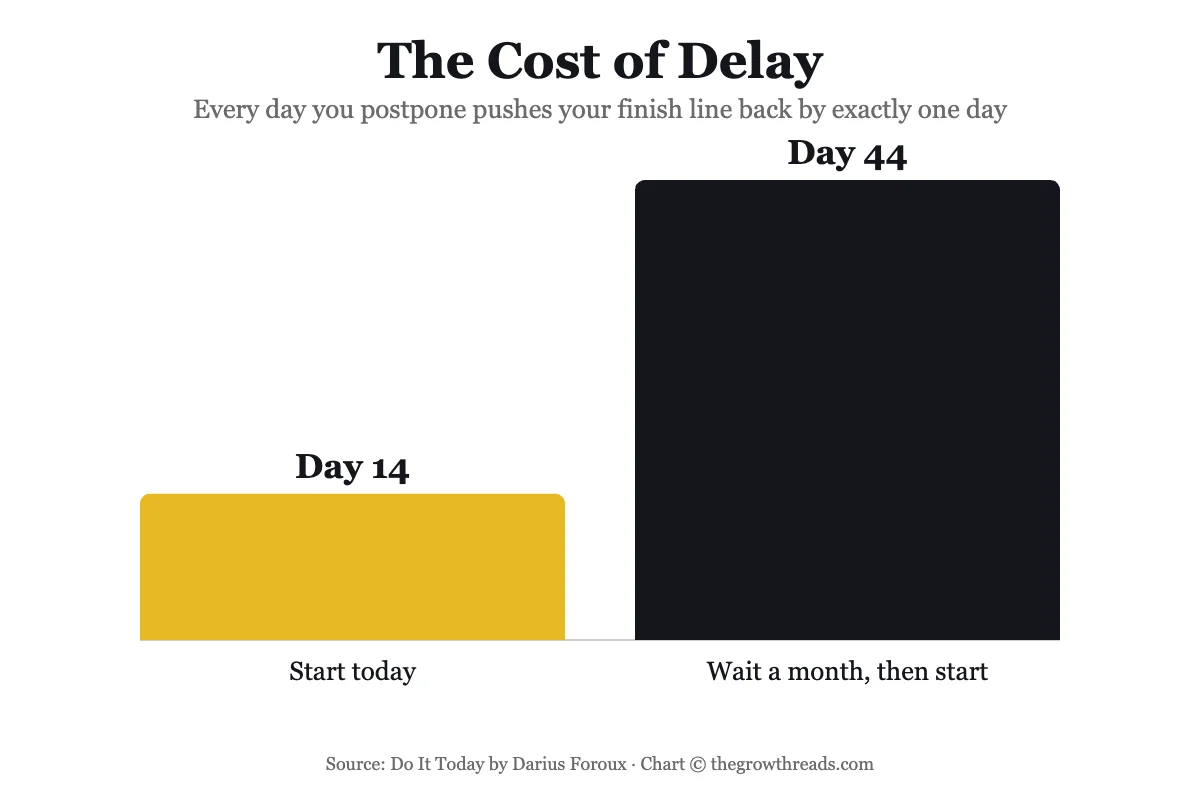
The book’s title is a direct response to a habit Foroux noticed in himself and in the readers of his blog: an endless supply of “I’ll do it tomorrow,” repeated so often that tomorrow never actually arrives. Rather than build another scheduling framework, he built the book around removing that escape hatch entirely — collapsing the time horizon for any task that matters down to today, on the theory that “tomorrow” is where most good intentions quietly go to die.
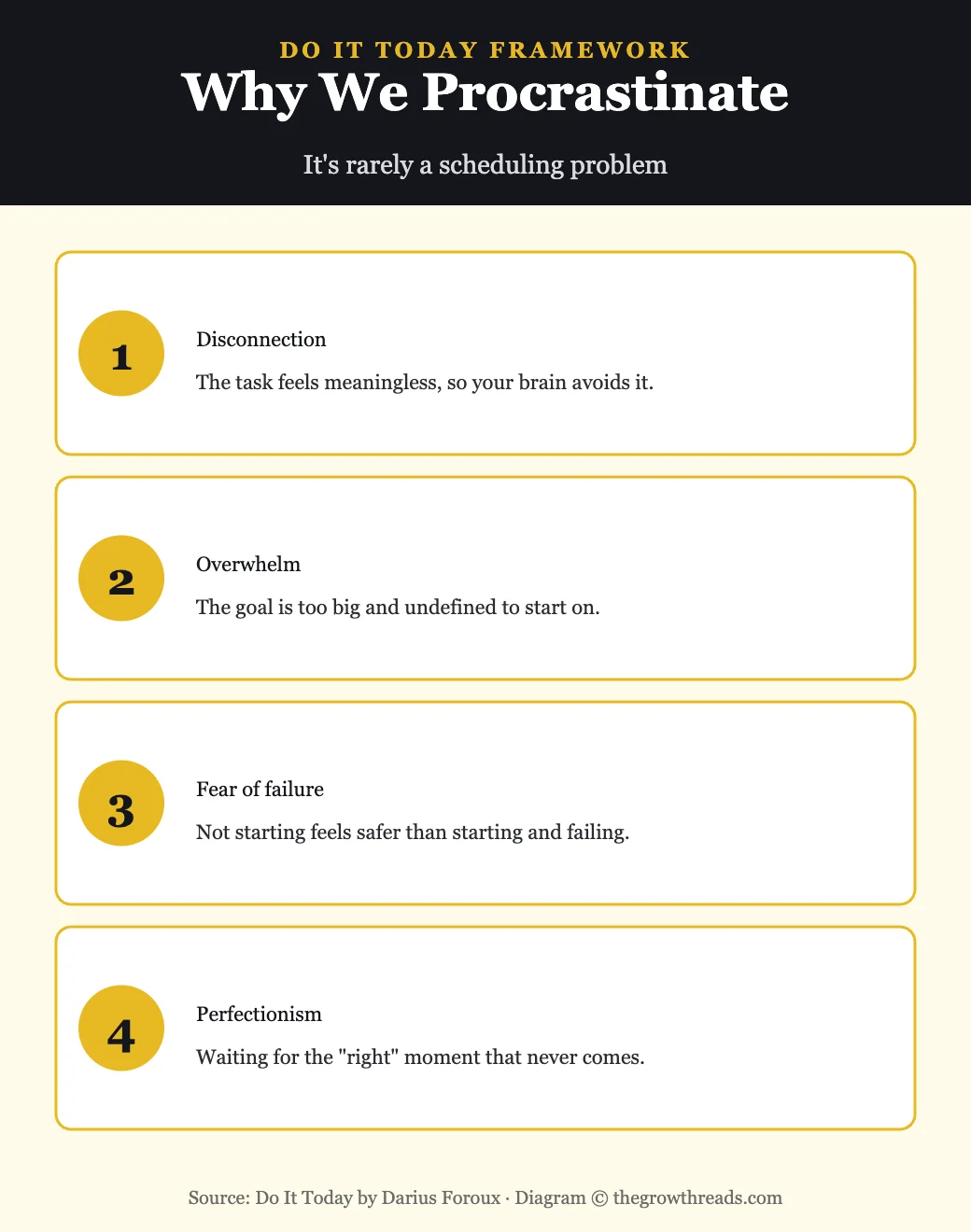
Foroux opens by dismantling the assumption that procrastination is a time-management problem. Most chronic procrastinators, he points out, are not short on planners, apps, or productivity books — many own several. What they’re short on is a genuine connection to the task at hand. When work feels disconnected from anything you care about, no calendar block or app reminder reliably gets you to start.
He identifies overwhelm and fear as the other two major drivers. A goal that’s too large or vague to act on today produces the same avoidance as a goal that feels meaningless — the mind simply has nothing concrete to grab onto. And underneath both, fear of failure often does quiet work: not starting a project protects you from the possibility of finishing it badly, which can feel safer than trying and falling short.
Perfectionism, in Foroux’s telling, is really this same fear wearing a more socially acceptable disguise. “I’m still refining it” or “it’s not ready yet” can be true statements about craftsmanship — or they can be procrastination that’s learned to sound productive. The distinction, he argues, is whether the refining has a deadline or has quietly become indefinite.
There’s a well-documented psychological pattern behind all of this that Foroux’s advice lines up with: humans are wired to weigh immediate discomfort much more heavily than a distant, uncertain payoff. Starting a hard task costs something right now — effort, the risk of doing it badly, an uncomfortable feeling. The reward for finishing usually arrives later, and feels abstract by comparison. Procrastination is, in that sense, a rational-feeling response to an emotional cost-benefit calculation that quietly gets the timing wrong. Naming that pattern doesn’t make it disappear, but it does make it easier to recognize the moment it’s happening rather than mistaking it for a legitimate reason to wait.
TGR Note: The disconnection diagnosis pairs well with J.D. Meier’s Getting Results the Agile Way, which independently arrives at “outcomes over activities” as a fix for the same disconnect — writing tasks as finished results, not vague activities, makes them concrete enough to actually start.
Part 2: Busy vs. Productive — and the Case for Starting Badly
Foroux draws a sharp line between busyness and productivity: busyness is measured in tasks touched, meetings attended, and hours logged; productivity is measured in what actually got finished. Juggling many things at once, he argues, typically reduces real output — attention split across a dozen half-started tasks rarely produces one meaningfully completed one.
The book’s practical answer to this is uncomfortable but simple: start before you feel ready, and accept that the first attempt will be imperfect. Motivation, in Foroux’s framing, is usually a consequence of action rather than its precondition — the act of starting, even clumsily, generates the momentum and interest that waiting for inspiration rarely does. This inverts the common intuition that you need to feel motivated before you can begin.
To make starting easier, Foroux repeatedly returns to breaking large, vague goals into smaller, well-defined pieces. A goal like “write a book” is genuinely hard to start on any given Tuesday; “write 300 words on chapter 2” is not. The size of the immediate next action, more than the size of the overall goal, determines whether procrastination wins that day.
He also pushes back on the instinct to make a decision “perfectly” before acting on it. Deliberating endlessly over which task to start first, or which approach is optimal, is itself a subtle form of procrastination — one that feels productive because it involves thinking hard about work, without any of the discomfort of actually doing it. Foroux’s advice is blunt: pick a reasonable next action and start it, rather than searching for the theoretically best one. A good task started today beats a perfect task still being planned next week.
TGR Note: The busy-vs-productive distinction is essentially the personal-productivity twin of Richard Koch’s argument in The 80/20 Principle — both books insist that most activity is low-leverage, and that the goal is fewer, better-chosen actions rather than more total effort.
Part 3: The Foundations That Make Consistency Possible
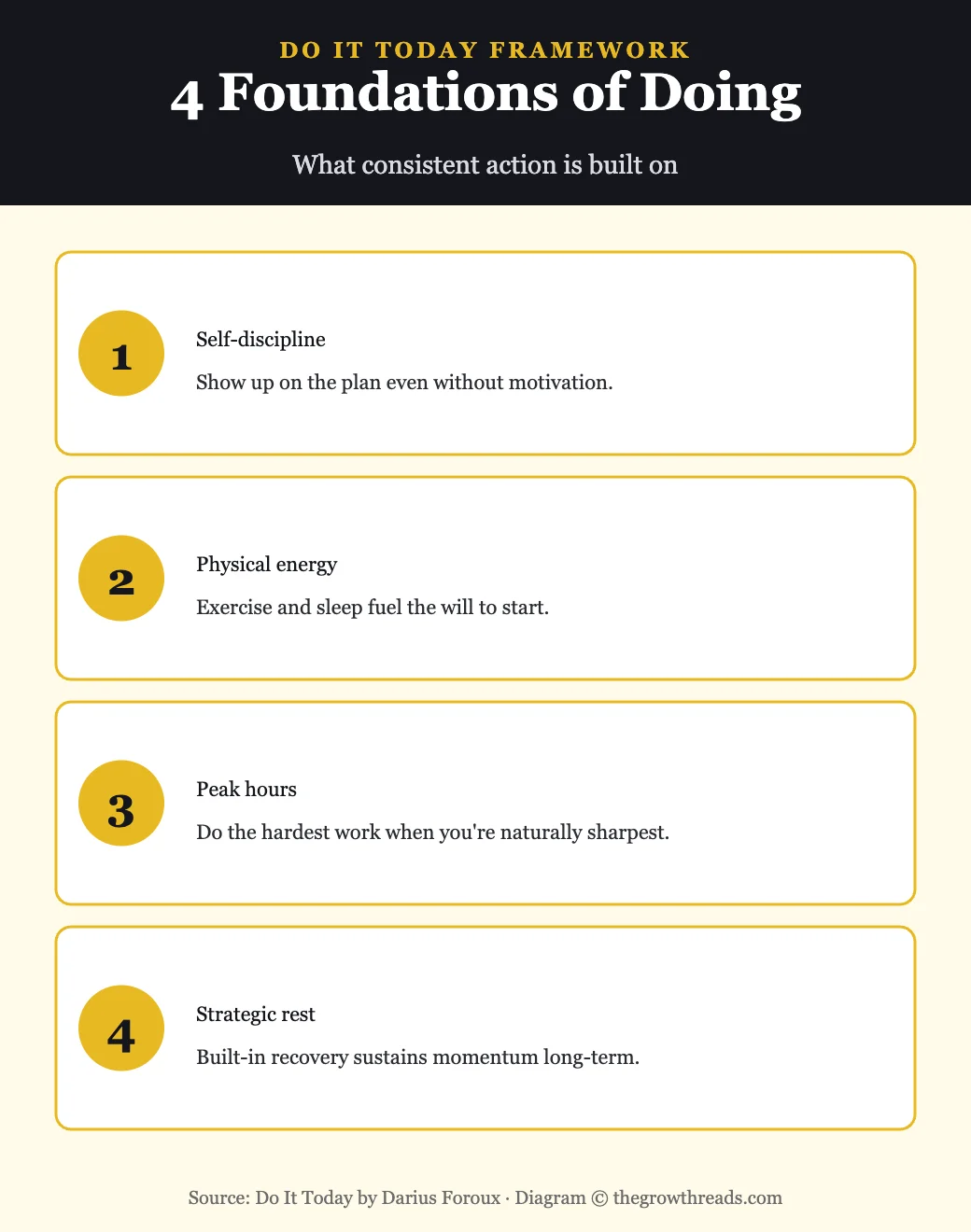
Starting once is easy; starting consistently is the actual challenge, and Foroux spends the book’s middle section on the foundations that make daily action sustainable rather than a one-week burst followed by collapse. Self-discipline comes first — not as raw willpower, but as a practiced habit of showing up on the plan regardless of mood, the same way a workout routine gets easier the more consistently it’s kept.
Physical energy is the second foundation, and Foroux is direct that productivity advice which ignores sleep and exercise is incomplete. A depleted body reliably produces a depleted will to start anything, no matter how well-designed the task list is. Working during your natural peak hours — whichever window of the day your focus and energy are genuinely highest — is the third foundation, and one of the more actionable pieces of advice in the book: protect that window for your hardest, most important work rather than letting it get consumed by email or meetings.
On self-discipline specifically, Foroux is careful to frame it as trainable rather than an innate trait some people simply have and others don’t. His practical version of building it is reducing the friction between deciding to act and actually acting — laying out what you need the night before, opening the document you’re avoiding before you let yourself check anything else, removing the small decision points where willpower typically leaks away. Discipline, in this account, isn’t gritting your teeth harder; it’s designing your environment so there’s less to resist in the first place.
The fourth foundation, strategic rest, is where Foroux most directly channels stoic influence: rest isn’t a reward you earn after finishing everything, it’s a deliberate input that makes sustained output possible at all. Treating recovery as optional, in his account, is what turns a promising productivity streak into a burnout cycle a few weeks later.
One concrete tactic ties the four foundations together: committing to just five minutes on a dreaded task, with permission to stop after that if it’s genuinely not going anywhere. In practice, Foroux notes, the hardest part of most avoided work is the first few minutes — momentum tends to carry a session well past the five-minute mark once the initial resistance is overcome. The rule works less because five minutes accomplishes much on its own, and more because it lowers the size of the commitment enough that starting no longer feels like a decision worth avoiding.
TGR Note: The strategic-rest foundation deserves a deeper look than one chapter can give it — Alex Soojung-Kim Pang’s Rest makes the fuller research-backed case for why deliberate recovery multiplies output rather than subtracting from it.
Part 4: Living the “Do It Today” Discipline
In its closing chapters, the book steps back from tactics to the underlying philosophy: stoic acceptance that you control your actions but not their outcomes, and that the only reliable answer to uncertainty is to act on what’s in front of you today rather than waiting for clarity that may never fully arrive. Foroux frames “do it today” less as a productivity slogan and more as a daily practice of taking ownership of a limited, finite amount of time.
He’s explicit that this isn’t about dramatic transformation. Small, consistent, slightly imperfect action compounds; occasional heroic effort followed by weeks of nothing does not. The book’s closing message is essentially a permission slip: you don’t need a better system, a clearer plan, or more motivation before you’re allowed to start — you need to do the next small thing today, and then do that again tomorrow.
Foroux also addresses setbacks directly, since a “do it today” mindset can otherwise collapse the first time a day is missed. His stoic framing treats a missed day as data, not a verdict on your character — the dichotomy of control means you can fully own today’s action while accepting that some days won’t go as planned, without either fact canceling out the other. The practical instruction is simple: when you miss a day, the only failure is not returning to it the next day. One missed day is a gap; several in a row, unaddressed, is how the system quietly stops.
TGR Note: If “do it today” resonates but you also need a weekly structure to sustain it, Ashley Whillans’s Time Smart and Meier’s Getting Results the Agile Way both supply the surrounding system — Foroux gives you the daily push to start, they give you the rhythm to keep going.
Who is Do It Today best for — and who should read something else first?
Do It Today is best suited to readers who already own productivity systems but still can’t get moving — the book’s core value is a mindset shift, not another set of tools to manage. It’s an especially good fit for anyone whose procrastination shows up as endless “research” or “planning” that never converts into action.
If your problem is less “I can’t start” and more “I don’t know what deserves my time in the first place,” start with The 80/20 Principle to identify your highest-leverage work, then come back to Do It Today for the push to actually begin it. And if procrastination is tangled up with a genuine overload of commitments rather than motivation, 168 Hours will help you see what’s realistically on your plate first.
Readers looking for heavy academic research or citation-dense argumentation should calibrate expectations: Foroux writes in short, direct chapters aimed at practical application rather than literature review, closer in spirit to a personal essay collection than a research monograph. That’s a feature for readers who find dense non-fiction itself a procrastination trigger, and a minor limitation for readers who want every claim traced back to a specific study.
Questions to reflect on
- What’s one task you’ve been postponing that would take less than 20 minutes to meaningfully start today?
- Is a current delay driven by disconnection (it doesn’t matter to you), overwhelm (it’s too big), or fear (you might fail)? Naming which one changes what actually helps.
- When is your natural peak-energy window, and what’s currently occupying it instead of your most important work?
- Where in your week do you mistake busyness for productivity — lots of activity, little that actually mattered getting finished?
- What would “good enough to start” look like for something you’ve been perfecting instead of shipping?
🔥 Ready to stop waiting and start today?
Pick your smallest postponed task and do it in the next 20 minutes — the book’s entire philosophy in one action.
How to apply Do It Today (7-day plan)
- Day 1 — Name one postponed task: Pick the task you’ve delayed longest and diagnose why: disconnection, overwhelm, or fear.
- Day 2 — Shrink it: Break that task into a piece small enough to finish in under 30 minutes, then do it.
- Day 3 — Find your peak hour: Notice when your focus is naturally sharpest today, and protect that window tomorrow.
- Day 4 — Protect the peak hour: Do your hardest task during that window, before email or meetings can claim it.
- Day 5 — Practice imperfect action: Ship or finish something before you feel fully ready. Notice what actually happens.
- Day 6 — Build in rest: Schedule one deliberate recovery block, not as a reward, but as a planned part of the week.
- Day 7 — Reflect: Review the week. Which days did you do it today, and which did you postpone? What made the difference?
Frequently asked questions
What is the main idea of Do It Today?
The main idea is that procrastination is caused by disconnection, overwhelm, and fear rather than poor scheduling. Darius Foroux argues that immediate, imperfect action — supported by self-discipline, physical energy, working during peak hours, and strategic rest — beats waiting for motivation or the perfect plan.
Why do we procrastinate, according to Do It Today?
Foroux identifies three main drivers: disconnection (the task feels meaningless), overwhelm (the goal is too big or vague to act on), and fear of failure (not starting feels safer than starting and falling short). Perfectionism is framed as fear wearing a more acceptable disguise.
What are the 4 foundations in Do It Today?
The four foundations for sustainable consistency are self-discipline (showing up regardless of mood), physical energy (sleep and exercise), working during your natural peak hours, and strategic rest built into the routine rather than earned after burnout.
Is Do It Today just another productivity system?
No — Foroux is explicit that the book is deliberately not a complicated system. Its core message is a single imperative (“do it today”) rather than a set of tools or apps to maintain, which is part of why it resonates with readers who already own several productivity systems but still struggle to act.
Does Do It Today draw on stoicism?
Yes. Darius Foroux openly incorporates stoic philosophy throughout the book, particularly the idea of focusing on what you control — your actions today — rather than outcomes you can’t fully control. This stoic thread runs through his later books as well, including Think Straight and The Stoic Path to Wealth.
How is Do It Today different from Eat That Frog?
Eat That Frog focuses primarily on task prioritization — tackling your hardest task first each day. Do It Today goes a layer deeper, addressing the psychological reasons tasks get avoided in the first place (disconnection, overwhelm, fear) and building sustainable habits like peak-hours work and strategic rest around the daily-action principle.
What’s a good first step if I only have 10 minutes?
Pick the task you’ve been postponing longest, break off a piece small enough to finish in the next 10 minutes, and do that piece now — before deciding whether you feel motivated. Foroux’s central claim is that motivation follows action more reliably than it precedes it.
Related summaries
- Getting Results the Agile Way by J.D. Meier — the weekly system to pair with Do It Today’s daily push.
- Time Smart by Ashley Whillans — why finished outcomes matter more than hours logged.
- The 80/20 Principle by Richard Koch — deciding which tasks deserve to be started at all.
- Rest by Alex Soojung-Kim Pang — the deeper case for strategic recovery.
- Browse all Productivity book summaries →
How we analyze books: Every TGR summary is built from a full reading of the source material, cross-checked against the author’s published interviews and research where relevant, and structured around practical application rather than just recap. We never reproduce a book chapter-by-chapter — instead we synthesize the core arguments, verify claims where possible, and add original frameworks (diagrams, 7-day plans, reflection questions) you won’t find in the book itself. Read our full methodology.