

⭐⭐⭐⭐☆ 4.4/5 — A practical, systems-first case for why finishing projects has nothing to do with willpower and everything to do with structure.
Best for: Chronic starters who have a drawer full of half-finished projects and want concrete tactics, not another pep talk about discipline.
Reading time: ~3-4 hrs to read the book (guide: 12 min)
Difficulty to apply: Low — the tactics are simple and mostly one-time setup work, not ongoing willpower.
Finish What You Start in one minute
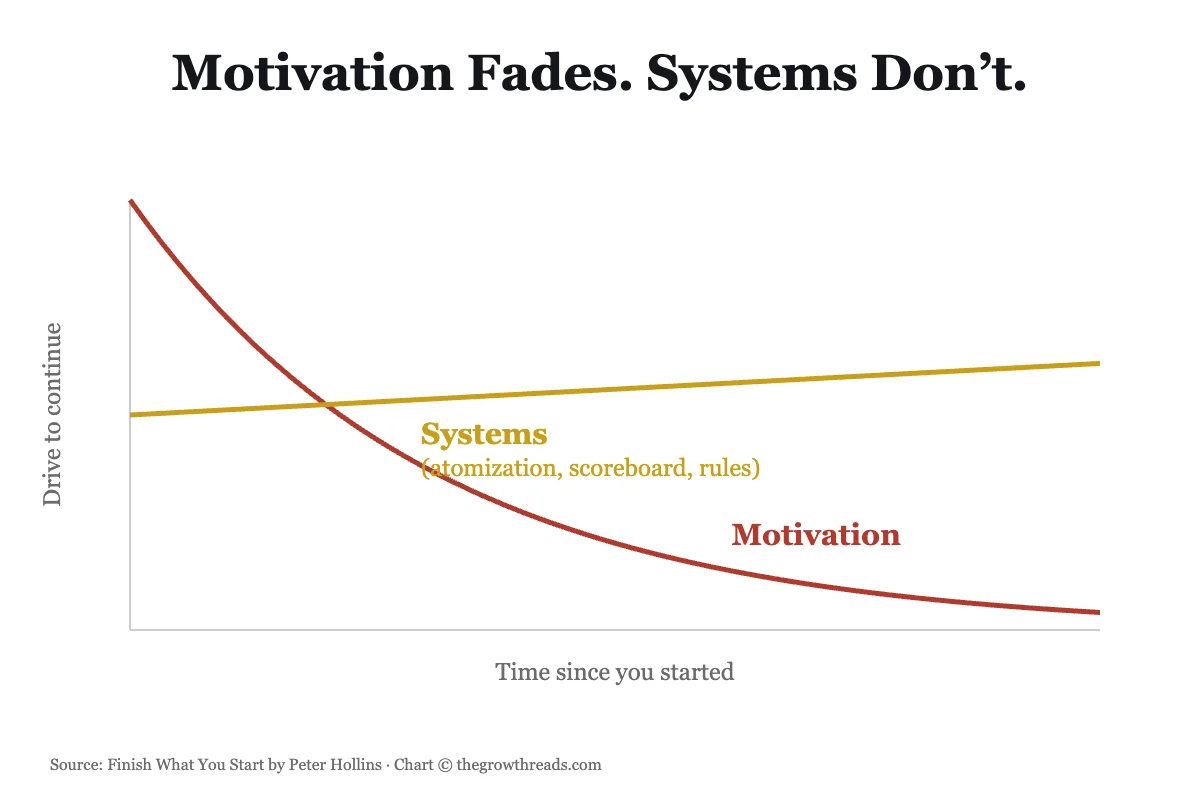
You don’t fail to finish projects because you lack willpower — motivation for any task naturally decays within days of starting it, and people who follow through have simply built systems that don’t depend on still feeling motivated. Peter Hollins, a behavioral-psychology writer, argues that follow-through is a combination of mindset, preparation, and structure: breaking tasks down until the first step is almost too small to skip, pairing unpleasant work with something enjoyable, tracking progress visibly, and setting concrete rules instead of vague intentions. The book is less a single dramatic reframe than a practical toolkit assembled from behavioral psychology, meant to be applied directly to whatever you’re currently not finishing.
Key takeaways
- Motivation is not the differentiator: everyone’s motivation fades after the initial excitement — finishers just don’t rely on it to carry them through.
- The “Finisher’s Mindset” shapes how you interpret obstacles: the mental habit of framing a setback as solvable, rather than as proof you should quit, determines whether you keep going.
- Atomize tasks until starting is nearly effortless: break a large project down until the first action is so small it feels silly not to do it.
- Temptation bundling makes unpleasant work sustainable: pair a task you’re avoiding with something you genuinely enjoy, so the pairing itself becomes a small reward.
- A visible scoreboard beats a vague intention: a simple, honest progress tracker — even a basic color-coded chart — creates accountability that good intentions alone don’t.
- Set restrictions and obligations, not just goals: restrictions cap unproductive behavior (“no more than two episodes a night”), obligations mandate specific actions (“write 300 words before checking email”) — both are more actionable than a general goal.
- Extrinsic motivation is a useful short-term accelerant: an accountability partner or a small financial stake can carry you through the early days while intrinsic motivation is still building.
- Rumination often masquerades as productivity: excessive deliberation about a task can feel like progress while actually delaying the first real step indefinitely.
- Task batching protects focus: grouping similar-cognitive-mode tasks into one session (all admin in one sitting) avoids the switching costs of scattering them throughout the week.
- The book compiles behavioral psychology rather than running its own studies: Hollins draws heavily on other well-known researchers and authors, which is worth knowing if you’re looking for primary citations.
- The book doesn’t address when to quit: it assumes your goal is worth finishing and focuses entirely on the mechanics of follow-through, so pair it with your own judgment about which projects deserve that effort.
What is Finish What You Start about?
Finish What You Start argues that following through on projects has nothing to do with having more willpower than other people — it’s about building systems (task-breakdown, visible tracking, concrete rules) that keep you moving after motivation, which always fades quickly, runs out.
About the author
Peter Hollins is a prolific writer on behavioral psychology and self-discipline, publishing frequently under his own name and describing his work as translating academic and popular psychology research into practical, everyday tactics. Finish What You Start (self-published, March 2018) is part of his broader “Live a Disciplined Life” series and reflects his consistent style: short, tactic-dense chapters aimed at readers who want concrete tools rather than a single unifying theory. Explore all Peter Hollins book summaries →
Because Hollins publishes prolifically and across overlapping topics — willpower, mental toughness, self-discipline, and productivity all recur across his catalog — readers sometimes note that his books share DNA with each other. What distinguishes this one is its narrow focus on the specific failure mode of starting things and not finishing them, rather than discipline in general, which keeps its tactics more directly applicable to a stalled project you’re facing right now.
Key concepts at a glance
| Concept | What it means | Use it when |
|---|---|---|
| Finisher’s Mindset | Framing obstacles as solvable rather than as evidence you should quit | You’re about to abandon something after hitting a setback |
| Atomization | Breaking a task down until the first step is nearly effortless | You keep avoiding starting because the whole project feels overwhelming |
| Temptation bundling | Pairing an unpleasant task with something you enjoy | A necessary task keeps getting pushed to tomorrow |
| The scoreboard | A visible, honest progress tracker | You have a goal but no way to see if you’re actually moving toward it |
| Restrictions vs. obligations | Caps on unproductive behavior vs. mandated productive actions | A vague goal (“be more productive”) needs to become an actual rule |
| Task batching | Grouping similar-mode tasks into one session | Constant task-switching is draining your focus during the day |
Part 1: Why we don’t finish
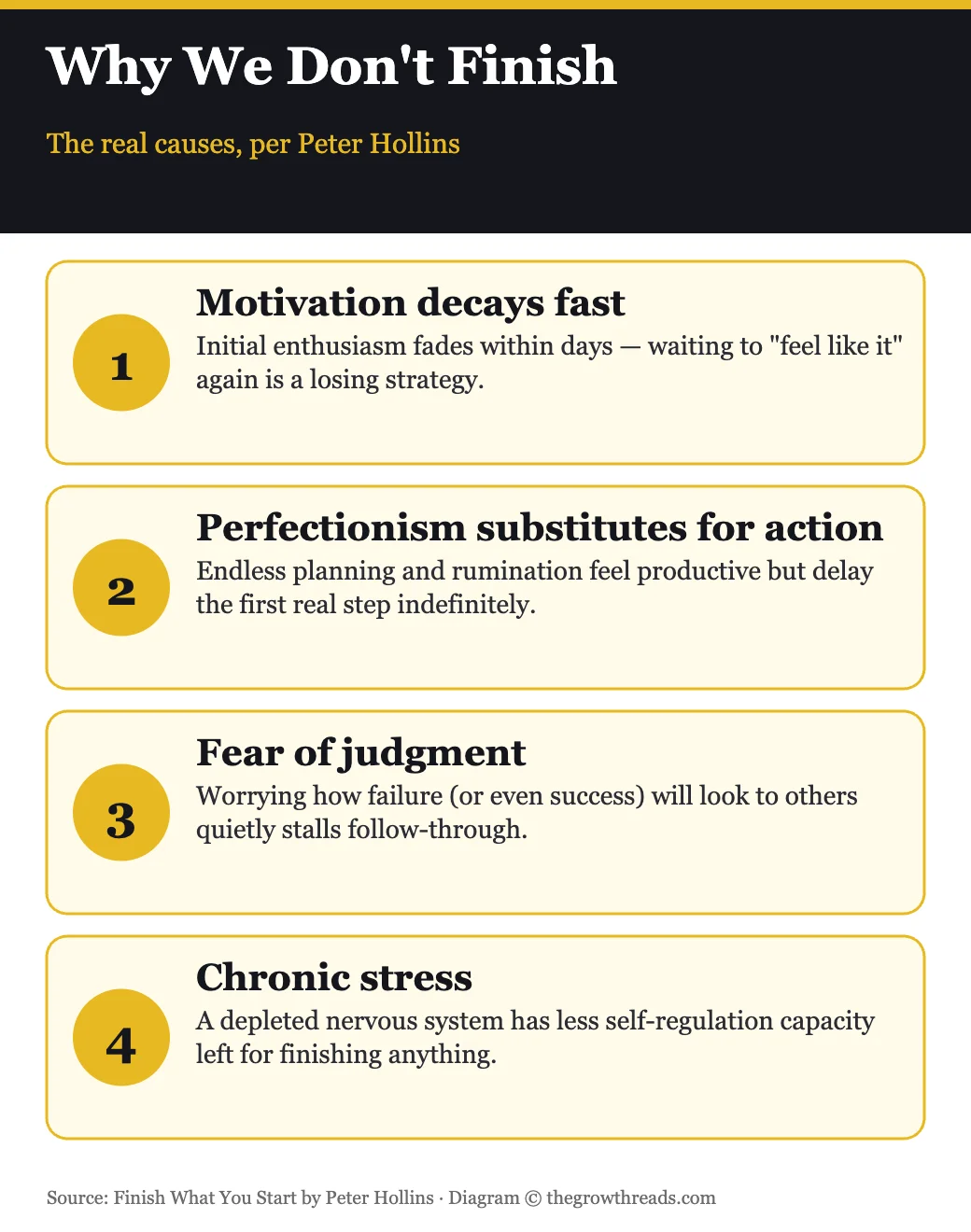
Hollins opens by dismantling the willpower explanation directly: motivation is not a fixed trait some people have more of, it’s a short-lived state that decays predictably after the initial enthusiasm of starting something new. Waiting to “feel like it” again before continuing is, in his framing, a losing strategy by design — the feeling simply isn’t coming back on its own. He walks through the more specific culprits that fill the gap once motivation fades: perfectionism that turns planning into a substitute for action, fear of how failure (or even success) will look to other people, and chronic stress that quietly depletes the self-regulation capacity finishing anything requires.
Hollins also spends time on a subtler culprit he calls rumination — the habit of extensively deliberating over a task’s future consequences before acting, which can feel productive in the moment because it involves real mental effort, but functions as a substitute for action rather than preparation for it. He connects this closely to perfectionism: the more a task matters to someone, the more likely they are to keep refining the plan rather than risk an imperfect first attempt, and the refinement itself becomes the reason nothing actually gets finished. His practical antidote is blunt — set a hard cutoff on planning time before the first concrete action, even if the plan still feels incomplete, because an imperfect action almost always produces more useful information than another round of deliberation.
TGR Note: This “motivation decays, systems don’t” framing pairs well with the kinetic attention research in Attention Span — both books treat the expectation of sustained, unwavering internal drive as the actual problem, not a personal failing to fix with more effort.
Part 2: Building the Finisher’s Mindset
Before offering tactics, Hollins spends a section on the interpretive habit he calls the Finisher’s Mindset — how you explain setbacks to yourself. Someone with this mindset treats a missed deadline or a failed first attempt as a solvable problem with a specific cause; someone without it treats the same setback as confirmation that the whole project (or their own capability) was flawed from the start. The distinction matters practically because the two interpretations lead to opposite next actions: a solvable-problem framing prompts a small adjustment and a next attempt, while a confirmation-of-failure framing prompts abandoning the project altogether — which means the same setback, depending on how it’s interpreted, either becomes a minor course correction or the end of the whole effort. He also distinguishes intrinsic motivation (durable, but slow to build) from extrinsic motivation (fast, but shallow), arguing the practical move is to use extrinsic pressure — an accountability partner, a financial stake, a public commitment — as a bridge while intrinsic investment in the work has time to develop.
He’s careful to frame extrinsic motivation as scaffolding rather than a permanent solution, since research he cites (via Daniel Pink) suggests that leaning on external rewards too long can actually crowd out a person’s sense of ownership over the work, making it feel like an obligation imposed from outside rather than a goal they chose. The intended sequence is to use the external push to get through the first difficult stretch — when a project feels most abstract and least rewarding — and then deliberately hand off the driving motivation to something more intrinsic, like visible progress or a sense of competence, once there’s enough momentum for that internal reward to actually register.
This section leans on other researchers more than original studies: Kelly McGonigal’s work on willpower and social contagion of habits, and Daniel Pink’s research on how extrinsic rewards can undercut intrinsic motivation when they reduce a person’s sense of autonomy over the task. Hollins’s contribution is less new data than a practical synthesis — translating that research into a rule of thumb readers can apply immediately.
Part 3: The Finisher’s Toolkit
This is the book’s most actionable section, and where the four core tactics live: atomization, temptation bundling, the scoreboard, and restrictions-versus-obligations. Atomization means shrinking a task until the very first move is almost too small to skip — “planning a wedding” becomes “set the budget,” and only once that’s done does the next atomized step appear. Temptation bundling pairs a task you’re avoiding with something you already enjoy, borrowing from the psychology of dopamine anticipation (a concept also central to James Clear’s Atomic Habits, which Hollins draws on here) to make the unpleasant task easier to start.
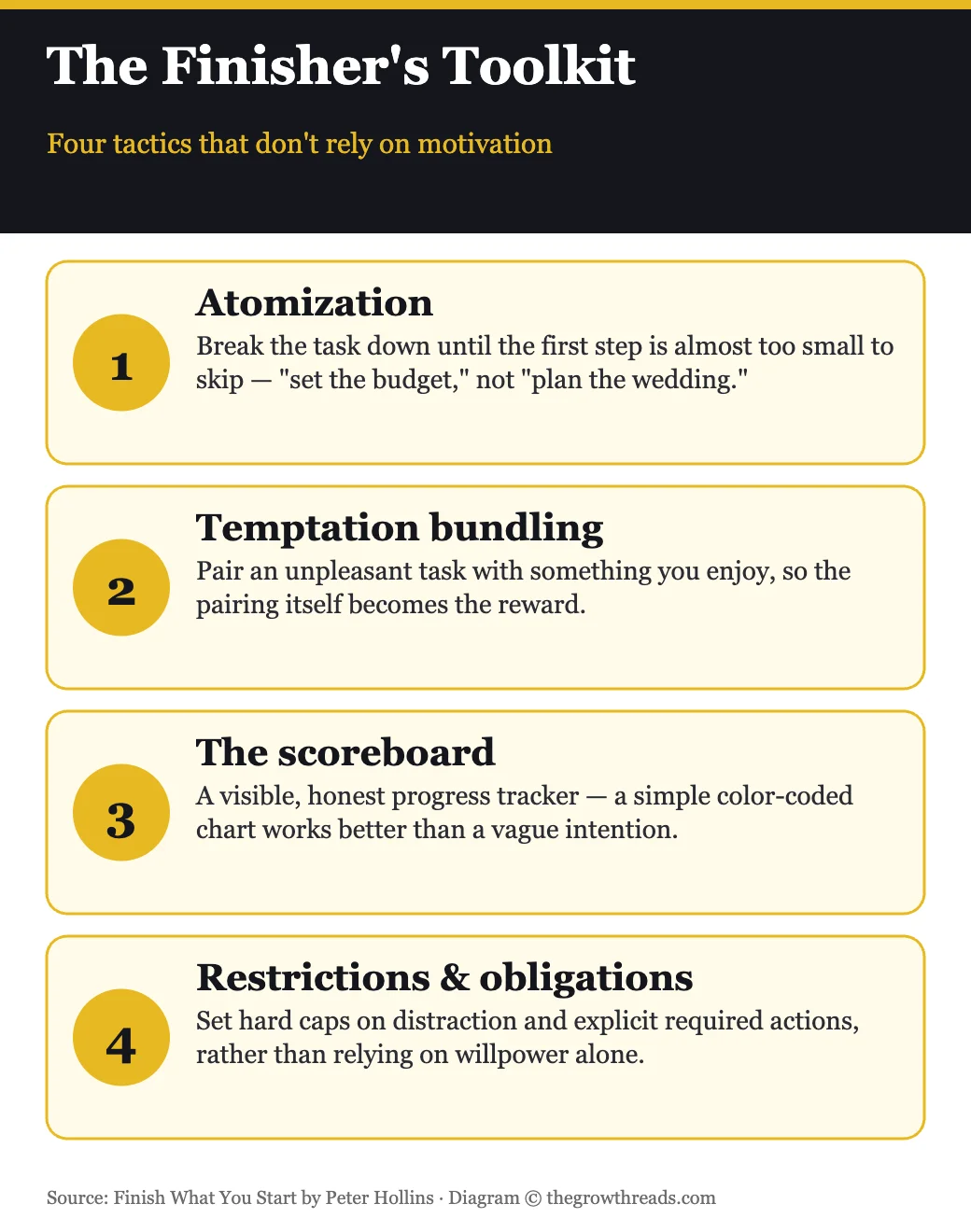
The scoreboard and the restrictions/obligations distinction work together: a visible tracker only holds you accountable if the rules it’s tracking are specific enough to be unambiguous. “Be more disciplined about email” isn’t trackable; “check email only twice a day, and reply to the three most important messages before doing anything else” is. Hollins also recommends task batching — grouping similar-cognitive-mode work into single blocks, citing Cal Newport’s argument that constant context-switching between different types of tasks carries a real cognitive cost that adds up over a day.
Hollins is specific about what counts as “similar cognitive mode” for batching purposes — it’s less about subject matter and more about the type of mental effort a task demands. Answering emails and paying bills might seem unrelated on the surface, but both are shallow, administrative, low-creativity tasks that draw on the same kind of attention, so grouping them into one weekly block avoids repeatedly shifting gears between that mode and deeper, more creative work throughout the day. He suggests protecting a single recurring window — say, ninety minutes every Friday morning — for this kind of batched admin, so it stops leaking into moments that would otherwise be available for the actual project you’re trying to finish.
TGR Note: The atomization tactic here is a close cousin of the “efficiency trap” discussion in Meditations for Mortals — both books push against the idea that the right move is always to plan bigger and more thoroughly before starting, when in practice starting smaller and sooner tends to produce more actual finished work.
Part 4: Preparing for and executing on your goal
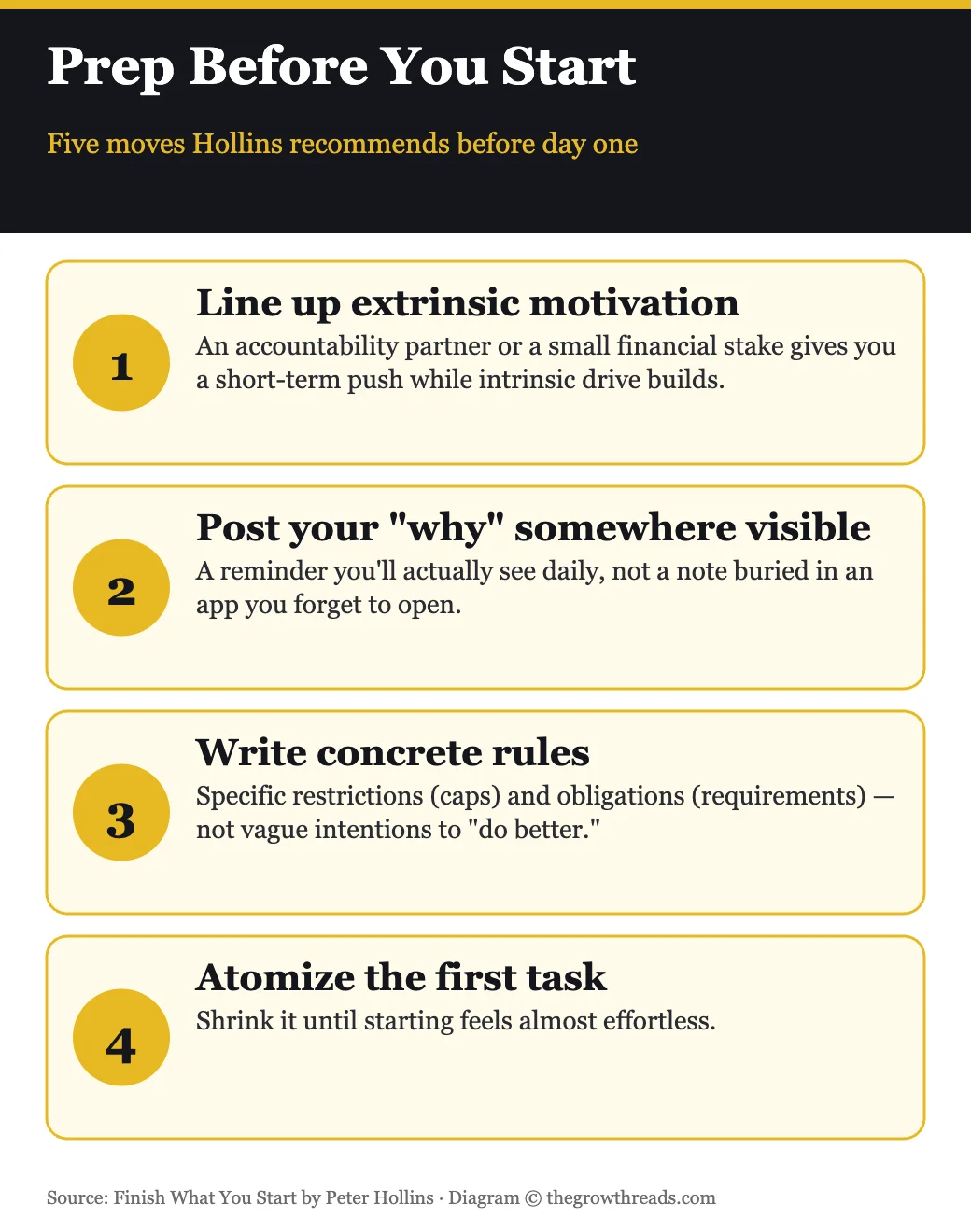
The closing section turns the prior tactics into a pre-launch checklist: line up your extrinsic motivation before day one rather than hoping it appears when you need it, post a visible reminder of your underlying “why” somewhere you’ll actually see it daily, write your restrictions and obligations down as concrete rules rather than vague intentions, and atomize the very first task so small that starting requires almost no activation effort. He pairs this with execution-phase advice — single-tasking rather than multitasking during focused sessions, and countering in-the-moment temptation by briefly visualizing the regret of not finishing, rather than relying on willpower to override the urge directly.
The visualization technique is worth spelling out because it’s more specific than generic “stay motivated” advice: rather than trying to will away the urge to abandon a task in the moment, Hollins recommends briefly and concretely imagining how you’ll feel a week or a month from now if you quit here — not as a vague warning, but as a specific mental rehearsal of the actual disappointment. The idea, borrowed loosely from research on how people misjudge future feelings, is that most people underestimate how much a specific, near-term regret will bother them, and making that regret vivid in the moment is often enough to tip the decision back toward continuing, without needing a burst of willpower to do it.
One fair critique worth naming: the book focuses entirely on how to keep going, and offers little guidance on when quitting a project is actually the right call. Readers looking for help distinguishing a worthwhile struggle from a genuinely bad goal will need to look elsewhere — Hollins’s assumption throughout is that the goal itself is sound and the obstacle is follow-through, not judgment about which goals deserve the effort in the first place.
That gap is worth planning around rather than treating as disqualifying. A reasonable way to fill it yourself is to set a brief, honest check-in at a predetermined milestone — not every difficult moment, which the book already addresses, but a specific point where you deliberately ask whether the goal itself still makes sense given what you’ve learned since starting. Building that single checkpoint into the plan lets you use Hollins’s follow-through tactics with more confidence, since you’re not relying on them to carry you through a project that should have been abandoned, only through the ordinary resistance that shows up in any project worth finishing.
Who is Finish What You Start best for — and who should read something else first?
This book is best for readers with a specific stalled project in mind who want concrete, immediately usable tactics rather than a philosophical reframe of productivity. Its short, practical chapters make it easy to apply the same week you read it, and its lack of deep theoretical grounding is less of a drawback if what you actually need is a checklist, not a treatise.
The tactics also translate well beyond personal projects — several apply directly to work assignments, side projects, and even household tasks that tend to stall out the same way a bigger goal does.
It’s also a good fit for readers early in building their productivity habits, since the tactics here are foundational rather than advanced — atomization, visible tracking, and concrete rules are the kind of building blocks that more sophisticated systems eventually get layered on top of. Readers who’ve already spent years experimenting with productivity literature may find some of the specific tactics familiar from other books, since Hollins draws openly on well-known authors rather than presenting something entirely new; the value for that audience is more in the compact, single-purpose framing than in novelty.
If your stalled projects are more about attention fragmentation than follow-through specifically, Attention Span addresses the underlying focus problem more directly. If perfectionism and over-planning are your main obstacle, Meditations for Mortals offers a gentler, more philosophical take on the same “good enough to finish” idea. And if you’re already deeply read in productivity literature, some of this book’s tactics (habit stacking, temptation bundling) will feel familiar from other popular titles it draws on.
Questions to reflect on
- What’s one project you started with real enthusiasm that’s now stalled — and has your motivation for it actually returned, or are you still waiting for it to?
- Could you atomize your next step on that project down to something almost too small to skip?
- What’s one unpleasant task you keep avoiding that you could pair with something you genuinely enjoy?
- Do you have a visible way to track progress on your current goals, or only a general intention?
- Is there a restriction or obligation — a specific, concrete rule — you could write down today instead of a vague resolution?
- Looking back at a project you did finish, what actually carried you through the middle stretch once the initial excitement wore off?
🔥 Ready to actually finish something?
Get Finish What You Start and build a system that doesn’t depend on motivation.
How to apply Finish What You Start (7-day plan)
- Day 1 — Pick one stalled project and write down why it actually matters to you, somewhere you’ll see it daily.
- Day 2 — Atomize the very next step until it feels almost too small to skip.
- Day 3 — Set up one piece of extrinsic motivation: tell someone your deadline, or put a small stake on it.
- Day 4 — Write one restriction (a cap on a distracting behavior) and one obligation (a required daily action) related to this project.
- Day 5 — Identify one unpleasant sub-task and bundle it with something you enjoy.
- Day 6 — Build a simple visible scoreboard — even a checklist on your wall counts — and update it.
- Day 7 — Batch this week’s remaining similar tasks into one focused session instead of scattering them.
Frequently asked questions
What is the main argument of Finish What You Start by Peter Hollins?
The book argues that following through has little to do with willpower, since everyone’s motivation fades within days of starting something new. What actually separates people who finish from people who don’t is whether they’ve built systems — task breakdown, visible tracking, concrete rules — that keep them moving once that initial motivation is gone. The practical focus is on structure and preparation, not on trying harder to feel motivated.
What is “atomization” in this book?
Atomization is Hollins’s term for breaking a large task down into steps so small that the very first action feels almost too easy to skip. Instead of “plan the wedding,” the atomized first step might be just “set the budget.” The idea is that most procrastination happens at the very start of a task, when it still feels large and undefined, so shrinking that first step removes the friction that stops people from beginning at all.
What is temptation bundling?
Temptation bundling means pairing a task you tend to avoid with something you genuinely enjoy, so the combination itself becomes appealing — for example, only allowing yourself a favorite podcast while doing financial admin. Hollins presents it as a practical way to make unpleasant-but-necessary tasks more sustainable without relying on willpower to push through the unpleasantness directly.
Does the book explain when you should quit a project instead of finishing it?
Not really — this is a fair, commonly noted limitation. The book is focused entirely on how to follow through once you’ve committed to a goal, and doesn’t offer much guidance on distinguishing a worthwhile struggle from a genuinely bad goal worth abandoning. Readers looking for help with that earlier decision will need a different resource; this book assumes the goal is sound and the obstacle is follow-through.
Is this book based on original research?
Mostly no — Hollins synthesizes findings from other well-known behavioral psychology and self-help authors (Kelly McGonigal, Daniel Pink, James Clear, Cal Newport, and others) rather than reporting his own studies. The value is in the practical compilation and clear, actionable framing rather than original empirical contribution, which is worth knowing if you’re looking for a book grounded in primary research.
How is this different from Hollins’s other books?
Hollins writes prolifically across overlapping topics — willpower, mental toughness, self-discipline, and productivity all recur in his catalog, and some tactics repeat across titles. What distinguishes this book is its narrow focus specifically on the failure mode of starting projects and not finishing them, rather than discipline in general, which keeps its advice more directly applicable if that’s your specific problem.
What should I read after Finish What You Start?
If attention fragmentation rather than follow-through is your main obstacle, Attention Span addresses that more directly. If perfectionism and over-planning are getting in your way, Meditations for Mortals offers a gentler, more philosophical take on finishing “good enough” work.
Related summaries
Continue building better follow-through with Meditations for Mortals, Attention Span, Dopamine Detox, and Time Anxiety, or browse the full productivity books collection.
How we analyze books: Every summary on The Growth Reads is built from a full read of the source material, cross-checked against the author’s interviews and published research where available, and structured around practical application rather than just recap. We focus on what you can actually do differently after reading. Read our full methodology.