

TGR Verdict: ★★★★☆ 4.2/5
A dense but genuinely original take on marital intimacy that rejects communication-skills therapy in favor of a growth model where conflict, not compromise, builds real passion.
Passionate Marriage in one minute
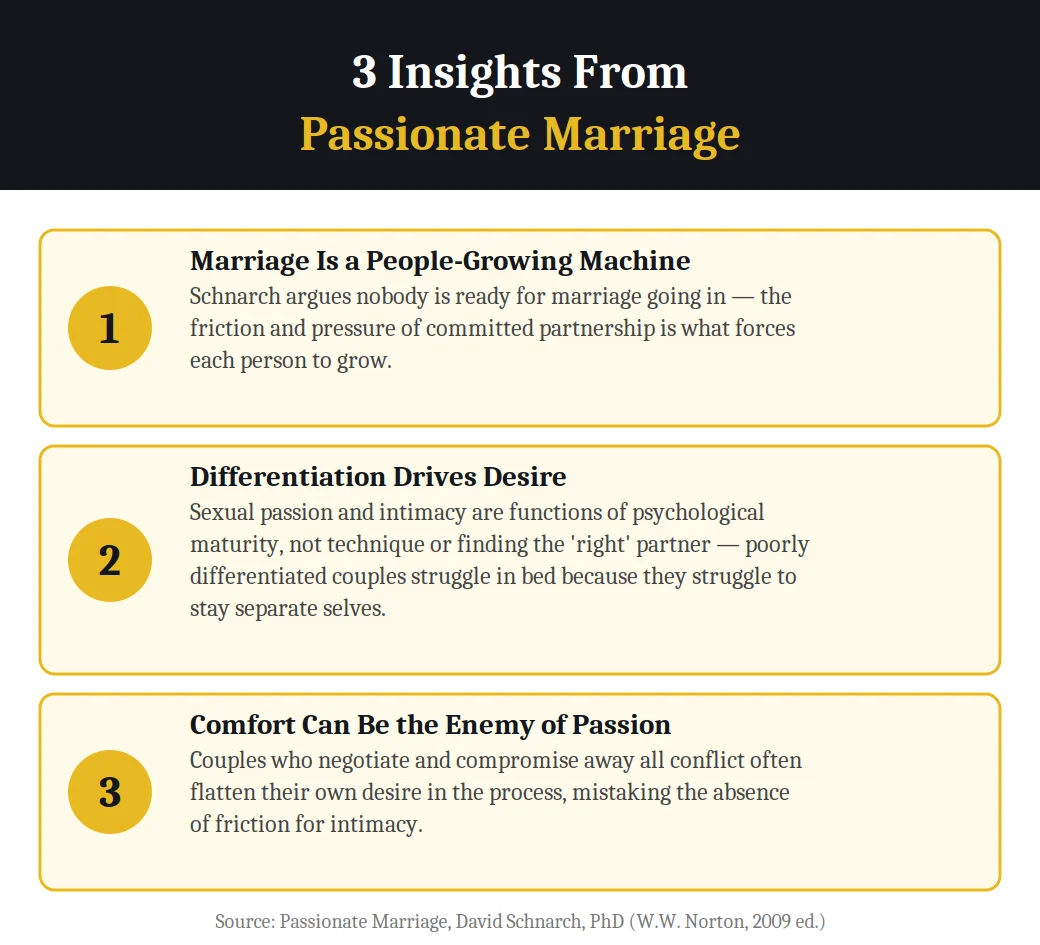
David Schnarch, a clinical psychologist and pioneer of “Crucible therapy,” argues that great sex and lasting intimacy have almost nothing to do with technique, compatibility, or finding the right partner. They are functions of differentiation — your capacity to hold onto a solid sense of yourself while staying deeply, non-defensively connected to your partner. Marriage, in his framing, is a “people-growing machine”: nobody is ready for it going in, and the friction it generates is exactly what forces each partner to mature. Where conventional couples therapy tries to smooth over conflict through communication skills, Schnarch treats conflict and exposure as the mechanism of real intimacy, arguing that couples who negotiate away all their friction often flatten their own desire in the process.
Key takeaways
- Sexual passion and intimacy are functions of psychological maturity — specifically differentiation — not technique or partner compatibility.
- Differentiation is the capacity to maintain a clear, solid sense of your own identity and values while staying deeply, non-defensively connected to your partner.
- Marriage functions as a “people-growing machine” — nobody is ready for it going in; its pressure is what forces growth.
- The Crucible metaphor reframes conflict and exposure as the forge that builds more fully realized selves, not evidence of relationship failure.
- Emotional gridlock — a stuck pursue-withdraw cycle — occurs when partners are poorly differentiated and operate as one anxious unit instead of two distinct selves.
- A “reflected sense of self” depends on a partner’s approval to feel okay, creating anxiety, control, or conflict avoidance.
- Self-validated intimacy is the mature capacity to self-soothe and reveal your true self even without your partner’s approval in the moment.
- Standard communication-skills therapy can backfire by optimizing for de-escalation and compromise, which often flattens desire along with conflict.
- How couples behave in bed is a remarkably authentic expression of their emotional connection — or the lack of it.
What is Passionate Marriage about?
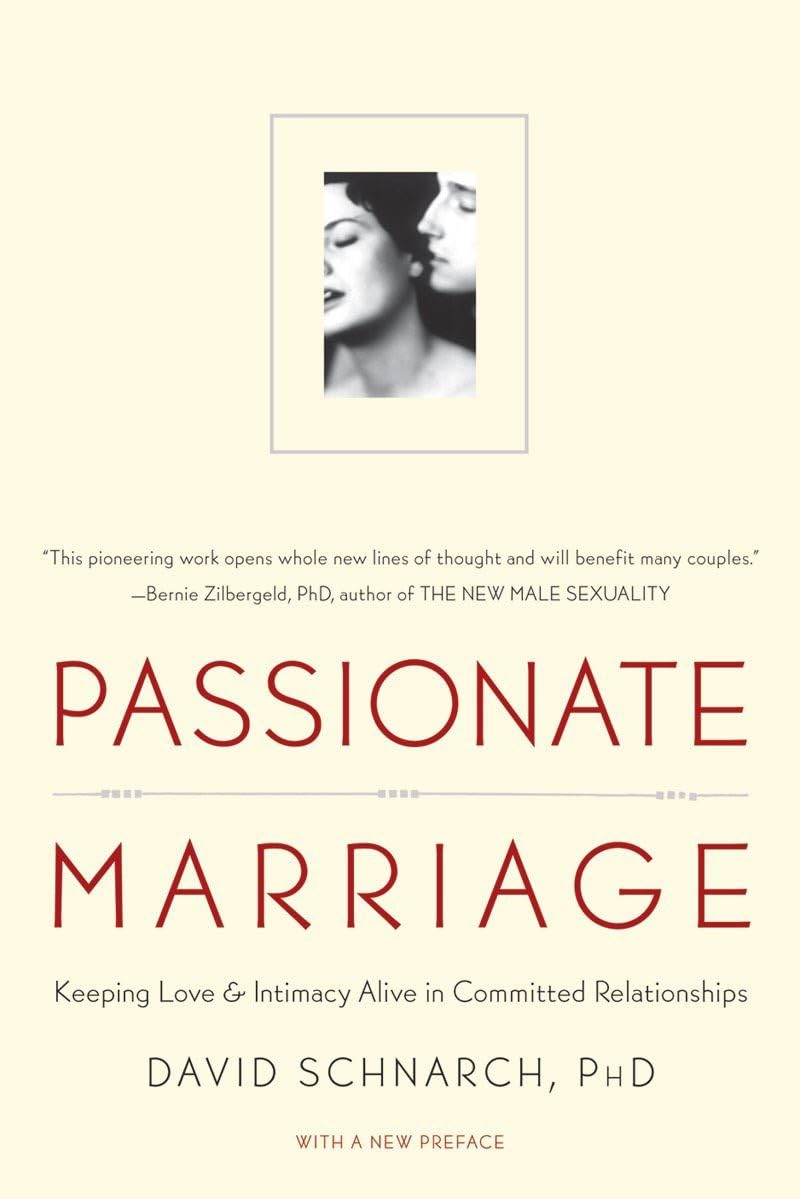
Passionate Marriage is David Schnarch’s general-audience distillation of “Crucible therapy,” a differentiation-based model of marital and sexual intimacy he developed drawing on Murray Bowen’s family systems theory. The book rejects the two dominant paradigms of its era: communication-skills-based couples counseling, which Schnarch argues optimizes for compromise at the expense of passion, and mechanical, technique-focused sex therapy, which sidesteps the emotional root causes of sexual disconnection. In their place, he offers a model centered on differentiation — the capacity to stay fully yourself while remaining deeply connected to a partner — arguing that couples who achieve this are capable of far greater intimacy and desire than those who merely learn to communicate more smoothly.
About the author
David Schnarch (1946-2020) was a clinical psychologist and sex therapist who directed the Marriage & Family Health Center in Evergreen, Colorado, and taught as a professor of urology at Louisiana State University Medical School. He first laid out his differentiation-based Crucible framework for clinicians in Constructing the Sexual Crucible (1991), then popularized it for general readers in Passionate Marriage (1997, reissued 2009), and later expanded it in Resurrecting Sex (2002) and Intimacy & Desire (2009). Explore all David Schnarch, PhD book summaries →
Key concepts at a glance
| Concept | What it means |
|---|---|
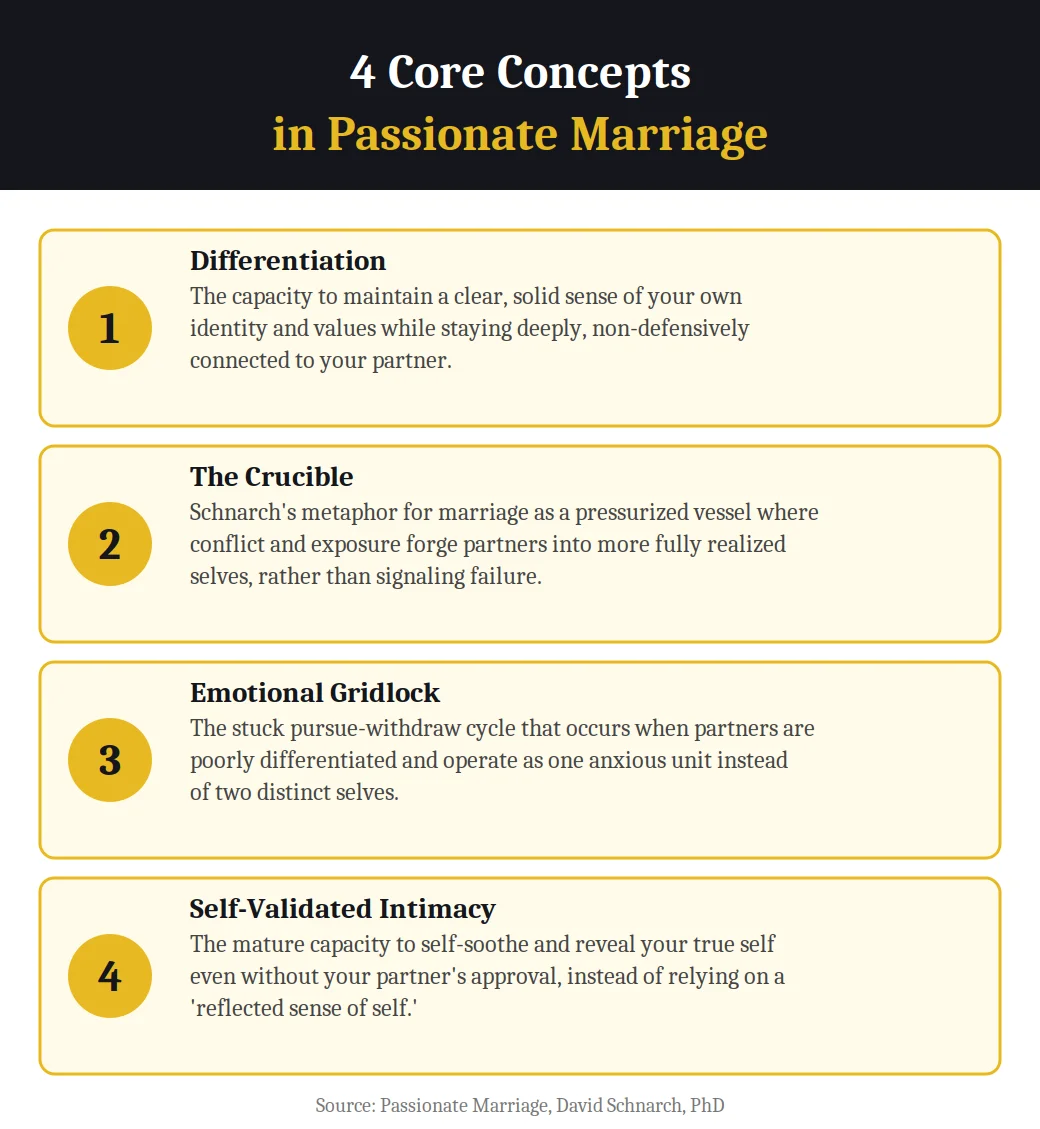
| Differentiation | The capacity to maintain a clear, solid sense of your own identity and values while staying deeply, non-defensively connected to your partner. |
| The Crucible | Schnarch’s metaphor for marriage as a pressurized vessel where conflict and exposure forge partners into more fully realized selves. |
| Emotional Gridlock | The stuck pursue-withdraw cycle that occurs when partners are poorly differentiated and operate as one anxious unit. |
| Reflected Sense of Self | Depending on a partner’s approval and mirroring to feel okay about who you are, which creates anxiety and conflict avoidance. |
| Self-Validated Intimacy | The mature capacity to self-soothe and reveal your true self even without your partner’s approval in the moment. |
Part 1: Differentiation as the engine of intimacy
Schnarch opens by dismantling the idea that couples need to be “compatible” or skilled communicators to have a passionate, intimate marriage. Instead, he argues that intimacy and desire are functions of differentiation — the capacity to stay a distinct, solid self while remaining emotionally close to your partner. Poorly differentiated people either fuse with their partner, losing their own identity to keep the peace, or achieve a false sense of independence through emotional distance. Highly differentiated people, by contrast, can tolerate closeness and difference simultaneously without becoming anxious or needing to control the other person — a capacity Schnarch treats as the real prerequisite for lasting passion, not romantic chemistry or shared interests.
TGR Note: This idea that mature intimacy requires tolerating a partner’s disapproval without collapsing echoes David Schnarch’s contemporaries in attachment-based relationship work, and connects directly to Harriet Lerner’s concept of the “I position” in The Dance of Anger — holding your own position calmly under pressure rather than either capitulating or attacking.
Part 2: Emotional gridlock and the crucible of conflict
When couples are poorly differentiated, Schnarch argues they fall into “emotional gridlock” — a stuck pursue-withdraw cycle where both partners operate as a single anxious unit rather than two distinct selves. Rather than treating this conflict as something to eliminate, Schnarch’s Crucible model treats it as the mechanism of growth: the pressure of an unresolved conflict, sustained rather than smoothed over, is what eventually forces both partners to reorganize into more mature, differentiated versions of themselves. This directly inverts conventional marriage counseling’s goal of minimizing conflict — for Schnarch, a marriage without friction is often a marriage without real intimacy, because the couple has negotiated away anything that might expose who they really are.
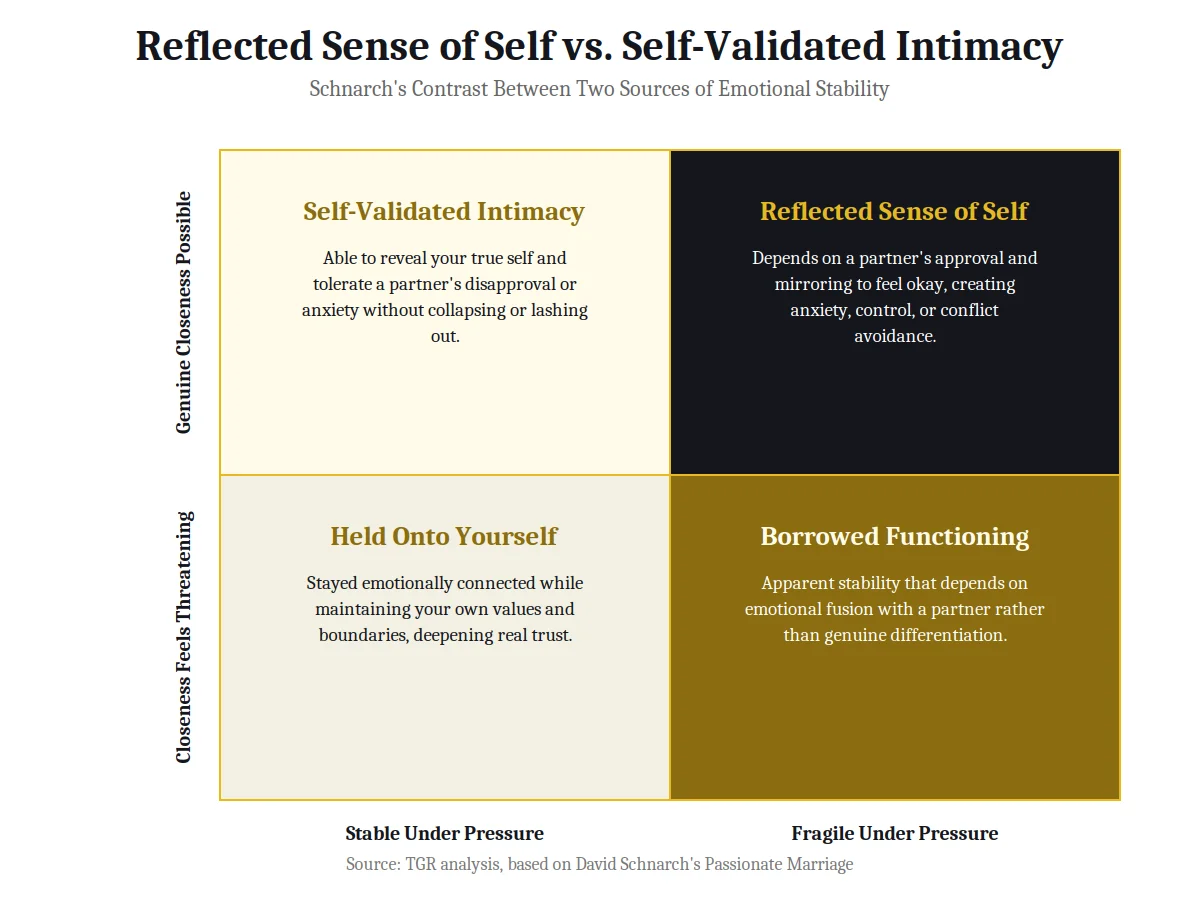
TGR Note: This contrast between borrowed stability and genuine self-possession parallels a theme in Alain de Botton’s The Course of Love, which argues that mature love requires accepting a partner’s flaws rather than depending on constant validation from them.
Part 3: Why this differs from standard therapy
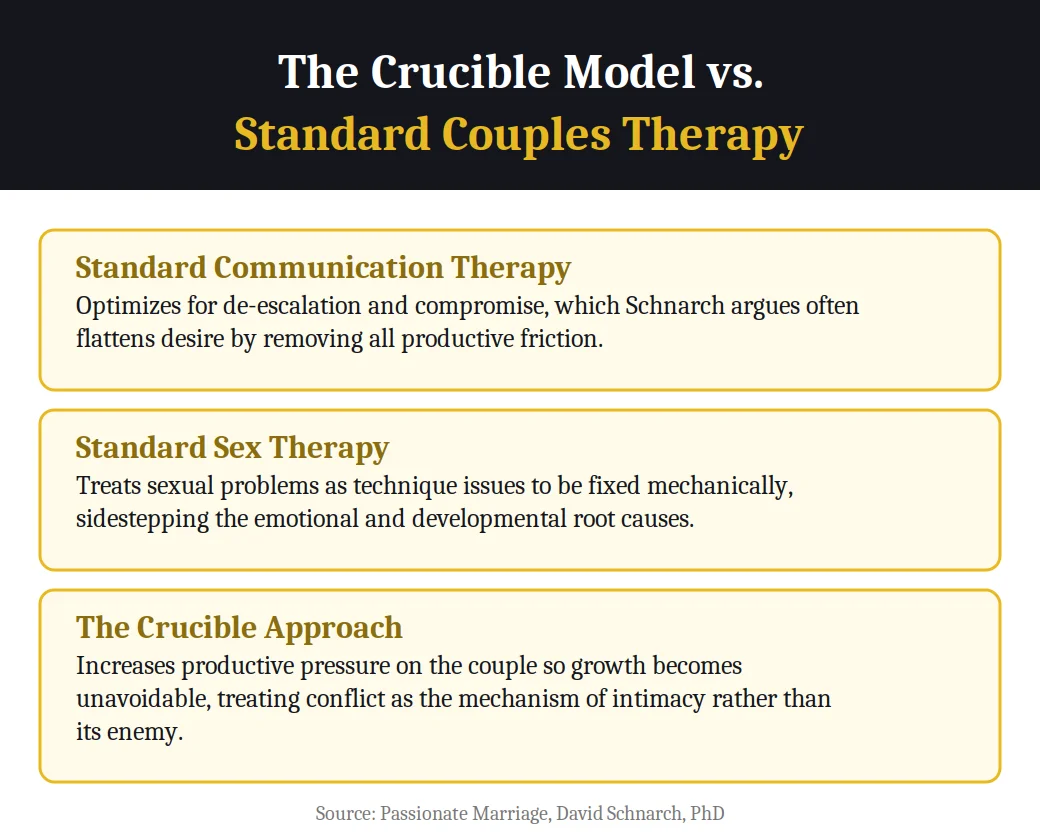
Schnarch was explicit that Passionate Marriage was written against the dominant couples-therapy paradigm of communication skills and against mechanical, technique-based sex therapy. He argued that teaching couples to negotiate and compromise more smoothly often flattens their desire along with their conflict, because it treats symptoms rather than the underlying lack of differentiation. Standard sex therapy, in his view, treats sexual problems as technical issues to be fixed with exercises, sidestepping the emotional and developmental root causes entirely. The Crucible approach instead increases productive pressure on the couple so that growth becomes unavoidable — the therapist’s job is to hold the heat, not smooth it away.
Who is Passionate Marriage best for?
This book is best for readers in a long-term relationship who feel their sexual and emotional connection has flattened despite good communication, and who are open to a denser, more psychologically demanding read than typical relationship self-help. It rewards readers willing to sit with Schnarch’s somewhat academic prose and case-study format in exchange for a genuinely different model of what drives lasting passion.
It pairs well with our The Course of Love summary for readers interested in philosophical and psychological models of mature love, or with our The Dance of Anger summary for readers specifically working through conflict patterns in a relationship.
Questions to reflect on
- Do you maintain a solid sense of your own identity in your relationship, or do you find yourself fusing with your partner’s moods and opinions?
- Is there a recurring pursue-withdraw pattern in your relationship that never quite resolves?
- Do you need your partner’s approval to feel okay about a decision, or can you hold your own position calmly even when they disagree?
- Has smoothing over every conflict in your relationship come at the cost of passion or honesty?
- What would it look like to stay emotionally connected to your partner while disagreeing with them without becoming anxious or defensive?
How to apply Passionate Marriage (7-day plan)
- Day 1: Notice one moment where you changed your opinion or behavior just to avoid your partner’s disapproval, rather than because you actually agreed.
- Day 2: Identify a recurring pursue-withdraw pattern in your relationship — who typically pursues, who typically withdraws, and what triggers it.
- Day 3: Practice holding a mild disagreement calmly without either capitulating or escalating.
- Day 4: Reveal one honest thought or feeling to your partner that you’ve been softening or withholding to keep the peace.
- Day 5: Notice a moment of your partner’s anxiety or disapproval and practice tolerating it without trying to immediately fix or soothe it.
- Day 6: Reflect on whether a recent conflict was fully resolved or just avoided — and if avoided, consider reopening it directly.
- Day 7: Identify one area where you depend on your partner’s validation to feel secure, and practice self-validating instead.
Frequently asked questions
What is differentiation in Passionate Marriage?
Differentiation is the capacity to maintain a clear, solid sense of your own identity and values while staying deeply, non-defensively connected to your partner — as opposed to fusing with them or achieving false independence through distance.
What does David Schnarch mean by “the Crucible”?
The Crucible is Schnarch’s metaphor for marriage as a pressurized vessel where conflict, exposure, and vulnerability forge partners into more fully realized selves, rather than signaling that the relationship has failed.
What is emotional gridlock?
Emotional gridlock is the stuck, repetitive pursue-withdraw cycle that occurs when partners are poorly differentiated and operate as one anxious unit rather than two distinct selves.
How does Passionate Marriage differ from standard couples therapy?
Schnarch argues standard communication-skills therapy optimizes for de-escalation and compromise, which can flatten desire, while his Crucible approach treats conflict as the mechanism of growth and intimacy rather than something to eliminate.
Is Passionate Marriage focused on sex or on emotional intimacy?
Both — Schnarch’s core argument is that sexual desire and emotional intimacy are directly linked, and that how couples behave in bed is an authentic expression of their broader emotional connection or lack of it.
Is Passionate Marriage a difficult read?
Many reviewers describe the prose as dense and academic compared to typical relationship self-help, with detailed case narratives rather than simple step-by-step exercises, though readers who stick with it often describe genuine “aha moment” insights.
What edition of Passionate Marriage is most commonly available today?
The 2009 W.W. Norton paperback reissue, subtitled “Keeping Love and Intimacy Alive in Committed Relationships,” with a new preface, is the most commonly sold edition today.
Related summaries
If you found Passionate Marriage valuable, read our The Course of Love summary for a philosophical take on mature love, or explore our full list of best relationship books.
Our methodology: TGR book summaries are researched using the original text, publisher materials, author interviews, and critical reception, then structured to give you the core arguments, practical applications, and an honest verdict on who the book is best for.