

★★★★☆ 4.2/5
One-liner: The language leaders use shapes the culture they build — and most leaders are using Industrial Age language in a knowledge-work world.
Best for: Managers and leaders who want to create psychologically safe teams, invite genuine dissent, and shift from command-and-control to collaborative decision-making.
Reading time: ~6 hours (304 pages)
Difficulty to apply: Moderate — requires changing deeply ingrained speech patterns and leadership habits.
Leadership Is Language in One Minute
The words you use as a leader are not decoration — they are the operating system of your team. L. David Marquet, the former submarine commander who wrote Turn the Ship Around, returns with a deeper insight: the language patterns leaders use either invite thinking or shut it down. He introduces two modes of operating — bluework (thinking, deciding, collaborating) and redwork (doing, executing, following the plan) — and argues that most leaders are stuck in redwork language even when the situation demands bluework. The book provides six “new plays” — specific language shifts that replace telling with asking, compliance with commitment, and certainty with curiosity. Marquet grounds each play in real-world examples, including the tragic sinking of the El Faro cargo ship, where Industrial Age leadership language directly contributed to disaster.
Key Takeaways
- Language shapes culture: The specific words leaders use — not just their intentions — determine whether teams think critically or follow blindly.
- Two modes exist — bluework and redwork: Bluework is for thinking and deciding; redwork is for executing. Leaders must know which mode to be in and signal the transition clearly.
- Control the clock, do not obey it: Pausing execution to think — even under time pressure — produces better outcomes than plowing ahead on autopilot.
- Invite dissent before deciding: Asking “what am I missing?” or “rate your confidence 1 to 5” produces better information than asking “any questions?” which invites silence.
- Replace compliance with commitment: Forced compliance creates fragile execution; genuine commitment creates resilient teams that adapt when plans change.
- Vote first, discuss second: Having people share their views independently before group discussion prevents anchoring and produces more diverse thinking.
- Celebrate completion, then learn: When work is done, shift deliberately into learning mode rather than immediately starting the next task.
- Connect daily work to purpose: People execute better when they understand why the work matters, not just what needs to be done.
- Gradient scales beat binary questions: Asking “how confident are you, one to five?” reveals information that “do you agree?” never will.
- Curiosity is a leadership strategy: Approaching decisions with genuine curiosity rather than predetermined conclusions produces better outcomes and more engaged teams.
What Is Leadership Is Language About?
Leadership Is Language reveals how the specific words leaders use shape team culture and decision quality. Marquet introduces bluework/redwork modes and six language plays that replace Industrial Age command-and-control patterns with collaborative, thinking-first leadership suited to knowledge work.
About the Author
L. David Marquet is a retired United States Navy captain who commanded the nuclear-powered submarine USS Santa Fe. His first book, Turn the Ship Around, documented how he transformed the worst-performing submarine crew in the fleet into the best by replacing the traditional leader-follower model with a leader-leader approach. That experience taught him that the words leaders use are not just communication tools — they are the mechanism through which culture is transmitted. Leadership Is Language extends that insight from submarines to organizations of all kinds. Marquet now works as a leadership consultant and speaker, helping organizations worldwide redesign their leadership language. Explore all L. David Marquet book summaries →
Key Concepts at a Glance
| Concept | What It Means | Use It When |
|---|---|---|
| Bluework | Thinking mode — pausing, exploring, deciding collaboratively | You need to make a decision, evaluate progress, or change direction |
| Redwork | Doing mode — executing, following the plan, reducing variability | The decision is made and the team needs to execute efficiently |
| Control the Clock | Deliberately pausing execution to think | You feel time pressure pushing you to act before thinking |
| Collaborate | Inviting genuine dissent and diverse perspectives before deciding | You are about to make a decision and want better information |
| Commit | Creating authentic buy-in rather than forced compliance | You need your team to own the decision, not just follow orders |
| Complete | Deliberately shifting from doing to learning after finishing work | A project or phase is done and you want to capture lessons |
Part 1: The Problem with Industrial Age Language
Marquet opens with the story of the El Faro, a cargo ship that sailed directly into Hurricane Joaquin in 2015, killing all thirty-three crew members. The investigation revealed that crew members had information suggesting the ship should change course, but the captain’s language patterns — certainty, dismissiveness, and command-and-control framing — effectively silenced them. The crew complied rather than challenged, and everyone died.
This tragedy illustrates Marquet’s core argument: the language of Industrial Age leadership — designed for factory workers doing repetitive manual labor — is catastrophically wrong for knowledge work where the leader does not have all the information. In the Industrial Age, the boss knew the best way to do the work and the workers’ job was to comply. In knowledge work, the people closest to the work often have the most relevant information, and the leader’s job is to create conditions where that information surfaces.
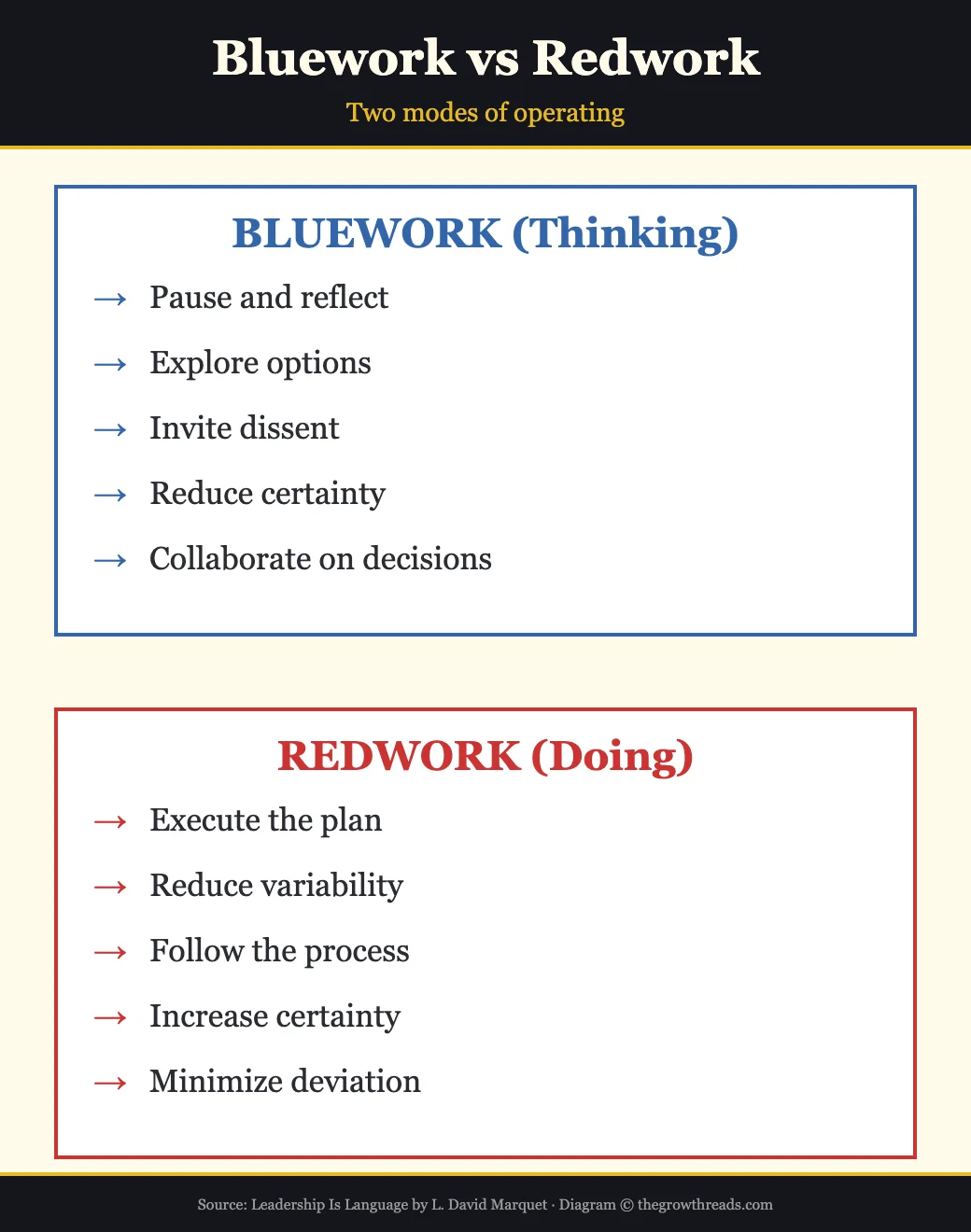
The fundamental distinction is between bluework and redwork. Redwork is execution — doing the plan, reducing variability, following the process. Bluework is thinking — pausing, exploring options, evaluating progress, and making decisions. Both are essential, but most leaders default to redwork language even during moments that require bluework. They say “let’s push through” when they should say “let’s pause and think.”
Part 2: The Six New Plays
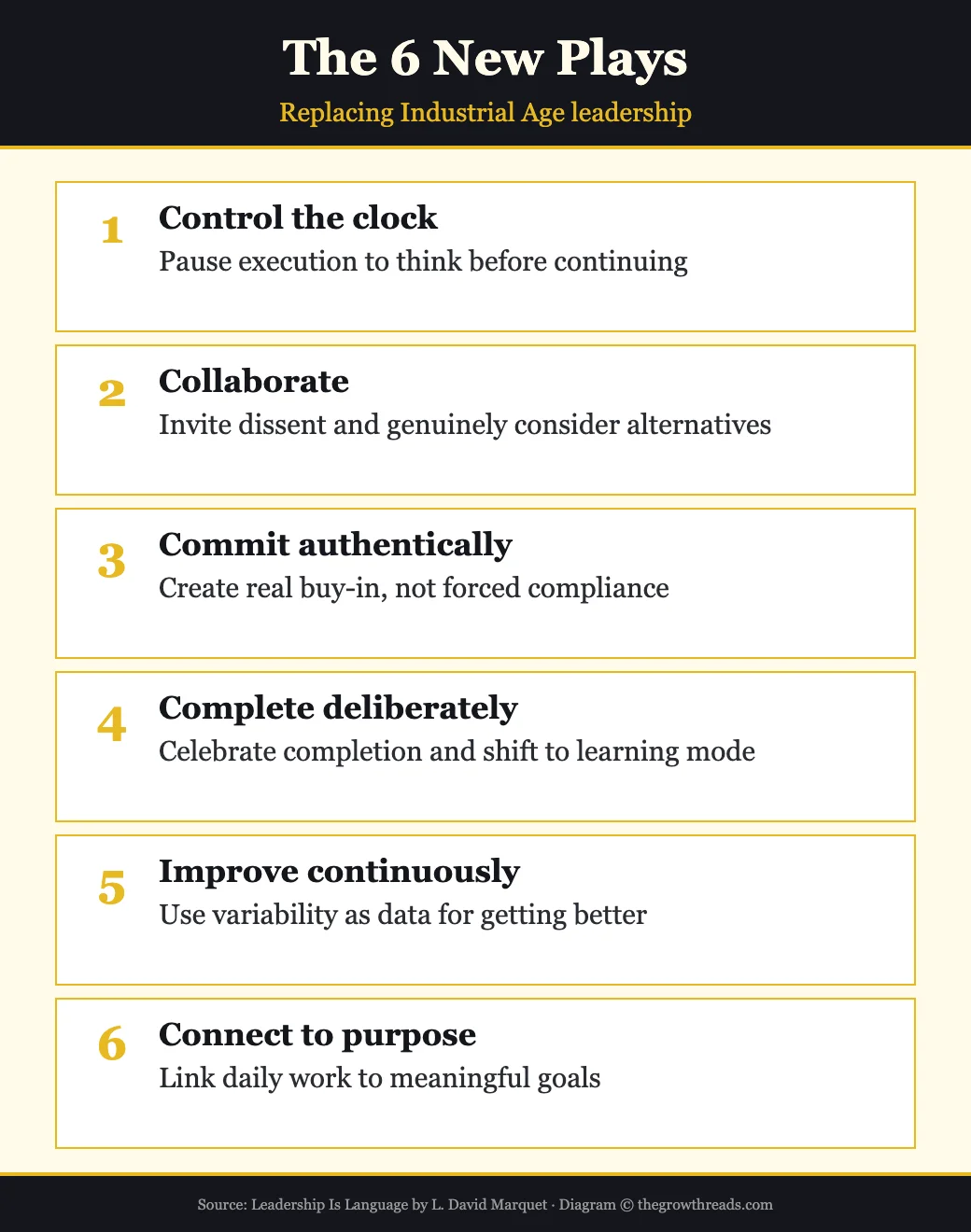
Marquet organizes his solution around six plays — specific language and behavioral shifts that replace Industrial Age patterns. Play one, Control the Clock, means deliberately pausing execution to think. When pressure mounts and the instinct is to push harder, the leader says “let’s stop and take five minutes to think about whether we’re solving the right problem.” This simple pause has saved ships, surgeries, and business decisions because it creates space for bluework when the default is redwork.
Play two, Collaborate, means genuinely inviting dissent before making a decision. The key technique is voting first and discussing second — having each person write their view independently before anyone speaks aloud. This prevents the anchoring effect where the first speaker (usually the most senior person) influences everyone else. Gradient scales also help: instead of asking “do you agree?” (which invites a binary yes), ask “rate your confidence from one to five” (which reveals the degree of uncertainty).
Play three, Commit, replaces compliance with genuine buy-in. When people feel they were heard and their concerns were addressed, they commit to the decision even if it was not their first choice. When they feel steamrolled, they comply superficially but undermine the plan passively.
Plays four through six — Complete, Improve, Connect — address the learning and purpose dimensions. Complete means deliberately shifting from doing mode to learning mode when work finishes. Improve means treating variability as information rather than error. Connect means linking every task to its larger purpose, because people execute with more energy and creativity when they understand why the work matters.
Part 3: Changing Your Language
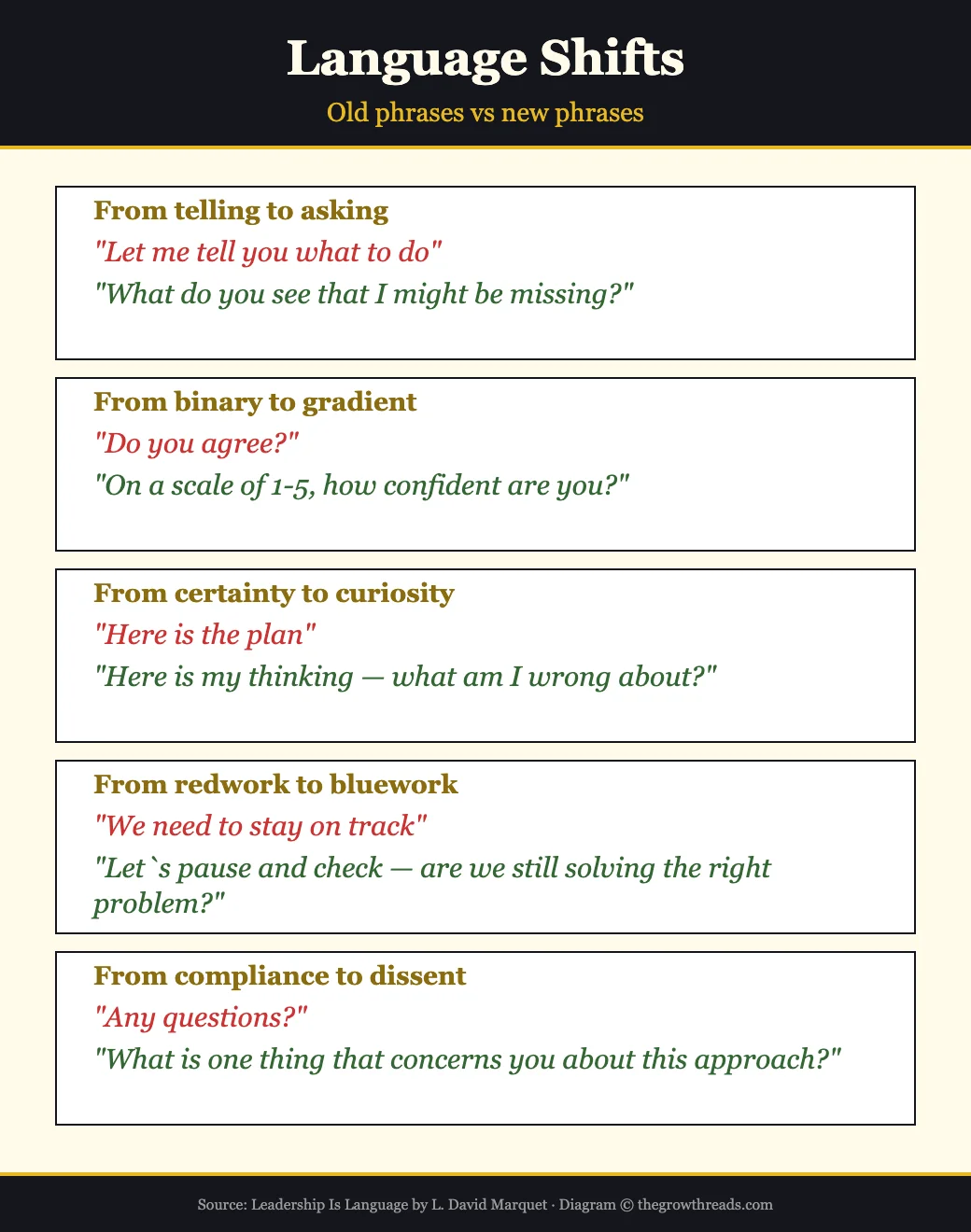
The final section provides practical guidance for implementing the language shifts. Marquet acknowledges that changing speech patterns is hard — the Industrial Age language of certainty, telling, and compliance is deeply ingrained in most leaders. He recommends starting small: pick one meeting this week and replace “here’s what we’re going to do” with “here’s my thinking — what am I wrong about?” Notice what happens when you ask “how confident are you, one to five?” instead of “any objections?”
The language shifts are deliberately concrete. Instead of “let me tell you what to do,” try “what do you see that I might be missing?” Instead of “we need to stay on track,” try “let’s pause and check whether we’re still solving the right problem.” Instead of “any questions?” try “what is one thing that concerns you about this approach?” Each shift moves from redwork language (telling, certainty, compliance) to bluework language (asking, curiosity, commitment).
Marquet emphasizes that these are not soft or weak leadership moves — they are strategically superior ones. In knowledge work, the leader who asks the best questions outperforms the leader who gives the best orders, because the asker accesses information the teller never sees.
Who Is Leadership Is Language Best For — and Who Should Read Something Else First?
This book is ideal for managers and leaders who want specific, actionable tools for creating psychologically safe teams and making better decisions. It works well for anyone who has already read about psychological safety or servant leadership conceptually but wants the concrete language to implement it.
If you have not read Turn the Ship Around, Marquet’s first book provides the foundational story that this book builds on. If you want a broader view of team culture, The Culture Code covers more ground across different types of organizations.
Questions to Reflect On
- In your last team meeting, were you in bluework mode (thinking) or redwork mode (doing) — and was that the right mode for the situation?
- When was the last time someone on your team genuinely disagreed with you in a meeting?
- Do you typically vote first and discuss second, or let the most senior person speak first?
- What language pattern do you use most often — telling or asking?
- If you paused your current project for ten minutes of pure thinking, what question would you ask?
🔥 Ready to Transform Your Leadership Language?
Discover the six language plays that turn command-and-control leadership into collaborative, thinking-first teams.
How to Apply Leadership Is Language (7-Day Plan)
- Day 1 — Audit your language: In every meeting today, notice whether you are telling or asking. Keep a tally of each. No changes yet — just awareness.
- Day 2 — Control the clock once: At any point today when you feel time pressure pushing you to act, pause for five minutes and ask your team: are we solving the right problem?
- Day 3 — Use gradient voting: In your next decision, ask everyone to rate their confidence from one to five before any discussion. Note what the numbers reveal.
- Day 4 — Replace one tell with an ask: Instead of announcing a decision, share your thinking and ask: what am I wrong about? Listen without defending.
- Day 5 — Seek dissent deliberately: Ask each team member privately: what is one thing you think we should be doing differently? Thank them for their honesty regardless of the answer.
- Day 6 — Complete deliberately: When any task finishes today, pause for three minutes of reflection before starting the next thing. Ask: what did we learn?
- Day 7 — Connect to purpose: For your team’s top three tasks, write one sentence explaining why each matters. Share these connections in your next meeting.
Frequently Asked Questions
What is the difference between bluework and redwork?
Bluework is thinking mode — pausing, exploring options, evaluating, deciding collaboratively. Redwork is doing mode — executing the plan, following the process, reducing variability. Both are necessary, but leaders need to know which mode the situation requires and signal transitions clearly. The most dangerous pattern is using redwork language during moments that require bluework — pushing ahead when the team should be thinking.
What are the six plays in Leadership Is Language?
Control the clock (pause to think), collaborate (invite dissent before deciding), commit (create genuine buy-in rather than compliance), complete (shift to learning mode after finishing work), improve (treat variability as data), and connect (link daily work to purpose). Each play replaces an Industrial Age language pattern with a knowledge-work alternative designed to access better information and produce better decisions.
How does this book connect to Turn the Ship Around?
Turn the Ship Around told the story of how Marquet transformed a submarine crew by replacing the leader-follower model with a leader-leader approach. Leadership Is Language goes deeper into the mechanism: it identifies the specific language patterns that create either a leader-follower or leader-leader dynamic. It is the “how” behind the “what” of Turn the Ship Around — the practical toolkit for implementing the philosophy.
What is the El Faro story?
The El Faro was a cargo ship that sailed into Hurricane Joaquin in 2015, killing all thirty-three crew members. The investigation revealed that crew members had information suggesting the ship should change course, but the captain’s command-and-control language patterns silenced them. Marquet uses this tragedy throughout the book to show how Industrial Age leadership language — certainty, dismissiveness, compliance — can have fatal consequences.
Why is voting before discussing important?
When people share their views independently before group discussion, you get genuinely diverse perspectives. When the most senior person speaks first, anchoring bias causes everyone else’s views to shift toward that initial position. Voting first — using numbers or written responses — captures what each person actually thinks before social pressure distorts it. This simple procedural change dramatically improves the quality of group decisions.
Is this book just for military leaders?
No. While Marquet draws on his military experience, the language patterns he identifies are universal. They appear in corporate boardrooms, hospital operating rooms, startup teams, and school leadership. Any environment where decisions are made under uncertainty — which is virtually every knowledge-work environment — benefits from the shift from telling to asking, from compliance to commitment, and from certainty to curiosity.
How quickly can you change your leadership language?
Individual phrases can be changed immediately — you can ask “what am I wrong about?” in your next meeting. But deeply ingrained patterns take weeks or months to shift permanently. Marquet recommends starting with one play per week and practicing it deliberately. The key insight is that language change is behavioral change — it requires the same intentional practice as building any new habit. Most leaders report noticeable differences in team dynamics within two to three weeks of consistent practice.
Related Summaries
- Turn the Ship Around by L. David Marquet — the foundational story behind this leadership philosophy.
- The Culture Code by Daniel Coyle — how great teams build psychological safety.
- Noise by Daniel Kahneman — why independent thinking produces better decisions than groupthink.
- Best Leadership Books — our complete guide to leading effectively.