

★★★★☆ 4.2/5
One-liner: The hidden flaw in human judgment is not just bias — it is noise, the random variability that makes the same case produce wildly different decisions.
Best for: Managers, leaders, and anyone who makes or oversees consequential decisions — hiring, pricing, sentencing, diagnosing — and wants to understand why those judgments are far less consistent than they assume.
Reading time: ~8 hours (464 pages)
Difficulty to apply: Moderate — the concepts are clear but implementing decision hygiene requires organizational change.
Noise in One Minute
Two judges look at the same case and give sentences that differ by years — not because of bias, but because of noise. Daniel Kahneman, Olivier Sibony, and Cass Sunstein reveal that wherever there is human judgment, there is noise — unwanted variability that is costly, pervasive, and largely invisible. While bias gets all the attention, noise often causes as much or more error. The authors introduce “decision hygiene” — a set of practical strategies including structured guidelines, independent assessments, and noise audits — to make judgments more consistent without eliminating human discretion. The book challenges every reader to question how much of the variation in their own decisions is signal and how much is just noise.
Key Takeaways
- Noise is unwanted variability in judgments: When different professionals reach very different conclusions about the same case, the spread is noise — and it is far more common than most organizations realize.
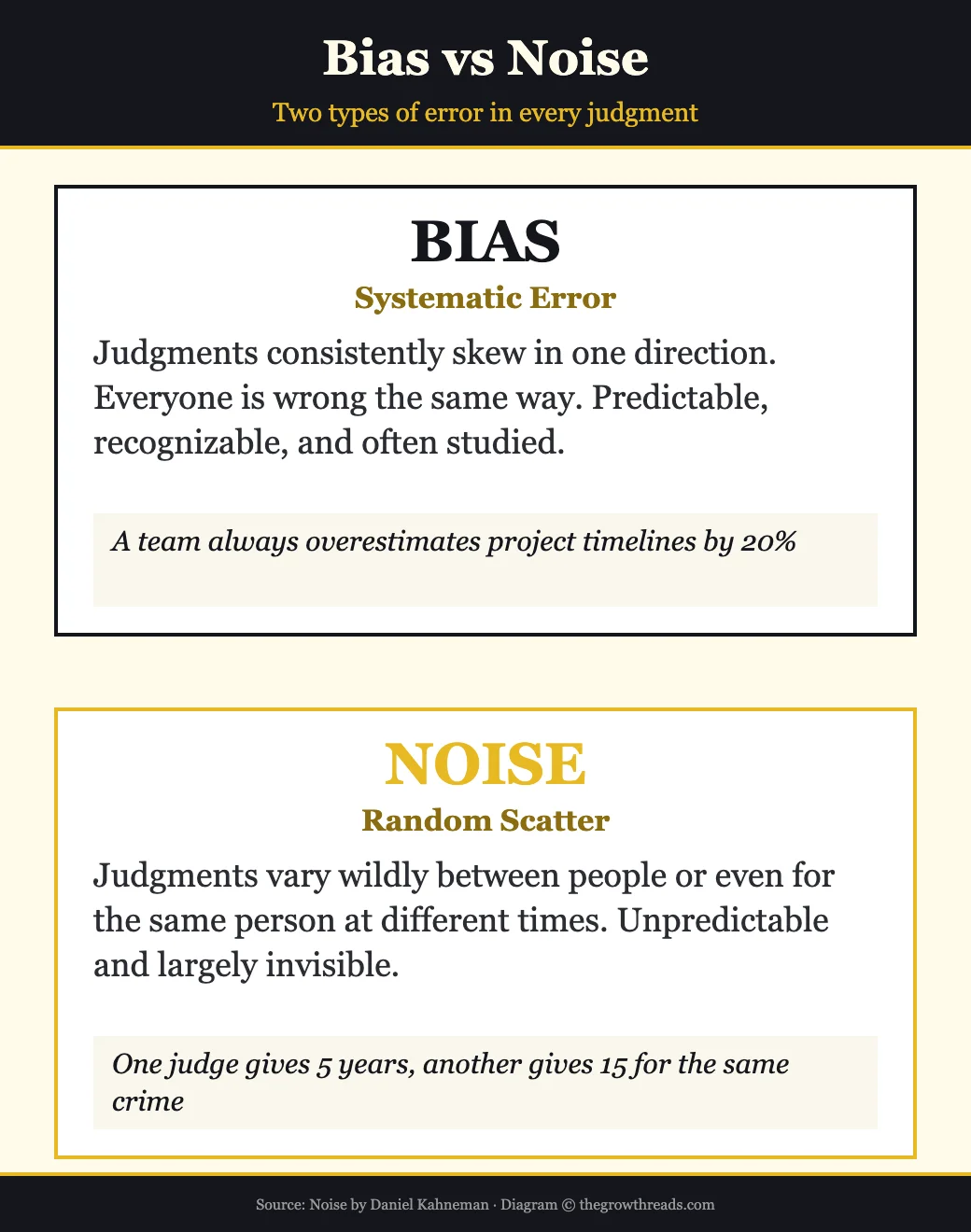
- Bias and noise are equally damaging: Bias pushes judgments consistently in one direction; noise scatters them randomly. Both degrade decision quality, but noise is typically harder to detect because it averages out in aggregate data.
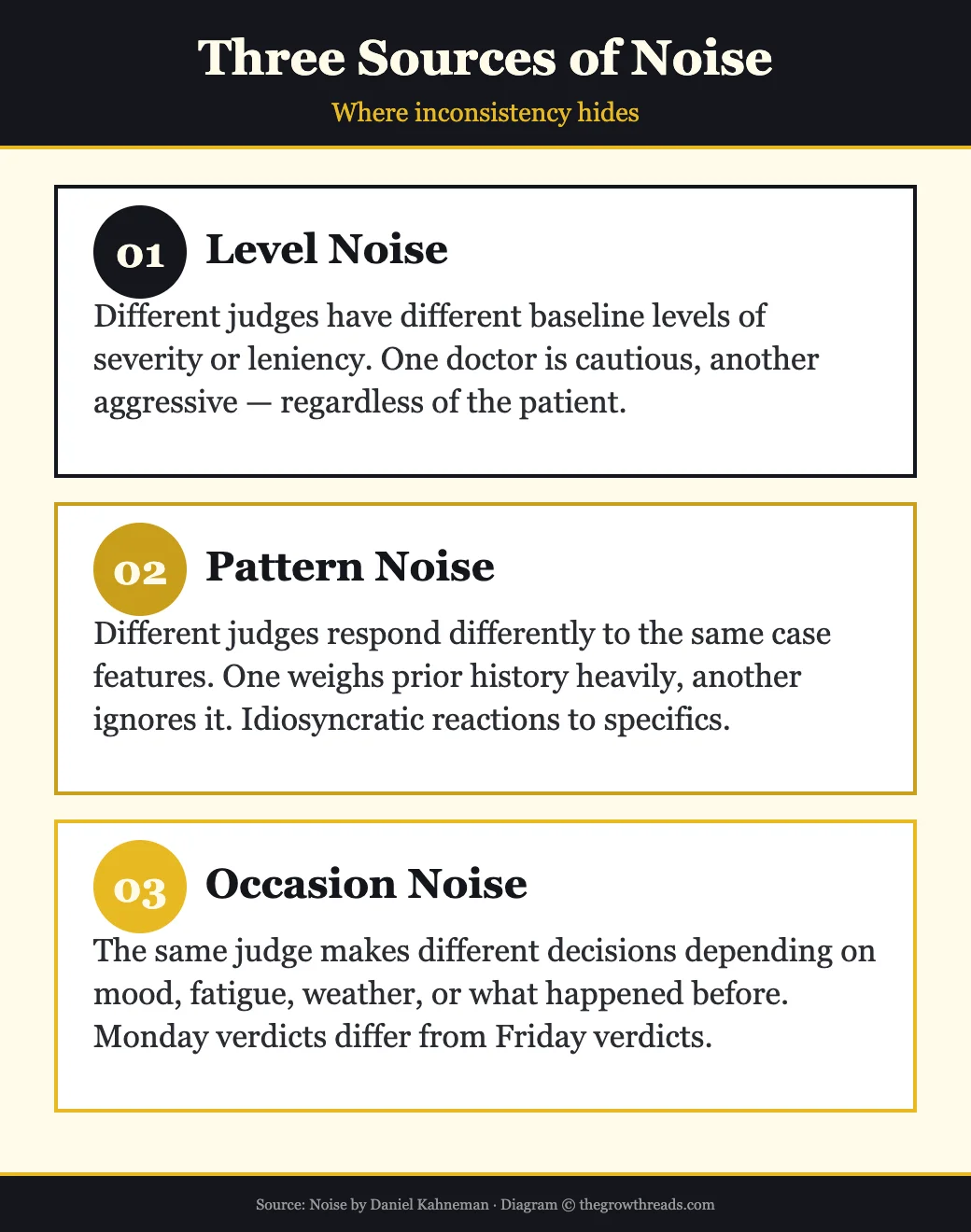
- Three types of noise exist: Level noise (judges differ in overall severity), pattern noise (judges respond differently to case features), and occasion noise (the same judge decides differently depending on mood or context).
- Noise audits reveal hidden problems: Most organizations have never measured the variability in their decisions. A simple noise audit — having multiple people evaluate the same cases independently — exposes shocking inconsistencies.
- System 1 thinking amplifies noise: Fast, intuitive judgments are more susceptible to noise because they rely on whatever information happens to be salient at the moment.
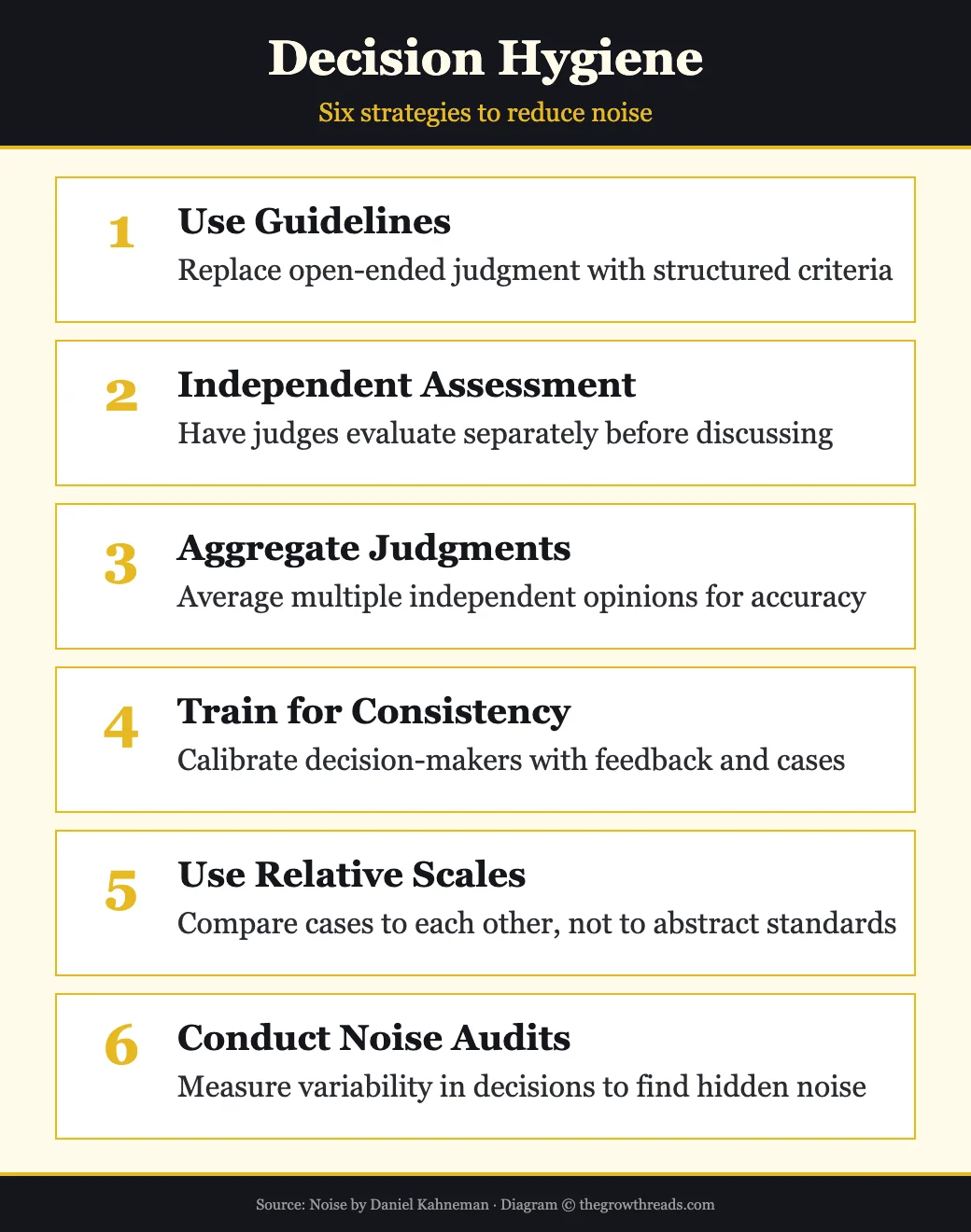
- Decision hygiene reduces noise systematically: Structured guidelines, independent evaluations, aggregated judgments, and calibration training can dramatically reduce variability without eliminating human expertise.
- Algorithms often outperform experts: Simple rules and statistical models are not just cheaper than expert judgment — they are frequently more accurate because they are noise-free.
- Professional consensus is often illusory: Experts in medicine, law, insurance, and hiring believe they would agree with peers far more than they actually do.
- Occasion noise is personal bias in disguise: Your decisions on Monday morning after good sleep differ meaningfully from your decisions on Friday afternoon when tired — and you rarely notice.
- Reducing noise is not the same as eliminating judgment: The goal is to keep human expertise while removing the random variability that degrades it.
What Is Noise About?
Noise exposes the hidden problem of unwanted variability in human judgment — the fact that doctors, judges, hiring managers, and other professionals often reach vastly different conclusions about identical cases. The book introduces practical “decision hygiene” strategies to reduce this inconsistency without replacing human judgment with rigid rules.
About the Author
Daniel Kahneman is a Nobel Prize-winning psychologist and professor emeritus at Princeton University, widely regarded as one of the most influential thinkers on human judgment and decision-making. His earlier work with Amos Tversky on cognitive biases and heuristics launched the field of behavioral economics. Olivier Sibony is a professor at HEC Paris and former senior partner at McKinsey, specializing in strategic decision-making. Cass Sunstein is a Harvard Law professor and former administrator of the White House Office of Information and Regulatory Affairs. Together, their combined expertise spans psychology, management consulting, and public policy. Explore all Daniel Kahneman book summaries →
Key Concepts at a Glance
| Concept | What It Means | Use It When |
|---|---|---|
| Noise | Unwanted variability in judgments that should be identical | You suspect inconsistency in your team or organization’s decisions |
| Bias | Systematic error that pushes judgments in one direction | Decisions consistently skew toward one outcome regardless of the case |
| Level Noise | Judges differ in average severity or leniency | You notice some team members are consistently harsher or more lenient than others |
| Pattern Noise | Judges respond differently to the same case features | People weigh the same information very differently |
| Occasion Noise | The same person decides differently at different times | You want to understand why your own decisions feel inconsistent |
| Decision Hygiene | Structured practices that reduce noise without removing judgment | You want practical strategies to improve organizational decision quality |
| Noise Audit | An exercise where multiple people evaluate the same cases independently | You want to measure how much noise exists in your decisions |
Part 1: Understanding Noise
Kahneman and his co-authors open with a thought experiment: imagine a large insurance company asks its underwriters to set premiums for the same cases. Management expects maybe a ten percent spread in their estimates. The actual median spread is fifty-five percent — one underwriter might charge a client thousands of dollars more than a colleague sitting in the next office. This is noise, and it is costing the company millions.
The distinction between bias and noise is central to the book. If you imagine a target, bias is the pattern where all shots cluster away from the bullseye in the same direction — everyone is wrong, but wrong together. Noise is the pattern where shots are scattered all over the target — some hit, some miss, but there is no consistency. Both patterns produce the same overall error, but bias is visible in aggregated data while noise hides because it averages out. This invisibility is what makes noise so dangerous.
The authors document noise in criminal sentencing (where identical cases produce sentences ranging from probation to twenty years), medical diagnosis (where pathologists disagree with their own earlier diagnoses thirty percent of the time), child custody evaluations, asylum decisions, and personnel evaluations. The pattern is universal: wherever there is professional judgment, there is far more variability than anyone expects or acknowledges.
Part 2: The Three Types of Noise
The book identifies three distinct sources of noise. Level noise is the simplest: different judges have different baselines. One manager gives higher performance ratings across the board; another is consistently tougher. This creates systematic differences between evaluators that have nothing to do with the people being evaluated.
Pattern noise is more subtle and more damaging. Two judges might have the same average severity, but they respond to case features very differently. One immigration judge might be sympathetic to asylum seekers from certain regions while harsh on others; a colleague shows the opposite pattern. Pattern noise is harder to detect because it does not show up as a simple average difference — it hides in the interactions between judges and case characteristics.
Occasion noise is the most personal and unsettling type. It is the variation within a single person’s judgments over time. Research shows that judges are more lenient after lunch than before. Doctors order different tests on Monday mornings than Friday afternoons. Your own decisions are influenced by the weather, the previous case you reviewed, whether your team won last night, and a hundred other factors you would consider irrelevant if you noticed them. Occasion noise makes a mockery of the idea that you are a consistent decision-maker.
Part 3: Decision Hygiene and Solutions
The authors propose “decision hygiene” — a set of structural practices designed to reduce noise without eliminating human judgment. The analogy is to physical hygiene: you wash your hands not because you know which specific germs are present but because the practice reduces infection across the board. Similarly, decision hygiene works by reducing variability systematically, even when you cannot identify the specific source of noise in a given case.
Six key strategies form the decision hygiene toolkit. First, use structured guidelines and scales rather than open-ended judgment. Second, have evaluators make independent assessments before discussing their views — early anchoring by a dominant voice introduces noise. Third, aggregate multiple independent judgments, because the average of several opinions is typically more accurate than any single opinion. Fourth, train decision-makers with calibration exercises and feedback on their consistency. Fifth, use relative rather than absolute scales — comparing cases to each other is more reliable than comparing each case to an abstract standard. Sixth, conduct regular noise audits to measure the variability in your organization’s decisions and track improvement over time.
The authors also address the tension between noise reduction and the value of individual judgment. They argue that the goal is not to turn humans into algorithms but to keep what humans do well — context sensitivity, moral reasoning, nuanced understanding — while removing the random variability that degrades those strengths. In many cases, simple algorithms outperform experts not because they are smarter but because they are consistent.
Who Is Noise Best For — and Who Should Read Something Else First?
Noise is essential reading for anyone who makes or oversees consequential decisions — managers, executives, judges, doctors, recruiters, and policy makers. If your organization relies on professional judgment, this book will reveal inconsistencies you did not know existed and provide practical strategies to address them.
If you have not yet read Thinking, Fast and Slow, start there — it provides the foundation in cognitive bias that Noise builds upon. If you are more interested in personal decision-making than organizational decisions, Predictably Irrational by Dan Ariely is a lighter, more accessible entry point.
Questions to Reflect On
- If your colleagues independently evaluated the same ten cases or candidates, how much variation would you expect — and how much would you find?
- When you make an important decision, do you ever wonder whether you would reach the same conclusion tomorrow?
- Which of the three types of noise — level, pattern, or occasion — is most likely present in your professional decisions?
- Has your organization ever conducted anything resembling a noise audit?
- What is one decision your team makes repeatedly that could benefit from structured guidelines?
🔥 Ready to Make Better, More Consistent Decisions?
Discover the hidden flaw in human judgment that costs organizations billions — and the practical strategies to fix it.
How to Apply Noise (7-Day Plan)
- Day 1 — Identify a noisy decision: Pick one recurring judgment in your work — hiring, pricing, evaluating, diagnosing — and hypothesize how much noise might exist in it.
- Day 2 — Run a mini noise audit: Take five past cases and ask two colleagues to independently evaluate them. Compare their assessments to each other and to the original decisions.
- Day 3 — Analyze the variation: Calculate the spread in the assessments. Separate level noise (overall differences in severity) from pattern noise (differences in how specific cases are rated).
- Day 4 — Create a structured guideline: For one recurring decision, write a brief checklist of criteria to evaluate. Replace open-ended judgment with specific dimensions rated on a defined scale.
- Day 5 — Practice independent assessment: In your next group decision, have everyone write their evaluation privately before any discussion begins. Compare the independent assessments before debating.
- Day 6 — Check your occasion noise: Review three recent decisions you made and ask honestly whether you might have decided differently on a different day or in a different mood.
- Day 7 — Design a simple algorithm: For one repetitive decision, identify the three to five factors that matter most and create a simple scoring formula. Test it against your past intuitive decisions.
Frequently Asked Questions
What is noise in decision-making?
Noise is the unwanted variability in judgments that should be identical or similar. When two doctors give different diagnoses for the same symptoms, or two judges assign very different sentences for the same crime, the spread between their judgments is noise. It is distinct from bias, which is a consistent error in one direction. Noise is random scatter — different people reach different conclusions, and even the same person may decide differently on different occasions, without any systematic pattern.
How is Noise different from Thinking, Fast and Slow?
Thinking, Fast and Slow focuses on cognitive biases — systematic, predictable errors in judgment caused by mental shortcuts. Noise focuses on the variability in judgments that is random and unpredictable. Bias makes everyone wrong in the same direction; noise makes everyone wrong in different directions. The books are complementary: together they provide a complete framework for understanding why human judgment fails and how to improve it.
What is a noise audit?
A noise audit is a simple exercise where multiple people independently evaluate the same set of cases. By comparing their assessments, you can measure how much variability exists in your organization’s judgments. Most leaders dramatically underestimate this variability. The authors describe insurance companies that expected ten percent variation and found fifty-five percent. A noise audit makes the invisible problem visible and provides a baseline for measuring improvement after implementing decision hygiene strategies.
Should algorithms replace human judgment?
The authors do not argue for replacing humans with algorithms in all cases. Instead, they advocate for using algorithms and structured guidelines alongside human judgment. Simple rules often outperform experts in prediction tasks because rules are noise-free — they always apply the same weights to the same factors. But human judgment remains essential for moral reasoning, context sensitivity, and situations that fall outside the training data. The goal is to keep human strengths while removing random variability.
What is occasion noise and why does it matter?
Occasion noise is the variation in a single person’s judgments across different times and contexts. You may be more lenient after lunch, harsher when tired, more optimistic on sunny days, or more critical after a frustrating meeting. This type of noise is particularly unsettling because it undermines the belief that you are a consistent decision-maker. Research shows that occasion noise accounts for a significant portion of total noise in professional judgments, and it is almost entirely invisible to the person affected.
Is Noise relevant for personal decisions?
Yes, though the book focuses primarily on organizational and professional decisions. The same principles apply to personal choices: your judgments about people, opportunities, and risks are affected by mood, fatigue, recent experiences, and other factors you would consider irrelevant. The practical takeaway is to make important personal decisions using structured criteria rather than pure intuition, and to be wary of decisions made when you are tired, hungry, or emotionally charged.
Is Noise worth reading if it is long?
At 464 pages, Noise is a substantial read. The core ideas — the distinction between bias and noise, the three types of noise, and the six decision hygiene strategies — can be grasped relatively quickly, but the book’s depth comes from its extensive case studies and research evidence. If you make consequential professional decisions, the full read is worthwhile. If you want the essentials faster, the first two parts and the final chapter on decision hygiene provide the most actionable content in roughly half the pages.
Related Summaries
- Thinking, Fast and Slow by Daniel Kahneman — the foundational work on cognitive biases that Noise builds upon.
- Predictably Irrational by Dan Ariely — a more accessible look at how judgment goes wrong.
- Superforecasting by Philip Tetlock — how to improve prediction accuracy with structured methods.
- Best Psychology Books — our complete guide to the top books on understanding the mind.