

★★★★★ 4.6/5 — The classic, practical guide to identifying and meeting the ten needs that keep a marriage affair-proof.
Best for: Married or committed couples who want a concrete framework instead of vague advice
Reading time: ~6 hrs to read the book · ~35 min to read this guide
Difficulty to apply: Easy to start, moderate to sustain — it takes one honest conversation and a weekly habit
His Needs, Her Needs in one minute
Most marriages don’t collapse from one big betrayal — they starve, one unmet need at a time. Willard Harley’s His Needs, Her Needs argues that romantic love runs on a mental “Love Bank”: every caring act is a deposit, every thoughtless one is a withdrawal, and you only feel “in love” once the balance clears a threshold. Decades of marriage counseling led Harley to a short, specific list of the needs men and women most commonly rank highest — five for him, five for her — and a matching list of habits (“Love Busters”) that drain the account faster than kindness can refill it. The fix isn’t more effort in general; it’s targeted effort on the handful of needs your specific spouse actually has.
Key takeaways
- The Love Bank: you keep a running emotional balance for everyone you know; caring behavior deposits, hurtful or thoughtless behavior withdraws.
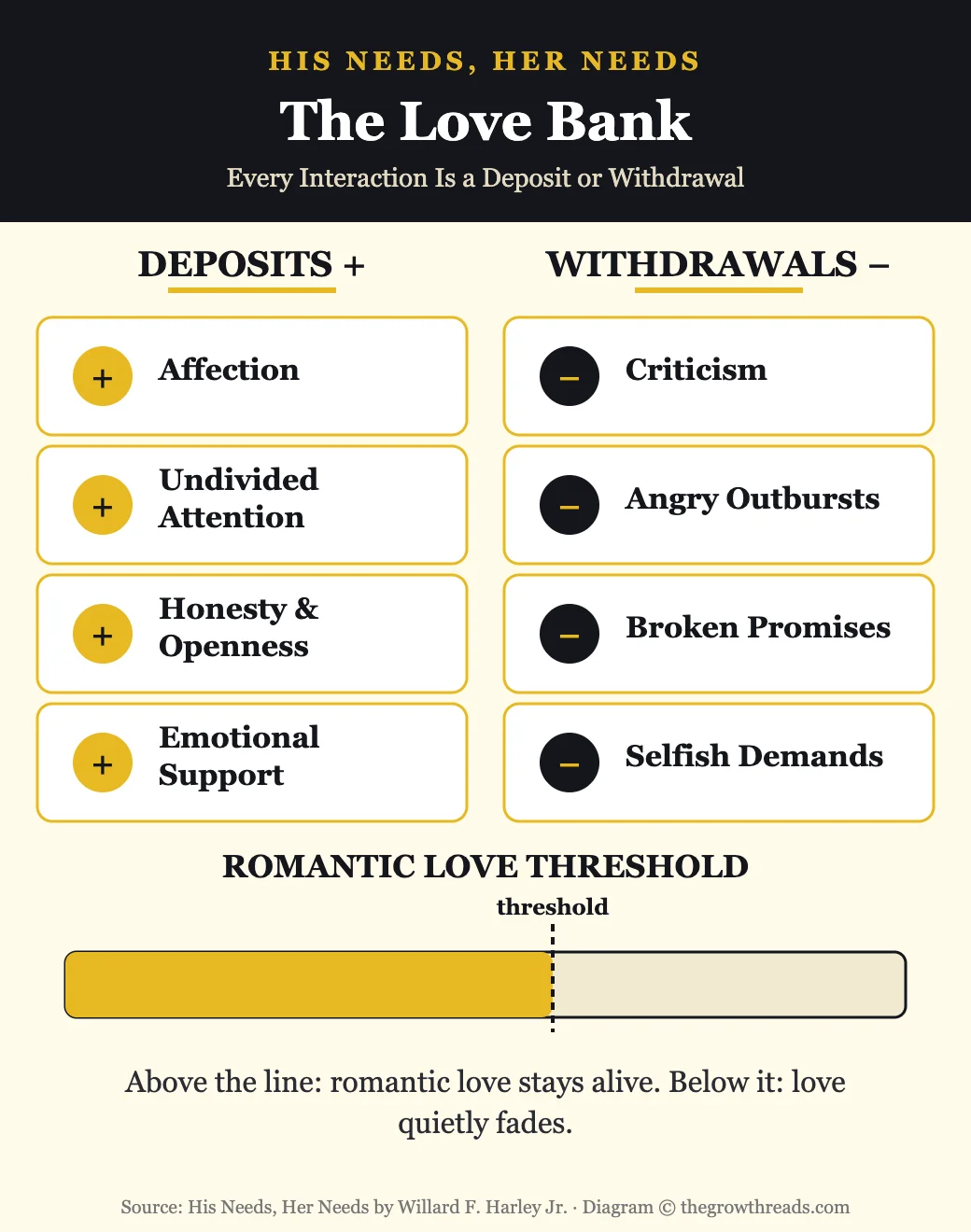
- The romantic love threshold: you feel “in love” only when a specific person’s balance stays above a certain line — drop below it and the feeling fades even if the commitment doesn’t.
- Needs are specific, not vague: “be more loving” is useless advice; “I need 15 minutes of undivided attention at dinner” is actionable.
- His most common top needs cluster around admiration, recreation, and physical attraction — not because men are shallow, but because these are what Harley’s male clients named most often.
- Her most common top needs cluster around emotional connection, honesty, and security — again, a pattern from counseling data, not a universal rule.
- Love Busters undo deposits fast: one angry outburst can erase weeks of goodwill, so eliminating negatives matters as much as adding positives.
- The Policy of Undivided Attention: Harley prescribes roughly 15 hours a week of focused, distraction-free time together as the maintenance dose for romantic love.
- The Policy of Joint Agreement: never do anything without your spouse’s enthusiastic agreement — it prevents the quiet resentment that builds from unilateral decisions.
- Affair-proofing is a byproduct, not the goal: couples who keep each other’s Love Banks full rarely look elsewhere, because the need is already being met at home.
- Your needs are a questionnaire, not a stereotype: the “his/her” lists are a starting menu — the real work is finding your specific spouse’s actual top five.
What is His Needs, Her Needs about?
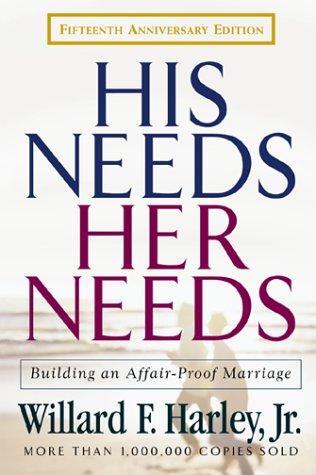
His Needs, Her Needs is Willard Harley’s marriage-counseling framework built around a “Love Bank” metaphor: spouses fall in and out of love based on emotional deposits and withdrawals. The book identifies the five needs men and women most commonly rank highest, then shows couples how to meet them deliberately while eliminating the habits — “Love Busters” — that drain the account.
About the author
Willard F. Harley Jr. earned a Ph.D. in psychology from the University of California, Santa Barbara, in 1967 and has been a licensed psychologist since 1975. He taught psychology at the graduate and undergraduate level for a decade before moving into full-time marriage counseling in 1977, once his success rate with couples climbed above 90%. Frustrated by advice that was too general to actually change behavior, he began tracking, case by case, exactly which needs went unmet in the marriages that failed and which habits reliably damaged goodwill. His Needs, Her Needs, first published in 1986, is the distillation of that casework — it has sold more than three million copies across twenty-two foreign translations and spawned a companion counseling organization, Marriage Builders, along with related titles like Love Busters and Five Steps to Romantic Love. Harley’s central credibility claim isn’t theoretical; it’s that the framework was built from what actually moved the needle in his own counseling room. Explore all Willard F. Harley book summaries →
Key concepts at a glance
| Concept | What it means | Use it when |
|---|---|---|
| Love Bank | The running emotional account each spouse keeps of the other | You want to explain why attraction rises or falls over time |
| His top 5 needs | Sexual fulfillment, recreational companionship, an attractive spouse, domestic support, admiration | A husband feels unfulfilled despite an outwardly “good” marriage |
| Her top 5 needs | Affection, conversation, honesty and openness, financial support, family commitment | A wife feels lonely despite a faithful, hardworking husband |
| Romantic love threshold | The minimum Love Bank balance required to feel “in love” | Diagnosing why the spark faded even though nothing “went wrong” |
| Love Busters | Six habits that drain the Love Bank faster than deposits can refill it | Troubleshooting one recurring, low-grade conflict |
| Policy of Undivided Attention | A target of ~15 hours a week of focused, distraction-free couple time | Rebuilding closeness after a busy or stressful season |
| Policy of Joint Agreement | Never do anything without your spouse’s enthusiastic agreement | Making decisions about money, time, or family that affect you both |
| Affair-proofing | Meeting each other’s top needs so neither partner looks elsewhere | Protecting a marriage during high-risk periods — travel, stress, a new job |
Part 1: The Love Bank and why romantic love fades
Harley opens with a reframe that does most of the book’s heavy lifting: falling out of love isn’t a character flaw or a sign the relationship was a mistake — it’s what happens when a specific person’s Love Bank balance drops below the threshold required to feel attraction. Every interaction either deposits or withdraws. A thoughtful text message, a shared laugh, or remembering something your spouse mentioned in passing — deposit. Being dismissed, criticized, or ignored — withdrawal. Because the balance is specific to each relationship, you can be a warm, likeable person in general and still be running a deficit with your own spouse.
This model matters because it turns “we fell out of love” from a mystery into a mechanism you can audit. If the balance is low, you can trace back which deposits stopped and which withdrawals started, instead of concluding the relationship itself is broken.
Harley builds the case from his own counseling files. Early in his practice, he noticed that couples rarely fought about the thing they said they were fighting about — a dish left in the sink, a canceled plan — and that the real pattern only showed up when he asked each spouse to describe, in detail, what made them feel loved versus resentful over the preceding weeks. He started keeping a running tally across cases and found the same handful of needs resurfacing again and again, split fairly consistently along gender lines. That tally became the ten-item list the rest of the book is organized around, and the Love Bank became the accounting system that explains why meeting those needs (or failing to) has a cumulative, not immediate, effect on how “in love” someone feels.
One practical implication follows immediately: a single grand gesture — an expensive gift, an elaborate anniversary trip — rarely moves the needle as much as couples expect, because it’s one deposit against months of small withdrawals. Harley’s emphasis throughout the book is on frequency and specificity over size: a marriage recovers its balance through many small, correctly targeted deposits, not one large, generic one.
TGR Note: The Love Bank is a behavioral model — it tells you what to do. If you want the “why” underneath it (why certain bids for connection land and others don’t), pair it with our Attached summary on adult attachment styles. Harley’s deposits and withdrawals often map cleanly onto anxious or avoidant attachment patterns.
Part 2: His five most important needs
Based on decades of client intake data, Harley found five needs that men in his practice named most consistently. He’s explicit that this is a pattern, not a law of nature — but it’s specific enough to be useful as a starting checklist.
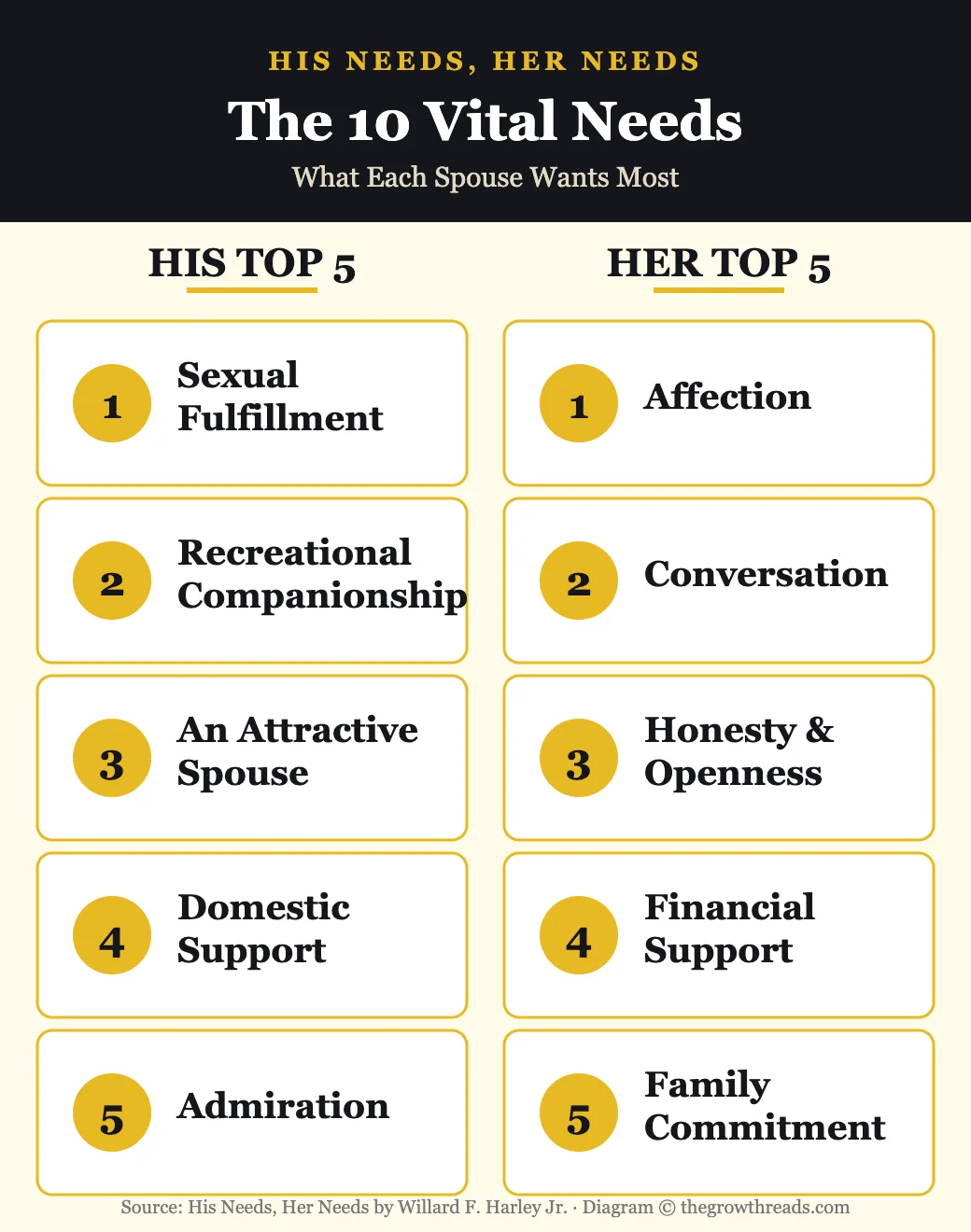
Sexual fulfillment. Harley treats this as a legitimate emotional need, not just a physical one — frequency matters less than feeling desired and prioritized, and he encourages couples to discuss it as openly as any other need on the list rather than leaving it unspoken. Recreational companionship. Many men bond through shared activity rather than conversation; a spouse who becomes a recreational companion (not just a co-parent or roommate) meets a need that hobbies with friends can’t fully replace, which is why Harley recommends couples deliberately develop at least one shared recreational interest rather than assuming it will happen naturally. An attractive spouse. Harley frames this carefully: it’s about effort and care, not a fixed beauty standard — a partner who visibly takes care of themselves signals ongoing investment in the relationship, and he’s explicit that this cuts both ways and isn’t a license for criticism. Domestic support. A peaceful, well-run home environment reduces daily friction and frees up energy for the relationship itself; Harley frames this as a shared responsibility rather than a fixed role, since the underlying need is calm and order, not who specifically provides it. Admiration. Specific, genuine praise — not flattery — is one of the cheapest, highest-return deposits available, and one of the first things to disappear once a marriage gets busy and partners start noticing what’s wrong more than what’s working.
Part 3: Her five most important needs
The mirror-image list from Harley’s female clients centers on connection and security rather than activity and admiration.
Affection. Non-sexual physical and verbal warmth — a hand on the shoulder, an unprompted “I’m glad you’re mine” — that communicates care without an agenda; Harley notes it needs to be offered freely, not just as a prelude to something else, or it stops registering as a deposit. Conversation. Not logistics-swapping, but sustained, undistracted talk about feelings, plans, and the day’s events; this is the single need Harley says is most often starved by phones and schedules, and the one couples most underestimate the cost of losing. Honesty and openness. Predictability and transparency about feelings, whereabouts, and finances build the safety that affection depends on — Harley treats even small, well-intentioned omissions as withdrawals, because they erode the predictability the need is really about. Financial support. Feeling that the household’s material needs are handled reliably, which frees emotional bandwidth for the relationship rather than survival logistics; like domestic support, Harley frames this as a shared outcome rather than a fixed gender role. Family commitment. Visible, active investment in the children and the family unit — not just provision, but presence at the events and routines that make a partner feel like they’re not raising a family alone.
TGR Note: If Harley’s specific ten needs feel too prescriptive for your relationship, The 5 Love Languages covers similar ground with a more flexible, self-diagnosed framework. The two books pair well: use Harley’s list to generate candidates, then use love languages to figure out how each need is best delivered.
Part 4: Protecting what you’ve built — Love Busters and the Policy of Undivided Attention
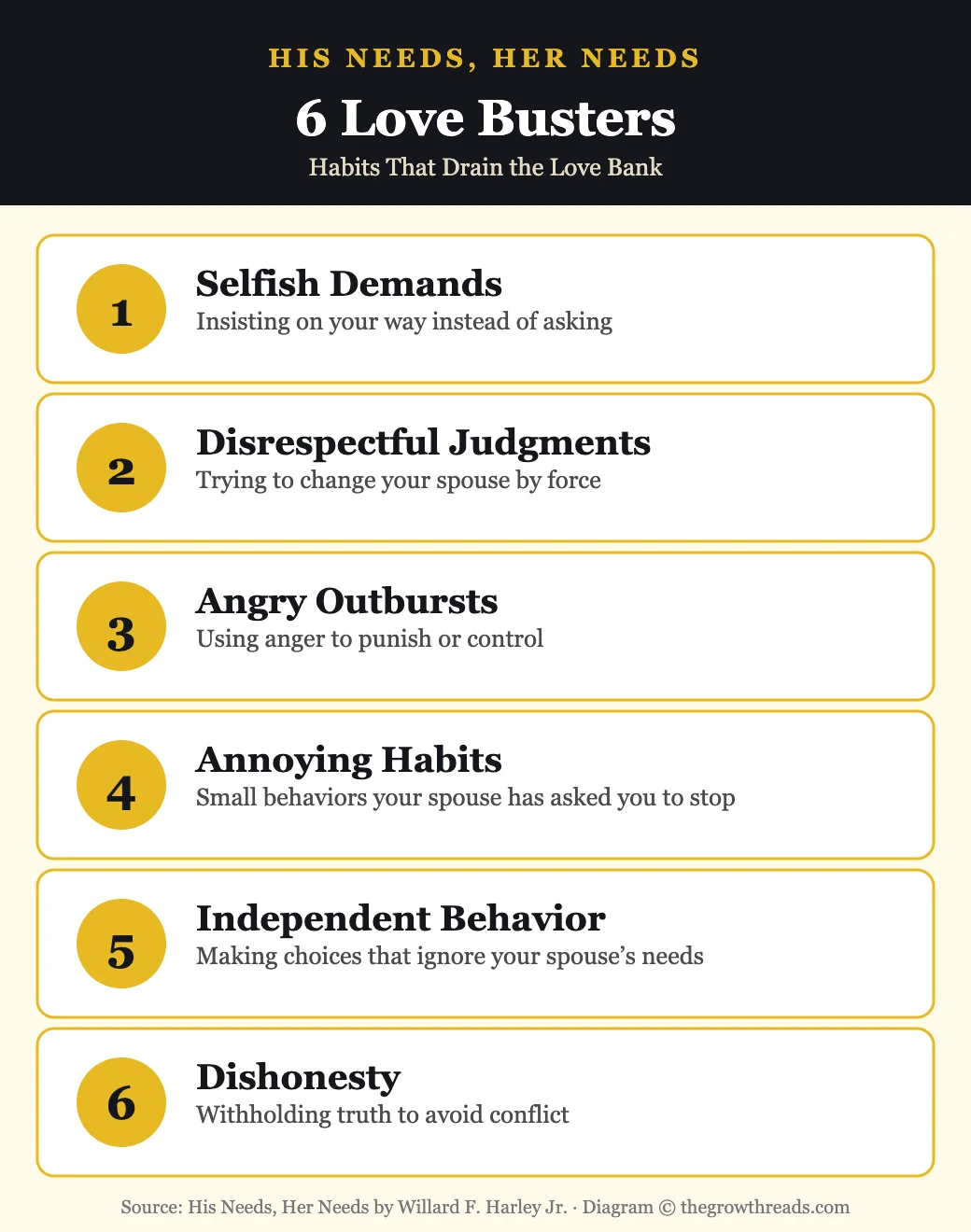
Meeting needs only works if you’re not simultaneously draining the account elsewhere. Harley names six recurring “Love Busters”: selfish demands, disrespectful judgments, angry outbursts, annoying habits, independent behavior, and dishonesty. Each one is corrosive precisely because it’s often invisible to the person doing it — nobody thinks of their own tone as an “angry outburst” in the moment.
Selfish demands frame a request as an obligation instead of a favor, which turns even reasonable asks into withdrawals. Disrespectful judgments try to change a spouse by criticizing or lecturing rather than asking — Harley argues this rarely produces the change it’s aiming for and reliably produces resentment instead. Angry outbursts use intimidation to win an argument, and because they’re remembered longer than almost any other withdrawal, Harley treats eliminating them as a non-negotiable first step before any deposit-building can stick. Annoying habits are the small, repeated behaviors a spouse has specifically asked you to stop — their cumulative cost is easy to underestimate because each instance feels minor. Independent behavior is any pattern of making decisions, plans, or friendships that structurally excludes your spouse, which is where the Policy of Joint Agreement below directly applies. Dishonesty, even the well-meaning kind meant to avoid a fight, destroys the predictability that every other deposit depends on — Harley considers it the hardest Love Buster to recover from once trust is broken.
To counter the drift, Harley prescribes two standing policies rather than one-off gestures. The Policy of Undivided Attention sets a target of roughly 15 hours a week of focused, distraction-free time — not just time in the same room, but time actually engaged with each other. The Policy of Joint Agreement asks each spouse never to act unilaterally on anything that affects the other without enthusiastic agreement first, which prevents the slow accumulation of resentment that independent decision-making creates. Together, the two policies are the maintenance system that keeps the Love Bank balance above the threshold long after the initial excitement of a relationship fades — which is also, not incidentally, what affair-proofs a marriage: needs met at home rarely go looking to be met elsewhere.
TGR Note: The Policy of Undivided Attention is a scheduling fix; it doesn’t teach you how to navigate the hard conversations that happen once you’re actually spending that time together. For that skill, see our Seven Principles for Making Marriage Work summary, which covers conflict repair in more depth.
Who is His Needs, Her Needs best for — and who should read something else first?
This book is best for couples who are stable but drifting — the marriage isn’t in crisis, but the spark has faded and both partners want a concrete diagnostic rather than vague reassurance to “communicate more.” It’s also well suited to couples heading into a high-stress season (a new baby, a job change, a long-distance stretch) who want a maintenance system in place before things slip.
If you’re not yet in a committed relationship and want to understand your own patterns first, start with Attached instead. If your core issue is repeated, unresolved arguments rather than unmet needs, Hold Me Tight addresses the emotional cycle underneath conflict more directly. And if you want a gentler, more flexible framework than Harley’s specific need lists, The 5 Love Languages is the more forgiving starting point.
Questions to reflect on
- If you ranked your own top five needs honestly, which ones has your spouse never actually heard you name out loud?
- What’s one recurring “Love Buster” — selfish demands, criticism, anger, independence, dishonesty — that you personally default to under stress?
- When was the last time you and your spouse had 15 uninterrupted, undistracted minutes together, let alone 15 hours a week?
- Where in your marriage have you been making a unilateral decision that your spouse experiences as a withdrawal, even if you meant well?
- What’s one small, specific deposit you could make today into your spouse’s Love Bank — not a grand gesture, just one true-to-form act of care?
🔥 Ready to affair-proof your marriage?
Learn to identify — and meet — the ten needs that keep romantic love alive.
How to apply His Needs, Her Needs (7-day plan)
- Day 1 — Rank your own needs. Privately, using Harley’s ten as a starting menu, write your true top five in your own words — not the ones you think you’re “supposed” to have.
- Day 2 — Have your spouse do the same. Independently and without peeking at each other’s lists, so neither of you edits toward what you think the other wants to hear.
- Day 3 — Trade lists, out loud. Set aside 30 distraction-free minutes to read each other’s top five and ask one clarifying question per item — no defending, just understanding.
- Day 4 — Name your Love Buster. Identify the one habit — selfish demands, criticism, anger, an annoying habit, independence, or dishonesty — you personally default to, and tell your spouse you’re working on it.
- Day 5 — Schedule undivided attention. Book one real block of distraction-free time this week — even 90 minutes — as the first installment toward the 15-hour target.
- Day 6 — Make two targeted deposits. Do one small, specific thing for each of your spouse’s top two needs from their list — not a guess, the actual list.
- Day 7 — Review and set the habit. Compare notes: what felt like a real deposit versus a miss, and pick one policy (undivided attention or joint agreement) to keep running past this week.
Frequently asked questions
What are the “10 vital needs” in His Needs, Her Needs?
Willard Harley identifies five needs men in his counseling practice most commonly ranked highest — sexual fulfillment, recreational companionship, an attractive spouse, domestic support, and admiration — and five most common among women: affection, conversation, honesty and openness, financial support, and family commitment. The book’s core exercise is having each spouse rank and share their actual top five, since individual priorities can differ from the general pattern.
Are the “his” and “her” needs always true for every couple?
No, and Harley says so directly — the lists are patterns drawn from his caseload, not a fixed rule for every man or woman. Some readers find their own top five needs don’t match their “assigned” list at all. The value of the book is less in the specific lists and more in the exercise of identifying and ranking your actual needs, then sharing them explicitly instead of assuming your spouse already knows.
What is the Love Bank concept exactly?
The Love Bank is Harley’s metaphor for a running emotional account each person keeps for everyone they know. Caring, considerate behavior makes a deposit; thoughtless or hurtful behavior makes a withdrawal. Romantic love toward a specific person only happens once that person’s balance clears a “romantic love threshold” — which is why a marriage can quietly drift out of love even without a single dramatic event, simply by too many small withdrawals outpacing deposits over time.
How does the book help affair-proof a marriage?
Harley’s argument is that affairs typically start when an important need goes unmet at home for long enough that someone outside the marriage meets it instead — often unintentionally at first, through simple attention or admiration. By systematically identifying and meeting each other’s top needs, and by adopting the Policy of Undivided Attention to keep the relationship a priority, couples reduce the vulnerability window where that kind of drift can happen.
What is the Policy of Undivided Attention?
It’s Harley’s prescription for maintaining romantic love over the long term: roughly 15 hours a week of focused, distraction-free time together — talking, doing an activity as a pair, or simply being present without phones, work, or kids competing for attention. Harley treats this as a floor, not a luxury; couples who let it slip to near zero are, in his framework, the ones most likely to drift apart even without any single triggering conflict.
Is His Needs, Her Needs based on research or opinion?
It’s grounded in Harley’s own clinical casework rather than a controlled academic study — he developed the framework from patterns he observed across decades of counseling couples, many in crisis. Some of the specific statistics and gendered framing have been debated by later researchers who favor more individualized models, but the practical exercises — ranking needs, tracking deposits and withdrawals, scheduling undivided attention — are uncontroversial and widely used by marriage counselors regardless of theoretical camp.
How is this different from The 5 Love Languages?
Both books try to solve the same problem — spouses expressing love in ways their partner doesn’t register — but with different mechanisms. The 5 Love Languages sorts affection into five delivery styles (words, time, gifts, service, touch) that apply somewhat evenly across people. His Needs, Her Needs instead asks what the need itself is, using a more detailed, gendered starting list. Many couples find it useful to work through both: Harley’s list to identify the need, love languages to figure out how to deliver it.
Related summaries
The 5 Love Languages Summary & Review ·
Attached Summary & Review ·
Hold Me Tight Summary & Review ·
The Seven Principles for Making Marriage Work Summary & Review ·
See all the best relationship books
How we analyze books: we read the full text, cross-reference the author’s other work and interviews, and build original diagrams and application plans rather than reproducing the book’s content. Read our full methodology.