

★★★★☆ 4.0/5
One-liner: A warm, step-by-step guide to building financial wholeness — covering everything from budgeting and debt to investing and estate planning in one accessible framework.
Best for: Financial beginners and anyone who feels overwhelmed by money management and wants a clear, judgment-free roadmap from financial mess to financial confidence.
Reading time: ~5 hours (304 pages)
Difficulty to apply: Low — the steps are sequential, specific, and designed for people starting from scratch.
Get Good with Money in One Minute
You do not need to be a financial genius — you need a system that takes you from where you are to where you want to be. Tiffany “The Budgetnista” Aliche lost everything during the 2008 financial crisis — her job, her savings, and her home — and rebuilt from zero using a ten-step framework she calls financial wholeness. The book walks readers through each step sequentially: budgeting, saving, debt elimination, credit repair, earning more, investing, insurance, net worth tracking, estate planning, and giving. What sets it apart is Aliche’s warm, nonjudgmental tone and her insistence that everyone — regardless of income level, background, or current financial situation — can achieve financial wholeness by following these steps in order.
Key Takeaways
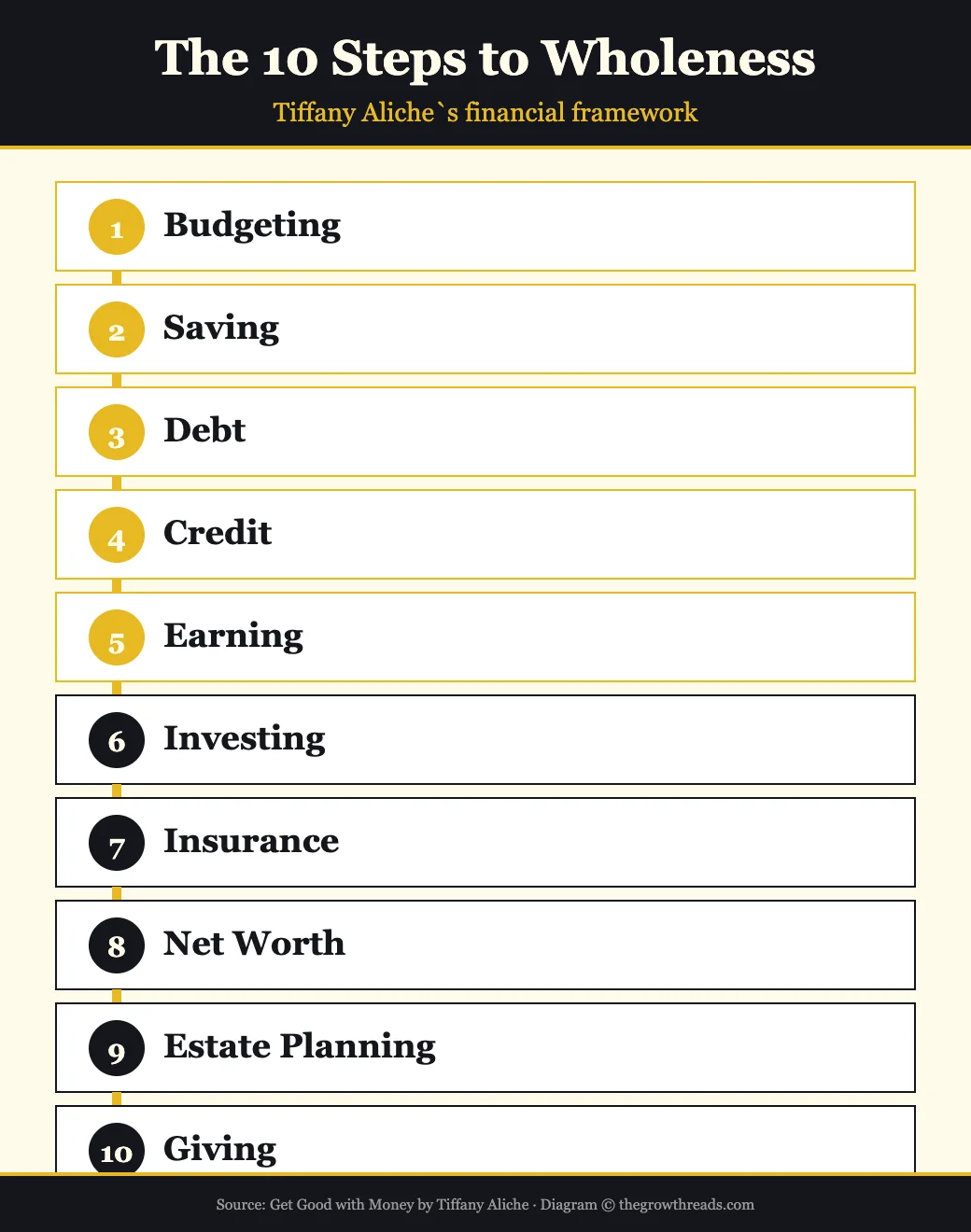
- Financial wholeness is a journey of ten steps: Budgeting, saving, debt, credit, earning, investing, insurance, net worth, estate planning, and giving — each building on the last.
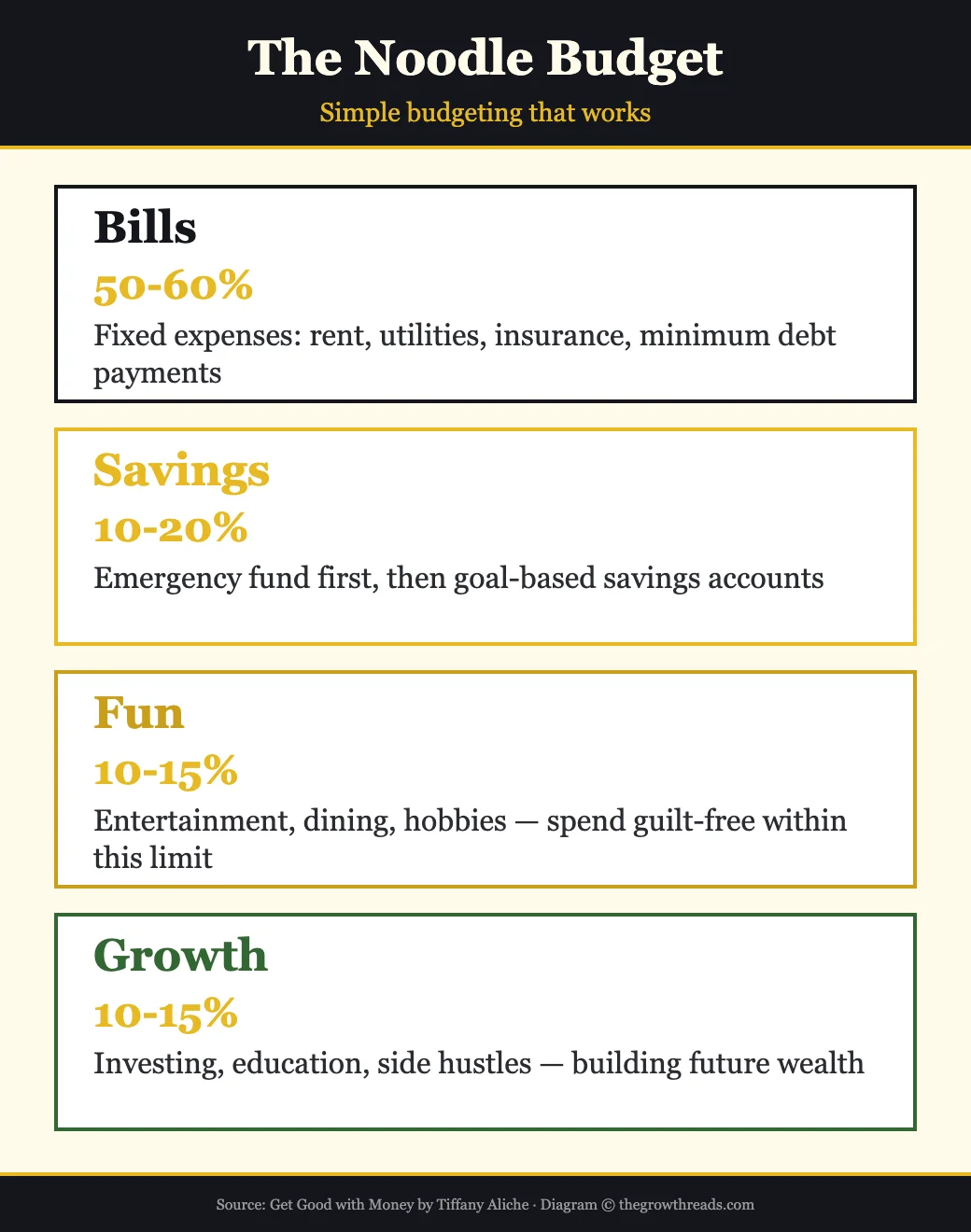
- The Noodle Budget makes budgeting simple: Allocate income into clear categories — bills, savings, fun, and growth — rather than tracking every dollar with complicated spreadsheets.
- Automate your savings: Set up automatic transfers to separate savings accounts on payday so saving happens before spending.
- Attack debt strategically: Use either the avalanche method (highest interest first) or the snowball method (smallest balance first) — both work if you stick with them.
- Your credit score is a financial superpower: Understanding and actively managing your credit score saves you tens of thousands of dollars in interest over your lifetime.
- Earning more matters as much as spending less: At some point, cutting expenses hits a floor. Building additional income streams is the path to accelerating financial progress.
- Investing is not optional: You do not need to be wealthy to invest. Start with whatever you have and let compound interest do the heavy lifting over time.
- Insurance protects everything you build: Without adequate insurance, one medical emergency or accident can destroy years of financial progress.
- Estate planning is for everyone: You do not need to be rich to need a will, power of attorney, and beneficiary designations — these protect your family regardless of your net worth.
- Financial wholeness includes giving: Generosity is the final step because it transforms your relationship with money from scarcity to abundance.
What Is Get Good with Money About?
Get Good with Money presents a ten-step framework for achieving “financial wholeness” — moving from financial chaos to confidence through sequential steps covering budgeting, saving, debt, credit, earning, investing, insurance, net worth, estate planning, and giving. Written in an accessible, judgment-free tone for beginners.
About the Author
Tiffany Aliche, known as The Budgetnista, is a financial educator who has helped over two million women save and manage more than three hundred million dollars collectively. After losing her job, savings, and home during the 2008 recession, she rebuilt her finances from scratch and began teaching others the system she developed. Aliche became the first Black woman to have a bill named after her when New Jersey passed the “Budgetnista Law” requiring financial education in schools. She has been featured in the New York Times, Good Morning America, and Forbes, and her Live Richer community has become one of the largest financial education movements in the United States. Explore all Tiffany Aliche book summaries →
Key Concepts at a Glance
| Concept | What It Means | Use It When |
|---|---|---|
| Financial Wholeness | A complete financial life across ten dimensions, not just wealth accumulation | You want a holistic framework for your financial life |
| The Noodle Budget | A simplified budgeting method using broad categories instead of line-item tracking | Detailed budgeting feels overwhelming and you keep quitting |
| Automate First | Setting up automatic transfers so saving happens before spending | You intend to save but always spend the money first |
| Debt Attack Strategy | Systematic debt elimination using snowball or avalanche method | You have multiple debts and need a clear payoff plan |
| Income Stacking | Building multiple income streams to accelerate financial progress | You have cut expenses as far as possible and need to earn more |
| Estate Planning Basics | Wills, powers of attorney, and beneficiary designations for everyone | You think estate planning is only for wealthy people |
Part 1: Foundation — Budgeting, Saving, and Debt
Aliche begins with budgeting because it is the foundation of every other financial step. Her Noodle Budget — named after the ramen noodles she ate while rebuilding her finances — divides income into broad, simple categories rather than tracking every individual expense. The key categories are bills (fifty to sixty percent), savings (ten to twenty percent), fun (ten to fifteen percent), and growth (ten to fifteen percent). This simplicity is intentional — Aliche found that overly detailed budgets cause people to give up.
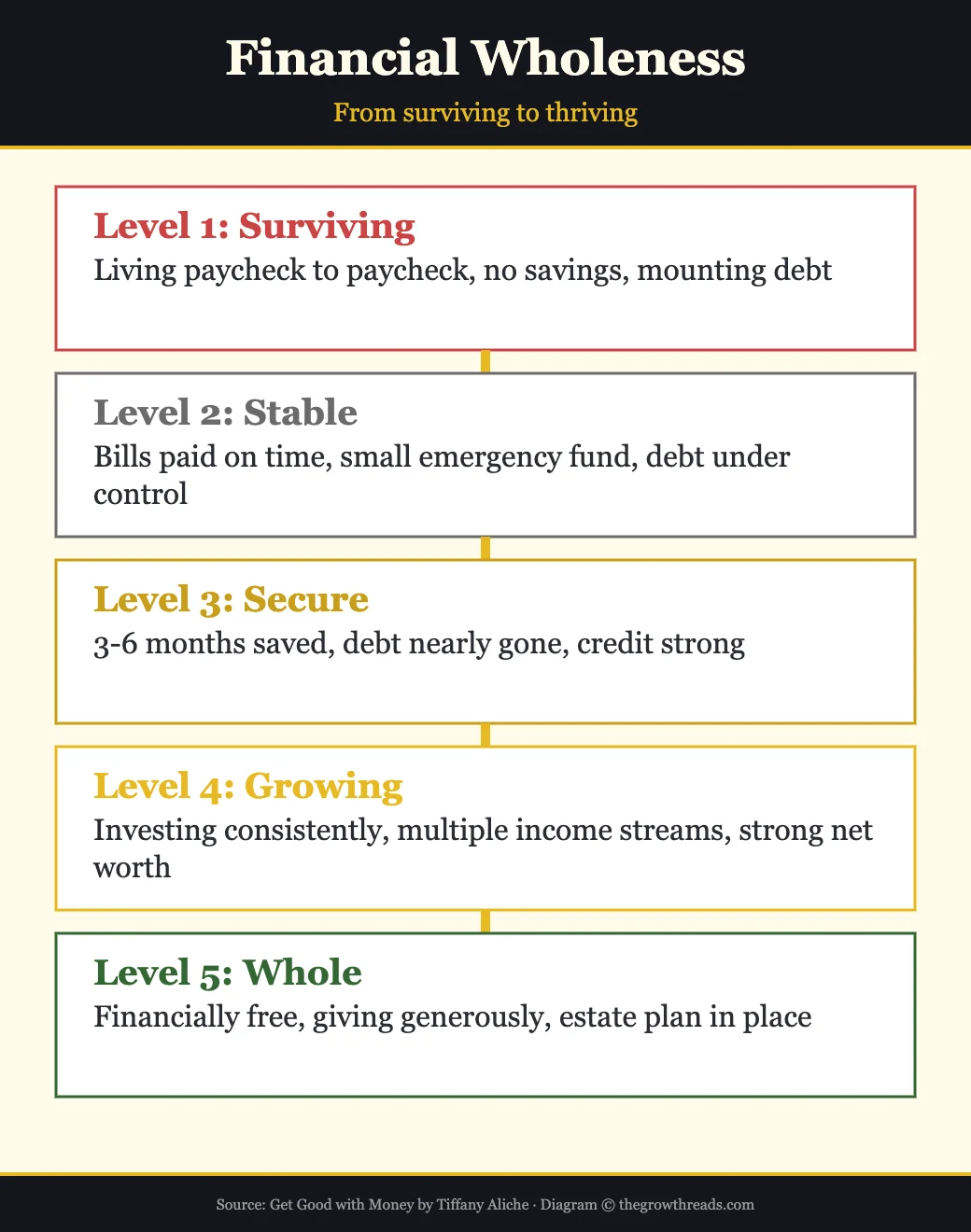
Saving comes next, and Aliche’s approach is automation-first. She recommends setting up separate savings accounts for specific goals — emergency fund, vacation, car repair — and automating transfers from checking on payday. When saving happens before spending, it requires no willpower. She recommends building a starter emergency fund of one thousand dollars before attacking debt, then growing it to three to six months of expenses.
The debt chapter presents both the snowball method (paying off smallest balances first for psychological wins) and the avalanche method (paying off highest interest rates first for mathematical efficiency). Aliche lets readers choose based on their personality, emphasizing that the best method is the one you actually stick with.
Part 2: Growth — Credit, Earning, and Investing
The middle section addresses the wealth-building steps. Credit receives detailed attention because your credit score affects the interest rates you pay on everything from mortgages to car loans — a difference that compounds into tens of thousands of dollars over a lifetime. Aliche provides specific, actionable steps for checking your credit report, disputing errors, reducing utilization, and building credit history.
The earning chapter is where Aliche pushes readers beyond frugality. While cutting expenses is essential early on, there is a floor to how much you can cut. The path to accelerating financial progress is earning more — through negotiating raises, building skills, starting side businesses, or creating passive income streams. Aliche shares her own journey from layoff to building a multi-million-dollar financial education business.
Investing follows, and Aliche demystifies it with characteristic warmth. She explains index funds, retirement accounts, compound interest, and employer matches in plain language, emphasizing that you do not need to be wealthy to start investing. Her message is clear: the biggest investing mistake is not starting — not picking the wrong fund.
Part 3: Protection — Insurance, Net Worth, Estate Planning, and Giving
The final section covers the protective and aspirational dimensions of financial wholeness. Insurance is presented not as an expense but as protection for everything you have built — without adequate health, auto, renters or homeowners, disability, and life insurance, a single unexpected event can destroy years of financial progress.
Net worth tracking provides the scoreboard. Aliche teaches readers to calculate and track their net worth monthly, because it is the single number that captures your entire financial picture — assets minus liabilities. Watching this number grow provides motivation that budget tracking alone cannot match.
Estate planning, the ninth step, is the most commonly skipped — and Aliche makes a passionate case for why everyone needs it, regardless of wealth. A will, healthcare directive, power of attorney, and properly designated beneficiaries protect your family and ensure your wishes are followed. Without them, the state decides what happens to your assets and your dependents.
The tenth and final step is giving. Aliche places generosity last not because it is least important but because it is the capstone of financial wholeness — the point where your financial health enables you to contribute to others. Tithing, charitable giving, and community support transform your relationship with money from scarcity and fear to abundance and purpose.
Who Is Get Good with Money Best For — and Who Should Read Something Else First?
Get Good with Money is ideal for financial beginners — people who feel overwhelmed by money, are living paycheck to paycheck, or simply never received financial education. Aliche’s warm, nonjudgmental tone makes this one of the most accessible personal finance books available. It is also excellent for people who have read finance books before but never followed through, because the sequential structure gives you exactly one thing to work on at a time.
If you already have budgeting, saving, and debt under control and want to focus specifically on investing, The Simple Path to Wealth goes deeper. If you want a more aggressive approach to building wealth quickly, The Millionaire Fastlane offers a different philosophy.
Questions to Reflect On
- Which of the ten steps is your weakest — and are you willing to commit to improving it this month?
- Do you have a budget that you actually follow, or do you track spending without changing behavior?
- If you automated your savings tomorrow, how much could you save without feeling the pinch?
- Do you have a will and properly designated beneficiaries — and when was the last time you reviewed them?
- What would financial wholeness look like for you personally — not just wealth, but confidence and peace?
🔥 Ready to Get Good with Money?
Follow the ten-step roadmap from financial chaos to financial wholeness — one step at a time, judgment-free.
How to Apply Get Good with Money (7-Day Plan)
- Day 1 — Assess your starting point: Rate yourself 1-10 on each of the ten steps. Identify your weakest area — that is where you start.
- Day 2 — Build your Noodle Budget: List your monthly income and divide it into bills, savings, fun, and growth. Keep it simple — four categories maximum.
- Day 3 — Automate one savings transfer: Open a separate savings account and set up an automatic transfer from checking on your next payday. Even twenty dollars counts.
- Day 4 — List all debts: Write down every debt with the balance, interest rate, and minimum payment. Choose snowball or avalanche and put an extra payment on your target debt.
- Day 5 — Check your credit report: Pull your free credit report, review it for errors, and dispute anything incorrect. Note your credit score as a baseline.
- Day 6 — Calculate your net worth: List all assets and all liabilities. Subtract liabilities from assets. This is your scoreboard — check it monthly.
- Day 7 — Take one protection step: Review your insurance coverage, check your beneficiary designations, or schedule an appointment to create a basic will.
Frequently Asked Questions
What is financial wholeness?
Financial wholeness is Aliche’s term for a complete, healthy financial life — not just having money, but having all ten dimensions of your finances working together: budgeting, saving, debt management, credit, earning, investing, insurance, net worth growth, estate planning, and giving. Wholeness means financial confidence and peace, not just wealth accumulation. Each step builds on the previous one in a deliberate sequence.
What is the Noodle Budget?
The Noodle Budget is Aliche’s simplified budgeting method that divides income into broad categories — bills, savings, fun, and growth — rather than tracking every individual expense. Named after the ramen noodles she ate while rebuilding her finances, the approach works because it is simple enough to actually follow. Detailed budgets with dozens of categories cause most people to quit, so the Noodle Budget focuses on getting the big categories right.
Do I need to follow the ten steps in order?
Aliche recommends following them sequentially because each step builds on the foundation of the previous one. You should not invest before you have a budget and emergency fund, for example, because you will likely need to pull the investment money out during an emergency and lock in losses. However, some steps can overlap — you can work on credit while paying off debt, for instance.
Is this book for people who are already doing well financially?
Get Good with Money is primarily designed for beginners and people starting over, but even financially comfortable readers often find gaps in the later steps — insurance adequacy, estate planning, and giving. If you already budget, save, and invest effectively, the book will feel basic in the early chapters but may reveal blind spots in the protective and aspirational dimensions of your financial life.
How is this different from other personal finance books?
Three things distinguish Get Good with Money: the comprehensive ten-step framework that covers the full financial life (most books focus on one or two areas), Aliche’s warm and nonjudgmental tone that makes finance accessible to people who feel intimidated by money, and the sequential structure that tells you exactly what to work on next. It is less about theory and more about action.
Why does the book include estate planning and giving?
Aliche argues that financial wholeness is not just about accumulating money — it is about protecting what you build and using your resources to benefit others. Estate planning ensures your family is protected and your wishes are honored. Giving transforms your relationship with money from scarcity to abundance. Including these steps elevates the book from a budgeting guide to a comprehensive life framework.
Can I follow this book on a low income?
Yes. Aliche built this framework while recovering from financial ruin on a low income. The steps are designed to work at any income level — the amounts you save and invest will be smaller, but the system works the same way. The emphasis on automation is particularly valuable for lower-income readers because it removes the willpower challenge. Even small amounts compound significantly over time.
Related Summaries
- I Will Teach You to Be Rich by Ramit Sethi — another action-oriented guide to automating your finances.
- Broke Millennial by Erin Lowry — financial basics for young adults.
- The Simple Path to Wealth by JL Collins — deep dive into simple index fund investing.
- Best Money Books — our complete guide to building wealth.