

⭐⭐⭐⭐✬ 4.5/5 — The data-driven management bible that proved great managers break conventional rules.
Best for: Managers at every level who want to get the most from their teams by focusing on individual strengths.
Reading time: ~7 hrs
Difficulty to apply: Moderate — requires a mindset shift from fixing weaknesses to amplifying strengths.
First, Break All the Rules in one minute
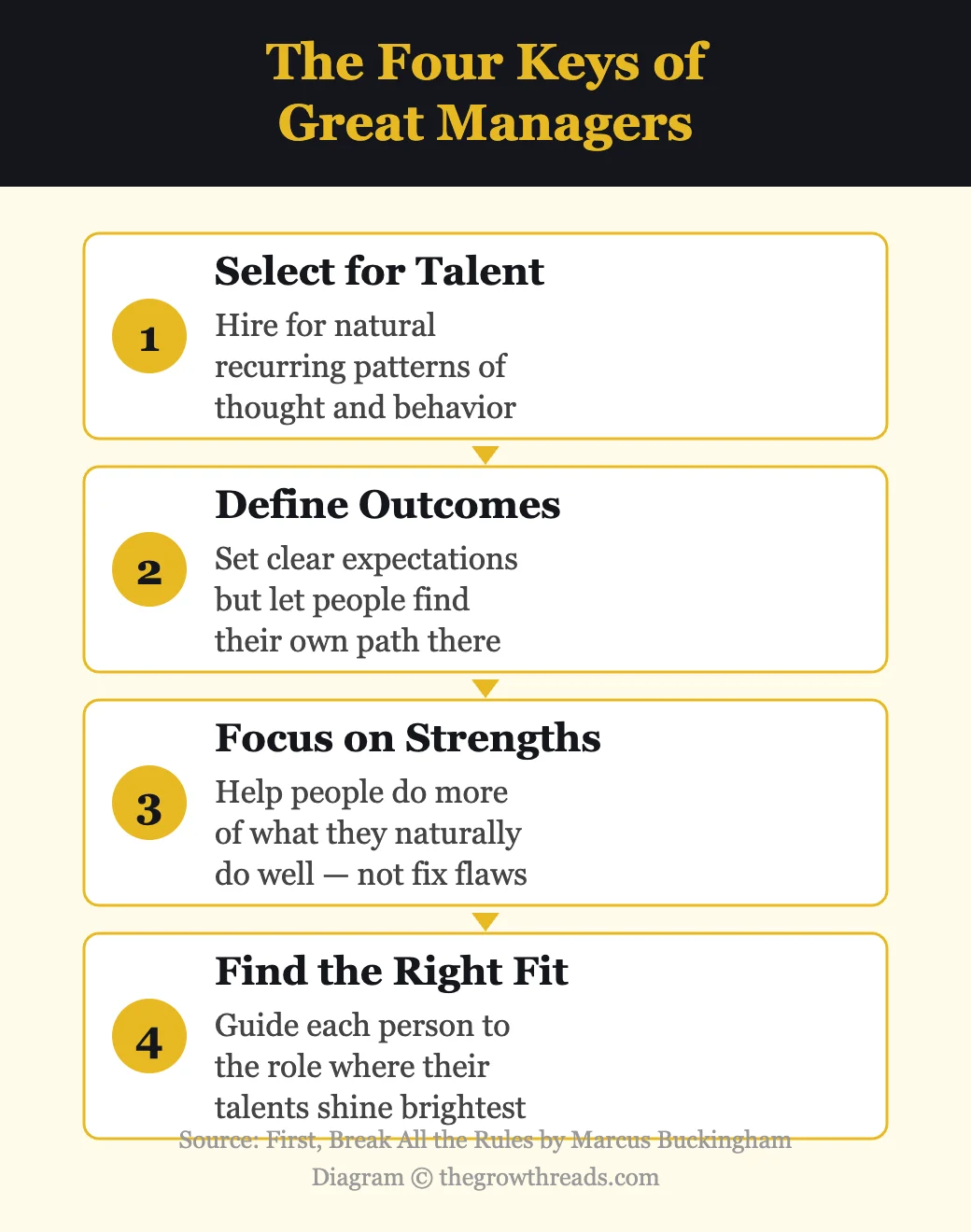
The world’s greatest managers do the opposite of what conventional wisdom recommends — and Gallup has the data to prove it. Marcus Buckingham and Curt Coffman analyzed interviews with over 80,000 managers across 400 companies — the largest study of management excellence ever conducted. Their conclusion upends standard practice: great managers do not treat everyone the same, do not focus on fixing weaknesses, and do not follow the “golden rule” of managing others the way they would want to be managed. Instead, they select for talent (not just experience), define outcomes (not steps), focus on strengths (not weaknesses), and find the right fit (not the next rung on the ladder). The book introduces the Gallup Q12 — twelve questions that predict team engagement and business performance — and builds a complete framework for managing people as individuals rather than interchangeable parts.
Key takeaways
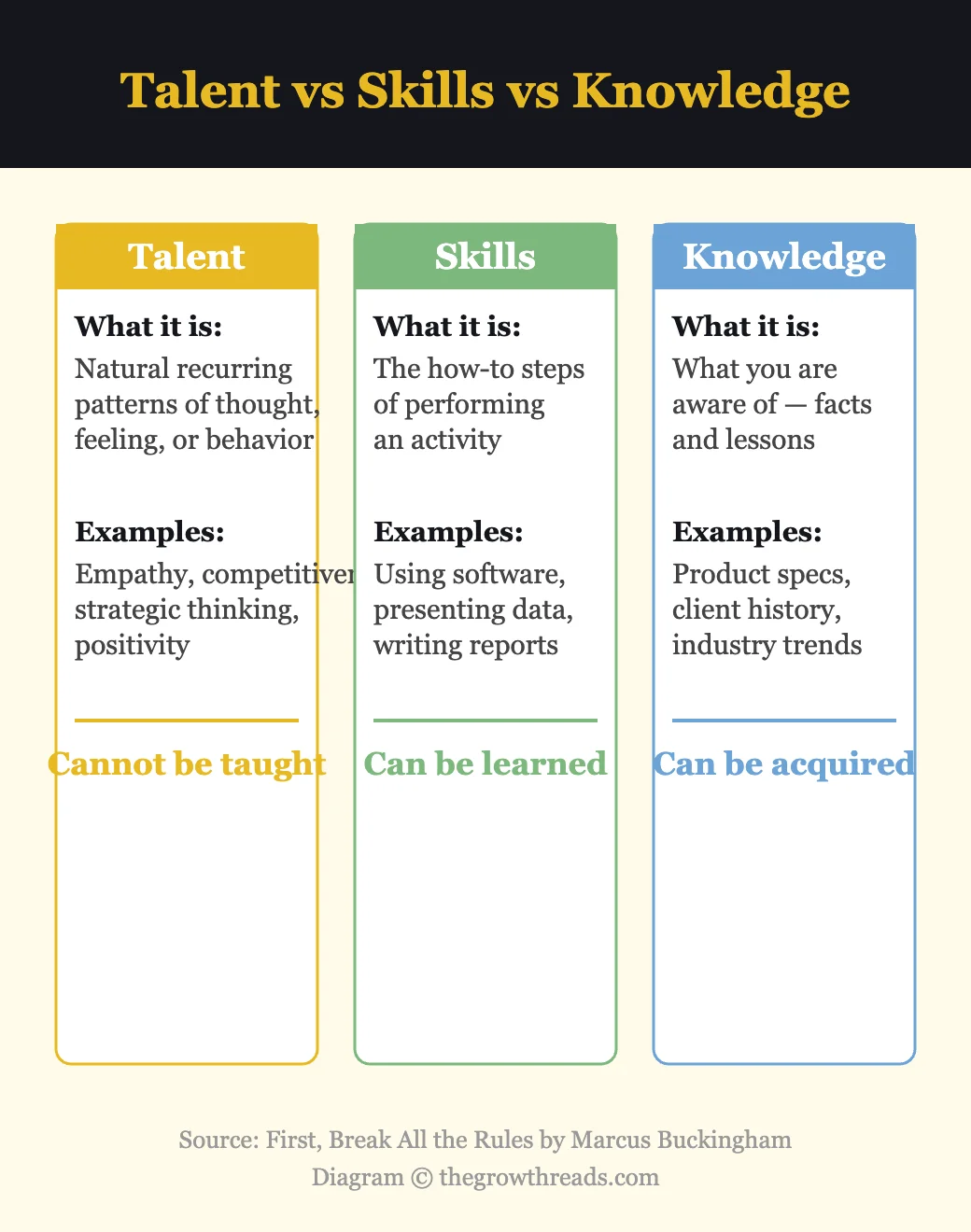
- Talent is distinct from skills and knowledge: Talent is a natural, recurring pattern of thought, feeling, or behavior — like empathy, competitiveness, or strategic thinking. Unlike skills and knowledge, talent cannot be taught. Great managers hire for it.
- Great managers focus on strengths: Rather than spending time fixing weaknesses, the best managers identify what each person does naturally well and then arrange roles, responsibilities, and partnerships to amplify those strengths.
- Define outcomes, not steps: Instead of prescribing how to do a job, great managers define what success looks like and then let each person find their own route to get there. This respects individual talent and drives better results.
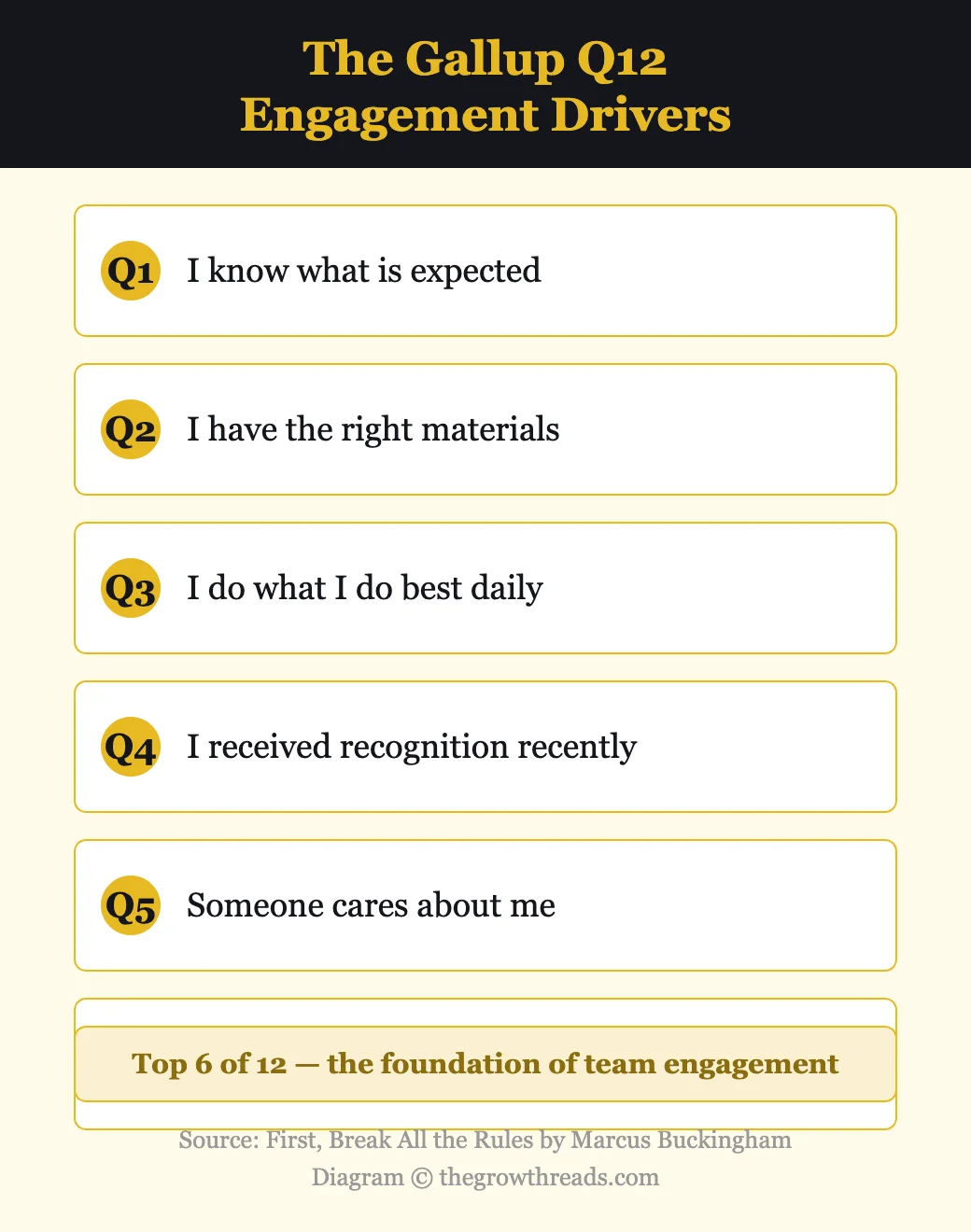
- The Q12 predicts business performance: Gallup identified twelve questions that, when answered positively, correlate with higher productivity, profitability, retention, and customer satisfaction. These questions measure the quality of the local manager, not the company overall.
- People leave managers, not companies: The single most important variable in employee engagement is the quality of the direct manager. No amount of perks, compensation, or corporate culture can overcome a bad manager.
- Treat every person as an individual: Great managers learn each person’s unique strengths, triggers, and learning style — then customize their approach accordingly. There is no one-size-fits-all management style.
- Do not promote everyone: The traditional career ladder assumes that the best individual contributors should become managers. Great managers create alternative paths — broadening roles, granting prestige, and increasing pay — without forcing people into management positions that do not fit their talents.
- Spend the most time with your best people: Conventional managers give the most attention to struggling employees. Great managers reverse this — they invest disproportionately in top performers because the return on that investment is highest.
- Manage around weaknesses: Rather than trying to fix what is broken, great managers find workarounds — partnering people with complementary strengths, restructuring roles, or using technology to compensate for gaps.
- The first six Q12 questions are the foundation: Engagement builds in a specific order. Before people can innovate or feel connected to a mission, they need to know what is expected of them and have the materials to do their work. Base camp comes before the summit.
What is First, Break All the Rules about?
First, Break All the Rules presents the findings of Gallup’s landmark study of over 80,000 managers. It reveals that the world’s best managers share four unconventional practices: selecting for talent, defining outcomes instead of methods, focusing on strengths instead of weaknesses, and finding the right fit for each person rather than defaulting to promotion.
About the author
Marcus Buckingham spent nearly two decades at the Gallup Organization, where he led the research program that produced this book and its follow-up, Now, Discover Your Strengths. He is widely credited with launching the global strengths-based management movement and has since founded his own research company focused on people development. Curt Coffman, co-author, was the global practice leader for workplace management and led the development of the Q12 employee engagement survey that has been used by millions of workers worldwide. Together, they turned Gallup’s massive dataset into the most influential management framework of the last three decades.
Key concepts at a glance
| Concept | What it means | Use it when |
|---|---|---|
| The Q12 | Twelve questions that predict team engagement and business outcomes | You want to measure and improve your team’s engagement |
| Talent vs. skill vs. knowledge | Talent is innate; skills and knowledge can be learned | You are hiring or deciding what to develop in each person |
| The four keys | Select talent, define outcomes, focus strengths, find fit | You want a complete framework for managing individuals |
| Manage around weaknesses | Partner, restructure, or use tools — do not try to fix innate gaps | Someone is struggling in an area that is not their natural talent |
| The career lattice | Alternative growth paths that do not force everyone into management | A top performer wants growth but would be miserable as a manager |
| Spend time with the best | Invest disproportionately in your top performers | You are deciding where to allocate your management attention |
| The engagement hierarchy | Base needs (clarity, materials) must come before higher needs (growth, purpose) | You want to diagnose why engagement is low on your team |
Part 1: The measuring stick — what great managers know
Buckingham opens with a provocation: most management wisdom is wrong. The standard playbook — select people based on experience, define the right steps, motivate by fixing weaknesses, promote based on performance — produces average results at best. Gallup’s research across hundreds of thousands of employees revealed that the most productive, profitable, and engaged teams share a single common factor: an exceptional direct manager.
The centerpiece of this section is the Gallup Q12 — twelve questions that, in combination, predict team-level outcomes including productivity, profitability, retention, safety incidents, and customer satisfaction. The questions are deceptively simple (“Do I know what is expected of me at work?” “Do I have the materials and equipment I need?”), but their power lies in the hierarchy they reveal. Engagement builds in stages: basic needs first (clarity, resources), then individual recognition, then a sense of belonging, and finally opportunities for growth.
Buckingham emphasizes that the Q12 measures the quality of the local manager, not the organization. Two teams in the same company, with the same pay and benefits, can have wildly different engagement scores. The difference is always the manager. This finding has profound implications: if you want to improve business performance, stop redesigning compensation plans and start developing managers.
Part 2: The four keys — what great managers do differently
The heart of the book lays out the four practices that distinguish great managers from average ones. The first key — select for talent — requires understanding what talent actually is. Buckingham defines talent as any recurring pattern of thought, feeling, or behavior that can be productively applied. Talent is not rare or precious; everyone has talents. The manager’s job is to identify each person’s specific talents and match them to the role. This means hiring for fit, not just credentials.
The second key — define the right outcomes — is about letting people use their unique talents to find their own path to results. Rather than prescribing a process (“make 50 cold calls a day”), great managers define the destination (“generate 10 qualified leads a week”) and trust each person to get there their own way. This is not abdication — it is respect for individual talent combined with clear accountability.
The third key — focus on strengths — is the most counterintuitive. Traditional management focuses on identifying gaps and fixing them through training. Buckingham’s research shows this approach has a ceiling: you can make a weakness adequate, but you cannot make it a strength. Great managers flip this: they spend most of their development energy amplifying what each person already does well, because the return on strength development is exponentially higher than the return on weakness repair.
The fourth key — find the right fit — challenges the assumption that career growth means moving up. Great managers create alternative paths that let people grow in mastery, prestige, and compensation without being forced into management roles that do not suit their talents. A brilliant engineer who becomes a mediocre manager is a loss for everyone.
Part 3: Talent, skills, and the individual
The final section provides the practical tools for applying the four keys. Buckingham draws a sharp distinction between talent, skills, and knowledge — a taxonomy that most managers confuse. Knowledge (facts and lessons) and skills (how-to steps) can be taught. Talent (innate patterns of thought and behavior) cannot. The implications for hiring are significant: you can train someone to use a CRM system (skill) and teach them your industry (knowledge), but you cannot train them to be naturally empathetic with customers (talent).
Buckingham provides detailed guidance on how to identify talent in interviews — not through hypothetical questions (“what would you do if…”) but through open-ended questions about recurring behavior (“tell me about a time when you had to deal with an angry customer — what did you do, and why?”). The best predictor of future behavior is not what someone says they would do but what they have repeatedly done in the past.
The section closes with practical strategies for managing around weaknesses. Rather than sending an empathy-deficient engineer to a communication workshop, pair them with a naturally empathetic project manager. Rather than training an introverted analyst to give presentations, let them contribute their insights in written form. The goal is not to round off every sharp edge but to build teams where individual strengths complement each other’s gaps.
Who is First, Break All the Rules best for — and who should read something else first?
Best for: New and experienced managers who want a research-backed framework for getting the best from each team member. HR leaders designing talent development programs. Anyone frustrated by one-size-fits-all management advice. Executives who want to understand why some teams dramatically outperform others in the same company.
Read something else first if: You want a warmer, more narrative take on leadership — start with Dare to Lead. If you need help with difficult conversations specifically, Radical Candor is more tactical. And if you are looking for a systems-level view of organizational design rather than individual management, try The Culture Code.
Questions to reflect on
- Can I name each team member’s top two or three natural talents — and am I actively putting them in positions to use those talents every day?
- When I set expectations, do I describe the destination (outcomes) or the route (steps)? What would change if I focused exclusively on outcomes?
- Where am I spending my management time — with my best performers or my weakest? What would happen if I reversed that ratio?
- Do I have someone on my team who is being pushed toward management when they would thrive in a deepened individual contributor role?
- If my team answered the Q12 today, which questions would score lowest — and what is the one action I could take this week to move that score?
🔥 Ready to manage like the world’s best?
Discover the four unconventional practices that separate great managers from everyone else.
How to apply First, Break All the Rules (7-day plan)
- Day 1 — Map your team’s talents: For each person you manage, write down two or three things they do naturally well — activities where they show consistent excellence and energy. Note where you are unsure and plan to observe more closely.
- Day 2 — Run a Q12 self-audit: Answer the twelve engagement questions from your team’s perspective. Which questions would they score lowest on? Pick the weakest one and identify one action you can take this week.
- Day 3 — Convert one process to an outcome: Find a task where you are prescribing steps and redefine it as an outcome instead. Tell the person what “great” looks like and let them find their own route.
- Day 4 — Have a strengths conversation: Meet one-on-one with a team member and ask: “What part of your job gives you the most energy? When do you feel most in your element?” Use the answers to look for ways to give them more of that work.
- Day 5 — Identify one weakness to manage around: Instead of sending someone to training for a weakness, find a partner, tool, or restructuring that compensates for the gap while preserving their strengths.
- Day 6 — Reallocate your time: Review your calendar for the past two weeks. Calculate how much time you spent with your best performers versus your weakest. Commit to shifting at least 20% more time toward your top people.
- Day 7 — Challenge one career assumption: Identify someone on your team who is on a traditional promotion track that may not fit their talents. Brainstorm an alternative growth path — increased mastery, broader scope, or specialized expertise — that would serve them better.
Frequently asked questions
Is First, Break All the Rules still relevant today?
Absolutely. The book was first published in 1999 and has been updated, but its core findings — based on Gallup research with over 80,000 managers — remain the foundation of modern strengths-based management. The Q12 engagement framework is still used by millions of employees worldwide. If anything, the shift toward remote and hybrid work has made its principles more important: when you cannot manage by proximity, you must manage by outcomes and individual strengths.
What are the Gallup Q12 questions?
The Q12 includes questions like “Do I know what is expected of me at work?” “Do I have the materials and equipment I need to do my work right?” “At work, do I have the opportunity to do what I do best every day?” and “Does my supervisor or someone at work seem to care about me as a person?” They build in a hierarchy from basic needs to growth, and together they predict team-level productivity, profitability, retention, and customer satisfaction.
What does “talent” mean in this book?
Buckingham defines talent as any recurring pattern of thought, feeling, or behavior that can be productively applied. Talent is distinct from skills (which can be learned through practice) and knowledge (which can be acquired through study). Examples include natural empathy, competitive drive, strategic thinking, and positivity. The key insight is that talent is innate — you can develop it, but you cannot install it from scratch.
Should managers ignore weaknesses entirely?
No — the book does not advocate ignoring weaknesses. It advocates managing around them. This means acknowledging that a weakness exists, then finding practical solutions — partnering with someone who has complementary strengths, restructuring the role, using tools or systems — rather than investing heavily in trying to convert a weakness into a strength. The distinction is between fixing and compensating.
How is this book different from StrengthsFinder?
First, Break All the Rules is about management — how to lead a team using strengths-based principles. StrengthsFinder (now CliftonStrengths) is the individual assessment tool that helps people identify their own top talent themes. Think of this book as the management philosophy and StrengthsFinder as the self-discovery tool. They complement each other: this book tells you why to focus on strengths, and StrengthsFinder helps you identify what those strengths are.
What should I read after First, Break All the Rules?
For the individual strengths assessment, read StrengthsFinder 2.0 by Tom Rath. For a complementary view on team building, try The Five Dysfunctions of a Team by Patrick Lencioni. For how to have the difficult conversations that strengths-based management requires, read Radical Candor by Kim Scott. And for organizational-level culture design, The Culture Code by Daniel Coyle shows how the principles in this book scale.
Can I apply this book if I am not a manager?
Yes. The strengths-based framework applies to managing yourself, choosing projects, and even managing up. Understanding your own talents helps you seek out roles where you will thrive, communicate your strengths to your manager, and build partnerships with colleagues whose talents complement yours. The Q12 questions are also useful for evaluating potential employers — if a team cannot answer them positively, it is a warning sign.
Related summaries
If First, Break All the Rules resonated with you, explore these related summaries:
- The Five Dysfunctions of a Team — Lencioni’s framework for building team trust and accountability
- Radical Candor — How to give direct feedback while caring personally
- The Culture Code — The secrets of highly successful groups
- Dare to Lead — Brené Brown on courageous leadership