

★★★★☆ 4.5/5 — A daily-practice companion for creative work, built around one urgent idea: use everything up before you run out of time.
Best for: People with real potential who keep postponing their best work for “someday.”
Reading time: ~4 hrs (guide: 60 min)
Difficulty to apply: Medium — daily reflection habits more than one-time fixes.
Die Empty in one minute
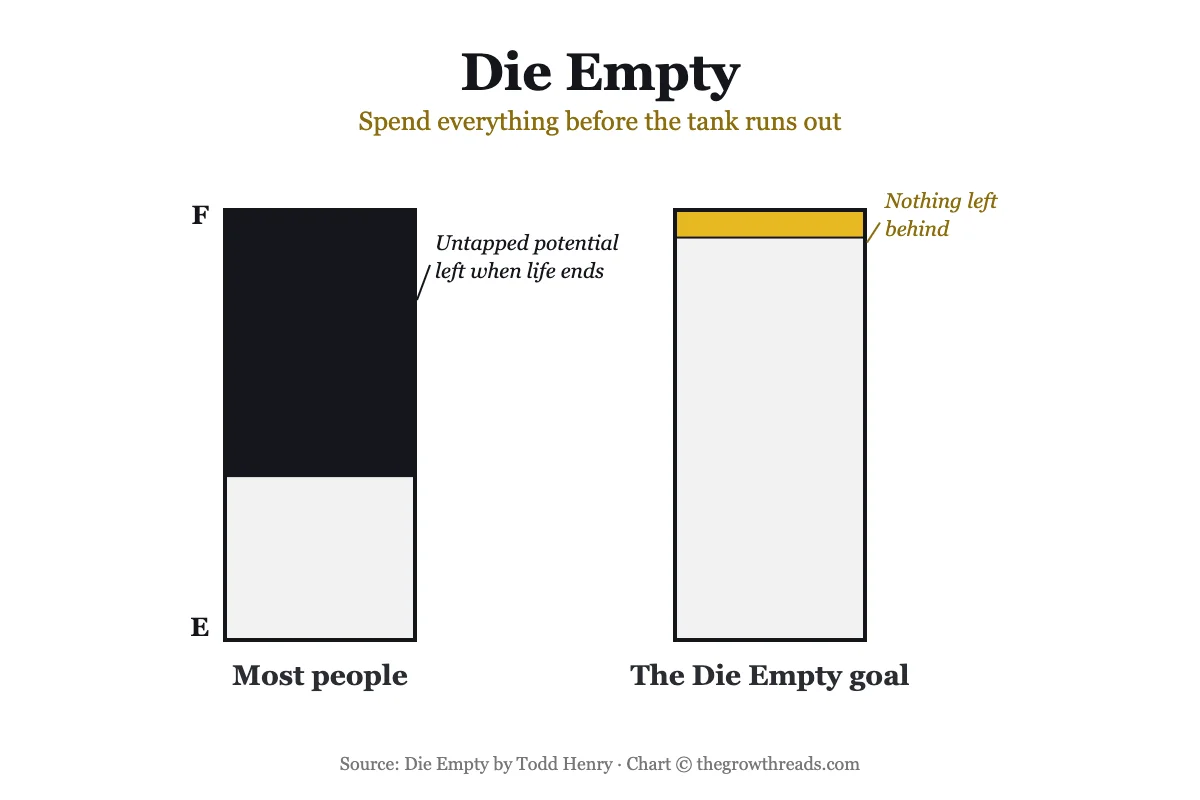
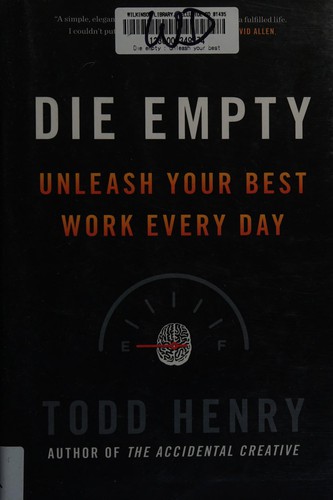
The greatest waste isn’t failure — it’s dying with your best work still inside you. Todd Henry’s Die Empty takes its title from the fuel gauge on its own cover: a life fully spent looks like a needle sitting on E, not F. Where many productivity books focus on getting more done, Henry focuses on a narrower and more urgent question — are you doing the work that will actually matter when you run out of time? He names three forces that quietly drain potential (fear, comfort, and rationalization), then builds a daily practice for spending down your capability on purpose instead of letting it expire unused.
Key takeaways
- The real risk isn’t failure: it’s reaching the end with your best work never attempted.
- Three villains drain potential: fear of failure, comfort with past success, and “someday” rationalization.
- Fear disguises itself as caution: playing it safe protects you from judgment but also guarantees the work never exists.
- Comfort is a slower trap than fear: repeating what already worked feels productive while it quietly stalls growth.
- Rationalization borrows against time you don’t actually have: “someday” assumes a guarantee no one gets.
- Your real work sits at the intersection of four questions: obsession, unique ability, demand, and regret.
- Study outside your field: unrelated input is what keeps creative work from going stale.
- Small, regular shipping beats rare, large launches: consistency compounds faster than intensity.
- Weekly honest review catches drift early: before a month of comfortable coasting becomes a habit.
- “Die empty” is a daily discipline, not a deathbed regret: it’s decided in ordinary weeks, not dramatic ones.
What is Die Empty about?
Die Empty is Todd Henry’s case for treating unspent potential as the real failure, not rejection or a bad outcome. It identifies three forces — fear, comfort, and rationalization — that quietly drain your best work over time, then offers a daily and weekly practice for locating and shipping the work that would otherwise go undone.
About the author
Todd Henry is a speaker and writer who spent years helping creative teams and leaders produce their best work reliably rather than sporadically. He’s the author of The Accidental Creative, which introduced a practical system for sustaining creative output under pressure, and hosts a podcast of the same name interviewing artists, entrepreneurs, and leaders about their craft. Die Empty, published in 2013, extended his focus from weekly creative output to a longer-horizon question: what happens if you never get around to your most important work at all. His background combines corporate consulting with a personal commitment to the arts, which shows in the book’s mix of practical daily habits and more reflective, mortality-aware framing. Explore all Todd Henry book summaries →
Key concepts at a glance
| Concept | What it means | Use it when |
|---|---|---|
| The three villains | Fear, comfort, and rationalization — the forces that quietly drain unused potential | You notice yourself avoiding, repeating, or postponing important work |
| Fear of failure | Playing it safe so an idea never risks being judged or rejected | You catch yourself avoiding a project specifically because it might not work |
| Comfort of success | Repeating a formula that already worked instead of risking something new | Your work has started to feel routine or safely predictable |
| Rationalization | “Someday” logic — assuming there will always be more time later | You keep deferring a project with no real deadline attached |
| Know your why | Locating real work at the intersection of obsession, ability, demand, and regret | You’re unsure which project actually deserves your best effort |
| Daily practice | Small, repeatable habits — focus blocks, outside study, shipping, honest review | You want consistent output rather than occasional bursts |
Part 1: The three villains that drain your potential
Henry opens by reframing what failure actually costs. A failed attempt, in his account, is recoverable — it produces information, experience, and often a second try. What isn’t recoverable is potential that never gets spent at all: the book you never wrote, the business you never started, the skill you let atrophy because using it felt too exposed. He names three specific forces responsible for that quieter, more permanent loss.
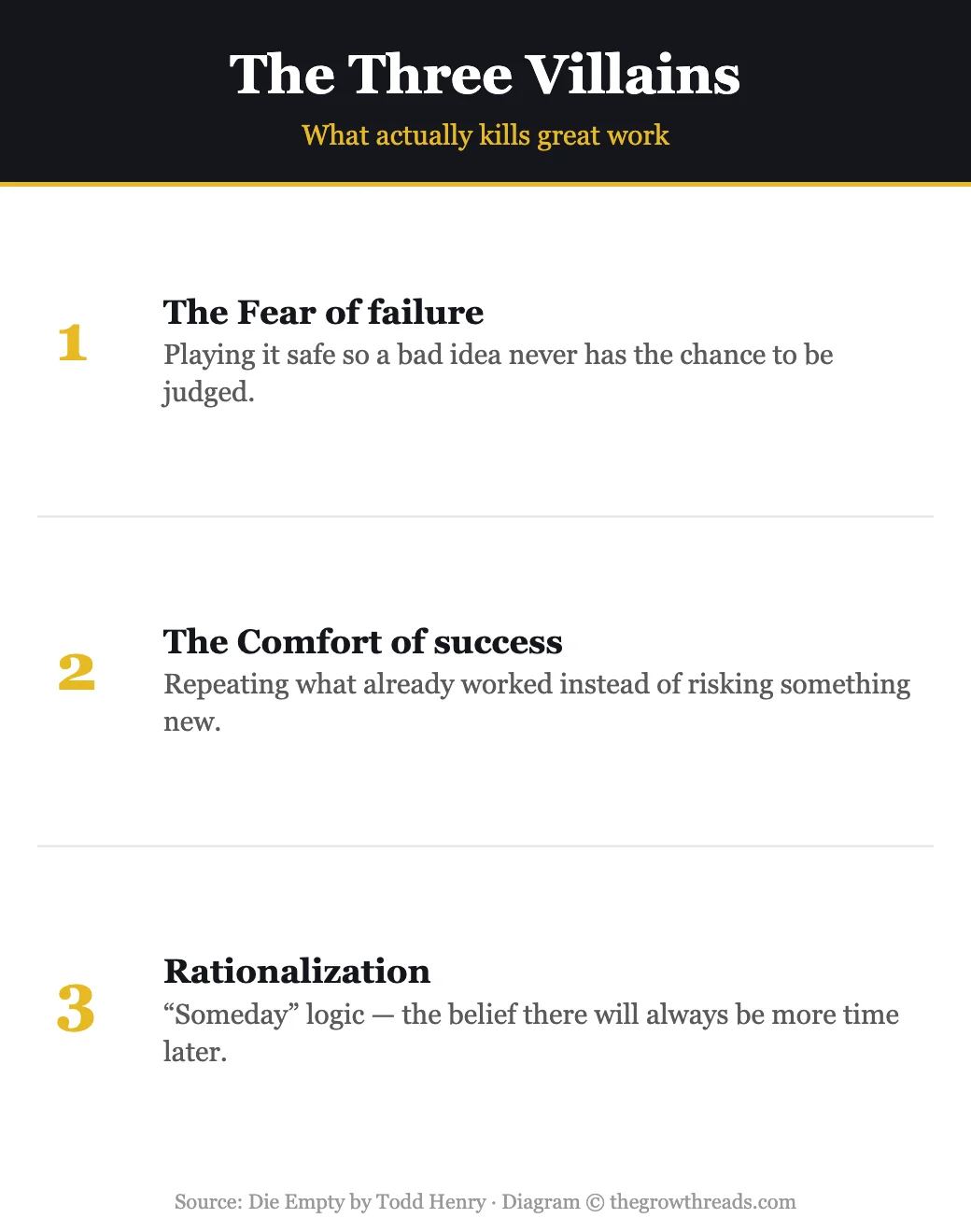
Fear of failure is the most familiar: staying safely inside what’s already proven so a new idea never has the chance to be judged and found wanting. Comfort of success is subtler and, Henry argues, more dangerous for people who’ve already had some wins — it disguises stagnation as stability, because repeating a working formula feels productive even as it quietly stops you from growing. Rationalization is the slowest villain of the three: the reasonable-sounding “someday” logic that assumes there will always be more time, more resources, or a better moment later. None of the three announce themselves as self-sabotage; each one sounds, in the moment, like good sense.
Part 2: Finding the work that’s actually yours
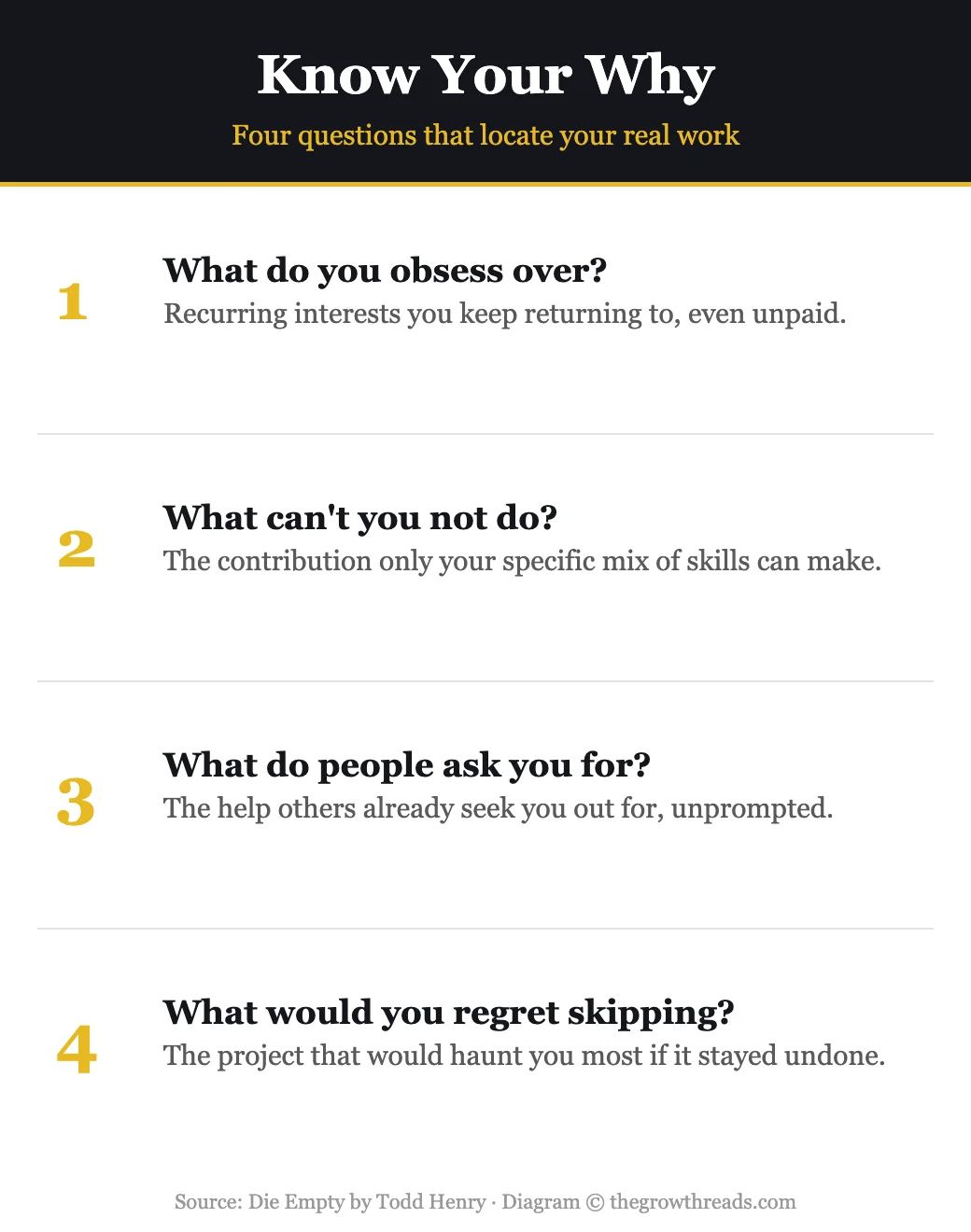
Before you can spend your potential deliberately, Henry argues you need to know precisely what it is you’re spending it on — a surprising number of people work hard for years without ever locating their most valuable contribution. He offers four questions as a locating tool: what do you obsess over even when it isn’t required of you, what can you do that draws on a combination only you have, what do people already come to you for without being asked, and what would you most regret leaving undone. Where those four questions overlap is usually where the real work lives.
This diagnostic matters because effort spent on the wrong target still drains the tank without producing the outcome Henry cares about. Busy isn’t the same as spent well; a calendar full of activity can still leave someone’s actual capability almost entirely untapped if none of it touches the intersection those four questions point to.
TGR Note: If “what can’t you not do” resonates, our Company of One summary covers a related idea — building work around your specific strengths rather than around growth for its own sake.
Part 3: The daily practice that keeps the tank draining
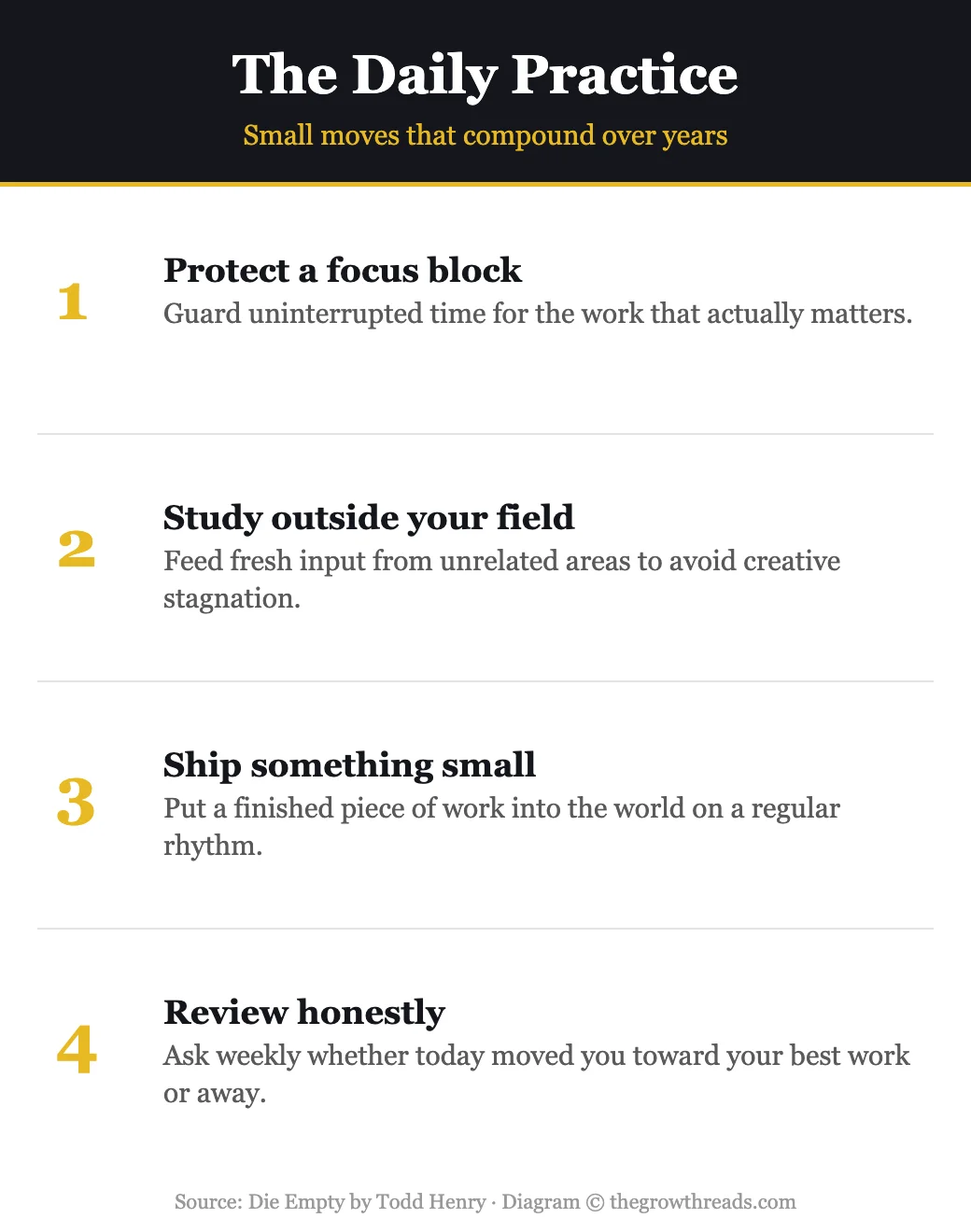
Knowing your real work only matters if a routine actually spends it, so the book’s middle stretch is the most tactical: a small set of repeatable habits meant to keep potential moving rather than accumulating unused. Henry recommends protecting a genuine focus block — uninterrupted time reserved specifically for the work identified in Part 2, not whatever feels urgent that day. He pairs this with deliberately studying outside your own field, on the theory that creative stagnation is usually an input problem before it’s an effort problem; a mind fed only by its own specialty runs out of new combinations to make.
The last two habits close the loop: shipping something small on a consistent rhythm, rather than waiting for a rare, large launch, and a weekly honest review that asks plainly whether the last seven days moved you toward your best work or just kept you occupied. None of these four habits is individually dramatic — Henry’s argument is that “die empty” is decided in exactly these unremarkable weeks, not in a single deathbed reckoning.
TGR Note: For a fuller treatment of protecting focus time specifically, see our Zen to Done summary, which pairs well with the daily-practice section here.
Part 4: Spending it on purpose, not by accident
Henry closes by widening the lens from weeks to a career, even a lifetime. The book’s title image — a fuel gauge reading E instead of F — is deliberately literal: he wants readers to picture their remaining capability as a finite, spendable resource rather than something that renews indefinitely. That framing isn’t meant to produce anxiety so much as urgency and permission — permission to attempt the ambitious, exposed, or unconventional project precisely because holding it back doesn’t preserve it, it just lets it expire unused.
The practical upshot is a standing question Henry wants readers to keep asking: given what I now know about my real work, is today’s effort spending down that tank on purpose, or just passing time comfortably? Repeated often enough, that question is the whole book compressed into a single daily check.
TGR Note: If the “someday” trap described here is more about avoidance than about mortality, Do the Work gives sharper, more tactical advice for the moment you actually sit down to start.
Who is Die Empty best for — and who should read something else first?
Die Empty is best for people who already have real skill and some track record, but who sense they’ve settled into repeating what’s safe rather than attempting what would actually matter. Its reflective, mortality-aware framing lands hardest for readers a few years into a career, not those just starting out.
If your problem is starting a specific stalled project rather than a broader sense of coasting, Do the Work is faster and more tactical. If you need daily systems more than motivation, Zen to Done is the better starting point. And if exhaustion, not complacency, is what’s actually draining you, Eat Sleep Work Repeat addresses that more directly.
Questions to reflect on
- Which of the three villains — fear, comfort, or rationalization — shows up most often in your work?
- Where do your obsession, unique ability, and what people ask you for actually overlap?
- What project have you been telling yourself you’ll get to “someday”?
- Looking back at the last month, was most of your effort spent on purpose or just comfortably occupied?
- What would it look like to ship a small, honest version of your most important idea this week?
🔥 Ready to spend your potential on purpose?
Get Die Empty and start the daily practice before “someday” quietly becomes never.
How to apply Die Empty (7-day plan)
- Day 1: Write down which of the three villains — fear, comfort, or rationalization — shows up most in your work right now.
- Day 2: Answer the four “know your why” questions and circle where they overlap.
- Day 3: Block one hour of genuinely uninterrupted time for the work that overlap points to.
- Day 4: Spend 20 minutes studying something completely outside your field for fresh input.
- Day 5: Ship one small, honest piece of the real work — imperfect is fine, undone is not.
- Day 6: Name one “someday” project you’ve been rationalizing and give it an actual date.
- Day 7: Run an honest weekly review — did this week spend your potential on purpose or on autopilot?
Frequently asked questions
What does “die empty” mean?
It means using up your creative potential before you run out of time, rather than reaching the end of your life or career with your best work still unattempted. The title borrows the image of a fuel gauge reading empty — everything spent, nothing left in reserve.
Is this a sequel to The Accidental Creative?
Not a direct sequel, but a natural follow-up. The Accidental Creative focuses on sustaining reliable creative output week to week; Die Empty widens the lens to a career-length question about whether your best ideas ever actually get attempted at all.
What are the “three villains” in the book?
Fear of failure, comfort with past success, and rationalization (“someday” logic). Henry argues all three feel reasonable in the moment, which is exactly what makes them effective at quietly draining potential without ever announcing themselves as self-sabotage.
How is Die Empty different from Do the Work?
Do the Work is short and tactical, focused on pushing one specific project through Resistance. Die Empty is longer and more reflective, focused on a career-wide pattern of avoidance and a set of daily habits meant to counter it over years, not days.
Do I need creative or artistic work for this book to apply?
No. Henry writes for anyone doing knowledge or creative work broadly — managers, entrepreneurs, and specialists included — not just artists. The four “know your why” questions and the daily practice apply to any field where effort and output aren’t automatically the same thing.
How long does it take to read?
Die Empty runs a little over 200 pages and most readers finish it in around four hours. Its short chapters and periodic reflection prompts make it easy to read in a few sittings rather than requiring one long session.
What’s the single most useful idea to take from this book?
That comfort, not just fear, is a legitimate threat to your best work. Readers most often cite the “comfort of success” villain as the one they hadn’t previously recognized in themselves, since it disguises stagnation as stability rather than obvious avoidance.
Related summaries
Continue exploring finishing, focus, and avoiding creative stagnation with these summaries: Do the Work, Turning Pro, Company of One, Zen to Done, or browse our full best productivity books pillar guide.
How we analyze books: we read primary sources and the author’s own essays and interviews, cross-reference key claims, and focus on practical application over academic critique. Read our full methodology.