

★★★★★ (4.5/5) — The voice in your head isn’t the enemy. Mismanaged, it’s noise; managed, it’s your best advisor.
Best for: Anyone whose inner monologue spirals into anxious rumination under pressure, and who wants research-backed tools rather than “just stop overthinking” advice.
Reading time: ~7 hrs to read (304 pages) · ~20 min to skim this guide
Difficulty to apply: Easy — most of the tools are small mental shifts usable in the moment.
Chatter in one minute
The voice in your head runs almost every waking moment — and for most people, it’s not helping as often as it could. Ethan Kross, a psychologist who directs the Emotion & Self-Control Lab at the University of Michigan, spent two decades studying “chatter” — the negative, looping inner dialogue that hijacks focus, decision-making, and wellbeing under stress. Chatter distills that research into a practical case: the inner voice itself isn’t the problem, since it’s essential for planning, rehearsing conversations, and processing experience. The problem is when it gets stuck in a loop, replaying the same anxious thought without resolving it. Kross’s core fix, illustrated throughout the book, is distance — psychological, temporal, or physical — which turns unproductive chatter back into useful reflection.
Key takeaways
- The inner voice isn’t inherently bad: chatter is what happens when it gets stuck in a loop, not the voice itself.
- Distanced self-talk works: using your own name or “you” instead of “I” measurably reduces anxiety and improves performance under pressure.
- Mental time travel shrinks problems: asking how much this will matter in a week or a year puts it back into proportion.
- Advise an imagined friend: imagining what you’d tell someone else facing your exact problem often reveals a clearer answer than advising yourself directly.
- Nature reliably reduces rumination: even a short walk among trees outperforms the same walk through a city street.
- Awe quiets the inner monologue: experiences that shrink the sense of self dial down chatter along with it.
- Order and small rituals restore control: structured routines and tidy environments provide real psychological benefit, even when the ritual itself does nothing physically.
- Not all support helps: co-rumination with a purely sympathetic listener can deepen a spiral instead of resolving it.
- The best confidants widen the view: they listen first, then gently broaden perspective, rather than only validating the chatter.
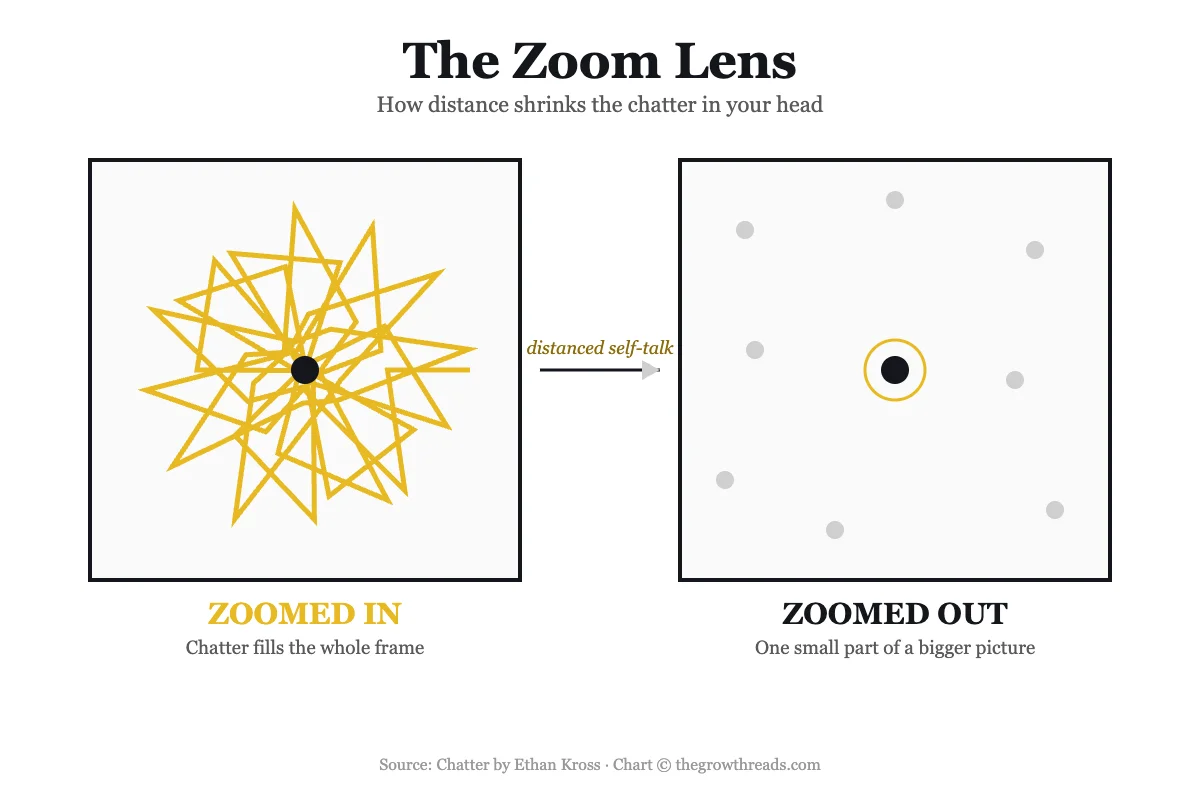
- Zooming out is the throughline: nearly every tool in the book, in one form or another, is a way of creating distance from a problem that feels too close.
What is Chatter about?
Chatter, by Ethan Kross, examines the inner voice that runs almost every waking moment, and explains why it sometimes spirals into anxious, unproductive rumination instead of helpful reflection. Drawing on two decades of research, Kross offers evidence-based tools, centered on psychological distance, for turning that voice from a critic back into a coach.
About the author
Ethan Kross is a professor of psychology and management at the University of Michigan, where he directs the Emotion & Self-Control Lab, and he has spent more than two decades researching how people can regulate their inner experience without suppressing it. His research has been funded by the National Institutes of Health and published in leading psychology journals, and he has advised organizations ranging from professional sports teams to the United Nations on applying these findings. Chatter (2021) distills that body of research into a book aimed at a general audience, translating laboratory findings on self-talk, rumination, and psychological distance into concrete, testable techniques. Kross’s approach throughout is consistently evidence-first: nearly every tool in the book is backed by a specific study he or a close collaborator ran, rather than intuition or anecdote alone. Explore all Ethan Kross book summaries →
Key concepts at a glance
| Concept | What it means | Use it when |
|---|---|---|
| Chatter | Negative inner dialogue that loops without resolving | Distinguishing useful reflection from unproductive rumination |
| Distanced self-talk | Addressing yourself by name or as “you” instead of “I” | Facing a high-pressure moment where anxiety is taking over |
| Mental time travel | Imagining how much a problem will matter in the future | A setback feels catastrophic in the moment |
| The zoom lens | Shifting between a close-up and a wide view of a problem | Chatter is making a single issue feel like your whole life |
| Awe and nature | Experiences that shrink the self and quiet rumination | You need to reset before or after a stressful stretch |
| Rituals and order | Structured routines and tidy environments that restore control | Chaos or uncertainty is amplifying anxious thoughts |
| Co-rumination | Venting repeatedly with someone who only validates, not widens | A relationship seems to deepen your spiral instead of easing it |
Part 1: What chatter actually is
Kross opens by defending the inner voice most self-help advice treats as the enemy. The capacity for inner speech does real cognitive work: it helps rehearse difficult conversations, hold information in working memory, and process experience after the fact. The problem isn’t that this voice exists — it’s what happens when it gets caught in a loop, replaying the same anxious thought on repeat without ever reaching resolution. Kross’s lab has documented the real physiological cost of sustained chatter: elevated cortisol, measurably worse decision-making, and even suppressed immune function during periods of prolonged rumination. Chatter isn’t just an uncomfortable mental state — it has consequences that show up in the body.
Part 2: Distance — the central tool
The book’s throughline is distance, in several forms. Distanced self-talk is the most studied: in one of Kross’s own experiments, people about to give a stressful public speech performed measurably better when they coached themselves using their own name (“Ethan, you’ve got this”) rather than “I’ve got this” — the small linguistic shift creates real psychological separation from the anxious voice. Mental time travel works similarly: asking how much a current problem will matter in a week, a month, or a year reliably shrinks its apparent size. And imagining what advice you’d give a friend facing your exact situation routinely produces clearer answers than trying to advise yourself directly, because the imagined distance strips away the emotional charge that muddies self-directed thinking.
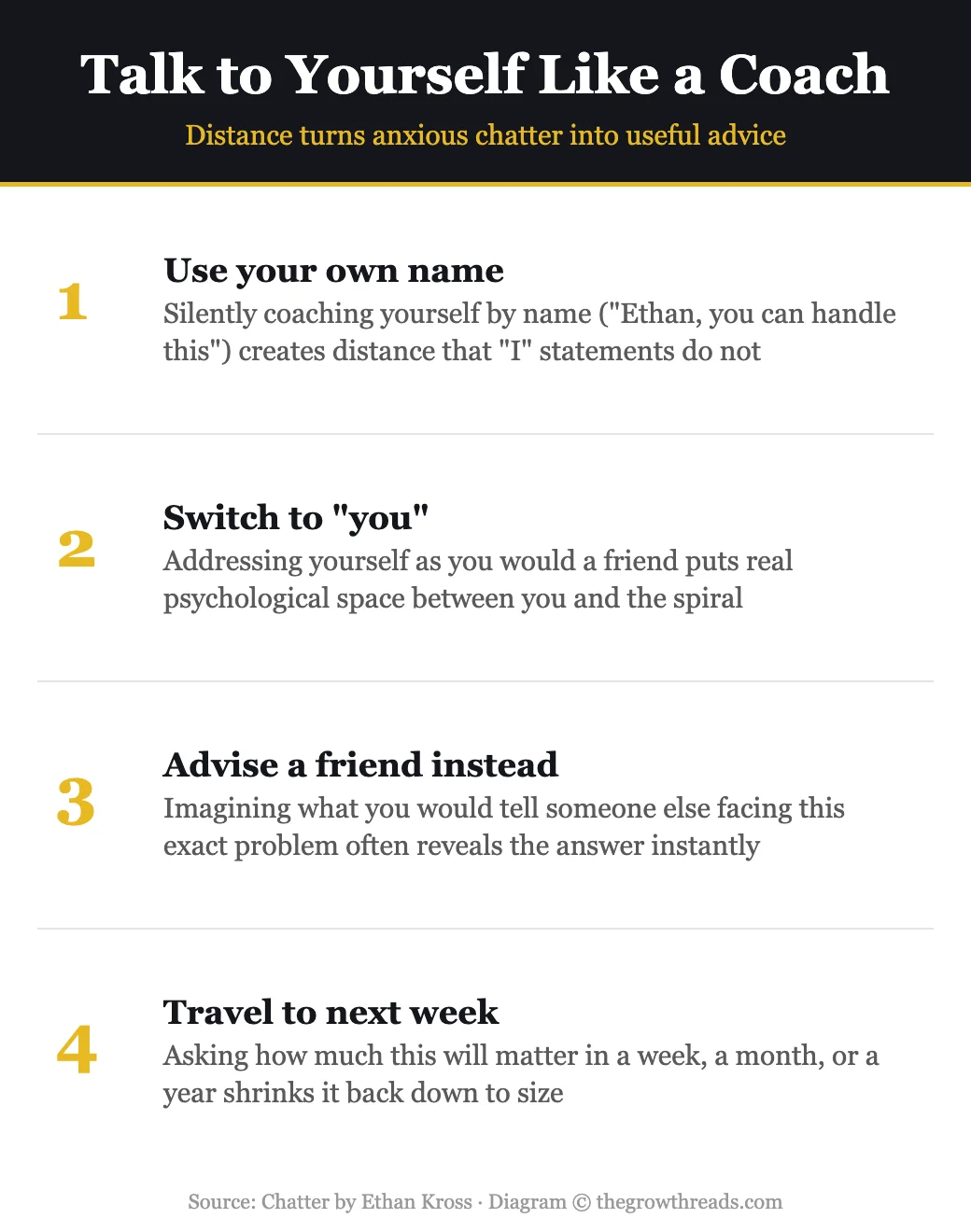
TGR Note: Advising an imagined friend is a close cousin of the “what would you tell someone else” reframe used throughout Solving the Procrastination Puzzle to defuse self-criticism.
Part 3: Shaping your environment
Chatter isn’t purely a mental exercise to manage — Kross shows that the physical and sensory environment shapes it directly. Time in nature reliably reduces rumination compared to the same amount of time spent in an urban setting, even when the walk itself is short. Experiences of awe — something vast enough to make you feel small in a good way — shrink the sense of self that chatter typically fixates on. And order matters more than it might seem: a tidy, controlled physical space, along with small structured rituals performed before a stressful moment, provides a genuine feeling of control, even when the ritual has no direct causal effect on the outcome itself.
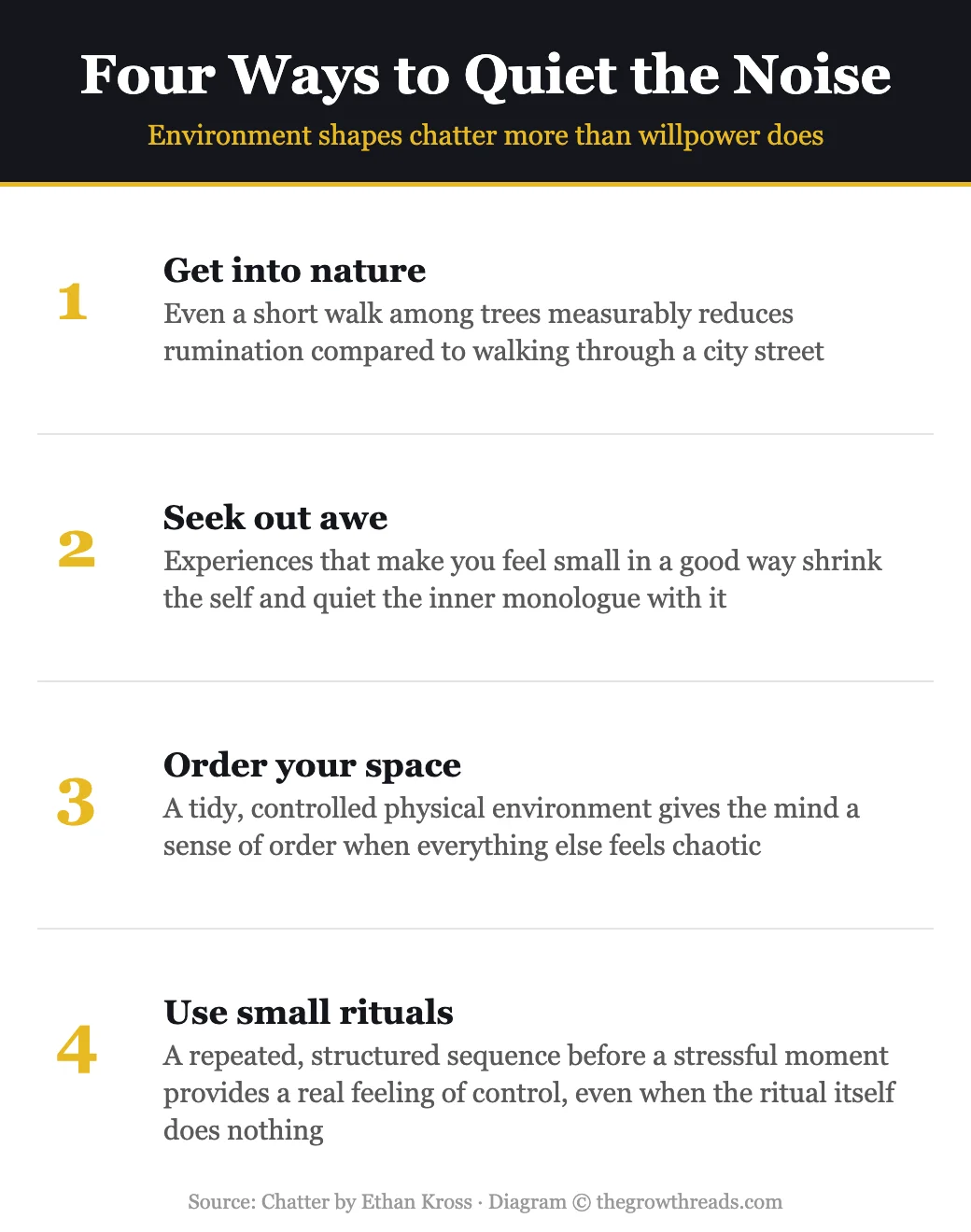
TGR Note: Order and ritual as tools for a sense of control echo the routine-building habit in Zen to Done — different vocabulary, same underlying mechanism.
Part 4: Getting support right
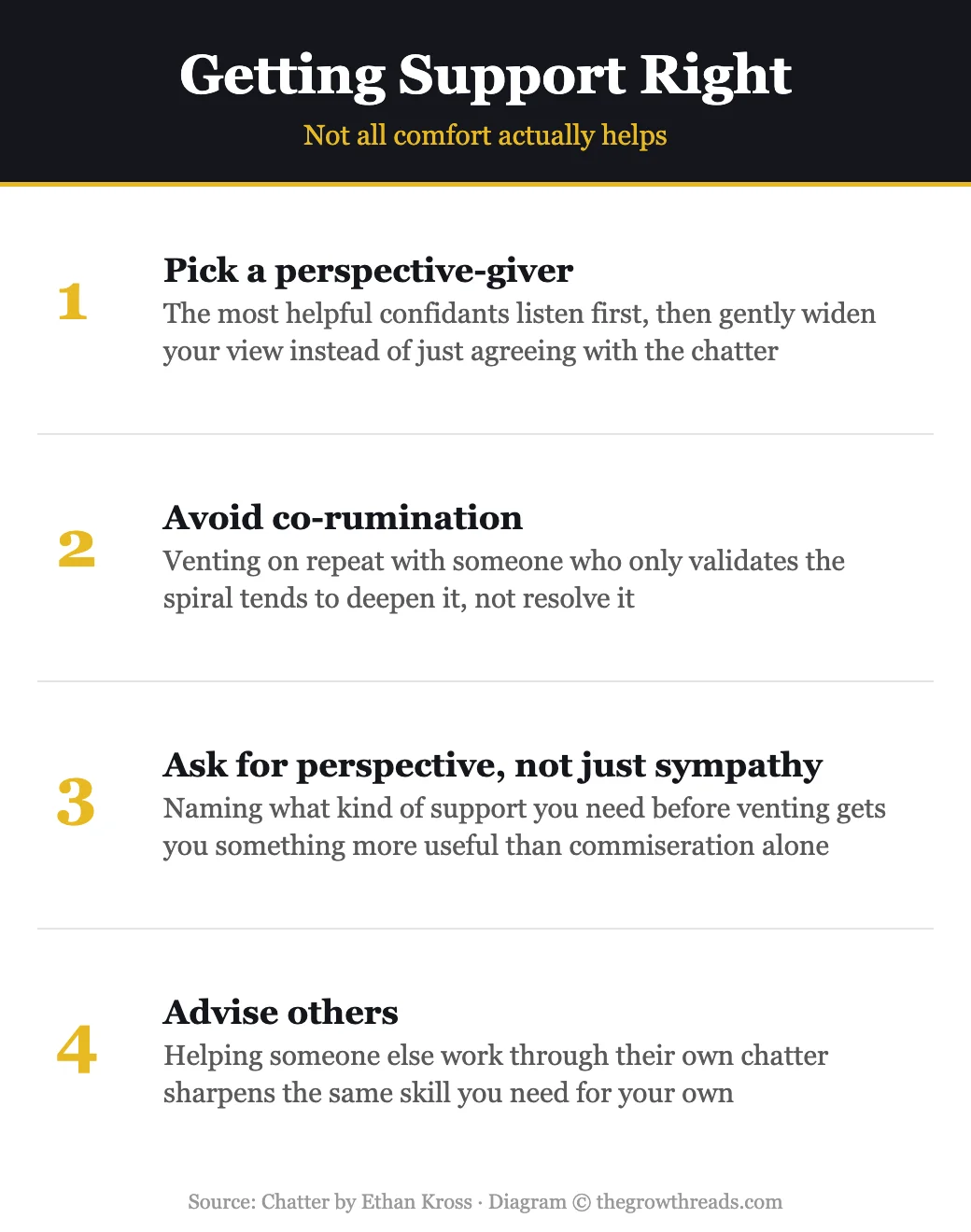
Kross devotes real attention to a counterintuitive finding: talking to other people about chatter doesn’t automatically help, and can sometimes make it worse. Co-rumination — repeatedly venting with someone who only validates the spiral without ever widening the perspective — tends to deepen distress rather than resolve it, even though it feels supportive in the moment. The confidants who actually help are the ones who listen first and then gently broaden the view, rather than just agreeing with every anxious thought. Kross also points out a useful side effect: practicing advice-giving for other people’s problems sharpens the exact same distancing skill needed to manage your own chatter, since it’s always easier to see clearly from the outside.
TGR Note: This mirrors the community-support argument in Peak Performance — the people around you can either normalize recovery or quietly reinforce the exact pattern you’re trying to break.
Who is Chatter best for — and who should read something else first?
Chatter is best suited to readers whose inner monologue spirals into anxious rumination under pressure, and who want specific, research-backed tools rather than generic advice to “just stop overthinking.” If the deeper issue is sustaining hard effort without burning out rather than managing self-talk specifically, Peak Performance covers that stress-and-recovery cycle in more depth. If you want a broader case for calm across mind, spirit, and body together, Stillness Is the Key takes a wider view. And if the chatter mostly shows up as procrastination and avoidance rather than anxiety, Solving the Procrastination Puzzle addresses that pattern directly.
Questions to reflect on
- When was the last time your inner voice looped on the same anxious thought without reaching any resolution?
- What would change if you coached yourself through your next stressful moment using your own name instead of “I”?
- Is there a problem right now that would shrink significantly if you asked how much it will matter in a year?
- Who in your life listens and then widens your perspective, versus who mostly just agrees with your chatter?
- What’s one small ritual or environmental change that reliably gives you a feeling of control under stress?
🔥 Ready to turn your inner critic into a coach?
Grab a copy of Chatter and start with distanced self-talk this week.
How to apply Chatter (7-day plan)
- Day 1: Notice one moment your inner voice loops on the same thought, and name it: is it useful reflection or unproductive chatter?
- Day 2: Coach yourself through a stressful moment using your own name instead of “I.”
- Day 3: Pick a current worry and ask how much it will matter in a week, a month, and a year.
- Day 4: Take a short walk somewhere with trees or greenery, with no phone, and notice the difference afterward.
- Day 5: Tidy one physical space that’s been feeling chaotic, and notice whether your mind feels different.
- Day 6: Before your next stressful task, use a small, deliberate ritual to start it — the same sequence, every time.
- Day 7: Identify the confidant in your life who widens your perspective rather than just validating you, and reach out to them.
Frequently asked questions
What is “chatter” according to Ethan Kross?
Chatter is Kross’s term for negative, looping inner dialogue — the voice in your head replaying the same anxious or self-critical thought without ever reaching resolution. He distinguishes it from the inner voice’s normal, useful functions, like rehearsing conversations or planning, which aren’t a problem on their own. Chatter specifically refers to when that inner speech gets stuck in an unproductive loop.
Is Chatter based on real scientific research?
Yes, extensively. Ethan Kross directs the Emotion & Self-Control Lab at the University of Michigan and has spent over two decades researching self-talk, rumination, and psychological distance, with funding from the National Institutes of Health. Nearly every technique in the book is tied to a specific study, often one Kross or a close collaborator conducted directly, rather than general psychological theory or anecdote.
What is distanced self-talk and does it actually work?
Distanced self-talk means addressing yourself using your own name or “you” instead of “I” — for example, “Alex, you can handle this” instead of “I can handle this.” Research from Kross’s lab has found this small linguistic shift measurably reduces anxiety and improves performance under pressure, including in public speaking and stressful problem-solving tasks, likely because it creates genuine psychological distance from the anxious voice.
Can talking to friends about my problems make chatter worse?
Yes, in a specific pattern Kross calls co-rumination — repeatedly venting to someone who only validates and sympathizes without ever widening the perspective. This can feel supportive in the moment but tends to reinforce and deepen the spiral rather than resolve it. The confidants who actually help are the ones who listen first and then gently broaden the view, rather than only agreeing.
How is Chatter different from general anxiety or mental health advice?
Chatter is narrower and more mechanistic than most general wellbeing advice — it focuses specifically on the mechanics of inner dialogue and offers targeted, testable techniques (distanced self-talk, mental time travel, environmental changes) rather than broad lifestyle recommendations. It’s not a replacement for treatment of clinical anxiety or depression, but a set of tools aimed at everyday rumination and stress-related inner monologue.
What are some quick, practical takeaways from Chatter?
Three are easy to start today: coach yourself through a stressful moment using your own name instead of “I”; ask how much a current worry will actually matter in a year; and notice whether the people you vent to are widening your perspective or just agreeing with the chatter.
How does Chatter compare to Stillness Is the Key?
Stillness Is the Key takes a broad, historically grounded approach to calm across mind, spirit, and body. Chatter is narrower and more clinical, focused specifically on the mechanics of the inner voice and backed by direct psychological research rather than historical case studies. The two complement each other well: Stillness Is the Key for the wider philosophy, Chatter for the specific, testable techniques to manage anxious inner dialogue in the moment.
Related summaries
- Peak Performance by Brad Stulberg & Steve Magness
- Stillness Is the Key by Ryan Holiday
- Solving the Procrastination Puzzle by Timothy A. Pychyl
- Best Productivity Books
How we analyze books: our summaries are researched from the author’s published work, interviews, and reputable secondary sources, then structured around practical application rather than critique. Read our full methodology.