

★★★★★ (4.6/5) — Nassim Taleb names a category we didn’t have a word for: things that don’t just survive disorder, they need it to grow.
Best for: Readers who want a rigorous, contrarian framework for building resilience into their finances, health, and decisions.
Reading time: ~15 min summary (book: ~16–18 hrs)
Difficulty to apply: Moderate-to-hard — the ideas are sharp, but Taleb’s uncompromising style takes some adjusting to
Antifragile in one minute
Some things are hurt by disorder, some things merely survive it, and a rare few actually grow stronger because of it — and until Nassim Taleb wrote this book, that third category didn’t even have a name. Antifragile is Taleb’s argument that modern life systematically over-engineers for stability and under-prepares for shocks, producing systems — financial, medical, political, personal — that look safe for long stretches and then fail catastrophically. His solution isn’t to predict the next shock; it’s to build things, including yourself, that benefit from volatility rather than merely tolerating it. The book ranges across finance, medicine, evolution, and philosophy, but the core move is always the same: stop trying to eliminate randomness, and start positioning yourself to gain from it.
Key takeaways
- Fragile things break under stress, robust things resist it, antifragile things gain from it: this three-way distinction is the book’s central framework.
- Prediction is overrated; positioning is underrated: instead of forecasting rare events, build a setup that benefits when they happen, whichever direction they go.
- The barbell strategy avoids the risky middle: combine extreme safety with small, capped, high-upside bets, and skip the moderate-risk options that offer real downside without matching upside.
- Small stressors build strength (hormesis): controlled exposure to difficulty — fasting, exercise, cold, financial risk — often makes systems and people more resilient, not less.
- Over-optimization is a hidden fragility: systems stripped of slack and redundancy look efficient right up until an unexpected shock breaks them.
- Naive interventionism backfires: suppressing every small, natural fluctuation in a system often just stores up a much larger failure for later.
- Via negativa often beats via positiva: removing what’s harmful is frequently more powerful, and more reliable, than adding what seems helpful.
- Skin in the game matters: advice from people who don’t share in the downside of being wrong is structurally unreliable, regardless of credentials.
- Time is the ultimate stress test: things that have survived a long time, across many different conditions, carry real evidence of robustness that models can’t replicate.
- You can’t engineer away all risk — you can choose which risks you take: the antifragile approach accepts small, visible harms to avoid rare, catastrophic, hidden ones.
What is Antifragile about?
Antifragile is Nassim Nicholas Taleb’s argument that some systems don’t just withstand disorder, shocks, and volatility — they actually need them to grow stronger, and that understanding this “antifragile” category can reshape how we manage risk in finance, health, decision-making, and daily life.
About the author
Nassim Nicholas Taleb is a former options trader turned scholar, essayist, and risk theorist, best known for his Incerto series — a set of books, including Fooled by Randomness, The Black Swan, and Antifragile, exploring uncertainty, probability, and rare, high-impact events. Before turning to writing full-time, Taleb spent nearly two decades as a quantitative trader, an experience that shaped his lasting skepticism of forecasting models and elegant theories that fail to account for real-world randomness. He holds a position as Distinguished Professor of Risk Engineering at NYU and is known for a combative, aphoristic writing style that mixes rigorous probability theory with sharp opinions about academia, media, and expert culture. Whatever readers think of his tone, his core insight — that fragility is often hidden and antifragility can be deliberately engineered — has influenced fields well beyond finance.
Key concepts at a glance
| Concept | What it means | Use it when |
|---|---|---|
| Fragile | Harmed by shocks, volatility, and disorder; wants a calm, predictable environment | Identifying systems or plans that look fine until a real shock arrives |
| Robust | Resists shocks without being harmed or helped by them | Describing something built to withstand disruption, not benefit from it |
| Antifragile | Actually gains strength or value from shocks, volatility, and stress, within limits | Designing systems, habits, or portfolios meant to improve under pressure |
| Barbell strategy | Combining extreme safety with small, high-upside risk, avoiding moderate risk entirely | Structuring investments, career bets, or life decisions under real uncertainty |
| Hormesis | Small doses of a stressor triggering a beneficial adaptive response | Explaining why controlled difficulty (exercise, fasting) builds resilience |
| Via negativa | Improving a system by removing harmful elements rather than adding new ones | Simplifying a plan, diet, or process instead of layering on more rules |
| Skin in the game | Having real, personal exposure to the downside of your own advice or decisions | Evaluating whether to trust advice, forecasts, or expert opinions |
Part 1: The Fragile, the Robust, and the Antifragile
Taleb opens with a deceptively simple observation: we have words for things that break under stress (fragile) and words for things that resist it (robust or resilient), but until this book, no word existed for things that actually improve because of stress. He coins “antifragile” to fill that gap, and the distinction turns out to matter enormously once you start looking for it.
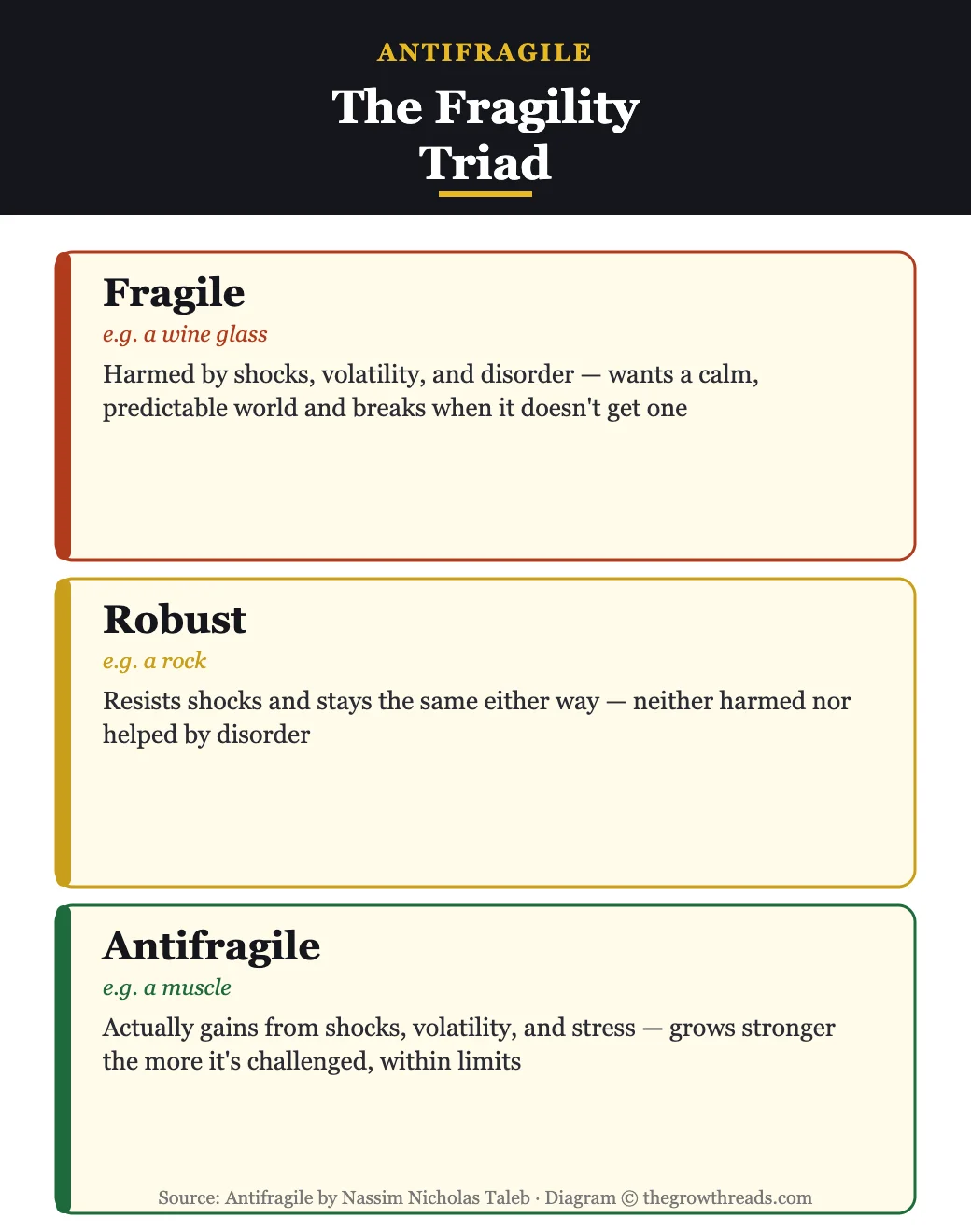
A wine glass is fragile: shipping it carefully, in a calm environment, keeps it intact, but any real shock shatters it. A rock is robust: throw it around, and it stays essentially the same rock. But a muscle — or an immune system, or certain kinds of financial positions, or even certain kinds of businesses — is antifragile: moderate, repeated stress makes it stronger, not weaker, up to a point. Taleb’s argument is that biological systems evolved to be antifragile in ways that our modern, over-engineered institutions often are not.
This matters because we routinely misdiagnose fragility as safety. A system that hasn’t experienced a shock in a long time can look robust while actually being fragile and simply “hasn’t been tested yet” — a distinction Taleb returns to constantly, because it’s exactly the kind of mistake that causes financial crises, engineering failures, and health crises that “came out of nowhere” but were, in hindsight, entirely predictable from the hidden fragility.
Taleb calls this the “turkey problem,” borrowing the image from his earlier work: a turkey is fed reliably every day for a thousand days, and each additional day of calm feeding makes the turkey more confident that the pattern will continue. Then the day before Thanksgiving arrives. The turkey’s data was perfect right up until the moment it became worthless, and worse, the very reliability of the pattern was what made the turkey blind to the risk. Taleb argues this isn’t a quirky edge case — it’s the default failure mode of any system that treats a stretch of calm as proof of underlying safety, whether that system is a bank’s risk model, a national economy, or a person’s sense that their job or relationship is secure simply because nothing bad has happened lately.
The antidote isn’t paranoia, it’s structural. Rather than trying to compute the probability of the next shock — which Taleb considers a fool’s errand for rare, high-impact events — the goal is to build in enough margin that when a shock does come, however unlikely it seemed beforehand, it strengthens your position instead of destroying it. This reframing, from “predict and avoid” to “prepare and benefit,” is the thread that runs through every practical technique in the rest of the book.
TGR Note: If this triad clicks for you, The Scout Mindset pairs well here — it’s about noticing your own hidden fragilities in belief and reasoning, not just in systems.
Part 2: The Barbell — Betting on Both Ends
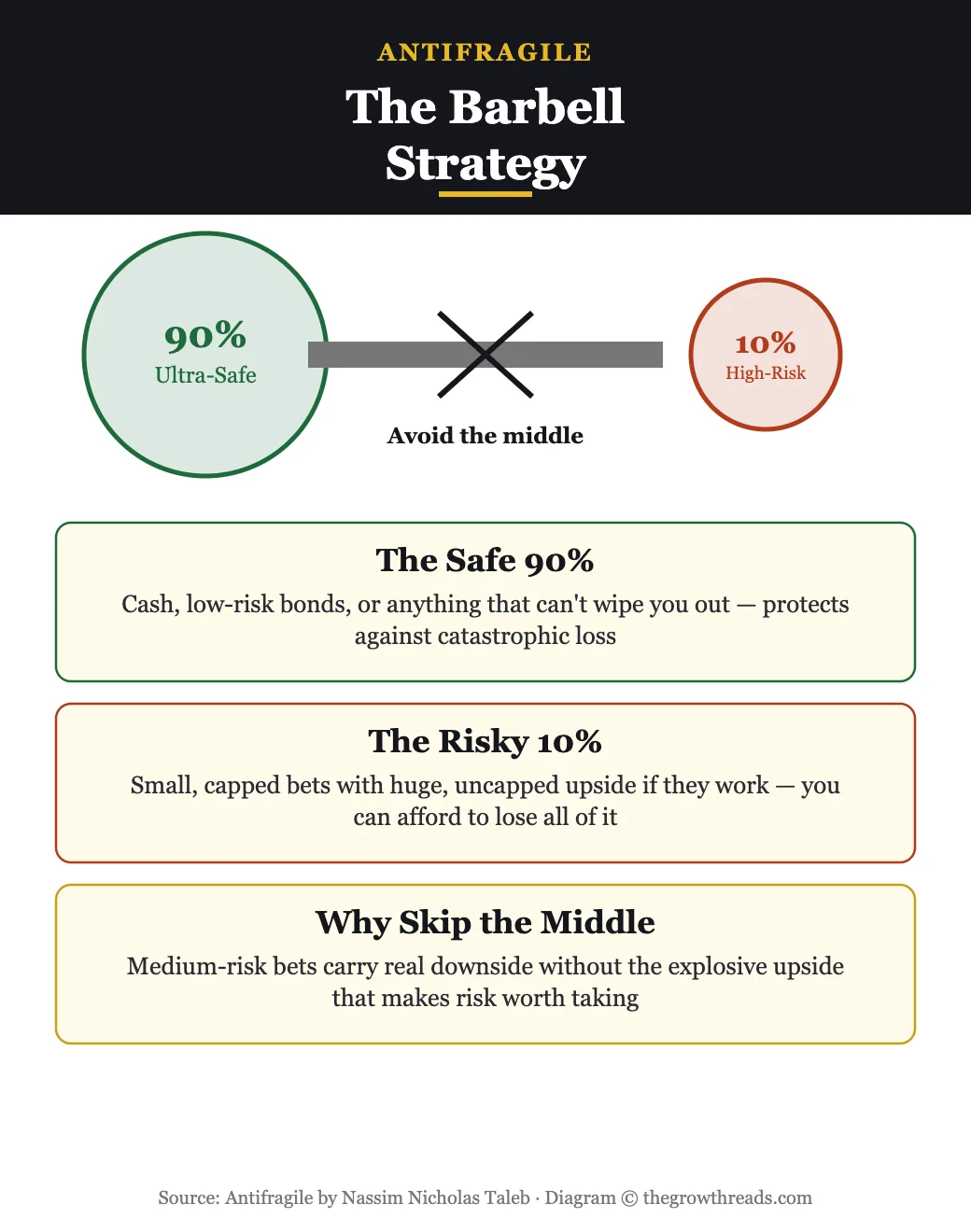
Taleb’s most practical contribution — the one that’s been most widely adopted outside academic circles — is the “barbell strategy.” Instead of putting your resources into moderate-risk positions that carry real downside without extraordinary upside, you split them between two extremes: a large portion in something extremely safe, and a small portion in something extremely speculative, capped so the maximum loss is affordable.
The logic is that moderate risk is often the worst place to be: it exposes you to genuine downside — enough to hurt if it goes wrong — without offering the outsized upside that would make the risk worth taking. A barbell, by contrast, protects the bulk of your position from catastrophic loss while leaving room for enormous, asymmetric gains on the small speculative slice, if it pays off. Crucially, you can afford to be wrong on the risky 10% repeatedly, because the loss is capped and the potential gain is not.
Taleb applies this logic well beyond investing — to career choices (a stable base with occasional high-upside side bets), to health (a conservative baseline diet with occasional extreme fasting), and to time management (protected deep-focus time alongside deliberately unstructured exploration). The common thread is always avoiding the fragile, exposed middle ground.
What makes the barbell counterintuitive is that it looks reckless from the outside — critics see the speculative slice and assume the whole strategy is high-risk — when in fact it’s the opposite. A person who puts 100% of their savings into a “moderately safe” investment vehicle is often taking on more real risk than someone who puts 90% into something nearly bulletproof and 10% into something wildly speculative, because the moderate option has hidden tail risk that rarely gets modeled correctly, while the barbell’s downside is capped and known in advance. Taleb’s point is that the appearance of caution and the reality of caution are frequently unrelated, and mistaking one for the other is exactly how supposedly conservative institutions end up blindsided by shocks they insisted were nearly impossible.
TGR Note: For a related, more grounded take on managing uncertainty over a lifetime rather than a single decision, Same as Ever makes a strong companion to this chapter.
Part 3: Small Stress, Real Strength
Taleb devotes significant attention to hormesis — the biological phenomenon where a small dose of a stressor triggers a disproportionately beneficial adaptive response. Exercise is the clearest example: brief, intense stress on muscles triggers repair processes that leave you stronger than before the stress occurred. Fasting, cold exposure, and even certain financial risks work on a similar principle — the system doesn’t just survive the stressor, it overcorrects in response to it.
This leads Taleb to one of the book’s more provocative arguments: that a life engineered to remove all discomfort, unpredictability, and difficulty actually produces fragility, not health. Children raised without any exposure to manageable risk, employees never allowed to make consequential decisions, and bodies never subjected to physical stress all lose the adaptive capacity that difficulty would have built. Comfort, taken too far, is itself a hidden risk.
The practical implication isn’t “seek out maximum suffering” — Taleb is explicit that stress has to be dosed correctly, with adequate recovery, to produce antifragile gains rather than simple damage. The skill is calibrating stressors so they’re large enough to trigger adaptation but small enough not to cause lasting harm, which is exactly the logic behind interval training, intermittent fasting, and deliberately difficult practice in any skill.
Taleb extends the same logic to institutions and economies, arguing that small, frequent recessions and failures are actually healthy signals that a system is shedding weak components before they accumulate into something systemic. An economy that hasn’t had a single small correction in a decade isn’t necessarily strong — it may simply be storing up the stress that smaller, more frequent corrections would have released gradually. He points to natural forest ecosystems, which depend on small, regular fires to clear undergrowth; suppress those fires for too long, and the eventual blaze, when it comes, burns hotter and spreads faster than anything the ecosystem evolved to handle. The same pattern, he argues, shows up in careers that avoid all failure until one catastrophic setback, and in bodies kept so sedentary and protected that a single injury or illness becomes disproportionately damaging.
TGR Note: The idea that our reasoning itself needs stress-testing rather than protection connects directly to Thinking, Fast and Slow, which maps the cognitive biases that make us overestimate how safe “calm” really is.
Part 4: Removing Harm, Distrusting Intervention, and Demanding Skin in the Game
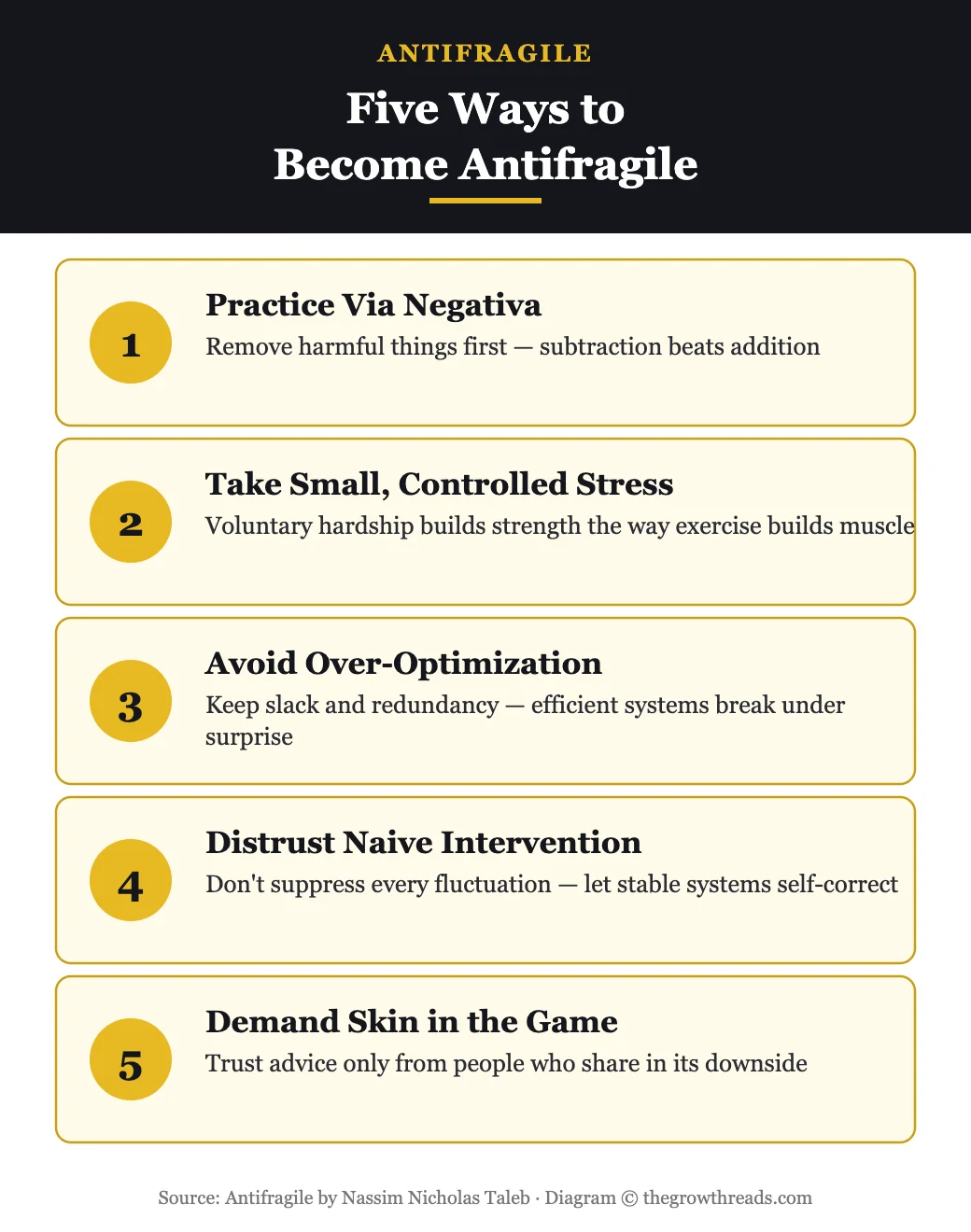
The book’s later sections turn practical, built around a set of heuristics for acting under uncertainty without needing to predict it. The first is “via negativa”: the observation that removing harmful elements from a system — a toxic habit, an unnecessary rule, a bad relationship — is usually more reliable than adding a new “solution,” because addition introduces new unintended consequences while subtraction rarely does.
The second is a deep suspicion of what Taleb calls naive interventionism: the well-intentioned but often destructive habit of suppressing every small, natural fluctuation in a system. Forest-fire suppression that lets fuel accumulate for one catastrophic fire, financial regulation that hides risk rather than eliminating it, and parenting that removes every minor struggle a child faces all follow the same failure pattern — short-term smoothing that stores up a much larger failure for later.
The final heuristic, and arguably the one that’s spread furthest beyond this book, is “skin in the game”: the principle that advice, forecasts, and policies should only be trusted from people who share meaningfully in the downside if they’re wrong. A forecaster with no stake in a bad prediction, an executive who profits regardless of a company’s failure, or an advisor who bears no cost for bad advice all lack the incentive alignment that makes real-world judgment reliable — credentials and confidence aren’t a substitute for actual exposure to being wrong.
Taleb is particularly pointed about what he calls the fragility of the “expert” class in domains where feedback is slow, indirect, or absent — economic forecasting, long-term policy, and certain areas of academic theorizing. He contrasts these with domains like engineering, surgery, and small business, where practitioners face fast, direct consequences for error and therefore develop genuinely reliable judgment over time. The takeaway isn’t to distrust all expertise, but to weight advice according to whether the person giving it actually bears a cost when they’re wrong, rather than according to their titles, credentials, or confidence in delivery.
TGR Note: Skin in the game is also a core theme in Charlie Munger’s approach to decision-making — Poor Charlie’s Almanack is an excellent next read for more on incentive-aware thinking.
Who is Antifragile best for — and who should read something else first?
This book is best for readers who enjoy rigorous, somewhat combative reasoning and want a genuinely new mental framework for risk, uncertainty, and resilience — in finance, health, or decision-making generally. It rewards patience with a dense, sometimes discursive style in exchange for ideas that are hard to find anywhere else in one place.
If you want the cognitive-bias foundation underneath Taleb’s skepticism of forecasting, start with Thinking, Fast and Slow first. If you’re specifically interested in applying antifragile thinking to long-term financial decisions, Same as Ever is a gentler, more approachable companion. And if the “skin in the game” heuristic resonates most, Poor Charlie’s Almanack extends that thread further.
Questions to reflect on
- Where in your life do you have a fragile setup that looks safe simply because it hasn’t been stress-tested yet?
- Do your investments, career, or habits sit in the “risky middle,” with real downside but no exceptional upside?
- What’s one small, controlled stressor you could add to your routine to build real resilience?
- Is there a rule, habit, or possession you could remove, rather than a new one you could add, to improve a system in your life?
- Whose advice do you follow that comes with no real skin in the game if it turns out to be wrong?
🔥 Ready to build systems that gain from disorder?
Grab a copy of Antifragile and start engineering your finances, health, and decisions to benefit from uncertainty.
How to apply Antifragile (7-day plan)
- Day 1 — Audit your fragilities: List three things in your life (financial, physical, professional) that look stable but haven’t been stress-tested recently.
- Day 2 — Sketch a barbell: For one area of risk, identify what an “ultra-safe” and a “small, capped, high-upside” allocation would look like, instead of the moderate middle.
- Day 3 — Add a small stressor: Introduce one controlled, recoverable challenge this week — a hard workout, a cold shower, a short fast.
- Day 4 — Practice via negativa: Identify one harmful habit, rule, or commitment to remove, rather than adding something new to compensate for it.
- Day 5 — Spot naive intervention: Notice one place you (or a system you rely on) suppress small, natural problems instead of letting them surface and resolve.
- Day 6 — Check skin in the game: Identify one piece of advice you’re following from someone with no real stake in the outcome, and reconsider its weight.
- Day 7 — Choose one antifragile experiment: Pick one small, real change from this week and commit to running it for the next month.
Frequently asked questions
Is Antifragile hard to read?
It’s denser and more discursive than a typical business or self-help book, mixing probability theory, philosophy, personal anecdotes, and pointed opinions about academia and expert culture. Taleb’s writing style is distinctive — aphoristic, combative, and occasionally repetitive — which some readers find energizing and others find exhausting. Readers who want the core ideas without the full 500-plus pages of tangents may prefer to focus on the sections covering the fragile-robust-antifragile triad and the barbell strategy, which carry most of the book’s practical weight.
Do I need to read The Black Swan first?
No, though it helps. The Black Swan, Taleb’s earlier book, focuses on rare, high-impact, hard-to-predict events and our tendency to underestimate them. Antifragile builds on that foundation but stands on its own, shifting the focus from predicting rare events to designing systems that benefit from them regardless of direction. Readers new to Taleb’s work can start with either book, though Antifragile is generally considered the more practically applicable of the two.
Is the barbell strategy only for investing?
No — Taleb explicitly extends it beyond finance. He applies the same logic to career decisions (a stable job paired with high-upside side projects), health (a conservative baseline with occasional intense physical stress), and time management (protected focus time alongside unstructured exploration). The underlying principle — combining extreme safety with small, capped, high-upside risk while avoiding the exposed middle — is presented as a general approach to decision-making under uncertainty, not a narrow investment tactic.
Who is Nassim Nicholas Taleb?
Nassim Nicholas Taleb is a former options trader turned scholar and essayist, known for his Incerto series of books on uncertainty and risk, including Fooled by Randomness, The Black Swan, and Antifragile. He spent nearly two decades as a quantitative trader before turning to writing and academia full-time, and holds a position as Distinguished Professor of Risk Engineering at NYU. His work is known for combining rigorous probability theory with a sharp, often combative critique of forecasting, academia, and expert culture.
Does “antifragile” just mean resilient?
No, and Taleb is emphatic about this distinction. Resilient or robust systems resist damage and return to their prior state after a shock — they neither gain nor lose from disorder. Antifragile systems go a step further: they actually improve, growing stronger or more valuable because of exposure to volatility and stress, within limits. The distinction matters because it changes the goal from merely surviving uncertainty to actively benefiting from it.
What’s one practical takeaway from the book?
If you take just one idea from the book, make it this: avoid the exposed middle ground in any major decision involving uncertainty. Instead of a moderate-risk investment, moderate-difficulty habit, or moderate-commitment plan, try splitting your approach into a very safe base and a small, capped, high-upside bet — and see whether that barbell structure protects you better than the “balanced” middle option you were considering.
Does Antifragile apply outside of finance and investing?
Yes — this is one of the book’s central points. While Taleb’s background is in finance and many of his examples draw on markets, he explicitly applies the fragile-robust-antifragile framework to health (hormesis and exercise), careers (barbell-style bets alongside stable work), politics and institutions (small versus suppressed disruptions), and personal decision-making generally (via negativa and skin in the game). Readers with no interest in finance can apply nearly all of the book’s core ideas directly to health, habits, and everyday choices.
Related summaries
- Thinking, Fast and Slow — the cognitive biases underneath our overconfidence in stability
- The Scout Mindset — spotting hidden fragility in your own beliefs and reasoning
- Same as Ever — a gentler take on planning for an uncertain future
- Poor Charlie’s Almanack — Munger’s incentive-aware, mental-models approach to decisions
See all our best psychology books →
How we analyze books: Every TGR summary is built from a full read of the book, cross-checked against the author’s interviews and published research, then structured into a practical, apply-it-this-week format. Read our full methodology.