

★★★★☆ 4.3/5
One-liner: The key to better thinking is not intelligence — it is the willingness to see the world as it actually is, even when that picture is uncomfortable.
Best for: Curious thinkers, decision-makers, and anyone who wants to reduce self-deception and reason more clearly about beliefs, predictions, and life choices.
Reading time: ~5 hours (288 pages)
Difficulty to apply: Moderate — the mindset shift is simple to understand but requires ongoing practice to internalize.
The Scout Mindset in One Minute
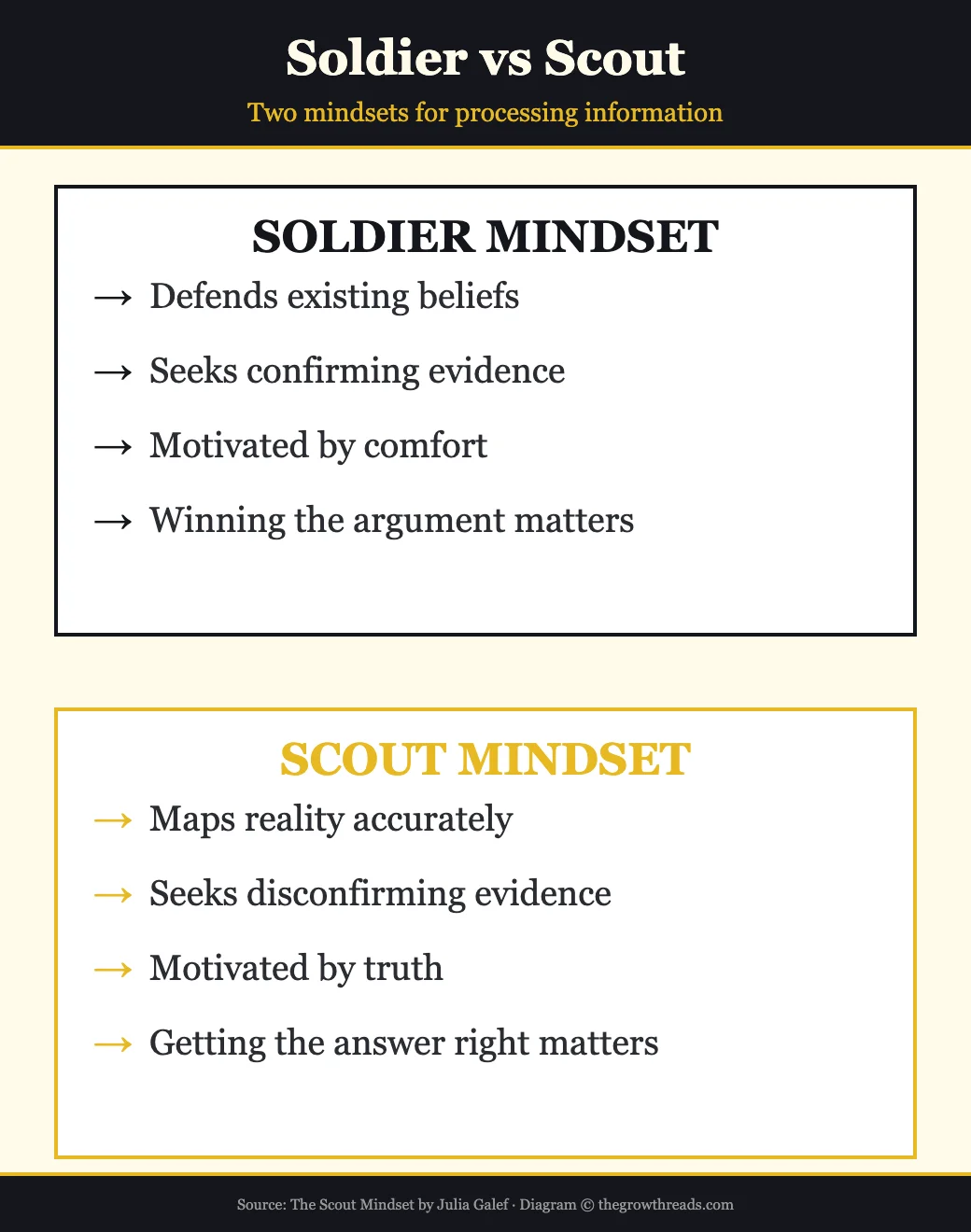
Most of us are soldiers defending our beliefs — scouts are the ones who actually find the truth. Julia Galef draws a distinction between two ways of thinking. The soldier mindset treats reasoning as a weapon: marshaling arguments, defending positions, attacking opponents. The scout mindset treats reasoning as a map: prioritizing accuracy, updating beliefs when evidence changes, and genuinely wanting to know what is true. Galef argues that the scout mindset is not about being emotionally detached or coldly rational — it is about being genuinely curious and finding identity in the process of seeking truth rather than in any particular belief. The book provides practical thought experiments, real-world examples, and a framework for building the habits of accurate thinking.
Key Takeaways
- Soldier mindset defends, scout mindset discovers: Soldiers fight for their existing beliefs; scouts genuinely seek to map reality accurately, even when the truth is uncomfortable or inconvenient.
- Motivated reasoning is the default: Our brains naturally look for evidence that confirms what we already believe and dismiss evidence that contradicts it. Recognizing this tendency is the first step to countering it.
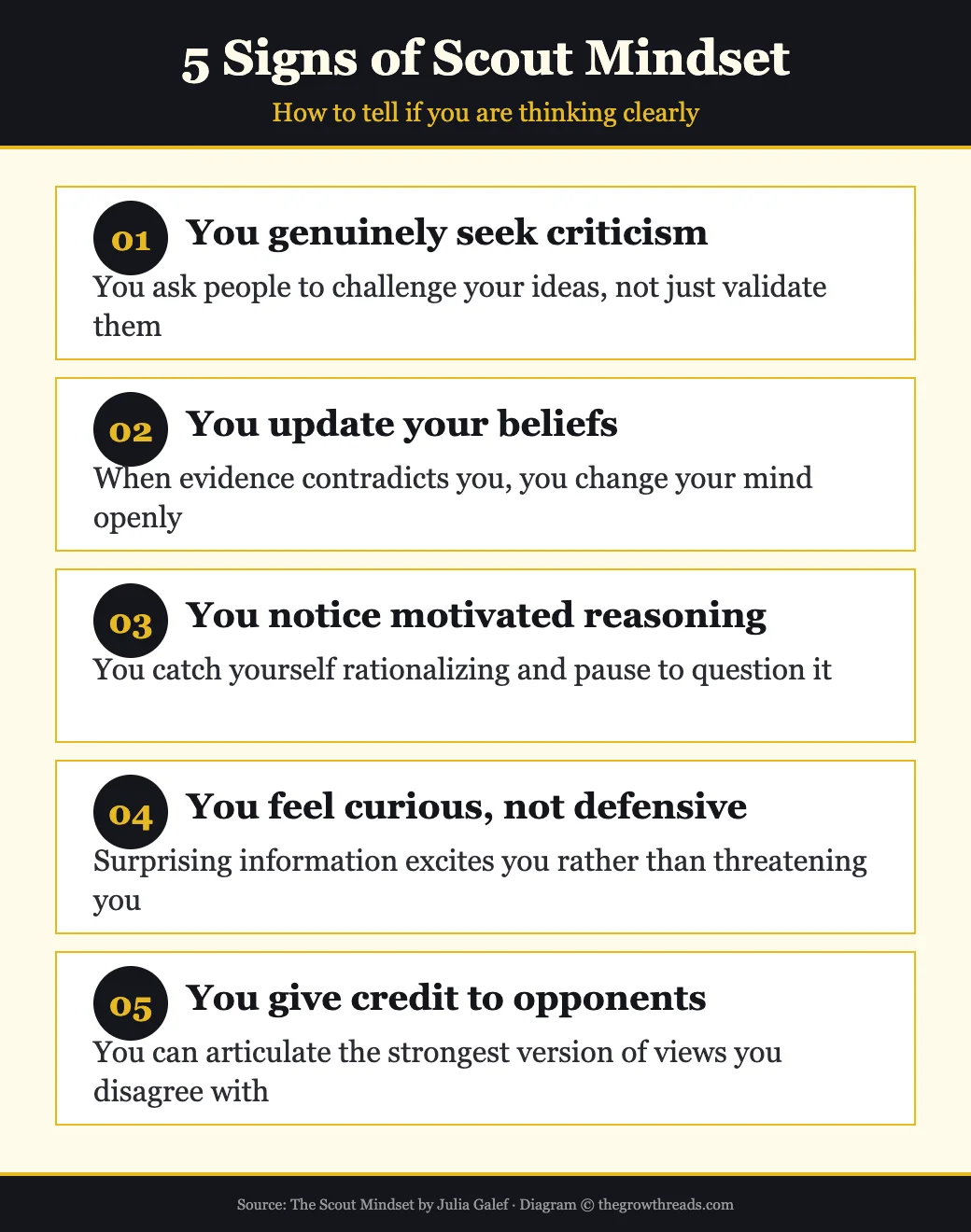
- Identity makes reasoning worse: The more strongly you identify with a belief, the harder it is to evaluate evidence about it objectively. Scouts hold their beliefs lightly.
- Being wrong is an update, not a failure: Scouts treat changing their minds as a sign of good thinking, not weakness. Each update brings their mental map closer to reality.
- Thought experiments test your reasoning: Simple tests — like asking whether you would evaluate the evidence differently if it supported the opposite conclusion — reveal hidden biases in real time.
- Calibration matters more than confidence: Good thinkers know how certain they should be. If you say you are ninety percent sure about ten things, roughly nine should turn out to be true.
- Scouts are not emotionally cold: The scout mindset is compatible with passion, conviction, and strong values. The difference is that scouts base these on accurate information rather than comfortable narratives.
- Social incentives reward soldier thinking: Communities often reward loyalty to positions over accuracy, making scout mindset harder to practice in groups.
What Is The Scout Mindset About?
The Scout Mindset contrasts two approaches to reasoning — soldier mindset (defending beliefs) and scout mindset (seeking truth) — and provides practical tools including thought experiments and calibration techniques for building the habits of accurate, honest thinking in everyday life.
About the Author
Julia Galef is the co-founder of the Center for Applied Rationality, a nonprofit organization dedicated to helping people improve their reasoning and decision-making. She hosted the Rationally Speaking podcast for over a decade, interviewing leading thinkers in science, philosophy, and psychology. Trained in statistics at Columbia University, Galef became interested in the gap between knowing about cognitive biases and actually overcoming them — a gap that inspired both her research and this book. She is known for her clear, engaging communication style and her ability to make abstract ideas about reasoning immediately practical. Explore all Julia Galef book summaries →
Key Concepts at a Glance
| Concept | What It Means | Use It When |
|---|---|---|
| Soldier Mindset | Using reasoning to defend existing beliefs and win arguments | You catch yourself arguing to be right rather than to find truth |
| Scout Mindset | Using reasoning to build an accurate map of reality | You want to make better decisions based on what is actually true |
| Motivated Reasoning | Unconsciously evaluating evidence based on what you want to be true | You notice yourself easily accepting convenient evidence and scrutinizing inconvenient evidence |
| Identity-Protective Cognition | Distorting reasoning to protect beliefs tied to your sense of self | A belief feels like an attack on who you are rather than just a factual question |
| Calibration | Matching your confidence levels to your actual accuracy | You want to know how much to trust your own predictions and judgments |
| Thought Experiments | Mental tests that reveal hidden biases in your reasoning | You want a quick way to check whether you are thinking like a soldier or a scout |
Part 1: The Case for Scout Mindset
Galef opens by describing two fundamentally different relationships with beliefs. In soldier mindset, your beliefs are positions to be defended. Reasoning is a weapon — you look for evidence that supports your side, construct arguments to defeat opponents, and treat changing your mind as a kind of surrender. In scout mindset, your beliefs are a map. Reasoning is a tool for making the map more accurate — you look for evidence that might reveal errors, welcome corrections, and treat updating your beliefs as a sign that you are doing the work well.
The analogy is precise: a soldier who sees what they want to see on the battlefield will get killed. A scout who accurately maps the terrain — including uncomfortable truths about enemy strength — helps the entire army survive. Yet in intellectual life, most of us default to soldier mode. We argue to win, rationalize our decisions after making them, and surround ourselves with information that confirms what we already believe.
Galef makes a crucial distinction: scout mindset is not about suppressing emotions or being a robot. It is about channeling your emotional investment differently — getting satisfaction from figuring out what is true rather than from being right. Scouts feel genuine pleasure at discovering they were wrong because it means their map just got better.
Part 2: Developing Scout Habits
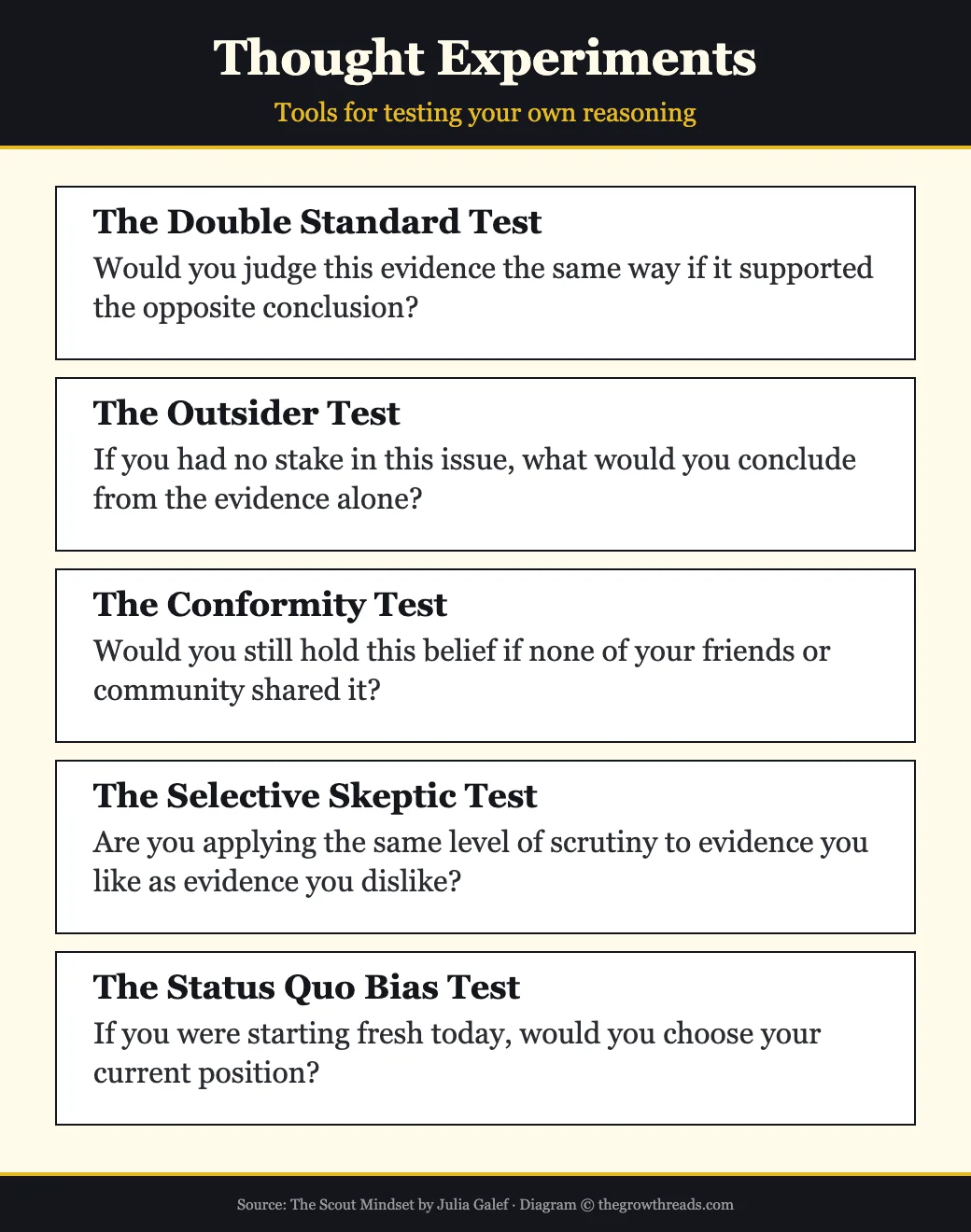
The middle section of the book provides practical tools for developing scout habits. Galef introduces a set of thought experiments designed to reveal motivated reasoning in real time. The double standard test asks whether you would evaluate a piece of evidence the same way if it supported the opposite conclusion. The outsider test asks what you would conclude if you had no personal stake in the question. The conformity test asks whether you would hold a belief if none of your social group shared it.
These tests are deceptively simple but remarkably effective. Most people discover, when they honestly apply them, that their reasoning is far less objective than they assumed. The selective skeptic test is particularly revealing: we tend to scrutinize evidence that challenges our views with extreme rigor while accepting evidence that supports our views with almost no scrutiny at all.
Galef also discusses calibration — the practice of matching your confidence levels to your actual accuracy. Well-calibrated thinkers know how uncertain they are. If you say you are eighty percent confident about a prediction, you should be right about eighty percent of the time. Most people are dramatically overconfident, especially about things they care about. Regular calibration practice — making predictions, tracking results, and adjusting — is one of the most direct paths to better thinking.
Part 3: Scout Identity and Social Reality
The final section tackles the hardest challenge: how to maintain scout mindset in a world that rewards soldier thinking. Communities, political parties, professional groups, and even friend groups often punish members who update their beliefs or express uncertainty. Being seen as loyal to the group’s positions matters more socially than being accurate.
Galef’s solution is not to abandon community but to reshape your identity. Instead of identifying as someone who holds a particular set of beliefs, identify as someone who seeks truth. This subtle shift makes updating your beliefs feel like fulfilling your identity rather than betraying it. You can be passionately committed to accuracy without being passionately committed to any specific conclusion.
She also addresses a common objection: does scout mindset make you indecisive or wishy-washy? Galef argues the opposite. Scouts can act decisively because their decisions are based on the best available evidence rather than on wishful thinking. A scout who launches a startup does so knowing the real odds and having planned for failure scenarios — not because they have convinced themselves that failure is impossible. This clear-eyed commitment, paradoxically, often produces better outcomes than the soldier’s blind confidence.
Who Is The Scout Mindset Best For — and Who Should Read Something Else First?
The Scout Mindset is ideal for anyone who cares about thinking clearly — leaders making strategic decisions, professionals evaluating evidence, or individuals navigating complex personal choices. It is especially valuable for people who have read about cognitive biases but struggle to apply that knowledge to their own reasoning.
If you want a deeper dive into the cognitive biases themselves, start with Thinking, Fast and Slow. If you are interested specifically in prediction and calibration, Superforecasting goes deeper on that dimension.
Questions to Reflect On
- When was the last time you genuinely changed your mind about something important — and how did it feel?
- Which of your beliefs are you most defensive about, and what would it take for you to update them?
- If you applied the double standard test to your last major decision, would your reasoning hold up?
- How well-calibrated are your predictions — do you track them?
- Is there a belief you hold primarily because your social group holds it?
🔥 Ready to See Reality More Clearly?
Learn how to trade the comfort of certainty for the power of accurate thinking — and make better decisions as a result.
How to Apply The Scout Mindset (7-Day Plan)
- Day 1 — Notice soldier mode: Throughout the day, catch yourself arguing to win, rationalizing a decision, or dismissing evidence. Just notice — no judgment yet.
- Day 2 — Apply the double standard test: Take one belief you hold strongly. Ask: would I accept this evidence if it pointed the other way? Write down your honest answer.
- Day 3 — Make three predictions: Write down three predictions about things that will happen this week, with your confidence level (e.g., 70%). Track whether they come true.
- Day 4 — Practice the outsider test: For a decision you are facing, imagine a stranger with no stake in the outcome. What would they advise based on the evidence alone?
- Day 5 — Seek disconfirming evidence: Pick one opinion you hold and spend fifteen minutes actively looking for the best arguments against it.
- Day 6 — Update one belief: Based on this week’s experiments, identify one belief you now hold less confidently — or more confidently — than before. Tell someone about the update.
- Day 7 — Reflect on identity: Ask yourself: am I someone who holds these specific beliefs, or am I someone who seeks truth? Write a short note about what shifts when you adopt the second identity.
Frequently Asked Questions
What is the scout mindset?
The scout mindset is an approach to thinking that prioritizes accuracy over comfort. Instead of defending your existing beliefs like a soldier defends territory, you explore reality like a scout mapping terrain — genuinely wanting to know what is true, even when the truth is inconvenient. It is characterized by curiosity, openness to being wrong, and the habit of updating beliefs when evidence changes.
Is the scout mindset about being unemotional?
No. Galef explicitly argues that scout mindset is compatible with strong emotions, passion, and conviction. The difference is where you direct your emotional investment. Soldiers feel satisfaction from winning arguments; scouts feel satisfaction from getting closer to truth. You can care deeply about a topic while still evaluating evidence honestly — in fact, caring about getting the right answer is itself an emotional commitment.
How is The Scout Mindset different from Thinking, Fast and Slow?
Thinking, Fast and Slow catalogs the cognitive biases built into human psychology — the systematic errors we all make. The Scout Mindset focuses on the motivational dimension: why we cling to wrong beliefs even when better evidence is available. Kahneman explains the mechanisms of biased thinking; Galef explains the motivations behind it and provides a practical framework for overcoming the desire to be right rather than accurate.
What are the thought experiments in the book?
Galef introduces several mental tests for checking your reasoning: the double standard test (would you judge this evidence differently if it supported the other side?), the outsider test (what would someone with no stake conclude?), the conformity test (would you believe this without social pressure?), and the selective skeptic test (are you scrutinizing all evidence equally?). These quick checks help you catch motivated reasoning in real time.
Does scout mindset make you indecisive?
Galef argues the opposite. Scouts make better decisions precisely because they are working from more accurate maps of reality. A scout who starts a business does so with clear-eyed awareness of the risks, not because they have convinced themselves failure is impossible. This realistic foundation actually supports more decisive action because plans account for real obstacles rather than being blindsided by them.
Can you practice scout mindset in groups?
Yes, but it requires conscious effort because social dynamics naturally reward soldier thinking. Groups reward loyalty, punish dissent, and pressure conformity. Galef suggests creating environments where updating beliefs is celebrated, where dissent is solicited before consensus, and where the group identity is “we seek truth” rather than “we believe X.” Organizations like intelligence agencies and prediction markets have successfully built scout-oriented cultures.
What is calibration and why does it matter?
Calibration is the practice of matching your confidence levels to your actual accuracy. If you say you are ninety percent confident about ten different predictions, roughly nine should come true. Most people are systematically overconfident — they say ninety percent but are right only sixty or seventy percent of the time. Tracking your predictions and comparing outcomes to your confidence levels is one of the most direct ways to improve your thinking and develop genuine scout habits.
Related Summaries
- Thinking, Fast and Slow by Daniel Kahneman — the foundational work on cognitive biases.
- Superforecasting by Philip Tetlock — how calibration and updating produce dramatically better predictions.
- Noise by Daniel Kahneman — the hidden variability in human judgment.
- Best Psychology Books — our complete guide to understanding the mind.