

★★★★☆ 4.2/5 — A blunt, practical playbook for reading a man’s actions instead of his words.
Best for: Women in the early-to-mid stages of dating who want plain-spoken, action-based filters for commitment-readiness.
Reading time: ~5 hrs to read the book · 45 min to read this guide
Difficulty to apply: Easy–Medium
Act Like a Lady, Think Like a Man in one minute
Steve Harvey’s core claim is simple: men reveal who they are through what they do, weeks before it ever shows up in what they say — and if you keep listening only to the words, you’ll keep being blindsided by the actions. Drawing on decades of stand-up comedy, radio call-ins, and conversations with men who rarely say this stuff out loud, Harvey lays out what he calls the male mindset on love, loyalty, and commitment. The book’s promise isn’t emotional theory — it’s a set of concrete filters: standards you name early, questions you ask directly, and a 90-day window for watching whether a man’s behavior matches his words. It became a cultural phenomenon (two million-plus copies sold, a hit movie adaptation) precisely because it turned vague relationship anxiety into a checklist women could actually use on a Tuesday night.
Key takeaways
- Three core needs: men are driven by support, loyalty, and intimacy — confusion in a relationship often traces back to which of the three feels unmet.
- Actions outrank words: a man’s behavior across 90 days is more reliable data than anything he says in the first three weeks.
- Behavior, not identity: “sports fish” and “keeper” describe patterns of behavior, not fixed types — a man shows you which one he’s being through consistency.
- Standards come first: naming your non-negotiables before you’re emotionally invested works; naming them after you’re hurt reads as an ultimatum.
- Direct questions save time: a small set of pointed questions about his plans and his view of you surfaces more than months of guessing.
- Family is a preview: how a man treats his mother and talks about faith and family previews how he’ll likely treat a partner.
- Introductions are milestones: being folded into each other’s inner circle is a marker of seriousness, not a formality to skip.
- Cheating is opportunity plus absent boundaries: in Harvey’s framing, infidelity is rarely proof a relationship was doomed from day one — it’s a boundary failure.
- Independence and clarity aren’t opposites: a self-sufficient woman can still name what she needs without it undercutting her independence.
- Commitment talks work better as negotiations: clear asks and clear timelines outperform emotional ultimatums when a relationship is ready to move forward.
What is Act Like a Lady, Think Like a Man about?
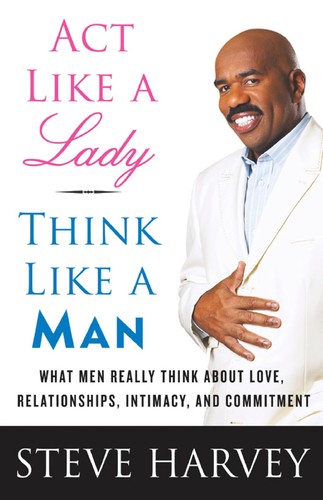
Act Like a Lady, Think Like a Man is Steve Harvey’s 2009 relationship guide that explains, from a man’s perspective, how men evaluate commitment, loyalty, and intimacy. It gives women a practical framework of standards, direct questions, and a 90-day observation window for recognizing genuine interest before investing deeply in a relationship.
About the author
Steve Harvey spent nearly three decades as a stand-up comedian before becoming one of America’s most recognizable media personalities. He toured as one of the Original Kings of Comedy alongside Cedric the Entertainer and Bernie Mac, hosted his own sitcom on The WB, and has spent over two decades on the nationally syndicated Steve Harvey Morning Show, where callers’ real relationship questions became the raw material for this book. He’s also the longtime host of Family Feud and Celebrity Family Feud. Act Like a Lady, Think Like a Man, his 2009 debut, became a #1 New York Times bestseller and was adapted into the hit 2012 film Think Like a Man. Harvey and his wife Marjorie run the Steve and Marjorie Harvey Foundation, focused on youth education. Explore all Steve Harvey book summaries →
Key concepts at a glance
| Concept | What it means | Use it when |
|---|---|---|
| The three needs | Support, loyalty, and intimacy — the needs Harvey says drive most male behavior in relationships | You’re trying to diagnose why a relationship feels off |
| Sports fish vs. keeper | Two behavior patterns — casual, catch-and-release interest vs. serious, investing interest | You’re unsure if his interest is situational or real |
| The 90-day standard | A trial period before deep intimacy that gives consistency time to show itself | You keep attracting men who disappear once they get what they wanted |
| The five key questions | Direct questions about his plans, his values, and how he sees you | Early dating, before feelings start outrunning information |
| Get some standards | Naming your non-negotiables before you’re emotionally attached | You notice your expectations shift for every new man |
| Mama’s boy / non-committer / player | Harvey’s shorthand names for recurring problem patterns in men | You want quick language for a pattern you keep running into |
| The full Harvey system | Combining standards, the 90-day window, and direct questions into one approach | You’re ready to move from casual dating to a defined relationship |
Part 1: The Mind of a Man
Harvey opens by arguing that men and women are simply wired to process relationships differently — not better or worse, just differently — and that most female frustration comes from applying female logic to male behavior. Men, in his telling, are goal-oriented: they define themselves by what they do and provide, not by what they say. That’s why a man might show love by fixing your car or handling a problem rather than by narrating his feelings, and why silence during a hard conversation often means he’s solving rather than shutting down.
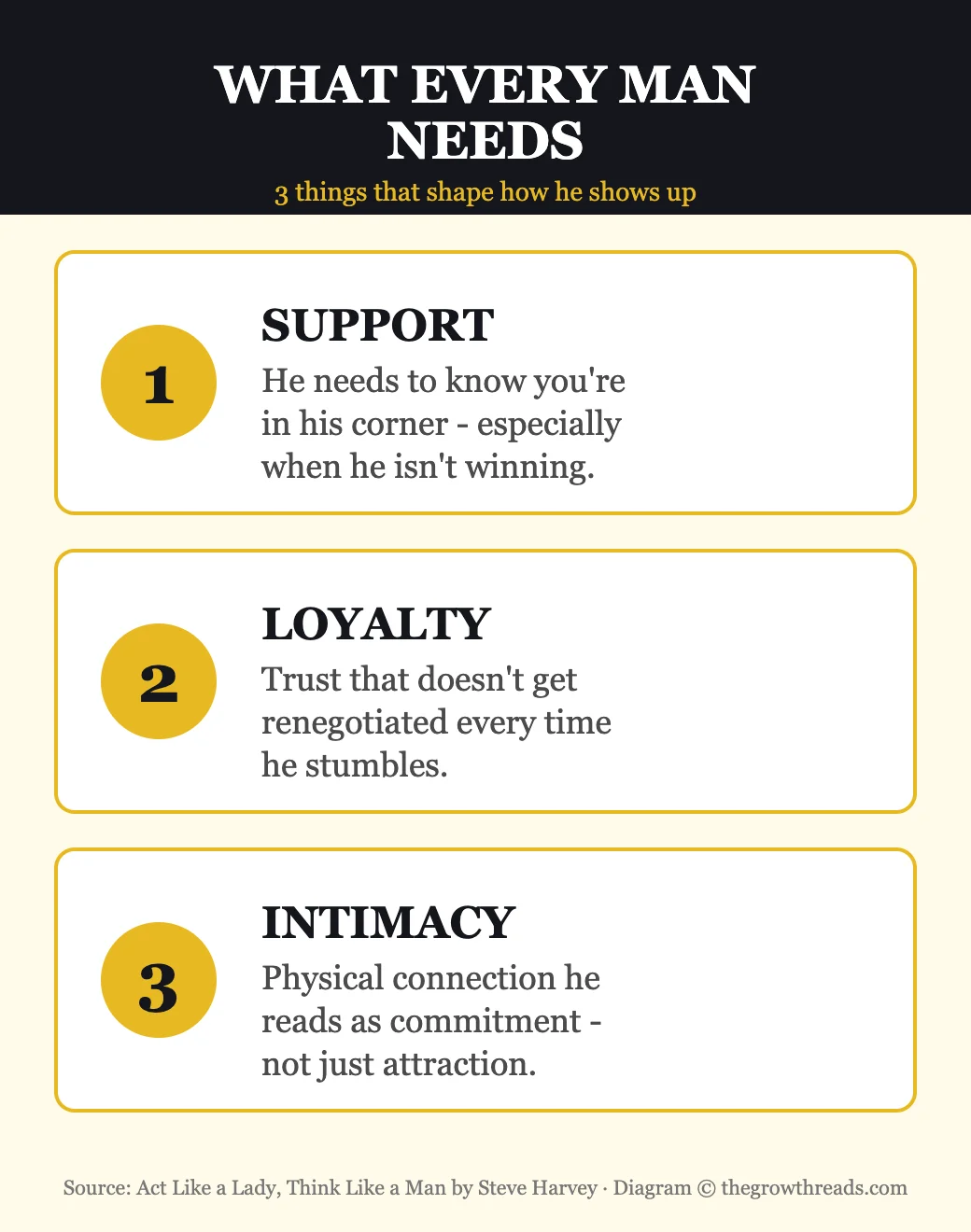
From this foundation, Harvey names three things he says every man needs from a partner: support (someone in his corner, especially when he isn’t winning), loyalty (trust that isn’t re-litigated every time he stumbles), and intimacy (a physical connection he reads as a marker of exclusive commitment, not just attraction). He’s explicit that these aren’t excuses for bad behavior — they’re a map. Knowing which need feels unmet in a given moment, he argues, is more useful than trying to have a feelings conversation a man isn’t equipped to have on the spot.
Harvey illustrates this with what he calls the provide-and-protect instinct: a man who feels secure in your support will often show it by handling something practical — fixing what’s broken, covering a bill without being asked, showing up early to help you move — long before he’ll say “I love you” out loud. Reading those actions as the message, rather than waiting for matching words, is the single habit he pushes hardest in this opening section. He also warns against a common mismatch: women raised to prioritize verbal reassurance often discount a man’s practical gestures as insufficient, while men raised to prioritize action often can’t understand why “I fixed your car” didn’t land as “I love you.” Naming that gap out loud, he argues, resolves more arguments than either partner trying to change how they naturally express care.
TGR Note: Harvey’s three needs describe what men want; they don’t explain why some women keep misreading the signals that indicate whether those needs are being met. For that psychological layer, our summary of Attached is the natural next read — attachment style shapes how easily you tolerate ambiguity while you wait for a man’s actions to catch up with his words.
Part 2: Reading the Signs
The book’s middle section gives names to recurring male archetypes so readers can spot patterns faster: the Mama’s Boy, who still needs his mother’s approval before he can commit to anyone else; the Non-Committer, who enjoys the relationship but avoids ever defining it; and the Player, who treats dating itself as the goal rather than a means to commitment. None of these are meant as permanent labels — Harvey’s point is that each pattern has a tell, and the tell shows up in actions long before it shows up in an argument.
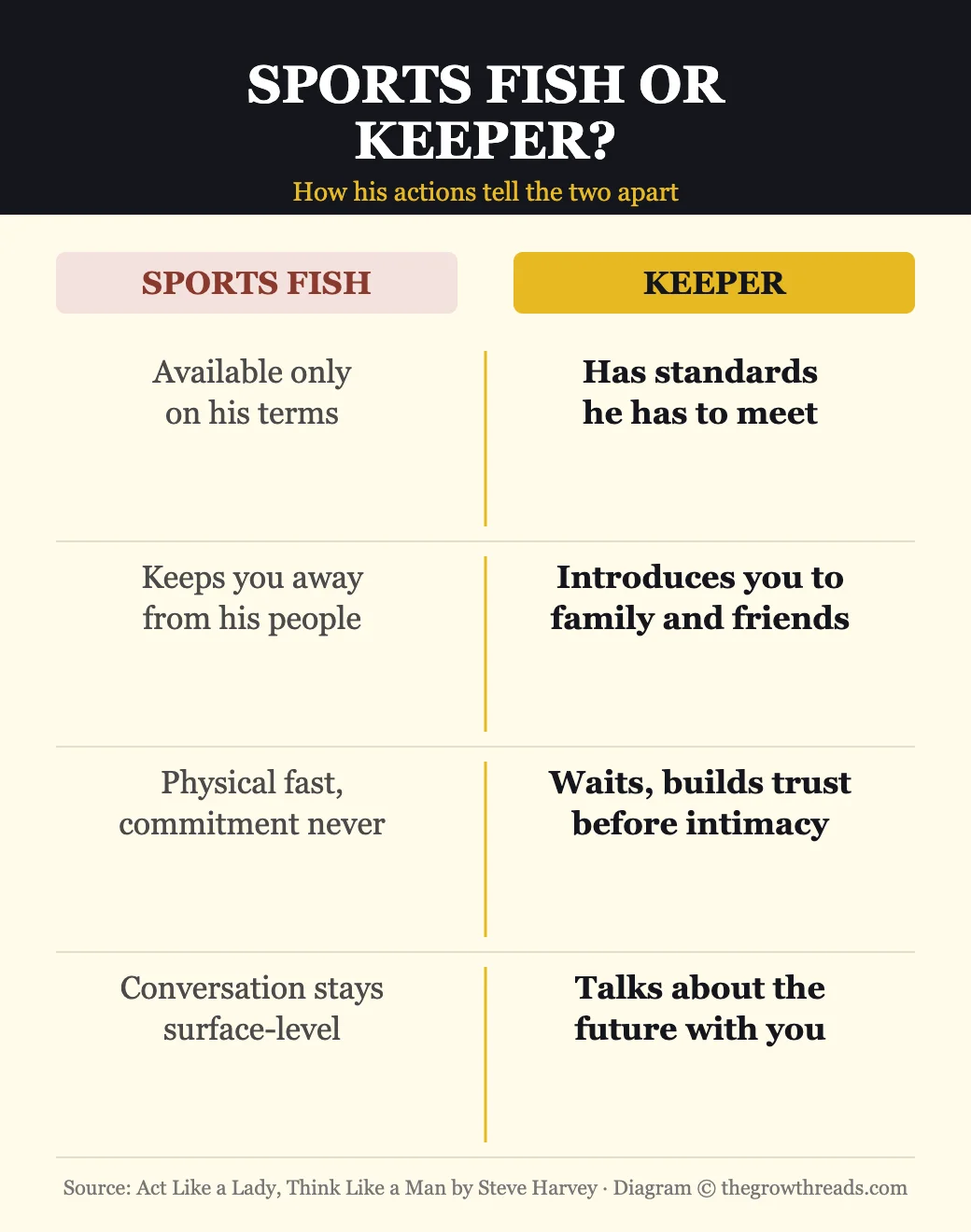
On infidelity, Harvey’s framing is that cheating is less often proof a relationship was broken from the start and more often a case of opportunity meeting an absent boundary — which is why he spends as much time on setting boundaries early as he does on choosing better partners. This leads into the book’s signature contrast: the sports fish, who is treated as available on his terms only, kept away from people who matter to him, and offered surface-level conversation — versus the keeper, who has standards to meet, gets introduced to family and friends, and is trusted with real conversations about the future.
Harvey is careful to note that most men aren’t permanently one or the other — the same man can behave like a sports fish with one woman and a keeper with the next, depending entirely on what she accepts. That reframes the whole chapter: instead of trying to identify which “type” a man is in the abstract, the more useful question is which pattern he’s allowed to get away with in this specific relationship. A man who senses that surface-level effort is enough will rarely volunteer more; a man who senses that real standards are in place will either rise to meet them or reveal, fairly quickly, that he isn’t going to.
TGR Note: Spotting the pattern is only half the work — the other half is communicating what you notice without it landing as an accusation. Our summary of The 5 Love Languages pairs well here: it gives you the vocabulary to say “this doesn’t feel like being treated as a keeper” in terms he can actually act on.
Part 3: Setting Standards and Asking the Right Questions
Harvey’s most-quoted chapter is “Get Some Standards,” and its argument is straightforward: women who wait until they’re hurt to state their requirements are negotiating from a weaker position than women who state them, gently but clearly, in the first few weeks. Standards aren’t demands shouted across a dinner table — Harvey frames them as expectations wrapped in ordinary conversation, stated once, and then measured against consistently.
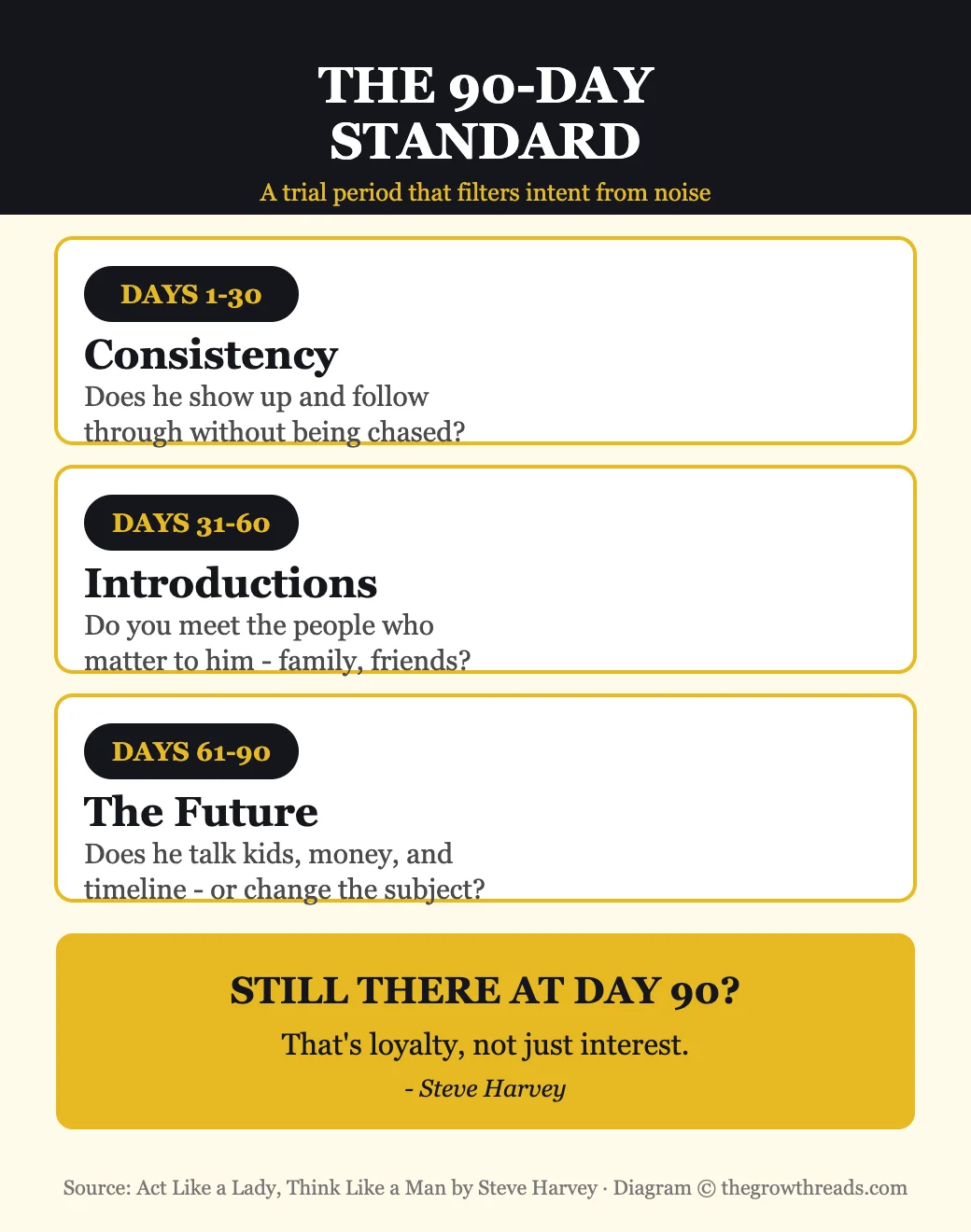
To make that measurement concrete, he offers five direct questions worth asking early: what are your current plans for the next five years, and where might I fit into them; what does your relationship with your mother (and, for Harvey, faith) look like; what do you think about me; what do you love about me; and how do you see family and children fitting into your future. Alongside the questions sits the book’s best-known device — the 90-day standard, a trial period before physical intimacy that gives a man’s consistency, not his charm, time to show up. It isn’t a rule about sex so much as a rule about information: 90 days is long enough to see how someone behaves across a bad week, a busy month, and an ordinary Tuesday.
What makes the standards chapter more useful than a generic “know your worth” pep talk is the delivery mechanism Harvey recommends: state the standard once, early, in ordinary conversation — not as a demand, not as a speech, and not after you’ve already been let down. Something as plain as “I don’t really do last-minute plans, I like knowing what a weekend looks like a few days out” tells a man exactly what’s expected without turning it into confrontation. The measurement then happens quietly, over the following weeks, by simply noticing whether that standard gets honored or ignored — no follow-up lecture required.
TGR Note: Harvey’s five questions work best when they sound like curiosity, not interrogation — which is exactly the skill Chris Voss teaches in our summary of Never Split the Difference. His calibrated “what” and “how” questions are a near-perfect delivery mechanism for getting honest answers to Harvey’s five questions without triggering a defensive reply.
Part 4: The Full Harvey System
The book’s final section pulls standards, the 90-day window, and direct questioning into one sequence Harvey calls timing and negotiation: state your standards early, observe consistency over 90 days, ask the five questions before feelings outrun the facts, and treat the move toward commitment as a clear, adult negotiation rather than a hoped-for surprise. The expanded edition adds a marriage-readiness self-test and guidance for handling a partner’s ex, friend group, or family resistance without losing the standards you set at the start.
The negotiation framing is deliberate — Harvey spent enough of his career around business and entertainment deals to notice that people who wouldn’t dream of accepting a vague verbal agreement in a contract will accept exactly that in a relationship. His fix is to treat the commitment conversation the same way: name what you want (exclusivity, a timeline, a specific next step), listen to the actual answer rather than the answer you’re hoping for, and treat hedging as information rather than something to argue past. Readers who’ve spent months in an undefined relationship often report that this is the single chapter that gets them to finally ask the direct question they’d been avoiding.
Used together, the system reframes dating as something you can actually manage rather than something that happens to you. You’re not waiting to find out how someone feels — you’re running a short, humane process that surfaces the answer faster, with less guessing and fewer avoidable surprises along the way.
TGR Note: Naming standards is one skill; holding them once someone pushes back is another. If that second part is where you struggle, our summary of Boundaries by Cloud and Townsend is the deeper toolkit for staying firm without becoming rigid.
Who is Act Like a Lady, Think Like a Man best for — and who should read something else first?
This book is best for women in the early-to-mid stages of dating who want plain-spoken, action-based filters rather than therapy-style analysis — if you want a checklist more than a framework, Harvey delivers. It’s also useful for anyone who tends to over-explain their needs rather than state them once and watch for follow-through.
If you want a more clinical lens on why certain patterns feel so hard to walk away from, start with Attached instead. If your issue is less “is he serious” and more “we keep having the same argument,” The 5 Love Languages or a communication-focused read will serve you better. And if standards are the one thing you can name but never enforce, Boundaries is the better starting point.
Questions to reflect on
- Which of the three needs — support, loyalty, or intimacy — have you never actually named out loud to him?
- Where have you accepted “sports fish” behavior while hoping it would eventually become “keeper” behavior?
- Which of the five key questions have you avoided asking because you were afraid of the answer?
- What would you do differently if you trusted your own standards more than his reassurances?
- Looking ahead to day 90, what would “he’s still here” actually need to look like for you to call it real?
🔥 Ready to stop guessing and start reading the signs?
Get Steve Harvey’s full playbook — standards, the five key questions, and the 90-day standard, explained step by step.
How to apply Act Like a Lady, Think Like a Man (7-day plan)
- Day 1: Write down your three non-negotiable standards before your next date or conversation.
- Day 2: Track how he’s already meeting (or missing) the three needs — support, loyalty, intimacy — without saying anything yet.
- Day 3: Ask one of the five key questions naturally, in conversation, not as an interview.
- Day 4: Notice how he talks about his mother, his family, and his faith or values.
- Day 5: Introduce him to one person who matters to you, and watch how he shows up.
- Day 6: Have one direct, calm conversation naming a standard you haven’t said out loud yet.
- Day 7: Review the week against your standards list from Day 1 and decide your next honest step.
Frequently asked questions
What is the 90-day rule in Act Like a Lady, Think Like a Man?
The 90-day rule (or standard) is Harvey’s suggestion to wait roughly three months before deep physical intimacy with a new partner. The point isn’t the number itself — it’s the window: 90 days is long enough to see how someone behaves across an ordinary week, a stressful one, and everything in between, rather than judging them on their best behavior during the first few dates. Harvey frames it as a filter for consistency, not a moral rule, and he’s explicit that it’s a guideline you adapt to your own relationship, not a strict deadline.
Is Act Like a Lady, Think Like a Man based on research or personal opinion?
It’s Harvey’s own observations, built from decades of stand-up material, radio call-in advice segments, and conversations with men who don’t usually say this stuff publicly — not a clinical or peer-reviewed study. That means some of the generalizations about “how men think” are broad by design, and readers with different relationship structures or experiences may find exceptions. The practical value is in the tools (standards, direct questions, the 90-day window) more than in the psychological claims underneath them.
What’s the difference between a “sports fish” and a “keeper”?
They describe patterns of treatment, not fixed personality types. A “sports fish” is someone treated as available only on his own terms, kept away from the people who matter to him, and offered mostly surface-level conversation. A “keeper” is someone held to real standards, introduced to family and friends, and trusted with conversations about the future. Harvey’s point is that you can tell which one you’re being treated as by watching actions over weeks, not by asking someone to self-report.
Does Steve Harvey’s advice still apply today?
Some of the book’s framing reflects fairly traditional gender-role assumptions from its original 2009 publication, and dating norms have shifted since — more dating apps, more varied relationship structures, more explicit conversations happening earlier. That said, the core mechanism holds up regardless of framework: naming your standards early, watching for consistency over time, and asking direct questions instead of guessing are practical habits that apply across relationship styles, not just the specific scenarios Harvey describes.
What are the five key questions to ask a man?
Harvey suggests asking, in your own words and over natural conversation: what his current plans are for the next several years and where you might fit into them; what his relationship with his mother (and, in his framing, his faith) looks like; what he thinks about you; what he loves about you; and how he sees family and children fitting into his future. Asked early and casually, they surface more real information than months of guessing based on how a date went.
Is this book only useful for women seeking marriage?
No — the underlying tools (naming standards, watching for consistency, asking direct questions early) apply to anyone trying to assess how serious a new relationship is, regardless of whether marriage is the goal. The book is written from a heteronormative, marriage-oriented perspective throughout, so readers with different goals or relationship structures will need to adapt the specific examples, but the mechanics translate well beyond that original frame.
How is this different from the movie Think Like a Man?
Think Like a Man (2012) is a fictionalized ensemble comedy inspired by the book’s concepts — sports fish, keepers, the 90-day standard — reimagined as storylines for a cast of characters, rather than a literal telling of Harvey’s advice. It’s a fun, loose adaptation of the ideas, but the book itself is a direct, non-fiction guide written in Harvey’s own voice, with far more specificity than any single movie scene can capture.
Related summaries
If this approach resonated, continue with Attached for the psychology of why these patterns feel so hard to walk away from, The 5 Love Languages for turning insight into daily communication, Boundaries for holding the standards you name, and Never Split the Difference for asking hard questions without triggering defensiveness. For the full library of relationship reads, see our best relationship books pillar guide.
How we analyze books: every TGR summary is built from a full read of the source text, cross-checked against the author’s public interviews and published essays, and structured around practical application rather than academic critique. We never rely on chapter-by-chapter reproduction, and every framework is paraphrased in our own words. Read our full methodology.