

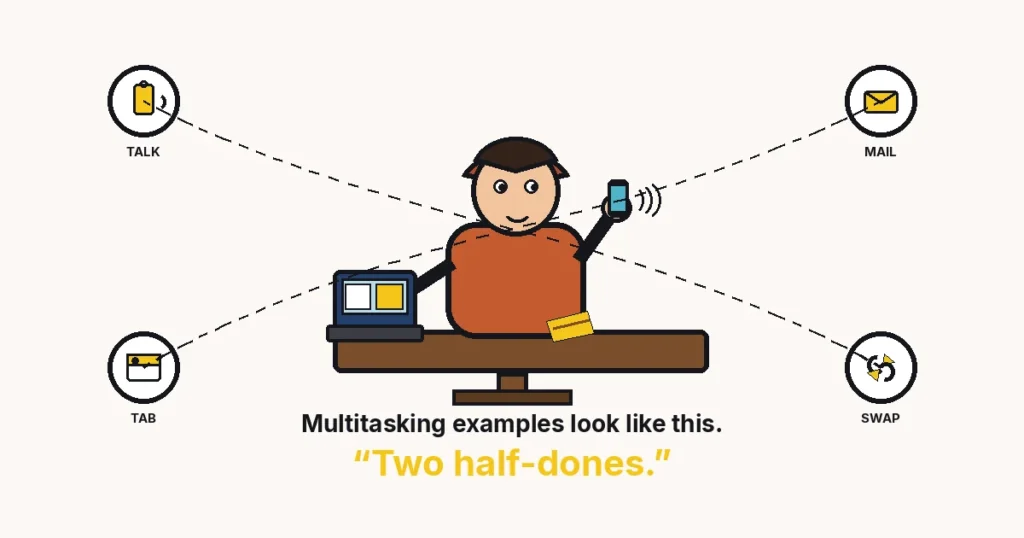
Multitasking examples are two live jobs sharing one body — a call you half-hear while you type, a document you leave to answer chat. They are not background music. Research treats the scene as a switch, not a skill. This page shows those pictures, not a second how-to-stop-multitasking guide.
Key takeaways
- Multitasking examples are two jobs that are both unfinished at the same moment — a half-heard call plus a half-written reply — not a talent for doing more (Rubinstein, Meyer and Evans, 2001).
- Knowledge workers in one field study averaged about three minutes on a task and about twelve minutes in a working sphere before they switched (González and Mark, 2004).
- The people who multitask the most tend to be worse at it and more impulsive, not more gifted (Sanbonmatsu, Strayer, Medeiros-Ward and Watson, 2013).
- Heavy media multitaskers filter irrelevant information worse, even in a quiet lab with no phone in sight (Ophir, Nass and Wagner, 2009).
- A design sprint in Jake Knapp’s Sprint is the opposite picture: one problem, one week, no second live job sitting in the same chair.
What multitasking examples actually are
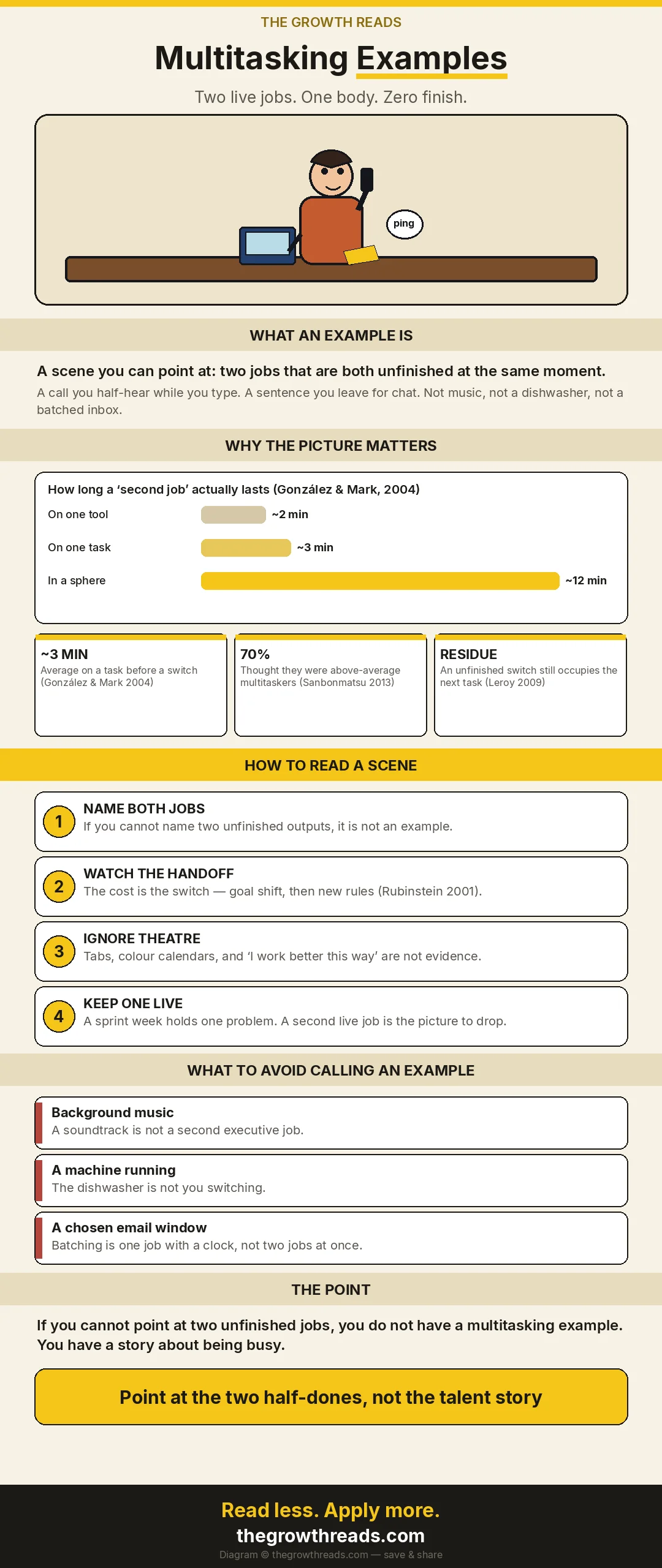
A multitasking example is a scene you can point at: two jobs that are both unfinished in the same body at the same moment. The test is crude on purpose. Can you name two outputs that are live right now — a call still going, a sentence still open, a chat still waiting — and see the same person holding both? If yes, you have an example. If you only have a colour-coded calendar or a story about being “good at juggling,” you have theatre.
That is a different job from the sister page on what multitasking actually costs. That page owns the mechanism: every switch pays a goal-shift and a rule-reload (Rubinstein, Meyer and Evans, 2001), and an unfinished first job leaves attention residue on the second (Leroy, 2009). This page owns the pictures. You should be able to walk through an ordinary Tuesday and say “that one counts” or “that one does not” without turning the day into a second how to focus better guide.
The research already treats the day as a sequence of visible switches, not as a personality. Víctor González and Gloria Mark sat with information workers — analysts, developers, managers — and timed the handoffs. People averaged about three minutes on a task, a little over two minutes on any one electronic tool or paper document, and about twelve minutes inside a working sphere before they jumped to another. They worked in about ten spheres a day. Those numbers are fieldwork, not a lab trick. They are also the raw material of a multitasking example: a person who cannot stay with one unfinished thing long enough for it to close.
Multitasking vs looking busy
Looking busy is a full calendar. A multitasking example is two unfinished jobs in one pair of hands. A stacked inbox, a back-to-back meeting block, or a desk covered in tabs can all look like proof. None of them are examples until two of those jobs are live at once. One protected hour of single tasking can look empty from the corridor and still be the opposite of the scene this page is about.
The mix-up is old. “I multitask” is used as a compliment in the same way “I am busy” is used as a status. Sanbonmatsu, Strayer, Medeiros-Ward and Watson (2013) measured both the boast and the skill. University of Utah students (n = 277) who reported more media multitasking and more phone use while driving scored worse on an operation-span test of executive control. About seven in ten rated themselves above average at multitasking — a distribution that cannot be true. The people most likely to offer a multitasking example as a flex were the people least able to hold two jobs without paying for it.
Why lookalikes get mistaken for examples
Lookalikes get mistaken for multitasking examples because they feel like two things, even when only one of them is a job. Music in the headphones, a dishwasher running, a compile finishing, a printer warming up — each adds motion to the room. None of them ask your executive control to load a second rule set. Rubinstein, Meyer and Evans split that load into two stages: decide to do the new thing, then activate the rules the new thing needs. A kettle does not need either stage from you. A Slack thread in the middle of a paragraph does.
The other lookalike is a chosen window. Batching mail at 11:00 is one job with a clock. It can sit next to a writing block and still not be a multitasking example, because the two jobs are not live together. The moment you open the inbox inside the writing block, the picture flips. Same tools. Different scene. That is why this page is a recognition page: the label attaches to the overlap, not to the apps.
Four scenes people misread
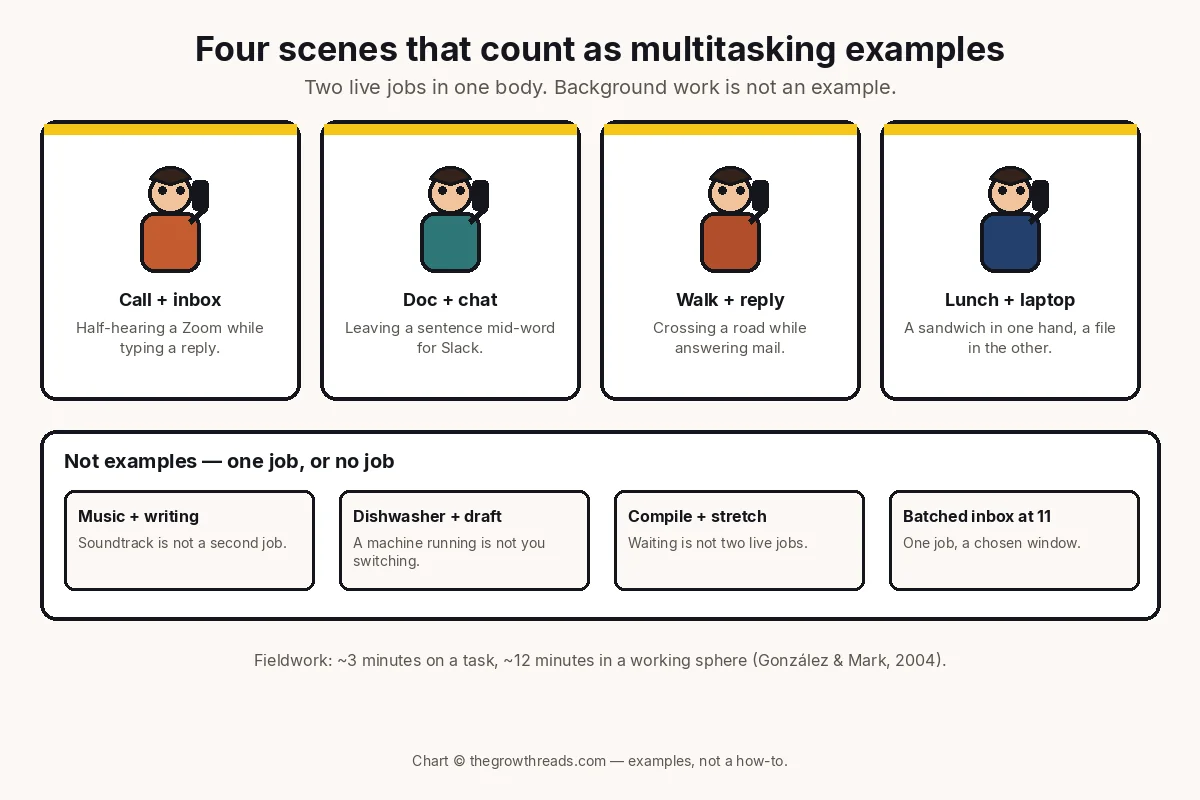
The four scenes people misread most often are the half-heard call, the mid-sentence chat, the walking reply, and lunch-at-the-laptop. Each can be sold as “I am just being efficient.” Each fails the two-unfinished-jobs test the moment you watch the hands.
| Scene | Counts as an example? | What is actually live | What people call it |
|---|---|---|---|
| Zoom + inbox | Yes | A conversation you are supposed to hear, and a reply you are composing | “I am just catching up while I listen” |
| Draft + Slack | Yes | An unfinished sentence and an unfinished thread | “I work better with the chat open” |
| Walk + mail | Yes, if both need you | A body in motion and a decision in the inbox | “I am using the dead time” |
| Sandwich + laptop | Yes | A meal and a file, both unfinished | “I do not have time to stop” |
| Playlist + writing | No | One job. The soundtrack is not a second output | “I am multitasking with music” |
| Dishwasher + draft | No | A machine running. You are not switching | “I am doing two things” |
| Compile + stretch | No | Waiting. The compiler is the other actor | “I am using the downtime” |
| Inbox at 11:00 | No | One job, a chosen window | “I batch, so I multitask better” |
The walking-reply row is the one people argue about. Walking while a podcast plays is usually one low-load motor task plus one stream of audio — closer to the narrow exception the sister page already names. Walking while you compose a reply, especially across a road or a kitchen, is two jobs. The test is still the same: are both unfinished, and do both need you?
Why the mix-up costs more than it feels like
Calling a lookalike a multitasking example hides the bill, because the switch feels free and the stress does not show up on the calendar. Gloria Mark, Daniela Gudith and Ulrich Klocke (2008) interrupted knowledge workers in a field study and watched them compensate. The interrupted people often finished in comparable or even shorter time. They also reported more stress, more frustration, more time pressure, and more effort. The deliverable still landed. The person paid in a currency no completion-time metric captures.
Sophie Leroy’s 2009 experiments added the part you can feel after the meeting ends. Switch away from Task A before it is finished and a residue of attention stays attached to A, dragging down B. Finishing A helps. Finishing A under a little time pressure to disengage helps more. Completion alone, without that release, is not a full reset. That is why “I will just check Slack for ten seconds” is a multitasking example even when the tab is closed again: the first sentence is still open in working memory.
Ophir, Nass and Wagner (2009) then showed the habit is not training. Heavy media multitaskers — people who live in the example, day after day — performed worse on filtering and on task-switching tests in a quiet lab. Practising the scene does not build a second-job muscle. It seems to wear down the filter that would have kept the second job out. That finding is correlational: it compares people who already differ. It does not prove that the habit caused the weaker filter. It is still a bad reason to treat the example as a skill you are getting better at.
Two honest caveats. González and Mark’s times come from a small set of information workers in one organisation, observed across three days — a sharp picture of that office, not a universal stopwatch. Sanbonmatsu’s 70% “above average” figure is self-report from students, not a field census of offices. This page uses both as recognition tools, not as proof that your Tuesday lasts exactly twelve minutes per sphere.
Put the pictures next to the mechanism and the cost is ordinary, not dramatic. A half-heard call is a goal-shift you did not budget. A mid-sentence chat is residue you will carry into the next paragraph. A sandwich on the keys is two jobs that both get worse. None of that needs a new how-to. It needs you to stop calling the scene a talent. The Focus cluster on the productivity hub is built for that recognition: name the overlap, then keep one job live.
Nearby ideas that are not examples
Several nearby ideas get filed under multitasking examples and do not belong there. They are useful. They are just different pages.
- Task switching is the mechanism underneath an example, not the example itself. The sister page already owns that word. This page only needs it to explain why a picture counts.
- Background work — music, a machine, a compile — is parallel activity that does not load a second rule set. Calling it an example inflates the label until nothing is left.
- Batching is one job with a fence around it. It can sit on a good Tuesday next to a writing block and still not be two live jobs.
- Phone distraction and digital distraction are how a second job gets in. A silent phone on the desk still taxes working memory (Ward, Duke, Gneezy and Bos, 2017). A notification you never open still costs (Stothart, Mitchum and Yehnert, 2015). Those are triggers. The example is what you do with them.
- A design sprint is the opposite picture. In Jake Knapp, John Zeratsky and Braden Kowitz’s Sprint, a team holds one problem for five days and refuses a second live job for the week. That is why this row’s unused review is the down-link: the book is a week-long single-task, not a stack of half-dones.
If you want the method for holding one job, that is how to stay on task and the parent how to focus better. If you want the cost of the habit, that is multitasking. If you want the length of a hold, that is what attention span actually means. This page stays with the pictures.
Common mistakes
Most mistakes on this topic are labelling errors: people point at the wrong scene and then take the wrong lesson.
- Calling a full calendar a multitasking example. A packed day can be six single-task blocks. Count live overlaps, not coloured squares.
- Calling music or housework a second job. If it does not need a goal-shift from you, it is not the example.
- Using “I work better this way” as evidence. Sanbonmatsu’s sample thought they were above average. The test said the frequent switchers were worse.
- Treating a ten-second Slack glance as free. Leroy’s residue does not care that the glance was short. The first sentence is still open.
- Rewriting this page as a how-to. The parent already has the system. The sister already has the tax. An examples page that turns into steps is a different URL wearing this slug.
- Pointing at a waiting period and calling it two jobs. The compiler, the kettle, and the printer are other actors. You are not switching until you pick up a second unfinished output.
- Confusing a sprint week with a stacked Tuesday. Sprint is one problem, protected. A Tuesday with two live jobs is the picture this page is for.
The evidence behind this
Every figure on this page traces to a dated study; here is what each one actually measured, and what it does not prove.
| Study | Design & size | What it found | Used here for |
|---|---|---|---|
| González and Mark (2004), CHI | Field observation of information workers in three roles, three days | About 3 minutes on a task, a little over 2 minutes on a tool or document, about 12 minutes in a working sphere; ~10 spheres a day | What a real switch looks like on an ordinary Tuesday |
| Rubinstein, Meyer and Evans (2001), J. Exp. Psychol.: HPP | Four lab experiments, 12–36 participants each | Switching has two stages — goal shifting, then rule activation — and costs rise with rule complexity | Why two live jobs are not “free parallel” |
| Leroy (2009), Organizational Behavior and Human Decision Processes | Two lab experiments on unfinished switches | Attention residue from Task A impairs Task B; time pressure to disengage helps more than completion alone | Why “just ten seconds of chat” still counts |
| Mark, Gudith and Klocke (2008), CHI | Field study of interrupted knowledge workers | Interrupted people often finish as fast or faster, with more stress, frustration, time pressure and effort | The hidden bill when the deliverable still lands |
| Ophir, Nass and Wagner (2009), PNAS | Correlational comparison of heavy vs light media multitaskers | Heavy multitaskers filter worse and switch worse, despite more “practice” | Why the example is not a trainable talent |
| Sanbonmatsu, Strayer, Medeiros-Ward and Watson (2013), PLOS ONE | 277 university students; media-multitasking index, driving-phone use, OSPAN | More multitasking predicted worse executive control; ~70% rated themselves above average | Why the boast and the scene come apart |
| Ward, Duke, Gneezy and Bos (2017), J. Assoc. Consumer Research | Two experiments, phone at three distances | A phone in sight, even off, reduces available working memory and fluid intelligence | The silent phone as a second unfinished job |
| Stothart, Mitchum and Yehnert (2015), J. Exp. Psychol.: HPP | Controlled notification vs no-notification groups | Receiving a notification, without touching the phone, disrupted attention about as much as using it | Why a ping in the meeting is already the example |
Frequently asked questions
What counts as a multitasking example?
A scene you can point at where two jobs are both unfinished in the same body at the same moment. A half-heard call plus a half-written reply counts. A document left mid-sentence for Slack counts. A sandwich in one hand and a file in the other counts. A playlist, a dishwasher, or a compile does not, because those are not second jobs you are executing. If you cannot name two live outputs, you do not have an example — you have a story about being busy.
Is listening to music while working a multitasking example?
Usually no. A soundtrack does not ask you to shift a goal and load a new rule set, which is the two-stage cost Rubinstein, Meyer and Evans (2001) measured. The writing is still one job. The exception is when the audio becomes a second unfinished output — a podcast you are trying to follow closely enough to remember, or a call you are supposed to answer. Then you have two live jobs, and the scene flips from lookalike to example. Volume is not the test. Whether both need you is.
Is answering email in a meeting a multitasking example?
Yes, if you are still supposed to be in the meeting. The call is an unfinished job. The reply is an unfinished job. That is the picture, even when both look small. Mark, Gudith and Klocke (2008) found interrupted people often still finish on time — they just pay in stress and effort. Leroy (2009) found the first job leaves residue on the second. The inbox-in-the-meeting scene is ordinary. It is also the cleanest everyday example this page has.
How is this different from the multitasking article?
The sister page on what multitasking actually costs owns the mechanism, the tax, and the rare exception for a well-practised motor task plus a light stream. This page owns recognition: which Tuesday scenes count, which are lookalikes, and which nearby ideas — batching, background work, a sprint week — should not steal the label. It is the same cluster. It is not a second how-to-stop-multitasking guide, and it does not rebuild the cost page as a list of pictures.
Do people who multitask a lot get better at it?
The best available comparisons say no. Ophir, Nass and Wagner (2009) found heavy media multitaskers were worse at filtering and at switching, in a quiet lab, despite more daily practice. Sanbonmatsu and colleagues (2013) found the people who reported more multitasking scored worse on executive control and still rated themselves above average. Both studies are correlational — they do not randomly assign a habit. They are still a poor basis for treating the example as training.
Is waiting for a file to export a multitasking example?
No. Waiting is not a second job you are doing. The exporter is the other actor, the way a kettle or a dishwasher is. You get an example only when you pick up a second unfinished output during the wait — a chat thread, a second document, a call — and keep the first job live as well. Stretching, standing, or filling a glass during a compile is downtime. Opening Slack “because I have thirty seconds” is the scene this page names.
What does a design sprint have to do with multitasking examples?
It is the opposite picture, which is why this row’s unused review is Jake Knapp, John Zeratsky and Braden Kowitz’s Sprint. A sprint week holds one problem and refuses a second live job for five days. That is not a claim that every Tuesday should be a sprint. It is a clean contrast: the book’s scene is one unfinished output, protected. A multitasking example is two unfinished outputs, shared. If you can see the difference on a whiteboard, you can see it in a meeting.
Can two easy tasks still be a multitasking example?
Yes, if both are unfinished and both need you. Ease does not retire the label. A “quick” reply plus a “simple” call is still two live jobs. The lab cost rises with rule complexity (Rubinstein, Meyer and Evans, 2001), so two easy jobs may be cheaper than two hard ones — they do not become one job. The recognition test stays crude: name the two outputs. If you can, you have an example, even when both look small from the corridor.
Sources
- González, V. M., & Mark, G. (2004). “Constant, constant, multi-tasking craziness”: Managing multiple working spheres. Proceedings of the SIGCHI Conference on Human Factors in Computing Systems, 113–120. doi:10.1145/985692.985707
- Rubinstein, J. S., Meyer, D. E., & Evans, J. E. (2001). Executive control of cognitive processes in task switching. Journal of Experimental Psychology: Human Perception and Performance, 27(4), 763–797. doi:10.1037/0096-1523.27.4.763
- Leroy, S. (2009). Why is it so hard to do my work? The challenge of attention residue when switching between work tasks. Organizational Behavior and Human Decision Processes, 109(2), 168–181. doi:10.1016/j.obhdp.2009.04.002
- Mark, G., Gudith, D., & Klocke, U. (2008). The cost of interrupted work: more speed and stress. Proceedings of the SIGCHI Conference on Human Factors in Computing Systems, 107–110. doi:10.1145/1357054.1357072
- Ophir, E., Nass, C., & Wagner, A. D. (2009). Cognitive control in media multitaskers. Proceedings of the National Academy of Sciences, 106(37), 15583–15587. doi:10.1073/pnas.0903620106
- Sanbonmatsu, D. M., Strayer, D. L., Medeiros-Ward, N., & Watson, J. M. (2013). Who multi-tasks and why? Multi-tasking ability, perceived multi-tasking ability, impulsivity, and sensation seeking. PLOS ONE, 8(1), e54402. doi:10.1371/journal.pone.0054402
- Ward, A. F., Duke, K., Gneezy, A., & Bos, M. W. (2017). Brain drain: The mere presence of one’s own smartphone reduces available cognitive capacity. Journal of the Association for Consumer Research, 2(2), 140–154. doi:10.1086/691462
- Stothart, C., Mitchum, A., & Yehnert, C. (2015). The attentional cost of receiving a cell phone notification. Journal of Experimental Psychology: Human Perception and Performance, 41(4), 893–897. doi:10.1037/xhp0000100
Related reading on The Growth Reads
Books
- Sprint summary — one problem, one week; the opposite of two live jobs.
Related articles
- How to focus better — parent: remove the switch, do not add grit.
- Multitasking: what it actually costs — sister: the tax, not the pictures.
- Single tasking — one live job at a time.
- Attention residue — why the first job still occupies the second.
- How to stay on task — the method cousin, not this page.
- Short attention span — hop rate, not a goldfish myth.
- Attention span: what it actually means — duration of hold on one target.
- Phone distraction — how a second job gets in.
- Digital distraction — the wider trigger family.
Hub and pillar
How this article was researched
The Growth Reads editorial team read González and Mark (2004) on working spheres, Rubinstein, Meyer and Evans (2001) on the two-stage switch, Leroy (2009) on attention residue, Mark, Gudith and Klocke (2008) on interrupted work, Ophir, Nass and Wagner (2009) on media multitaskers, Sanbonmatsu, Strayer, Medeiros-Ward and Watson (2013) on who multitasks, Ward, Duke, Gneezy and Bos (2017) on phone proximity, and Stothart, Mitchum and Yehnert (2015) on bare notifications. Jake Knapp, John Zeratsky and Braden Kowitz’s Sprint is the named unused review for this queue row — a one-problem week, not a second how-to-stop-multitasking guide.
Limits: González and Mark observed one organisation for three days. Ophir and Sanbonmatsu are correlational. Mark, Gudith and Klocke show a stress cost, not a quality collapse. This page does not replace the cost sister, the focus parent, or a later how-to-increase-attention-span row.
Methodology: examples page on the locked v3 play template (no HowTo node). Primary sources are peer-reviewed papers plus one named book review. No invented percentages. Last checked 18 September 2026.