

★★★★★ 4.7/5 — A builder’s biography you can spend this week: cut the list until taste has room to work.
Best for: Product people, designers, and founders who keep adding features instead of subtracting them
Reading time: ~15 hrs for the full book · ~14 min for this guide
Difficulty to apply: Easy to quote “focus”; harder to cut the list to three by Friday
Steve Jobs in one minute
The useful question is not “what would Steve do?” It is “what am I still saying yes to that should have been a no?” Walter Isaacson wrote this authorized life at Jobs’s request — more than forty interviews with him and a hundred with family, colleagues, and rivals. Steal the kit, not the turtleneck: a story a demo can prove, a list cut to three, A-player rooms that can still say no, and products that live where technology meets the liberal arts. Garage, Reed, Macintosh, ouster, NeXT, Pixar, return, iMac, iPod, iPhone, iPad — the loop does not change. Integrate the stack so the handoff is not someone else’s problem.
Key takeaways
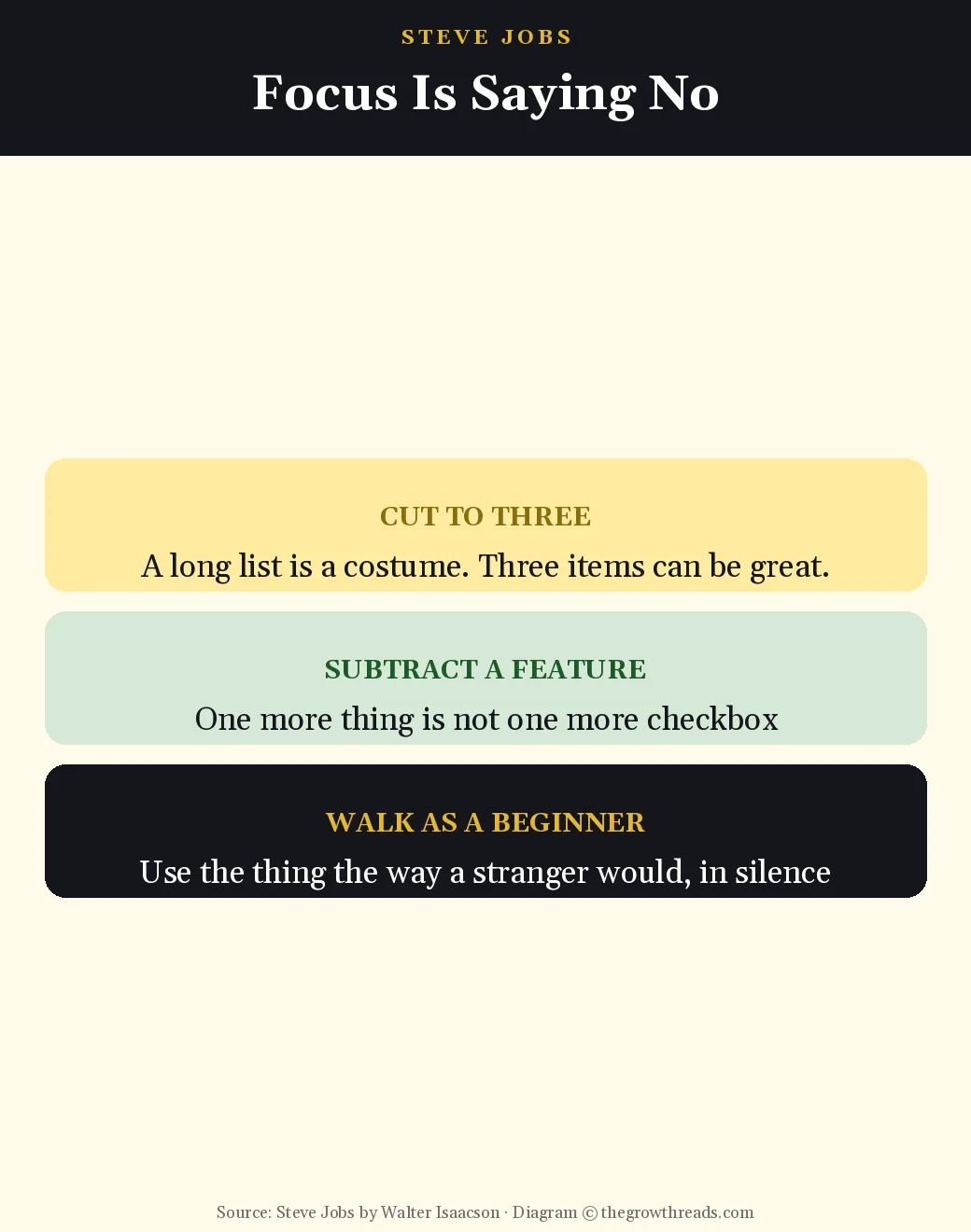
- Focus is saying no: a long list is a costume. Three items can be insanely great.
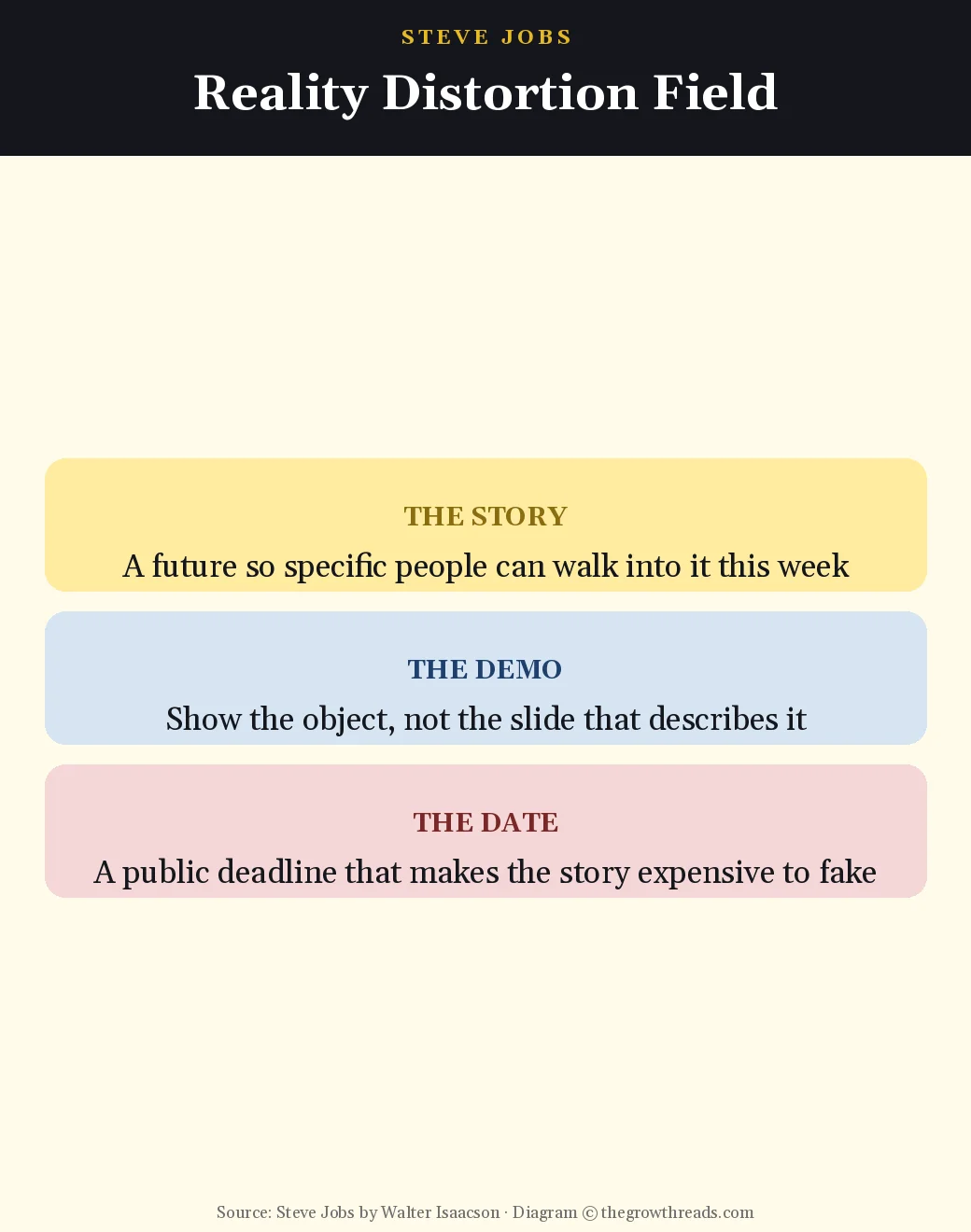
- Reality distortion is a date plus a demo: a story without an object is still a meeting.
- Connect the dots backward: Reed calligraphy was not a career plan. It became Mac fonts. Keep unused inputs.
- Design is how it works: pretty that hides the move is a costume, not taste.
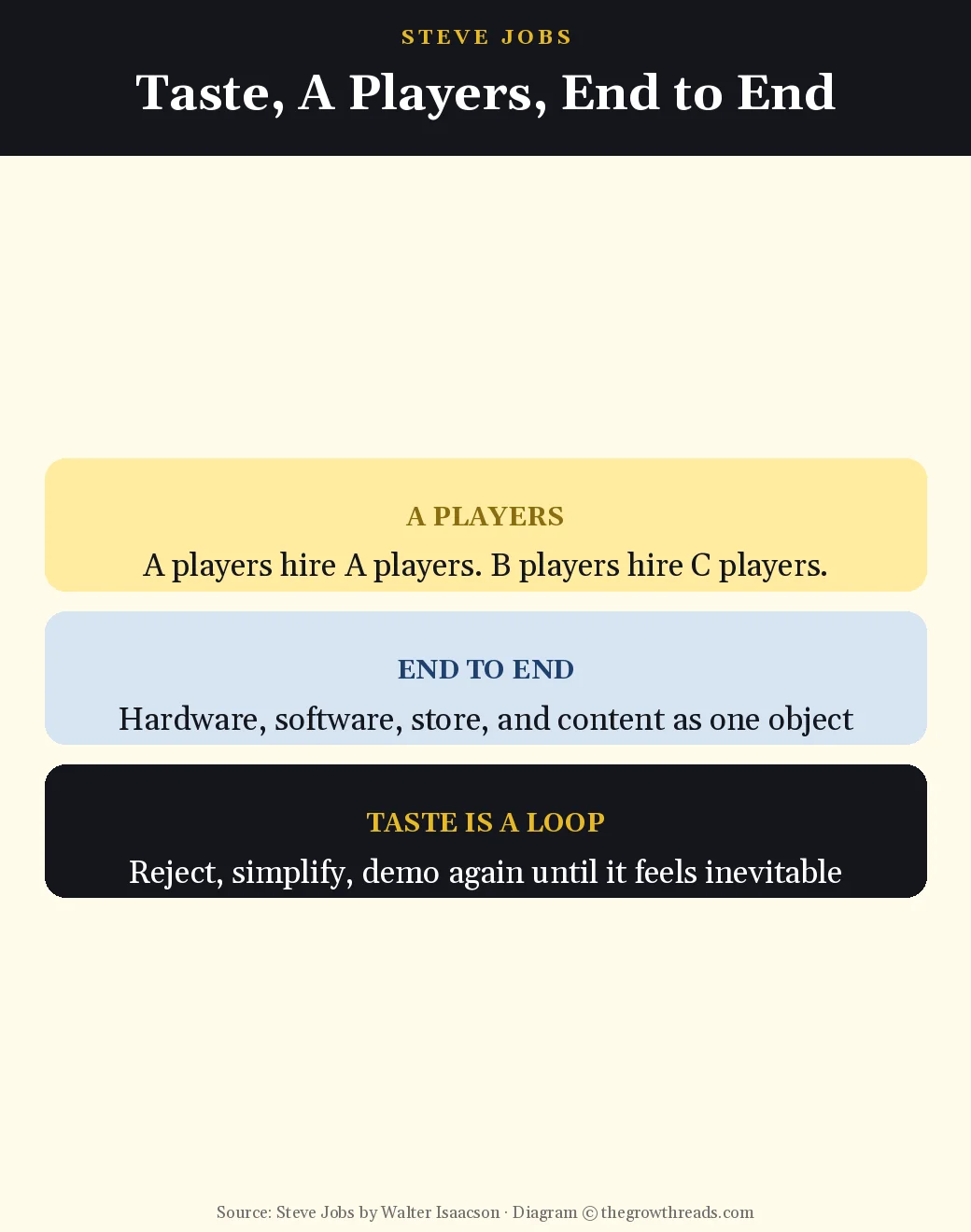
- A players hire A players: B players hire C players, and the room fills with people who cannot say no.
- End-to-end is a product: hardware, software, store, and content as one object, not four departments.
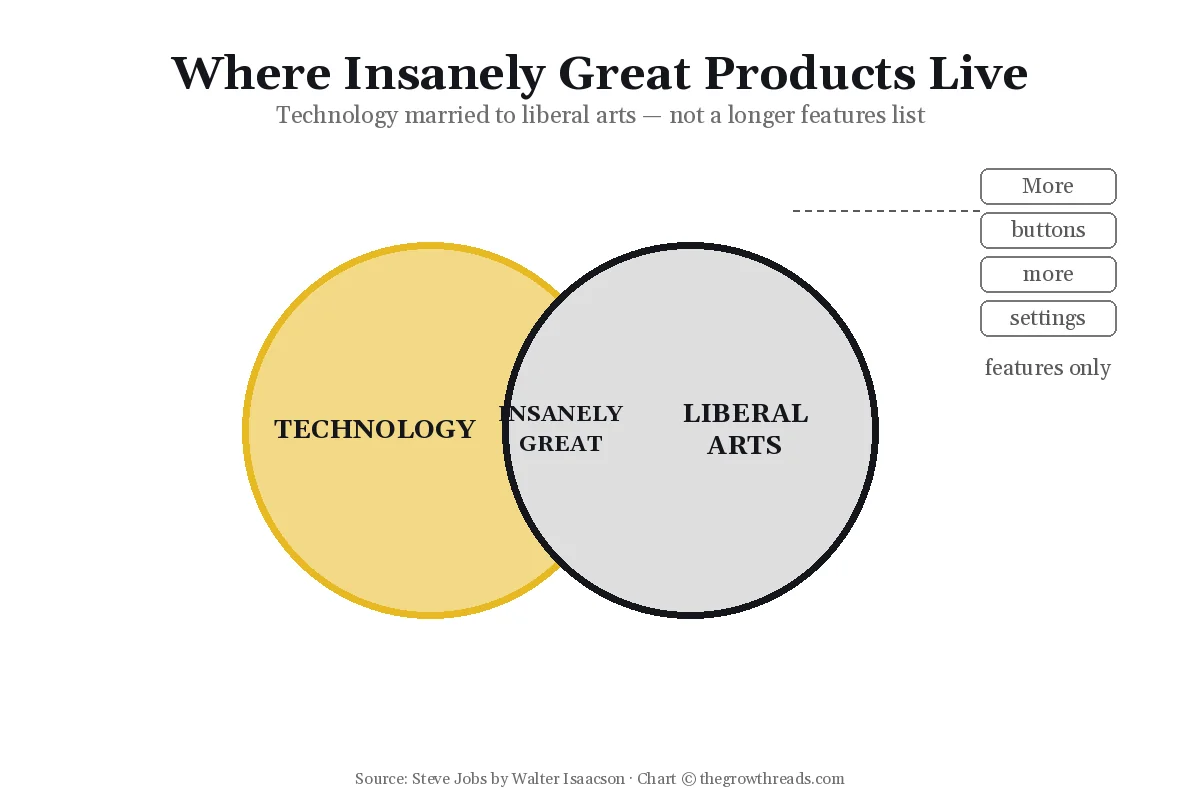
- Technology married to liberal arts: the good stuff lives in the overlap, not in more buttons.
- Walk as a beginner: use the thing the way a stranger would, in silence, before you add a tooltip.
- The wilderness taught focus: NeXT and Pixar were not a detour. They were the cut-the-list laboratory.
- Steal the sequence, not the intensity: a 630-page life is a case study. Your week needs one list cut to three.
What is Steve Jobs about?
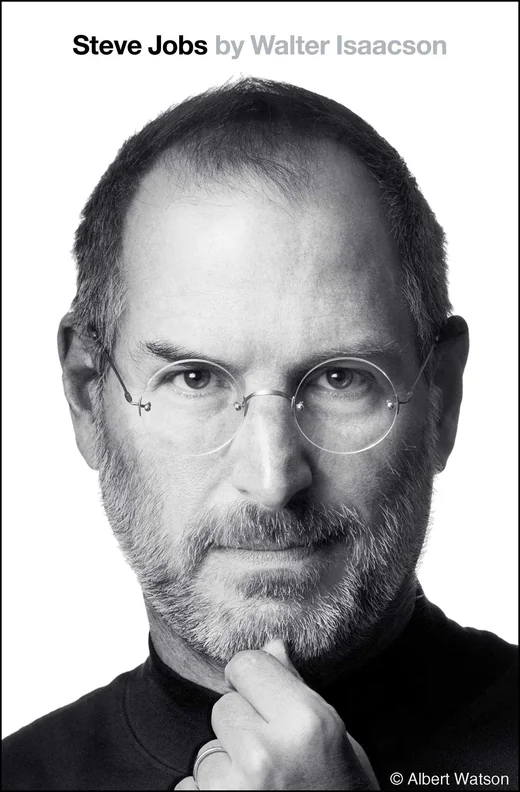
Steve Jobs is Walter Isaacson’s 2011 authorized biography of Apple’s co-founder, built from more than forty interviews with Jobs and a hundred with family, colleagues, and rivals. It follows one working kit: reality distortion, ruthless focus, A-player teams, and products that live where technology meets the liberal arts.
About the author
Walter Isaacson (born 1952) is an American journalist and biographer, a former CNN chair, TIME editor, and Aspen Institute CEO, now a history professor at Tulane. Jobs asked him to write the life after reading Isaacson’s Einstein, then sat for more than forty interviews over two years and told others to speak honestly. Isaacson kept the cover; he did not get a veto on the pages. Simon & Schuster published the book on 24 October 2011, nineteen days after Jobs’s death — 630 pages in the hardcover. The practical question is the same as in his Franklin, Einstein, and later Musk volumes: how does this mind actually work when the materials talk back? Explore all Walter Isaacson book summaries →
Key concepts at a glance
| Concept | What it means | Use it when |
|---|---|---|
| Reality distortion field | A story, a demo, and a public date that make a future expensive to fake | The roadmap only works in a meeting |
| Focus is saying no | Cut the list until three things can be great | Everything is P0 and nothing ships finished |
| Connecting the dots | Unused inputs (calligraphy, music, film) become product later | You are pruning “useless” liberal-arts time |
| Design is how it works | Taste is the object in the hand, not the skin on the box | You are decorating a confusing control |
| A players | A players hire A players; B players hire C players | The room cannot tell you no |
| End-to-end | Hardware, software, store, and content as one object | Each team hands the user a different story |
| Intersection | Technology married to liberal arts, not a longer features list | The object got more buttons and less soul |
| Beginner walk | Use it the way a stranger would, in silence | You keep narrating the “right” path |
Part 1: Garage, Reed, and a field that bends the room
Isaacson starts with an adoption in Silicon Valley, a workbench, Hewlett-Packard, Atari, and a Reed drop-in who stays for a calligraphy class he cannot put on a résumé. The opening stores an input — serif and sans, the space between letters — that the Macintosh will need a decade later. Connecting the dots backward is the transferable habit: keep a few “useless” inputs. You will not know which ones until the product asks. Apple I and II with Steve Wozniak are the first public tests. Wozniak built the elegant board. Jobs argued for the whole object. The circuit is not the product if the person still has to forgive the box.
On the Macintosh team, Bud Tribble names the “reality distortion field.” Isaacson treats it as a three-part tool: a story specific enough to walk into, a demo that is an object, and a date that makes the story expensive to miss. The Mac ships in 1984 with fonts from a class Jobs had no business taking. The steal is a calendar. Write the outcome in one sentence a stranger could test. Put a demo on the week, not a status.
TGR Note: Carmine Gallo’s The Presentation Secrets of Steve Jobs is the keynote craft — how the room saw the story. Isaacson is how the object got onto the stage. Start with Gallo if you only needed slides that behave like a demo. Don Norman’s The Design of Everyday Things is the cousin once the object exists: if a stranger cannot use it, the design failed.
Part 2: Macintosh taste, and the ouster that made focus expensive
The Macintosh chapters are where “design is how it works” stops being a poster. Isaacson reports Jobs’s line that design is not just what it looks like and feels like — design is how it works. The team obsesses over mouse, desktop, fonts, and case; they also ship late and lose a corporate argument in 1985. The ouster is data, not a morality play. A company that cannot decide what it is making will eventually decide who gets to make it. Jobs leaves. The product matrix keeps growing.
Read these chapters for the taste loop. Reject. Simplify. Demo again. Walk the object as a beginner. If you have to narrate the path, the path is not done. The 1985 exit looks like failure in the moment. In the book it is the laboratory. Without it there is no NeXT, no Pixar, no decade of companies that had to choose. Focus is cheaper to preach on Apple II profits. It is more expensive when the next machine has to be the whole company.
TGR Note: Clayton Christensen’s The Innovator’s Dilemma is why a great firm keeps serving its best customers until a simpler machine eats the floor. Isaacson’s 1985–1997 stretch is that theory with names. Read Christensen for the pattern; read Isaacson to watch someone thrown out of it learn which products to kill. Nir Eyal’s Hooked is the habit loop — only after the first action is findable.
Part 3: NeXT, Pixar, and the laboratory of no
NeXT is the expensive workstation almost nobody bought — and the software soul Apple later needed. Pixar is the $10 million purchase from George Lucas that becomes Toy Story in 1995 and a Disney deal worth more than the workstation. Isaacson treats both as focus school. At NeXT the hardware is beautiful and the market is thin. At Pixar the story has to work in a room that will walk out if the character is a lecture. You cannot ship every idea. You can ship the one that survives the demo.
A-player math gets its scars here. Jobs’s version: A players hire A players. B players hire C players, and the “bozo explosion” fills the building with people who cannot tell you no. Look at the last three people you added. Did they raise the room’s ability to reject weak work? Pixar’s gift to later Apple is end-to-end from another industry: story, picture, technology, and a ticket as one object. The wilderness is how he practiced saying no without a cult hit to hide behind.
TGR Note: Isaacson’s later Elon Musk is the factory sibling: first principles, the line, a five-step Algorithm. Keep this book for taste and a product matrix; keep Musk when the requirement cannot be derived from physics. Eric S. Raymond’s The Cathedral and the Bazaar is the other way to ship: many eyeballs, release early. Jobs built cathedrals on purpose. Know which game you are in.
Part 4: Return, intersection, and a 2026 steal
Jobs returns in 1997 to a company ninety days from insolvency and a product list that had lost the plot. The first move is subtraction: a few desktops, a few portables, consumer and pro. Think Different is the story; the iMac in 1998 is the demo; the date is public. Then the stack integrates. Apple stores so the object is not explained next to inkjet leftovers. iPod and iTunes in 2001 so a thousand songs in your pocket is a system. iPhone in 2007 so phone, computer, and iPod stop being three apologies. iPad in 2010 so the liberal-arts circle gets a piece of glass you hold like a book.
The signature diagram is a Venn. Technology in one circle, liberal arts in the other, the product in the overlap. Calligraphy becomes fonts. Music becomes a store plus a pocket. A phone becomes a computer you want to hold. Competitors sit in the features-only pile — more buttons, more beige. The 2026 names are new (model-written screens, a hundred-ticket roadmap); the test is not. If you added a control and the object got less inevitable, you left the overlap. Run the Tuesday diagnostic: what are we still saying yes to, where does the stack hand off, and when did we last walk this as a beginner?
TGR Note: Neil Postman’s Amusing Ourselves to Death is the caution if the iPhone chapters made you ask what a pocket computer does to a mind. Keep Isaacson for how the object was integrated; add Postman when the live problem is attention. Chris Miller’s Chip War is the atoms underneath every iPhone. Read Miller when your bottleneck is the supply of the universe’s hardest parts.
Who is Steve Jobs best for — and who should read something else first?
Read it if you ship products, interfaces, hardware, or a store, and your list got longer while the object in someone’s hand got worse. You do not need to run a consumer-electronics company. You need a list that can still be cut and a demo that is not a slide.
Read something else first if you wanted keynote craft — start with The Presentation Secrets of Steve Jobs. If you wanted disruption theory with no childhood chapter, use The Innovator’s Dilemma. If you wanted first principles on a factory floor, use Elon Musk. If you wanted the door, the stove, and the gulf of execution, use The Design of Everyday Things. This book is a superb first read if you were about to add another feature instead of deleting one.
Questions to reflect on
- What are the three things I am actually shipping this month — and what am I still calling a priority that is not on that list?
- Where is my demo, and where am I still using a slide as a substitute for an object?
- Which unused input (a class, a walk, a film, a typeface) am I treating as waste that a later product might need?
- On my last hire or last collaborator: did they raise the room’s ability to reject weak work?
- Where does my stack hand off — hardware, software, store, copy — and who owns the feeling in the user’s hand?
🔥 Ready to cut the list this week?
Get Steve Jobs and start reading.
How to apply Steve Jobs (7-day plan)
- Day 1 — Cut to three. Write every live project. Circle three. Move the rest to a dated not-now list. Do not delete yet. Just see the costume.
- Day 2 — Walk as a beginner. Use one of the three the way a stranger would, in silence, for twenty minutes. Write what your hands did, not what the spec says.
- Day 3 — Subtract a feature. Remove one control, one setting, or one step from that object. Note what still works. If nothing breaks, it was never required.
- Day 4 — Connect one unused dot. Take a liberal-arts input you already have — a walk, a typeface, a film, a sentence of copy — and let it change one decision on the object.
- Day 5 — End-to-end audit. Sketch hardware, software, store, and copy as four boxes. Mark the handoff where the user feels a different company. Fix one seam.
- Day 6 — Put a demo on the calendar. Not a review. An object someone can hold or click. Invite one person who did not build it.
- Day 7 — A-player note. One page: the three, the no’s, the demo, and whether the last person you added can tell you no. Put next week’s stop on the calendar when you put the start.
Frequently asked questions
What is the “reality distortion field”?
Bud Tribble coined the phrase on the Macintosh team for Jobs’s ability to describe a future so specifically that engineers started building it. Isaacson treats it as a tool, not a trick: a story, a demo, and a public date. The story has to be concrete enough to walk into. The demo has to be an object, not a slide. The date has to be expensive to miss. Steal a smaller version this week. Write the outcome in one sentence a stranger could test, then put a demo on the calendar. If the story only works in a meeting, it is still a costume.
What does Isaacson mean by focus is saying no?
Jobs’s line, reported throughout the return-to-Apple chapters, is that focus is not a mood. It is the thousand things you refuse so three can be insanely great. Isaacson shows the move after 1997: kill the sprawling matrix, pick a few machines, and let design, software, and marketing share one object. For a working week, write everything you claim to ship and circle three. The rest go on a dated not-now page. If you cannot name the three without a slide, you do not have focus yet — you have a backlog with better typography.
Is Steve Jobs a business book or a biography?
It is a biography you can spend like a working manual. Isaacson follows a life: adoption, Reed, Apple I and II, Macintosh, the 1985 ouster, NeXT, Pixar, the 1997 return, iMac, iPod, iPhone, iPad. The kit is the same in every chapter — reality distortion, saying no, A-player teams, an end-to-end stack, and products at the technology–liberal-arts intersection. If you wanted a 200-page method book with no childhood, this is the wrong object. If you wanted those tools under real constraints, the life is the case study. Read it for the kit, not as a costume.
How long is Steve Jobs, and is there an audiobook?
The Simon & Schuster hardcover is 630 pages, published 24 October 2011, nineteen days after Jobs’s death. Most readers need about fifteen hours; this guide is a fourteen-minute working pass. Dylan Baker reads a well-known Audible edition — useful on walks, weaker for the product-matrix scenes you will want on a page. If you start in audio, pause after each company chapter and write the focus move in one sentence. Keep a pen. The book is long because the life is long; the kit still fits on one card: cut the list, demo the object, integrate the stack.
Who should read Steve Jobs first?
Product people, designers, and founders who keep adding features instead of subtracting them — and anyone whose work still has to feel inevitable in someone’s hand. Also useful if hardware, software, and store still behave like separate companies. If you wanted keynote craft, start with The Presentation Secrets of Steve Jobs. If you wanted disruption theory, start with The Innovator’s Dilemma. If you wanted first principles on a factory floor, Isaacson’s Elon Musk is the later sibling. Come back here when the live problem is a list that will not get shorter.
What is the intersection of technology and liberal arts?
Jobs’s working picture, from Macintosh fonts born in a Reed calligraphy class through the iPad, is that great tools live where engineering meets the humanities — not in a longer features column. Isaacson keeps returning to that Venn: calligraphy and the Mac; music and the iPod; a phone you actually want to hold. The steal is a pairing. Take one technical object. Add one liberal-arts input this week — a walk, a film, a typeface, a sentence of copy — and let it delete a control. If the object only got more buttons, you stayed in one circle.
How do I apply this without copying someone else’s intensity?
Do not copy a reality-distortion tantrum. Copy the order of operations. Cut the list to three. Walk the object as a beginner. Subtract a feature. Check where hardware, software, and the store hand off. Put a demo on the calendar instead of another review. Isaacson shows the kit when the constraints are ugly: ninety days from insolvency, a product matrix that had lost the plot. You do not need those constraints. You need the same sequence on a smaller object this week, with a stop on the calendar so intensity stays a tool.
Related summaries
- Elon Musk — Isaacson’s later builder biography: first principles and the factory floor.
- The Design of Everyday Things — if a stranger cannot use it, the design failed.
- Amusing Ourselves to Death — what a pocket screen does to a mind that still needs to argue.
- Chip War — the atoms, fabs, and nations underneath every integrated device.
Browse every title in our Best AI Books pillar page.
How we analyze books: our summaries are built from a full read of the source text, cross-referenced against the author’s published interviews and research where relevant, and structured around practical application rather than critique. We disclose our editorial process and affiliate relationships in full. Read our full methodology.