

★★★★⅗ 4.7/5 — A visual craft manual for people who already work hard and still skip the film.
Best for: makers, operators, and athletes whose hours are real and whose details are still optional.
Reading time: ~3.5 hours (208 pages, photo-heavy) · this guide ~12 min
Difficulty to apply: Medium. The unit is one skipped detail plus a study slot, not a new personality.
The Mamba Mentality in one minute
Talent gets you in the gym. Details are how you play. Kobe Bryant’s The Mamba Mentality, photographed by Andrew D. Bernstein, is not a memoir of rings. It is a two-part craft book: Process (the student life nobody posts) and Craft (the mechanical edges other players treat as optional). Kobe watched film from decades he had not played in, arrived before the gym was a gym, and treated a defender’s hip as information. The nickname was a standard, not a costume. You do not need his vertical. You need a week where you already put in hours and still skip the study.
You do not need a new identity by Friday. Name one detail you skip, put fifteen minutes of film on the calendar, and steal one useful piece — not the whole act.
Key takeaways
- Process before lights: Film, early hours, questions, and recovery are the job. The game is the exam.
- Craft is details: Footwork, angles, tells. The pretty move is what other people notice. The edge is what they skip.
- Curiosity is training: Ask everyone in the building. A question is a rep you can take without a ball.
- Get there first: The gym before the gym. Hours that do not show up on a highlight.
- Watch the old tape: Study games you did not play in. Patterns hide in other people’s decades.
- Steal one piece: Greats are a library. Copy a wrinkle, not the costume.
- One more rep after done: Stay when they leave. That extra unit is the standard.
- Teach it to own it: If you cannot explain the detail, you are still borrowing it.
- The nickname is a calendar: Mamba Mentality is repeated study, not a mood you wait to feel.
What is The Mamba Mentality about?
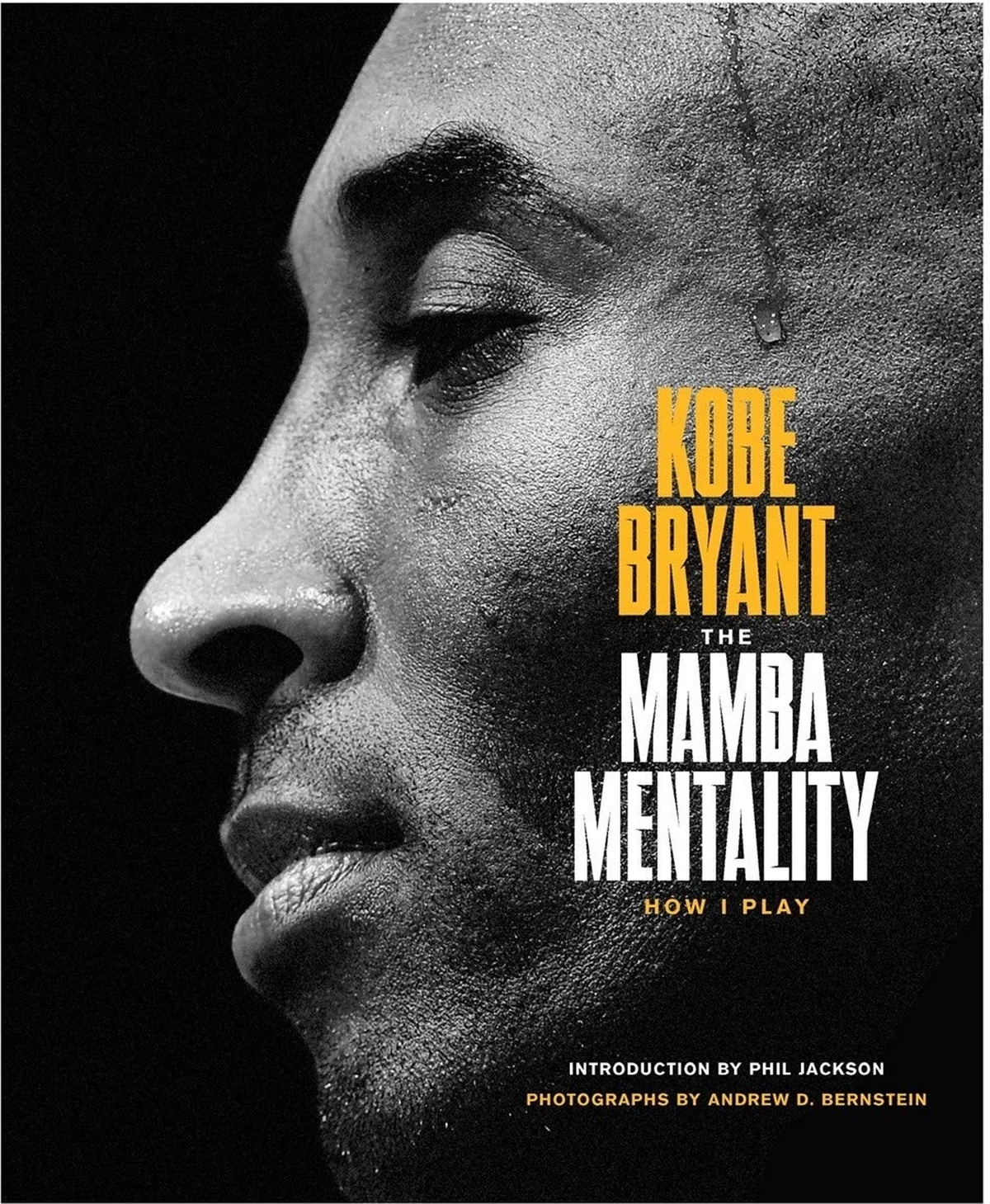
The Mamba Mentality is Kobe Bryant’s visual playbook for how he prepared and how he played. Split into Process and Craft, it argues that greatness is curiosity plus details: film nobody else watches, gym hours before the gym opens, and the small mechanical edges other players skip.
About the author
Kobe Bean Bryant (1978–2020) spent twenty seasons with the Los Angeles Lakers, won five NBA titles, and treated film study like a second practice. He entered the league from high school in 1996, built a reputation for 4 a.m. gym sessions, and spent off nights watching games from decades he had not played in. After retiring in 2016 he made this book with photographer Andrew D. Bernstein — a visual record of how he prepared and how he played — and later won an Academy Award for the short Dear Basketball. The Mamba Mentality is the working name he gave that standard: curiosity plus details, repeated when nobody is watching. He died in a helicopter crash in January 2020. The book is the closest thing he left to a craft manual. Explore all Kobe Bryant book summaries →
Key concepts at a glance
| Concept | What it means | Use it when |
|---|---|---|
| Process | Student life before the lights: film, early gym, questions, recovery. | Your hours are public and your study is still optional. |
| Craft | The details that show up in the possession: footwork, angles, tells. | You work hard and still play generic. |
| Film as homework | Watch games you did not play in. Pause. Steal one angle. | You only review your own last attempt. |
| Get there first | Arrive before the official start. The empty gym is the point. | You show up with everyone else and call it dedication. |
| Curiosity reps | Questions to coaches, trainers, opponents, history. | You wait to be taught instead of hunting the detail. |
| Steal a wrinkle | Take one useful piece from a great. Make it yours. | You copy a whole persona and wonder why it feels fake. |
| One more rep | The hour after they leave is the standard, not extra credit. | You stop when the group stops. |
| Teach to own | If you cannot explain the move, you do not have it yet. | The skill dies the moment the drill ends. |
Part 1: Process — show up as a student of the game
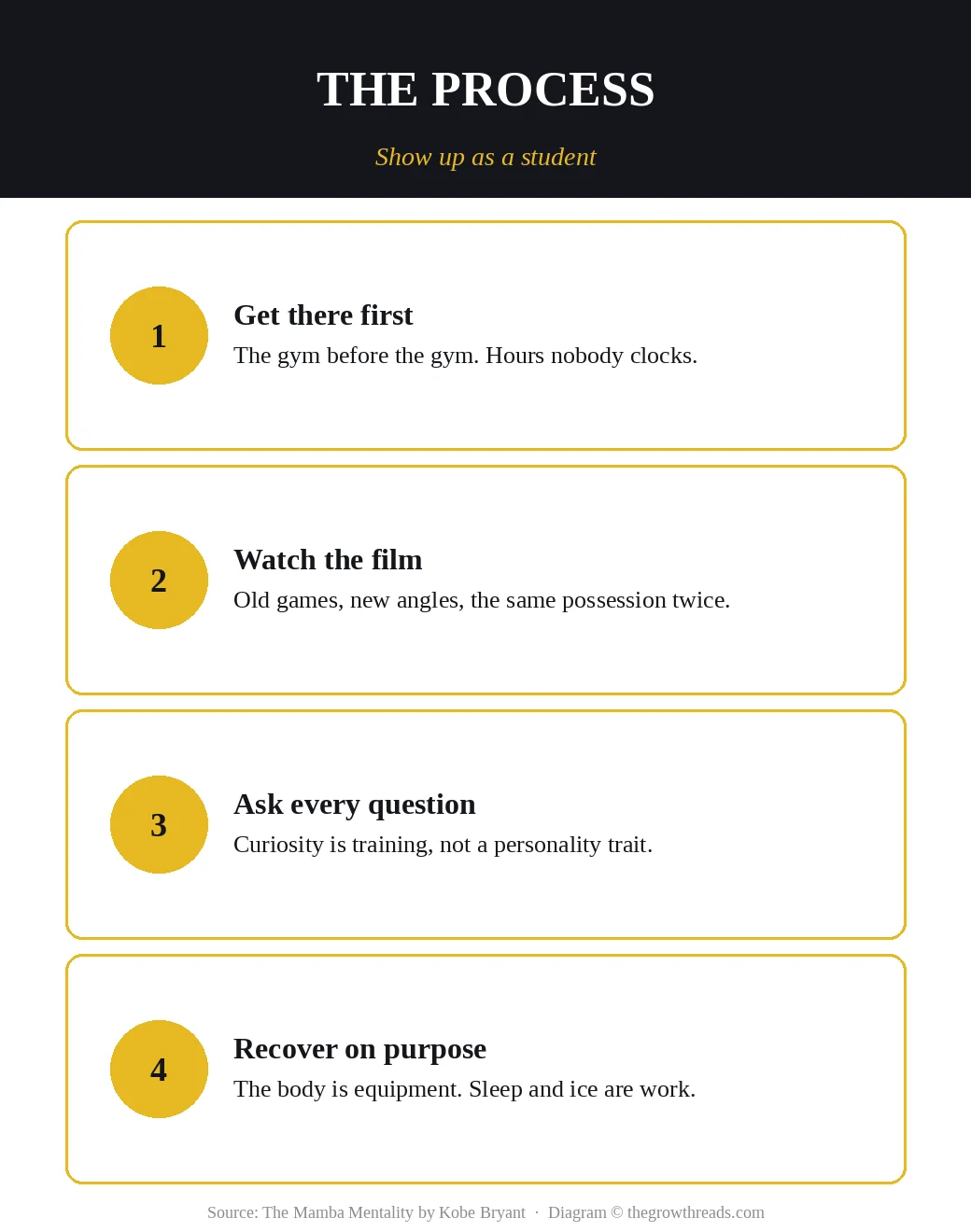
The first half of the book is not a pep talk. It is a student schedule with sweat on it. Kobe describes watching film the way other people describe practice: old games, new angles, the same possession twice. He asked questions of everyone in the building — trainers, video staff, opponents, people who had been in rooms he had not. The 4 a.m. gym was not a brand. It was how you get the court before the court is a social event. Recovery sits in the same column: ice, sleep, and a body treated as equipment, not as a mood. Process is everything that happens when there is no crowd to impress.
That is the fork most high-output weeks hide. You can log hours and still be a tourist in your own craft. Tourists replay their last attempt and call it study. Students watch other decades, pause on the hip, and write one sentence about what changed. If So Good They Can’t Ignore You argued that skills beat passion as a career bet, this book is the daily texture of that bet. You do not wait to feel like a student. You put film on the calendar and go. The photographs make the argument without a slogan: this is what the hours look like when nobody is filming you back.
TGR Note: If the remaining leak is walking toward pressure instead of negotiating with it, start with Relentless — Grover’s view from the same room. If the remaining leak is simply showing up on dull Tuesdays, Chop Wood Carry Water is the process romance. Kobe is the student notebook under both: film plus hours, not a vibe.
Part 2: Obsession is a calendar, not a mood
The middle of Process is the part people quote and then do not schedule. Obsession, in this book, is not a feeling you wait to catch. It is a slot: the extra film, the question you actually ask, the session before the session. Kobe is blunt that caring looks like repetition. “If you really want to be great at something, you have to truly care about it,” he writes — and then the photos show what caring cost on ordinary mornings. You do not get the nickname for free. You pay in boredom, early alarms, and a social life that does not get a vote on the gym.
This is also where the book stays practical about comparison. Studying Jordan or Magic is not cosplay. It is homework. You take the useful piece and you leave the costume. Completers of a different kind collect quotes and wait to feel ready. Students put fifteen minutes on Tuesday. If The Motivation Myth is start-first, feel-it-later, Kobe is start-the-film, feel-it-never-required. The mood can arrive after the tape. It does not get to be the gate. Readers who used Atomic Habits for a cue will recognize the install: the identity is “I study,” not “I am inspired.” Kobe just refuses to make the install cute.
TGR Note: If you want the lab on why hours plus feedback beat gift stories, read Talent Is Overrated and Peak. If you want the bounce after a miss, Bounce is the practice-seen-from-far-away cousin. Kobe is the picture book those arguments were waiting for.
Part 3: Craft — the details other people skip
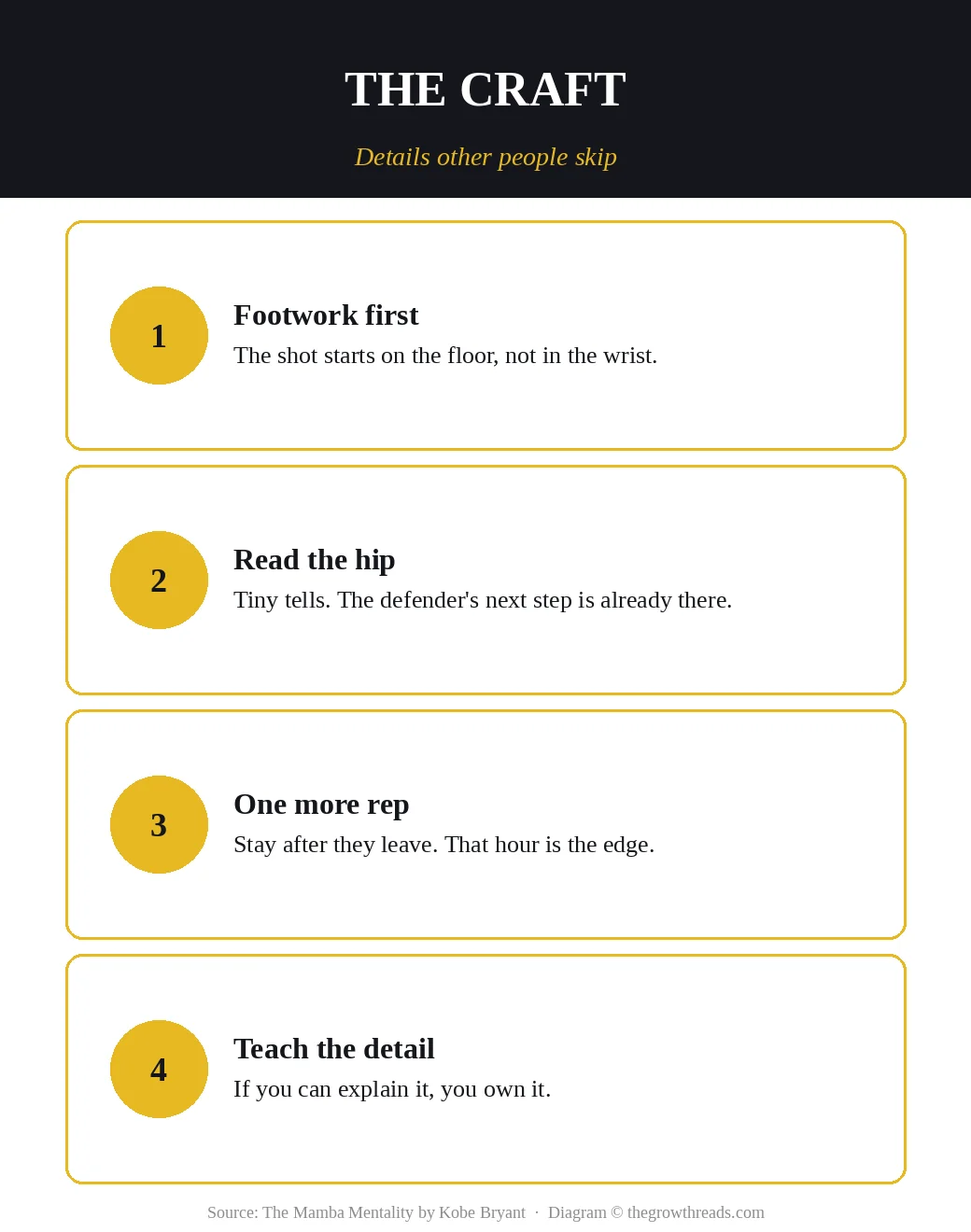
Craft is the second half of the hallway. Process gets you to the possession. Craft decides whether the possession is generic. Kobe talks footwork the way a carpenter talks joints: the shot starts on the floor. He reads a defender’s hip as a tell, not as decoration. He stays after the gym empties for the rep that will not make a story. Teaching sits here too — showing a teammate the wrinkle is how you find out whether you own it. If you cannot explain the move in five sentences, you are still renting it from yesterday’s drill.
The application is rude in a useful way. Most skilled weeks already have volume. They do not have a named detail. You send the work and skip the teardown. You run the meeting and skip the recording. You train the visible lift and skip the boring accessory that would actually change the shot. Craft is picking one of those skips and treating it like the job. Grover’s Winning says keep racing after the result. This chapter says the race was already lost if you never studied the hip. You can be a Competitor in the stands and still a tourist in the film room. Kobe will not let those two jobs stay confused.
TGR Note: If the remaining leak after the detail is a missing deep-work block, Deep Work is the door closer. If the remaining leak is still a tiny start, Mini Habits is the first two minutes. Kobe assumes the door is already open and the two minutes already happened. Now study.
Part 4: Steal from the greats, then make it yours
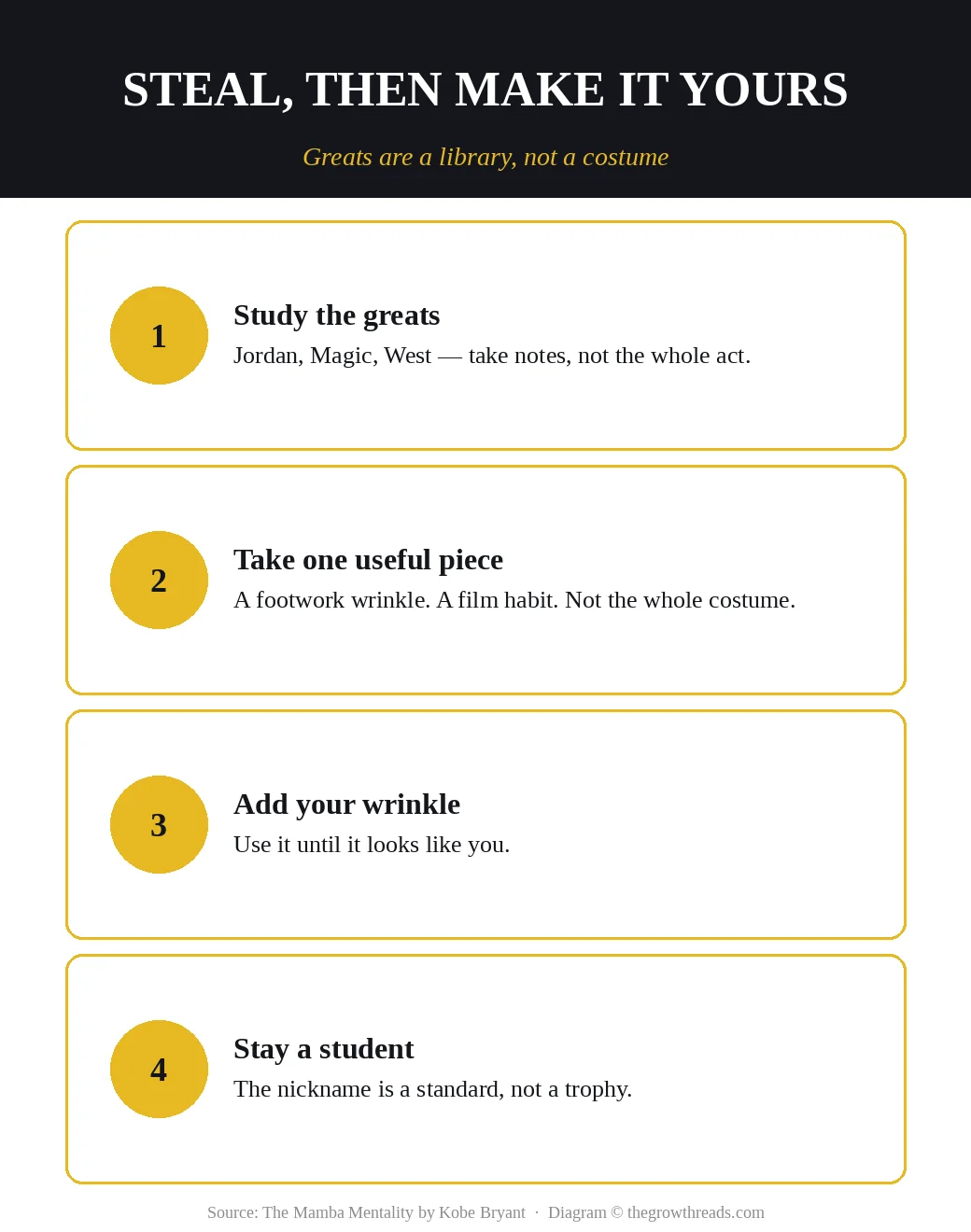
The last movement is how Kobe used other people’s greatness without becoming a tribute act. He studied Jordan, Magic, Jerry West, whoever had a piece he did not yet own. Then he added a wrinkle until the move looked like him. That is the opposite of fandom. Fandom copies the whole costume and wonders why it feels stiff. Students copy one joint and test it on Thursday. The book is full of that library logic: the greats are not saints to imitate. They are shelves. Take the volume you need. Leave the rest. Stay a student after the nickname arrives, because the nickname is a standard, not a trophy you get to sit on.
You do not need his roster to run the last chapter. You need one better practitioner in your field and one piece you can steal without stealing their life. Name it. Try it. Teach it. Then write the next detail. The scoreboard is allowed to report. It is not allowed to become a sofa — Grover already said that. Kobe’s addition is that the sofa often starts earlier, in the skipped film. Process plus Craft, one skipped detail, one study slot, one wrinkle. Repeat on a calendar, not on a feeling. That is The Mamba Mentality in practice: a student who plays, not a talent who hopes.
TGR Note: If the job after the wrinkle is staying free when the number gets personal, Inner Excellence trains the chest so the standard does not own your worth. If the job is proving you can stay in the dark, Can’t Hurt Me is the accountability mirror. Kobe is the film room those books still need.
Who is The Mamba Mentality best for — and who should read something else first?
Best for people whose skill is already real and who still skip the study: operators, makers, athletes, anyone whose week has hours without homework. If you want locker-room pressure first, start with Relentless. If you want the competitor OS after a win, start with Winning. If you want the science of practice, start with Peak.
Read something else first if you need a tiny start or a cue. Begin with Mini Habits or Atomic Habits. If the leak is waiting to feel ready, read The Motivation Myth. Come to The Mamba Mentality when the calendar is already open and the leak is skipping the film.
Questions to reflect on
- Which detail in your craft do you currently treat as optional — and what is the evidence, not the story?
- When did you last study someone else’s work the way you study your own last attempt?
- Where in your week do you stop when the group stops?
- What one piece could you steal from a better practitioner without stealing their costume?
- If the nickname were a calendar, what slot would you add this week?
🔥 Ready to study like it is the job?
Name the skipped detail. Watch the film. Steal one wrinkle — not the costume.
How to apply The Mamba Mentality (7-day plan)
- Day 1 — Name the skipped detail. Write one sentence: the part of your craft you treat as optional. Put it where you will see it tomorrow morning.
- Day 2 — Fifteen minutes of film. Watch or reread one real example of the work. Pause. Note one angle you missed last time. No playlist of ten videos.
- Day 3 — Get there first. Arrive twenty minutes before the official start. Use it on the boring setup other people do in a rush.
- Day 4 — One more rep after done. When you feel finished, add one extra unit: one more pass, one more question, one more rep. That hour is the edge.
- Day 5 — Steal one useful piece. Pick one better practitioner. Copy one footwork, one template, one question they ask. Not the whole costume.
- Day 6 — Teach the detail. Explain yesterday’s wrinkle to someone in five sentences. If you cannot teach it, you do not own it yet.
- Day 7 — Write the next detail. The first skip you named is no longer the whole standard. Name the next one. Put next week’s film slot on the calendar.
Frequently asked questions
What is The Mamba Mentality about?
The Mamba Mentality is Kobe Bryant’s visual playbook for how he prepared and how he played, photographed by Andrew D. Bernstein with an introduction by Phil Jackson. It splits the work into Process and Craft. Process is the student life: film, early gym, questions, recovery. Craft is the details other people skip: footwork, reading a defender’s hip, one more rep after the gym empties. The argument is not that talent is fake. It is that talent without a study habit stalls. You do not need a Lakers jersey. You need a craft with film, reps, and a detail you currently shrug off.
How long does it take to read The Mamba Mentality?
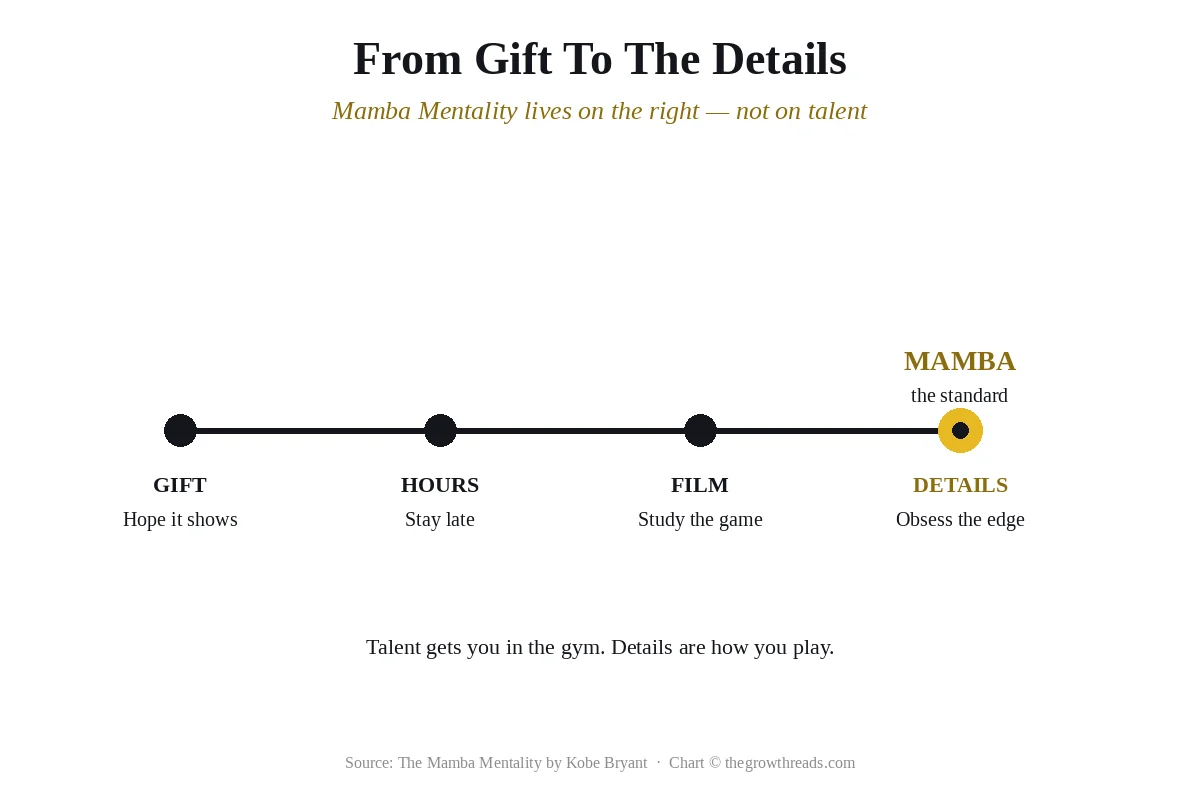
The hardcover is about 208 pages and heavily illustrated, so most readers finish in three to four hours. This summary is a twelve-minute pass: Process versus Craft, the gift-to-details spectrum, and a seven-day plan. If you only have lunch, pick one detail you currently skip and schedule fifteen minutes of film or notes on it. Come back to the photo essays once that slot exists. The book rewards a second look more than a highlight dump, because the pictures are the argument: this is what obsession looks like on a Tuesday, not on a trophy night.
Is The Mamba Mentality only for basketball players?
The photos are basketball. The mechanism is not. Any week you already put in hours and still skip the unglamorous study — a recording of the call, a teardown of the deck, the footnote in the spec — is a Process week. Operators, makers, students, and athletes hit the same fork. If you want a tiny first step, start with Mini Habits. If you want a cue you can repeat, start with Atomic Habits. Read this when the hours are already real and the leak is skipping the film. Kobe’s gym is a metaphor with sweat in it, not a closed club.
How is The Mamba Mentality different from Relentless?
Relentless is Tim Grover’s pressure OS from the trainer’s side of Kobe’s room: Cooler, Closer, Cleaner, do not negotiate with the loud minute. The Mamba Mentality is Kobe’s own craft manual: how he studied, how he moved, which details he refused to treat as optional. Grover tells you to keep racing after the result. Kobe shows you the homework that made the race possible. If you are still backing down when it counts, start with Relentless. If you already show up and still play generic, read this. Winning is the sequel about Completers versus Competitors. This book is the student notebook under both.
What is the difference between Process and Craft in the book?
Process is everything that happens before the lights: film from decades you did not play, questions asked of everyone in the building, the 4 a.m. gym, ice and sleep treated as work. Craft is everything that shows up in the possession: footwork, angles, reading a hip, the extra wrinkle you added after you stole a useful piece from a better player. Process without Craft is a busy student who still plays loose. Craft without Process is a pretty move you cannot repeat on Thursday. Kobe’s standard is both halves on the same calendar. That is the whole book in one hallway.
Who should read something else before The Mamba Mentality?
If you still need permission to start small, start elsewhere. Mini Habits is the tiny first step. Atomic Habits is the cue-and-identity install. The Motivation Myth is start-first, feel-it-later. Relentless is the walk toward pressure. This book assumes you can already work and still skip the study. It is also a photo-heavy object, not a dense theory text — Peak and Talent Is Overrated are better if you want the lab on deliberate practice. Come here when you want a standard you can see: curiosity plus details, repeated when nobody is watching.
What should I do on day one with The Mamba Mentality?
Write one sentence: which detail in your craft do you currently skip because it feels optional? Then put a fifteen-minute film or notes block on tomorrow’s calendar. Do not pick ten details. Kobe’s loop is watch, ask, repeat, then add one wrinkle. Day one is a named skip plus one study slot. The photographs are not a substitute for that sentence. Read a chapter after the slot exists, not instead of putting it there. If you already train in public and study in private, you are already on the right side of the spectrum. Tighten the detail, do not collect another slogan.
Related summaries
- Relentless — walk toward pressure when you are still negotiating with it.
- Winning — keep racing after the result lands.
- Talent Is Overrated — deliberate practice without the gift story.
- Peak — the lab version of staying a student.
- Best productivity books — the full Productivity silo.
How we analyze books: every book on The Growth Reads is read cover to cover, summarized in thousands of words of original analysis, and rated against our five-criteria rubric (lasting impact, evidence quality, practical application, writing & originality, external consensus). Read our full methodology.