

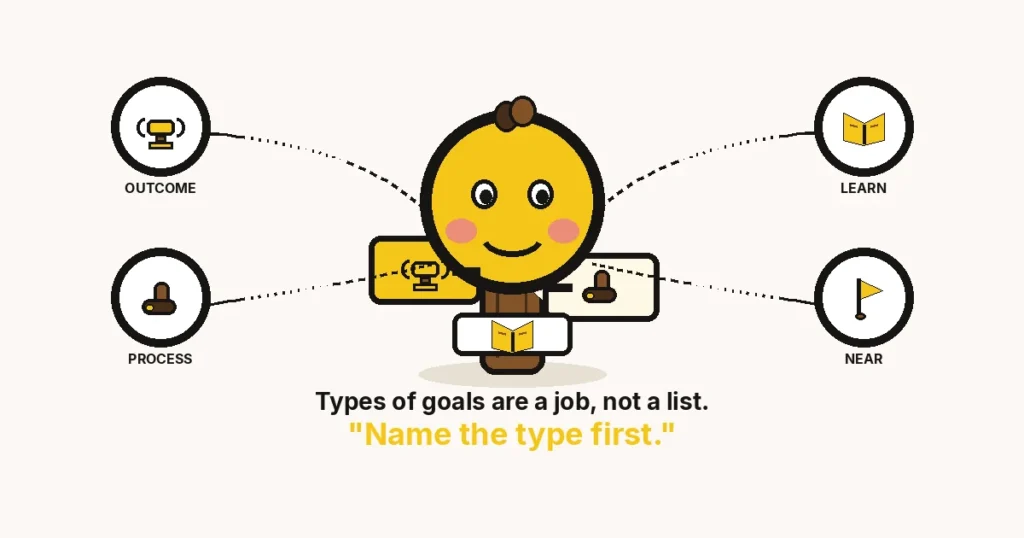
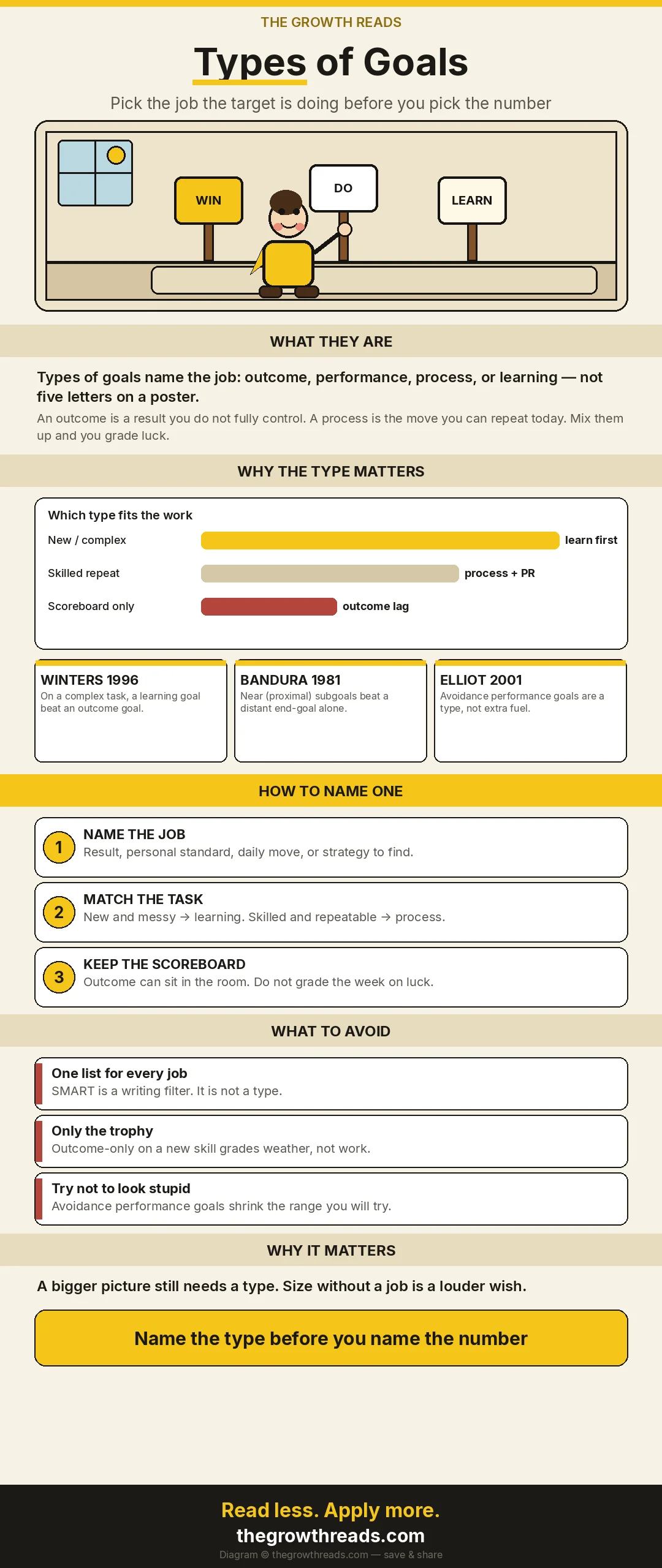
Types of goals are the job a target is doing: outcome, performance, process, or learning. An outcome names a result you do not fully control. A process names the move you can repeat today. Mix them up and you grade luck. Name the type before you name the number.
Key takeaways
- Filby, Maynard and Graydon (1999) split sport goals into outcome, performance and process, and found mixed-goal strategies beat a single type in training and competition.
- Winters and Latham (1996) showed that on a complex task, a learning goal (discover strategies) outperformed an outcome goal — the type that works on a simple task can stall a new one.
- Bandura and Schunk (1981) found proximal (near) subgoals raised children’s arithmetic skill and self-efficacy more than a distant end-goal alone.
- Elliot and McGregor (2001) mapped four achievement goals: mastery-approach, mastery-avoidance, performance-approach, performance-avoidance — “try not to look stupid” is a type, not extra fuel.
- David Schwartz’s The Magic of Thinking Big is the named unused review on this URL: a larger picture still needs a type, or the size is just a louder wish.
What types of goals actually are
Types of goals are the job a target is doing — outcome, performance, process, or learning — not a longer list of wishes and not five letters on a poster. If you cannot say which job this sentence is hired to do, you do not have a type. You have a slogan.
This spoke sits in the Decisions cluster, which is why it links up to live analysis paralysis rather than minting a new parent. Goal setting has no silo of its own on this site: the definition lives on what is goal setting, the filter lives on SMART goals, and Locke and Latham’s mechanism lives on goal setting theory under Habits. Habits-cluster articles still climb to live keystone habits. This URL is not that parent and does not replace it. The productivity library is the hub for the rest of the silo.
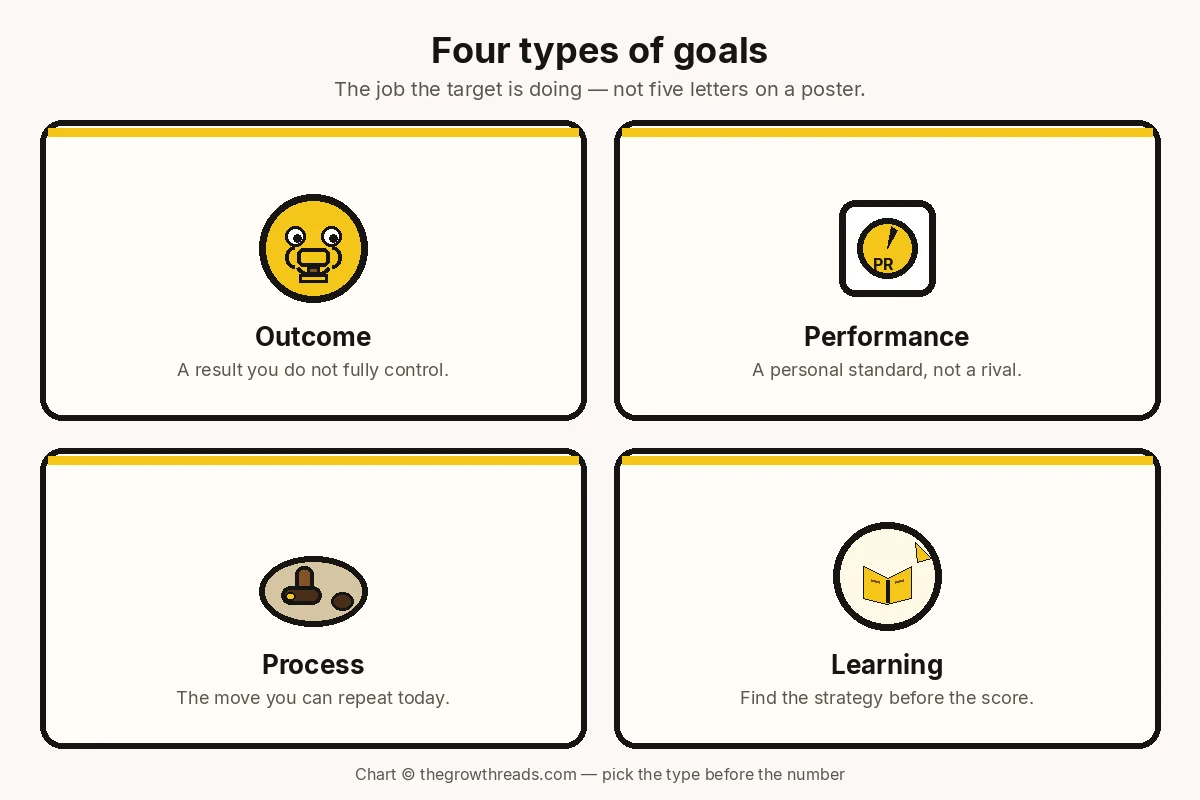
Sport psychologists have used a three-way split for decades: outcome (beat the field), performance (hit a personal standard), process (run the move). Work psychologists added a fourth when the task is new: a learning goal, which is a hunt for strategies rather than a score. Those four change the week. Approach versus avoidance, and near versus far, are extra axes on the same sentences. They are not a second poster you have to memorise.
How is this different from SMART, a wish, and a habit?
A wish has no test. A habit is a cue you repeat. SMART is a writing filter. A type of goal is the job the sentence is hired to do.
Sister page what is goal setting owns the definition of naming a finish you can check later. SMART goals owns the 1981 letters — and where the realistic letter fails as a lid. Goal setting theory owns Locke and Latham’s finding that a hard, specific number beats “do your best,” if you are committed, able, and can see the score. Keep the lanes. If you came here to pick a job for the sentence, stay on the types. If you came here to learn what a goal is, or how to spell SMART, those pages are cleaner.
Why the type you pick changes the work
The type changes what you count as a good day, and what you blame when the day misses. That is the mechanism, not “some people are outcome-oriented,” and not a personality test.
Winters and Latham (1996) is the cleanest demonstration. On a simple task, an outcome goal did what Locke and Latham would predict: it pulled performance up. On a complex scheduling task, the same kind of outcome goal lost to a learning goal — “find strategies” beat “hit this number.” The type that helps on work you already know how to do is the type that stalls work you do not. Seijts and Latham (2005) later wrote that for managers without pretending a mnemonic had appeared in the lab.
Zimmerman and Kitsantas (1997) showed a sequence rather than a forever-choice. In a dart-throwing study, process goals (focus on the move) beat outcome goals (focus on the score) while the skill was new. Shifting from process to outcome once the move was there beat staying on process forever. The type can change as the work changes. A freeze on “I am an outcome person” is how a new skill gets graded as a character flaw.
Bandura and Schunk (1981) add the time axis. Children working on subtraction did better with proximal (near) subgoals than with a distant end-goal alone: faster mastery, higher self-efficacy, more interest in the work. Latham and Seijts (1999) found the same shape on a moderately complex business simulation: a distal goal plus proximal checkpoints beat a distal goal alone and beat do-your-best. Near is a type of range, not a smaller dream.
Counter-case. Outcome goals are not the villain. They are the scoreboard. Locke and Latham (2002) still want a specific, difficult target when the person can do the task, is committed, and can see the result. The miss is hiring an outcome sentence to do a learning job, or hiring an avoidance sentence (“do not look stupid”) to do an approach job. Elliot and McGregor (2001) are explicit: performance-avoidance is a type with a cost, not extra seriousness. If the owner cannot change the result, or cannot yet run the skill, stop using the trophy as a daily grade.
The four working types
Name the type by the job, then write one sentence a stranger could check. You do not need twelve posters. You need a hire: result, personal standard, daily move, or strategy hunt.
| Type | The job | You mostly control | It fails when |
|---|---|---|---|
| Outcome | A result other people, luck, or the market can still veto | The aim, not the weather | You grade a new skill, or a single week, on a trophy you cannot force |
| Performance | A personal standard, independent of rivals | The number if the skill is already there | The task is new and you have no method yet (Winters and Latham, 1996) |
| Process | The move you can repeat today | The action, if the cue is real | You never look up, or you confuse motion with a finish |
| Learning | Find strategies for work you have not mastered | The hunt: pages, trials, reviews | You stay on “explore” after the method is known, and never set a hard number |
Filby, Maynard and Graydon (1999) are why the table is allowed to stack. Mixed-goal strategies — process plus performance plus outcome — beat a single type in their training and competition study. A clean stack for a week is one outcome on the wall, one personal performance standard, and one process for today. If the work is new, swap the performance line for a learning line until you have a method. That is a stack. Three outcome sentences is not a stack. It is three trophies and no move.
Approach and avoidance cut across the table. Mastery-approach is learning toward a skill. Performance-approach is scoring against a standard or a rival. Mastery-avoidance is “do not lose the skill.” Performance-avoidance is “do not look worse than them.” Elliot and McGregor (2001) mapped those four cells. You do not need the jargon on a sticky note. You need to notice when the sentence starts with do not, because that type shrinks the range you will try.
Why a mixed-up type costs more than it feels like
A mixed-up type charges you twice: you work the wrong scoreboard, then you write a story about the person who “failed” a job they were never hired to do.
An outcome-only week on a new skill is the expensive version. You cannot yet control the trophy, so every miss becomes a verdict. Winters and Latham (1996) already showed the performance cost on a complex task. The hidden cost is the story: “I am bad at this” is often “I graded a learning job as an outcome.” Process-only has the opposite bill. You can rack up moves and never ask whether the moves still serve a finish. A streak of opened files is not a shipped draft.
Avoidance goals add a quieter tax. You pick safe work so you cannot be seen missing. That can look like high standards from the outside. Elliot and McGregor’s performance-avoidance cell is the name for it. The 1-3-5 rule is one way to stop a day collecting owner-less trophies. How to prioritise tasks is the ranking judgement inside the week. Neither replaces naming the type.
Common mistakes that turn types into a poster
- Treating SMART as a type. The letters tell you whether the sentence can be checked. They do not tell you which job it is doing. A SMART outcome can still grade luck.
- Outcome-only on day one of a new skill. Write a learning goal until you have a method (Seijts and Latham, 2005). Then raise a hard number.
- Process-only forever. Zimmerman and Kitsantas (1997) shifted from process to outcome once the move was there. Staying on the warm-up is how a draft never ships.
- Three trophies, no move. Mixed goals means different jobs, not more outcome sentences.
- A far goal with no near checkpoint. Bandura and Schunk (1981), and Latham and Seijts (1999), both favour a distal picture plus proximal tests. A five-year sentence with no Friday check is a wish.
- Avoidance dressed as standards. “Do not look stupid” shrinks the range. Rewrite it as a move toward something you can count.
- Minting a new parent because the keyword says goals. Goal rows on this site still live under Decisions or Habits. Habits still links up to keystone habits. Do not invent a seventh silo.
The evidence behind this
The evidence is for types as jobs, not for a trademarked four-box product. There is no randomised trial of this page’s table as a bundle. What follows is the adjacent literature, with design and limit named.
| Study | Design and size | Finding | What we used it for |
|---|---|---|---|
| Winters and Latham (1996) | Lab / class scheduling task; simple vs complex versions | On the complex task, a learning goal beat an outcome goal | Type follows task difficulty, not personality |
| Bandura and Schunk (1981) | Children with subtraction gaps; proximal vs distal goals | Near subgoals raised skill, self-efficacy, and interest vs a distant end-goal alone | Range (near vs far) is a type of job, not a smaller dream |
| Zimmerman and Kitsantas (1997) | Dart throwing; process vs outcome, including a shift condition | Process beat outcome while the skill was new; shifting later was best | The type can change as the skill arrives |
| Elliot and McGregor (2001) | 2 × 2 achievement-goal framework; undergraduate samples | Mastery/performance × approach/avoidance are separable orientations | “Do not look stupid” is a type with a cost |
| Filby, Maynard and Graydon (1999) | Training and competition; single-type vs mixed-goal strategies | Combining process, performance and outcome beat a single type | Stack types; do not mash three trophies |
Locke and Latham (2002) remain the background: specific, difficult goals beat vague do-your-best goals when ability, commitment and feedback are in place. That is why an outcome or performance sentence still has to be hard and checkable. It is also the limit. Their review is not a trial of four labels, and it is not a licence to put a trophy on work the person cannot yet do. Latham and Seijts (1999) is the proximal-plus-distal companion. Seijts and Latham (2005) is the manager-facing split between learning and performance goals. None of these papers is David Schwartz. The named book on this URL argues for a larger picture. We use it as the opposite pressure: size without a type is still a wish.
Frequently asked questions
What are the types of goals?
Types of goals are the job a target is doing. The working set on this page is outcome (a result you do not fully control), performance (a personal standard), process (the move you can repeat today), and learning (find the strategy before you chase a score). Sport research also uses outcome, performance and process. Work research adds learning versus performance goals when the task is new. SMART is a writing filter, not a fifth type. Name the job first, then the number.
What is the difference between outcome and process goals?
An outcome goal names a result other people, luck, or the market can still veto: win the pitch, hit the revenue line, finish first. A process goal names the move you can run today: send three drafts before noon, run the warm-up, open the file after coffee. Filby, Maynard and Graydon (1999) treated them as different jobs, not synonyms. Keep the outcome in the room as a scoreboard. Grade the week on the process, or you will treat weather as character.
What is a learning goal versus a performance goal?
A performance goal says hit this number with the skill you already have. A learning goal says find the strategies that make the number possible. Winters and Latham (1996) put people on a complex scheduling task: a learning goal beat an outcome goal. Seijts and Latham (2005) later put that into manager language: when the work is new, write “discover X ways,” not “score 90.” Once the method is known, a hard performance number is the right type again. The type follows the task, not your personality.
What are approach and avoidance goals?
Approach goals move toward a positive standard: learn the method, beat last month’s time. Avoidance goals move away from a feared standard: do not look stupid, do not finish last. Elliot and McGregor (2001) mapped four cells — mastery-approach, mastery-avoidance, performance-approach, performance-avoidance. “Try not to look stupid” is a type with a cost: you shrink the range you will try. It is not extra fuel. If the sentence starts with do not, you are usually on an avoidance goal. Rewrite it as a move toward something you can check.
How many types of goals are there?
There is no official count. This page uses four working types because they change the week: outcome, performance, process, learning. You can also split by time (near versus far) and by direction (approach versus avoidance). Those are extra axes, not a second poster. Do not collect twelve labels. Pick the job this task is doing, write one sentence a stranger could check, and leave the rest on the shelf. A longer taxonomy that never names a dated do is still a wish.
Should I use more than one type of goal at once?
Often, yes — stacked, not mashed. Filby, Maynard and Graydon (1999) found mixed-goal strategies beat a single type in training and competition. A clean stack is one outcome on the wall, one personal performance standard, and one process for today. Zimmerman and Kitsantas (1997) showed a sequence: process first while the skill is new, then shift toward an outcome once the move is there. The miss is grading a new skill on an outcome you do not control, or running three outcome sentences and calling that a mix.
Are SMART goals a type of goal?
No. SMART is a 1981 writing filter for how specific, measurable, assigned, realistic and dated a sentence is. It does not say whether the sentence is an outcome, a process, or a learning goal. A SMART outcome can still grade luck. A vague process is still a process, just a foggy one. Use sister page SMART goals for the filter and where the realistic letter fails. Use this page to name the job. Then write the sentence so it can be checked. Five letters do not replace a type.
What should I read after this page?
Start with analysis paralysis, the Decisions parent this taxonomy sits inside, if the stall is an unbound wish you keep rewriting. What is goal setting is the sister definition of naming a finish. SMART goals is the writing filter. Goal setting theory is Locke and Latham’s hard-number mechanism, filed under Habits, and it still links up to live keystone habits rather than a new parent. The 1-3-5 rule is a daily size budget. Then the named review: The Magic of Thinking Big — size still needs a type, or the picture is a louder wish.
Sources
- Locke, E. A., & Latham, G. P. (2002). Building a practically useful theory of goal setting and task motivation: A 35-year odyssey. American Psychologist, 57(9), 705–717. https://doi.org/10.1037/0003-066X.57.9.705
- Winters, D., & Latham, G. P. (1996). The effect of learning versus outcome goals on a simple versus a complex task. Group & Organization Management, 21(2), 236–250. https://doi.org/10.1177/1059601196212007
- Bandura, A., & Schunk, D. H. (1981). Cultivating competence, self-efficacy, and intrinsic interest through proximal self-motivation. Journal of Personality and Social Psychology, 41(3), 586–598. https://doi.org/10.1037/0022-3514.41.3.586
- Elliot, A. J., & McGregor, H. A. (2001). A 2 × 2 achievement goal framework. Journal of Personality and Social Psychology, 80(3), 501–519. https://doi.org/10.1037/0022-3514.80.3.501
- Zimmerman, B. J., & Kitsantas, A. (1997). Developmental phases in self-regulation: Shifting from process goals to outcome goals. Journal of Educational Psychology, 89(1), 29–36. https://doi.org/10.1037/0022-0663.89.1.29
- Filby, W. C. D., Maynard, I. W., & Graydon, J. K. (1999). The effect of multiple-goal strategies on performance outcomes in training and competition. Journal of Applied Sport Psychology, 11(2), 230–246. https://doi.org/10.1080/10413209908404202
- Latham, G. P., & Seijts, G. H. (1999). The effects of proximal and distal goals on performance on a moderately complex task. Journal of Organizational Behavior, 20(4), 421–429. https://doi.org/10.1002/(SICI)1099-1379(199907)20:4<421::AID-JOB898>3.0.CO;2-#
- Seijts, G. H., & Latham, G. P. (2005). Learning versus performance goals: When should each be used? Academy of Management Executive, 19(1), 124–131. https://doi.org/10.5465/ame.2005.15841964
Related reading on The Growth Reads
The books this method draws on
- The Magic of Thinking Big summary & review — the named unused review; a larger picture still needs a type
Related articles
- Analysis paralysis — the Decisions parent; the stall a type is built to stop
- What is goal setting — the sister; naming a finish versus naming a job
- SMART goals — the writing filter, not a type
- Goal setting theory — Locke and Latham’s hard number; Habits child of live keystone habits
- The 1-3-5 rule — a daily size budget so types do not become a pile
- How to prioritise tasks — the ranking judgement inside the week
- Keystone habits — the Habits cluster anchor; this URL does not replace it
Go deeper
How this article was researched
The Growth Reads editorial team writes from primary sources: the books themselves, the authors’ published essays, and the peer-reviewed literature behind the claims. Every study cited above was read in the original publication or its published abstract, and every figure is quoted with its design and limit so you can judge its weight rather than take ours. Where a finding is a 35-year research synthesis, a lab scheduling task, a dart-throwing study, an achievement-goal framework, a sport mixed-goal study, or a motivational book rather than a randomised test of four trademarked labels, we say so in the body rather than in a footnote.
This page is a productivity method, not a book review of any single title, and not medical or clinical advice. Persistent inability to start work across contexts belongs with a clinician, not with a prettier taxonomy. Decisions-cluster articles on this site link up to live analysis paralysis. Habits-cluster articles still link up to live keystone habits. This URL does not mint a new habits parent.
How we work: every article on The Growth Reads is built from the books in our library plus the research they rest on, and is reviewed and date-stamped when the evidence changes. Read our full methodology.