

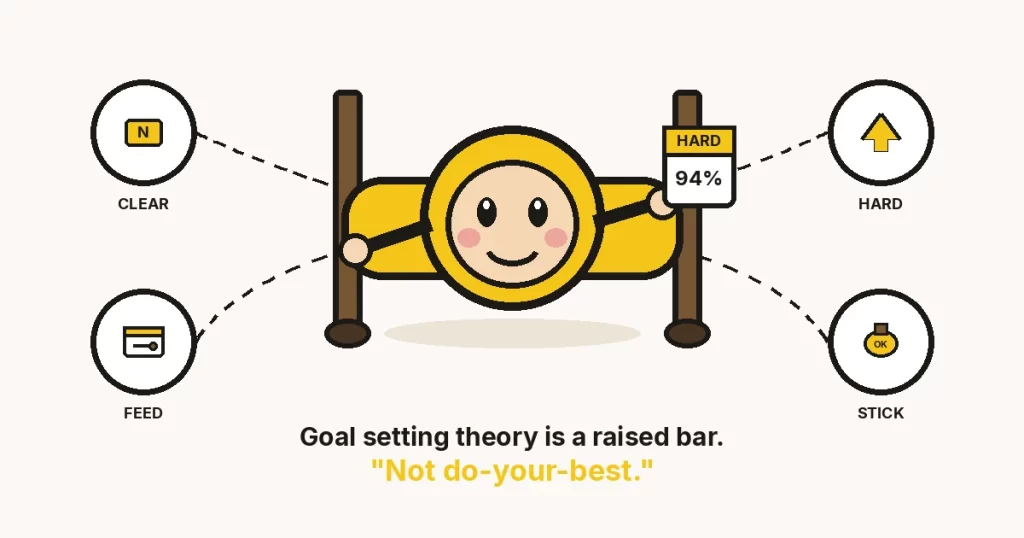
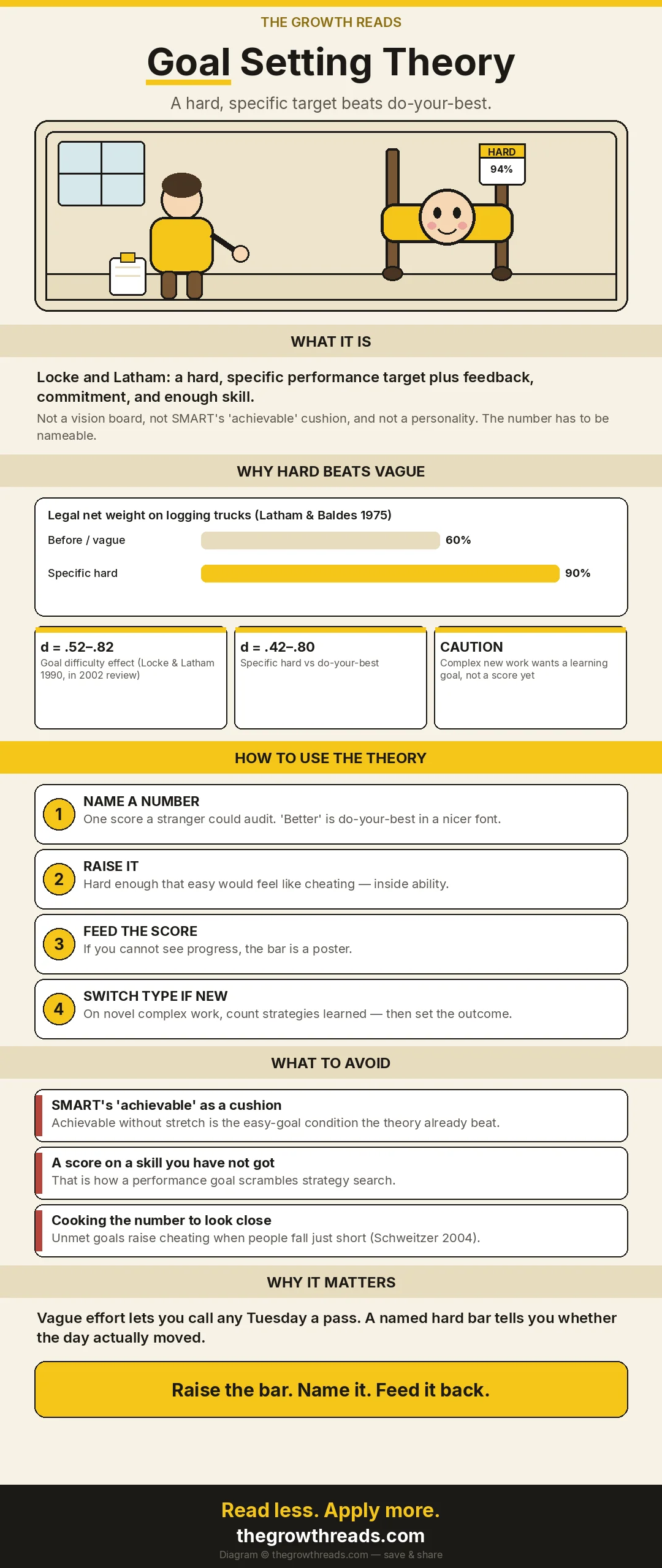
Goal setting theory says a hard, specific target beats a speech to do your best — if you are committed, able, and can see the score. It is Locke and Latham’s work finding, not a vision board and not SMART. Raise the bar, name the number, and feed the score back.
Key takeaways
- Edwin Locke and Gary Latham (2002) summarise 35 years of tests: goal difficulty effect sizes sit between d = .52 and .82, and specific hard goals beat “do your best” between d = .42 and .80, because a vague bar is defined idiosyncratically.
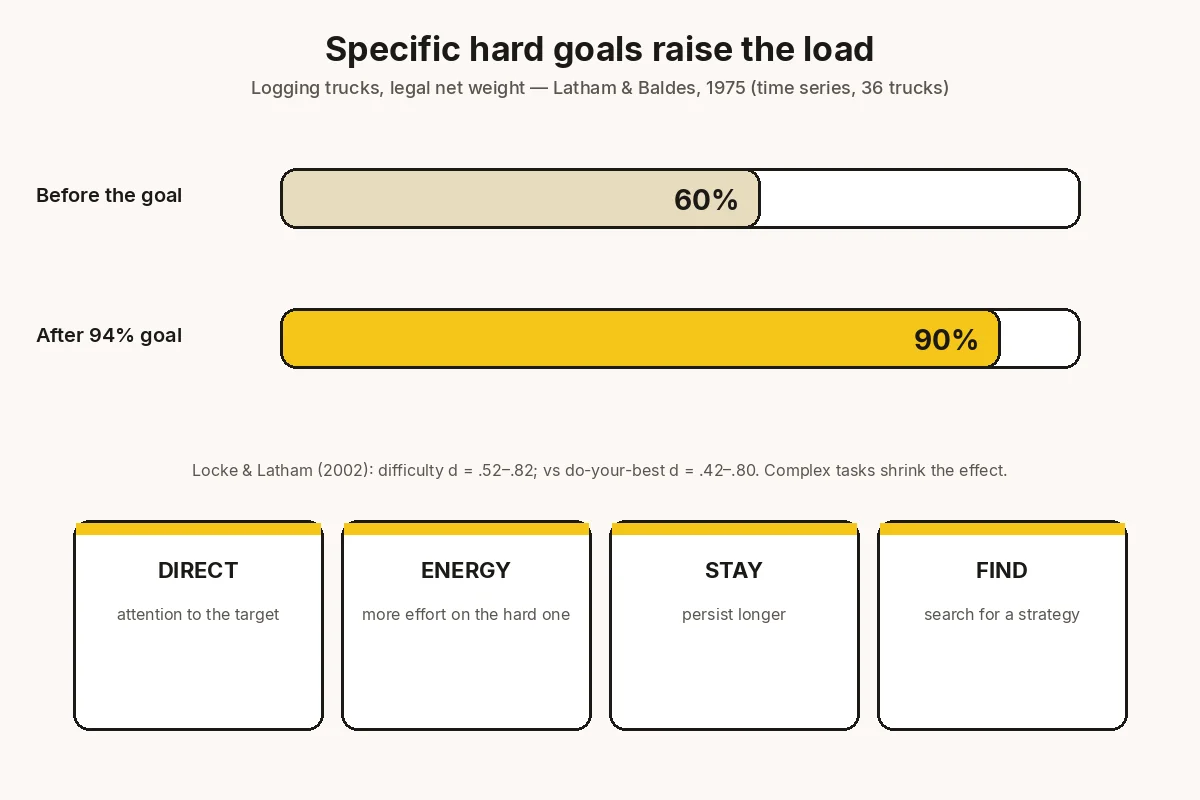
- Gary Latham and J. James Baldes (1975) assigned unionised logging-truck drivers a specific hard goal of 94% of legal net weight: loads moved from about 60% to about 90% across 36 trucks and 12 months, and the firm’s accountants priced the extra capacity at $250,000 in nine months.
- Robert Wood, Anthony Mento and Edwin Locke (1987) found the difficulty effect shrinks on complex tasks (d = .48) versus simple ones (d = .67) — a hard score on a skill you have not got is not the same medicine.
- Maurice Schweitzer, Lisa Ordóñez and Bambi Douma (2004) found people with unmet goals overstated productivity more than people told to do their best, with and without money, especially when they fell just short — a named bar can also buy a lie.
- Napoleon Hill’s Think and Grow Rich argues for a definite chief aim as desire. This page keeps the unused review for that book and keeps the science on Locke and Latham: a number you can audit, not a vision you can feel.
What goal setting theory actually is
Goal setting theory is the claim that a hard, specific performance target produces more than urging someone to do their best, provided commitment, ability, and feedback are in the room. It is not a personality. It is not a vision board. It is not the SMART acronym wearing a lab coat. If you cannot name the number a stranger could audit, you do not have a goal in this theory. You have a hope with better stationery.
Locke and Latham’s 2002 review in American Psychologist is the map. They treat a goal as “the object or aim of an action” — usually a standard of proficiency inside a time limit — and they summarise a linear difficulty function: the highest or most difficult goals produced the highest effort and performance until ability ran out or commitment lapsed. Specificity alone does not raise the mean; a specific easy goal is still easy. Specificity reduces ambiguity about what counts as done. Difficulty is what raises the mean. That pairing is the whole trick, and it is why a poster that says “be better” is not this page.
This URL is a Habits child. Later Habits articles on this site still link up to live keystone habits. Do not mint a new habits parent. A keystone is the loop that pulls others. Goal setting theory is the named bar you put on a loop you already mean to run — or the bar that tells you the loop never fired. Sister page the habit loop is the automatic cousin: a cue that pays. This page is the intentional overlay: a score the cue is supposed to serve.
How is this different from SMART, do-your-best, or a vision board?
Do-your-best is a bar with no height. SMART is a planning checklist. A vision board is a feeling. Goal setting theory is a number plus a score you can see.
Locke and Latham are blunt about do-your-best: when people are asked to do their best, they do not, because the phrase has no external referent and is defined idiosyncratically. That is why the meta-analytic gap versus specific hard goals sits between d = .42 and .80 (Locke and Latham, 1990, reported in the 2002 review). SMART goals is the Decisions cousin on this site — the acronym, and where it fails. Specific and time-bound overlap this theory. Measurable overlaps feedback. Achievable is the collision: a cushioned bar is the easy-goal condition. Relevant is a values filter, not a mechanism. A vision board can sit next to all of that and still never name a score. Hill’s definite chief aim, in the Think and Grow Rich summary, is closer to desire than to a weigh-station number. Keep the book on the review. Keep the theory here.
Why a hard number changes behaviour
A hard number changes behaviour because it removes the private passing grade and then spends the day on direction, effort, persistence, and — if the move is not already automatic — a hunt for a method. That is the mechanism, not “people who write goals are more successful,” and not a manifestation slogan.
Latham and Baldes (1975) is the field picture people actually remember, and it is smaller than the TED-talk version. They ran a time series on the net weight of 36 logging trucks across six operations for 12 consecutive months. Drivers were assigned a specific hard goal: 94% of legal net weight. Performance improved immediately. Locke and Latham later describe the before/after as roughly 60% to 90% of legal allowable weight, with company accountants pricing the extra capacity at $250,000 in nine months — the cost of buying more trucks to move the same wood. Drivers also changed how they estimated load before the weigh station. That last detail is the strategy mediator, not a personality transplant. It is a time series, not a randomised trial, and it is one unionised crew. It is still the cleanest demonstration that a named hard bar can move a real load.
Locke, Shaw, Saari and Latham’s 1981 Psychological Bulletin review is the earlier sweep: across a decade of studies, specific hard goals were reliably tied to higher task performance than easy or vague ones. The 2002 paper is the tighter statement of mechanisms and moderators. Neither paper is a certificate that writing “Q4” on a whiteboard raised anyone’s output. The finding is conditional: committed, able, fed back, and — on a simple enough task — already in possession of the skill the bar assumes.
Counter-case. On a new complex task, a specific hard outcome goal can be worse than do-your-best. People scramble for strategies, get evaluative, and learn the wrong moves (Earley, Connolly and Ekegren, 1989; Kanfer and Ackerman, 1989, discussed in Locke and Latham 2002). Winters and Latham (1996) and Seijts and Latham (2001) show the theory’s own patch: set a specific hard learning goal — discover N strategies — then, once the skill exists, put the outcome bar back. If today’s work is still a puzzle, a revenue number is the wrong height.
The four mechanisms
Name the four by what they do: direct, energise, stay, and find. Locke and Latham (2002) call them direction, effort, persistence, and task-relevant knowledge or strategy. If a goal is not doing at least one of those, it is decoration.
| Kind of bar | What it names | What it is good for | Where it lies |
|---|---|---|---|
| Do-your-best | A speech with no height | A polite kickoff when you truly cannot specify a score yet | People set private, easy passing grades (Locke & Latham, 2002) |
| Specific easy | A number you will hit in your sleep | Reduces ambiguity about “done” | Does not raise the mean. Specificity without difficulty is a labelled shrug |
| Specific hard (performance) | A score at the edge of current skill | Simple or well-learned work: loads, calls, words, closed loops | Scrambles novel complex work; unmet bars can buy cheating (Schweitzer et al., 2004) |
| Specific hard (learning) | A count of strategies or skills to acquire | New complex work where the method does not exist yet | A waste once the skill is already there — then you want the outcome bar |
| SMART acronym | Specific, measurable, achievable, relevant, timed | A planning checklist people already search | “Achievable” undercuts difficulty. See the cousin page, not this URL |
Direction is the cheapest win. Rothkopf and Billington (1979), cited in the 2002 review, found students with specific learning goals learned goal-relevant passages better than irrelevant ones. You look where the number points. Effort is the volume knob: higher bars pull more energy on ergometers, addition sheets, and self-reported grind. Persistence is time: when people control the clock, hard goals keep them on the task (LaPorte and Nath, 1976, in the same review). Find is the interesting one for knowledge work. If cutting trees is already a skill, the bar just makes you cut. If the path is new, the bar is supposed to make you invent a method — or, if you set it too early, to make you invent a bad one fast. The hub at the productivity library is full of methods that fail the same way when they become collections rather than a number you can point at.
Commitment, feedback, and complexity
The four mechanisms only fire if you care, you can see the score, and the task is not still a maze. Commitment matters most when the bar is high (Klein and colleagues, 1999, in Locke and Latham 2002). Assigned goals work as well as participative ones when the rationale is given; a terse “do this” does not (Latham, Erez and Locke, 1988). Feedback is not a nice-to-have. Bandura and Cervone (1983) is the classic pairing: goals plus knowledge of results move effort and self-efficacy; a bar you cannot see is a poster. How to track productivity is the Decisions cousin for the scoreboard. Which habits to track is the Habits sister for which rows earn a card. Complexity is the third moderator: Wood, Mento and Locke (1987) put difficulty d at .67 on the simplest tasks and .48 on the most complex, and the do-your-best gap at .77 versus .41. That is why this page will not tell you to put a revenue number on a craft you started on Tuesday.
Why vague effort costs more than it feels like
Vague effort feels kind because every Tuesday can be called a pass. The bill is a week with no evidence the load moved, then a story that you lacked discipline.
Do-your-best is cheap in the moment. It costs you the information. Locke and Latham’s point about idiosyncratic standards is the cost sheet: without an external referent, “best” is whatever you needed it to be at 6 p.m. You cannot tell a stall from a win. You also cannot tell a lie from a load. Schweitzer, Ordóñez and Douma (2004) showed the other side of a named bar: in a lab anagram task, people with unmet goals overstated how many they had solved more often than people told to do their best, with and without a cash bonus, and the cheat clustered in the just-short zone. That is not “goals make people evil.” It is “a bar you are about to miss is a motive.” If your only score lives in a slide nobody else can audit, you have built the just-short zone in private.
The logging study’s $250,000 is the cost of the missing bar, not a promise your Tuesday will print money. It is one firm’s accounting of unused truck capacity. Translate it into knowledge work and you get weeks of “I was busy” with no named output. Consistency is showing up next to the same cue. It is not this URL. This URL is the height that showing-up is supposed to clear. Without the height, consistency is just attendance.
How to use goal setting theory
Name a number, set it hard inside the skill you have, feed the score, and switch to a learning bar when the work is still a puzzle. This is a selection pass, not a numbered how-to product. There is no HowTo schema on this page because the slot is a spoke.
Pick one bar, not a lifestyle. If you need the loop that would pull others, that choice lives on keystone habits. If you already have a pile of candidate scores, which habits to track is the filter. Then say the number out loud in a sentence a stranger could verify: 94% of legal weight, 800 words before lunch, three closed tickets, nine sales conversations. If the sentence needs a feeling, it is not a goal yet.
Set it hard enough that easy would feel like cheating, and not so hard that you will only hit it by lying. Locke and Latham’s linear function stops at ability and at lapsed commitment. Write the if-then that attaches the bar to a cue you already never skip: after the kettle, at the desk, I will write 400 words. Implementation intentions are that written form. Habit stacking is the attachment move. Neither paper is a goal-setting-theory trial; they are how a bar finds a kettle.
Feed the score where you will see it without opening a shrine. If you cannot tell by Thursday whether you are under the bar, you do not have feedback. On novel complex work, count strategies first — “find four ways to estimate this load” — then put the outcome bar back. How to learn new skills is practice, not a talent story. Review once a week, not all day: which bar was theatre? Which bar was under-skilled? Which bar got cooked? The test is whether the load moved, not whether the poster looks complete.
Common mistakes that turn the theory into a poster
- Writing “be better” and calling it a goal. Do-your-best has no external referent. Name a number a stranger could audit.
- Using SMART’s “achievable” as a cushion. That is the easy-goal condition. See SMART goals for the acronym; this page keeps the height.
- Putting a revenue number on a craft you started this week. Winters and Latham (1996): learning goals first on complex new work.
- A bar with no scoreboard. Bandura and Cervone (1983): goals without knowledge of results are a speech. How to track productivity is the scoreboard cousin.
- Twenty bars. A bloated card is not a theory. Which habits to track is the filter.
- Cooking the number to look close. Schweitzer et al. (2004): unmet goals, especially just-short ones, raise overstatement.
- Treating Hill as the science. Think and Grow Rich is desire and a definite chief aim. Locke and Latham are a weigh station. Keep the book on the review.
When it is more than a bar
Goal setting theory is for work you can score and a skill you actually have. It is not a diagnosis, a trauma plan, or a substitute for help when starting anything is broken across every context. This is a productivity method page. It does not treat, and it does not list clinical symptoms. If the stall is “I cannot begin, anywhere, for weeks,” that is not a missing percentage. That is a different problem, and a clinician is the right next step — not a prettier bar. Sleep, pain, and mood belong with people qualified to handle them. You can still name today’s number while that other work happens. The theory cannot hold “fix my life.”
The evidence behind this
The literature supports a reliable advantage for specific hard goals over easy or vague ones on tasks people can already do, smaller effects as complexity rises, a learning-goal patch for novel work, and a documented cheat-risk when people fall just short. It does not support a vision board, a SMART cushion, or a promise that your Tuesday will print $250,000.
| Study | Design and size | Finding we used | Limit |
|---|---|---|---|
| Locke & Latham, 2002 | 35-year inductive review in American Psychologist | Difficulty d = .52–.82; vs do-your-best d = .42–.80; four mechanisms; commitment, feedback, complexity as moderators | A review, not a new experiment; effect sizes cite Locke & Latham 1990 |
| Latham & Baldes, 1975 | Time series, 36 logging trucks, six operations, 12 months | Assigned 94% of legal net weight; loads ~60% → ~90%; extra capacity priced at $250,000 in nine months | Not randomised; one crew and one metric; accountants’ counterfactual |
| Locke, Shaw, Saari & Latham, 1981 | Psychological Bulletin review of 1969–1980 goal studies | Specific hard goals reliably tied to higher task performance than easy or vague goals | A review of then-available studies, many lab tasks |
| Wood, Mento & Locke, 1987 | Meta-analysis of goal effects by task complexity | Difficulty d = .67 simple vs .48 complex; vs do-your-best .77 vs .41 | Complexity coding is a judgement; not a licence to skip bars on hard work — switch type |
| Winters & Latham, 1996 | Lab, n = 114 business students; simple vs complex scheduling | On complex work a learning goal beat an outcome goal and do-your-best; more effective strategies | Students, one scheduling task, not a firm |
| Seijts & Latham, 2001 | Lab, n = 96; class-scheduling, knowledge still being acquired | Do-your-best beat a specific difficult outcome goal; a specific difficult learning goal beat do-your-best | Moderately complex lab task; proximal outcome add-ons did not help here |
| Bandura & Cervone, 1983 | Lab: goals and self-evaluative / efficacy mechanisms | Goals plus knowledge of results move effort; self-efficacy shapes the response to the score | Lab tasks, not knowledge-work field output |
| Schweitzer, Ordóñez & Douma, 2004 | Lab experiment on overstating anagram productivity | Unmet goals raised cheating vs do-your-best, with and without money, especially just short of the bar | Anagrams in a lab, not cooked sales reports; still the honest limit on this page |
Frequently asked questions
What is goal setting theory?
Goal setting theory is Locke and Latham’s finding that a hard, specific performance target produces more than a speech to do your best, provided you are committed, able, and can see the score. Meta-analyses they summarise in 2002 put the difficulty effect between d = .52 and .82, and the gap versus do-your-best between d = .42 and .80. It is a work-and-habits mechanism, not a vision board and not the SMART acronym. If you cannot name the number, you do not have a goal in this theory. You have a mood.
Who created goal setting theory?
Edwin Locke and Gary Latham built it inductively from decades of lab and field studies. Locke’s 1968 paper on task motivation and incentives is the early stake. The 2002 American Psychologist review is the map most people mean when they say the theory: specificity plus difficulty, four mechanisms, and the moderators of commitment, feedback, and task complexity. Napoleon Hill’s Think and Grow Rich is not the source. Hill argued for a definite chief aim as desire. Locke and Latham argued for a named hard bar plus a score you can see.
How does goal setting theory work?
Four mechanisms, not a pep talk. A specific hard goal directs attention to the relevant work, raises effort, lengthens persistence, and — when the path is not already automatic — pushes a search for strategy (Locke and Latham, 2002). Feedback is a moderator: without a score, you cannot steer. Commitment matters most when the bar is high. On a new complex task, a performance score too early can scramble that search; a specific learning goal — count the strategies you try — is the theory’s own fix, not a retreat to vague effort.
What is the difference between goal setting theory and SMART goals?
SMART is a 1981 planning acronym. Goal setting theory is a performance finding. Specific and time-bound overlap. Measurable overlaps with feedback. Achievable is the fight: Locke and Latham found a linear difficulty function until ability or commitment breaks. A cushioned ‘achievable’ bar is the easy-goal condition the theory already beat. Relevant is a values filter, not a mechanism. Live SMART goals on this site is the cousin page. This URL owns the theory: raise the height, name it, feed it back.
Do difficult goals always work?
No. Performance levels off when ability runs out or commitment lapses (Erez and Zidon, 1984, in Locke and Latham 2002). Wood, Mento and Locke (1987) found smaller effects on complex tasks (difficulty d = .48) than on simple ones (d = .67). On novel complex work, a specific hard outcome goal can be worse than do-your-best until you have a strategy; a specific hard learning goal reverses that (Winters and Latham, 1996; Seijts and Latham, 2001). The theory is not ‘harder is always kinder.’ It is ‘hard and specific beats vague, inside the skill you actually have.’
What are the four mechanisms of goal setting theory?
Direction, effort, persistence, and task strategy (Locke and Latham, 2002). Direction: you look at the work the goal names and look away from the rest. Effort: a higher bar pulls more energy on the same clock. Persistence: when you control time, a hard goal keeps you on the task longer. Strategy: if the move is not already automatic, the bar makes you hunt a method — truck drivers in Latham and Baldes (1975) modified how they estimated load. Those four are mediators. Commitment, feedback, and complexity decide whether they fire.
Can goal setting theory backfire?
Yes, in two documented ways. First, a performance goal on a skill you have not got can scramble strategy search (Kanfer and Ackerman, 1989; Winters and Latham, 1996). Second, unmet goals raise cheating. Schweitzer, Ordóñez and Douma (2004) found people with unmet goals overstated productivity more than people told to do their best, with and without money on the line, especially when they fell just short. A named hard bar is not a licence to cook the number. If the only way to look close is to lie, the bar is too high or the score is the wrong one.
What should I read after this page?
Start with keystone habits if you need one loop that pulls others — that is the Habits parent, and this page does not mint a new one. The habit loop is the sister: automatic cue-and-pay versus a named bar you still decide. SMART goals is the acronym cousin under Decisions. Which habits to track is how feedback becomes a row. Think and Grow Rich is the named unused review: Hill’s definite chief aim is desire; this page keeps the number. None of those replace writing today’s score where you can see it.
Sources
- Locke, E. A., & Latham, G. P. (2002). Building a practically useful theory of goal setting and task motivation: A 35-year odyssey. American Psychologist, 57(9), 705–717. https://doi.org/10.1037/0003-066X.57.9.705
- Latham, G. P., & Baldes, J. J. (1975). The “practical significance” of Locke’s theory of goal setting. Journal of Applied Psychology, 60(1), 122–124. https://doi.org/10.1037/h0076354
- Locke, E. A., Shaw, K. N., Saari, L. M., & Latham, G. P. (1981). Goal setting and task performance: 1969–1980. Psychological Bulletin, 90(1), 125–152. https://doi.org/10.1037/0033-2909.90.1.125
- Wood, R. E., Mento, A. J., & Locke, E. A. (1987). Task complexity as a moderator of goal effects: A meta-analysis. Journal of Applied Psychology, 72(3), 416–425. https://doi.org/10.1037/0021-9010.72.3.416
- Winters, D., & Latham, G. P. (1996). The effect of learning versus outcome goals on a simple versus a complex task. Group & Organization Management, 21(2), 236–250. https://doi.org/10.1177/1059601196212007
- Seijts, G. H., & Latham, G. P. (2001). The effect of distal learning, outcome, and proximal goals on a moderately complex task. Journal of Organizational Behavior, 22(3), 291–307. https://doi.org/10.1002/job.70
- Bandura, A., & Cervone, D. (1983). Self-evaluative and self-efficacy mechanisms governing the motivational effects of goal systems. Journal of Personality and Social Psychology, 45(5), 1017–1028. https://doi.org/10.1037/0022-3514.45.5.1017
- Schweitzer, M. E., Ordóñez, L., & Douma, B. (2004). Goal setting as a motivator of unethical behavior. Academy of Management Journal, 47(3), 422–432. https://doi.org/10.5465/20159591
- Hill, N. (1937). Think and grow rich. The Ralston Society. TGR review: Think and Grow Rich summary.
Related reading on The Growth Reads
The books this method draws on
- Think and Grow Rich summary & review — the named unused review; definite chief aim is desire, not a weigh-station number
Related articles
- Keystone habits — the Habits parent; one loop that pulls others
- The habit loop — the sister; automatic cue-and-pay versus a named bar
- SMART goals — the acronym cousin, and where “achievable” undercuts height
- Which habits to track — which rows earn a card; feedback as a habit
- How to track productivity — the scoreboard, not the theory
- Implementation intentions — the written if-then that binds a cue to a do
- How to stack habits — attach the bar to a cue you already never skip
- What is consistency — showing up next to the same cue
- How to learn new skills — practice loops; learning goals before outcome bars
- Analysis paralysis — when more thinking is the stall, not a missing number
Go deeper
How this article was researched
The Growth Reads editorial team writes from primary sources: the books themselves, the authors’ published essays, and the peer-reviewed literature behind the claims. Every study cited above was read in the original publication or its published abstract, and every figure is quoted with its design and limit so you can judge its weight rather than take ours. Where a finding is a review’s meta-analytic range, a time series on one logging crew, a student scheduling lab, or a lab anagram cheat, we say so in the body rather than in a footnote.
This page is a productivity method, not a book review of any single title, and not medical or clinical advice. Persistent inability to start work across contexts belongs with a clinician, not with a prettier bar. Habits-cluster articles on this site link up to live keystone habits. This URL is a Habits child and does not mint a new habits parent.
How we work: every article on The Growth Reads is built from the books in our library plus the research they rest on, and is reviewed and date-stamped when the evidence changes. Read our full methodology.