

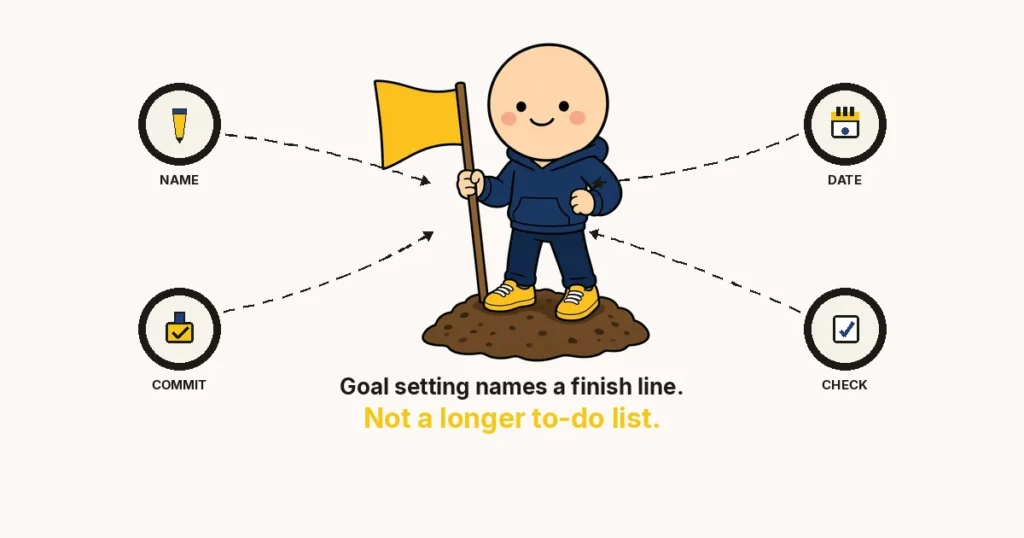
Goal setting is naming a finish line you can test later: this happened, or it did not. It is a decision, not a longer to-do list. Specific, hard goals beat “do your best” across decades of experiments (Locke & Latham, 2002), unless the work is still too new to measure.
Key takeaways
- Goal setting is the decision to name a specific outcome with a test attached — not a wish, a task, a habit, or a filled-in SMART template (Locke, 1968; Doran, 1981).
- Specific, difficult goals produce higher performance than easy goals or a vague instruction to “do your best,” which is the core finding of 35 years of goal-setting research (Locke & Latham, 2002).
- That advantage shrinks as the work gets more complex: a meta-analysis of 125 studies found weaker goal effects on complex tasks than on simple ones (Wood, Mento & Locke, 1987).
- A stronger intention is not the behaviour. Across 47 experiments, a medium-to-large change in intention produced only a small-to-medium change in what people actually did (Webb & Sheeran, 2006).
- If–then plans that name the first move raise the odds that a written goal lands; a 94-test meta-analysis put the effect at d = 0.65 (Gollwitzer & Sheeran, 2006).
What goal setting actually is
Goal setting is the act of deciding an outcome in advance, in words specific enough that a later you can score it. The outcome is the point. The list of work that might produce the outcome is not the goal, any more than a shopping list is dinner.
Edwin Locke put it in research language in 1968: a goal is a conscious standard of proficiency that regulates action. Hard goals produced more output than easy ones. Specific hard goals produced more output than “do your best.” The finding is old enough to be furniture, and it is still the cleanest definition of the practice: you name a standard, then behaviour organises around it.
That is also why this page is not the SMART page, and not the theory page. Live SMART goals is the writing template — and where that template fails when it is treated as the whole job. Live goal setting theory is Locke and Latham’s machinery: direction, effort, persistence, strategy. This page is the decision underneath both. If you cannot tell a goal from a wish, the acronym and the theory will not save the week.
How a goal differs from a wish, a task, and a habit
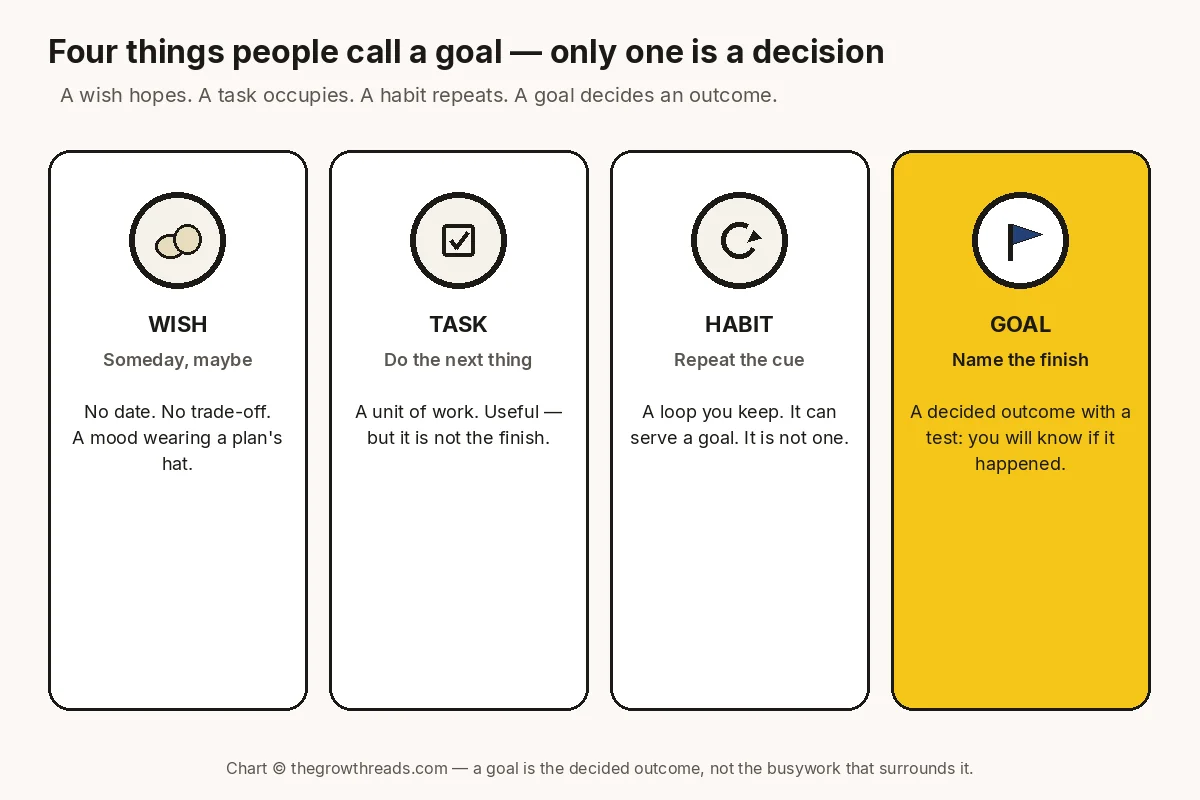
A wish has no test. A task has no finish line beyond the action. A habit has no outcome beyond the repeat. People use “goal” for all four, which is how a notebook fills with items that cannot fail because they cannot succeed either.
A wish sounds like “get healthier” or “be more productive.” There is no date and no observable result, so there is nothing to be wrong about. A task sounds like “email the client” or “open the spreadsheet.” Completing it can be honest work and still leave the actual outcome untouched. A habit sounds like “write every morning.” Showing up is the whole score. Useful — and a different object. Goal setting, in the sense this page uses it, is the remaining case: a named result with a window attached. “Ship the draft to the client by Friday at 4.” Friday comes. The draft either went or it did not.
Why naming a finish changes behaviour
A named finish line does four jobs a to-do list cannot: it points attention, it raises effort, it keeps you on the task longer, and it forces a search for a strategy. Locke and Latham’s 2002 synthesis of 35 years of experiments is the source for that list. This is not willpower poetry. It is what a specific, difficult standard does to a person who has accepted it.
Direction is the unglamorous one, and the one most lists skip. Once a finish is named, some other finishes become off-limits. That is the whole point of analysis paralysis as a parent of this cluster: without a stopping rule, comparison never ends. A goal is a stopping rule aimed at the future. You are no longer collecting options. You are protecting one outcome.
Effort and persistence follow that choice. A vague “do your best” instruction lets you redefine “best” the moment the work gets uncomfortable. A number with a date does not give you that courtesy. The 2002 paper is explicit that the effect is not magic and not unlimited. Commitment has to be real. Feedback has to exist, or the standard is a poster. Ability has to cover the work, or the standard is a dare. Those moderators are why the live goal setting theory page exists as its own URL. Here, take the short version: the decision only organises behaviour if you actually mean it, can see progress, and can already do the work.
The last job — strategy — is the one that fails on new problems. When the task is simple, a harder goal mostly means “try more.” When the task is complex and you do not yet know how, a harder outcome goal can freeze the search. Wood, Mento and Locke’s 1987 meta-analysis of 125 studies is the caution: goal effects were stronger on simpler tasks than on complex ones. Seijts and Latham then showed, in a 2001 class-scheduling experiment with 96 people who still had to learn the task, that a specific difficult learning goal beat a specific difficult outcome goal, and that “do your best” even beat the hard outcome number. If you cannot yet do the work, the first goal is not the result. It is the method.
Why a missing goal costs more than it feels like
Without a finish line, the day fills with work that can never be wrong, because it was never aimed at a result. Inbox zero, a cleaned desktop, a meeting that produced another meeting — all of it scores as activity. None of it can fail a test you never wrote.
That is the cost that does not show up on a timesheet. You can be exhausted and still have no outcome to point at. The how to prioritise tasks page is the ranking problem; this page is the target problem. Ranking a list of tasks that do not add up to a finish is how a busy week impersonates a decided one. Live how to track productivity will not rescue that either. Tracking a pile of actions without an outcome just produces a more detailed pile.
Alex Hormozi’s 10x Is Easier Than 2x is the assigned book here because it makes the same point from the other direction. A 2x goal usually means “do more of the current mix.” A 10x goal, in his telling, forces a constraint: most of the mix has to go. You can disagree with the rhetoric and still use the test. If the goal you wrote does not force a trade-off, it is probably a to-do list wearing a finish line’s coat. The productivity hub is full of methods for doing the work once the finish exists. None of them can invent the finish for you.
There is a second, quieter cost. A missing goal keeps the decision-making process open. Every morning you re-litigate what the day is for. That is not flexibility. It is unpaid strategy work, done at the worst time, with the least evidence. A dated outcome moves that argument to yesterday, which is the only place it belongs.
Goal vs wish vs task vs habit vs SMART
Most “goal setting” failures are category errors: people wrote the wrong kind of sentence and then blamed themselves for not following it. The table is the diagnostic you actually need. It is not a list of personality types.
| What you wrote | What it actually is | The test | Typical miss |
|---|---|---|---|
| “Get healthier this year” | Wish | None. There is no observable fail. | The sentence cannot be wrong, so it cannot steer a Tuesday. |
| “Email the client” | Task | Did the action happen? | The action can complete and the outcome can still be missing. |
| “Write every morning” | Habit | Did you show up? | The loop can run for months without a finish line. |
| “Increase revenue 3% by filling in SMART” | Template | Did the letters get filled? | Doran’s 1981 prompt is a writing aid, not a difficulty setting. Easy SMART goals still underperform hard ones. |
| “Send the signed proposal by Friday 4pm” | Goal | Did the result happen inside the window? | This is the only row that can fail out loud — which is the feature. |
George Doran’s 1981 Management Review note is the origin of SMART, and it is more modest than the posters. Specific, Measurable, Assignable, Realistic, Time-related. He also wrote that not every objective needs all five letters, and that middle managers can lose a useful abstract aim by forcing a number onto it. That caveat is why the live SMART article exists as a separate URL: the acronym is a prompt for writing, not a substitute for choosing a hard enough finish. If you want the letters, go there. If you want the decision, stay here.
One honest limit. Locke and Latham’s core effect is among the most replicated findings in applied psychology, and it still does not license a hard number on work you cannot yet perform. Wood, Mento and Locke (1987) and Seijts and Latham (2001) are the counter-case, not a footnote. On a new skill, the first goal is a learning goal: discover N strategies, run N reps, ship N ugly drafts. The outcome number comes after the method exists.
How a goal actually gets set
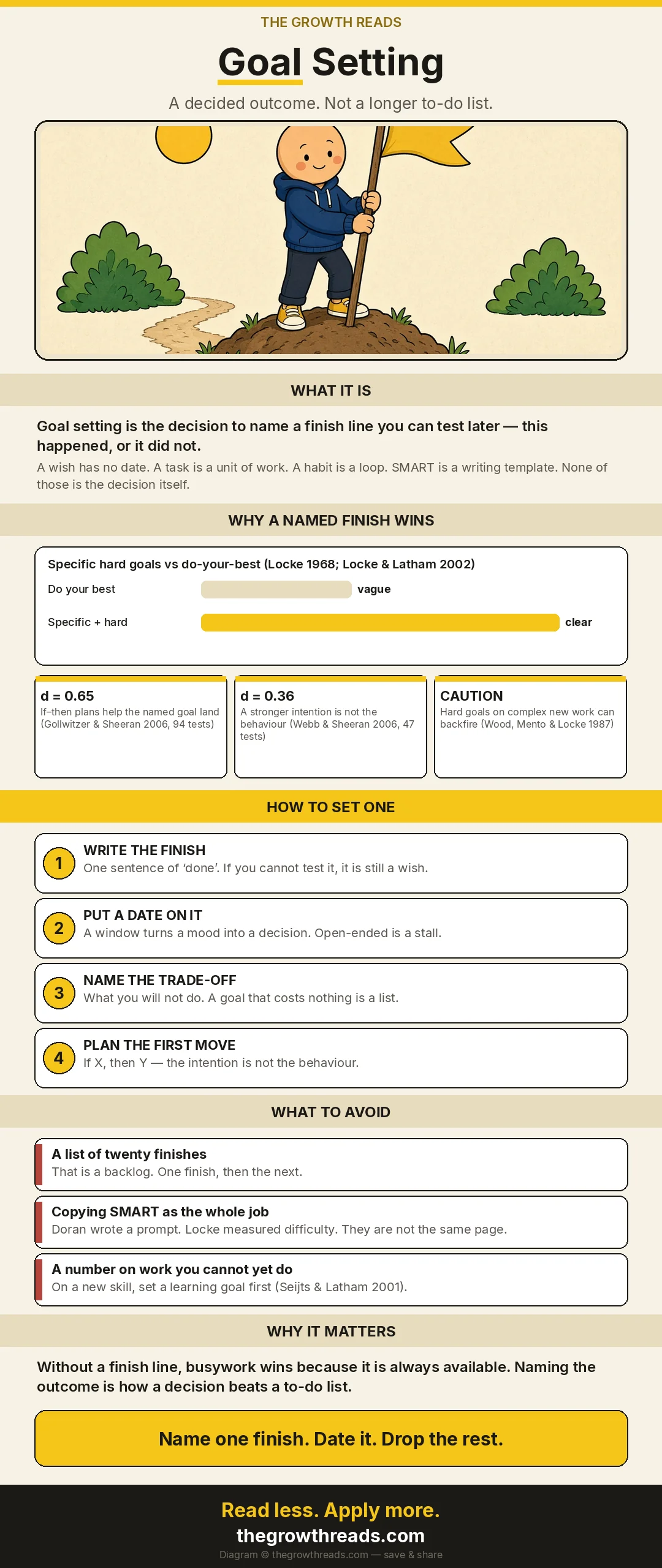
You set a goal by writing one testable sentence, dating it, naming what it costs, and attaching the first move — then stopping. That is a decision sequence, not a seven-step program. Play pages do not ship a HowTo ladder. The work is four sentences on paper, done once, not a ritual you re-open every morning.
Write the finish in the past tense if it helps: “The proposal is with the client.” If you cannot picture the evidence, you are still in wish territory. Put a calendar window on it. Open-ended is how a goal becomes a personality. Name the trade-off in the same sitting: the two things you will not do so this one can happen. Hormozi’s 10x argument is useful here even if you never adopt the slogan. A finish that costs nothing is a list.
Then write the first move as an if–then, because a goal intention is not the behaviour. Webb and Sheeran’s 2006 meta-analysis of 47 experiments (N = 8,802) is the cold water: interventions that produced a medium-to-large change in intention (d = 0.66) produced only a small-to-medium change in behaviour (d = 0.36). Wanting it more is not a plan. Gollwitzer and Sheeran’s 2006 meta-analysis of 94 tests found that spelling out the when/where/how in advance — “If it is 9am at the desk, then I open the proposal file” — had a medium-to-large effect on attainment (d = 0.65). The live implementation intentions page owns that method. Use it. Do not confuse it with the goal itself. The goal is the finish. The if–then is how Tuesday starts.
One goal at a time is not a personality preference. It is how a finish stays a finish. The 1-3-5 rule is a daily cap on work, not a substitute for the outcome. If you need more than one finish this month, sequence them. Parallel finishes are how people return to a list and call it ambition. Live how to make a decision is the sister skill when the finish itself is the thing you cannot pick. Use that page when you are stuck on which outcome. Use this one when you already know and have not written it down.
Common mistakes
Most failed “goal setting” is a sentence that was never a goal, followed by a week of self-scolding.
- Writing twenty finishes. That is a backlog. Pick one, date it, then the next. The Ivy Lee method is the daily version of the same cap.
- Treating SMART as the job. Filling letters can produce a tidy, easy goal. Locke measured difficulty. Doran measured wording. They are not the same article — start at SMART goals if the template is what you came for.
- Putting a number on work you cannot yet do. On a new skill, set a learning goal first (Seijts & Latham, 2001). A hard outcome here is how people quit on Tuesday and call it a character flaw.
- A goal with no trade-off. If nothing is dropped, the current mix stays, and the finish is a wish. See 10x Is Easier Than 2x.
- Stopping at the intention. “I will ship it” is not a plan. Write the first if–then, or borrow one from implementation intentions.
- Re-opening the goal every morning. A review date is a check. A daily relitigation is a process with no stopping rule.
- Using try-language. “Try to send” cannot fail, so it cannot steer. Write the result, not the mood.
The evidence behind this
The claim that a named, difficult finish beats a vague intention is one of the most replicated findings in applied psychology — and the exceptions are as important as the headline.
| Study | Design and size | Finding | What we used it for |
|---|---|---|---|
| Locke (1968) | Integrative review of laboratory studies on conscious goals and task performance | Hard goals beat easy goals; specific hard goals beat “do your best.” Incentives appeared to work through the goals people actually held. | The definition: a goal is a conscious standard, not a mood. |
| Locke & Latham (2002) | 35-year synthesis of goal-setting theory in American Psychologist | Specific, difficult goals outperform vague ones via direction, effort, persistence and strategy, with commitment, feedback and ability as moderators. | Why naming a finish changes behaviour — and when it does not. |
| Wood, Mento & Locke (1987) | Meta-analysis of 125 goal-setting studies (1966–1985) | Goal effects were stronger on simple tasks than on complex ones. | The complexity counter-case. A hard number is not free on new work. |
| Seijts & Latham (2001) | Laboratory experiment, n = 96, class-scheduling task that had to be learned | A specific difficult learning goal beat a specific difficult outcome goal. “Do your best” beat the hard outcome number. Strategy discovery tracked performance. | When the first goal should be a method, not a result. |
| Webb & Sheeran (2006) | Meta-analysis of 47 experimental tests, N = 8,802 | A medium-to-large change in intention (d = 0.66) produced only a small-to-medium change in behaviour (d = 0.36). | A written goal is not follow-through. |
| Gollwitzer & Sheeran (2006) | Meta-analysis of 94 independent tests | Implementation intentions had a medium-to-large effect on goal attainment (d = 0.65). | The first-move layer, once the finish exists. |
| Ordóñez, Schweitzer, Galinsky & Bazerman (2009) | Critical review in Academy of Management Perspectives | Over-prescribed goals can narrow attention, distort risk, invite unethical shortcuts, and suppress learning and intrinsic motivation. | The other counter-case: more goal is not always better. |
| Doran (1981) | Practitioner essay, Management Review 70(11) | SMART as a writing prompt. Not every objective needs all five letters. | The boundary with the SMART page. Letters ≠ difficulty. |
Ordóñez and colleagues are the warning label the posters skip. A specific hard goal is a strong intervention. Used on the wrong work, or on too many finishes at once, it can buy the number and spend the rest of the system. That is not a reason to go back to “do your best.” It is a reason to set fewer goals, on work you can already do, with a first move attached.
Frequently asked questions
What is goal setting, in one sentence?
Goal setting is the decision to name a specific outcome you can later test: this happened, or it did not. It is not a personality trait, a journal mood, or a longer list of tasks. Locke’s 1968 review treated a goal as a conscious standard of proficiency that directs action. The useful check is boring on purpose. If you cannot say, on a date you already picked, whether the result occurred, you have not set a goal yet. You have described a direction. Directions are useful. They are not this page.
Is a to-do list the same as a goal?
No. A to-do list is a pile of tasks. Completing a task answers “did I do the action?” A goal answers “did the result happen inside the window?” You can clear twelve tasks and still miss the only outcome that would have made the week count. Rank the work after the finish exists — that is what how to prioritise tasks is for. Writing a longer list because the current list feels weak is how people avoid the decision this page is about.
What is the difference between a goal and a wish?
A wish has no test and no date, so it cannot fail. “Get healthier” and “be more productive” are wishes wearing a plan’s vocabulary. A goal names an observable result and a window: the signed proposal is with the client by Friday at 4. Friday comes. The file went, or it did not. That pass/fail is the feature. It is also why a wish feels kinder. It never has to be wrong. It also never has to steer a Tuesday, which is the whole problem.
Do SMART goals count as goal setting?
They can, if the sentence that comes out is a specific, difficult, dated outcome. They often do not. Doran’s 1981 note was a writing prompt for managers, and he said not every objective needs all five letters. Filling the acronym can produce a tidy, easy target that still underperforms a harder one. Locke and Latham measured difficulty, not stationery. If you want the letters and where they fail, that is the SMART goals article. This page is the decision underneath the template.
Why do specific hard goals beat “do your best”?
Because “do your best” lets you redefine best the moment the work gets uncomfortable. A named standard does not. Locke and Latham’s 2002 synthesis says specific, difficult goals point attention, raise effort, extend persistence, and push a search for strategy. The effect assumes commitment, feedback, and enough ability to do the work. On a task you already understand, “do your best” is a slogan. On a task you do not yet understand, a hard outcome number can be worse than that slogan — which is the next question.
When should you not set a hard outcome goal?
When you still have to learn the work. Wood, Mento and Locke’s 1987 meta-analysis of 125 studies found weaker goal effects on complex tasks. Seijts and Latham (2001) then showed, with 96 people on a class-scheduling task they had to learn, that a specific difficult learning goal beat a specific difficult outcome goal, and that “do your best” beat the hard result number. On new skills, the first goal is a method: N strategies, N reps, N ugly drafts. Put the outcome number on after the method exists.
Is writing a goal enough to make it happen?
No. A stronger intention is not the behaviour. Webb and Sheeran’s 2006 meta-analysis of 47 experiments found that a medium-to-large change in intention (d = 0.66) produced only a small-to-medium change in behaviour (d = 0.36). The missing layer is a first move, written as an if–then. Gollwitzer and Sheeran’s 2006 meta-analysis of 94 tests put that effect at d = 0.65. Name the finish on this page. Attach the Tuesday morning action on the implementation-intentions page. Do not mix the two objects.
How is this different from goal setting theory?
Goal setting theory is Locke and Latham’s account of how a specific, difficult standard changes performance, including the four mechanisms and the moderators. This page is the prior question: what counts as a goal in the first place, and how it differs from a wish, a task, a habit, and a SMART template. Read the theory page when you already have a finish and want the machinery. Stay here when you keep writing lists and calling them goals. The SMART page is the third sibling, for the acronym itself.
Related reading on The Growth Reads
The book this page draws on
- 10x Is Easier Than 2x summary — a finish that does not force a trade-off is usually a to-do list
Related articles
- Analysis paralysis — the parent of this Decisions cluster; a goal is a stopping rule aimed at the future
- SMART goals, and where the framework fails — the writing template, not the decision
- What goal setting theory actually is — Locke and Latham’s mechanisms, once a finish exists
- The decision-making process — how to pick when the finish itself is the stall
- How to make a decision — the method sibling in the same cluster
- How to prioritise tasks — ranking the work after the outcome is named
- Implementation intentions — the if–then that turns a written goal into a Tuesday
Go deeper
How this article was researched
The Growth Reads editorial team writes from primary sources: the books themselves, the authors’ published essays, and the peer-reviewed literature behind the claims. Every study cited above was checked against the original publication or its published abstract, and every figure is quoted with its design, sample and effect so you can judge its weight. Where a finding is a synthesis rather than a single trial, or where later work limits the headline (complex tasks, new skills, over-prescribed goals), we say so in the body rather than in a footnote.
This is a productivity article about deciding an outcome at work. It is not a clinical page, not a diagnosis of “goal-setting disorder,” and not advice about mental health treatment.
How we work: every article on The Growth Reads is built from the books in our library plus the research they rest on, and is reviewed and date-stamped when the evidence changes. Read our full methodology.
Sources
- Locke, E. A. (1968). Toward a theory of task motivation and incentives. Organizational Behavior and Human Performance, 3(2), 157–189. doi:10.1016/0030-5073(68)90004-4
- Locke, E. A., & Latham, G. P. (2002). Building a practically useful theory of goal setting and task motivation: A 35-year odyssey. American Psychologist, 57(9), 705–717. doi:10.1037/0003-066X.57.9.705
- Wood, R. E., Mento, A. J., & Locke, E. A. (1987). Task complexity as a moderator of goal effects: A meta-analysis. Journal of Applied Psychology, 72(3), 416–425. doi:10.1037/0021-9010.72.3.416
- Seijts, G. H., & Latham, G. P. (2001). The effect of distal learning, outcome, and proximal goals on a moderately complex task. Journal of Organizational Behavior, 22(3), 291–307. doi:10.1002/job.70
- Webb, T. L., & Sheeran, P. (2006). Does changing behavioral intentions engender behavior change? A meta-analysis of the experimental evidence. Psychological Bulletin, 132(2), 249–268. doi:10.1037/0033-2909.132.2.249
- Gollwitzer, P. M., & Sheeran, P. (2006). Implementation intentions and goal achievement: A meta-analysis of effects and processes. Advances in Experimental Social Psychology, 38, 69–119. doi:10.1016/S0065-2601(06)38002-1
- Ordóñez, L. D., Schweitzer, M. E., Galinsky, A. D., & Bazerman, M. H. (2009). Goals gone wild: The systematic side effects of overprescribing goal setting. Academy of Management Perspectives, 23(1), 6–16. doi:10.5465/amp.2009.37007999
- Doran, G. T. (1981). There’s a S.M.A.R.T. way to write management’s goals and objectives. Management Review, 70(11), 35–36.