

★★★★☆ 4.6/5 — A no-nonsense classic that treats confidence as a skill you build, not a trait you’re born with.
Best for: Capable people who keep choosing the safe, small option — early-career professionals, entrepreneurs, and career-changers.
Reading time: ~6 hrs to read the book · 12 min for this guide
Difficulty to apply: Easy — mostly language and habit shifts, no complex systems.
The Magic of Thinking Big in one minute
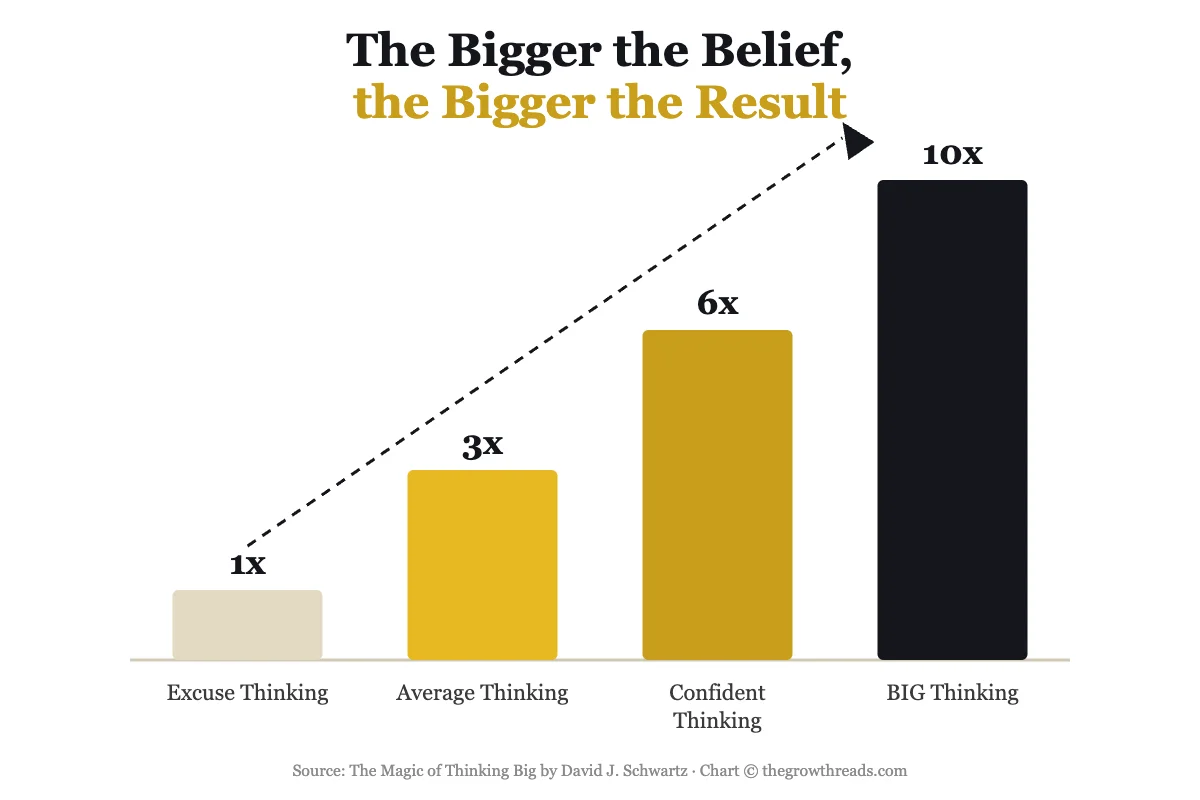
Belief sets the ceiling on your results — and you can raise it on purpose. Published in 1959, David J. Schwartz’s The Magic of Thinking Big argues that success is not reserved for the naturally gifted. Schwartz, a marketing professor, spent years studying why some capable people stall while less “talented” people climb past them, and traced the gap back to belief: people who expect little take small, cautious actions, while people who expect more take bigger, bolder ones — and bigger actions produce bigger results. The book is a practical manual for raising that ceiling: naming and curing the four “excusitis” diseases that shrink ambition, replacing timid language with committed language, choosing an environment that expects more of you, and building daily habits that make thinking big automatic rather than occasional.
Key takeaways
- Belief sets your ceiling: You rarely outperform what you honestly believe you can do, so raising the belief is the first real move.
- Four excuses do the most damage: Health-itis, education-itis, age-itis, and luck-itis are the go-to reasons people give for staying small — and all four are treatable.
- Action cures fear, not the reverse: Waiting to feel confident before acting gets it backwards; confidence is usually the result of having already acted.
- Your environment edits your ambition: The people you spend the most time with quietly reset what feels “normal” to want.
- Language shapes belief: Habitually hedging (“I’ll try,” “maybe,” “we’ll see”) trains your brain to expect a smaller outcome.
- Ideas are worth nothing until acted on: Schwartz has little patience for people who collect big ideas but never test them.
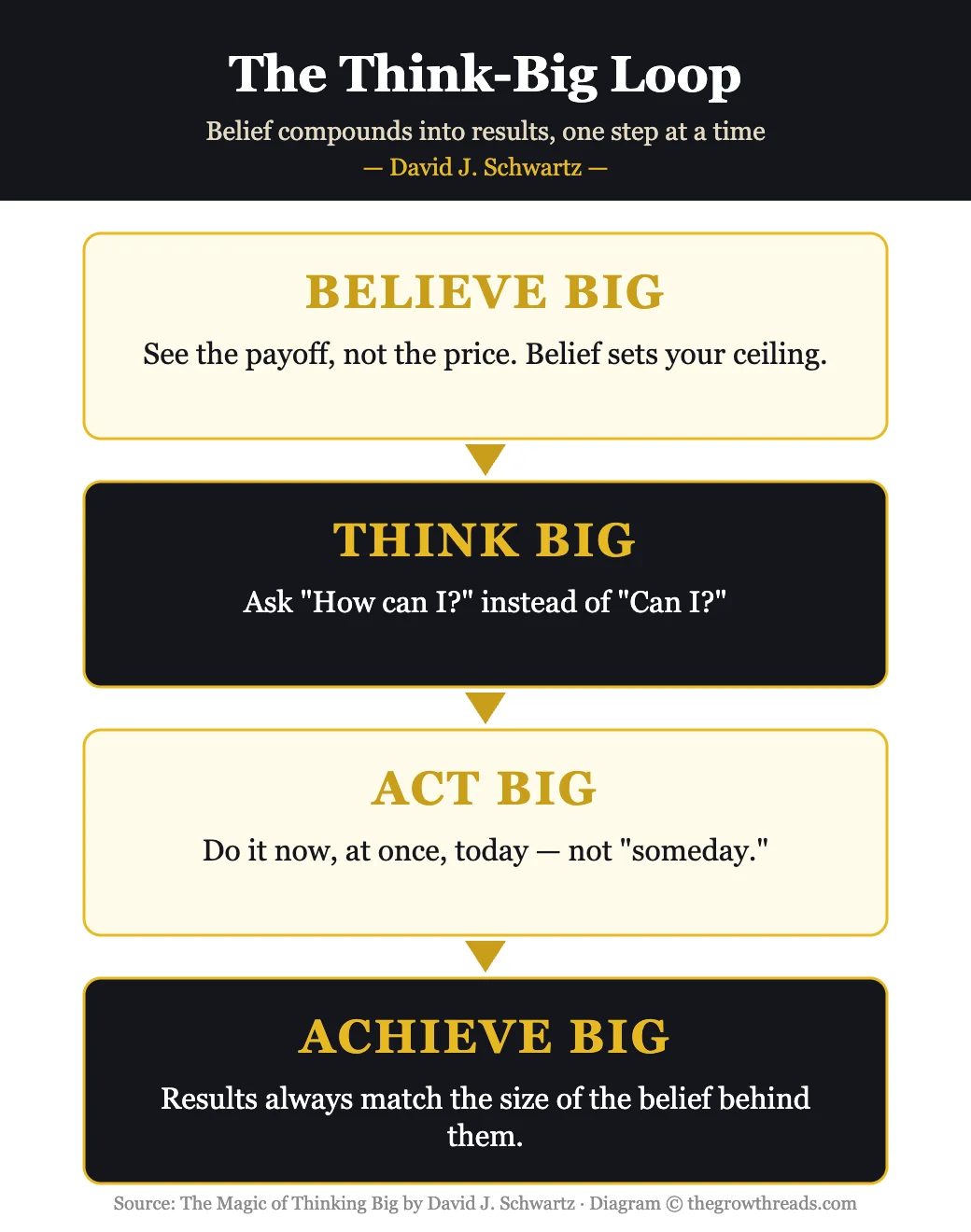
- Think “how,” not “if”: Reframing an obstacle as “how can I” keeps momentum where a flat “can I” kills it.
- Service to others compounds: People and organizations that clearly add value get rewarded — thinking big isn’t the same as thinking only of yourself.
- Attitude is a daily practice: Optimism and confidence are built the same way any habit is — through repetition.
- Setbacks are data, not verdicts: Big thinkers treat failure as one piece of evidence to learn from, not proof they were wrong to try.

What is The Magic of Thinking Big about?
The Magic of Thinking Big is a 1959 self-help classic by David J. Schwartz arguing that success depends less on intelligence or talent than on the size of a person’s belief in what is possible. It offers practical techniques — curing self-limiting excuses, managing language and environment, and building confident daily habits — for thinking, and therefore acting, bigger.
About the author
David J. Schwartz (1927–1987) was an American marketing professor and motivational writer who chaired the marketing department at Georgia State University. He earned his PhD from Ohio State University in 1953 and spent years studying why capable, well-trained people often underperformed their own potential while others with fewer advantages consistently exceeded expectations. That research became The Magic of Thinking Big, first published in 1959 by Prentice-Hall, which has sold more than six million copies and remains one of Simon & Schuster’s best-selling paperbacks decades after his death. Schwartz went on to build a career consulting on sales and management training, but this book remains his defining contribution: a plainspoken case that confidence is a discipline you build, not a gift you’re born with. Explore all David J. Schwartz book summaries →
Key concepts at a glance
| Concept | What it means | Use it when |
|---|---|---|
| Excusitis | The habit of manufacturing believable-sounding reasons to avoid a hard action | You catch yourself explaining “not now” instead of starting |
| Thinking as image-building | Every decision is preceded by a mental picture of the outcome | You are deciding how ambitious a goal to set |
| The “how-to” mindset | Reframing “can I?” into “how can I?” to keep momentum alive | An idea feels blocked by an obstacle |
| Environmental engineering | Deliberately choosing people and settings that expect more of you | Your current circle treats ambition as unusual |
| Action-first confidence | Acting before you feel ready, since confidence follows action | Fear is stalling a decision you’ve already made |
| Service thinking | Framing your work around the value it adds to others | You are pricing, pitching, or positioning something you’ve built |
| Attitude as practice | Treating optimism and confidence as trainable daily habits | You notice pessimistic self-talk becoming a default |
Part 1: Believe Big — the Ceiling Only You Can Raise
Schwartz opens with a claim that sounds almost too simple: success is directly proportional to belief. Not talent, not luck, not even hard work in isolation — belief. He is not talking about wishful thinking. He means a concrete, practical expectation of what is possible that shapes the size of the goals you set and the actions you take toward them.
His case rests on a pattern he observed repeatedly while consulting with sales teams and management trainees: two people with similar backgrounds, similar intelligence, and similar opportunities would produce wildly different results, and the gap traced back to what each one believed they were capable of. The person who believed a modest territory was realistic hit close to that number. The person who believed a much bigger territory was realistic — and who therefore made more calls, took bigger risks, and asked for bigger commitments — hit closer to their own, larger number. Same market, same product, different ceiling.
This is where the book earns its “magic” in the title, and also where it is easiest to misread. Schwartz is not arguing that belief alone produces results — he spends the rest of the book on the concrete habits that translate belief into action. The claim is narrower and more useful: belief functions as a governor on effort. You will rarely commit to actions that exceed what you think is possible, so if you want bigger actions, you first have to authorize yourself to expect a bigger outcome.
TGR Note: This is close to what James Clear calls identity-based change in Atomic Habits — Clear argues habits stick when they match the identity you believe you have. Schwartz’s version is blunter: decide what you believe is possible first, and let the habits follow from there.
Part 2: Curing Your Excusitis
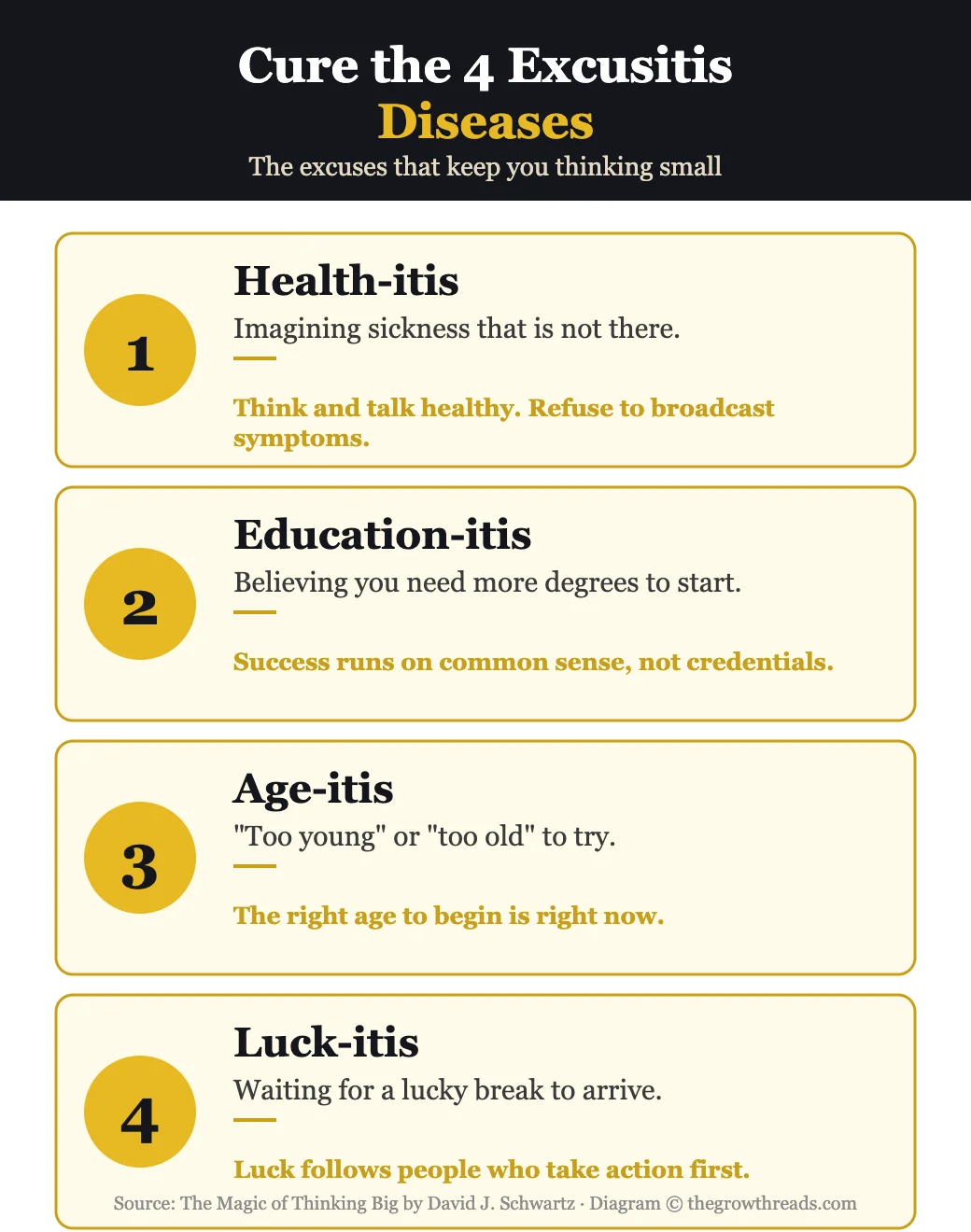
Schwartz names four “excusitis” diseases — health-itis, education-itis, age-itis, and luck-itis — as the most common reasons capable people talk themselves out of bigger goals. He treats them almost literally as diseases: mild versions are nearly universal, and left untreated they get more convincing over time, not less.
Health-itis is the habit of overestimating minor physical complaints as reasons to hold back — using a headache, a bad night’s sleep, or general tiredness as evidence you’re not up to a challenge. Schwartz’s antidote is blunt: talk about your health less, not more, and act as capable as you actually are on an average day.
Education-itis shows up as “I need one more certification, one more degree, one more course before I’m ready.” Schwartz points out that plenty of highly credentialed people underperform, and plenty of people with modest formal education outperform them, because execution and judgment matter more than the credential itself.
Age-itis cuts both ways — “I’m too young to be taken seriously” and “I’m too old to start over” are symptoms of the same disease. Schwartz’s answer: the right age to start something is whatever age you are when you decide to start it.
Luck-itis is the belief that other people’s success came from a lucky break you were denied. Schwartz’s counter is that what looks like luck from the outside is usually the visible tip of a long string of unglamorous actions — the person “got lucky” because they had already put themselves in a position for luck to matter.
TGR Note: The “waiting to feel ready” trap in education-itis and age-itis shows up again in Ego Is the Enemy, where Ryan Holiday makes a similar case that the desire to appear qualified often gets in the way of becoming qualified through practice.
Part 3: Engineering Your Environment and Your Language
Two of the book’s most practical chapters deal with things Schwartz argues you can control directly: who you spend time with, and how you talk about yourself and your plans.
On environment, his argument is that ambition is contagious in both directions. Spend most of your time around people who consider a modest life the sensible ceiling, and that starts to feel like the sensible ceiling to you too — not through any single conversation, but through hundreds of small, unspoken cues about what counts as “normal” ambition. Schwartz’s recommendation isn’t to abandon people who think smaller, but to make sure you also have regular contact with people who expect more, so your sense of “normal” gets pulled upward instead of downward.
On language, Schwartz is almost obsessive about word choice, and this is one of the more immediately actionable parts of the book. He catalogs the small verbal habits — “I’ll try,” “we’ll see,” “I guess,” self-deprecating jokes about your own ambition — that quietly train your brain to expect a modest outcome, because the words you use to describe a plan shape how seriously you take the plan. His fix isn’t empty positivity; it’s precision. Replace vague, hedging language with specific, committed language, and match it with specific, committed action.
He extends the same logic to how you think about other people: describing someone as “boring” or “difficult” primes you to notice more boring or difficult behavior from them, while looking for what’s interesting or capable in the same person tends to surface more of that instead. Schwartz calls this thinking right toward people, and treats it as a practical negotiation and leadership tool, not just a nicety.
TGR Note: This lines up with the environment-design ideas in The Compound Effect, where Darren Hardy makes the same case for curating your inputs — the people, media, and self-talk you allow into your day compound the same way small financial choices do.
Part 4: Building the Daily Habits of a Big Thinker
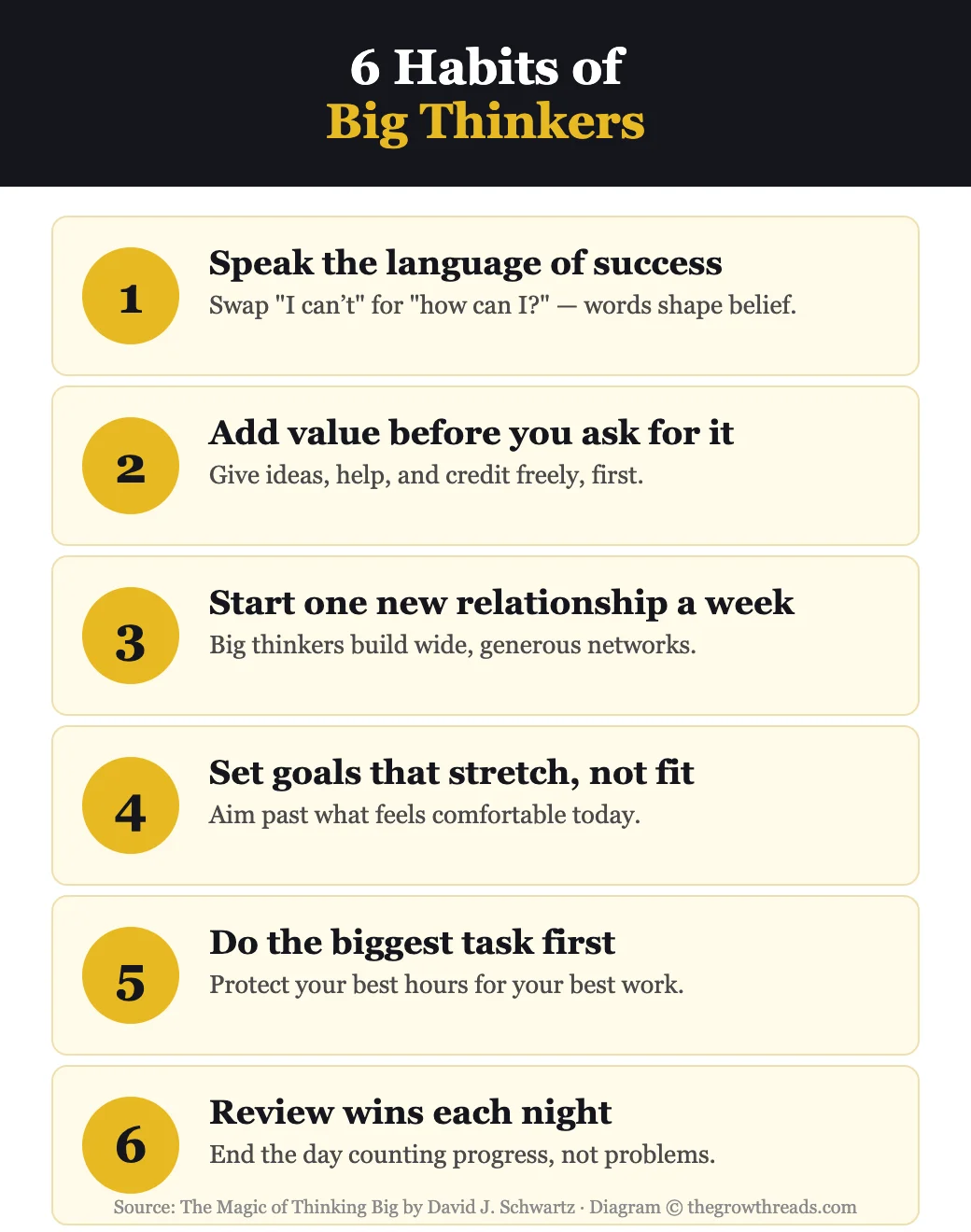
The last section of the book turns belief into a repeatable practice rather than a one-time decision. Schwartz’s core insight here is that thinking big has to be scheduled like any other habit, or it quietly reverts to thinking small under the pressure of an ordinary day.
He recommends starting each day by deciding, specifically, what “thinking big” will look like in the next 24 hours — one bigger ask, one bolder pitch, one uncomfortable conversation you’ve been postponing — rather than treating ambition as a background mood you either have or don’t. He’s also insistent about protecting your best hours for your most important work, arguing that big thinking dies quietly when the biggest task of the day gets pushed to “later” and never quite gets there.
Reviewing the day’s wins before bed, rather than replaying its mistakes, is Schwartz’s other recurring habit — not as a self-esteem exercise, but because what you rehearse right before sleep tends to shape the beliefs you wake up with the next day.
TGR Note: If you want a lighter-weight system for making these habits stick, Tiny Habits by BJ Fogg is a useful pairing — Schwartz tells you what to believe and do; Fogg gives you the mechanics for making any of it automatic.
Who is The Magic of Thinking Big best for — and who should read something else first?
This book is best for people who already have real capability but keep choosing the safe, small option — early-career professionals negotiating their first raises, entrepreneurs pricing their work too low, and anyone who notices they’re quietly talking themselves out of bigger opportunities. It works especially well for readers who respond to direct, slightly old-fashioned motivational writing rather than heavily footnoted research.
If you want a book built more on behavioral science than motivational argument, Atomic Habits is a better starting point. If your issue is less about ambition and more about self-sabotage and ego, start with Ego Is the Enemy. And if what’s actually holding you back is a lack of a concrete system rather than a lack of belief, Getting Things Done will serve you better.
Questions to reflect on
- Where in your life are you already using one of the four excusitis excuses — and what would you do this week if that excuse weren’t available to you?
- Who are the people you spend the most time with, and does their idea of a “big” goal match, exceed, or fall short of your own?
- What’s one specific phrase you use (“I’ll try,” “we’ll see,” “maybe”) that quietly signals a smaller expectation than you actually want?
- What’s the single biggest task you’ve been pushing to “later” for more than a week, and what would it take to do it first tomorrow?
- If belief were the only thing standing between you and a bigger goal, what would you set your sights on right now?
🔥 Ready to think — and act — bigger?
Read Schwartz’s full case for engineering your belief, your language, and your environment.
How to apply The Magic of Thinking Big (7-day plan)
- Day 1 — Diagnose your excusitis: Write down the excuse you reach for most often (health, education, age, or luck) and one goal you’ve shelved because of it.
- Day 2 — Audit your language: Notice every time you say “I’ll try,” “maybe,” or “we’ll see” about something you actually want, and rewrite each one as a specific commitment.
- Day 3 — Map your circle: List the people you spend the most time with and honestly rate whether their ambitions pull yours up or down.
- Day 4 — Do the biggest task first: Before checking messages, complete the one task you’d normally push to the afternoon.
- Day 5 — Make one bigger ask: Send the pitch, ask for the raise, or make the introduction you’ve been sizing down out of caution.
- Day 6 — Practice thinking right toward someone: Pick one person you’ve been quietly writing off and note three capable, interesting things about them instead.
- Day 7 — Review your wins: Before bed, write down three things that went well this week because you thought slightly bigger than usual, and set one bigger target for next week.
Frequently asked questions
Is The Magic of Thinking Big still relevant today, given it was published in 1959?
Yes, though some examples feel dated. The core mechanism — belief shaping the size of your actions — is well supported by later research on self-efficacy and goal-setting, even if Schwartz’s language and anecdotes reflect a mid-century sales-and-management culture. Readers who filter the era-specific examples and keep the underlying framework generally find it holds up.
What is “excusitis” in The Magic of Thinking Big?
Excusitis is Schwartz’s term for the habit of manufacturing plausible-sounding reasons to avoid a difficult or ambitious action. He identifies four common strains — health-itis, education-itis, age-itis, and luck-itis — and argues each is a trained habit rather than a fixed truth, which means each can be unlearned with deliberate practice.
How is this different from other confidence or mindset books?
Compared to research-heavy books like Mindset, The Magic of Thinking Big is more prescriptive and anecdote-driven, offering direct instructions rather than building a scientific case first. Readers who want concrete daily actions tend to prefer this approach; readers who want the evidence behind the advice may prefer a more research-forward book.
Does the book address failure and setbacks?
Yes. Schwartz treats setbacks as useful information rather than verdicts on a person’s ability, and devotes attention to how big thinkers interpret failure differently — as one data point to adjust from, not proof the original goal was wrong.
Is this book more about business success or personal growth?
Both, though the original audience was largely sales and management professionals. The core ideas — belief, language, environment, and habits — apply equally to career negotiations, creative projects, and personal goals outside of work.
What is the single most actionable idea in the book?
Most readers point to the language chapter — replacing hedging phrases like “I’ll try” with specific, committed language — because it’s immediately testable in any conversation, unlike bigger shifts such as changing your social circle.
How long does it take to read, and is a summary a good substitute?
The full book runs about 6 hours for most readers. A summary like this one is useful for previewing the framework and deciding whether to read further, but the original includes many more worked examples and exercises that reinforce the four core skills in more depth.