

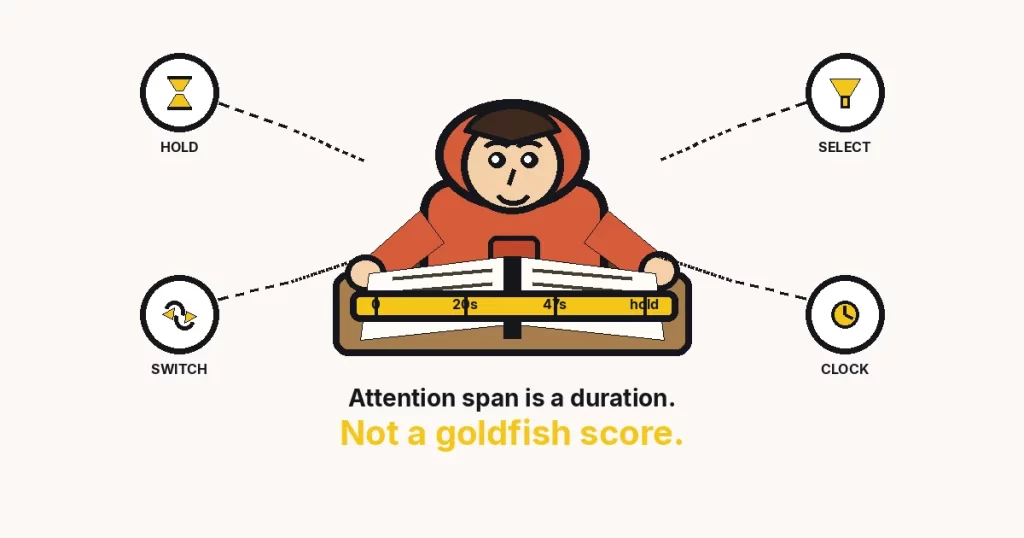
Attention span meaning is how long you can stay with one chosen target before the mind or the room forces a hop. It is a duration of sustained attention, not a personality score and not the eight-second goldfish number. Labs split that duration into holding, filtering, and switching — one seconds figure is how the myth got started.
Key takeaways
- Attention span, in the research that actually uses the idea, is the duration of sustained attention on a chosen target — one job inside a larger attention system, not an IQ-like score (Posner and Petersen, 1990).
- The eight-second “goldfish” figure is a 2015 consumer-insights claim, not a laboratory measurement; the classroom “ten-minute lecture span” fails the same test (Bradbury, 2016).
- Workplace logs measure visit length — about three minutes on a device in 2005 information work — which is a hop rate set by the room, not a brain size (Mark, Gonzalez and Harris, 2005).
- Leaving a task unfinished leaves a residue that measurably hurts the next task; the span you feel is often leftover attention, not a shorter clock (Leroy, 2009).
- Memory systems treat attention as the gate to encoding: if nothing is held long enough to mark, nothing is stored — the practical claim behind Kevin Horsley’s Unlimited Memory.
What attention span actually means
Attention span is the length of time you can keep attention on one chosen target before something — a thought, a ping, a person, a tab — pulls it off. That is a duration. It is not a grade, not a personality, and not a medical label. The word only earns its keep when you can name the target: this paragraph, this call, this page of Horsley’s memory work. A span with no object is just a mood.
Psychology does not treat “attention” as one knob. Posner and Petersen (1990) described an attention system with separable jobs — alerting, orienting, and executive control — later restated in Petersen and Posner (2012). Popular speech collapses those jobs into a single seconds number and then panics when the number looks small. The panic is aimed at the wrong unit. A person can filter badly and still hold a chosen page for twenty minutes. A person can hold a page and still lose the next one because the last task was never closed. Those are different failures. Only the first is a span.
The opposite of a useful definition is the goldfish line. “Humans now have an eight-second attention span” treats a consumer-insights slide as if it were a lab clock. It is not. The sister page on what a short attention span looks like already covers hop rate and the room that causes it. This page stays with the word itself: what the span is, what it is not, and which nearby words steal its job.
In our experience, people who ask “what does attention span mean” are rarely hunting a DSM entry. They have just been told their brain is broken because they checked a phone. The honest answer is smaller and more useful: attention span is how long the hold lasts on a target you picked. If the hold is short, ask whether the target was named, whether the room kept switching you, and whether the last task left residue — before you buy a seconds-trainer app.
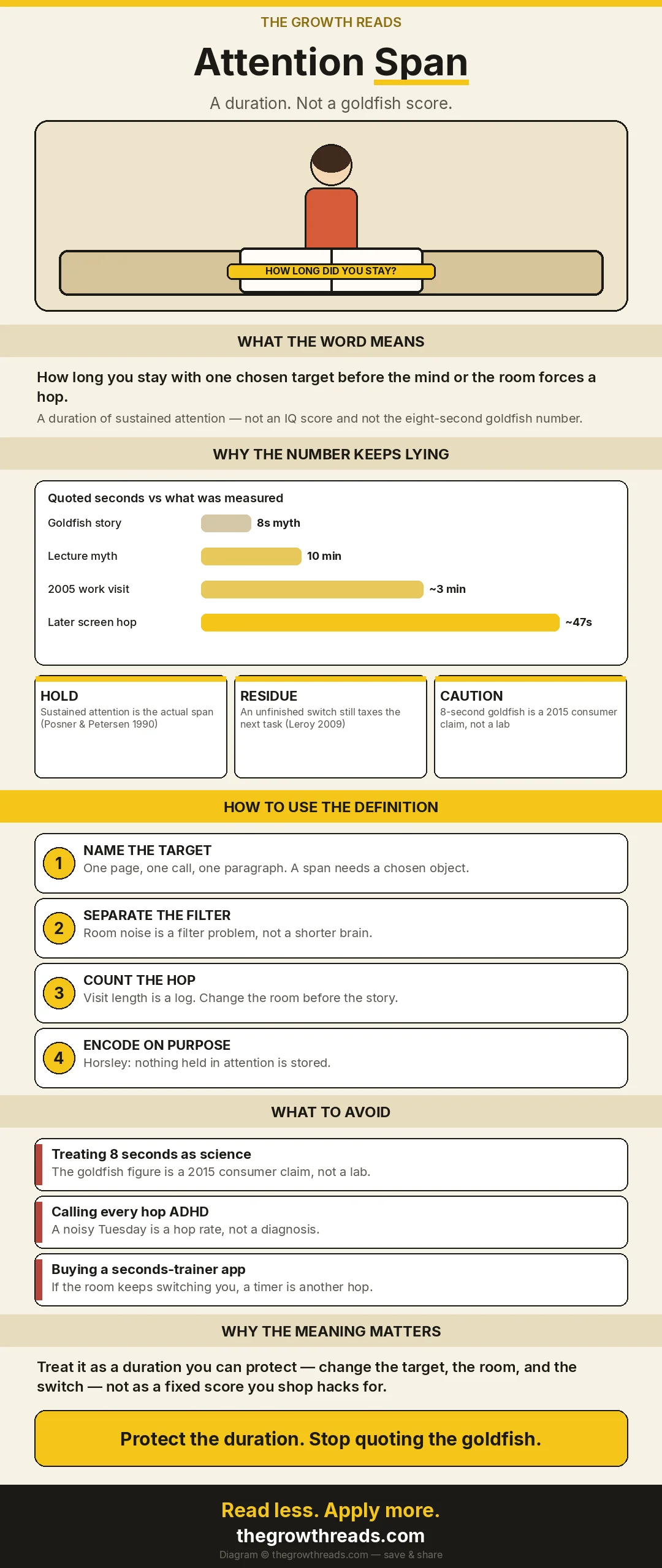
Working definition. Attention span = duration of sustained attention on a chosen target. Not filter quality. Not working-memory capacity. Not a goldfish score.
Attention span vs focus, concentration, and working memory
Focus is the state of staying; attention span is how long that stay lasts; concentration is the effort of holding; working memory is how many items you can keep live. Mixing them is how a duration becomes a character flaw. The parent page on how to focus better treats focus as the near-total absence of task-switching. That is the state. Span is the clock on that state. You can be “focused” for ninety seconds and still have done the job the page asked for. You can also sit still for an hour and never have named a target — that is not a long span; that is drift with good posture.
Working memory is the other frequent theft. Cowan (2001) argued that the live set adults can hold is closer to four chunks than Miller’s seven. That is a capacity claim, not a seconds claim. A short span and a small live set can travel together — you encode nothing if you never hold the page — but they are not the same measurement. “Why does my memory suck” is often an encode failure: nothing attended, nothing stored. Horsley’s book starts in the same place. It is a memory method, not an attention-span trainer, which is why it sits as the down-link here rather than as a second how-to-focus guide.
Concentration is the effort layer. You can concentrate hard on the wrong object (the badge on a lock screen) and still have a useless span. You can also hold a chosen page with low drama because the room is quiet and the last loop is closed. Effort is not the definition. Duration-on-target is.
Why the eight-second story stuck
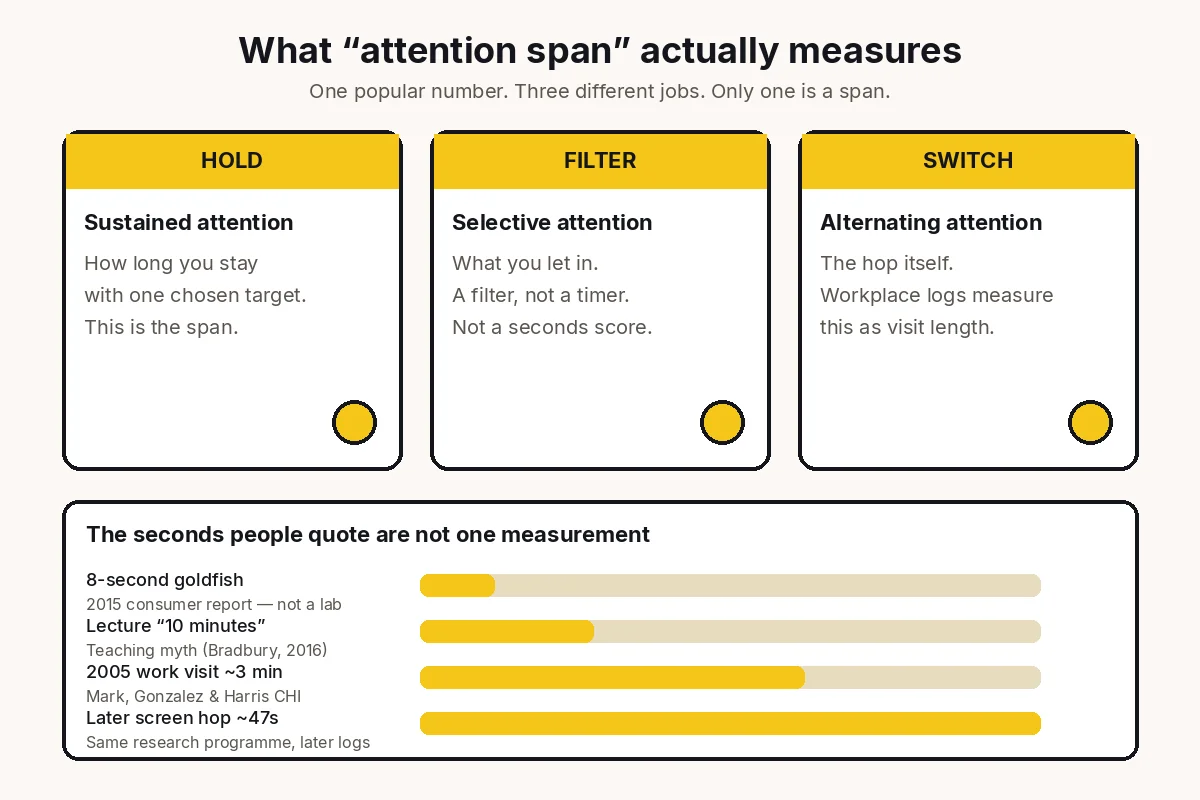
The eight-second story stuck because it is a single number that flatters a frustrated afternoon and needs no method. Microsoft Canada’s 2015 Attention Spans consumer-insights report is the usual source of the “humans now lose to goldfish” line. It was not a peer-reviewed experiment, it did not define a target, and it treated “attention span” as if one clock sat inside every skull. Bradbury (2016) took the classroom cousin — the claim that lecture attention dies at ten or fifteen minutes — and showed the same pattern: a tidy number repeated in handbooks, thin evidence underneath.
Wilson and Korn (2007) had already warned teaching guides that the “ten-minute rule” was being copied without a measurement. Students look away. That is not the same as a span expiring. A look-away can be a blink, a note, a check of the next slide, or a hop. If you do not say which, you do not have a span; you have a vibe.
Workplace research measures something closer to a real clock, and it still is not a personality. Mark, Gonzalez and Harris (2005) logged information workers and found they spent about three minutes on a device before switching, with many working spheres cut even shorter. Later logging from the same research programme is widely reported around forty-seven seconds on a screen. That is a visit length in a notification-rich room. It is evidence that the environment sped up the hop. It is not evidence that human sustained attention shrank to goldfish size. The multitasking page is where that hop tax lives; this page only needs the distinction: a log of visits is not a definition of a span.
The story also stuck because it is useful to the people who sell the cure. If the span is a broken organ, you need an app. If the span is a duration on a named target, you need a quieter room and a closed last loop — the unglamorous work already mapped on notification overload and attention residue.
The four things people fold into one word
People fold four different jobs into “attention span,” and only one of them is a span. Name the four and the word stops being a smear.
- Hold. Sustained attention: staying with the target you picked. This is the span. Vigilance research (Mackworth’s clock, later work on decrement) studies how that hold decays when the target is dull and long. A boring inbox is a vigilance problem, not a goldfish.
- Filter. Selective attention: what you let in. A phone face-up on the desk taxes available working memory even when you do not touch it (Ward, Duke, Gneezy and Bos, 2017). That is the filter leaking, not the clock running out.
- Switch. Alternating or divided attention: the hop itself. Rubinstein, Meyer and Evans (2001) split every switch into a goal shift and a rule activation. Heavy media multitaskers are worse at filtering irrelevance, not better at switching (Ophir, Nass and Wagner, 2009). Visit length is this layer.
- Residue. Leftover attention from the last unfinished task (Leroy, 2009). You can sit on the new page and still be on the old one. The span feels short because the previous target never closed.
When someone says “my attention span is gone,” ask which of the four just failed. Hold, filter, switch, and residue want different next moves. Collapsing them into eight seconds hides the move.
Why the definition costs more than it feels like
A wrong definition of attention span costs you the diagnosis, so you spend the week treating the wrong layer. If you think the span is a fixed score, you shop for hacks and identity stories (“I’m just not a deep person”). If you think it is a duration you can protect, you name a target, close the last loop, and change the room. Those are not the same afternoon.
Mark, Gudith and Klocke (2008) found that interrupted workers finished faster and wrote with comparable quality — at the price of more stress, more frustration, and more effort. The hop does not always show up as a worse document. It shows up as a more expensive body. That is why a “short span” can coexist with a finished to-do list. The list got done. The hold never happened. Single-tasking is the practice of refusing the extra open file so the duration can exist at all.
The other cost is encoding. Horsley’s memory system is blunt about the gate: you cannot store what you did not attend. In our experience that is the quiet failure behind “I read the page and nothing stuck.” The eyes moved. The span did not. A highlight colour is not a hold. A tab left open is not a hold. The productivity hub collects the pages that protect a hold; this page only has to stop you quoting a goldfish while you bounce.
There is a limit worth saying out loud. Observational workplace logs are not causal proof that phones shrank the human span. They are proof that visit length in those rooms got shorter. A quieter room can lengthen a visit without changing anyone’s biology. Treat the 47-second figure as a description of a logged environment, not as a species downgrade.
Nearby ideas that are not attention span
Most phrases that sit next to “attention span” in a search bar are neighbouring jobs, not synonyms. The table is a map, not a diagnostic of types-and-fixes — that work belongs on the sister hop-rate page and on the focus parent.
| Phrase | What people think it is | What it actually is | Wrong next move |
|---|---|---|---|
| Attention span | A seconds score you either have or lack | Duration of hold on a chosen target | Quoting eight seconds as science |
| Focus | The same thing as a long span | The state of not switching — the parent page | Adding willpower to a buzzing desk |
| Short attention span | Proof the organ is broken | A hop rate, usually set by the room | Self-diagnosis from a Tuesday log |
| Working memory | How many seconds you can last | How many chunks stay live (Cowan, 2001) | A new notes app for unread pages |
| Attention residue | Another word for a short span | Leftover attention from an unfinished switch (Leroy, 2009) | Starting the next file with the last one still open |
| Deep work / flow | What a “good” span looks like | A protected block, or a rare absorbed state — see deep work meaning and flow state | Waiting to feel absorbed before you name a target |
Staying on task is the applied cousin: one named next action, then protection. Average screen time for adults is a dose measure, not a span. You can have a long hold on the wrong screen. Hours are not the definition either.
Common mistakes
The common mistakes are all category errors — treating a duration as a score, a mood, or a diagnosis.
- Repeating the goldfish number as if it were a finding. It is a consumer-insights line. Bradbury (2016) is the academic warning label on the lecture version. Link it out loud so it stops travelling.
- Calling every hop ADHD. A noisy Tuesday is a hop rate. A clinical pattern across years and rooms is a different question, and not this page. Do not collect symptoms from a workplace log.
- Buying a seconds-trainer on the same phone that is hopping you. If the room is the switch, a timer on the device is another target. Move the phone; then measure the hold. The focus parent is the method page.
- Confusing a finished list with a span. Mark, Gudith and Klocke (2008) already showed interrupted work can still finish. Finish is not hold.
- Treating working memory drills as span training. Capacity and duration can help each other. They are not the same clock. Horsley’s book trains encoding, not a goldfish score.
- Leaving the last task open and blaming the new one. Residue is not a short span. Close the loop — one line of “where I stopped” — before you start the next hold. That is attention residue, not a smaller brain.
- Waiting for flow before you start. Flow is a rare absorbed state. A span can be ordinary: one page, a few quiet minutes, a named stop. Waiting for the feeling is how the afternoon disappears.
The evidence behind this
The evidence supports a split attention system and a hop-rate that tracks the room; it does not support an eight-second species downgrade. The table below is what we actually used. Observational logs are marked as observational. The goldfish line is left in the sources as a document, not as a result.
| Study | Design and size | Finding | What we used it for |
|---|---|---|---|
| Posner and Petersen, 1990; Petersen and Posner, 2012 | Annual-review synthesis of attention networks | Attention is a system with separable alerting, orienting, and executive jobs, not one knob | The definition: span is the hold, not the whole system |
| Cowan, 2001 | Theoretical review of short-term / working memory capacity | Live capacity is closer to four chunks than seven | Why working memory is not a seconds score |
| Mark, Gonzalez and Harris, 2005 | Field logging of information workers (CHI) | About three minutes on a device before a switch; working spheres often shorter | Visit length is a hop rate, not a goldfish span |
| Mark, Gudith and Klocke, 2008 | Lab experiment on interrupted work (CHI) | Interrupted people finished faster, with more stress, frustration, and effort | A finished list can hide an expensive hop |
| Leroy, 2009 | Lab studies of task switching and attention residue | An unfinished switch impairs the next task; mere completion is not enough to clear it | Residue is a fourth job people misname as “span” |
| Rubinstein, Meyer and Evans, 2001 | Task-switching experiments | A switch has two stages — goal shift, then rule activation — and costs more on complex tasks | The hop itself is not the span |
| Ophir, Nass and Wagner, 2009 | Media-multitasking individual differences (PNAS) | Heavy multitaskers filtered irrelevance worse, not better | More hopping does not train a longer hold |
| Ward, Duke, Gneezy and Bos, 2017 | Experiments on smartphone presence (JACR) | One’s own phone nearby reduced available working memory and fluid intelligence | Filter leak from the room, not a shorter clock |
| Bradbury, 2016; Wilson and Korn, 2007 | Critical reviews of lecture-attention claims | The “ten-minute span” is a recycled teaching myth with thin measurement | Why tidy seconds numbers keep travelling |
Frequently asked questions
What is the meaning of attention span?
Attention span is how long you can keep attention on one chosen target before the mind or the room forces a hop. It is a duration of sustained attention, not a personality score and not working-memory capacity. Posner and Petersen’s attention-system work is the reason that split matters: hold, filter, and switch are different jobs. If you cannot name the target, you are not measuring a span — you are describing a mood. The eight-second goldfish line is not this definition.
Is the eight-second goldfish attention span real?
No. The usual source is a 2015 Microsoft Canada consumer-insights report, not a laboratory clock on a named target. Bradbury (2016) and Wilson and Korn (2007) show the same pattern in teaching lore: a tidy number, thin measurement, endless reprints. Workplace logs that show shorter screen visits are real, and they describe a hop rate in a noisy room. They do not prove that human sustained attention shrank to eight seconds. Treat the goldfish line as marketing folklore.
What is the difference between attention span and focus?
Focus is the state of staying with a task — the near-total absence of switching, which is the job of the parent page on how to focus better. Attention span is the duration of that stay. You can be focused for two quiet minutes and have a useful span. You can also sit still for an hour without a target and have no span at all, only drift. Concentration is the effort of holding; working memory is how many items stay live. None of those words should steal the clock.
Why does my attention span feel shorter on a phone?
Because the phone is a switch machine sitting inside the hold. Ward and colleagues (2017) showed that merely having your own phone nearby reduced available working memory. Mark’s workplace logs show visit lengths shrinking as the room filled with pings. That is a hop rate and a filter leak, which the short-attention-span sister page covers. It is not proof that your sustained-attention organ failed. Move the phone to another room and measure the hold on a named page before you rewrite your personality.
Is a short attention span the same as ADHD?
No, and this page will not diagnose you. Attention-deficit hyperactivity disorder is a clinical pattern that has to hold across years and rooms. A noisy Tuesday, a 47-second screen visit, or a hard afternoon after poor sleep is a hop rate. Those can overlap with a clinical picture, but a workplace log is not a clinic. If the hop is new, context-bound, and tracks the room, start with the room. Do not collect a symptom list from a productivity article.
How is attention span measured in research?
It depends which job the lab is studying. Vigilance tasks measure how a hold decays on a dull stream. Task-switching tasks measure the cost of a hop (Rubinstein, Meyer and Evans, 2001). Field logs measure visit length on devices (Mark, Gonzalez and Harris, 2005). Working-memory tasks measure live chunks, not seconds (Cowan, 2001). If a headline gives you one number without saying which of those clocks it used, it is not a measurement of “attention span.” It is a slogan.
Does multitasking shrink your attention span?
Habitual media multitasking is linked to worse filtering of irrelevance, not to a trained longer hold (Ophir, Nass and Wagner, 2009). Switching also leaves residue that hurts the next task (Leroy, 2009). That can make the next span feel short without changing anyone’s biology. The multitasking article is the cost page. The practical move is fewer open files, not a seconds-trainer. Single-tasking is the refusal that lets a duration exist.
Can you increase your attention span?
You can protect a duration: name one target, close the last loop, and take the phone out of the room. That is not the same as growing a new organ, and this play page is not the how-to-increase-attention-span guide. Ward’s phone-presence effect and Leroy’s residue effect are the two cheapest levers, because they are in the room you already have. Horsley’s memory work adds the encoding test — if nothing stuck, the hold never happened. Measure the hold on a chosen page before you buy a programme.
Sources
- Posner, M. I., & Petersen, S. E. (1990). The attention system of the human brain. Annual Review of Neuroscience, 13, 25–42. https://doi.org/10.1146/annurev.ne.13.030190.000325
- Petersen, S. E., & Posner, M. I. (2012). The attention system of the human brain: 20 years after. Annual Review of Neuroscience, 35, 73–89. https://doi.org/10.1146/annurev-neuro-062111-150525
- Cowan, N. (2001). The magical number 4 in short-term memory: A reconsideration of mental storage capacity. Behavioral and Brain Sciences, 24(1), 87–114. https://doi.org/10.1017/S0140525X01003922
- Mark, G., Gonzalez, V. M., & Harris, J. (2005). No task left behind? Examining the nature of fragmented work. Proceedings of CHI 2005, 321–330. https://doi.org/10.1145/1054972.1055017
- Mark, G., Gudith, D., & Klocke, U. (2008). The cost of interrupted work: More speed and stress. Proceedings of CHI 2008, 107–110. https://doi.org/10.1145/1357054.1357072
- Leroy, S. (2009). Why is it so hard to do my work? The challenge of attention residue when switching between work tasks. Organizational Behavior and Human Decision Processes, 109(2), 168–181. https://doi.org/10.1016/j.obhdp.2009.04.002
- Rubinstein, J. S., Meyer, D. E., & Evans, J. E. (2001). Executive control of cognitive processes in task switching. Journal of Experimental Psychology: Human Perception and Performance, 27(4), 763–797. https://doi.org/10.1037/0096-1523.27.4.763
- Ophir, E., Nass, C., & Wagner, A. D. (2009). Cognitive control in media multitaskers. Proceedings of the National Academy of Sciences, 106(37), 15583–15587. https://doi.org/10.1073/pnas.0903620106
- Ward, A. F., Duke, K., Gneezy, A., & Bos, M. W. (2017). Brain drain: The mere presence of one’s own smartphone reduces available cognitive capacity. Journal of the Association for Consumer Research, 2(2), 140–154. https://doi.org/10.1086/691462
- Bradbury, N. A. (2016). Attention span during lectures: 8 seconds, 10 minutes, or more? Advances in Physiology Education, 40(4), 509–513. https://doi.org/10.1152/advan.00109.2016
- Wilson, K., & Korn, J. H. (2007). Attention during lectures: Beyond ten minutes. Teaching of Psychology, 34(2), 85–89. https://doi.org/10.1080/00986280701291291
- Microsoft Canada. (2015). Attention spans (consumer insights). Cited as the usual source of the eight-second / goldfish claim — not as a laboratory result.
- Horsley, K. (2016). Unlimited Memory. TCK Publishing. Review: Unlimited Memory summary.
Related reading on The Growth Reads
Books
- Unlimited Memory summary — attention as the gate to encoding, not a goldfish score.
Related articles
- How to focus better — parent: focus as the absence of switching.
- Short attention span — sister: hop rate, causes, and the room.
- Attention residue — leftover attention from the last unfinished switch.
- Multitasking — what the hop actually costs.
- Single-tasking — the refusal that lets a duration exist.
- What deep work actually means — a protected block, not a mood.
- What flow state actually is — absorbed work, not a synonym for span.
Hub and pillar
How this article was researched
The Growth Reads editorial team read the attention-system reviews (Posner and Petersen, 1990; Petersen and Posner, 2012), the hop and residue experiments (Mark, Gonzalez and Harris, 2005; Mark, Gudith and Klocke, 2008; Leroy, 2009; Rubinstein, Meyer and Evans, 2001; Ophir, Nass and Wagner, 2009; Ward, Duke, Gneezy and Bos, 2017), Cowan’s capacity review (2001), and the lecture-span critiques (Wilson and Korn, 2007; Bradbury, 2016). The Microsoft Canada 2015 consumer report is cited only as the source of the goldfish slogan. Kevin Horsley’s Unlimited Memory is the named unused review for this queue row — a memory method that treats attention as the encode gate, not a second how-to-focus guide.
Limits: workplace logs are observational. They describe visit length in those rooms; they do not prove a biological shrink. This page does not diagnose ADHD, list clinical symptoms, or replace the sister hop-rate article or the later how-to-increase-attention-span row.
Methodology: definition page on the locked v3 play template (no HowTo node). Primary sources are peer-reviewed papers plus one named book review. No invented percentages. Last checked 16 September 2026.