

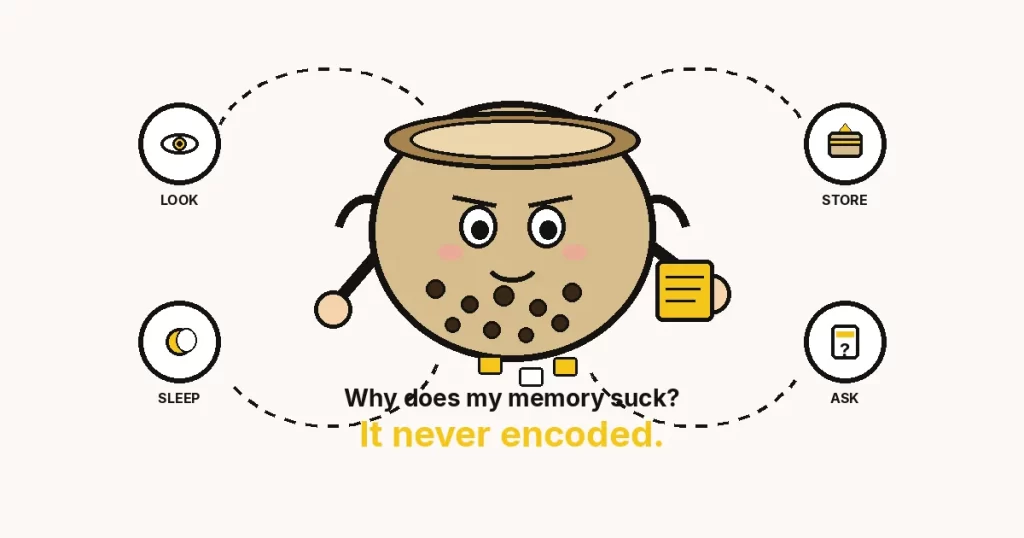
Why does my memory suck is usually a filing problem, not a broken brain. Names and meeting points vanish because attention never encoded them, working memory was already full, or nothing asked you to retrieve them later. Sleep and a nearby phone make the leak worse. The fix is encoding on purpose, then testing yourself.
Key takeaways
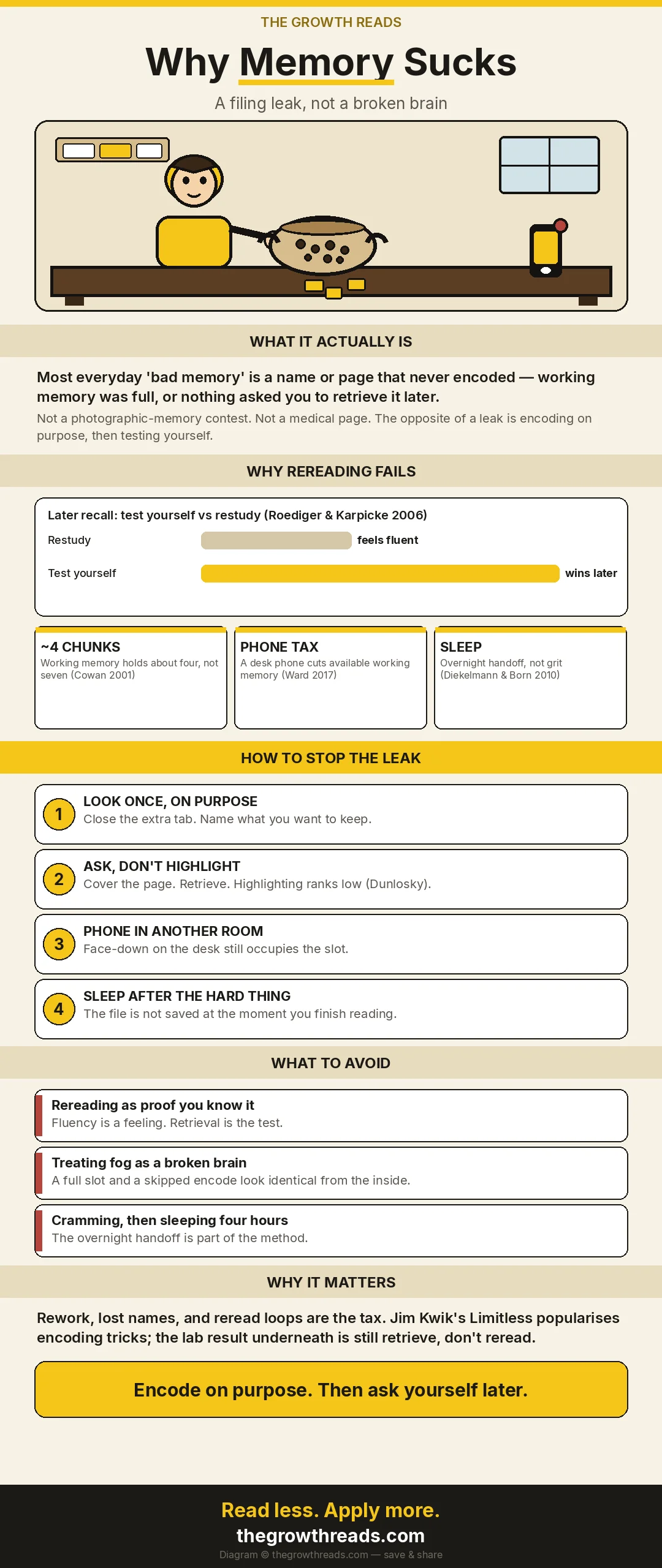
- Everyday working memory holds about four chunks at once — the folk “seven plus or minus two” overstates the slot you actually have for a name or a next step (Cowan, 2001).
- After a delay, students who had been tested remembered more than students who had restudied the same material; rereading feels fluent and still loses later (Roediger & Karpicke, 2006).
- A phone sitting on the desk reduces available working memory and fluid intelligence even when it is silenced, unused, and face down; another room beats a pocket (Ward, Duke, Gneezy & Bos, 2017).
- Sleep is when recent traces are handed to a longer-term store; short sleep is a filing delay, not proof that memory “just isn’t your thing” (Diekelmann & Born, 2010).
- Across decades of classroom research, practice testing ranks high and highlighting plus rereading rank low — fluency is a feeling, not a stored file (Dunlosky, Rawson, Marsh, Nathan & Willingham, 2013).
What a “bad memory” actually is
A “bad memory” at work is usually a name, page, or meeting point that never became a file — not a brain that lost the warehouse. The search phrase “why does my memory suck” sounds like a hardware complaint. The research treats it as a sequence complaint. Something has to be attended to, encoded, held overnight, and asked for later. Skip any one of those and the inside experience is identical: you are sure you “had it,” and then you do not.
That is a narrower object than how to focus better, the parent page in this cluster. Focus is the beam on the current task. Memory is whether anything from that beam is still there after the beam moves. You can feel sharp in a meeting and still lose the name, because looking at a face is not the same as storing the name. You can feel foggy and still keep the one fact you retrieved on purpose yesterday. The method lives in the filing, not in the feeling that you are “bad at names.”
It is also not the same as staying on the open task. Remaining is refusing to leave the file; remembering is whether the file was written. The sister page how to stay on task is the remaining half. This page is the half that starts after you looked — or thought you did — and later cannot produce the thing. Jim Kwik’s Limitless is useful here as a popular encoding kit (visualise, attach, retrieve). The lab result underneath is older and blunter: rereading is a weak store, and asking yourself later is a strong one.
Is a bad memory the same as a small brain?
No — working memory is a small, busy slot; long-term memory is the warehouse, and most everyday failures never reach the warehouse. Nelson Cowan (2001) reviewed the short-term literature and put the practical capacity nearer four chunks than George Miller’s famous seven. Four is enough for a sentence you are writing and a name you just heard, until a badge, a leftover loop, or a second name arrives. Then the slot overwrites. From the inside that overwrite feels like “I have a terrible memory.” From the mechanism it is a full desk, not a missing archive.
Long-term memory is the part people mean when they say they want a better memory. It is also the part that is usually fine. The leak is earlier: attention never encoded the item, or nothing later asked for it, so the warehouse was never stocked. Anders Ericsson’s work in Peak is the performance version of the same point — experts look like they “just remember” because they practised retrieving under the real conditions, not because they were born with a larger warehouse.
| What it feels like | What usually happened | What did not happen |
|---|---|---|
| I just read that page and I cannot say it back | Reread fluency; no retrieval | A damaged long-term store |
| I forgot the name as they sat down | The working-memory slot was already full | A personality called “bad with names” |
| I knew it last night and not this morning | No overnight handoff, or no ask today | Proof that “cramming works if I care” |
| I keep losing the next step mid-task | A switch emptied the slot | A need for more willpower on the same desk |
The productivity hub collects the sibling pages around attention and habits. This page stays on the filing half: why a normal Tuesday produces the sentence “why does my memory suck,” and what the encoding research actually supports.
Why does everyday memory leak?
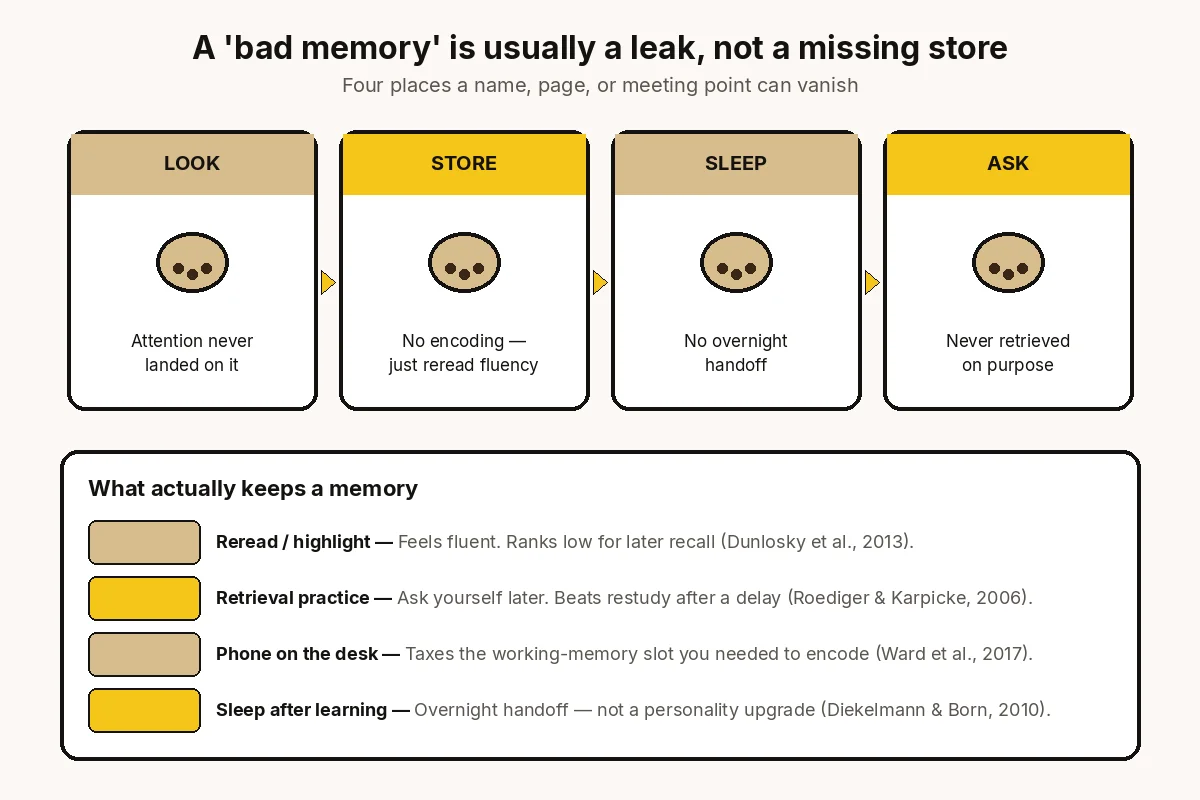
Everyday memory leaks because the item never finished the sequence — look, store, sleep, ask — and a full working-memory slot or a nearby phone can break the sequence before it starts. None of those require a character flaw. They require a meeting, a phone on the desk, a reread that felt like studying, or a short night. All of which describe an ordinary week.
Fergus Craik and Endel Tulving (1975) showed the encoding half in the lab: words processed for meaning were recalled better than words processed for typeface. “I looked at it” is not “I stored it.” A name you repeated once while already planning your answer is a typeface pass. A name you attached to a face, a place, or a question is a meaning pass. Kwik’s Limitless kit (visualise the name, attach it to something absurd, retrieve it before you leave the room) is a popular version of that deeper pass. It is not a peer-reviewed trial. The Craik and Tulving result is why the kit is even plausible.
The retrieval half is the one people skip because rereading feels like work. Henry Roediger and Jeffrey Karpicke (2006) had students either restudy a passage or take a free-recall test on it. After a few minutes, restudy looked as good or better. After two days, the tested group remembered more. The feeling that “I know this, I just reread it” is the short-delay illusion. The later test is the file. Jeffrey Karpicke and Janell Blunt (2011) then put retrieval practice against elaborative concept mapping and still found the ask-yourself condition ahead on a later short-answer test. Mapping can be useful. It is not a substitute for retrieval.
The four leaks that produce the complaint
- Attention never landed. You were in the room. The name still missed the slot. A badge, a leftover loop, or the next sentence you were already writing took the four chunks Cowan described. Sophie Leroy’s (2009) attention residue is the leftover-loop version: the last unfinished task keeps running after you have already switched, so the new name arrives on a desk that is not empty.
- Nothing encoded. You reread the page, highlighted the heading, and felt fluent. John Dunlosky, Katherine Rawson, Elizabeth Marsh, Mitchell Nathan and Daniel Willingham (2013) rated practice testing high and highlighting plus rereading low across a large review of learning techniques. Fluency is a feeling generated by familiarity. A stored file is something you can produce with the page covered.
- No overnight handoff. Susanne Diekelmann and Jan Born (2010) reviewed how sleep supports memory: slow-wave sleep in particular is when recent hippocampal traces are replayed into a more stable store. This is not a claim that one extra hour “upgrades IQ.” It is a claim that the save is not finished at the moment you close the laptop. Julian Lim and David Dinges (2010) meta-analysed short-term sleep deprivation and found reliable hits on attention and working memory — the two things this page needs in order to encode at all.
- Nothing asked later. The warehouse is use-it-or-lose-access. If the only time you meet the fact is while looking at it, you have trained recognition, not recall. Scott Young’s Ultralearning is the aggressive practice version of the same ask: retrieve under the real conditions, early, before fluency talks you out of it.
Why the leak costs more than it feels like
A forgotten name feels free because it is quiet, but the bill is rework, a second meeting, and a reread loop that steals the next morning’s slot. The honest cost is not a dramatic clinical number. It is the hour you spend reconstructing a decision you already made, the Slack thread you reopen because the next step was never written down, and the credibility nick of asking for the same name twice.
Adrian Ward, Kristen Duke, Ayelet Gneezy and Maarten Bos (2017) priced one quiet version of that tax. People who left their own smartphone on the desk, even silenced and unused, showed lower available working memory and fluid intelligence than people who left the phone in another room. A bag or pocket sat in the middle. You do not have to pick the phone up. The desk still pays. That is why “I’ll ignore it while I memorise this” is not a method. The phone does not need your cooperation to occupy the slot you were going to use for encoding.
Leroy (2009) priced the leftover-loop version. Switching away from an unfinished task left residue that impaired the next one. If the “next one” is remembering a name or a decision, the residue is not a mood. It is occupied capacity. Combined with Cowan’s four-chunk slot, a day of half-closed loops is a day in which almost nothing new can encode, which is exactly how a competent person ends the week saying their memory sucks.
What the evidence does not show. None of the studies above prove that a colander method treats a disease, or that everyone who forgets a name has a phone problem. Observational workplace complaints are not causal proof. Roediger and Karpicke’s classroom passages are not your Q3 deck. Ward’s lab is not a month of open-plan life. Use the direction — encode, retrieve, empty the slot, sleep — and do not upgrade a lab effect into a personality verdict.
How do you stop everyday memory from leaking?
You stop the leak by finishing the sequence on purpose: look once, store with meaning, sleep after the hard thing, and ask yourself later with the page covered. This is not a six-step system and not a numbered recipe. It is the same four leaks run in reverse, small enough to use on a Tuesday without becoming a new identity.
- Look once, on purpose. Close the extra tab. Put the phone in another room — Ward and colleagues already ran the version where people tried to ignore it on the desk. Name the one thing you want to still have in an hour: the name, the number, the decision. If you cannot name it, you are still browsing, and browsing does not encode.
- Store with a meaning pass, not a highlight. Attach the name to a face, a place, or a question you will actually ask later. Craik and Tulving (1975) are why “I said it once” is weaker than “I used it.” Kwik’s visual hooks in Limitless are optional colour on that same pass. A line in a notebook that you will retrieve from — not a yellow stripe you will reread — is the adult version.
- Ask, don’t reread. Cover the page. Produce the three points. Check. Roediger and Karpicke (2006) and Karpicke and Blunt (2011) are why this feels worse in the moment and wins after a delay. Dunlosky and colleagues (2013) are why the highlighter is a weak substitute. For exam-week retrieval and spacing, the sister page is how to focus while studying. This page is the work version of the same ask.
- Sleep after the hard thing. Diekelmann and Born (2010) are the reason the save is not finished at 11:40 p.m. A short night after a dense briefing is a filing delay. Lim and Dinges (2010) are why the next morning’s slot is also smaller, so tomorrow’s encode starts already behind. This is a sleep-as-file-save claim, not a wellness page.
- Park the leftover loop so it stops occupying the slot. One line: where you stopped, plus the next physical action. Leroy (2009) found a ready-to-resume plan reduced residue. The longer if-then version lives on implementation intentions. Here it is enough that yesterday’s half-email is not still running when today’s name arrives.
What are the common mistakes?
The common mistakes all treat a feeling as a file — fluency, effort, or shame — and skip the ask that would have told you whether anything stored.
- Rereading as proof you know it. Familiarity is cheap. Retrieval is the test. Roediger and Karpicke already priced the delay at which restudy loses.
- Highlighting the heading and calling it a method. Dunlosky and colleagues ranked highlighting low. A stripe is a decoration unless you later produce the line without looking.
- Leaving the phone on the desk “face down so I can concentrate.” Ward, Duke, Gneezy and Bos (2017) already ran face-down. Another room won. Face-down is a courtesy. For the checking-loop version of that leak, see how to reduce screen time.
- Treating a forgotten name as a personality. A full slot and a skipped encode look identical from the inside. Change the sequence before you change your story about yourself.
- Cramming, then sleeping four hours, then blaming the brain. The overnight handoff is part of the method. A short night is a filing choice.
- Asking the warehouse to do the remaining job. If you never stayed with the page, there was nothing to encode. Remaining is the sister skill on how to stay on task; memory cannot file a page you only visited.
- Collecting mnemonic systems and never retrieving. A palace you do not walk is a reread with extra architecture. Ericsson’s Peak point still holds: practise the retrieval you will actually need.
When it is more than a habit
A sudden change, confusion that is new, or a drop after a head injury is a clinician problem — not a colander page. This article is the work-and-habits version of “why does my memory suck”: encoding, retrieval, sleep, and a full slot. It is not a diagnosis, not a symptom checklist, and not treatment. If memory has changed quickly, if you are getting lost in familiar places, or if someone who knows you is worried, that is a different conversation with a doctor. Sleep that never restores, loud snoring, or medication changes also sit outside a productivity article. Nothing below should be read as a claim that forgetting a name is a disorder, or that a desk setup treats one.
What does the evidence actually show?
The evidence shows a direction — retrieve beats restudy after a delay, a nearby phone taxes the slot, sleep supports the handoff — not a guarantee that one notebook will fix every forgotten name.
| Study | Design and size | Finding | What we used it for |
|---|---|---|---|
| Cowan (2001) | Review of short-term / working-memory capacity estimates | Practical capacity nearer four chunks than seven | Why a “full desk” feels like a bad memory |
| Craik & Tulving (1975) | Lab encoding: shallow vs deep processing of words | Meaning-level processing recalled better than typeface-level | Why “I looked at it” is not “I stored it” |
| Roediger & Karpicke (2006) | Students restudied or took a free-recall test on passages; short vs two-day delay | After a delay, the tested group remembered more than the restudy group | Why rereading feels fluent and still loses later |
| Karpicke & Blunt (2011) | Retrieval practice vs elaborative concept mapping; later short-answer test | Retrieval practice outperformed concept mapping on the later test | Why a pretty map is not a substitute for asking yourself |
| Dunlosky et al. (2013) | Review of learning techniques against classroom evidence | Practice testing high utility; highlighting and rereading low | Why the highlighter is a weak method |
| Ward, Duke, Gneezy & Bos (2017) | Own smartphone on desk vs bag/pocket vs other room; working memory and fluid intelligence | Mere presence on the desk reduced available capacity; other room best | Why “I’ll ignore the phone” is not encoding |
| Diekelmann & Born (2010) | Review of sleep-dependent memory consolidation | Sleep, especially slow-wave, supports the hippocampal handoff | Why the save is not finished when you close the laptop |
| Lim & Dinges (2010) | Meta-analysis of short-term sleep deprivation on cognition | Reliable impairment of attention and working memory | Why a short night shrinks tomorrow’s encode slot |
| Leroy (2009) | Lab task-switch experiments on unfinished work | Unfinished leave leaves residue that impairs the next task; a ready-to-resume plan helps | Why leftover loops occupy the slot a new name needs |
| Jha, Stanley, Kiyonaga, Wong & Gelfand (2010) | Eight-week mindfulness training with military cohorts under stress | Working memory held or improved with more practice; untrained declined | Attention exercise can protect the slot — not a treatment claim |
Frequently asked questions
Why does my memory suck even though I read a lot?
Reading is exposure. Memory is a file you can produce later. Roediger and Karpicke (2006) showed that restudying a passage feels strong after a few minutes and still loses to a test after two days. If most of your “reading” is rereading, highlighting, or leaving a tab open, you have trained familiarity. Cover the page and ask for the three points. If you cannot produce them, nothing stored — the volume of reading is not the evidence. That is a filing problem, not proof that a high-volume reader has a broken warehouse.
Is a bad memory the same as being bad at focusing?
No. Focusing is the quality of the beam on the current task. Memory is whether anything from that beam is still there after the beam moves. You can focus hard and still lose a name if you never encoded it. You can feel foggy and still keep the one fact you retrieved yesterday. The parent page on how to focus better is the beam. This page is the filing. They travel together because a full slot wrecks both, but the fix is different: remaining vs asking yourself later with the page covered.
Does putting my phone face down help my memory?
Less than putting it in another room. Ward, Duke, Gneezy and Bos (2017) found that the mere presence of one’s own smartphone reduced available working memory and fluid intelligence even when the phone was silent, unused, and face down. A bag or pocket was better than the desk; another room was better still. Face-down is a courtesy to the phone. Another room is the condition that actually won. If the work itself needs the phone, put it away until you have encoded the one thing, then take a batched check.
Why do I forget names immediately?
The name arrived while the working-memory slot was already full — a leftover loop, the next sentence you were planning, or a badge. Cowan (2001) put everyday capacity nearer four chunks. A name is a chunk. If four are taken, the name overwrites or never enters. Repeat it, attach it to a face or a question, and retrieve it before you leave the room. That is a meaning pass (Craik and Tulving, 1975), not a personality called “bad with names.” Park the last loop first so the slot is actually empty.
Is rereading ever useful?
As a first pass, yes — you cannot retrieve what you have never seen. As the method you trust, no. Dunlosky, Rawson, Marsh, Nathan and Willingham (2013) ranked rereading and highlighting low against later performance. Roediger and Karpicke (2006) showed the delay at which restudy loses to a test. Use rereading to meet the material once, then close it and produce the points. If production fails, reread the hole, not the whole chapter. Fluency after a reread is a feeling. A file is something you can say with the page covered.
How is this different from how to memorise something fast?
This page is the complaint: why everyday memory feels broken. A later Focus spoke, how to memorise something fast, is the technique kit for a named item under time pressure. Do not collapse them. The leak here is usually attention, no encode, no ask, and no sleep. Speed mnemonics sit on top of that sequence; they do not replace it. Jim Kwik’s Limitless is a popular encoding kit you can use on either page. The lab result you should not skip is still retrieve, don’t reread.
Does sleep actually save what I learned?
Sleep supports the handoff. Diekelmann and Born (2010) reviewed how recent traces are replayed, especially in slow-wave sleep, into a more stable store. That is not a claim that one extra hour upgrades intelligence, and it is not causal proof that your Tuesday briefing will be perfect after eight hours. It is a reason not to treat 1 a.m. as the end of the method. Lim and Dinges (2010) add the other half: short sleep also shrinks the next day’s attention and working memory, so tomorrow’s encode starts already behind.
When is a bad memory more than a habit?
When it is new, sudden, or paired with getting lost, confusion, or a head injury — that is a clinician conversation, not a colander page. This article is the work-and-habits version: a full slot, a skipped encode, a missing ask, a short night. It does not diagnose, treat, or list clinical symptoms. If someone who knows you is worried, or if memory dropped quickly, see a doctor. A forgotten name after a noisy meeting is the page you are on. A changed baseline is not.
Sources
- Cowan, N. (2001). The magical number 4 in short-term memory: A reconsideration of mental storage capacity. Behavioral and Brain Sciences, 24(1), 87–114. doi:10.1017/S0140525X01003922
- Craik, F. I. M., & Tulving, E. (1975). Depth of processing and the retention of words in episodic memory. Journal of Experimental Psychology: General, 104(3), 268–294. doi:10.1037/0096-3445.104.3.268
- Roediger, H. L., & Karpicke, J. D. (2006). Test-enhanced learning: Taking memory tests improves long-term retention. Psychological Science, 17(3), 249–255. doi:10.1111/j.1467-9280.2006.01693.x
- Karpicke, J. D., & Blunt, J. R. (2011). Retrieval practice produces more learning than elaborative studying with concept mapping. Science, 331(6018), 772–775. doi:10.1126/science.1199327
- Dunlosky, J., Rawson, K. A., Marsh, E. J., Nathan, M. J., & Willingham, D. T. (2013). Improving students’ learning with effective learning techniques: Promising directions from cognitive and educational psychology. Psychological Science in the Public Interest, 14(1), 4–58. doi:10.1177/1529100612453266
- Ward, A. F., Duke, K., Gneezy, A., & Bos, M. W. (2017). Brain drain: The mere presence of one’s own smartphone reduces available cognitive capacity. Journal of the Association for Consumer Research, 2(2), 140–154. doi:10.1086/691462
- Diekelmann, S., & Born, J. (2010). The memory function of sleep. Nature Reviews Neuroscience, 11(2), 114–126. doi:10.1038/nrn2762
- Lim, J., & Dinges, D. F. (2010). A meta-analysis of the impact of short-term sleep deprivation on cognitive variables. Psychological Bulletin, 136(3), 375–389. doi:10.1037/a0018883
- Leroy, S. (2009). Why is it so hard to do my work? The challenge of attention residue when switching between work tasks. Organizational Behavior and Human Decision Processes, 109(2), 168–181. doi:10.1016/j.obhdp.2009.04.002
- Jha, A. P., Stanley, E. A., Kiyonaga, A., Wong, L., & Gelfand, L. (2010). Examining the protective effects of mindfulness training on working memory capacity and affective experience. Emotion, 10(1), 54–64. doi:10.1037/a0018438
Related reading on The Growth Reads
The books behind this
- Limitless summary & review — Jim Kwik on encoding, visual hooks, and retrieving on purpose
- Peak summary & review — Anders Ericsson on retrieval under the real conditions, not a born warehouse
- Ultralearning summary & review — Scott Young on asking yourself early, before fluency talks you out of it
Related articles
- How to focus better — the parent page: the beam, not the filing
- How to stay on task — remaining with the open file so there is something to encode
- How to focus while studying — exam-week retrieval and spacing
- How to reduce screen time — the checking loop that keeps emptying the slot
Go deeper
How this article was researched
The Growth Reads editorial team writes from primary sources: the books themselves and the peer-reviewed literature behind the claims. The working-memory capacity, depth-of-processing, test-enhanced learning, technique-utility, smartphone-presence, sleep-consolidation, sleep-deprivation, attention-residue and mindfulness-training findings above were checked against the original papers or their published abstracts and are quoted with study design and, where the source supports it, the direction of the effect. Percentages that the papers do not state as headline effects are not invented here. Roediger and Karpicke (2006) is flagged as a classroom-passage design, not a month of workplace observation, because that is what the design supports. Jim Kwik’s Limitless is cited as a popular encoding kit, not as a trial.
This article contains no medical advice and no diagnosis. Nothing above should be read as a claim that forgetting a name is a disorder, or that a desk setup treats one.
How we work: every article on The Growth Reads is built from the books in our library plus the research they rest on, and is reviewed and date-stamped when the evidence changes. Read our full methodology.