

★★★★★ 4.6/5 — A rigorous, practical framework for building AI that keeps people in control without giving up automation’s benefits.
Best for: managers, designers, and engineers choosing or building AI tools for their team
Reading time: ~7 hrs for the book, ~12 min for this guide
Difficulty to apply: Moderate
Human-Centered AI in one minute
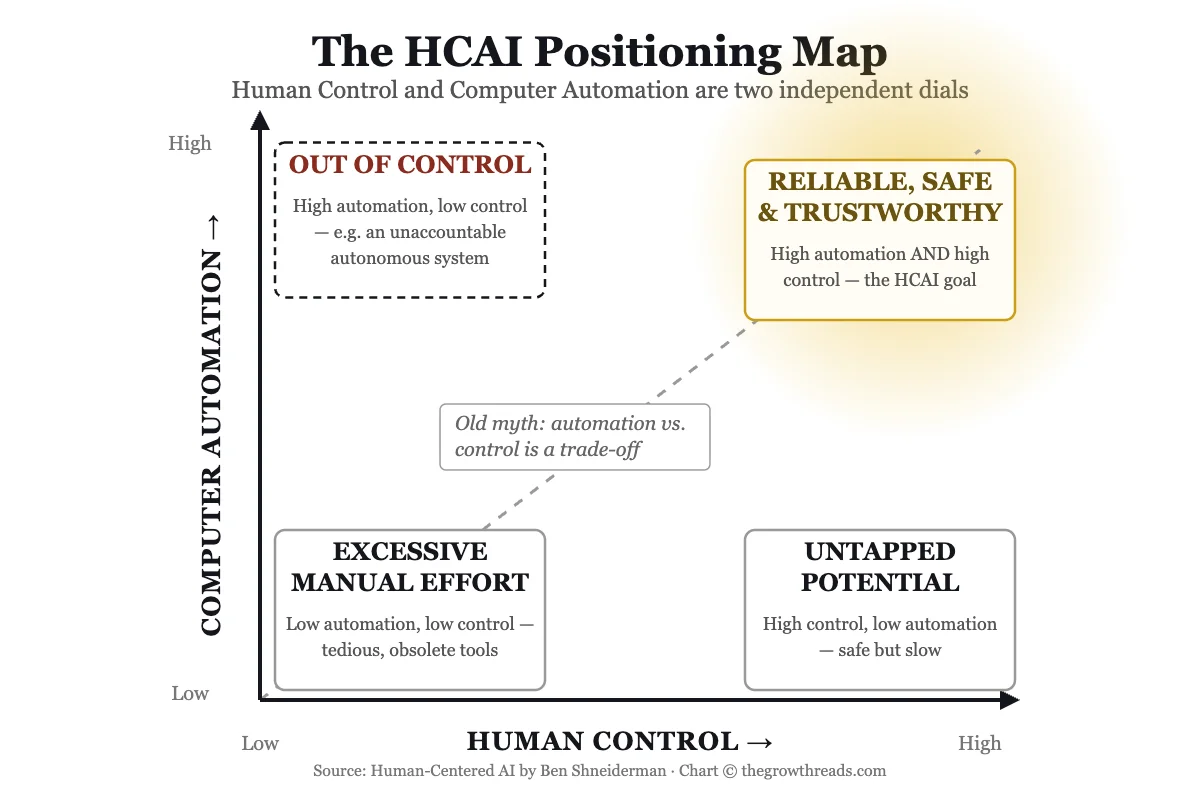
Automation and human control are not opposites — they’re two separate dials, and the best AI systems turn both up at once. That’s the core claim of Human-Centered AI, University of Maryland HCI pioneer Ben Shneiderman’s 2022 book. Most conversations about AI treat “more automation” and “more human control” as a seesaw. Shneiderman, who spent decades studying how humans actually use interfaces, argues this is a false choice: a well-designed AI system can be highly automated and keep a human meaningfully in charge — visible status, predictable behavior, a fast override, and a clear audit trail. The book maps out a two-dimensional design space, concrete interface guidelines, and a three-layer governance model (reliable, safe, and trustworthy) for getting there. It’s less a manifesto about what AI might become and more a field guide for the choices teams make this quarter.
Key takeaways
- Two independent dials: human control and computer automation aren’t a trade-off — you can raise both at the same time.
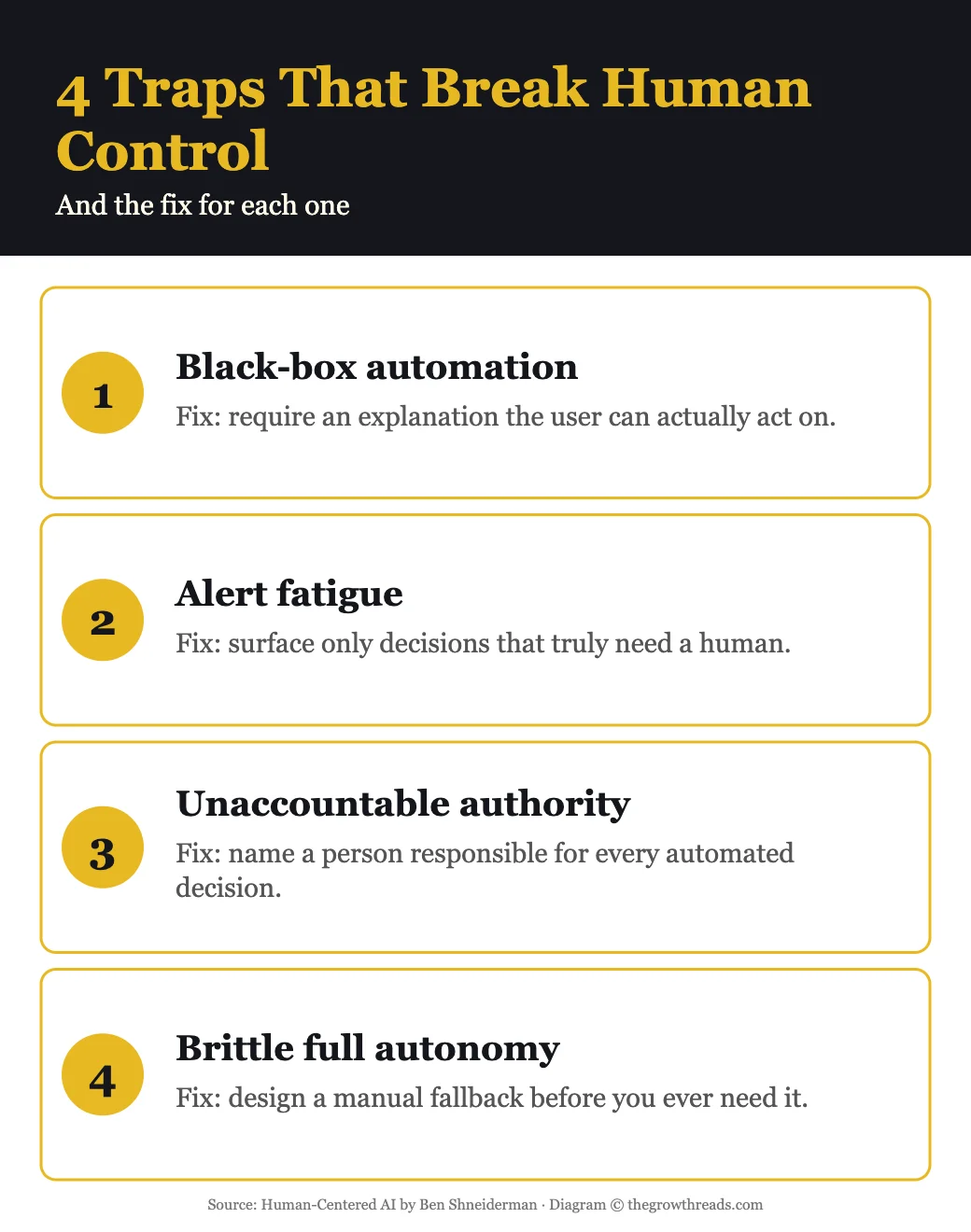
- The black-box trap: high automation with low human control produces systems no one can question, explain, or safely override.
- The excessive-control trap: low automation that leaves people doing manual work a tool could safely handle just wastes automation’s upside.
- Reliable, safe, trustworthy (RST): good governance needs three layers — sound engineering, an organizational safety culture, and independent outside oversight.
- Interface basics still apply: visible automation status, predictable behavior, and a one-click override make AI usable, not just powerful.
- Explanations must be actionable: a technically correct explanation is worthless if the user can’t actually do anything with it.
- Audit trails turn risk into asset: logging what a system did and why is what makes a post-incident fix possible at all.
- Trustworthy is the layer teams skip: certification, insurance, and independent review rarely get budget — and that’s exactly where trust breaks down.
- Start small, this week: pick one automated tool your team already uses and audit it against the two-dial framework before adding a new one.
What is Human-Centered AI about?
Human-Centered AI (2022) argues automation and human control aren’t opposites — the best AI systems maximize both at once. Drawing on decades of interface-design research, it offers a practical framework and concrete guidelines for building AI that is reliable, safe, and trustworthy while keeping people meaningfully in charge of the outcome.
About the author
Ben Shneiderman is an Emeritus Distinguished University Professor of Computer Science at the University of Maryland, where he founded and directed the Human-Computer Interaction Laboratory from 1983 to 2000. He’s best known for the “eight golden rules” of interface design — a set of principles, refined over decades, for building software people can predict, trust, and control. He’s a Fellow of the AAAS, ACM, IEEE, and the Visualization Academy, and a member of the U.S. National Academy of Engineering. Human-Centered AI extends that lifelong project into the AI era: it applies the same rigor that shaped clickable web links and touchscreen keyboards to the much harder problem of keeping humans in control of systems that can act on their own. Explore all Ben Shneiderman book summaries →
Key concepts at a glance
| Concept | What it means | Use it when |
|---|---|---|
| Two-dimensional design space | Human control and computer automation plotted as independent axes, not one seesaw | Evaluating any AI tool or feature before you ship it |
| Black-box automation trap | High automation with low human control — decisions no one can explain or override | You spot a system that can’t be questioned or paused |
| Excessive human control trap | Low automation that leaves people doing manual work the tool could safely handle | A tool keeps asking for approval on trivial, low-risk actions |
| Reliable, safe, trustworthy (RST) | Three governance layers — sound engineering, safety culture, independent oversight | Setting policy for how AI gets built and deployed on your team |
| Actionable explanations | An explanation a user can actually act on, not just a technical justification | Designing or choosing an AI feature that affects real decisions |
| Audit trail | A record of what an automated system did, and why | Any AI system making consequential or hard-to-reverse decisions |
| Eight golden rules, updated | Classic interface guidelines — consistency, feedback, error recovery — applied to AI | Reviewing the UX of an AI product before launch |
Part 1: The Two Traps — Why Automation and Control Aren’t Opposites
Shneiderman opens with a metaphor: the ancient clash between Aristotle’s rationalism and da Vinci’s empiricism. Most AI discourse inherits Aristotle’s framing — optimize the algorithm, and human oversight is friction to engineer away. Shneiderman’s counter-argument, built from decades of watching real people use real interfaces, is that oversight isn’t friction. It’s what makes automation safe enough to use at scale.
He formalizes this as a two-dimensional design space: human control on one axis, computer automation on the other, both running low to high. The old intuition treats this as a single diagonal line — more of one means less of the other. Shneiderman rejects that entirely. A thermostat is low automation, high control. A landmine is high automation, near-zero control. Between those extremes sit two traps that matter more in practice than either pure corner.
The first is excessive automation — the “black box” problem: a system makes consequential decisions with no visible reasoning, no override, and no one accountable when it’s wrong. Shneiderman’s go-to caution is aviation’s documented history of pilots losing manual flying skill because autopilot handled everything, then struggling when a rare failure demanded exactly that skill. The second, less-discussed trap is excessive human control — a tool so cautious it interrupts constantly for approvals a machine could safely make on its own. This is the trap most workplace tools actually fall into: an approval dialog for every trivial action, a macro still triggered by hand every day.
The productive move is to stop treating “more oversight” as the safe default and “more automation” as the risky one. Instead: identify which decisions are safe to fully automate (low stakes, reversible, well-understood) and which need a human checkpoint (high stakes, hard to reverse, judgment-dependent) — then design each one deliberately, rather than picking one automation level for an entire tool.
TGR Note: This “two dials, not one seesaw” idea pairs well with Human + Machine‘s “missing middle” argument — Daugherty and Wilson also reject the idea that humans and machines are competing for the same job, just from an organizational-design angle rather than an interface-design one. If you want the everyday, conversational version of “keep the human meaningfully involved,” Co-Intelligence covers similar ground with more day-to-day prompting habits and less formal framework.
Part 2: Design Guidelines for Keeping Humans in Control
The second part is the most immediately usable: concrete guidelines for building or choosing AI tools that avoid both traps, updating Shneiderman’s own “eight golden rules” of interface design — decades-old principles about consistency, feedback, and error recovery, applied to systems that now make probabilistic, sometimes-wrong decisions.
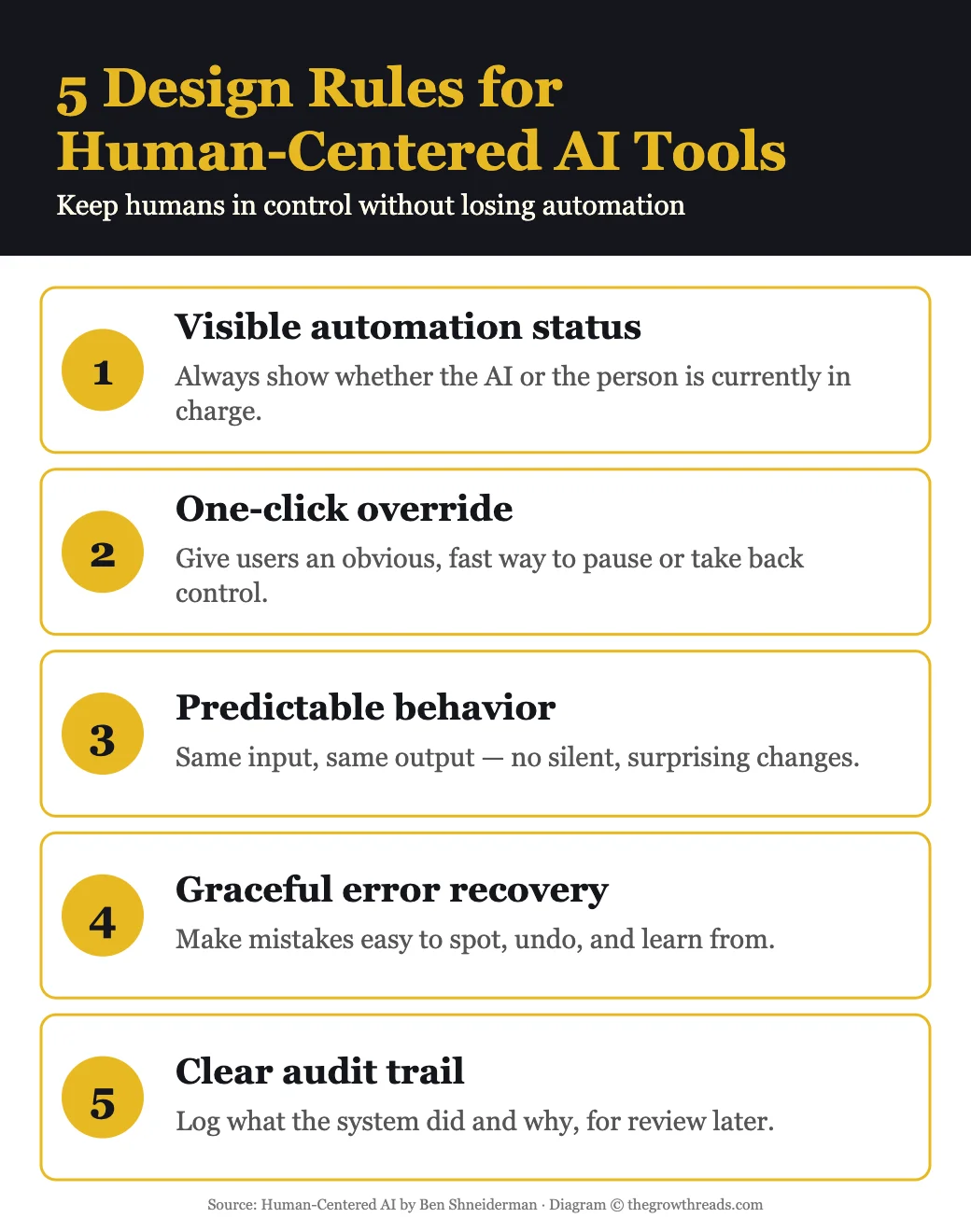
The first guideline is visible automation status: a user should always be able to tell whether they or the AI is currently driving — ambiguity is where trust breaks, like a navigation app silently rerouting with no “recalculating” signal. The second is predictable behavior: the same input should produce the same category of output without silent, unannounced changes in reasoning, which is why Shneiderman treats change logs and versioning as a design requirement.
The third, and arguably most-violated in real products, is a genuine one-click override: a fast, obvious way to pause automation, not buried three menus deep. The fourth is actionable explanations. Shneiderman is sharply critical of “explainable AI” that produces technically accurate but useless output — a confidence score that tells a user nothing about what to do differently. A good explanation names the specific factors that drove a decision: not “87% confidence,” but “flagged because the amount exceeds your usual weekly spending by 4x.”
The fifth is graceful error recovery — making it easy to spot a mistake, undo it, and understand why, rather than requiring the user to already suspect something’s wrong. Together these five guidelines separate an AI feature people trust enough to rely on daily from one they quietly abandon within a month.
TGR Note: If you lead a team choosing between AI tools rather than building one, The Algorithmic Leader is the useful companion read — Mike Walsh’s decision-rights framework maps almost directly onto Shneiderman’s “which decisions get automated” question, just written for a management audience instead of a design one.
Part 3: Reliable, Safe & Trustworthy — Governance Beyond the Interface
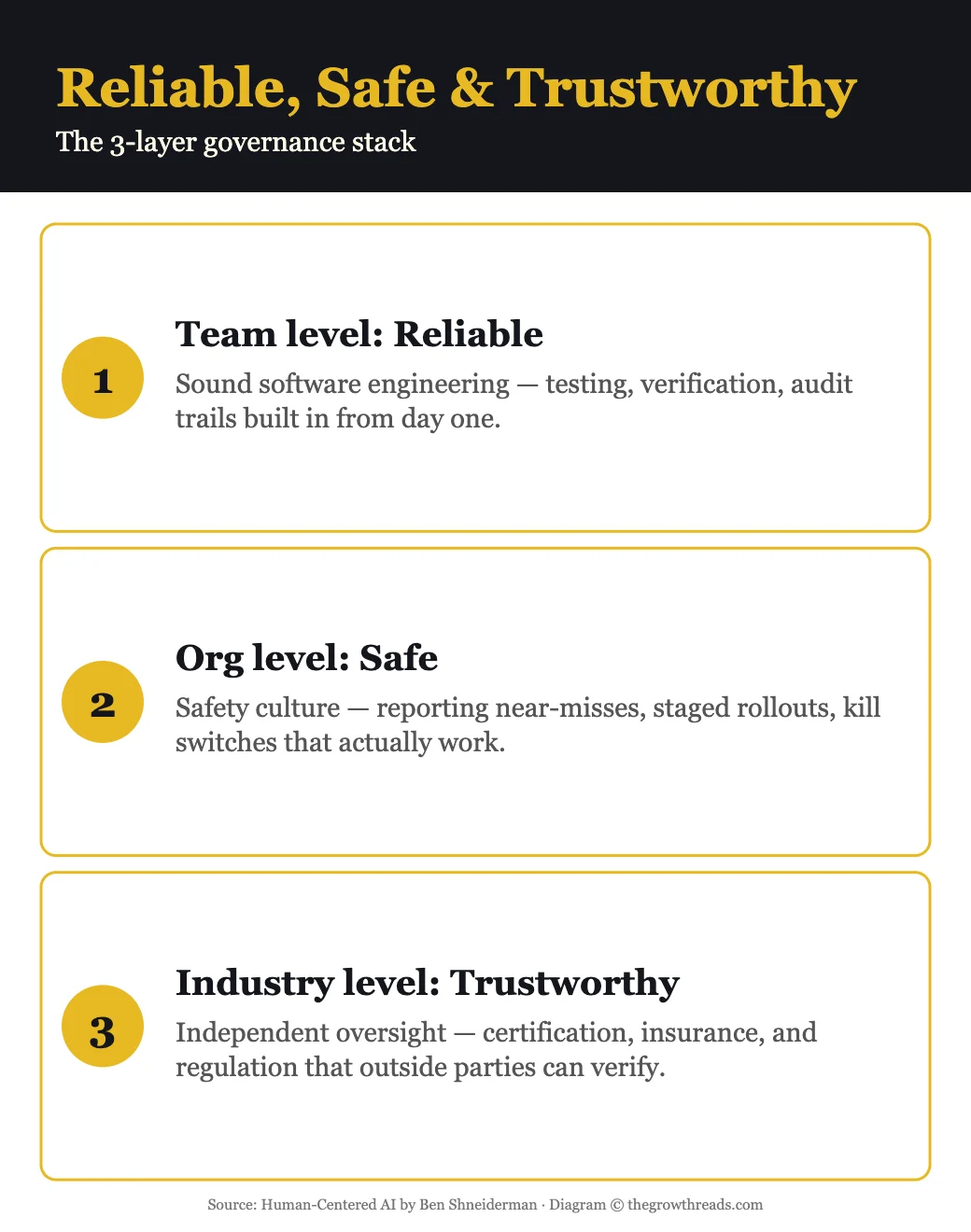
Good interface design isn’t sufficient on its own — Shneiderman’s third pillar is governance, structured as three layers mapping roughly onto team, organization, and industry. The team layer is reliable: standard software-engineering discipline — testing, staged rollouts, verification against known-good baselines — applied specifically to the parts of a system that make autonomous decisions, where a silent regression is far harder to catch than a crashed page.
The organizational layer is safe: a culture where near-misses get reported rather than buried, a kill switch exists and has actually been tested, and staged rollouts are the default for any new automated feature. Shneiderman draws an explicit parallel to aviation and medicine, both of which built safety cultures around mandatory incident reporting long before AI existed — a “safety culture” is an organizational habit, not a feature you bolt on.
The industry layer is trustworthy, and it’s the one Shneiderman argues gets skipped most often: independent certification, insurance that prices AI risk, and external audits a company can’t self-report its way past. This is uncomfortable, because real accountability then sits outside the org chart — but trust an organization asserts about itself is worth much less than trust a credible outside party has verified.
Put together, these three layers explain why a well-designed interface still isn’t enough: a beautifully built override button means little if the organization has no process for acting on what it reveals, and no outside party checking that the process is real.
TGR Note: Superminds approaches a related question from the opposite direction — not how to govern one AI system, but how groups of people and computers organize themselves as a collective. Read together, the two books cover both ends of the human-AI governance question: the single system, and the network of systems and people around it.
Part 4: Applying HCAI at Work — From Individual Habits to Team Policy
The final part turns the framework toward daily use, at three scales. Individually, audit every AI tool you rely on rather than just adopting it: where does it sit on the two-dimensional map, does it explain itself usefully when wrong, and can you override it in under ten seconds. Most people never ask this about the small tools they use daily — a scheduling assistant, a spam filter, autocorrect — precisely because those feel too small to interrogate. Habits formed there generalize to how you evaluate bigger tools later.
At the team scale, build a lightweight audit trail into any workflow with an automated decision step, even an informal one — what got automated, what got flagged, and how often the flag mattered. This is less compliance theater than a recalibration tool: a checkpoint that hasn’t caught a real problem in six months is evidence the automation dial can move higher.
At the organizational scale, treat the “trustworthy” layer as a real budget line, not an afterthought — someone responsible for independent review, a documented incident-reporting process, and a genuinely tested kill switch for anything customer-facing. None of this needs an enterprise AI program to start; a two-person team can keep an audit log in a shared doc and already be more accountable than one with none.
TGR Note: The AI-First Company is the natural next read if you’re building this out at company scale — Ash Fontana’s data-network-effect framework is squarely about the organizational and team layers Shneiderman describes here, with more emphasis on the business case for getting them right.
Who is Human-Centered AI best for — and who should read something else first?
This book is best for people who make real decisions about AI tools: engineering and product managers choosing what to automate and how much oversight to build in, designers working on AI-facing interfaces, and team leads setting policy for how their group uses AI day to day. Its academic register and dense citation style reward readers who want the underlying research, not just the takeaways.
If you want a more conversational, habit-building introduction to working alongside AI day to day, start with Co-Intelligence instead. If your interest is specifically organizational redesign around AI rather than interface and governance design, Human + Machine is the better entry point. And if you’re a leader more focused on strategic decision rights than on design guidelines, start with The Algorithmic Leader.
Questions to reflect on
- Pick one AI tool you use daily — where does it actually sit on the human-control × automation map, and is that where you’d choose to put it?
- Which decision in your workflow is currently over-automated, with no easy override, versus under-automated, with too much manual approval friction?
- If your team’s most-used automated tool failed silently tomorrow, would you find out from the audit trail — or from a customer complaint?
- Whose job is “trustworthy” oversight on your team right now — and if the honest answer is no one’s, what’s the smallest first step?
- What’s one explanation your current tools give you that’s technically accurate but practically useless — and what would an actionable version look like?
🔥 Ready to build AI you can actually trust?
Get the full framework, guidelines, and case studies in Human-Centered AI.
How to apply Human-Centered AI (7-day plan)
- Day 1: List every AI-assisted tool you personally use in a normal work week — even small ones like autocorrect or a scheduling assistant.
- Day 2: Pick your three most-used tools and place each on the human-control × automation map from memory.
- Day 3: For each of those three, time how long it actually takes to override or undo an automated action. Flag anything over ten seconds.
- Day 4: Find one tool that gives you a technically accurate but practically useless explanation, and write down what an actionable version would say instead.
- Day 5: Start a simple shared log for one team workflow: what got automated, what got flagged, whether the flag mattered.
- Day 6: Ask who on your team owns “trustworthy” oversight for your main AI tools. If no one does, name a temporary owner.
- Day 7: Pick one over-automated or over-controlled tool from Day 2 and propose one concrete change to move it toward the reliable-safe-trustworthy zone.
Frequently asked questions
What is human-centered AI, in simple terms?
Human-centered AI (HCAI) is an approach to building AI systems that maximizes both automation and human control at once, instead of treating them as a trade-off — highly capable tools that still give people visibility into what’s happening, a fast override, and a clear record of decisions. Shneiderman coined the term to push back on the assumption that more autonomous AI necessarily means less human oversight.
Is Human-Centered AI anti-automation?
No — the goal isn’t less automation, it’s better-designed automation. Shneiderman is critical of both the “black box” trap of unaccountable full automation and the “excessive control” trap of tools too cautious to be useful. The book welcomes high automation as long as it’s paired with visible status, predictable behavior, actionable explanations, and a real override. The argument is about how automation gets built, not whether it should exist.
What are the “eight golden rules” and how do they relate to this book?
A set of interface-design principles Shneiderman developed over decades — covering consistency, feedback, error handling, and user control — first published in his textbook Designing the User Interface. Human-Centered AI applies and updates these same principles for AI systems, where behavior is probabilistic and sometimes wrong in ways deterministic software isn’t, making predictable behavior and graceful error recovery even more important.
What does “reliable, safe, and trustworthy” actually mean in practice?
Shneiderman’s three-layer governance model. Reliable is a team-level property, achieved through standard engineering discipline like testing and staged rollouts. Safe is organizational — a genuine safety culture with incident reporting and tested kill switches. Trustworthy is industry-level, established through independent certification, audits, and insurance that outside parties can verify, rather than something a company asserts about itself.
Is this book technical, or accessible to non-engineers?
It’s written for a broad professional audience — designers, product managers, policymakers, researchers — rather than as a hands-on engineering manual. There’s no code, and the concepts are explained in plain language with real product examples. That said, it’s a substantial, well-cited academic-style book (416 pages), so readers wanting a lighter read may prefer a more conversational title first and return to this one for the framework.
How does this compare to general “AI ethics” books?
Most AI ethics writing focuses on principles — fairness, accountability, transparency — at a fairly abstract level. Human-Centered AI is more design-and-engineering focused: concrete interface guidelines and a governance structure you can apply to a specific product decision this week, rather than values to aspire to. It complements ethics-focused reading rather than replacing it.
What’s the single most useful idea to take from this book if I only remember one thing?
That automation and human control are two independent dials, not one seesaw — so the question for any AI tool isn’t “how much should we automate,” it’s “where on both dials should this decision sit, and can we verify it’s there.” Instead of asking whether AI should be trusted in general, you ask whether this particular automated decision has visible status, a real override, and an audit trail.
Related summaries
- Human + Machine — Paul R. Daugherty & H. James Wilson
- The Algorithmic Leader — Mike Walsh
- Superminds — Thomas W. Malone
- Co-Intelligence — Ethan Mollick
- See all Best AI & Technology Books
How we analyze books: every TGR summary is built from a full read of the source material, cross-checked against the author’s published essays and interviews, and structured around practical application rather than just a chapter recap. We never critique a book’s ideas here — our job is to help you decide if it’s the right read for you and get value from it faster. Read our full methodology.
Related Technology Summaries
Nexus Summary & Review: Why More Information Doesn’t Mean More Truth
Novacene Summary & Review: Why AI Might Save Earth, Not Destroy It
Our Final Invention Summary & Review: Is Superintelligent AI a Genuine Threat?
Rebooting AI Summary & Review: Why Deep Learning Alone Won’t Get Us to Trustworthy Machines
Weapons of Math Destruction Summary & Review: How Algorithms Quietly Punish the Poor