

★★★★★ 4.6/5 — A landmark, unsettling map of how everyday life became raw material for a new kind of economy.
Best for: Curious, critical readers who want to understand the business logic behind the apps and platforms they use every day.
Reading time: ~11 hours for the full book · ~15 minutes for this summary.
Difficulty to apply: Moderate — the ideas are dense, but the practical takeaways are simple, everyday habits.
The Age of Surveillance Capitalism in one minute
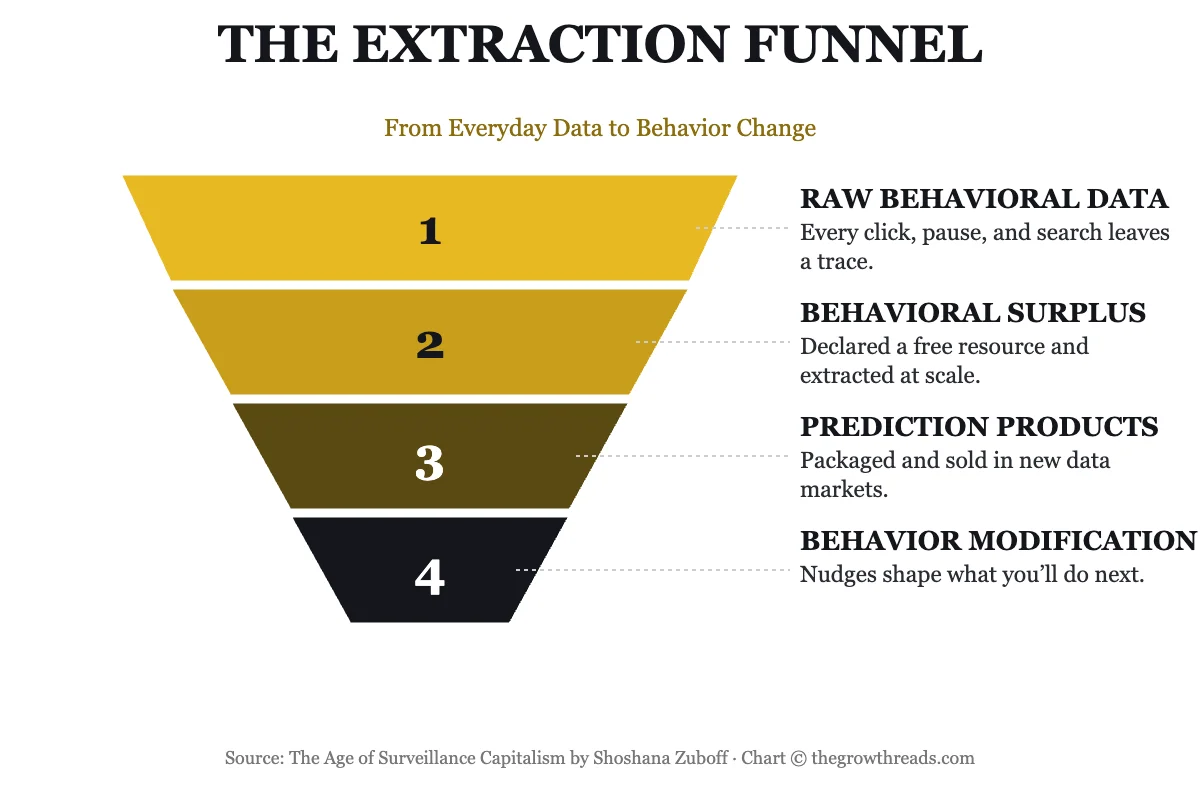
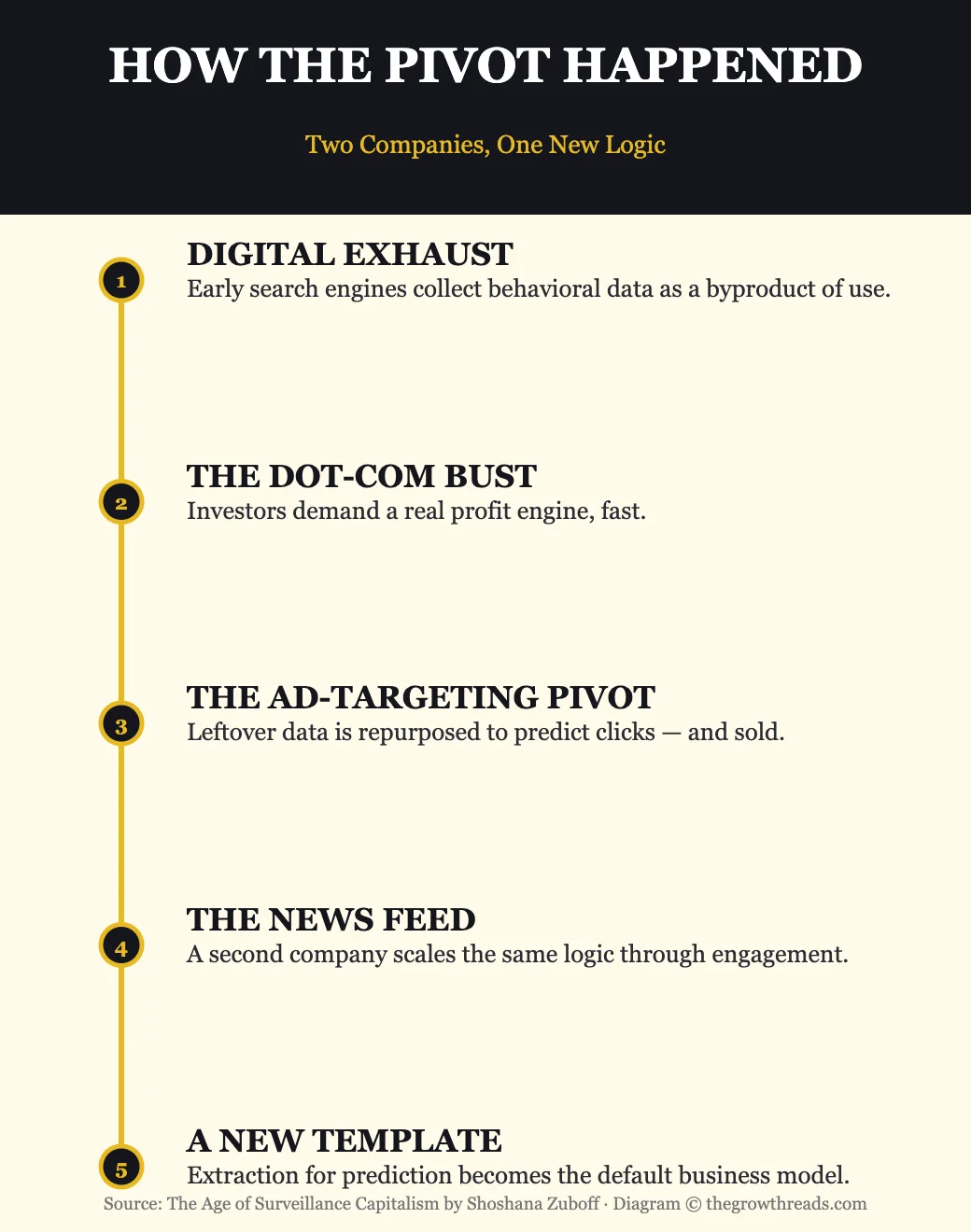
Every time you use a free app, you are the raw material, not just the customer. Shoshana Zuboff’s sweeping book argues that a new economic logic, surveillance capitalism, has quietly become the default operating system of the internet. It began with a discovery inside Google in the early 2000s: the data left over after a search was answered, the “digital exhaust” nobody thought was valuable, could predict what a person would click next. That leftover data, or behavioral surplus, turned out to be worth more than the search itself. Google packaged it into prediction products and sold access to advertisers. Facebook copied and scaled the model through the News Feed. Within a decade, “free” services across the internet were built on the same logic: collect behavioral data, predict behavior, and increasingly, shape it. Zuboff’s warning is that this isn’t just a privacy problem, it’s a new form of power that treats human experience as a resource to be mined, and gradually shifts from watching what people do to engineering what they’ll do next.
Key takeaways
- Surveillance capitalism claims human experience as free raw material: the way industrial capitalism treated nature as a free resource, this logic treats your clicks, location, and voice as data to be extracted.
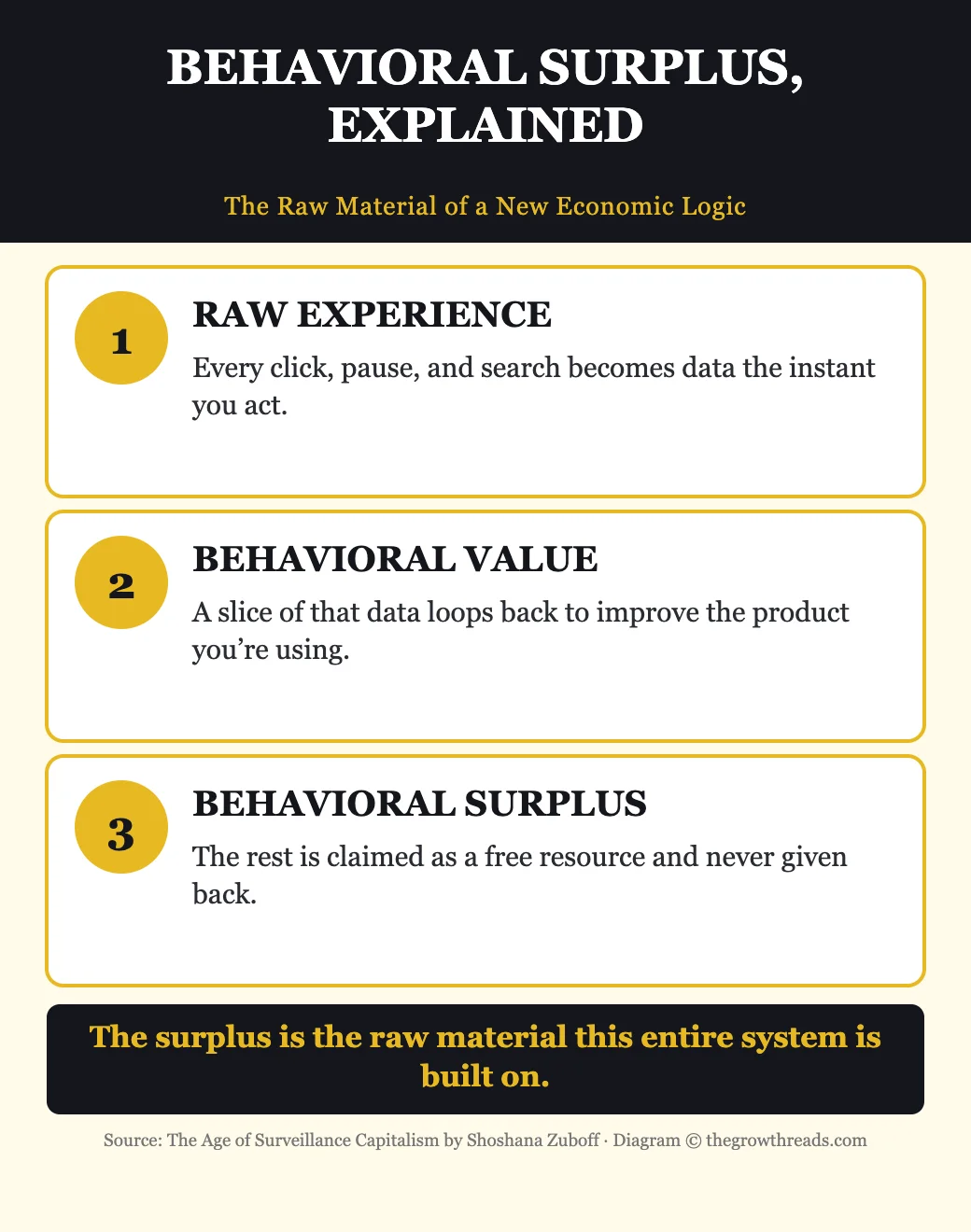
- Behavioral surplus is the real product: only a small slice of collected data improves the service you’re using. The rest, the surplus, is what gets sold.
- Prediction is the business: that surplus becomes prediction products forecasting what you’ll do, feel, or buy next, sold in new markets trading in human futures.
- Google discovered the model by accident: facing pressure to profit after the dot-com bust, engineers realized leftover search data could power far more precise advertising.
- Facebook scaled it through engagement: the News Feed’s algorithm was tuned to maximize time on-site, turning social connection into a rich new data source.
- Watching became shaping: Zuboff traces a shift from surveillance to instrumentarian power — using subtle design to actively nudge behavior toward profitable outcomes.
- It hides in plain sight: most of this operates through consent agreements nobody reads and interfaces designed to feel convenient rather than extractive.
- Individual privacy settings aren’t enough: since the business model depends on extraction, opting out of one feature rarely changes the underlying incentives.
- Zuboff calls for collective, not just personal, action: new laws and public pressure, not just better habits, are what she argues can meaningfully push back.
- The stakes are autonomy and democracy: a business model that profits from predicting and steering behavior at scale threatens free will and the shared reality democracy depends on.
What is The Age of Surveillance Capitalism about?
The Age of Surveillance Capitalism is Shoshana Zuboff’s account of how Google and Facebook pioneered a new economic logic that treats human experience as free raw material for data extraction. It traces how “behavioral surplus” becomes prediction products, sold in new markets, and warns that this business model increasingly aims to shape, not just study, human behavior.
About the author
Shoshana Zuboff is Professor Emerita at Harvard Business School, where she spent decades studying the intersection of technology, capitalism, and power. Long before surveillance capitalism became a mainstream concern, she wrote about how digital technology reshapes work and society, examining the rise of the “smart machine” in the workplace and the promise of a more human-centered digital economy. That early optimism curdled into alarm as she watched Google and Facebook build business models around extracting and monetizing human behavior at scale. The Age of Surveillance Capitalism, published in 2019, took nearly a decade to research, drawing on economics, psychology, law, and the history of capitalism itself. It became a New York Times bestseller and a touchstone reference for journalists, regulators, and technologists debating the ethics of the modern data economy. Explore all Shoshana Zuboff book summaries →
Key concepts at a glance
| Concept | What It Means | Use It When |
|---|---|---|
| Behavioral surplus | The extra behavioral data collected beyond what’s needed to run the service — the raw material of the whole system. | You’re asked to trust that data collection is “just to improve your experience.” |
| Prediction products | Packaged forecasts of what a person will do, feel, or buy next, built from behavioral surplus. | You want to understand what’s actually being sold behind a targeted ad. |
| Behavioral futures markets | New marketplaces where businesses buy and sell predictions about human behavior. | You’re evaluating why so many “free” products exist. |
| Instrumentarian power | Power that works by subtly shaping behavior through design and incentives, rather than by force or persuasion alone. | You notice a product seems built to keep you engaged rather than served. |
| The “Big Other” | Zuboff’s term for the pervasive, always-on sensing environment created by connected devices and platforms. | You’re mapping how many devices and apps are quietly gathering data around you. |
| Radical indifference | Treating human experience purely as a data source, without regard for its personal meaning. | You want language for why data collection can feel dehumanizing even when “harmless.” |
| The right to the future tense | The idea that people deserve genuine, undetermined choices about their own future actions. | You’re thinking about what’s really at stake beyond privacy alone. |
Part 1: The Origins — From Behavioral Value to Behavioral Surplus
Zuboff opens with an origin story that reads less like a grand conspiracy and more like an accident that hardened into a business model. Google launched with a promise to put users first and stay clear of the advertising-driven compromises that had corrupted earlier media. But after the dot-com crash, investors ran out of patience for a company that hadn’t turned its popularity into revenue. Engineers noticed something in the pressure: the data left behind by every search, not just the query but the clicks and pauses, carried a signal. Used in aggregate, it could predict which ads a person was likely to click.
That discovery split data into two categories. A slice, what Zuboff calls behavioral value, flowed back into the product to improve search results. But the rest, the leftover signal with no obvious use for the service, wasn’t discarded. It became behavioral surplus: raw material quietly declared a free resource, much the way industrial capitalism treated forests and land as free inputs to exploit. Google turned that surplus into a genuinely new product, a prediction of what a person would do next, and sold access to it through an advertising auction. AdWords made this concrete and wildly profitable, giving Google a business model that didn’t depend on charging users a cent.
The bargain looked, on the surface, like a fair trade: a free, useful service in exchange for some advertising. Zuboff argues the real trade was far more one-sided. Users never negotiated over how much of their behavior would be extracted or who would profit. The exchange happened invisibly, buried in terms of service nobody read, and what was collected kept expanding — search terms gave way to location, browsing history, and eventually behavior far beyond anything resembling “search.” What began as a way to fund a free product became the blueprint for a new economic logic that spread across the industry.
TGR Note: If this fascinates you, Atlas of AI by Kate Crawford picks up a related thread, tracing the hidden physical and human infrastructure behind large-scale data extraction.
Part 2: Scaling the Machine — Facebook and the Reality Business
If Google discovered surveillance capitalism, Zuboff argues Facebook perfected its most aggressive form. The News Feed gave the company something Google’s search box never had: a reason for people to keep scrolling indefinitely, generating a continuous stream of behavioral data. Facebook’s engineers tuned the algorithm to maximize engagement — time on-site, clicks, shares, reactions — because engagement meant more data and more ad opportunities. The content that spread fastest wasn’t necessarily the most accurate; it was whatever kept people scrolling, a dynamic that later drew scrutiny for amplifying outrage and misinformation.
Zuboff details how Facebook, like Google before it, expanded its reach far beyond its own app through social login buttons and embedded “Like” widgets scattered across the web, each quietly reporting behavior back to the platform. She calls the resulting sensing environment the “Big Other,” a pervasive, always-on data-collection apparatus surrounding ordinary life once smartphones and connected devices are added in. It isn’t one company; it’s an ecosystem of platforms competing to extract ever more granular surplus, each normalizing the next company’s more invasive version of the same idea. What started as one company’s advertising insight became, within about a decade, the default business model for a huge share of the consumer internet.
TGR Note: For an insider account of this scaling logic inside one company, Empire of AI by Karen Hao examines OpenAI’s rise and the costs behind today’s AI boom.
Part 3: From Watching to Shaping — Instrumentarian Power
The most unsettling turn in the book is Zuboff’s argument that surveillance capitalism doesn’t stop at watching. Once a company can predict behavior with confidence, the next incentive is to improve the prediction by nudging the outcome, subtly shaping what a person does so the forecast comes true more often. Zuboff calls this instrumentarian power: influence that works through the design of the environment itself rather than persuasion or coercion. A notification timed to catch you at a vulnerable moment, a feed order tuned to keep you engaged, a default quietly pre-selected toward more data — none of these announce themselves as an attempt to change your behavior, and that’s the point.
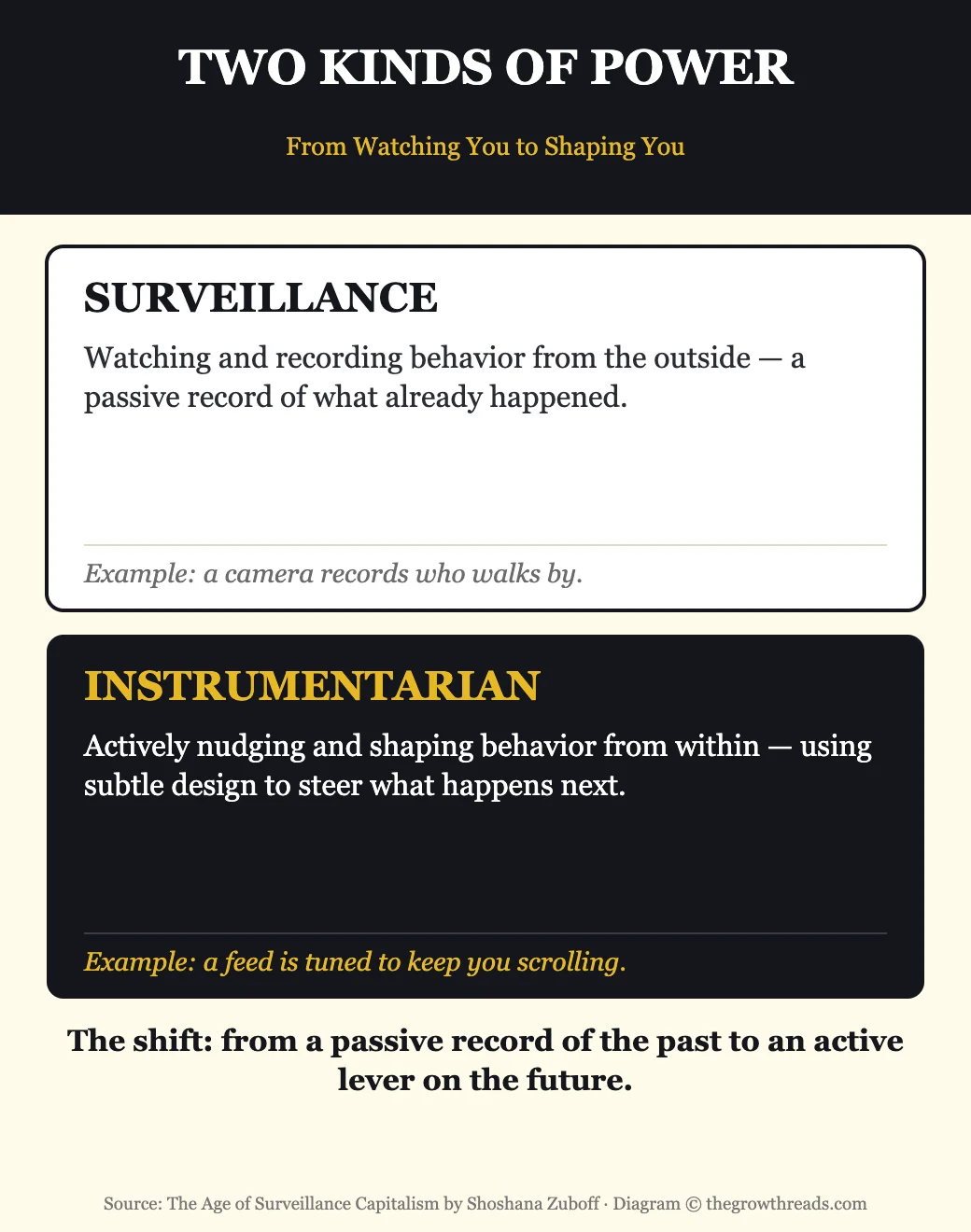
Zuboff draws a sharp line between this and older forms of power. Traditional surveillance, a wiretap, a camera, watches and records, but the record doesn’t act on the world. Instrumentarian power closes that loop: it senses, predicts, and intervenes, continuously, at a scale no human overseer could manage directly. She describes this as operating with “radical indifference” — the system doesn’t care about anyone’s inner life or consent; it cares only about the behavioral signal and how reliably it can be steered toward profit. That indifference, she argues, is what makes the shift dangerous: not malicious like a villain, but treating human autonomy as an inconvenience to engineer around.
TGR Note: Zuboff’s argument that algorithms shape consequential outcomes echoes Weapons of Math Destruction by Cathy O’Neil, on how opaque scoring models reproduce bias at scale.
Part 4: The Fight for a Human Future
Zuboff doesn’t end on pure alarm. The book’s final section argues this pattern isn’t inevitable, it’s a set of choices that can still be reversed. She’s skeptical of solutions that put the burden entirely on individuals, like reading every privacy policy; when the business model itself depends on extraction, isolated opt-outs rarely change the underlying incentives. Instead, she argues for the kind of collective response that has curbed other extractive industries before: new laws, real regulatory oversight, and organized public pressure that changes what companies are permitted to do with behavioral data.
She frames the stakes in terms broader than privacy alone. What’s really at risk is something closer to self-determination — the ability to act without every choice being anticipated and monetized in advance. And because these platforms increasingly shape the information environment democracy depends on, she connects the fight over data extraction to democracy’s health itself: a public sphere run by engagement-maximizing algorithms is a worse foundation for collective decisions than one shaped by open exchange. The book closes as a call to treat this as a public, political problem, not a personal inconvenience managed one settings toggle at a time.
TGR Note: For a skeptical, plain-language toolkit for questioning tech-industry claims day to day, Artificial Unintelligence by Meredith Broussard is a practical complement here.
Who is The Age of Surveillance Capitalism best for — and who should read something else first?
This book rewards readers who want the full intellectual case, not just the highlights — it’s dense, academic in places, and unapologetically long. It’s an excellent fit if you want a rigorous framework for why so much of the internet is free, and you’re willing to sit with detailed argument. If you’d prefer a faster, narrative-driven account of one company’s story, Empire of AI is a more approachable entry point. If your main interest is the infrastructure and labor behind AI, start with Atlas of AI instead. And for practical, skeptical habits without the theory-heavy framing, Artificial Unintelligence is the gentler on-ramp.
Questions to reflect on
- Which apps on your phone do you use most, and do you actually know how they make money?
- Can you name one moment recently when a notification or feed nudged you to do something you hadn’t planned to do?
- If a service is free, what do you think you’re actually paying with?
- Where do you draw the line between a feature that’s genuinely convenient and one that’s designed to keep you engaged?
- What would it take, personally or collectively, for you to trust a platform’s privacy promises?
🔥 Ready to see the machine behind the feed?
Get the full, rigorously researched case, direct from Shoshana Zuboff.
How to apply The Age of Surveillance Capitalism (7-day plan)
- Day 1 — Audit your permissions: check which apps have access to your location, microphone, and contacts. Revoke anything unnecessary.
- Day 2 — Review two ad-personalization settings: pick your two most-used platforms and turn off what you can in “ad preferences.”
- Day 3 — Try a privacy-respecting default: swap your usual search engine or browser for a more privacy-focused alternative for a day.
- Day 4 — Track persuasive design patterns: jot down every time you notice autoplay, infinite scroll, or a notification pulling you back in.
- Day 5 — Skim your own data: look up the data-download option on one major platform and skim what’s actually stored about you.
- Day 6 — Turn off three notifications: pick the three that interrupt you most and disable them for good.
- Day 7 — Decide on one permanent change: choose one setting, habit, or app switch to keep, and tell someone else what you learned.
Frequently asked questions
What is surveillance capitalism, in plain terms?
Surveillance capitalism is Shoshana Zuboff’s term for a business model where companies collect far more behavioral data than they need to run their products, then turn the surplus into predictions about what people will do, feel, or buy. Those predictions become prediction products, sold in new markets, mainly advertising at first. Instead of paying with money, users effectively pay by generating a continuous stream of data about their behavior. Zuboff argues this isn’t just a privacy trade-off, it’s a new economic logic that treats human experience as a free resource to be claimed and sold.
What is behavioral surplus, exactly?
Behavioral surplus is the data collected beyond what’s needed to run and improve a service. If a search engine needs some data to return relevant results, that’s behavioral value. Everything extra, the leftover signal about your habits and preferences, is surplus, and Zuboff argues it’s the true raw material of surveillance capitalism. It feeds machine-learning systems that build prediction products, then gets sold to advertisers, all without most users realizing how much extra data was collected or where it ended up.
Is this book only about Google and Facebook?
Google and Facebook are the book’s central case studies, since Zuboff traces the model’s origin to Google’s advertising pivot and its scaling through Facebook’s News Feed. But her argument covers a broader pattern. She describes how the same logic, collect surplus data, build prediction products, shape behavior, spread across the industry, from smart-home devices to insurance apps, wherever a business found it profitable to extract more behavioral data than a product strictly required.
What does Zuboff mean by instrumentarian power?
Instrumentarian power is Zuboff’s term for influence that works by shaping the environment around a person’s choices rather than through direct persuasion. Instead of arguing with you, a system nudges you, through interface design, notification timing, or default settings, toward behavior that makes its predictions more reliable. She distinguishes it from older surveillance, which mainly watches and records, by noting that instrumentarian power closes the loop: it senses, predicts, and actively intervenes to steer outcomes, continuously and at massive scale.
Is surveillance capitalism the same as government surveillance?
No, Zuboff draws a clear distinction. Government surveillance is generally about state power, often justified around security or law enforcement. Surveillance capitalism is a commercial logic, driven by companies competing for advertising revenue, not a state agenda. That said, she notes the two can become entangled, since governments sometimes buy data or access from commercial platforms rather than building their own surveillance infrastructure. But the book’s core critique targets the private business model, not government policy.
What can I actually do about this as an individual?
Zuboff is candid that individual habits alone can’t fix a business model built around extraction, but she doesn’t dismiss personal action either. Steps like auditing app permissions, turning off ad personalization, and noticing persuasive design patterns build genuine awareness and reduce some exposure. Her bigger point is that lasting change requires collective action too: regulation, public pressure, and organized advocacy that change what companies are permitted to collect and do with behavioral data, rather than leaving every trade-off to individual settings menus.
Is the book difficult to read, and how long is it?
The full book runs roughly 700 pages and is written at an academic register, with arguments drawn from economics, psychology, and the history of capitalism. It rewards patient reading rather than a quick skim, though Zuboff’s prose is more accessible than a typical academic text. If the length feels daunting, this summary captures the core argument and structure, though engaging with the book afterward, even in parts, adds detail a summary can’t fully replace.
Related summaries
- Empire of AI by Karen Hao — an inside account of OpenAI’s rise and the human costs of the AI boom.
- Atlas of AI by Kate Crawford — the hidden physical and human infrastructure behind AI systems.
- Weapons of Math Destruction by Cathy O’Neil — how opaque algorithms can quietly reinforce bias and inequality.
- Artificial Unintelligence by Meredith Broussard — a practical, skeptical toolkit for evaluating tech claims.
Or browse the full Best AI & Technology Books list.
How we analyze books: our team reads the full text, cross-checks key facts and figures, and distills the core arguments into a practical, application-focused summary. We never rank books we haven’t read in full. Read our full methodology.
Related Technology Summaries
Irresistible Summary & Review: The Six-Ingredient Hook Behind Your Habits
Nexus Summary & Review: Why More Information Doesn’t Mean More Truth
Superagency Summary & Review: What Could Possibly Go Right with AI
The Age of Spiritual Machines Summary & Review: Kurzweil’s 1999 Blueprint for the AI Age
You Look Like a Thing and I Love You Summary & Review: What AI’s Funniest Failures Teach Us