

Best for: Anyone who wants to reason clearly about AI hype without needing a computer science degree.
Reading time: ~8 hrs to read the book (this summary: about 15 minutes)
Difficulty to apply: Easy — the payoff is sharper judgment, not a new skill to practice.
Artificial Intelligence in one minute
Today’s AI is far narrower, more brittle, and less “intelligent” than the headlines suggest — and knowing exactly where it breaks is the single most useful skill for using it well. In Artificial Intelligence: A Guide for Thinking Humans, computer scientist Melanie Mitchell walks through how modern AI actually works — from the neural networks behind image recognition to the language models behind chatbots — and shows, again and again, how systems that ace a benchmark can fail on a case a child would handle instantly. Her core argument isn’t that AI is fake or useless; it’s that we keep confusing narrow statistical pattern-matching for general understanding, and that confusion has real costs when these systems get deployed in medicine, hiring, and criminal justice.
Key takeaways
- “Artificial Intelligence” is a moving target: the term has meant different things across seven decades, and today’s deep learning boom is just the latest chapter.
- Deep learning is powerful pattern recognition, not understanding: networks find statistical regularities in data without grasping what the patterns mean.
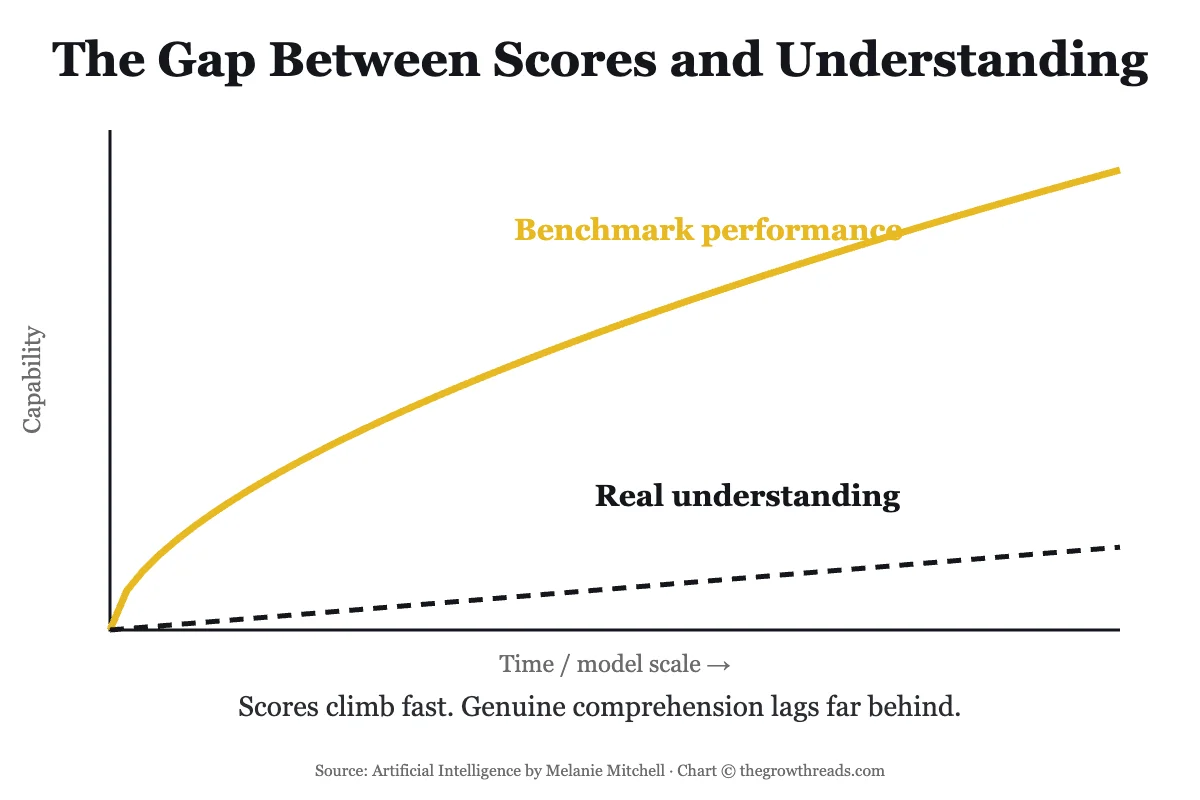
- Benchmarks measure narrow skill, not general intelligence: a system can top a leaderboard while failing on inputs that differ only slightly from its training data.
- Adversarial examples reveal how shallow “vision” can be: a handful of altered pixels, invisible to a human, can flip a confident correct answer into a confident wrong one.
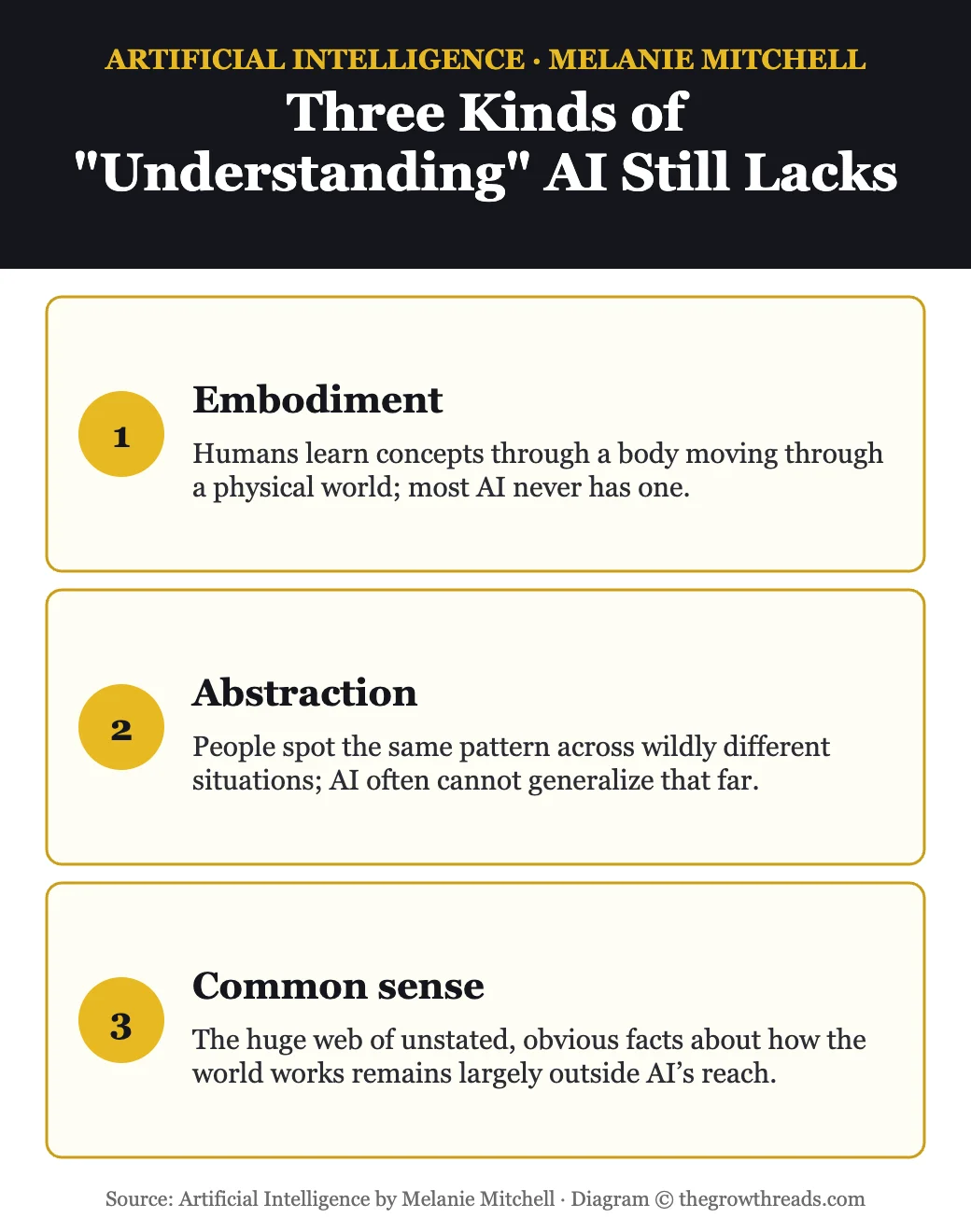
- AI lacks embodiment and common sense: humans learn concepts by moving through a physical world; most AI never has a body or direct experience to learn from.
- Anthropomorphizing AI is a trap: describing a model as “thinking” or “knowing” smuggles in assumptions about understanding the system doesn’t have.
- The “barrier of meaning” is the real frontier: Mitchell argues the hardest unsolved problem in AI isn’t more data or compute, but genuine comprehension of concepts.
- Hype cycles repeat on a predictable schedule: AI has swung between inflated promises and “AI winters” for seventy years, and today’s excitement follows the same pattern.
- Skepticism and enthusiasm aren’t opposites: Mitchell writes as someone who has spent her career in AI research and remains excited about it — while insisting on precision about what it actually does.
What is Artificial Intelligence: A Guide for Thinking Humans about?
The book is Melanie Mitchell’s plain-language explanation of how modern AI actually works and where it falls short of the “intelligence” the term implies. It walks through neural networks, deep learning, and language models, using concrete examples to show the gap between benchmark performance and genuine, human-like understanding.
About the author
Melanie Mitchell is a professor at the Santa Fe Institute and a longtime researcher in artificial intelligence, complex systems, and cognitive science. She studied under AI pioneer Douglas Hofstadter and has spent decades researching how humans and machines form abstract concepts and analogies. Mitchell has written multiple books on complexity science and AI, and her writing is known for making technical material accessible without oversimplifying it. Her hands-on research background — building and testing the kinds of systems she critiques — gives her skepticism real weight; she isn’t an outsider criticizing a field she doesn’t understand, but an insider explaining exactly where the field’s own claims outrun its results. Explore all Melanie Mitchell book summaries →
Key concepts at a glance
| Concept | What it means | Use it when |
|---|---|---|
| Narrow AI | A system built to excel at one specific task, with no ability to generalize beyond it | Evaluating whether a tool will actually handle your real-world edge cases |
| Deep learning | Neural networks that learn statistical patterns from large amounts of data | Understanding what’s really happening behind an “AI-powered” product |
| Adversarial examples | Inputs deliberately crafted to fool a model that otherwise performs well | Stress-testing any AI system before trusting it in a high-stakes setting |
| The barrier of meaning | Mitchell’s term for the gap between pattern recognition and true conceptual understanding | Deciding how much to trust an AI’s stated “reasoning” |
| Common sense | The vast web of everyday facts about the world that humans use without thinking | Predicting where a system is likely to fail unexpectedly |
| Embodiment | Learning concepts through physical experience in the world | Explaining why AI struggles with tasks humans find trivial |
| AI winter | A historical period when AI funding and enthusiasm collapsed after overpromising | Calibrating expectations during a new wave of AI hype |
Part 1: What deep learning actually does
Mitchell opens by demystifying the machinery behind modern AI: layers of artificial neurons adjusting numerical weights until they can reliably map inputs to outputs. She’s careful to strip away the anthropomorphic language that usually surrounds this — a network doesn’t “see” a cat the way you do; it finds statistical correlations between pixel patterns and a label, built from millions of labeled examples. That distinction matters because it explains both deep learning’s remarkable successes and its strange, specific failures.
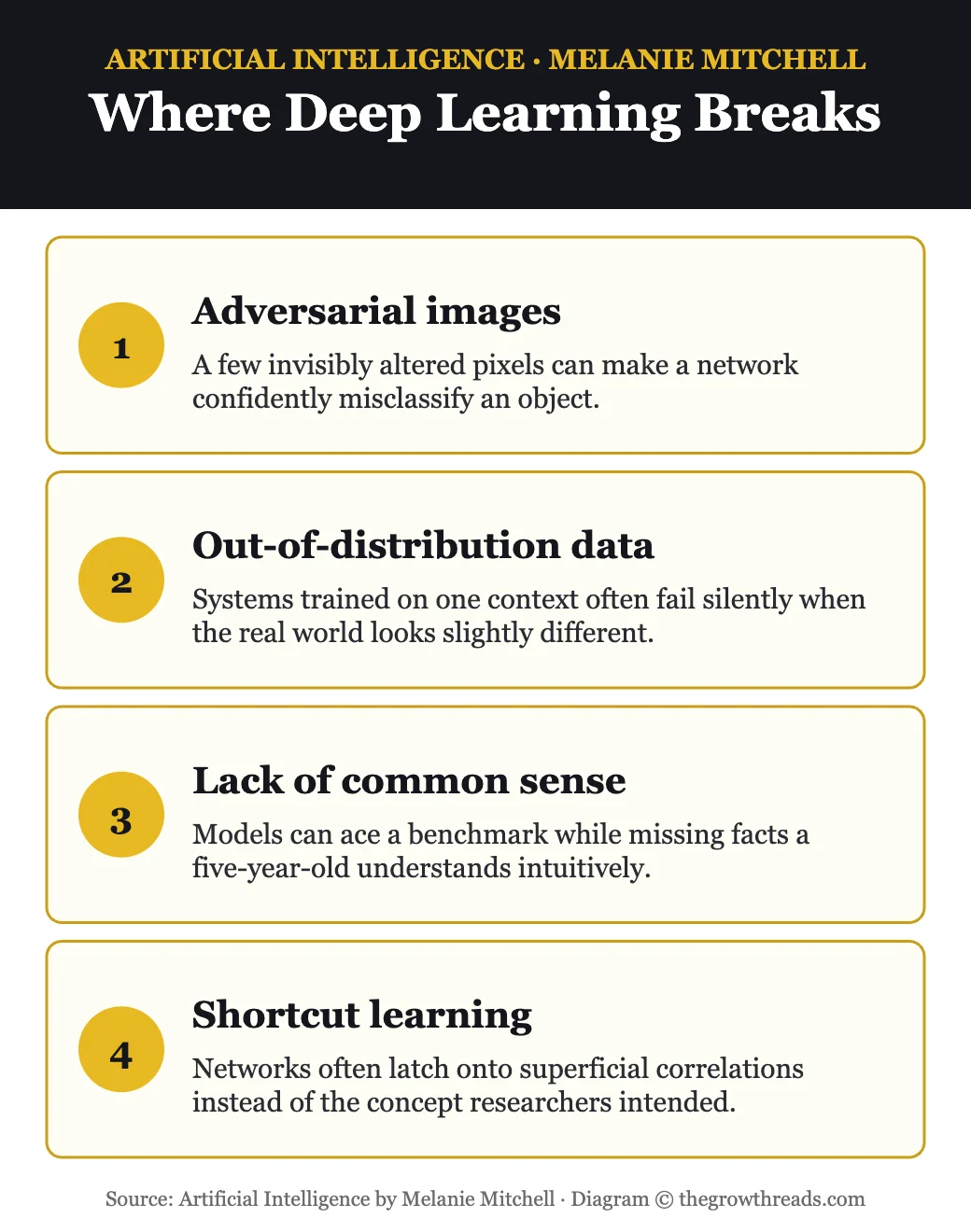
The successes are real: image recognition, speech transcription, and game-playing systems have all reached or exceeded human performance on narrow, well-defined tasks. But Mitchell keeps circling back to a key point — performance on a benchmark is not the same thing as the capability the benchmark was designed to measure. A system can learn to win at a task through a shortcut that has nothing to do with the underlying concept researchers intended to test.
Part 2: Where the cracks show — adversarial examples and brittleness
Some of the book’s most memorable moments come from Mitchell’s tour of adversarial examples: images altered in ways invisible to a human eye that cause a state-of-the-art classifier to confidently misidentify a school bus as an ostrich, or a stop sign as a speed limit sign. These aren’t edge-case curiosities — they reveal that networks are latching onto statistical textures rather than the conceptual features humans use to recognize objects.
This brittleness extends beyond deliberately crafted attacks. Systems trained on one distribution of data — a particular lighting condition, accent, or demographic — often degrade sharply when the real world looks even slightly different from the training set. Mitchell walks through real deployment failures, including facial recognition systems performing far worse on darker-skinned faces and medical AI trained on one hospital’s data failing on another’s, to show these aren’t hypothetical risks.
Part 3: The barrier of meaning
Mitchell’s central theoretical contribution is what she calls “the barrier of meaning” — the idea that the hardest unsolved problem in AI isn’t scale (more data, more compute) but genuine comprehension of concepts. She draws on her own research into analogical reasoning, arguing that human intelligence is built on the ability to form abstractions and transfer them flexibly across wildly different situations — recognizing that a chess opening and a military campaign share a strategic structure, for instance. Current AI systems, however impressive their outputs, generally cannot do this kind of flexible transfer; they excel within the statistical neighborhood of their training data and struggle the moment they step outside it.
This section also tackles the role of embodiment: the idea that human concepts are grounded in having a body that moves through physical space, feels consequences, and builds intuition from direct experience. Most AI systems learn only from text or images, secondhand, with no equivalent grounding — which may explain why they can describe physical common sense they don’t actually possess.
Part 4: Living with AI’s real limits
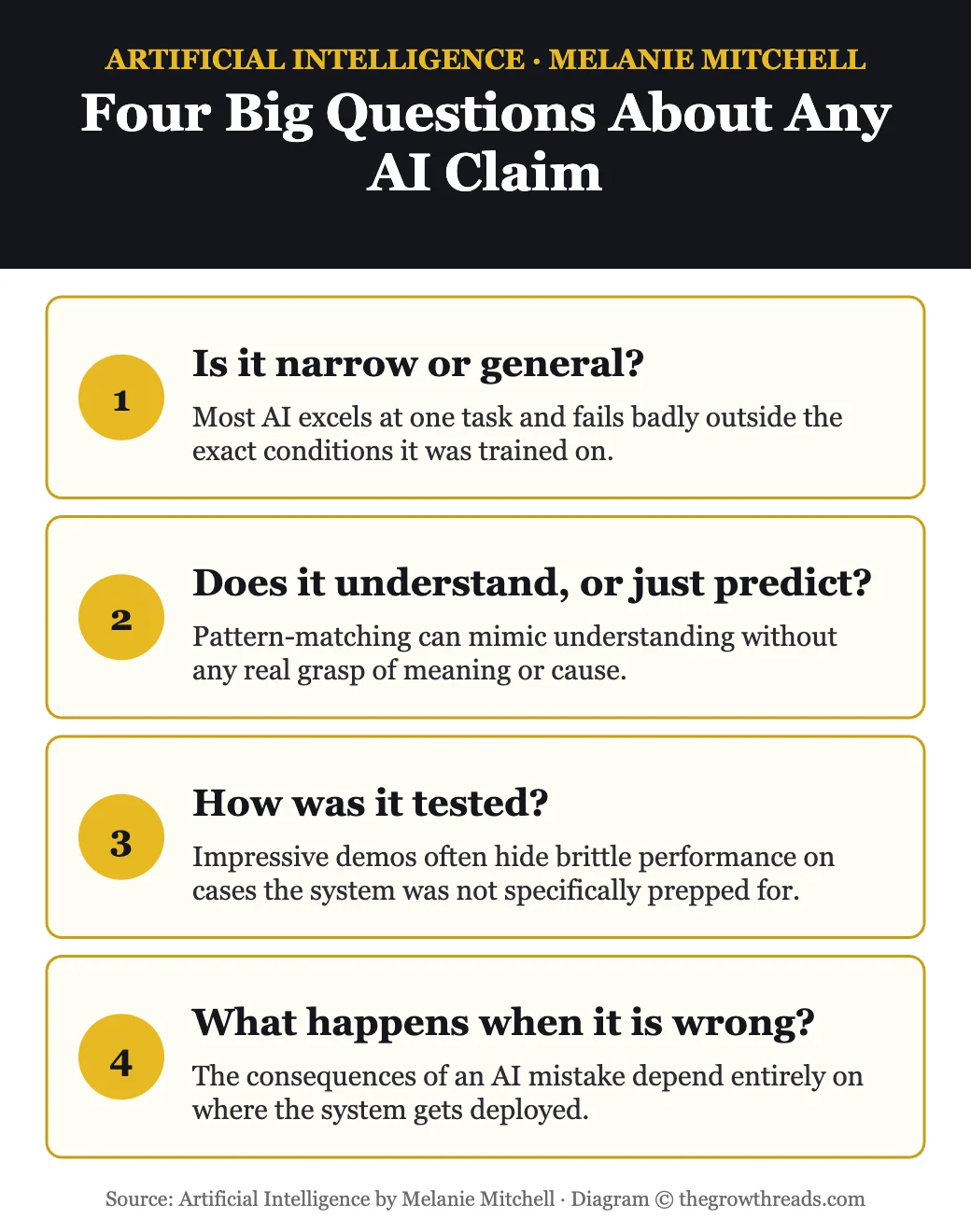
The book closes by placing today’s AI boom inside a longer history of hype cycles and “AI winters” — periods when overpromising led to funding collapses and public disillusionment. Mitchell isn’t predicting another winter, but she is urging readers to notice the pattern: extraordinary demos, sweeping claims about imminent general intelligence, and then a slower, messier reality once systems meet the real world. Her closing advice is refreshingly practical — stay curious about what AI can do, stay skeptical of claims that it “understands,” “reasons,” or “knows” in a human sense, and always ask what a system was actually tested on before trusting what it’s tested for.
Who is Artificial Intelligence best for — and who should read something else first?
This book is best for anyone who wants to reason clearly about AI without a technical background — managers evaluating AI vendors, journalists covering the field, students, or simply curious readers tired of hype in either direction. If you want the more alarming, activist-oriented version of “what AI costs,” start with Kate Crawford’s Atlas of AI. If you want a deep dive specifically into algorithmic bias in deployed systems, Cathy O’Neil’s Weapons of Math Destruction is the natural next step.
Questions to reflect on
- Think of an AI tool you’ve used recently — did you ever ask what it was actually tested on before trusting its output?
- Where have you caught yourself describing an AI system as “thinking” or “understanding”? Does the distinction matter in that context?
- What would a “common sense” failure look like in a tool you rely on at work?
- Are you more skeptical or more enthusiastic about AI after reading this summary — and why?
- What’s one AI claim you’ve seen recently that you’d now want to fact-check against a real benchmark?
🔥 Ready to think more clearly about AI?
Get Artificial Intelligence and learn exactly where the hype ends and the science begins.
How to apply Artificial Intelligence: A Guide for Thinking Humans (7-day plan)
- Day 1: Pick one AI tool you use and try to describe, in plain language, what task it was actually trained to do.
- Day 2: Deliberately test that tool on an edge case slightly outside its normal use and note what happens.
- Day 3: Catch yourself using words like “thinks” or “knows” about an AI system and rephrase what’s actually happening.
- Day 4: Read about one real deployment failure (facial recognition, medical AI, hiring tools) and identify which of Mitchell’s four questions would have caught it.
- Day 5: Ask a colleague what they assume AI can do, and compare it against what you now know it actually does.
- Day 6: Identify one decision at work where you’d want a human, not an AI system, to have the final say — and why.
- Day 7: Write down your own one-sentence definition of the difference between pattern recognition and understanding.
Frequently asked questions
What is the “barrier of meaning” Melanie Mitchell describes?
The barrier of meaning is Mitchell’s term for the gap between an AI system’s ability to recognize statistical patterns and genuine understanding of the concepts behind those patterns. She argues this — not raw computing power or data volume — is the central unsolved problem in artificial intelligence, and that closing it will likely require fundamentally new approaches rather than simply scaling up current methods.
Is this book against AI?
No. Mitchell is an AI researcher who remains genuinely enthusiastic about the field’s potential. Her goal is precision, not opposition — she wants readers to understand exactly what current systems can and cannot do so that both the excitement and the concern about AI are grounded in reality rather than hype in either direction.
Do I need a technical background to read this book?
No. Mitchell explains neural networks, deep learning, and related concepts in plain language with concrete examples, avoiding heavy math. Some passages get technical, but the book is designed for a general, curious audience rather than AI researchers.
What are adversarial examples, and why do they matter?
Adversarial examples are inputs deliberately altered — often in ways invisible to a human — to cause an AI system to make a confident, incorrect prediction. They matter because they reveal that many systems are relying on statistical shortcuts rather than the conceptual understanding their performance seems to imply, which has real security and safety implications for AI deployed in the world.
Has the rise of large language models changed the book’s arguments?
The book predates the current generation of large language models, but its core framework — narrow performance versus genuine understanding, the barrier of meaning, the risk of anthropomorphizing systems — remains a widely used lens for evaluating even the newest chatbots and generative tools. Many of the same brittleness patterns Mitchell describes still show up in today’s most advanced systems.
What does Mitchell mean by an “AI winter”?
An AI winter is a historical period when inflated promises about artificial intelligence failed to materialize, leading to collapsed funding, reduced enthusiasm, and skepticism toward the field. Mitchell traces several such cycles across AI’s history and uses them to encourage calibrated expectations during the current wave of enthusiasm.
How is this different from other general-audience AI books?
Unlike books written by journalists or outside critics, Mitchell writes as a career AI researcher explaining her own field’s limitations from the inside. That combination of technical fluency and honest skepticism is relatively rare, and it’s what gives the book’s caution particular credibility.
Related summaries
- Rebooting AI by Gary Marcus and Ernest Davis
- Atlas of AI by Kate Crawford
- Human Compatible by Stuart Russell
- Weapons of Math Destruction by Cathy O’Neil
- Best AI Books — The Full List
Related Technology Summaries
Hooked Summary & Review: The Habit Model Behind Every App You Can’t Put Down
Rise of the Robots Summary & Review: Why Automation Now Threatens Cognitive Jobs Too
Superminds Summary & Review: How People and AI Think Smarter Together
The Age of Surveillance Capitalism Summary & Review: How Big Tech Turned Your Life Into a Product
The Master Algorithm Summary & Review: Five Tribes, One Learning Machine