

★★★★☆ 4.1/5 — A genuinely useful map of machine learning’s five competing schools, even if the unifying algorithm itself remains more promise than proof.
Best for: Readers who want the technical taxonomy of machine learning approaches, one level under the hood.
Reading time: ~7 hrs (320 pages) · Guide: 16 min
Difficulty to apply: Moderate — conceptual, not code-along
The Master Algorithm in one minute
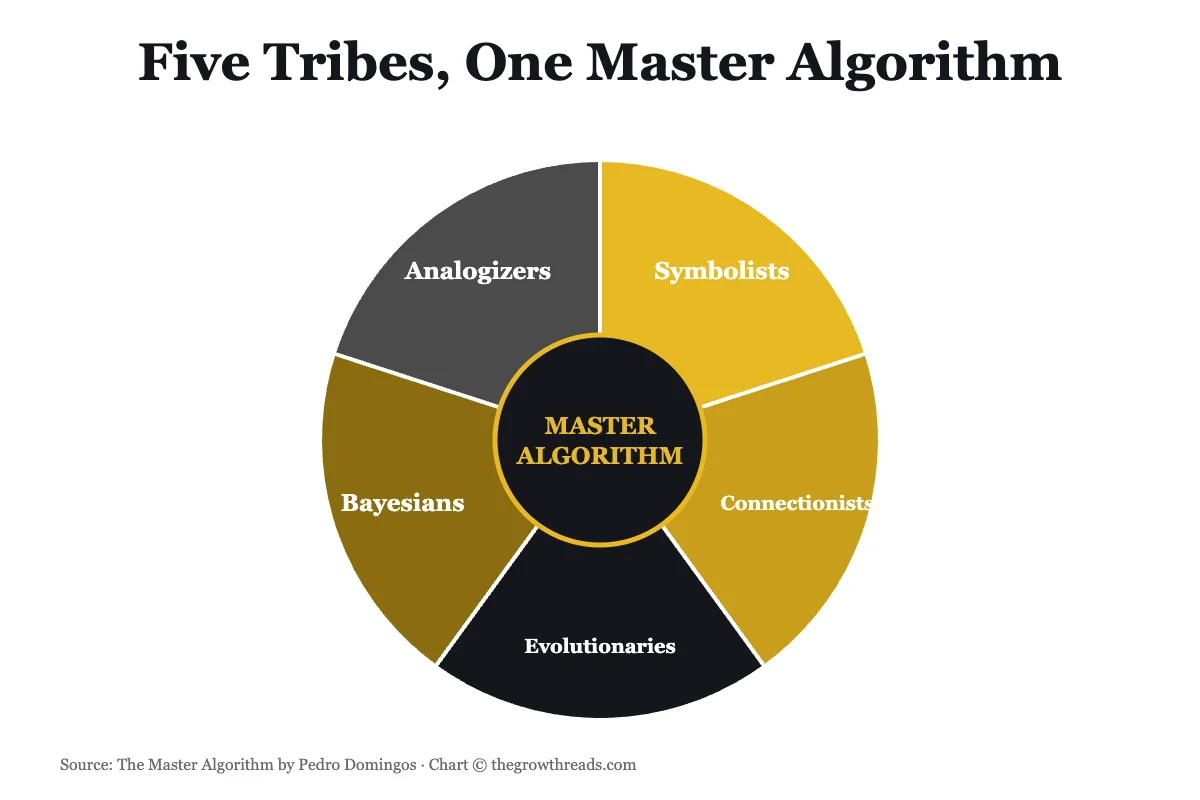
Every machine learning algorithm belongs to one of five tribes — and Pedro Domingos thinks they’re all pointing at the same underlying idea. Symbolists reason with logic and rules. Connectionists build neural networks that learn by adjusting connection strengths. Evolutionaries breed better algorithms through simulated natural selection. Bayesians update probabilities as evidence arrives. Analogizers learn by comparing new situations to similar past ones.
Domingos, a machine learning researcher at the University of Washington, argues that each tribe has found a genuinely different piece of the learning puzzle — and that a single “master algorithm,” combining the best of all five, is both possible and closer than most people think. Whether or not that unification ever fully arrives, the book remains one of the clearest available maps of why AI research looks the way it does.
Key takeaways
- There are five tribes of machine learning: symbolists, connectionists, evolutionaries, Bayesians, and analogizers — each with its own master-algorithm candidate.
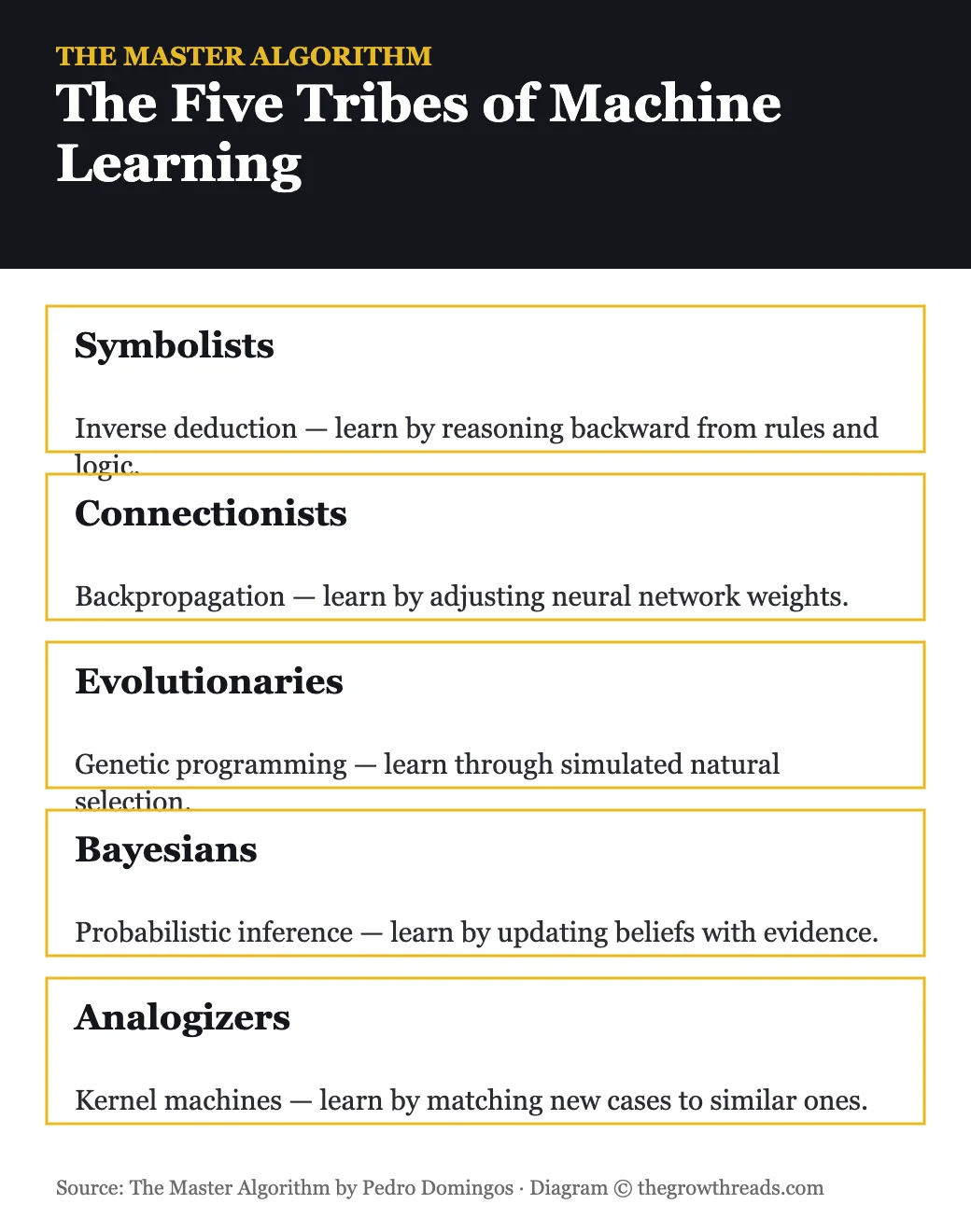
- Symbolists use inverse deduction: working backward from known facts and rules to fill in missing knowledge, the way expert systems do.
- Connectionists use backpropagation: adjusting the weights of a neural network so its output error shrinks a little with every example.
- Evolutionaries use genetic programming: mutating and recombining candidate programs, keeping the fittest across generations.
- Bayesians use probabilistic inference: starting from a prior belief and updating it as new evidence arrives, never claiming certainty.
- Analogizers use similarity: classifying new cases by how closely they resemble cases already seen, the logic behind kernel machines.
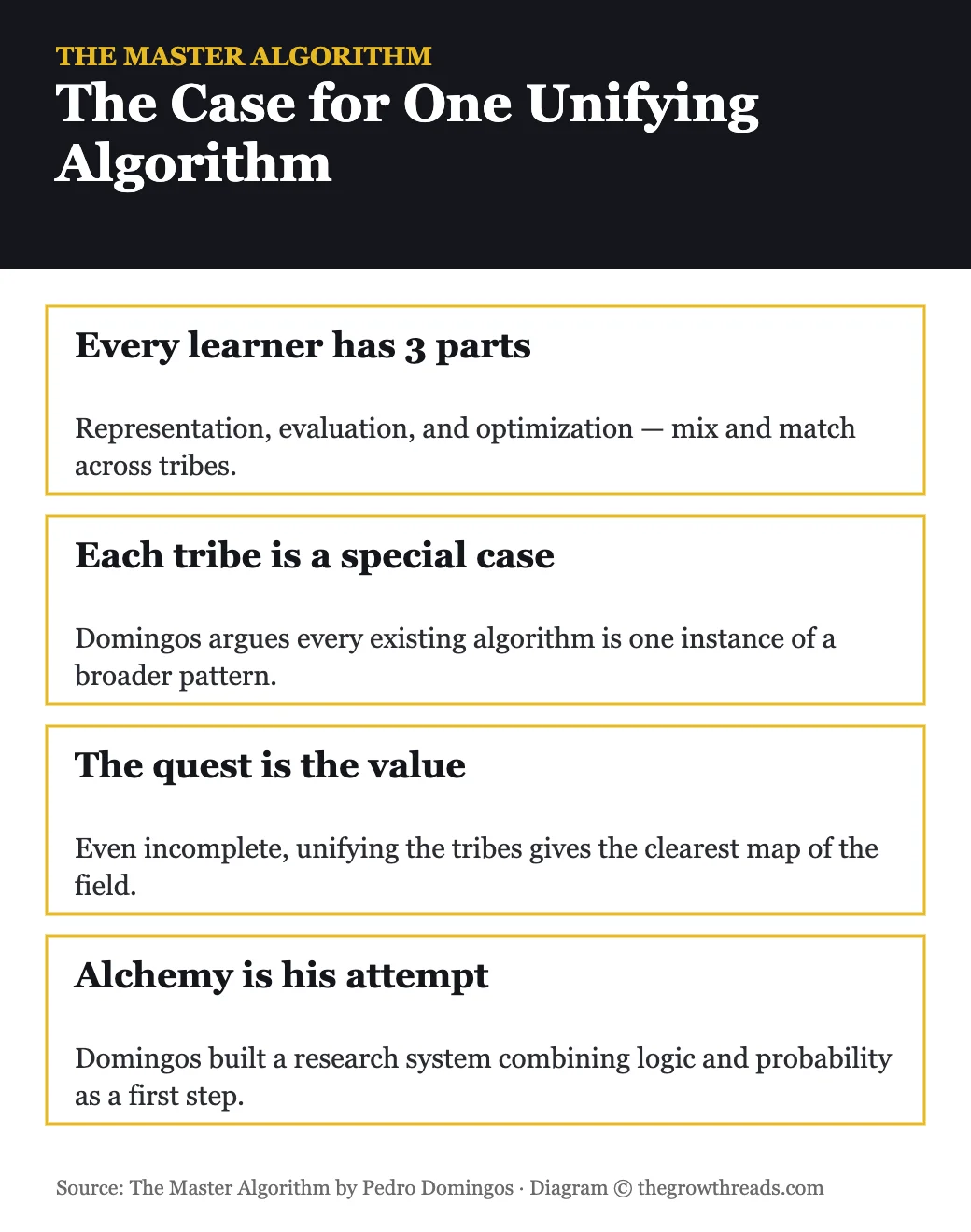
- Every learner has three ingredients: a representation (the hypothesis space), an evaluation function (how good is a hypothesis), and an optimization method (how to search for a better one).
- No single tribe has won: each excels in different domains, which is exactly why Domingos thinks the real answer is a combination, not a victor.
- Overfitting is the central danger: a model that memorizes its training data instead of learning the underlying pattern will fail on anything new.
- Data is replacing hand-coded knowledge: across all five tribes, the shift Domingos charts is toward letting data determine the rules rather than programmers writing them by hand.
What is The Master Algorithm about?
The Master Algorithm argues that all of machine learning’s competing approaches — logic-based systems, neural networks, evolutionary algorithms, Bayesian methods, and similarity-based learning — are incomplete pieces of one underlying master algorithm, and that finding it would let a single system learn anything from data the way the human brain does.
About the author
Pedro Domingos is a professor of computer science at the University of Washington, where his research spans machine learning, data mining, and artificial intelligence. He has won the SIGKDD Innovation Award, the highest honor in data science, and served as president of the International Machine Learning Society. Explore all Pedro Domingos book summaries →
Domingos built Alchemy, an open-source system combining logical and statistical AI, as his own attempt at a step toward the master algorithm the book describes. His research career, spanning all five tribes he writes about, gives the book a rare cross-disciplinary authority — few researchers work fluently across symbolic AI, neural networks, and Bayesian methods at once.
Key concepts at a glance
| Concept | What it means | Use it when |
|---|---|---|
| Inverse deduction | Working backward from facts to the rules that would explain them | You have clean rules and need to fill logical gaps |
| Backpropagation | Adjusting neural network weights to reduce output error | You have huge labeled datasets and complex patterns |
| Genetic programming | Evolving better solutions through mutation and selection | The solution space is too large to search directly |
| Bayesian inference | Updating probability estimates as evidence accumulates | You need to reason under uncertainty, not certainty |
| Kernel machines | Classifying by similarity to known examples | You want a robust classifier without deep architecture |
| Overfitting | A model that memorizes training data instead of generalizing | Always guard against it — it’s the field’s central failure mode |
| Alchemy | Domingos’ own combined logic-and-probability research system | You want to see an actual attempt at unification in code |
Part 1: The Five Tribes
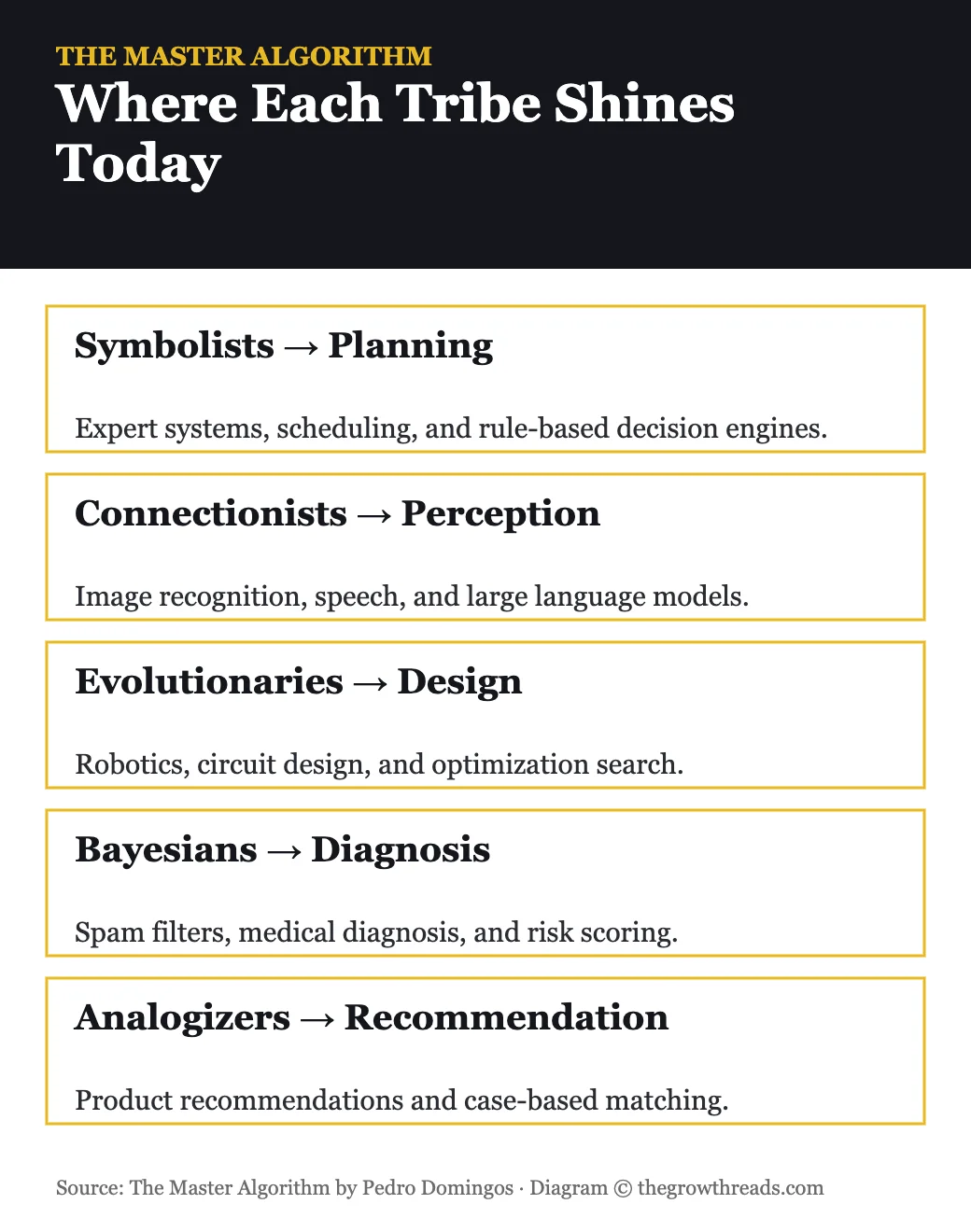
Domingos opens by mapping the field’s history onto five schools of thought, each convinced its approach holds the deepest truth about learning. Symbolists, rooted in logic and philosophy, believe intelligence is fundamentally about manipulating symbols according to rules — their master algorithm candidate is inverse deduction, working backward from known outcomes to the general rules that would produce them. This lineage runs through expert systems and remains the backbone of rule-based planning software today.
Connectionists, by contrast, take their inspiration from the brain itself: intelligence emerges from networks of simple units adjusting the strength of their connections. Their master algorithm is backpropagation, the technique that trains neural networks by nudging every weight a little in the direction that reduces error. It’s tedious in principle and, at large enough scale with enough data, has produced the deep learning systems now driving most headline AI progress.
TGR Note: Domingos wrote this in 2015, well before the large language model wave. Read alongside our Genius Makers summary for the human story behind how the Connectionist tribe eventually pulled ahead in resources and attention, even though Domingos himself resists picking a winner.
Part 2: Evolutionaries, Bayesians, and Analogizers
The remaining three tribes get equally serious treatment. Evolutionaries treat learning as natural selection in miniature: candidate programs mutate, recombine, and compete, with the fittest surviving into the next generation. It’s slow and computationally expensive, but it excels exactly where the solution space is too vast and poorly understood to search any other way — robotics and circuit design are classic proving grounds.
Bayesians reject the idea of certainty altogether. Every hypothesis carries a probability, and new evidence shifts those probabilities according to Bayes’ theorem rather than confirming or rejecting anything outright. This makes Bayesian methods the natural choice whenever noisy, incomplete data is the norm — spam filtering and medical diagnosis both lean heavily on this tribe’s tools. Analogizers, the least famous of the five, learn by comparing: a new case is classified by how closely it resembles cases already seen, the idea behind kernel machines and nearest-neighbor methods, and the quiet engine behind most recommendation systems.
TGR Note: For a more rigorous, technically grounded companion to this chapter, see our Superintelligence summary — Bostrom writes from inside the Bayesian and decision-theoretic tradition Domingos describes here, one level more formal.
Part 3: What Every Learner Has in Common
Domingos’ most durable contribution may be the framework he uses to compare the tribes rather than the tribes themselves: every learning algorithm, regardless of tribe, is built from three components. A representation defines the space of hypotheses the algorithm can even consider. An evaluation function scores how good any given hypothesis is. An optimization method searches that space for the hypothesis that scores best. Swap out any one component and you get a genuinely different algorithm — which is why Domingos believes the tribes aren’t really rivals so much as different combinations of the same three ingredients.
This framework also explains the field’s central danger: overfitting, where a model’s evaluation function rewards memorizing the training data too precisely, producing a hypothesis that looks perfect on paper and fails on anything new. Every tribe has developed its own defenses — regularization, cross-validation, Bayesian priors — but the underlying problem, Domingos argues, is the same everywhere, which is itself evidence for his unification thesis.
TGR Note: If the unification thesis intrigues you but you want the more skeptical counterpoint, our Rebooting AI summary makes the case that no single learning paradigm — symbolic or connectionist — gets you to real understanding on its own.
Part 4: Toward the Master Algorithm
In the book’s final stretch, Domingos moves from description to proposal. His own attempt, a system called Alchemy, combines symbolic logic with probabilistic graphical models — a first, admittedly partial, step toward unifying at least two of the five tribes. He’s candid that a full master algorithm, one that folds in evolutionary search and analogical reasoning too, remains unbuilt. What he offers instead is a bet: that the differences between the tribes are more a matter of historical accident and academic tribalism than of any fundamental incompatibility.
The closing chapters also turn practical, walking through what a mature master algorithm might mean for medicine, business, and daily life — a system that learns your preferences, habits, and context well enough to act as a genuine digital assistant rather than a narrow tool. A decade after publication, pieces of that vision (foundation models trained across many types of data and tasks) have arrived, even if not in exactly the unified form Domingos predicted.
Who is The Master Algorithm best for — and who should read something else first?
This book rewards readers who want a structural understanding of machine learning without diving into code or mathematics — a technically literate overview rather than a beginner’s introduction. If you’re brand new to AI and want the friendliest possible on-ramp, start with our You Look Like a Thing and I Love You summary instead. If you want the plain-English explanation of how deep learning actually works from a working researcher, our Rebooting AI summary and Melanie Mitchell’s work cover similar ground with less taxonomy and more mechanism.
Questions to reflect on
- Which of the five tribes’ assumptions about intelligence feels closest to how you personally think and learn?
- Where in your own work do you rely on rules (Symbolist), pattern-matching (Connectionist), or precedent (Analogizer) without naming it that way?
- Domingos wrote this before the deep learning wave fully hit — which of his predictions have aged well, and which hasn’t?
- If a true master algorithm existed, what decision in your life would you most want to hand to it — and what would you want it to still ask you first?
- What’s the risk of overfitting outside of machine learning — in a habit, a strategy, or a belief you’ve “trained” too tightly on past experience?
🔥 Ready to meet the five tribes of machine learning?
Get the book that maps the entire field in one framework.
How to apply The Master Algorithm (7-day plan)
- Day 1: List every “AI” tool or feature you use regularly. Guess which tribe (or combination) likely powers each one.
- Day 2: Read up on inverse deduction and rule-based systems — notice where you already reason this way at work.
- Day 3: Learn the one-paragraph version of backpropagation. You don’t need the math, just the idea: adjust, measure error, adjust again.
- Day 4: Notice a decision you made recently by analogy (“this is like that other situation”) — that’s the Analogizer tribe in action.
- Day 5: Practice stating a belief as a probability instead of a certainty for one day — the Bayesian habit.
- Day 6: Identify one place in your own thinking where you might be “overfitting” — over-relying on a pattern that worked once.
- Day 7: Write one paragraph on which tribe’s worldview you find most convincing, and why — then revisit it in six months.
Frequently asked questions
What is the “master algorithm” Pedro Domingos describes?
The master algorithm is Domingos’ proposed single learning algorithm that could, in principle, derive any knowledge from data — combining the strengths of all five machine learning tribes (symbolist, connectionist, evolutionary, Bayesian, and analogical approaches) into one unified system. He argues it doesn’t yet fully exist but that the pieces to build it are closer than most researchers assume, and that finding it would mark as significant a milestone for civilization as the invention of computers or the internet.
Do I need a technical background to understand this book?
No advanced math or coding is required. Domingos writes for a general audience and explains each tribe’s core idea through analogy and story rather than equations, though readers with some technical curiosity will get the most out of the deeper chapters. It’s more demanding than a typical business book but far more accessible than an academic machine learning textbook.
Is this book still relevant given how fast AI has changed since 2015?
The five-tribes taxonomy remains one of the clearest available frameworks for understanding why AI research fractures into such different-looking approaches, and that framing has aged well. Domingos’ specific prediction that a unifying master algorithm was imminent hasn’t obviously panned out the way he forecast, but the underlying map of the field is still widely used as a teaching tool.
Which tribe is winning the AI race today?
By resources, attention, and headline results, the Connectionist tribe (neural networks and deep learning) has pulled dramatically ahead since the book’s 2015 publication, particularly with the rise of large language models. Domingos would likely argue this reflects available compute and data more than any fundamental superiority — his thesis is that all five approaches still have real strengths the current wave hasn’t erased.
What is Alchemy, and did Domingos actually build the master algorithm?
Alchemy is Domingos’ own open-source research system, combining symbolic logic with probabilistic graphical models — his attempt at unifying two of the five tribes rather than all five. He is explicit in the book that it’s a first step, not a finished master algorithm, and that fully unifying all five approaches remains an open research problem.
How is this different from other AI overview books?
Most AI books either focus narrowly on one approach (usually deep learning) or stay at a purely conceptual level without explaining the mechanics. The Master Algorithm is distinctive for organizing the entire field by underlying method rather than by application, and for coming from a researcher who has worked across multiple tribes rather than championing just one.
What’s the best follow-up book after this one?
For the plain-English mechanics of how deep learning actually works, read Melanie Mitchell’s work or our Rebooting AI summary. For the human story of how the Connectionist tribe came to dominate, our Genius Makers summary is the natural next read.
Related summaries
- Rebooting AI Summary & Review
- Genius Makers Summary & Review
- Superintelligence Summary & Review
- Best AI Books, Ranked
How we analyze books: Every book on The Growth Reads is read cover to cover, summarized in original analysis, and rated against our five-criteria rubric. We never use AI-generated summaries — every word is human-curated. Read our full methodology.
Related Technology Summaries
Chip War Summary & Review: Why Silicon Chips Now Decide Global Power
Power and Prediction Summary & Review: Redesigning Decisions, Not Just Predictions
Superagency Summary & Review: What Could Possibly Go Right with AI
Talking to Robots by David Ewing Duncan Summary & Review
The Book of Why Summary & Review: How to Think in Causes, Not Just Correlations