

One step still gets skipped when the job is familiar and a known piece is still missing from the send. Atul Gawande’s 10 December 2007 New Yorker essay, later reused in The Checklist Manifesto, shows experts dropping a step they already know. Name five lines for one repeated job, and do not send while a line is blank.
Key takeaways
- One step still gets skipped when the send is a job you already know, and a piece you can name is still missing from it.
- Atul Gawande, in the New Yorker essay “The Checklist,” dated 10 December 2007, writes that a test pilot forgot a lock on a plane he was expert enough to fly, and that the remedy the pilots adopted was a checklist rather than more training.
- Gawande writes that Peter Pronovost’s 2001 line checklist used steps already taught, and that observers found at least one of those steps skipped in more than a third of patients.
- The essay gives that list two jobs Gawande attributes to Pronovost: recall of mundane steps, and an explicit minimum, plus permission for a nurse to stop a skip.
- The five-line pause on this page is The Growth Reads’ own script for one repeated send. It is not a clinical protocol, and the hospital figures in the essay are not a promise about a proposal or a weekly note.
What one skipped step is
One step still gets skipped when you could recite the job, and the note still leaves without a piece of it. You are a solo founder. The proposal is one you have sent twenty times. The draft sounds finished. You hit send, and the file the second paragraph names is not attached. Or the price you already decided is still in your head. Or the line that says what this round does not include is missing, so the client reads the extra as included. You are a new manager. The Friday note is the same note as last Friday. The date of the decision is not on it. People reply as if the date were obvious. On Monday it is not.
This is not ignorance, and it is not Monday’s priority cut. It is not a first hire’s week one, not a build’s time budget, and not the backbrief before they start. The steps are already yours. One of them did not travel, because the send left from memory while a client, a thread, or the next call was louder. The draft is open. One known line is still blank.
What the essay actually says
The checked copy is Gawande’s New Yorker essay, not the print book. “The Checklist” is headed 10 December 2007 and was read in full on 18 November 2026. The Profile Books copyright page, read the same day, says The Checklist Manifesto was first published in America in 2009 by Metropolitan Books of Henry Holt and Company, and in Great Britain in 2010 by Profile Books, ISBN 978-1-84668-313-8. It says some material first appeared in the essay, in different form. The chapters were not opened. No page number is used. A rule about how long a list may be is not on a page this article read.
His exhibit is a plane. On 30 October 1935, at Wright Air Field in Dayton, the Boeing Model 299 stalled and crashed after takeoff. He writes that nothing mechanical had gone wrong. Major Ployer P. Hill, whom he identifies as the Army Air Corps’ chief of flight testing, had forgotten to release a locking mechanism on the elevator and rudder controls. A newspaper called the plane “too much airplane for one man to fly.” The pilots did not add more training. They wrote a checklist for takeoff, flight, landing, and taxiing. With it, he writes, they flew the Model 299 1.8 million miles without one accident, and the Army ordered almost thirteen thousand of the aircraft, the B-17.
He says intensive care had become the same kind of problem: too much to carry from memory, and too various for one card to cover every case. The trial he describes is one danger. In 2001 Peter Pronovost, at Johns Hopkins, listed five steps for putting in a line: wash with soap, clean the skin with chlorhexidine, drape the whole patient, wear mask, hat, gown, and gloves, and cover the site with a sterile dressing. This page is not a clinical protocol. Those steps are not instructions. Gawande’s point is that they were already known and taught, and that a checklist for them looked silly.
Nurses watched for a month. He writes that in more than a third of patients at least one step was skipped. The hospital then let nurses stop a doctor who skipped, and ask daily whether a line should come out. He reports the ten-day infection rate moving from eleven per cent to zero, then two infections in fifteen further months. The team calculated forty-three infections and eight deaths prevented, and two million dollars saved, in that one hospital. This page did not open the monitoring paper. Those figures stay in his account. They are not a result to expect from a proposal.
He gives the list two jobs, both attributed to Pronovost. It helped people remember mundane steps when something louder was happening. It made the minimum explicit, including for experienced staff who did not see why a precaution mattered. Permission to stop is what made the floor real. A reminder nobody can enforce is a poster.
Some physicians were offended. Others noted that the evidence was one well-staffed hospital. Gawande quotes Tom Piskorowski, at Sinai-Grace in Detroit: “Forget the paperwork. Take care of the patient.” That is the sentence a founder already uses when a client is waiting. He does not claim every list has earned that answer. He claims this one had, for this one known danger.
On the Michigan Keystone program, he writes that the state hospital association asked Pronovost in 2003, and that a December 2006 New England Journal of Medicine paper reported a sixty-six per cent drop in three months, quarterly rates at zero in the typical unit, and, over eighteen months, an estimated hundred and seventy-five million dollars and more than fifteen hundred lives. That paper was not opened. The numbers are his report of a hospital program. They are not your close rate, and they do not belong in a pitch. One detail does travel. Christine Goeschel, then directing Keystone, told him the soap the list required was in fewer than a third of units that first month, and that full drapes were often missing. Executives had to stock them. A blank line sometimes means the object is not in the folder, not that you forgot a sentence.
His limit is the one this page keeps. A list does not remove the need for judgment. He says it would be ludicrous to drop courage, wits, and improvisation, and that the work should also accept what he calls the virtues of regimentation. The pause catches a step you already believe is mandatory. It does not decide an open price, invent a job you have never done, or bless a send that can do real damage.
The five-line pause
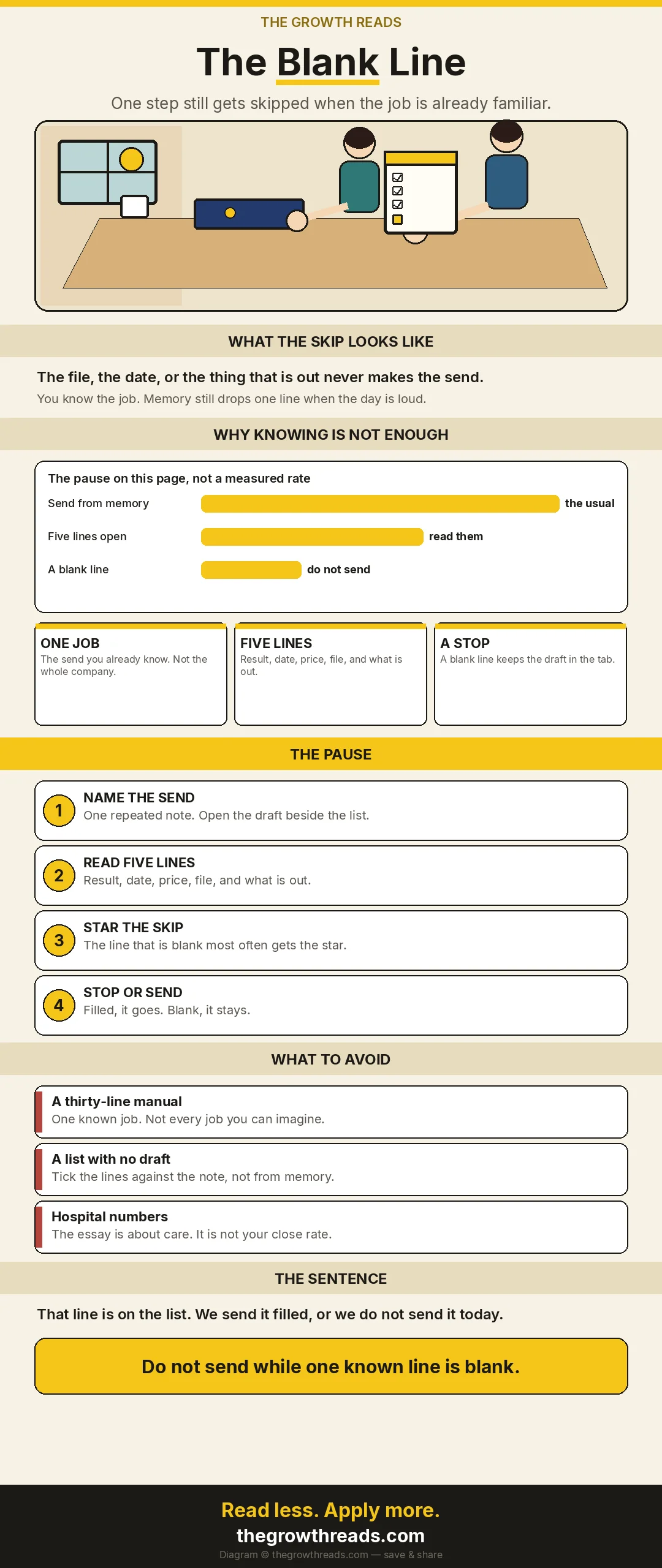
Pick one send you already know, put five lines beside the draft, and do not send while a line is blank. Pronovost, in Gawande’s account, did not try to cover everything. He covered one danger whose steps were already taught. You do the same. One repeated send. Not the whole company. The proposal you send every week is a fair choice. So is the Friday note, the invoice, or the kickoff email, if that is the one that left missing a piece last time. Write the name of the job at the top. If you cannot name it in four words, you have picked a department, not a send.
The five lines are this page’s script. They are not in the essay. They are the minimum for a client or internal note that is about to leave, written so each line can be ticked against the draft rather than against your memory of the draft.
The job, in four words. One send. Not the company.
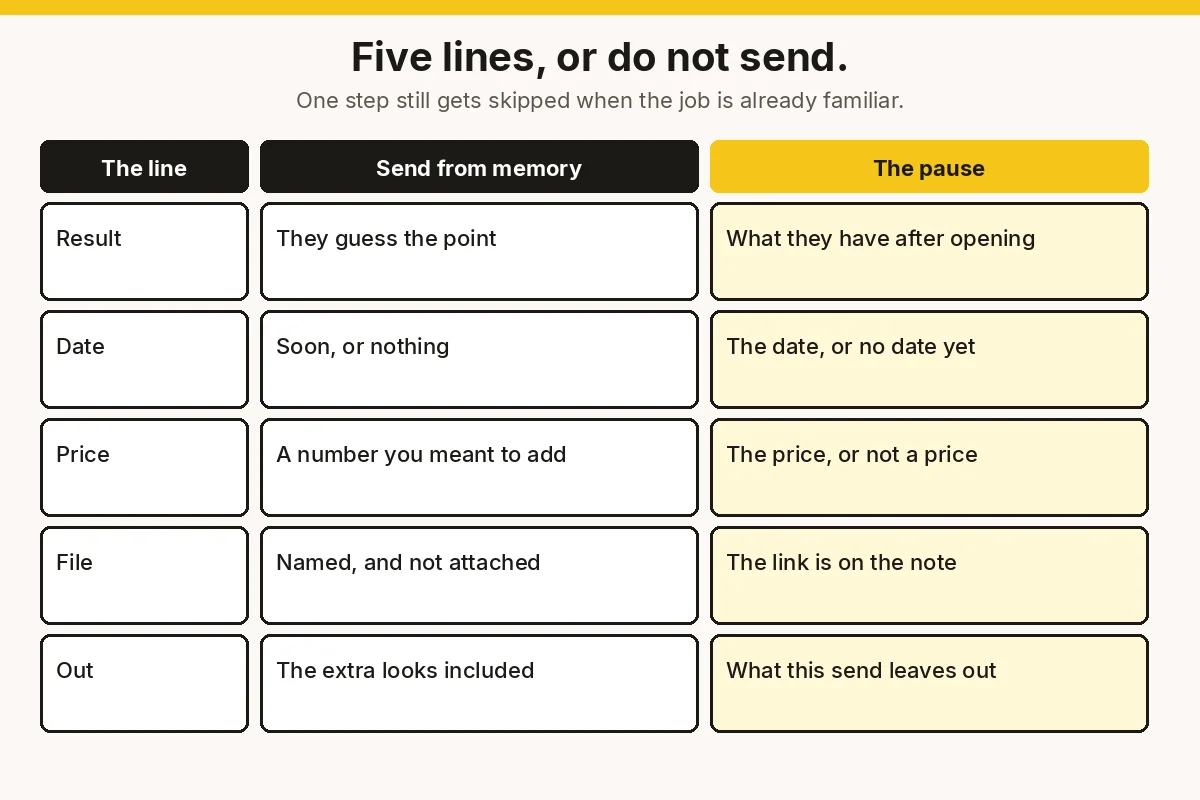
1. Result. One line in the note: what they have after they open it.
2. Date. The date, or the words “no date yet.”
3. Price. The price you already decided, or the words “this note is not a price.”
4. File. The attachment or link the note names is actually on the note.
5. Out. One line: what this send does not include.
Read the five lines with the draft open. A blank line means the tab stays open.
Star the line that is blank most often. That star is the step you already know and still skip.
“Proposal attached” is not a result. One sentence a tired reader can act on is a result. “Soon” does not tick the date. The price line does not invent a number. If you settled it on the guessy-price page, or changed it on the page about work that moved after the price, this line only checks that the decided figure, or “not a price,” is visible. A new number, typed so the box looks ticked, is a different mistake.
The file is the mundane step. Tick it only when you can see it on the draft. Out is one written exclusion, so a friendly note does not become new scope. If everything is included, write that on purpose. Silence is not a tick. Five lines is the cap because his working example covered one problem, and because a manual will not be read at the send button. A sixth line replaces one of the five. For two weeks, star whichever line was blank when you sat down. The line that wins twice moves to the top.
| The line | What a skip looks like | What a tick looks like |
|---|---|---|
| Result | They can tell it is a proposal, and not what they are supposed to do with it. | One sentence says what they hold after opening. |
| Date | “Soon,” or a date that lived only on the call. | A date, or the words “no date yet.” |
| Price | The number is in your head, or a new number appears so the line looks done. | The decided price is visible, or the note says it is not a price. |
| File | The paragraph names a file the draft does not carry. | The named file or link is on the draft, and you looked. |
| Out | The extra reads as included because you were being helpful. | One sentence says what this send leaves out. |
Who may stop the send
Someone must be allowed to hold a blank line, including you if you are the only person. In the essay, the list started to matter when nurses could stop a doctor and the administration would back them. Before that, Gawande writes, a nudge was optional, and people were unsure a given step was worth the argument. Without a stop, five lines are a poster beside the button.
Alone, you are both parts. Draft as you already draft. Then read the five lines against the open note. “I know the price” is not a tick. The price is a tick when it is on the note. The skip happens in the fluent minute. The second pass is the careful one.
If someone else can see the draft, their only reply is “Stopped. Line 4 is blank.” They do not rewrite the opening or take the send. The moment they edit, you are back on the bottleneck, and a pause has become a handoff. Say that limit before you ask them to watch. A silent fix hides the skip, so the star never gets worn. If the file does not exist, the stop has found a missing object. Export it, attach it, then tick. A promise to attach it later is how the paragraph and the file part ways.
The sentence when someone wants to skip
Say the line stays, and say what happens if it is blank. “Forget the paperwork” is a fair objection when someone is waiting. Gawande’s account does not mock it. The mundane step was still the one that got dropped. For a send that is not a procedure, use one sentence and do not decorate it:
That line is on the list. We send it filled, or we do not send it today.
Say it to yourself when line 5 is empty and the client has pinged. Say it when someone wants the file in a follow-up. Say it when a senior colleague says everyone already knows the date. The date is on the note, or the note waits. “We do not send it today” is allowed. A skip that leaves anyway teaches the room that the list is theatre. If you truly must send with a gap, name it in the note: “File follows tomorrow. This send is going without it.” That is a recorded exception, and it still wears the star. Two exceptions in a week means the line is the problem. Do not use the sentence to dodge an open price. The next action is the pricing conversation. The list did not decide it.
When the list is the wrong tool
A pause for known steps is the wrong tool when the steps are not known, or when the decision is still open. Gawande does not let the list replace judgment. Use that limit here.
- You have not done this send three times. You do not yet know which step gets skipped. Do not invent a manual for a job you are doing once. His example was steps already taught.
- The price or the promise is still open. Line 3 cannot be ticked with a guess. Use more than the price or the change after the price. This page only checks that a decision you already made is visible.
- The send is not open today. A list for next quarter is a problem you do not have yet. Park it.
- The send can do real damage. Money leaving the account, or a promise you cannot undo, is not a five-line tick. The list is a floor. You stay on the draft until you would sign it.
A new hire’s first week is a calendar, not this pause. Do not hand them five lines and call them onboarded. The pause is yours until the job is familiar to them.
Common mistakes
- Writing thirty lines, or a new card every Monday. His example covered one problem. Five lines, one job, left alone until the same skip shows up twice.
- Ticking from memory. The draft has to be open. “I always attach the file” is how the file stays in yesterday’s folder.
- Sending, then patching. A follow-up that carries the missing file is a skip that left. Name it in the note if you must, and star the line.
- Letting the stopper rewrite the note. Their reply is “Stopped,” plus the line number. A rewrite puts the work back on the most fluent person.
- Using the list to pick the price. A number invented to fill line 3 is a new decision disguised as a tick.
- Borrowing the hospital percentages. The rates and the dollar figures in the essay are about infections. They are not your win rate. Quoting them in a deck is a false citation.
- Importing the stakes. Gawande also describes a list that got an operating room ready before a hypothermic patient arrived. That is a rare emergency. A Friday note is not. The shared idea is only a known step, written down, at the moment it gets dropped.
What the source does and does not say
The essay gives you the shape of a known step skipped, the short list, and the permission to stop. It does not give you the five lines, the sentence, or a result for a founder’s proposal. It is a reported account of aviation history and of hospital infection work. The print chapters of The Checklist Manifesto were not opened, so this page does not claim the book’s later rules.
| Source | What was read | What this page uses | What this page does not use |
|---|---|---|---|
| Atul Gawande, “The Checklist,” The New Yorker, headed 10 December 2007. | The full essay, on 18 November 2026. | The Model 299 account, including 1.8 million miles and almost thirteen thousand aircraft, as he tells it. Pronovost’s already-known steps. A skip in more than a third of patients. Permission to stop. The two benefits. Piskorowski’s objection. Goeschel on missing soap. Gawande’s limit: a list does not replace judgment. | The clinical steps as instructions. Hospital outcome figures, except as his account. The December 2006 New England Journal of Medicine paper, which was not opened. An Israeli study he mentions and does not name. Any claim that a proposal checklist saves lives or money. |
| Profile Books copyright page and contents for The Checklist Manifesto, read 18 November 2026. | The opening pages that state publisher, year, ISBN, and that some material first appeared in the essay in different form. The contents list names a chapter called “the checklist.” That chapter was not read. | America, 2009, Metropolitan Books of Henry Holt and Company. Great Britain, 2010, Profile Books. ISBN 978-1-84668-313-8 as printed on that page. The fact that the essay is acknowledged as earlier material. | Every chapter. Every page number. Any rule about the length of a checklist, read-do against do-confirm, or pause points. Those may be in the book. They were not in the pages opened. |
He is writing about hospitals and, briefly, about a bomber. A solo founder’s proposal is close enough for the mechanism: familiar work, one known piece missing, a short list, a person who may stop the send. It is not close enough for a claim about survival, cost, or infection. The five-line pause and the sentence are our application. They have not been tested the way he says Keystone was tested. If your starred line is still blank in two weeks, the pause is not sticking. That is a fact about your send. It is not a finding from the essay.
Frequently asked questions
What does it mean that one step still gets skipped?
One step still gets skipped when you have already done the job, you can name the pieces, and the send still leaves without one of them. The file, the date, or the line that says what is out stays behind. You are not missing a theory. You are missing a pause at the moment of sending. Gawande’s essay of 10 December 2007 describes experts dropping a step they already knew. This page uses that shape for one repeated note. It does not measure how often your own sends fail.
Why would a checklist help if I already know the steps?
Because knowing is the situation the essay describes, not the opposite of it. Gawande writes that Pronovost’s steps for a line were already taught, and that it seemed silly to list them. Observers still found at least one step skipped in more than a third of patients. He attributes two uses to the list: recalling mundane steps when something louder is happening, and making the minimum explicit. A founder’s loud minute is a waiting client. The mundane step is the file or the exclusion. The list is open beside the draft so “I know this” cannot stand in for looking.
What are the five lines before you send?
They are this page’s script, not a quotation. Name one send. Then tick five lines against the open draft: the result they hold after opening, the date or the words “no date yet,” the price you already decided or the words “this note is not a price,” the file or link the note names, and the one thing this send leaves out. A line you cannot point to stays blank. A blank line means you do not send. Star the line that is blank most often. That star is the step you already know and still drop. A sixth line replaces one of the five. It does not extend them.
What if you work alone and nobody can stop you?
You run the stop yourself, as a second pass. Write the draft the way you already write it. Then open the five lines and read them against that draft. You may tick a line only when you can point to it. Remembering the price is not the price on the note. The sentence you use on yourself is the same one you would use on anyone else: that line is on the list, and you send it filled or you do not send it today. Waiting until tomorrow is allowed. A silent skip, followed by a patch, teaches you that the list is optional.
What do you say when someone wants to skip a line?
Say: “That line is on the list. We send it filled, or we do not send it today.” Use it when a client has pinged, when a colleague wants the file “in a follow-up,” or when someone says everyone already knows the date. If you truly must send with a gap, name the gap in the note, in one sentence, and star that line. Two recorded exceptions in a week mean the line is the problem and the urgency was the excuse. Do not use the sentence to avoid a price you have not decided. An open decision is a different page, and the note waits.
Is this the same as a first-week plan or a Monday priority list?
No. A first hire’s week one is a five-day calendar for a person who does not yet know the work. Monday’s cut chooses what you will start, and what you will not start, before the week fills. This page assumes the job is already familiar and the draft is already open. You are not choosing the work. You are checking that a known piece is on the send. The build’s appetite is a time budget before design. A backbrief is their words before they start. Use those pages for those problems. Use this pause only in the minute before something you already know how to send actually leaves.
Did the essay test this on proposals or on managers?
No. The essay is about a 1935 bomber test and about infection checklists in intensive care, especially Peter Pronovost’s work at Johns Hopkins and the Michigan Keystone program. Gawande reports large drops in line infections, including figures from a December 2006 New England Journal of Medicine paper. That paper was not opened, and those figures are not evidence about a proposal, an invoice, or a Friday note. The transferable piece is the mechanism he describes: known steps, still skipped, caught by a short list and by permission to stop. The five lines and the sentence are our application. They have not been trialed.
Did this page open The Checklist Manifesto?
No. The text read on 18 November 2026 is the New Yorker essay “The Checklist,” headed 10 December 2007. The Profile Books copyright page, read the same day, says the book was first published in America in 2009 by Metropolitan Books of Henry Holt and Company, and in Great Britain in 2010 by Profile Books, and it prints ISBN 978-1-84668-313-8. That page says some material appeared first in the essay, in different form. The chapters were not opened, so no page number is given, and no rule from an unread chapter is used. The five-line pause is not presented as his wording.
Sources
- Gawande, A. “The Checklist.” The New Yorker, 10 December 2007. Read in full on 18 November 2026 from the printable text of that Annals of Medicine article. The public home of the piece is newyorker.com/magazine/2007/12/10/the-checklist. Used for the Model 299 account, Pronovost’s known steps and the skip he reports, the permission to stop, the two benefits, Piskorowski’s sentence “Forget the paperwork. Take care of the patient.”, Goeschel’s account of missing supplies, and Gawande’s limit on what a list cannot replace. Clinical steps are cited as history, not as instructions. Hospital outcome figures are his report. The New England Journal of Medicine paper he cites was not opened.
- Gawande, A. The Checklist Manifesto: How to Get Things Right. Copyright page and contents of the Profile Books edition, read 18 November 2026. Those pages state first publication in America in 2009 by Metropolitan Books of Henry Holt and Company, first publication in Great Britain in 2010 by Profile Books, ISBN 978-1-84668-313-8, and that some material first appeared in the New Yorker essay “The Checklist” in different form. The chapters were not opened. No page number was taken. The five-line pause, the stop rule for a solo sender, and the sentence “That line is on the list. We send it filled, or we do not send it today.” are not in the pages that were read.
Related reading on The Growth Reads
- Monday has no priority — choosing what to start, before this pause checks a send you already know
- The first hire’s week one has no shape — a five-day calendar, not a tick on a familiar note
- The build has no appetite — a time budget before the design, which five lines do not set
- They nodded, and the work came back — their words before they start, not your finger on send
- The price feels guessy — deciding the number, which line 3 only checks is visible
- You are the bottleneck — what happens if the person who stops the send starts rewriting it
- Productivity — the cluster this article sits in
- How we review — what a checked source is, and what an unread chapter is not
How this was checked
Who it is for. A solo founder or a new manager whose repeated send still leaves without a piece they could have named.
What was read. Gawande’s New Yorker essay “The Checklist,” 10 December 2007, in full on 18 November 2026, plus the Profile Books copyright page and contents the same day.
What was not read. The book’s chapters. Any page number. The December 2006 New England Journal of Medicine paper. The Israeli study he mentions and does not name.
Limit. The five lines and the sentence are our application. Hospital figures stay in his account of hospital work. A list does not decide an open price.
How we work: every article on The Growth Reads is built from books we have read and from primary accounts we can check, and it is date-stamped when those sources change. Read our methodology.