


Monday has no priority when the list is full and nothing on it is first. Write three outcomes in the order you will touch them, and name the one item you will not start. J.D. Meier’s Monday Vision asks which three results you would want finished by Friday, then puts those three at the top of the list.
Key takeaways
- Monday has no priority when the list is full and no item is first, so the morning starts wherever the inbox opens.
- J.D. Meier’s chapter 5 page, read on 15 November 2026, says that on Mondays you figure out three outcomes you want for the week, and that each day you determine your three most important outcomes.
- On his Day 2 page, Monday Vision is the question “If this were Friday, what are three outcomes, wins, or results that I would want under my belt?”, then the week’s list with those three written at the top.
- That Day 2 page says to focus on outcomes rather than track tasks, and that there is no point in focusing on a bunch of things you will not do. The worked example is his product list, not a founder’s client list.
- The Monday cut on this page — three outcomes in the order you will touch them, plus one named item you will not start — is this article’s script. No numbered page of the book was opened.
What a Monday with no priority actually is
Monday has no priority when you open a full list and the first thing you touch is whichever line answers first. You are a solo founder, so the list is clients, invoices, the thing you promised Friday, and the hire who is waiting on a login. You are a new manager, so the list is your own work plus whatever your team dropped in the channel overnight. Nothing is labelled urgent. Everything is simply there. By noon you have answered six messages and started none of the three results the week actually needed.
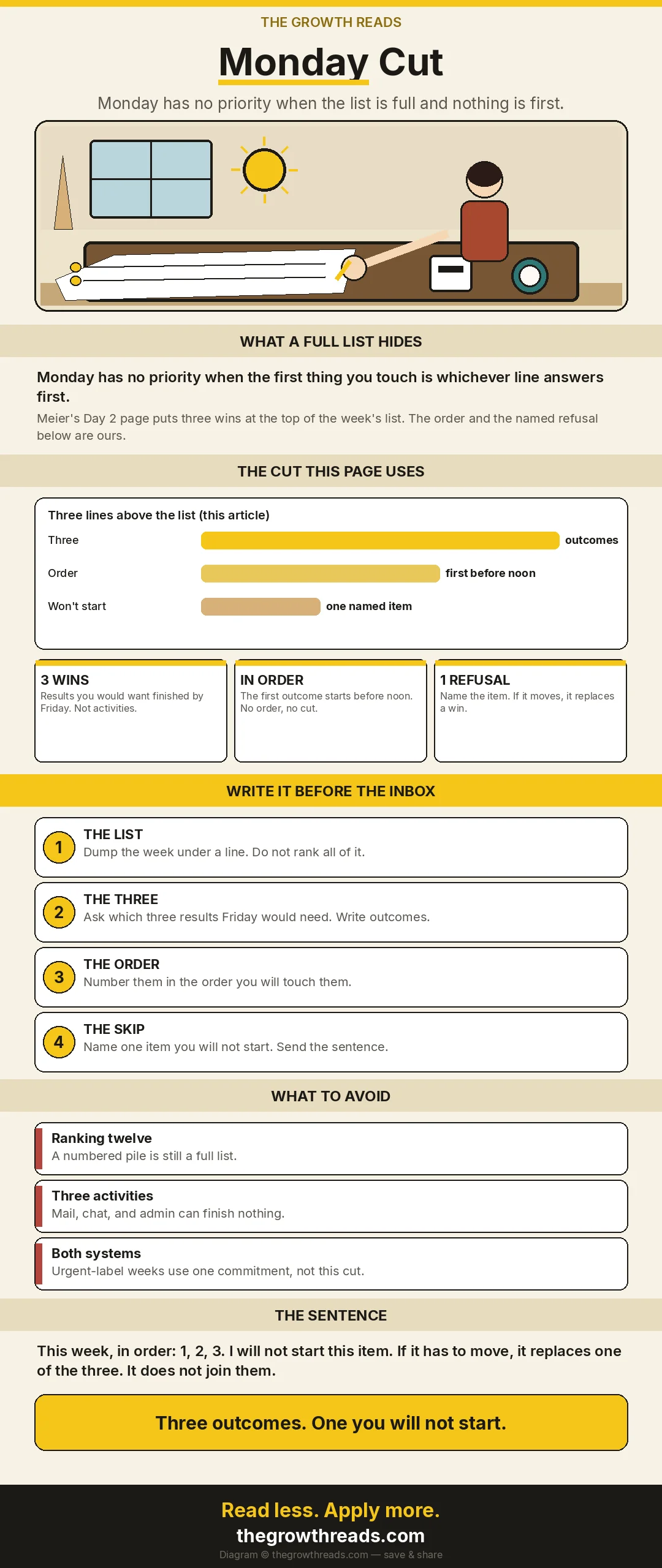
That is a different morning from a week where every request wears the same urgent label. A full unmarked list does not need a speech about focus. It needs a cut you can send before the next message arrives: three outcomes, the order you will touch them, and one item you will not start. The rest of the list stays written. It does not get a turn this morning.
What Monday Vision actually names
J.D. Meier’s Monday Vision is three outcomes for the week, written after you have looked at the list, not a ranking of every line. The book is Getting Results the Agile Way. This article did not open a numbered page. It read four public pages on 15 November 2026. The author’s book page says the print edition runs 274 pages, and it names three starting moves: the Rule of 3, the Monday Vision, Daily Outcomes, Friday Reflection pattern, and Hot Spots. It does not show a year or an ISBN. The chapter 5 page on his site is titled “Monday Vision, Daily Outcomes, and Friday Reflection.” The opening says that on Mondays you figure out three outcomes you want for the week, that each day you determine your three most important outcomes, and that on Fridays you reflect. The same opening says a common mistake is to confuse activities with outcomes, and that there are always more things to do than there is time in a day. The page then says the rest of the chapter is unavailable under an agreement with Amazon. So the chapter exists, and this article has only that opening.
The concrete weekly step is on his free Day 2 page, “Day 2 of Agile Results,” which he describes as the system from the book. Monday Vision, on that page, is this question: “If this were Friday, what are three outcomes, wins, or results that I would want under my belt?” He then tells you to write a quick list of what is on your plate for the week, scanning the calendar for meetings and events, and to write three wins at the top of that list. He does the same for today. He says he is not tracking tasks. He is focusing on outcomes. He also writes that there is no point in focusing on a bunch of things you will not do. The worked list on that page is his: slides ready, a product story ready to ship, a straw-man plan in place. It is not a client delivery and not a manager’s Monday. Copy the move. Do not copy the items.
A Microsoft Learn archive of his post “10 Personal Productivity Tools from Agile Results” repeats the week question in nearby words: imagine it is Friday and name three results you would be proud of. The archive page, as fetched, does not display its own publication date. A comment on it is dated 22 June 2016. That date is a comment, not a publication date, and this article does not treat it as one. The same post also describes Hot Spots, timeboxing, and a line about keeping draining work inside 20 percent of the day. None of those are this Monday cut. The Day 2 page also says that if you name the three wins you are “ahead of 99% of the population.” The page gives no sample for that figure. Leave it out of the note you send.
| What is in front of you | What it is | What you write |
|---|---|---|
| The full list | Everything already on the week, including the calendar. Not a rank. | Keep it under a line. Do not delete it to feel decisive. |
| Three outcomes | Results you would want finished by Friday. Not activities. | Write them above the line, in the order you will touch them. |
| The one you will not start | One named item from the list that does not get a start this week. | Name it in the sentence. If it must move, it replaces one of the three. |
The Monday cut
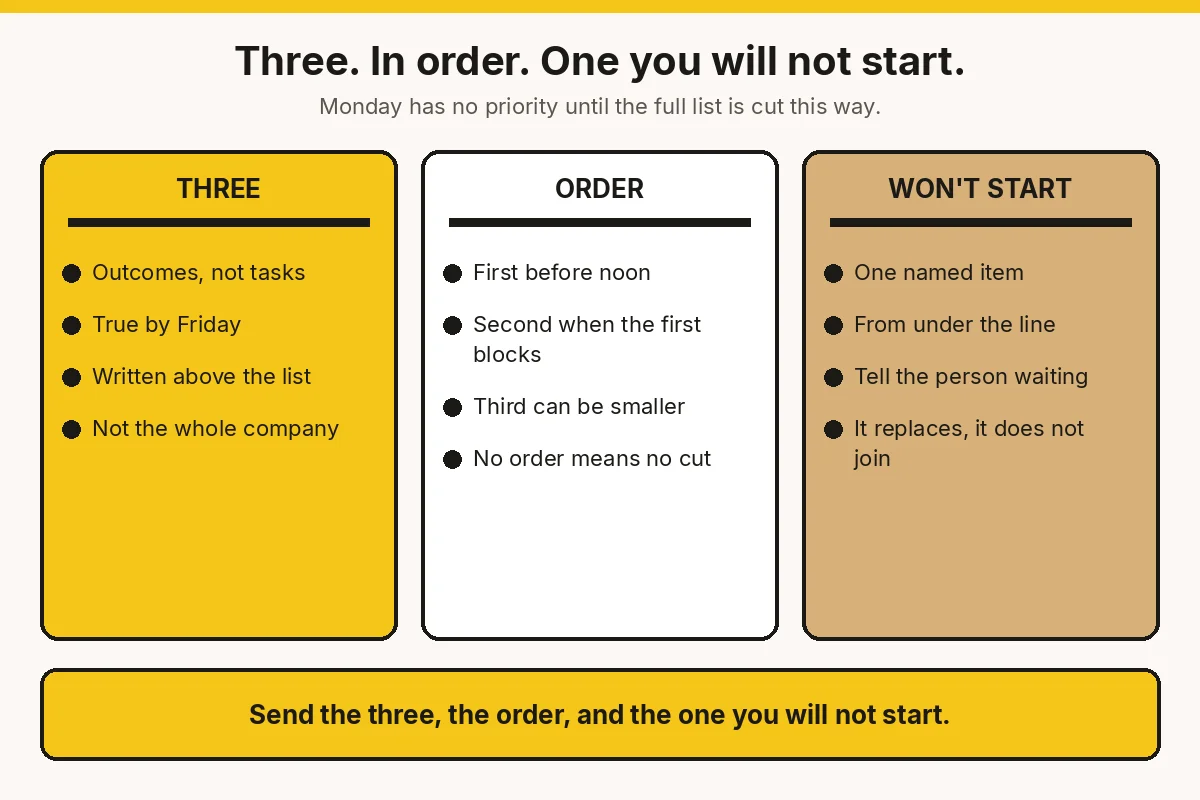
Write the list, put three outcomes above it in touch order, and name one item you will not start. Meier’s Day 2 page is the list and the three wins at the top. The order you will touch them, and the single named refusal, are this article’s lines. His page numbers the three wins. It does not say that number one must start before noon, and it does not require you to announce one item you are leaving unstarted. A full list with three titles on it still starts wherever the phone buzzes unless the order and the refusal are in the sentence.
- Dump the week under a line. Ten minutes. Calendar, promises, and the messages you already know about. Do not sort them yet. Day 2 calls this a quick list, not a complete inventory of your life.
- Ask the Friday question. If this were Friday, which three results would you want finished? Write them as outcomes. “Reply to mail” is an activity. “The proposal the client can sign is sent” is an outcome. Chapter 5’s opening names that mix-up as a common mistake.
- Put them in the order you will touch them. The first one starts before noon. The second is what you touch when the first is sent or blocked. The third is allowed to be smaller. If you cannot say which one is first, you still have a list.
- Name one item you will not start. Pick it from under the line. It is a project, a person, or a deliverable, not “other stuff.” Tell the person who expected it. If that item later becomes unavoidable, it replaces one of the three. It does not become a fourth.
- Send the sentence, then open the inbox. The cut is useless if the first new request rewrites it. A request that arrives after the sentence waits until one of the three is finished, or it replaces one of them in a second sentence.
Day 2 also asks for three outcomes for today, after the week’s three. Use today’s three only as slices of the week’s three. A second pile of three, unrelated to the week, is how Monday has no priority again by Tuesday. If you are a solo founder, the week’s three are the cut the client can hear. If you are a new manager, the week’s three are what you will do, and the one you will not start is what you will tell the team not to begin. Do not assign them a different three.
The sentence you send
Send four lines, then stop adding. The chapter opening does not print this note. The Day 2 page does not print it. The lines are how a founder or a new manager makes the cut visible to the person who would otherwise start the refused item.
You: This week, in this order: 1) [outcome]. 2) [outcome]. 3) [outcome].
You: I will not start [the named item].
You: If that item has to move, it replaces one of these three. It does not join them.
You: I start number one before noon.
Send it to the person who is waiting, or put it where you will see it at noon. A solo founder sends it to the client whose work is the item you will not start, or to the one hire who would otherwise pick up that item. A new manager sends it to the person who would have begun the refused work. Do not add a fifth line of apology that offers to “squeeze it in.” Squeezing it in is how the three become the full list again.
If number one is blocked before noon, the sentence does not expire. Say what blocked it, and either clear the block or swap in the item you had refused, in a second sentence that still has three lines. Do not keep both.
When everything is already marked urgent
If every item on the list is already labelled urgent, do not run this cut on top of the one-commitment note. That morning is everything is marked urgent: one commitment, what slips, and the sentence you send. This page is for the list that has no marks, only length. Two systems on the same list produce six priorities and a second apology. If you already sent the one commitment this week, keep it. Do not rename it as item one of a new three unless the other two are the work that commitment needs, and you still name one item you will not start.
A list that mixes one true emergency with a long unmarked tail can use this cut after the emergency is named. The emergency is item one. It does not get to pull the whole tail up with it. The other two outcomes are what the emergency does not cancel. The item you will not start is still one named line, not the entire tail.
When Sunday already had a review
A Sunday review empties the map. Monday morning still has to pick three outcomes off that map. The weekly review is a sitting that makes the lists and the calendar match. It is not this cut. If you already did that sitting, do not dump a second life inventory on Monday. Read the map for ten minutes, then write the three outcomes and the one item you will not start. If you did not do a review, the short list in step one is enough. Catching up on every inbox is how Monday becomes the review and the work never starts.
Meier’s Friday questions, on the Microsoft archive page, are “What are 3 things going well?” and “What are 3 things to improve?” Those belong to Friday. They are not a substitute for naming Monday’s three. Use what you learned last Friday as input. Do not spend Monday morning writing the reflection you skipped.
When the refused item is the job
Name one item you will not start this week. Do not use that line to quit the work the company still depends on you to do. If the thing you keep refusing is the same kind of task every week, the decision is the capacity cut on the company still depends on your hours: one kind of work you stop, who absorbs it, what you protect. This Monday sentence is smaller. It parks one deliverable until a named day, or until it replaces one of the three. A founder who writes “I will not start sales” has not made a Monday cut. They have hidden a different decision inside it.
If two people would both start the same line, the refusal is not enough. One name has to own the outcome you are actually doing. That owner line is two people think they own the same task. Put the name in the same note as the three outcomes. A new manager who tells the team “we will not start this” and then starts it at 9 p.m. has taught them to ignore the sentence.
Common mistakes
- Ranking the whole list. A numbered list of twelve is still a full list. Three outcomes above a line is the cut.
- Three activities. “Email, Slack, admin” can fill a Monday and finish nothing Meier’s Friday question would recognise.
- Three outcomes that are the whole company. “Ship the product, hire, and fix cash” is a year. Shrink each line until it can be true on Friday.
- Leaving the refusal unnamed. “And the rest if I have time” is how the rest starts at 9:05. Name one item.
- Running this and the urgent-commitment note on the same list. Pick the page that matches the list. Do not send both sentences.
- Copying his product examples. Slides, an identity story, and an FY15 plan are the Day 2 illustration. Your three are the results in your week.
- Quoting “ahead of 99%.” The Day 2 page says it and shows no sample. It does not belong in the note.
What the sources do and do not say
The sources say to choose three outcomes for the week and to write them at the top of a list. They do not show this sentence, this touch order, or a founder’s client list.
| Source | What it is | What we took | What it does not show |
|---|---|---|---|
| Meier, chapter 5 opening, “Monday Vision, Daily Outcomes, and Friday Reflection,” on gettingresults.com. Read 15 November 2026. The page says the rest is unavailable. | The public start of a book chapter. Not a study. | On Mondays, three outcomes for the week. Each day, three most important outcomes. Fridays, reflect. Activities are not outcomes. There is more to do than time. | The rest of the chapter. A page number. A script. An order that says “before noon.” One named item you will not start. |
| Meier, “Day 2 of Agile Results,” on gettingresults.com. Read 15 November 2026. | A free boot-camp page. He says the system is the one in the book. | The Friday question. Write the week’s list, then three wins at the top. Do the same for today. Outcomes, not tasks. No point focusing on things you will not do. His example is a product list. | A sample behind “ahead of 99%.” A client or a new manager. Permission to start the whole list after the three are written. This article’s refusal line. |
| Meier, book page for Getting Results the Agile Way, on gettingresults.com. Read 15 November 2026. | The author’s sales page for the book. Print edition stated as 274 pages. | The title and the author. Three starting moves: Rule of 3, the Monday pattern, Hot Spots. The Rule of 3 as three wins for the day, the week, the month, and the year. | A year. An ISBN. Any sentence from inside a page. Hot Spots as part of this cut. |
| Meier, “10 Personal Productivity Tools from Agile Results,” Microsoft Learn archive. Read 15 November 2026. | The author’s archived post. No publication date displayed. A comment is dated 22 June 2016. | Three wins for the week, imagined from Friday as three results you would be proud of. Friday’s two questions: three things going well, three to improve. | A post date. The 20 percent line, timeboxing, and Hot Spots, which this article does not use. A Monday sentence for a founder. |
Limit: an opening and a boot-camp page can describe a weekly selection and still hide what the unread chapter requires. Where this article tells you to touch the three in order and to name one item you will not start, that script is ours. Three wins at the top of a list are his. His worked example is product work from his own week. It is not evidence about solo founders or new managers. The “99%” sentence has no sample, and the comment date on the archive is not a publication date.
Frequently asked questions
What do you do when Monday has no priority?
Monday has no priority when the list is full and nothing on it is first. Write the week under a line, then three outcomes above it in the order you will touch them, and name one item you will not start. J.D. Meier’s Day 2 page says to list the week and put three wins at the top, after asking which three results you would want finished by Friday. The touch order and the named refusal are this page’s lines. Send the four-line sentence before you open the next request. If a new request must happen, it replaces one of the three. It does not join them.
How is this different from one urgent commitment?
Everything marked urgent is a list where every item wears the same label, so you name one commitment and what slips. Monday has no priority is a list with no marks, only length, so you name three outcomes and one item you will not start. Do not send both sentences about the same list. If you already sent the one commitment, keep it. Use this cut only when the other two lines are work that commitment needs, and you still name one item that will not start. A true emergency can be item one. It does not promote the whole tail.
What are the three outcomes?
They are results you would want finished by Friday, not activities that can fill a day. Meier’s chapter 5 opening calls the mix-up of activities and outcomes a common mistake. “Reply to mail” is an activity. “The proposal the client can sign is sent” is an outcome. Write three, in the order you will touch them, with the first starting before noon. If a line cannot be true by Friday, shrink it. Three outcomes that mean “ship the company” are a year wearing a Monday hat. His Day 2 example is a product list. Yours should be your week.
What do you say in the sentence?
Use four lines and then stop. This week, in this order: the three outcomes. I will not start this named item. If that item has to move, it replaces one of the three, and it does not join them. I start number one before noon. Send it to the person who expected the refused item, or leave it where you will see it at noon. Do not add an apology that offers to squeeze the item in. If number one is blocked, say so and swap, still keeping three. The chapter opening and the Day 2 page do not print this note. The lines are ours.
Does Monday Vision tell you to refuse one item?
Not in the pages this article read. The Day 2 page tells you to write the list and put three wins at the top, and it says there is no point in focusing on a bunch of things you will not do. It keeps the long list on the page. It does not require you to name one item out loud, and it does not say the first win starts before noon. Those two lines are this article’s, so a full list with three titles cannot quietly start at the buzz of a phone. The rest of chapter 5 was unavailable on the author’s site. No numbered page was opened.
What if you already did a weekly review?
Use the review as the map, and still make the Monday cut. Do not dump a second inventory of your life. Read the map for ten minutes, write the three outcomes, and name the one item you will not start. A weekly review makes the lists and the calendar match. It does not choose the touch order for Monday morning. If you skipped the review, the short list in the first step is enough. Emptying every inbox before you name the three is how the morning becomes the review and the first outcome never starts.
What if the item you will not start is the actual job?
Then this sentence is the wrong tool. Parking one deliverable for a week is a Monday cut. Writing “I will not start sales,” or the same task you refuse every Monday, is a capacity decision: what you stop, who absorbs it, and what you protect. Do that on the page about the company still depending on your hours. If two people would both start the outcome you are keeping, put one name on it in the same note. A manager who announces a refusal and then does the item at night has taught the team to ignore the sentence.
Should you tell people you are ahead of 99 percent?
No. J.D. Meier’s Day 2 page says that naming three wins puts you ahead of 99 percent of the population, and the page shows no sample, no year, and no count behind that figure. This article does not treat it as a finding, and it does not belong in the sentence you send. Send the three outcomes, the order, and the one item you will not start. A Monday cut is a decision you can keep. It is not proof that the week will finish clean, and it is not a comparison with anyone else.
Sources
- Meier, J. D. Chapter 5 opening, “Monday Vision, Daily Outcomes, and Friday Reflection.” gettingresults.com. Read 15 November 2026. The page says the rest of the chapter is unavailable under an exclusive agreement with Amazon. Used for the weekly pattern: three outcomes on Monday, three most important outcomes each day, Friday reflection; the warning not to confuse activities with outcomes; and the line that there is more to do than time. No numbered page of the book was opened. Chapter 5 opening.
- Meier, J. D. “Day 2 of Agile Results.” gettingresults.com. Read 15 November 2026. A free boot-camp page. He says the system comes from Getting Results the Agile Way. Used for the Friday question, the instruction to list the week and write three wins at the top, the same move for today, the focus on outcomes rather than tasks, and the line that there is no point focusing on things you will not do. His worked example is a product list. The page’s “ahead of 99%” sentence is noted only to say it has no sample. It is not used as a finding. Day 2 of Agile Results.
- Meier, J. D. Book page for Getting Results the Agile Way. gettingresults.com. Read 15 November 2026. Used for the title, the author, the statement that the print edition runs 274 pages, and the three starting moves: the Rule of 3, the Monday Vision pattern, and Hot Spots. The Rule of 3 is described there as three wins for the day, the week, the month, and the year. No year, no ISBN, and no numbered page appeared on the page. Getting Results the Agile Way.
- Meier, J. D. “10 Personal Productivity Tools from Agile Results.” Microsoft Learn archive. Read 15 November 2026. The page did not display a publication date. A comment on the page is dated 22 June 2016, and that date is not treated as the post date. Used for the week question in the form “three results that you would be proud of,” and for Friday’s two questions. Hot Spots, timeboxing, and the 20 percent line on that page were not used. Microsoft Learn archive.
Related reading on The Growth Reads
The decision next to this one
- Everything is marked urgent — one commitment when every item wears the same label
- The weekly review — the Sunday map this Monday cut reads, not a second inventory
- The company still depends on your hours — when the refused item is the job, not one deliverable
- Two people think they own the same task — one name on the outcome you are actually doing
- Poor time management — a calendar that is late, open, and urgent is a different diagnosis
Where this sits
How this article was researched
The planning book is J.D. Meier, Getting Results the Agile Way. On 15 November 2026 this article read the public opening of chapter 5, the Day 2 boot-camp page, the author’s book page, and the Microsoft Learn archive of his tools post. The book page says the print edition runs 274 pages. It does not show a year or an ISBN, and no numbered page was opened. The chapter page says the rest of the chapter is unavailable. The Monday cut — three outcomes in the order you will touch them, plus one named item you will not start — is our application for a solo founder or a new manager whose Monday list is full and unmarked.
Limit: three public pages and an archive post are not the unread chapter, and a product-manager’s worked list is not a study of founders. The “ahead of 99%” sentence has no sample. The archive comment dated 22 June 2016 is not a publication date. Hot Spots and the 20 percent line are outside this cut. If the list is already all labelled urgent, use the one-commitment note instead of this one. If the relationship around the refused item is already unsafe, do not handle it with a four-line sentence.
How we work: every article on The Growth Reads is built from sources we can check, and it is date-stamped when those sources change. Read our methodology.