

★★★★½ 4.5/5 — A practical map from a brochure website to one offer path.
Best for: Founders who already have an offer and still send people to a homepage.
Reading time: ~6 hrs, guide: 18 min
Difficulty to apply: Medium. You need one real offer and a place to publish a page.
DotCom Secrets in one minute
A homepage that explains everything asks a stranger to decide everything. DotCom Secrets is Russell Brunson’s case for the opposite. Name the customer, find where they already gather, offer bait they can accept quickly, and lead them up a ladder toward the result they came for.
Each screen does one job. A hook gets the click, a story earns the next minute, and a single offer asks for the yes. The follow-up finishes the sale: five emails that tell one story, then shorter notes that keep you present. Traffic is last. More visitors on an empty ladder only make a quiet page look busy.
Key takeaways
- Secret Formula: Name who you want, where they gather, what bait you will use, and what result the path is for. Do those four lines before you buy traffic.
- Value ladder: Stack bait, a frontend purchase, a middle offer, and a backend. Each rung exists to earn the next conversation.
- A buyer beats a browser: A small first purchase tells you who is serious. A free subscriber who never pays is still a stranger with an inbox.
- One decision per page: Hook, story, and a single offer. If the visitor has to choose among three goals, they will leave.
- Attractive character: Lead with a backstory, teach with a parable, show a real flaw, and say who this is not for.
- Soap opera sequence: Five emails carry one story from the open loop to an invitation. Send them before you invent a weekly newsletter.
- Seinfeld emails: After the story, stay present with short notes from your world that connect back to the offer without a hard sell every day.
- Funnel hacking: Buy a path that already converts, map every step, and rebuild the structure for your result. Do not copy their sentences.
What is DotCom Secrets about?
DotCom Secrets is Russell Brunson’s playbook for replacing a brochure website with one path. You name the customer, find where they already gather, offer bait, and lead them up a value ladder from a first yes to the result they came for.
About the author
Russell Brunson is an online marketer who got tired of websites that looked finished and sold almost nothing. He studied direct-response advertising, the craft of making one clear offer and asking for a decision, and Dan Kennedy wrote the foreword to DotCom Secrets. The book came out of that apprenticeship. Brunson published it through Morgan James in 2015, then in a longer Hay House edition in 2020. He cofounded ClickFunnels so a small team could publish the pages the book describes without a custom software build. Expert Secrets and Traffic Secrets came later. They cover the presentation and the traffic. This volume is the foundation: who the customer is, what you offer them first, and how the next email earns its place. Explore all Russell Brunson book summaries →
Key concepts at a glance
| Concept | What it means | Use it when |
|---|---|---|
| Secret Formula | Four questions before any ad spend: who, where, bait, result. | You are about to buy traffic or redesign the homepage. |
| Value ladder | Bait, frontend, middle, and backend, in that order. | Buyers finish one step and then vanish. |
| Bait | A small, useful yes that earns attention. | Strangers will not start at the expensive offer. |
| Attractive character | Backstory, parable, flaw, and polarity. | The page sounds like a committee wrote it. |
| Soap opera sequence | Five emails that open one story and invite a decision. | A new subscriber gets a newsletter and no plot. |
| Seinfeld emails | Short, regular notes from your world that point back to the offer. | The story sequence ended and the list went quiet. |
| Funnel hacking | Buy a working path, map it, rebuild the structure in your words. | You are inventing a flow from a blank page. |
| Hook, story, offer | One headline, one story, one ask on each screen. | A page is trying to win three arguments at once. |
The Secret Formula
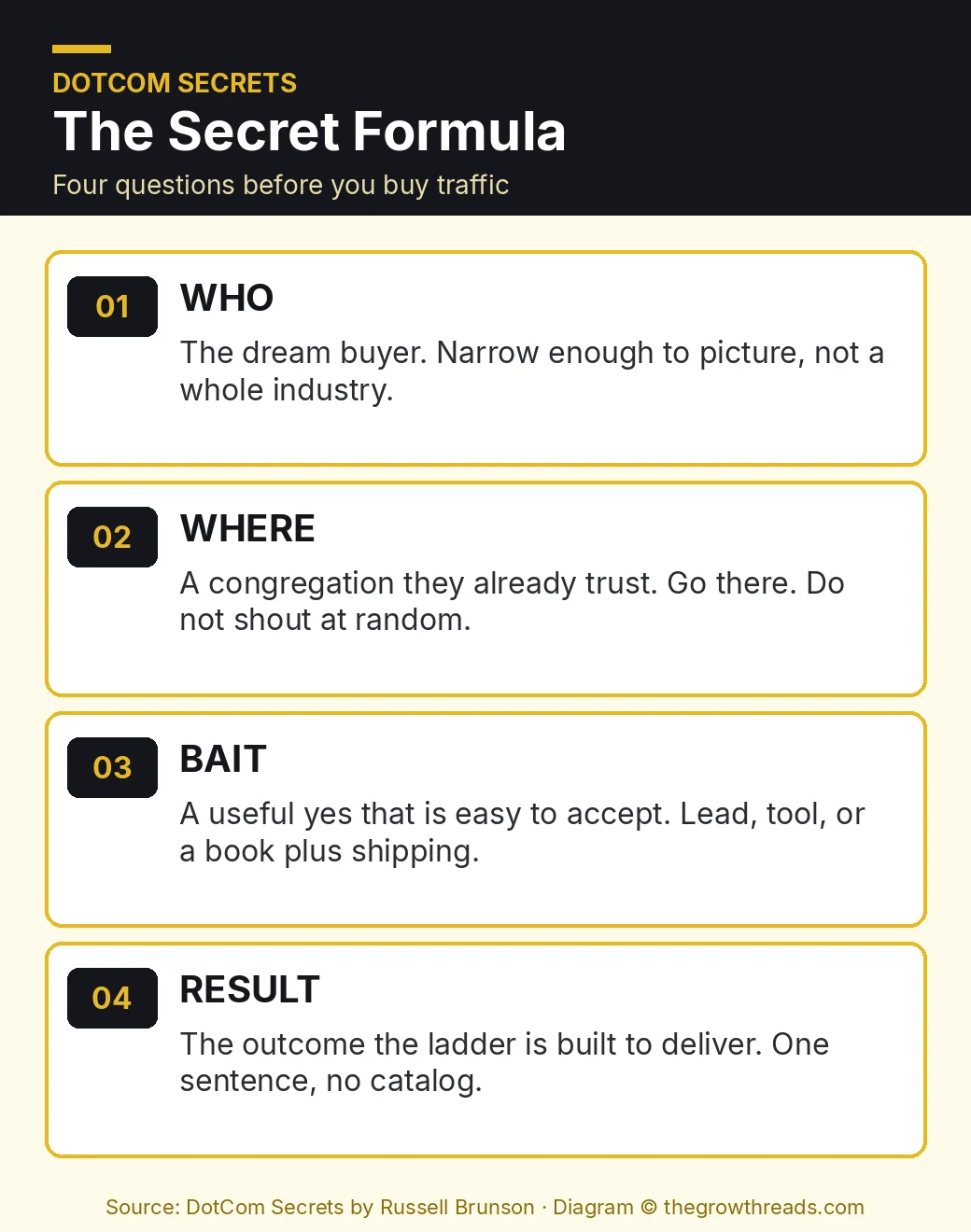
Brunson starts with four questions, and he wants them answered in order. Who is the dream customer? Where can you find a group of them already gathered? What bait will you use to attract them? What result do you want to give them? Most teams invert the list. They buy ads, then discover they cannot describe the person, or they redesign the homepage before they have decided what the first yes is.
The who has to be narrow enough to picture. “Online business owners” is a conference, not a customer. A tighter line names the situation: a coach whose calendar is full of free calls and empty of paid work, or a local shop that gets compliments and almost no repeat orders. The where is a congregation, not a demographic. It might be a search phrase, a partner’s list, a podcast they already finish, or a community they check at lunch. You go there with bait, not with a company story.
Bait is something they already wanted, delivered in exchange for attention. A checklist, a short training, or a physical book they receive for the cost of shipping all qualify. The result is the far end of the relationship, the outcome you can actually help them reach. If you cannot say it in a sentence, the later rungs will wander.
TGR Note: The four lines are a positioning test as much as a media plan. The 22 Immutable Laws of Marketing asks you to be first in a category a stranger can repeat. This Is Marketing asks who the work is for and what change they seek. Answer those, then spend Brunson’s questions on the path.
The value ladder
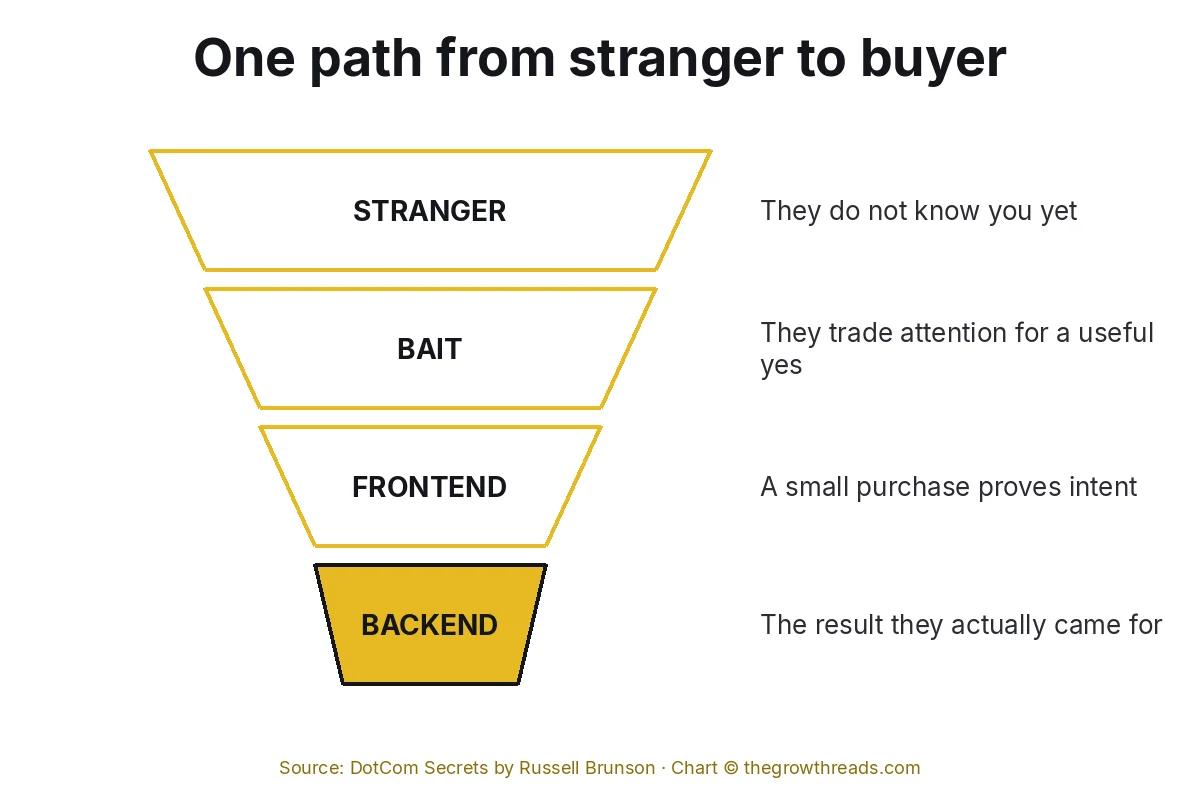
Once the result is clear, Brunson draws a ladder. The bait earns the relationship. The frontend is a low-priced offer, often built so the sale pays for the ads that found the person. The middle is the core product: a course, a workshop, a continuity program, the thing you are actually known for. The backend is high-touch help for the buyers who want the result faster or with you in the room. Coaching, a done-for-you service, or a live event usually live here.
The ladder is a promise about sequence, not a demand that you launch four products this month. What it rules out is sending a new person straight at the backend and calling the silence a traffic problem. Someone who pays even a little has raised a hand in a way a free subscriber has not. That is the logic of the free-plus-shipping book: the book is the bait, shipping is the first yes, and the next offer is how a reader becomes a buyer of the real work.
Price the early rungs so the yes is easy and the delivery is still honest. A weak first product teaches people to ignore the next email. Write the ladder on one sheet, with a name and a price only on the rungs you can deliver.
TGR Note: If a rung is vague, fix the offer before you decorate the page. $100M Offers is the companion for making one ask strong enough to stand on its own. $100M Money Models picks up after the first sale and asks how the next purchase funds the work of finding the next customer.
Match a funnel to each rung
Brunson does not think of a funnel as a trick. He thinks of it as the page sequence that belongs to one rung. The bait usually needs a simple opt-in, or the two-step book funnel: a page that offers the book, then an order form for shipping. The frontend wants a checkout with one order bump, a small add-on chosen in the moment, and at most one upsell after the purchase. The middle often wants a registration page, a presentation that teaches one shift, and an invitation. The backend wants an application and a conversation, not a buy button squeezed under a blog post.
He also teaches funnel hacking, which is less sneaky than it sounds. Find a business whose customers look like yours and whose path already sells. Buy the frontend. Save every page, email, and bump. Draw the ladder you just walked. Then rebuild the structure for your result, in your voice, with your proof. You are borrowing the order of decisions, not the sentences. Teams that skip this step invent seven pages and test none of them. Teams that do it ship a path someone has already shown will move a person forward.
When a step is slow, change one thing: the hook, the story, or the offer. Brunson’s scripts are skeletons. Your customer and your result put the words on them.
Attractive character and the follow-up
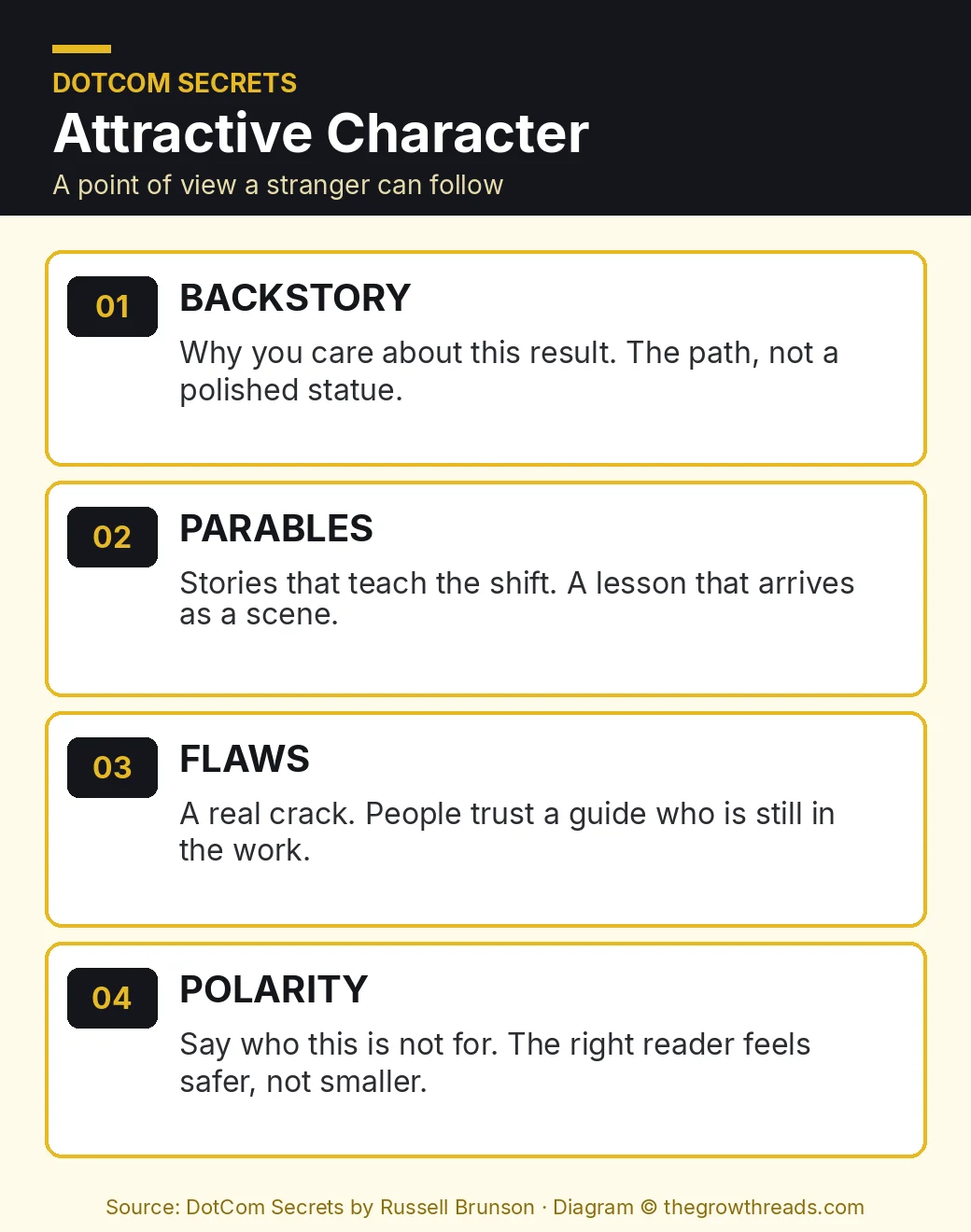
Pages do not create trust by themselves. Brunson asks you to show up as an attractive character: not a fictional mask, a point of view a stranger can follow. Four elements do the work. The backstory explains why you care about this result. Parables are the stories you tell so a lesson arrives as an experience instead of a lecture. Character flaws keep you from posing as a finished statue. Polarity says who the work is not for, which makes it safer for the people it is for.
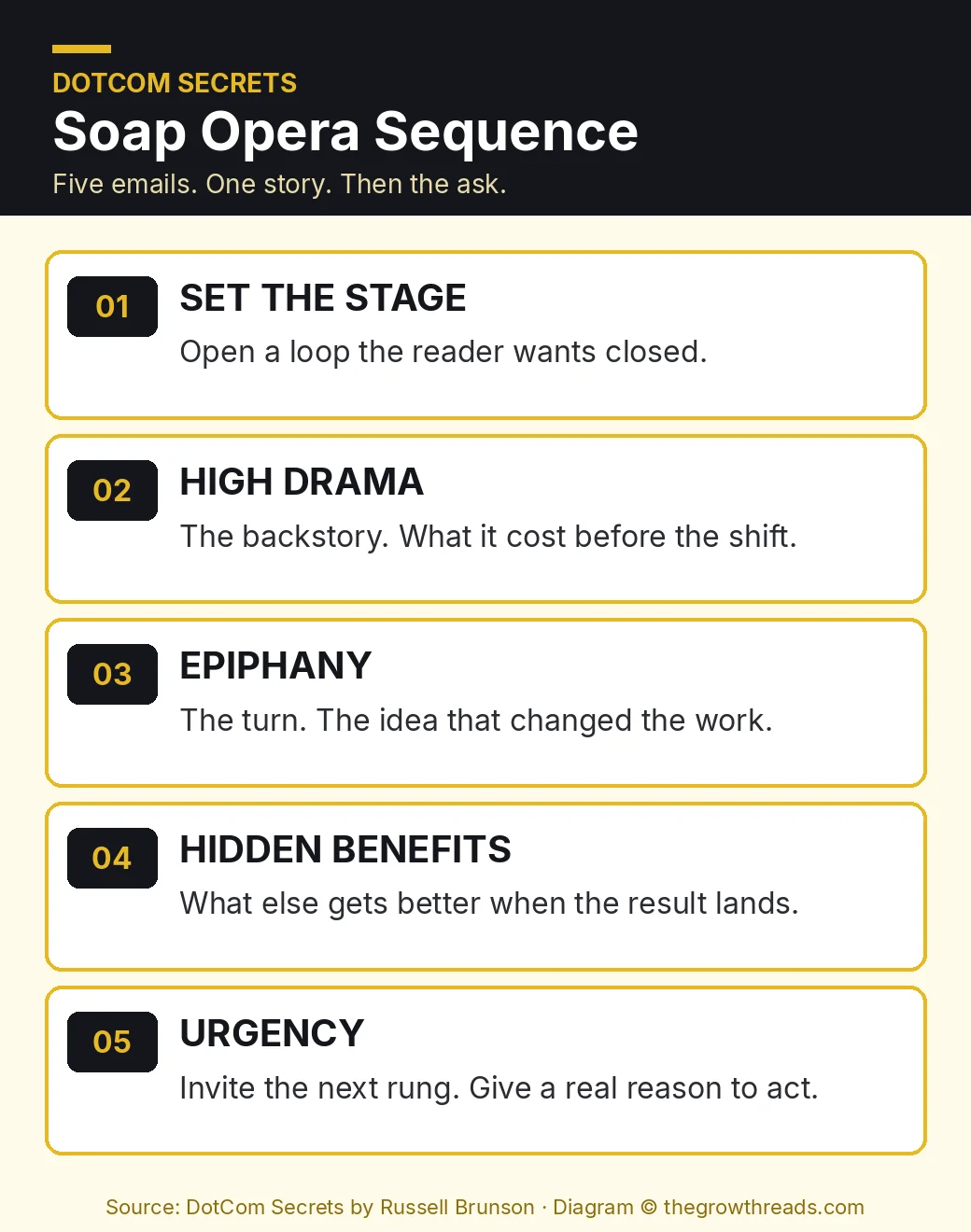
The first follow-up is a soap opera, not a newsletter. Five emails carry one plot. You set the stage and open a loop. You tell the high-drama backstory. You name the epiphany that changed how you work. You show a hidden benefit the reader did not see coming. You invite them to the next rung with a real reason to act now. If an email can be deleted without breaking the story, it does not belong in the five.
After the story, Brunson switches to what he calls Seinfeld emails. They are short notes from your world, a conversation or a mistake, tied back to the offer without a pitch every day. They keep you familiar, so the next campaign does not arrive from a stranger. A list that only hears from you when you want money learns to ignore you.
TGR Note: The five emails only work if you earned the right to send them. Permission Marketing is the older argument for that consent. On the page itself, Building a StoryBrand keeps the customer as the hero and you as the guide, which is the same job as Brunson’s parable, told as a message script.
Who is DotCom Secrets best for — and who should read something else first?
Read this if you sell a real offer and your site still behaves like a lobby. Coaches, course builders, agencies, and small product teams get a clear week from the formula, the ladder, and the five emails.
Read something else first if the offer itself is soft. $100M Offers will do more for you than another page. If strangers cannot tell what category you lead, start with The 22 Immutable Laws of Marketing or This Is Marketing. If the sale is a complex B2B jump that a simple page will not carry, Crossing the Chasm is the better map. Come back when you are ready to ask for one next step and deliver it.
Questions to reflect on
- Who, specifically, is the dream customer for the next 90 days, and who are you willing to disappoint?
- Where do those people already gather, and what would you have to say to earn a minute there?
- What is the bait, and can someone understand the yes in one reading?
- Which rung is missing, and which rung are you pretending you have?
- If a new buyer received only five emails from you, what story would those five emails tell?
🔥 Ready to build one funnel this week?
Sketch the ladder, write the bait, and ship one next step before you buy more traffic.
How to apply DotCom Secrets (7-day plan)
- Day 1 — Name the customer and the result. Write one sentence for who you want and one sentence for the result you can honestly help them reach. If either line lists three audiences, it is not done.
- Day 2 — Find three congregations. List three places those people already pay attention. Circle the one you can reach this month without a new brand campaign.
- Day 3 — Sketch the ladder. On one page, label bait, frontend, middle, and backend. Leave a rung blank if you cannot deliver it.
- Day 4 — Write the bait page. One hook, one short story, one offer. Cut every sentence that explains the company instead of the next step.
- Day 5 — Add one ascent. Put a single order bump or one upsell behind the bait. Price it so a yes is easy.
- Day 6 — Draft the five emails. Set the stage, tell the backstory, name the epiphany, show a hidden benefit, and invite the next rung. If email three does not need email two, start again.
- Day 7 — Send it to a small group. Publish the bait to a warm list or a small test. Did a stranger take it, and did anyone take the next rung? Fix the page before you widen the traffic.
Frequently asked questions
What is the shortest honest DotCom Secrets summary?
DotCom Secrets says a website that tries to explain the whole company asks a stranger to do too much. Russell Brunson replaces that brochure with a path. You name who you want, find where they already gather, offer bait they can accept quickly, and name the result the relationship is for. Offers then sit on a value ladder, so a small yes pays for the chance to make a better one. Each page keeps a hook, a story, and one ask. Follow-up email does the teaching a homepage never finishes. Read it as a build sheet. Ship one rung before you design the rest.
What are the four questions in the Secret Formula?
Brunson asks four questions before he spends money on traffic. Who is the dream customer? Where do they already gather, so you are not shouting at a vague audience? What bait will you use: a lead, a free-plus-shipping book, or a small tool they actually want? What result will you walk them toward once they raise a hand? The order is the lesson. Teams that start with a logo, a homepage, or an ad account skip the formula and then wonder why the click never became a customer. Write the four lines before you open a page builder.
What is a value ladder in DotCom Secrets?
A value ladder is the stack of offers that takes someone from a first yes to the result they came for. The bait earns attention. The frontend is a small purchase that proves intent and often pays for the ads. The middle is the core product, a workshop, or a continuity offer. The backend is the high-touch work: coaching, a done-for-you service, or a live event. You do not need every rung on day one. You do need to know which rung exists and which one is next, so a buyer is never dropped onto a homepage that asks them to figure the path out alone.
What does Brunson mean by “a confused mind always says no”?
He means a visitor who is given three goals will pick none. A page that explains the company, lists every product, and asks people to browse feels polite and converts poorly. Brunson wants one decision per screen. The headline is the hook, the copy is one story, and the button is one offer. The next step can be smarter, but it should not appear until this step is finished. That is why his funnels look narrow. The narrowness is kindness. It keeps a new person from having to become an expert in your catalog before they are allowed to take a small, obvious action.
Do you need ClickFunnels to use this book?
No. ClickFunnels is the software Brunson cofounded so a small team could publish these pages without a custom build. The book is the doctrine, not a menu inside the app. A squeeze page, a two-step book order, an order bump, one upsell, and a five-email story can live in any page builder and any email tool you already trust. What you cannot skip is the sequence. If the tool makes it easy to add seven offers on one screen, ignore that convenience. The useful test is whether a stranger can see the next step in one reading and take it without asking you what to do.
How is DotCom Secrets different from $100M Offers?
Alex Hormozi’s $100M Offers is about making one offer so strong that the right person feels silly refusing it. DotCom Secrets assumes you are ready to place that offer, or a smaller sibling of it, on a path. Brunson spends his pages on order: who it is for, where they are, what the bait is, how the rungs connect, and how the emails continue the story after the click. Read Offers when the thing you sell is fuzzy. Read DotCom Secrets when the offer is real and the traffic still lands on a brochure.
Who should read DotCom Secrets, and who should wait?
Read it if you already sell something and your site still tries to introduce the whole company at once. Coaches, course builders, agencies, and small product teams get the most from the ladder and the five-email story. Wait if you do not yet have an offer a real customer would pay for. A funnel cannot rescue an empty rung. Wait, too, if your buyers need a long education cycle and a category story before a simple page makes sense. In that case, get the offer sharp, or get the market story straight, and come back when you are ready to ask for one next step.
Related summaries
- $100M Offers — make one rung strong enough that the right person can say yes.
- $100M Leads — what to do once the path exists and you need more of the right strangers.
- Building a StoryBrand — the message script that keeps the customer as the hero on every page.
- The 22 Immutable Laws of Marketing — be first, and own one word, before you spend it on a longer line.
- Best productivity books — the wider shelf this playbook sits on.
How we analyze books: we read for the models you can use this week, check the edition we link, and write a 7-day plan a working person can finish. Read our full methodology.