

★★★★½ 4.6/5 — One customer should pay for the next two.
Best for: owners who already sell something and want the first month of cash to fund more customers.
Reading time: ~3 hrs (guide: 190 min)
Difficulty to apply: Medium. You need a real offer and a way to take payment.
$100M Money Models in one minute
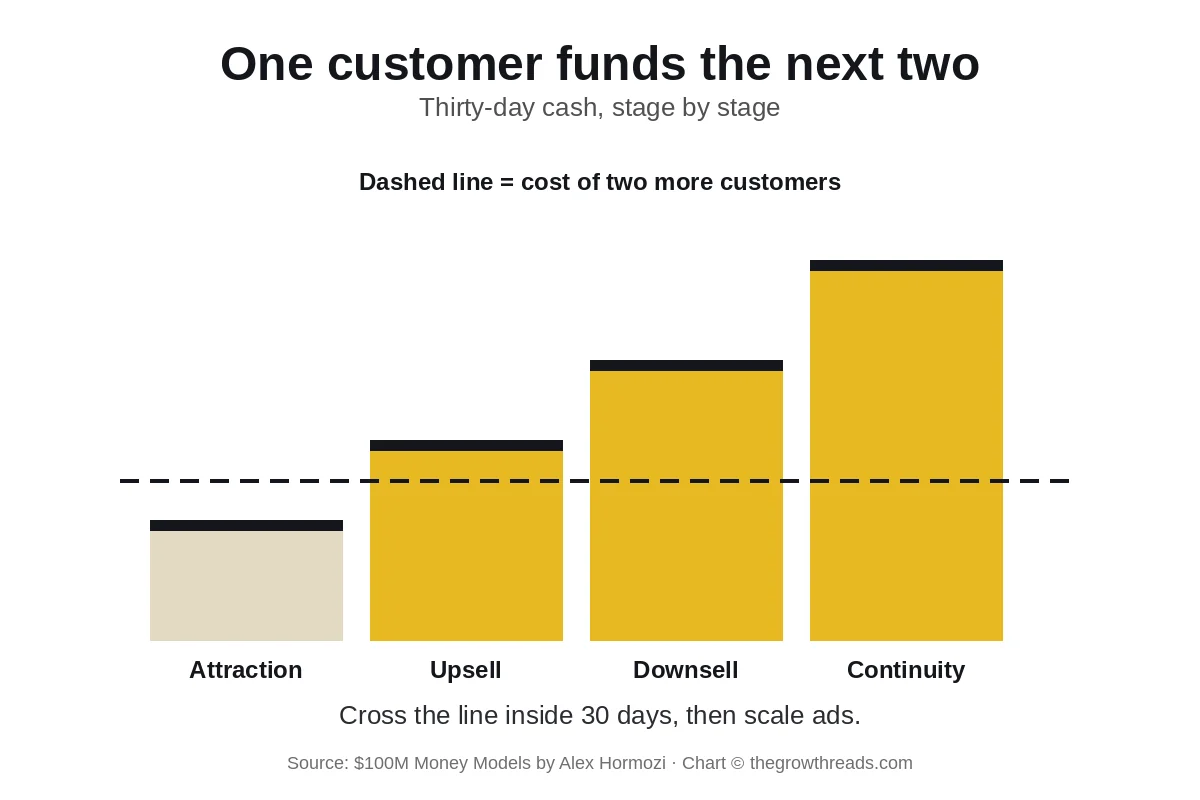
A money model is a deliberate sequence of offers that makes one customer fund the next two inside thirty days.
Alex Hormozi’s third playbook, published by Acquisition.com on August 20, 2025, picks up after the offer is designed and after strangers know you exist. The question left on the table is timing. Can the cash from a new customer arrive fast enough to pay for the customers who come after them? When it can, advertising becomes a repeatable print.
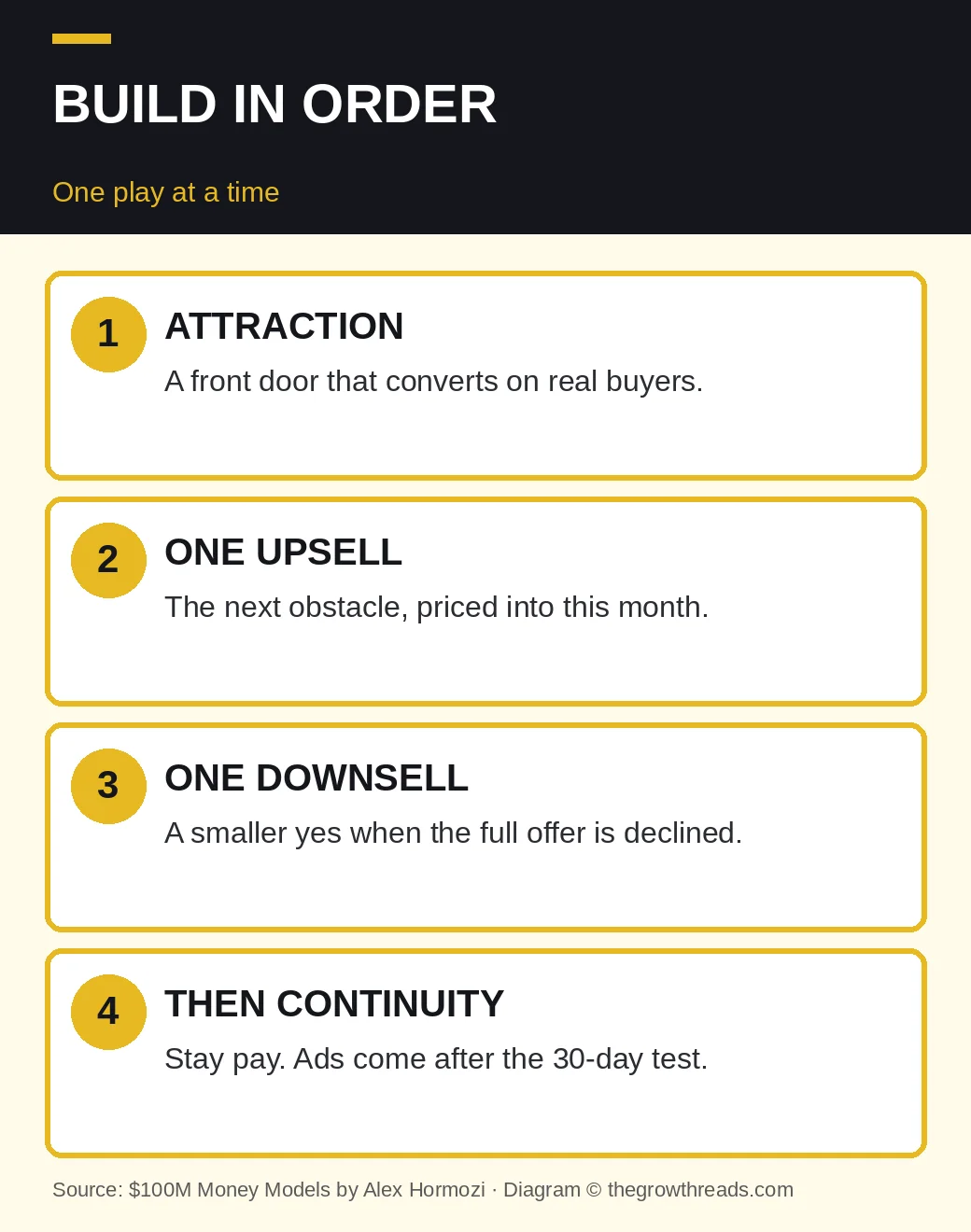
He splits the work into three stages. Get Cash uses attraction offers for the first yes. Get More Cash uses upsells and downsells so more of that first month is planned. Get The Most Cash uses continuity so the right people keep paying. Install one play, watch the thirty-day cash, then add the next play only after the current one pays.
Key takeaways
- Sequence beats a single promotion: what you offer, when you offer it, and how you offer it is the model. A clever discount with no next step is a one-night event.
- The thirty-day test: profit from one customer should cover getting and serving at least two more customers inside a month.
- Get customers reliably first: an attraction offer exists to open the relationship at a cost you can live with.
- Make them pay for themselves next: upsells raise the cash collected while the first problem is still fresh.
- A no can still be a yes: downsells change the payment plan or the feature set. The full offer keeps its price.
- Continuity is stage three: bonuses and waived fees earn an ongoing payment after the first transaction works.
- Advertise last: spend heavily only after one customer already funds the next two.
- Install one play at a time: stack a second offer only after the first one converts on real buyers.
What is $100M Money Models about?
$100M Money Models shows owners how to arrange offers so a business collects cash fast enough to fund its own growth. Hormozi groups the plays into attraction offers, upsells, downsells, and continuity. The standard is practical: profit from one customer should pay to get and serve two more customers within thirty days.
About the author
Alex Hormozi is an American entrepreneur and investor. With Leila Hormozi he built a portfolio of service and education companies, then started Acquisition.com to back businesses they know how to grow. The operating story begins in gyms. He learned to sell memberships, and later a licensing offer, by making the first purchase so clear that ads stopped feeling like a gamble. $100M Offers, released in 2021, is his field manual for that offer: dream outcome, perceived likelihood, time delay, and effort. $100M Leads is the field manual for getting strangers to raise a hand through warm outreach, content, cold outreach, and paid ads. Explore all Alex Hormozi book summaries →
$100M Money Models is the third book. Acquisition.com published the 190-page hardcover on August 20, 2025. The writing keeps the same voice: short chapters, named plays, and a bias for cash this month.
Key concepts at a glance
| Concept | What it means | Use it when |
|---|---|---|
| Money model | A planned sequence of offers, timed so cash arrives fast. | Ads bring buyers and the bank account still shrinks. |
| Thirty-day test | One customer should fund getting and serving two more inside a month. | You need a single number that says the model works. |
| Attraction offer | The first yes: a win-your-money-back promise, a giveaway, a decoy, or buy-X-get-Y. | Strangers like the promise and still will not start. |
| Upsell | A menu, an anchor, or a rollover credit that raises this month’s spend. | Buyers already said yes and the next problem is obvious. |
| Downsell | A payment plan, a trial with clear terms, or a smaller feature set. | They want the result and the full price stopped them. |
| Continuity offer | An ongoing payment earned with a bonus or a waived setup fee. | The first result was real and people should stay. |
| Get cash, then more, then the most | Three stages: attraction, then upsell and downsell, then continuity. | You are tempted to launch four offers in one week. |
| Advertise after the model pays | Scale spend only once the thirty-day test already clears. | Someone asks for a bigger ad budget before the second offer exists. |
Stage I: Get cash with an attraction offer
The first job of a money model is a reliable first yes. Attraction offers are the front door, built to get more customers for less, with enough margin left to keep serving people. A busy inbox of browsers still fails this stage.
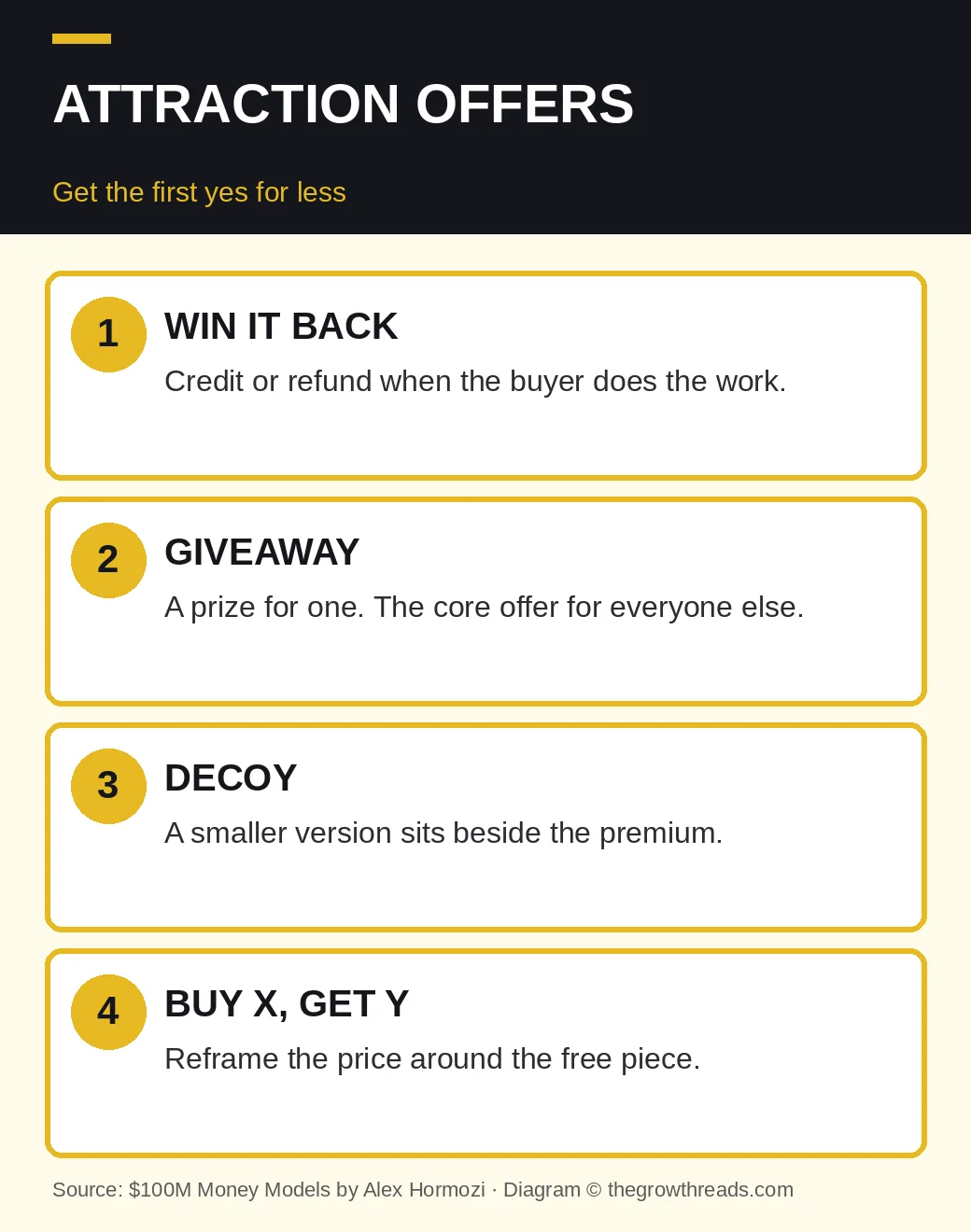
Four plays do most of the work. Win your money back ties a refund or credit to the buyer showing up and finishing the work. Giveaways advertise a prize, collect names, and offer the core product to everyone else on a deadline. A decoy sets a smaller version beside the premium so the premium feels like the obvious choice. Buy X, get Y free reframes the price, especially when Y is the piece they already wanted more.
Each play gives a stranger a reason to start this week and a path into the core offer. A front door with no path only rents attention. A front door that leads to a thin promise needs the earlier book, not a fifth play.
TGR Note. Attraction offers assume the core promise is already strong. If buyers cannot picture the result, start with $100M Offers and the value equation before you add a decoy. If the promise is clear and nobody new is seeing it, $100M Leads is the companion on warm outreach, content, cold outreach, and ads. Money Models is the timing layer on top of both.
Stage II: Get more cash with upsells
Once people buy, the model asks what else they need while the first problem is still in the room. Upsells raise thirty-day cash. A lifetime value that shows up in month fourteen does not pay this month’s ad invoice, so the upsell has to be something a new buyer can understand today.
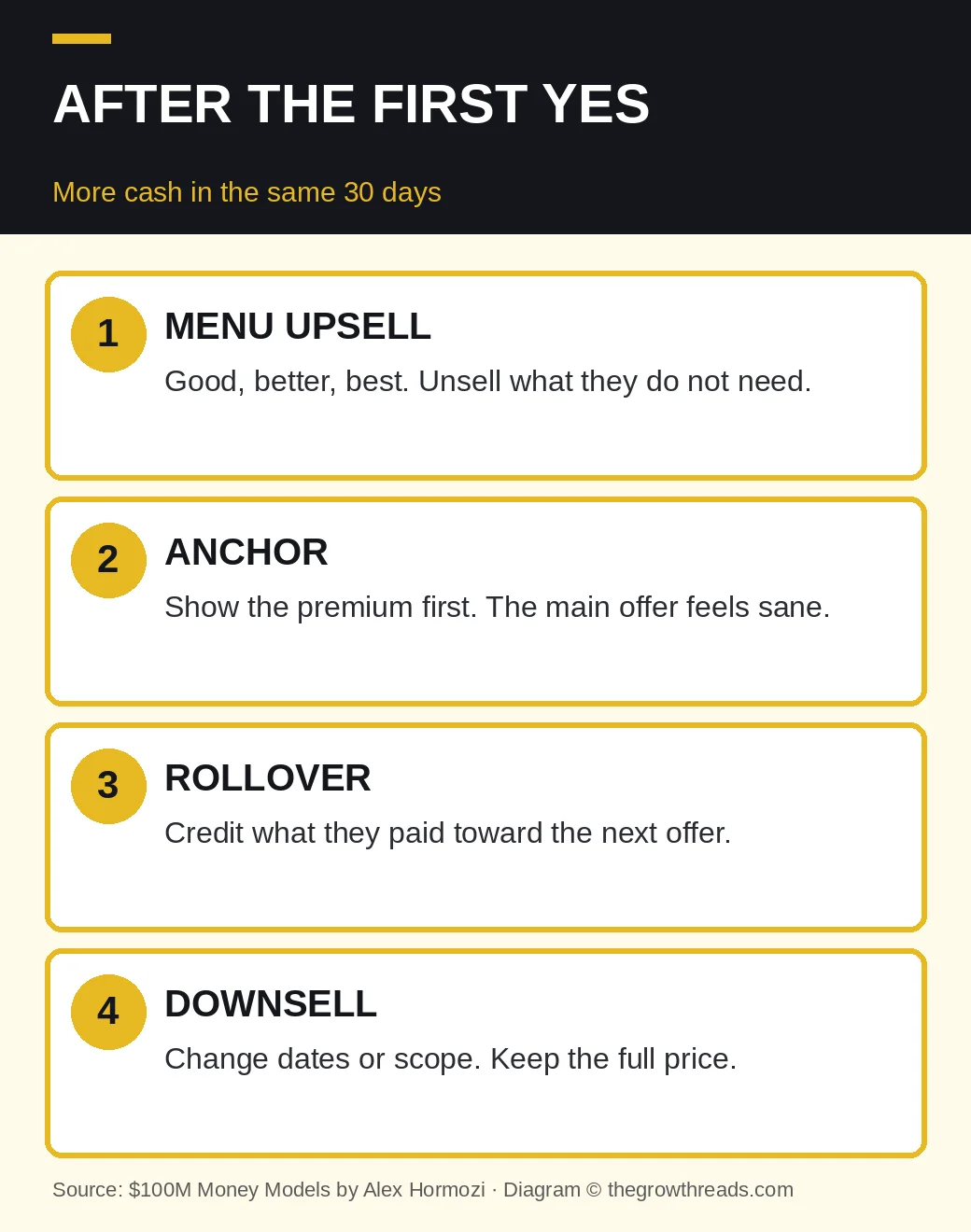
Three shapes cover most cases. A menu upsell offers good, better, and best, and can honestly unsell a piece they do not need. An anchor shows a premium version first so the main version feels like the sensible pick. A rollover credits what they already paid toward the next offer.
The upsell should solve the next real obstacle. If someone buys a workshop, the upsell might be the reviews that make the work stick. If someone buys a service package, it might be the done-with-you version of the step they will stall on. Price it so the combined first month still clears the thirty-day test.
Add the upsell only after the attraction offer converts. Two new scripts in the same week hide which one moved the cash.
Downsells that keep the full price intact
Some people want the result and still say no to the full offer. A downsell is the play for that moment. The rule that keeps the model healthy is simple to say and hard to keep: change the terms or the scope. Leave the full offer’s price where it is. A quiet twenty percent off the same package trains the market to wait, and it trains your team to apologize.
Payment plans spread a yes over dates the buyer can meet, and the total can stay whole. A trial with terms lets someone start if they meet the conditions. Feature downsells remove a piece, or hand back a do-it-yourself version, so the price follows the work. You are selling a different product on purpose.
Downsells bring more people in and protect the premium path. The buyer who can pay full price still sees that price. The buyer who cannot gets a real alternative. If almost everyone takes the downsell, the full offer has become an accidental decoy, and the front door needs another look.
TGR Note. A downsell works when the delivery can survive a smaller scope. If every client still needs the founder on the call, read Built to Sell before you add payment plans. Productize the piece you can repeat, then let the downsell point at that piece. Pair it with the offer design in $100M Offers so the smaller version is still a complete result, just a narrower one.
Stage III: Continuity so the best customers stay
Attraction, upsells, and downsells can fund the next two customers and still leave the business starting over every month. Continuity offers are stage III: Get The Most Cash. They trade ongoing value for an ongoing payment, and they are how the thirty-day engine becomes a book of business.
Two plays are enough to start. A continuity bonus, worth more than the first payment, earns the ongoing plan today. A waived-fee offer drops a large setup charge when the buyer commits to a longer term. Both sell the relationship. If the month itself is thin, fix the month before you add the gift.
His order is the part owners skip. Get customers reliably. Make sure they pay for themselves. Make sure they pay for other customers. Then maximize long-term value. Then spend advertising dollars the model can print. Continuity is the fourth step. A membership with a weak front door never funds the second customer.
TGR Note. Continuity fails when the business only runs if you are in the room. Clockwork is the companion for designing the week so delivery survives a vacation. The E-Myth Revisited makes the same point from the technician’s trap. Use Hormozi to time the cash. Use those two to make the promise deliverable by a team.
Who is $100M Money Models best for — and who should read something else first?
Read this first if you already sell a product, a service, or a program and the gap is cash timing. You can describe the buyer, you can take a payment, and you still feel a flinch every time you raise ad spend. The thirty-day test gives you a scoreboard, and the named plays give you something to install.
Read something else first in three common cases. If the offer itself is fuzzy, start with $100M Offers and come back when the promise, the proof, and the effort are written down. If the offer is sharp and the calendar is empty of new conversations, start with $100M Leads. If you are still the only person who can deliver, start with Built to Sell or The E-Myth Revisited so a second customer does not break the week. A money model multiplies a working promise. It does not invent one.
Questions to reflect on
- If you paused ads tomorrow, would one recent customer already have funded two more, or only their own delivery?
- What is the first yes a stranger can give you this week, and what core offer does that yes lead to?
- Which upsell solves the very next obstacle your last ten buyers actually hit?
- When someone says the full price is too high, do you change the scope, or do you discount the same package?
- What would a continuity bonus need to include so staying feels like the obvious second purchase?
🔥 Ready to make one customer fund the next two?
Put the offers you already sell into a thirty-day sequence before you raise the ad budget.
How to apply $100M Money Models (7-day plan)
- Day 1 — Write the thirty-day test. Pick one core offer. Note the price, the delivery cost, and what you spend to get a customer today. Write one sentence: profit from one buyer inside thirty days should cover two more buyers.
- Day 2 — Choose one attraction offer. Pick a single front door: win your money back, a giveaway, a decoy, or buy-X-get-Y. Write the promise, the deadline, and the click that leads to the core offer.
- Day 3 — Show it to ten real people. Send the attraction offer to ten past buyers or warm conversations. Record the exact words they use when they hesitate. Do not add a second offer today.
- Day 4 — Draft one upsell from the next obstacle. From those hesitations and from your last deliveries, name the stuck point that shows up after the first yes. Price one menu item, one anchor, or one rollover credit that solves it.
- Day 5 — Draft one downsell with a different scope. Write a payment plan or a feature-smaller version. Keep the full offer’s price on the page. Put both options in the same checkout note so the team says the same thing.
- Day 6 — Sketch continuity, and leave it off. Name the monthly promise and one bonus that is worth more than the first payment. Do not launch it until the attraction offer and one upsell have real takers.
- Day 7 — Score the week and pick one change. Count yeses, cash collected, and delivery hours. If the front door is quiet, rewrite the attraction offer. If people buy and stall, add the upsell. Leave the ad budget alone until the thirty-day line clears.
Frequently asked questions
What is a money model in $100M Money Models?
A money model is a deliberate sequence of offers: what you sell, when you sell it, and how you present it so cash arrives quickly. Hormozi’s test is specific. One customer should produce enough profit within thirty days to get and serve at least two more customers. Attraction offers open the relationship. Upsells and downsells raise what you collect in that first month. Continuity offers keep the right people paying after the first problem is solved. The order matters more than any single promotion. Build the sequence until the first month pays for the next two customers, and only then turn advertising up.
How is $100M Money Models different from $100M Offers and $100M Leads?
$100M Offers designs the thing you sell: the dream outcome, the belief it will happen, the time it takes, and the effort it asks. $100M Leads finds people you can contact, through warm outreach, content, cold outreach, and paid ads. $100M Money Models assumes you can already take a payment. It asks whether cash from one buyer shows up soon enough to fund the next buyers. Read Offers when the promise is fuzzy. Read Leads when the promise is sharp and the pipeline is empty. Read Money Models when strangers already say yes sometimes and the bank account still argues with the ad account.
What are the three stages in the book?
Stage I is Get Cash. Attraction offers bring in more customers for less, with plays such as win your money back, giveaways, decoys, and buy-X-get-Y. Stage II is Get More Cash. Upsells and downsells increase what a new buyer spends in the first month, while the original problem is still vivid. Stage III is Get The Most Cash. Continuity offers trade ongoing value for an ongoing payment so the relationship outlasts the first invoice. In practice he wants a reliable front door, then proof that buyers pay for themselves, then proof they pay for other buyers, then a longer relationship, and only then a larger ad budget.
What is an attraction offer, and which one should I start with?
An attraction offer is the first yes. It gives a stranger a reason to start now and a path into the core product. Win your money back links a refund or credit to the buyer doing the work. A giveaway advertises a prize, gathers names, and offers the core product to everyone else on a deadline. A decoy places a smaller version next to the premium so the premium reads as the sensible choice. Buy X, get Y free reframes the price, especially when Y is the piece they wanted most. Start with one, and run it before you open a second front door.
What is a downsell, and how is it different from a discount?
A downsell is another way to buy, or a narrower thing to buy, when someone wants the result and declines the full package. A payment plan keeps the total and changes the dates. A trial with terms lets them start if they meet the conditions. A feature downsell removes work, and the price follows the scope. A discount takes money off the same full package. That teaches buyers to wait and teaches the team to flinch. Hormozi keeps the full price on the menu and sells a different offer beside it. Use a downsell when you can deliver the smaller scope well, and watch which path people pick.
Who is $100M Money Models for, and how long is it?
The book is for owners who already have something to sell and need the first month of revenue to carry the next customers. Service firms, coaches with a defined program, and local businesses with a real ticket price will recognize the plays quickly. People still hunting for a problem to solve should read $100M Offers first. The Acquisition.com hardcover, ISBN 9781737475781, came out on August 20, 2025, and runs 190 pages. Hormozi says the tactics took him a decade and the read takes about three hours. Use one sitting for the map and a second pass with last month’s prices beside you.
Do I need attraction, upsell, downsell, and continuity all at once?
The build order is the point. Perfect one attraction offer until new buyers come in at a cost you can explain. Add one upsell that solves the next obstacle those buyers hit. Add one downsell so a sincere no to the full price can still become a smaller yes. Sketch continuity, and turn it on after the first two stages show cash. Advertising comes last, when one customer already funds two more inside thirty days. Launching the full menu in a weekend makes the numbers unreadable. Keep a simple card: yeses, cash in thirty days, and hours to deliver. Change one line on that card at a time.
Related summaries
- $100M Offers Summary — design the promise before you sequence it.
- $100M Leads Summary — fill the front door the money model depends on.
- Built to Sell Summary — make delivery repeatable before you add payment plans.
- Clockwork Summary — keep the promise alive when you are not the one delivering it.
Browse the full shelf on our best productivity books pillar.