
Technology
The Creativity Code Summary & Review: Can AI Really Create?
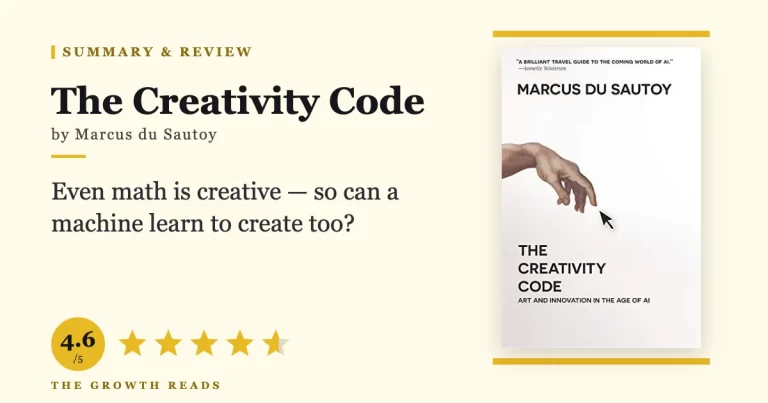
Marcus du Sautoy's The Creativity Code tests whether AI is genuinely creative across games, art, music, and mathematics — using Move 37,…
Read Summary →
"Oxford mathematician probing whether machines can truly create"
Marcus du Sautoy is a British mathematician and the Simonyi Professor for the Public Understanding of Science at the University of Oxford, a chair previously held by Richard Dawkins. A number theorist by training, he has spent his career translating abstract mathematics for general audiences through books, television, and public lectures, including the BBC series "The Story of Maths." In The Creativity Code, he turns his mathematician's eye on artificial intelligence, asking whether machines that compose music, paint pictures, and play world-class Go are actually being creative, or merely executing very sophisticated pattern-matching -- and uses his own discipline, mathematics, as a test case for what creativity really requires.
Our in-depth summaries and reviews of his work
Marcus du Sautoy's The Creativity Code tests whether AI is genuinely creative across games, art, music, and mathematics — using Move 37,…
Read Summary →Du Sautoy borrows Margaret Boden's framework -- exploratory, combinational, and transformational creativity -- to judge whether an AI's output is genuinely novel or just a remix of its training data.
AlphaGo's famously "impossible" move against Lee Sedol becomes the book's touchstone for machine creativity: a move no human expert would play, arrived at through self-play rather than imitation.
Du Sautoy argues that proving a theorem is as creative an act as composing a symphony, which is why he treats his own field as the sharpest test of whether AI can ever cross from generation into genuine invention.
""—
""—
""—
Marcus du Sautoy's The Creativity Code tests whether AI is genuinely creative across games, art, music, and mathematics — using Move 37, GAN art, and his own field as the proof.