

★★★★★ 4.6/5 — Write last night’s story, then name the wish it was protecting.
Best for: Readers who already jot down dreams and anyone whose night plots keep recycling yesterday’s leftovers
Reading time: ~22 hrs for the Basic Books Strachey paperback · ~10 min for this guide
Difficulty to apply: The notebook is small; reading Freud’s 688 pages is the long part
The Interpretation of Dreams in one minute
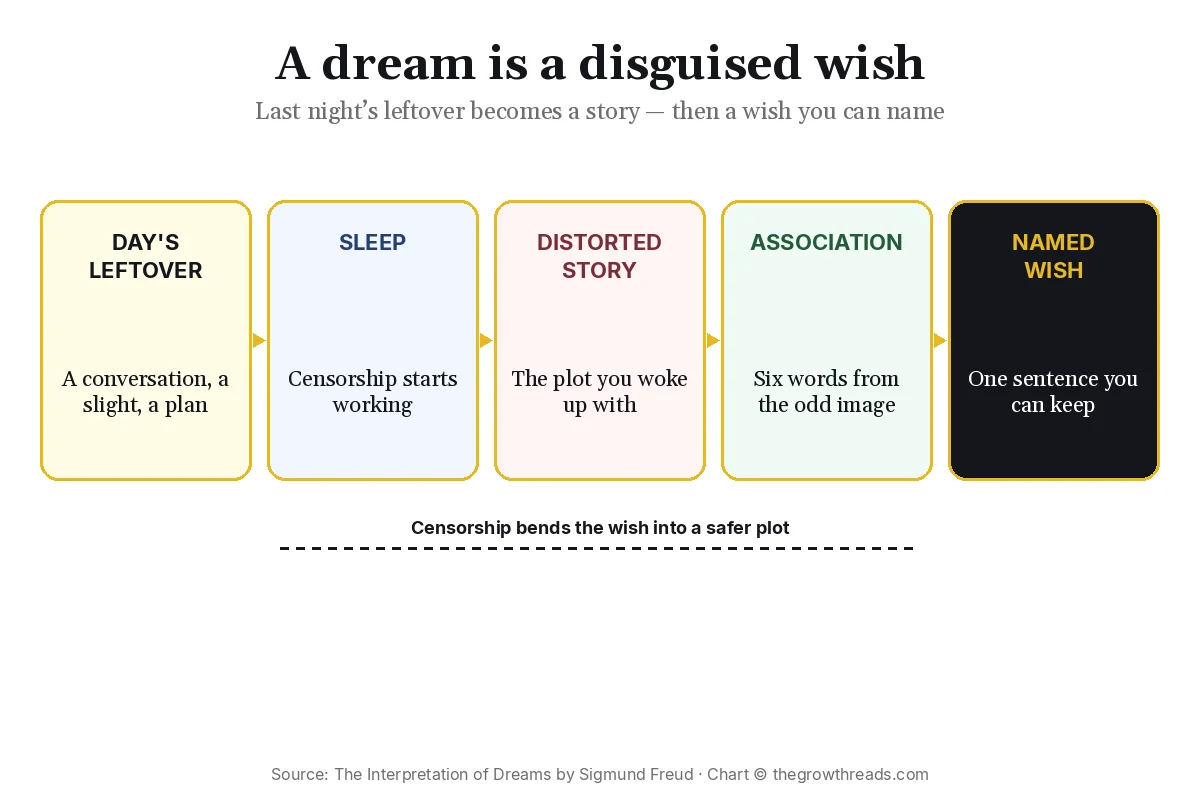
A dream is a wish that had to borrow a costume. Sigmund Freud’s 1899 book — dated 1900 on the title page — is not a poster of snakes and trains. It is a method. You start from the plot you remember, the leftover from yesterday, and the odd image that does not belong. You let words come. Then you name a wish the day would not let through the door. Condensation packs many leftovers into one face. Displacement moves a feeling onto a safer object. Secondary revision tidies the ending so breakfast can hear it. The “royal road” is a road you can walk with a notebook. This summary steals the method, not a diagnosis. Write eight lines. Name one wish. Take one small action in daylight.
Key takeaways
- Dreams are work, not noise: Sleep has a job. The remembered plot is a finished costume, not the first draft.
- A dream is a disguised wish: The wish is usually small and recent — to speak, to rest, to be seen, to undo a slight.
- Start from the leftover: Yesterday’s conversation, plan, or embarrassment walks into the night. Write that residue first.
- Free association beats a symbol list: Six words from the oddest image will tell you more than a poster of “what dreams mean.”
- Condensation crowds the picture: One hallway can hold three people. Ask who else is in the room.
- Displacement moves the feeling: Anger at a partner can land on a stranger or a missed train. Follow the feeling, not the prop.
- Revision is the tidy ending: The decent close is often the censorship. Ask what it made safe.
- The unconscious is a weekday word: It is the part that will not speak at the meeting. A dream is one letter from it.
- The usable close is a notebook: Eight lines, three leftovers, one wish-sentence. Stop before you invent a new personality.
What is The Interpretation of Dreams about?
The Interpretation of Dreams is Sigmund Freud’s 1899 method for reading a night story as a disguised wish. You start from the remembered plot, free-associate, and name yesterday’s leftover plus the wish the dream-work hid. The usable steal is a notebook, not a diagnosis.
About the author
Sigmund Freud (6 May 1856 – 23 September 1939) was an Austrian neurologist and the founder of psychoanalysis. Born Sigismund Schlomo Freud in Freiberg, Moravia — now Příbor in the Czech Republic — he trained in medicine in Vienna, worked at the General Hospital, studied with Jean-Martin Charcot in Paris, and opened a private practice for nervous disorders. With Josef Breuer he published Studies on Hysteria in 1895. The Interpretation of Dreams, written through the late 1890s and released in November 1899 with a 1900 imprint, is the book he treated as his master-work: free association, the claim that a dream is a disguised wish, and the first full map of the unconscious. He later built the talking cure around that claim. In 1938 he left Vienna for London, and he died there the next year. Explore all Sigmund Freud book summaries →
Key concepts at a glance
| Concept | What it means | Use it when |
|---|---|---|
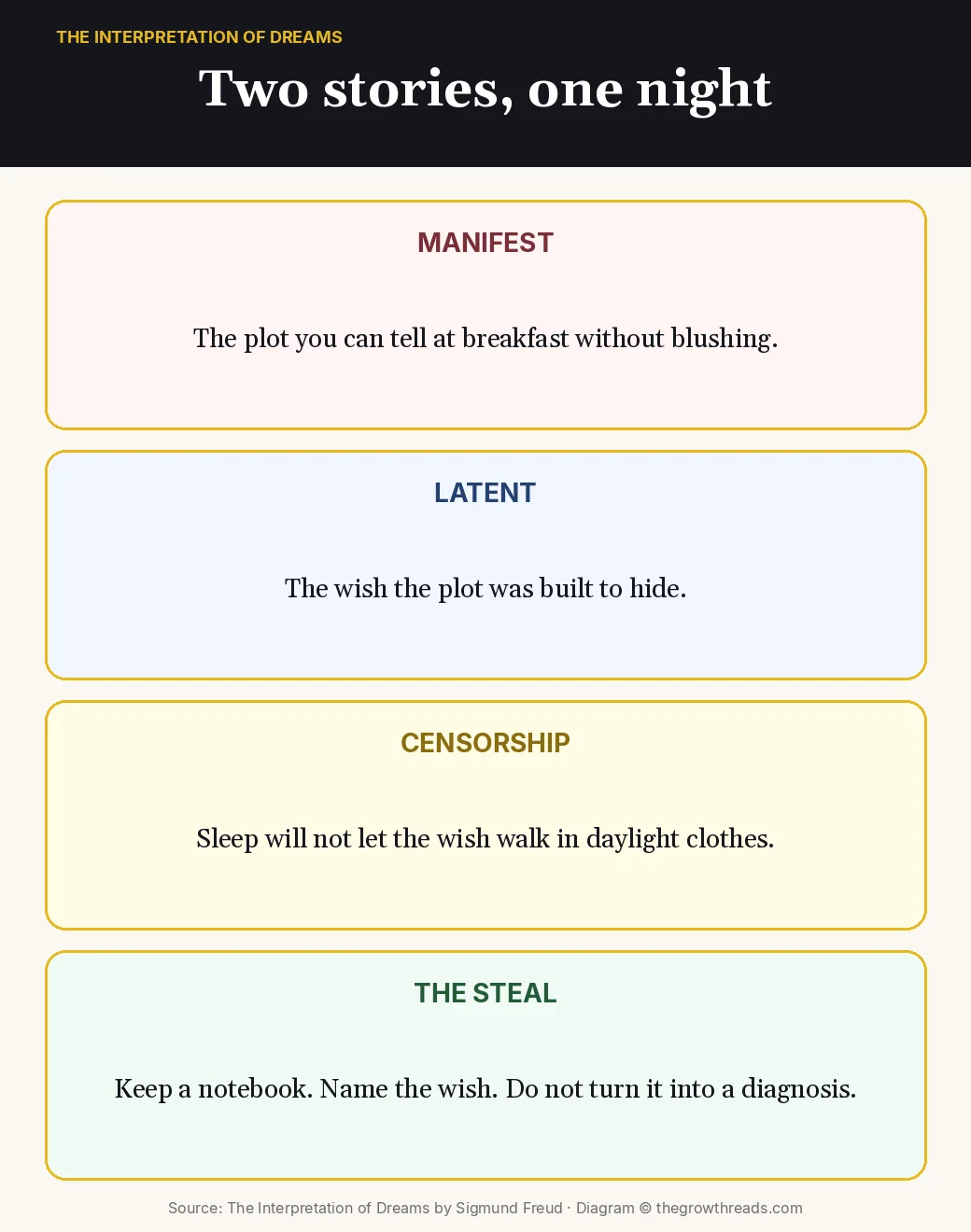
| Manifest content | The plot you can tell at breakfast | You remember a story but not why it mattered |
| Latent content | The wish the plot was built to hide | The feeling is bigger than the scene |
| Day’s residue | Yesterday’s leftover that walks into the night | The same hallway keeps using Tuesday’s slight |
| Wish-fulfillment | A dream stages a wish the day refused | You wake with a feeling and no useful plot |
| Dream-work | Condensation, displacement, pictures, tidy ending | The story looks random and crowded |
| Free association | Words from an image, without a tidy editor | A symbol list is making you invent meanings |
| Censorship | Sleep will not let the wish walk in daylight clothes | The ending is suddenly decent and dull |
| Royal road | A walkable path to the part that will not speak at work | You want a method, not a poster |
Part 1: The dead science and Irma’s injection
Freud opens with a tour of a literature that had already given up. Nineteenth-century science could say a dream was digestion, a leftover image, or a little psychosis of the night. It could not say why this face, this hallway, this missed train. He is not polite about the gap. If dreams are only noise, there is nothing to interpret. If they are work, there is a method. The rest of the book is that method, argued at a length that still startles a weekday reader.
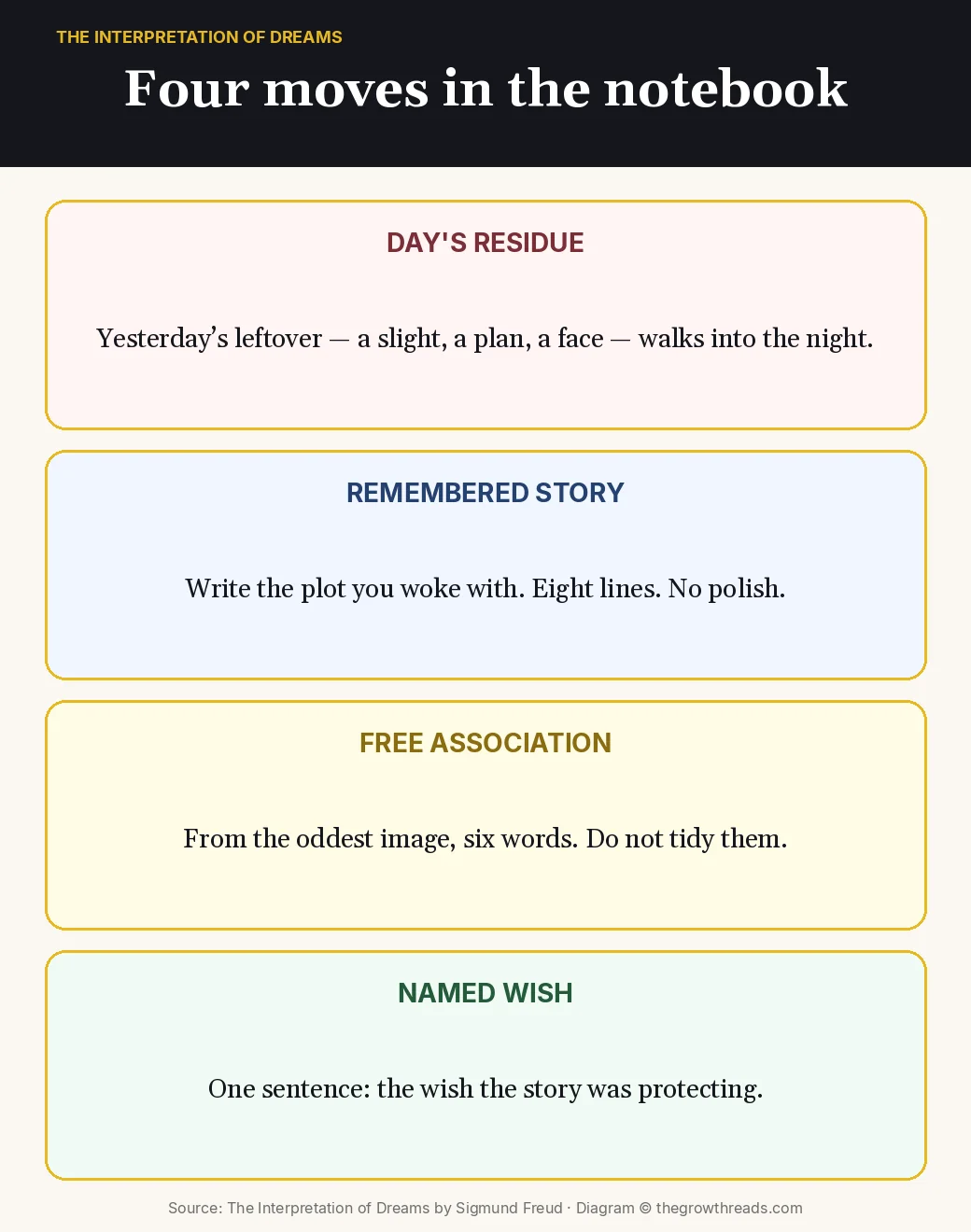
The specimen dream is his own: Irma’s injection. A patient, a party, a colleague, a dirty syringe. He writes the plot, then he lets words come from each node — the host, the diagnosis, the blame. What arrives is not a symbol from a poster. It is a cluster of leftovers from his practice and his friendships, packed into one night, plus a wish to be innocent of a case that was not going well. You need the move. Write the plot. Do not tidy it. Ask which leftover from yesterday walked in.
That is why the book still earns a Tuesday. Most of us treat a dream as weather. Freud treats it as a letter that had to be coded because the day would not accept the plain text. The code is not cosmic. It is local: a slight, a plan, a face you did not finish talking to. The 7-day plan below starts there. Eight lines. Three leftovers. No clinic.
TGR Note: Feeling Good gives you a daylight thought-record. Freud gives you the night letter that used yesterday’s thought as a leftover. The Man Who Mistook His Wife for a Hat is the clinic as story, not as a method for your notebook.
Part 2: A dream is a wish — and a disguise
Chapter III is the sentence the rest of the book has to defend: a dream is the fulfillment of a wish. Children’s dreams often do this in the open — the trip, the sweet, the parent who stayed. Adult dreams do it in costume. The wish is usually not a prophecy and not a new identity. It is a recent hunger the day refused: to speak, to rest, to be found innocent, to undo a slight, to keep a person. Freud’s claim is stronger than “dreams are hopeful.” He says the plot is a stage for a wish that could not walk into the meeting.
Distortion is why the stage looks random. Sleep will not let the wish wear daylight clothes. Censorship — his word — bends the wish into a safer object. That is why a fight with a partner can land on a stranger, a train, a locked door. The feeling is the clue. The prop is the costume. If you chase only the prop, you write a travelogue. If you chase the feeling back to yesterday, you get a sentence you can use.
“The interpretation of dreams is the royal road to a knowledge of the unconscious activities of the mind,” he writes near the end. The line is famous because it is a road, not a throne. You walk it the same way every time: remembered story, leftover, association, named wish. The unconscious, in this book, is not a monster in the basement. It is the part of you that will not speak at the meeting and still writes at night.
TGR Note: The Denial of Death is what happens when the wish under the dream is a hero-story about not dying. Freud names the night letter. Becker names the weekday costume. The Power of Now is the ten-minute reset when the night letter is still loud at 9am.
Part 3: The dream-work
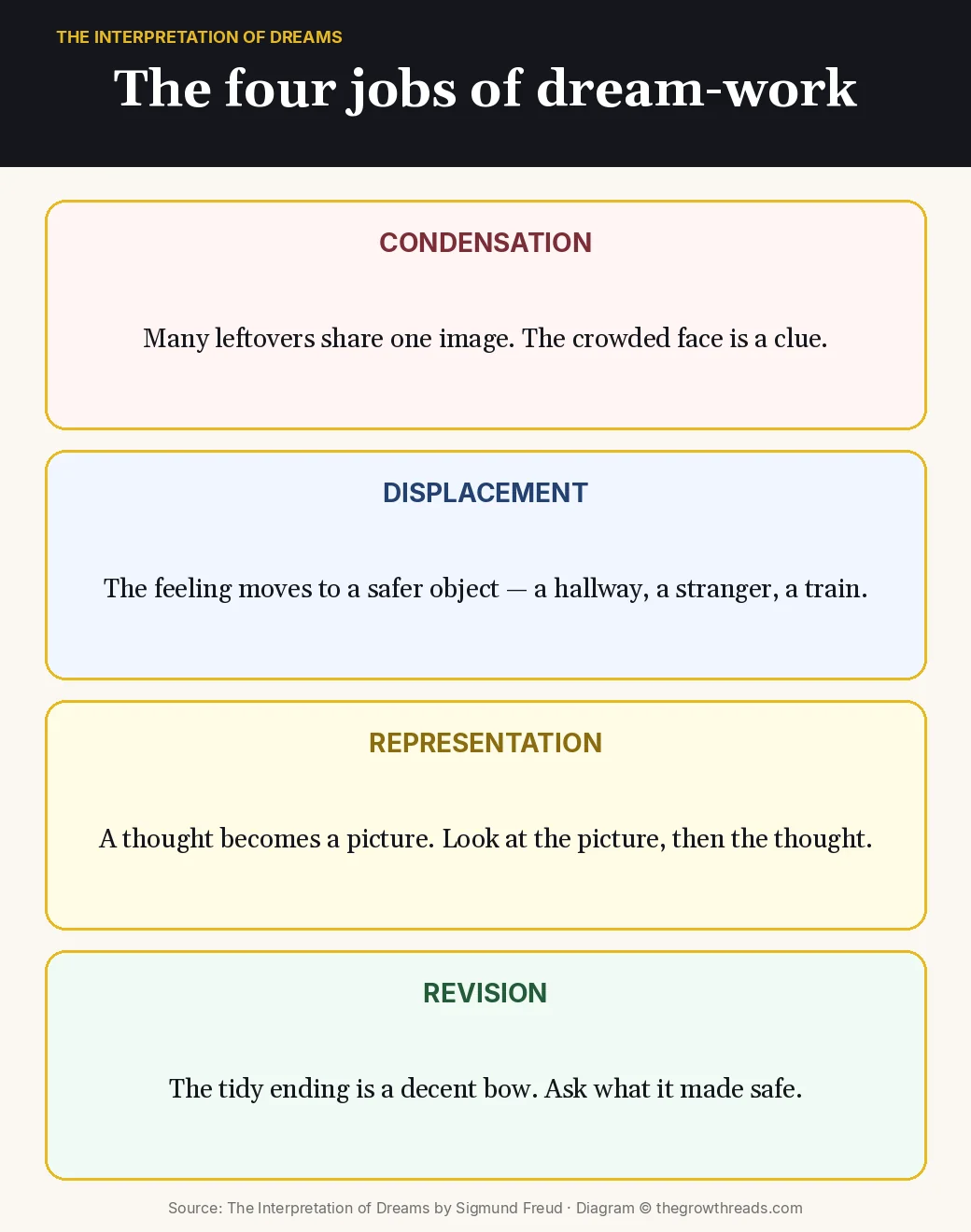
Chapter VI is the engine room. Dream-work is the set of jobs sleep does to a wish before you wake. Freud names four that you can steal without joining a school. Condensation: many leftovers share one image. A crowded face is a clue, not a glitch. Displacement: the intensity moves. The hallway is not about architecture; it is where the feeling was allowed to stand. Means of representation: a thought becomes a picture. Look at the picture, then ask what thought needed a body. Secondary revision: the tidy ending, the decent close, the joke that makes the dream tellable. That tidy ending is often the censorship putting a bow on the costume.
This is why a symbol dictionary fails. A train is not always a train and not always “a journey.” In your dream it is yesterday’s missed call, or the job you did not take, or the person you will not text. Freud’s later editions added more literal symbolism under Wilhelm Stekel’s influence. The weekday steal is still the first method: association from your image, not a poster. If six people would give six meanings to the same snake, you are not holding a science. You are holding a Rorschach. Your leftover is the data.
The practical test is crowding and mismatch. If one scene holds three people who do not belong together, ask what they share. If the feeling is huge and the object is small, ask where the feeling started yesterday. If the ending is suddenly decent, ask what it made safe. Those three questions are dream-work in a notebook. They take twelve minutes. They do not require the Oedipus chapter, which this review will not unpack as a life script.
TGR Note: The Red Book is inner work as a conversation with figures. Freud is inner work as a letter you decode. The Hero with a Thousand Faces maps the same departure as myth. Use Freud when the myth last night used Tuesday’s leftover as a prop.
Part 4: The royal road and a notebook you can keep
The last movement is a psychology of the dream-process: forgetting, regression, primary and secondary process. Primary process is the night logic — condensation, displacement, pictures. Secondary process is the daylight editor that wants a résumé and a linear story. You live in both. A dream is what happens when the editor clocks out and the night logic still has a wish to stage. That is why the remembered plot feels both stupid and expensive. It spent real feeling on a costume.
Freud thought this book would outlive the rest of his work. He revised it eight times. You do not need the eighth revision. You need a rule that fits a working week. Cap the session. If a dream is violent, tied to trauma, or leaves you unable to work, this review is not the tool — talk to a licensed clinician. For an ordinary night letter, the steal is pattern. If the same hallway shows up four times, write the hallway. Then take one daylight action that honours the wish: send the message, decline the meeting, or go to bed.
Later sleep science updated the physiology. Dreams do more than disguise wishes, and some of Freud’s case readings have been debated. The practical advice is uncontroversial. Write the story. Notice the leftover. Name a wish in one sentence. That is enough for a week. It is also, in his sense, a kind of honesty: you stop treating the night as weather and start treating it as a letter from the part that will not speak at the meeting.
TGR Note: Stay with Man’s Search for Meaning when you want a meaning you can practice in a hard shift. Stay with Thinking, Fast and Slow when you want the daylight editor mapped as System 1. Come back to Freud when last night used that editor’s leftovers as props.
Who is The Interpretation of Dreams best for — and who should read something else first?
Best for the reader who already writes down dreams and wants a method, and anyone whose night plots keep recycling yesterday’s leftovers. Read something else first if you need sleep hygiene this week — Why We Sleep — or a thought-record for mood, which is Feeling Good. For presence without the theory, use The Power of Now. For inner work as a conversation, use The Red Book. This review is not medical advice and not therapy. If dreams or anxiety are disrupting sleep or work, talk to a licensed clinician.
Questions to reflect on
- What leftover from yesterday walked into last night’s story — a slight, a plan, a face?
- Which image was the oddest, and what six words come if you do not tidy them?
- Where did the feeling sit, and what safer object was it wearing?
- What did the tidy ending make decent enough for breakfast?
- If the wish is true, what is one daylight action that honours it without wrecking Thursday?
🔥 Ready to name the wish under last night’s story?
Get The Interpretation of Dreams and steal a notebook method you can finish in twelve minutes.
How to apply The Interpretation of Dreams (7-day plan)
- Day 1 — Write the plot. Eight lines, no audience. Last night, or the most recent dream you still have. Do not polish the ending.
- Day 2 — List the leftovers. Three items from the day before the dream: a conversation, a plan, a slight. Circle the one that still stings.
- Day 3 — Associate. From the oddest image, write six words. No sentences. If you start explaining, stop and write the next word instead.
- Day 4 — Name a wish. One sentence: “The wish hiding in that story is ___.” Keep it small and recent. Not a life thesis.
- Day 5 — Spot a displacement. Where did the feeling sit? Write the safer object, then the person or task it probably belonged to.
- Day 6 — Mark the tidy ending. One line on what the decent close made safe. You are not accusing yourself. You are noticing the bow.
- Day 7 — One daylight move. Take one action that honours the wish without wrecking the week. Send, decline, rest, or tell one human. Then keep the notebook for seven more nights.
Frequently asked questions
What is The Interpretation of Dreams about?
The Interpretation of Dreams is Sigmund Freud’s 1899 method for reading a night story as a disguised wish. You write the plot you remember, free-associate from the oddest image, and name the leftover from yesterday plus the wish the dream-work hid. The book founded psychoanalysis; this summary is a field guide. Keep a notebook. Do not turn last night into a diagnosis. The usable steal is one named wish you can carry into Tuesday without inventing a new personality.
What does Freud mean by “dream-work”?
Dream-work is the set of jobs sleep does to a wish before you wake. Condensation packs many leftovers into one image. Displacement moves a feeling onto a safer object. Representation turns a thought into a picture. Secondary revision tidies the plot so breakfast can hear it. The remembered story is the finished costume. Interpretation walks the costume back to the wish. You do that with association, not with a symbol dictionary from a poster. Your leftover is the data.
Is The Interpretation of Dreams still useful after modern sleep science?
Later sleep science updated Freud’s physiology. Dreams are not only disguised wishes, and the brain has more jobs at night than censorship. Some of his case readings have been debated; the practical advice is uncontroversial. Write the story. Notice yesterday’s leftover. Name a wish in one sentence. That notebook habit still earns a weekday even if you never join a clinic. This review is not therapy and not medical advice. Use the method as self-inquiry, then keep your day.
What is the “royal road” in The Interpretation of Dreams?
Freud’s line is that the interpretation of dreams is the royal road to a knowledge of the unconscious activities of the mind. He means a road you can walk, not a throne. A dream is a night letter from a part of you that will not speak at the meeting. The method is free association from the remembered plot. You are not hunting a secret identity. You are naming a wish the day would not let through, then taking one small action that belongs to you.
How do I interpret a dream without overdoing it?
Cap the session. Eight lines for the plot. Three leftovers from yesterday. Six words from the oddest image. One wish-sentence. If the dream is violent, sexual in a way that scares you, or tied to trauma, stop and talk to a licensed clinician — this review is not treatment. For an ordinary Tuesday dream, the steal is pattern, not prophecy. If the same hallway keeps showing up, write the hallway. One night is only a letter, not a life script.
Who should read The Interpretation of Dreams first?
Read it if you already write down dreams and want a method, or if a night story keeps using yesterday’s leftovers. Skip it as a first book if you need sleep hygiene — start with Why We Sleep — or a thought-record for mood, which is Feeling Good. If you want presence without the theory, use The Power of Now. The Basic Books Strachey edition is 688 pages. You do not need every chapter. You need the method and one named wish this week.
What should I read after The Interpretation of Dreams?
Pair Freud with The Red Book when you want inner work as a conversation, not a clinic. Pair him with The Denial of Death when the wish under the dream is a hero-story about not dying. Pair him with Feeling Good when the day’s leftover is a thought you can test. The next move is not another theory. Keep the notebook for seven nights. If a pattern repeats, take one small action in daylight that honours the wish without wrecking the week.
Related summaries
- The Red Book — inner work as a conversation, not a clinic.
- The Denial of Death — when the wish under the dream is a hero-story.
- Feeling Good — a daylight thought-record for the same leftover.
- The Power of Now — presence when the night letter is still loud.
Browse the full list on our Best Psychology Books pillar.
How we analyze books: our summaries are built from a full read of the source text, cross-referenced against the author’s published interviews and research where relevant, and structured around practical application rather than critique. We disclose our editorial process and affiliate relationships in full. Read our full methodology.