

★★★★★ 4.8/5 — the book therapists recommend more than any other for lifting depression and anxious thinking without medication.
Best for: anyone stuck in repetitive negative thought loops, mild-to-moderate depression or anxiety, or noisy self-criticism · Reading time: ~8–9 hrs (this guide: ~16 min) · Difficulty to apply: Easy — the first technique works the same day
Feeling Good in one minute
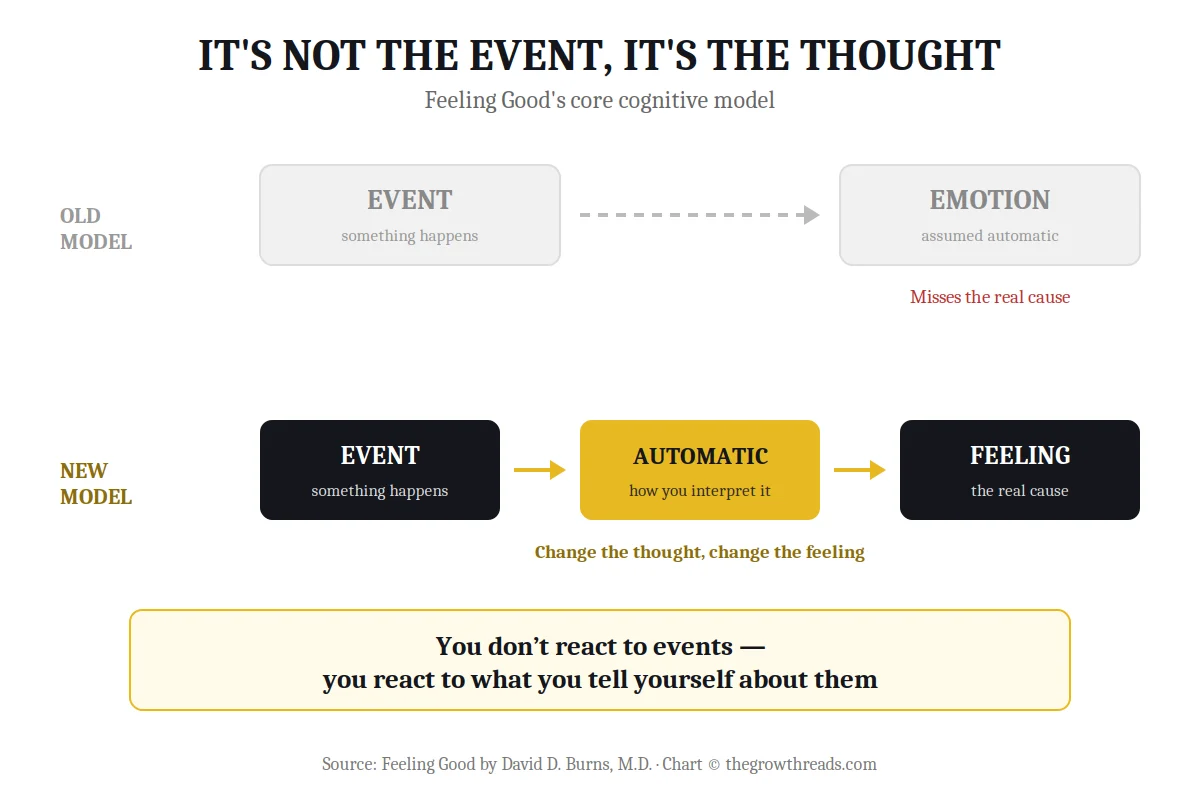
You are not upset by what happened — you’re upset by what you just told yourself about it. Dr. David Burns, a Stanford psychiatrist trained directly under Aaron Beck (the founder of cognitive therapy, who wrote this book’s preface), built Feeling Good around one claim that was radical for 1980: depression and anxiety are driven less by events themselves than by the distorted, automatic thoughts that run through your mind in response to them. Catch the distortion, replace it with a more accurate thought, and the mood measurably lifts — often within weeks, on paper, without a prescription. Backed by more bibliotherapy research than any other self-help title in print, it’s still the book mental health professionals recommend most.
Key takeaways
- Moods follow thoughts, not events: your emotional reaction is generated by the automatic thought running through your head in that moment — not directly by the situation.
- Ten distortions do most of the damage: nearly all self-defeating thoughts fall into ten recognizable patterns. Learn to name them and you can catch them in real time.
- All-or-nothing thinking sets impossible standards: seeing yourself as a total success or total failure, with nothing in between, guarantees disappointment.
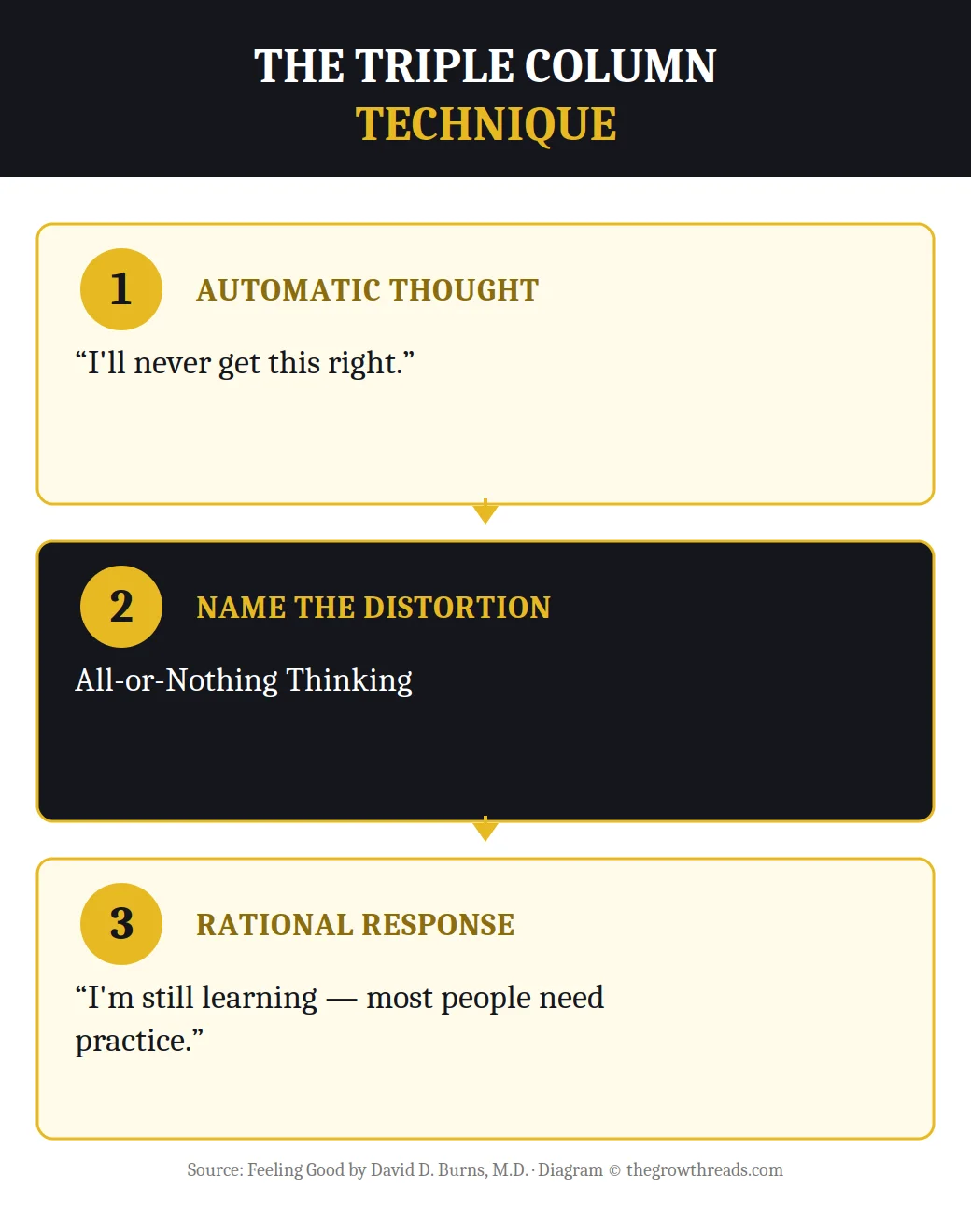
- The Triple Column Technique makes distortions visible: write the automatic thought, name its distortion, then write a more accurate response — on paper, not just in your head.
- Feelings aren’t facts: emotional reasoning (“I feel like a failure, so I must be one”) is one of the most convincing and most misleading distortions.
- Cost-benefit analysis breaks self-defeating beliefs: listing what a belief truly costs you against what it protects you from often reveals it isn’t worth keeping.
- Small scheduled action beats waiting for motivation: for procrastination, Burns argues that breaking a task into tiny scheduled steps rebuilds momentum faster than willpower alone.
- Self-esteem shouldn’t be conditional: Burns argues your worth isn’t contingent on being productive, approved of, or right.
- Relapse is part of recovery, not proof it failed: expecting occasional setbacks and having a plan for them stops one bad week from undoing months of progress.
What is Feeling Good about?
Feeling Good: The New Mood Therapy is Dr. David Burns’s guide to cognitive therapy, the evidence-based approach that treats depression and anxiety by identifying and correcting distorted thinking patterns. Rather than starting with childhood analysis or medication, Burns gives readers specific pen-and-paper techniques to test and reframe the automatic thoughts driving a low mood.
About the author
David D. Burns, M.D. is adjunct professor emeritus of psychiatry at Stanford University School of Medicine. In the 1970s he trained under Aaron T. Beck at the University of Pennsylvania — the psychiatrist who developed cognitive therapy, and who personally wrote the preface to Feeling Good. Burns’s contribution was translation: he took Beck’s clinical framework and rebuilt it into plain-language, self-administered tools, including the now-famous list of ten cognitive distortions. First published in 1980, Feeling Good has sold more than four million copies and, per the research Burns cites, is the self-help book most frequently recommended by mental health professionals in the United States. He later expanded these methods into TEAM-CBT, detailed in his 2020 book Feeling Great. Explore all David D. Burns book summaries →
Key concepts at a glance
| Concept | What it means | Use it when |
|---|---|---|
| Cognitive distortion | A predictable thinking error that skews a situation more negative than reality | You notice a strong negative feeling and want to check if it’s justified |
| Triple Column Technique | Writing the automatic thought, its distortion, and a rational response side by side | You keep replaying the same self-critical thought |
| All-or-nothing thinking | Judging yourself or a result in absolute, no-middle-ground terms | You call a partial success a “total failure” |
| Emotional reasoning | Treating a feeling as proof of fact | You think “I feel like a failure,” therefore “I am one” |
| Cost-benefit analysis | Listing what a belief truly costs you versus what it protects you from | A belief feels true but keeps making you miserable |
| Should statements | Motivating yourself with guilt-inducing “shoulds” and “musts” | You notice guilt or resentment instead of motivation |
| Externalization of Voices | Role-playing a spoken or written debate between your critical and rational voice | The written technique alone doesn’t feel convincing enough |
| Daily Mood Log | A running record of situations, thoughts, distortions, and outcomes over time | You want to track whether the techniques are actually working |
Part 1: Why your thoughts, not your life, run your mood
Freud’s model of depression assumed the real trouble was buried in childhood, reachable only through years of analysis. Burns, trained directly under Aaron Beck, argued something far more testable: in the moment your mood drops, a specific automatic thought just ran through your mind — and that thought, not the event itself, produced the feeling. The idea isn’t new; Burns traces it back to the Stoic philosopher Epictetus, who wrote that people are disturbed not by events but by the views they take of them. What Beck and Burns added was a clinical method for catching those views and testing them like a scientist tests a hypothesis, rather than accepting them as self-evident truth.
Burns builds this on what Beck called the cognitive triad: depression is sustained by a persistently negative view of yourself, your circumstances, and your future, all three running at once. Each automatic thought is a small data point feeding that triad. The practical implication is liberating: you don’t need to overhaul your entire life or personality to feel better — you need to catch and correct the specific, repeated thoughts keeping the triad running. That’s a finite, learnable skill, and it’s the reason Feeling Good reads more like a workbook than a memoir.
TGR Note: Burns’s automatic thoughts are close cousins of what Daniel Kahneman later mapped as fast, effortless System 1 judgments in Thinking, Fast and Slow — quick, automatic, and reliably wrong under stress. Beck and Burns simply got there first, in a clinical setting, and built a way to interrupt the process before it becomes a mood.
Part 2: The ten cognitive distortions, in plain English
Burns’s most durable contribution is a catalog of ten specific thinking errors that show up, in some combination, behind almost every depressive or anxious thought. Naming them is most of the battle — a thought that feels like an undeniable truth becomes a lot less convincing once you can label it “all-or-nothing thinking” or “mind reading.”
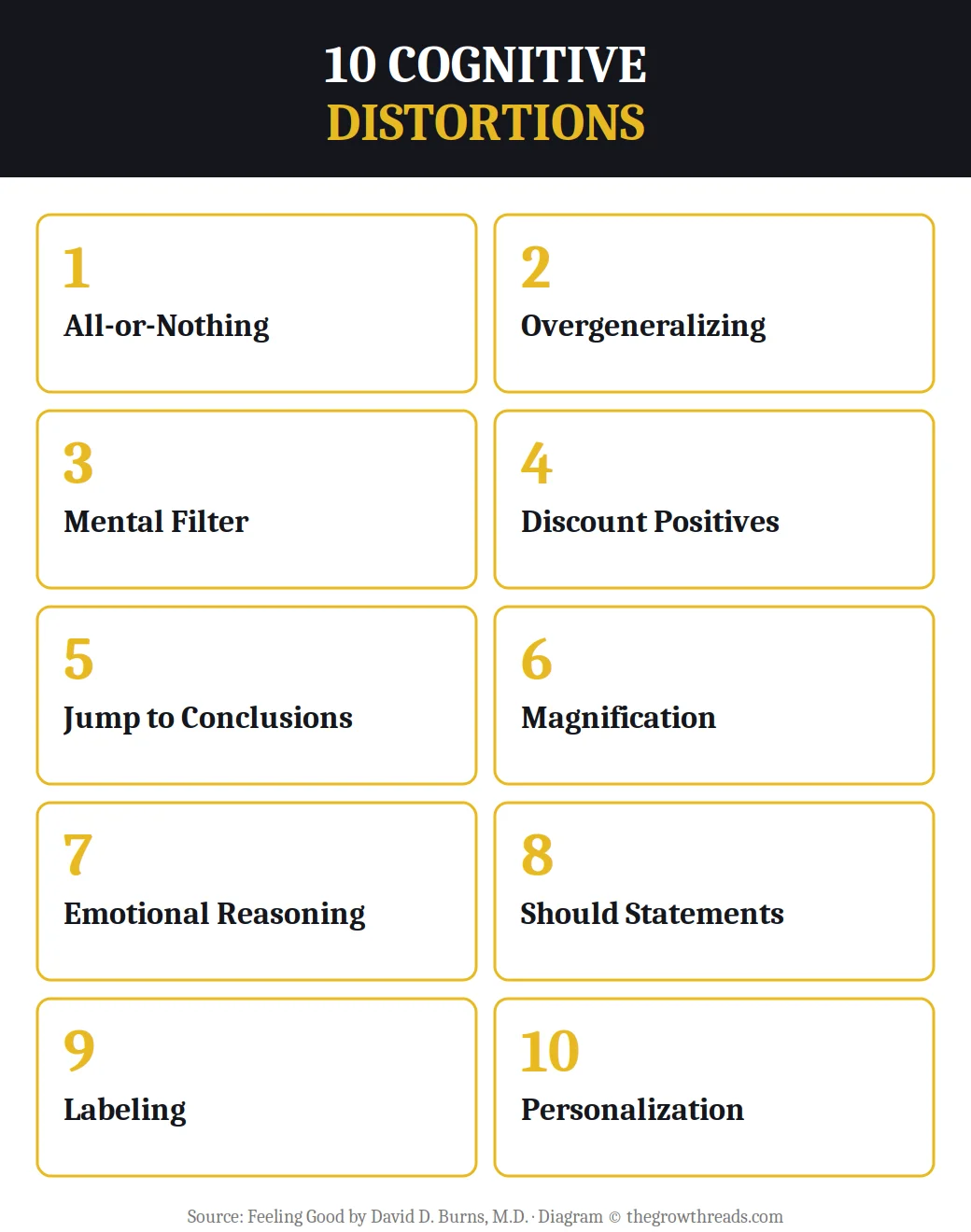
A few are worth knowing in more depth because they show up constantly outside therapy too. All-or-nothing thinking evaluates a result as a total win or a total loss, so one mistake in an otherwise good presentation becomes “I blew it.” Mental filter plucks a single negative detail out of a mostly positive situation and dwells on it until it colors everything. Emotional reasoning is the sneakiest of the ten because it doesn’t feel like a distortion at all — if you feel anxious, it seems obvious you must be in danger, even when nothing supports that. Should statements aim rigid, guilt-driven demands at yourself (“I should be further along by now”) and produce shame instead of motivation. And personalization takes responsibility for outcomes that were only partly, or not at all, within your control.
TGR Note: If this list feels familiar, it should — nearly every modern CBT app and therapy worksheet borrows Burns’s ten distortions directly. The underlying discipline of testing a belief against actual evidence rather than trusting how confident it feels is also the whole argument of The Scout Mindset, just applied to reasoning about the world instead of reasoning about yourself.
Part 3: The toolkit — from automatic thought to rational response
Naming a distortion isn’t enough on its own; Burns insists the correction has to be written down, because arguing with yourself silently tends to lose. The core tool is the Triple Column Technique: one column for the automatic thought exactly as it occurred to you, one for which distortion it is, and one for a more balanced, evidence-based response.
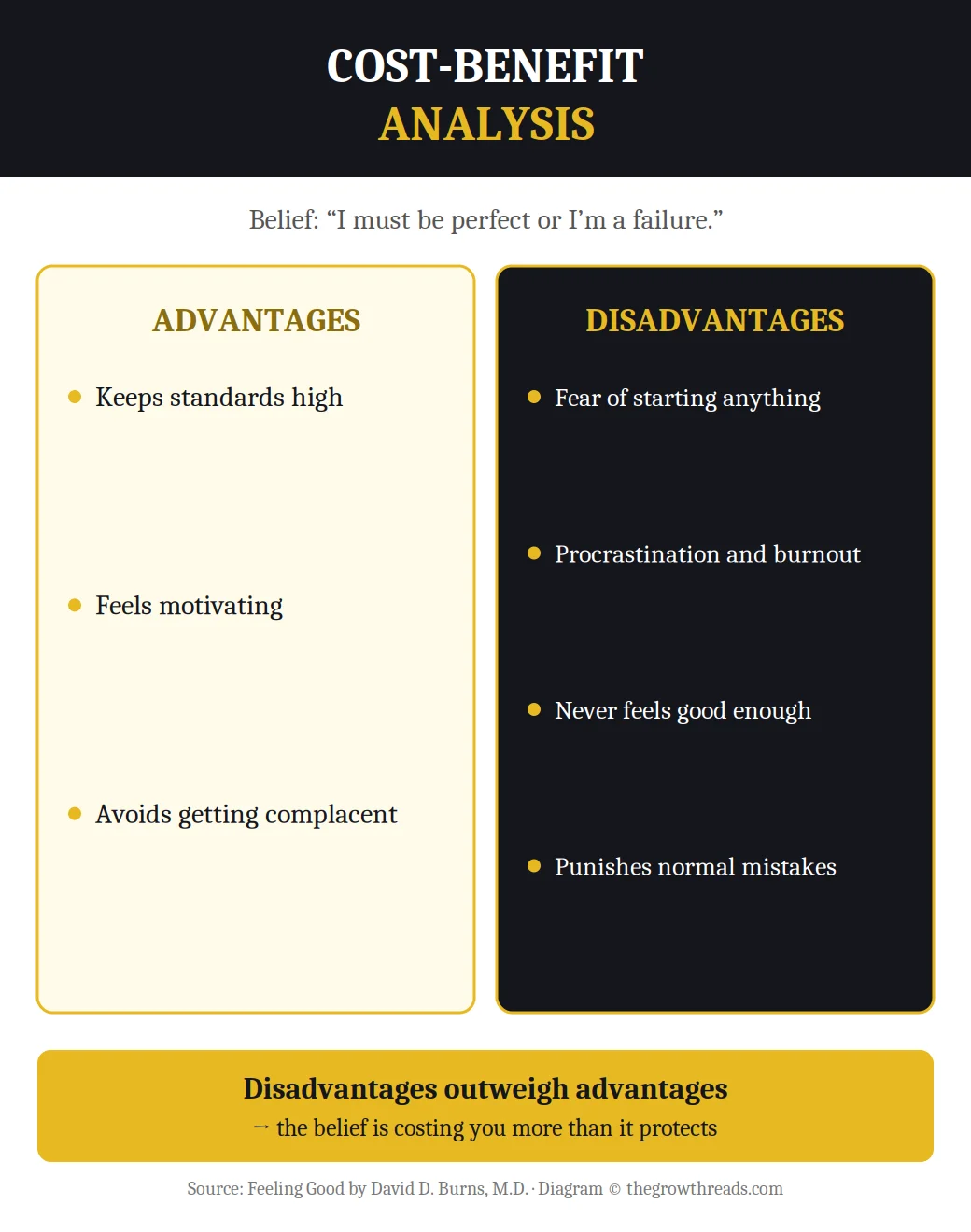
For beliefs that feel true but keep making you miserable — “I have to be perfect or I’m a failure,” for instance — Burns recommends a cost-benefit analysis: two honest columns listing what the belief actually gives you against what it actually costs you. Most self-defeating beliefs survive because they offer a real, if small, advantage (perfectionism does raise your standards); the technique works by forcing an honest reckoning of whether that advantage is worth the much larger cost.
Burns rounds out the toolkit with several other techniques for when the Triple Column alone doesn’t land: Examine the Evidence asks you to gather actual facts for and against the thought like a detective, rather than debating it in the abstract; the Double-Standard Technique asks what you’d say to a friend who had the same thought about themselves, since most people are far kinder to others than to themselves; the Vertical Arrow Technique repeatedly asks “if that were true, what would it mean?” to trace a surface worry down to the deeper core belief driving it; and Externalization of Voices has you speak the critical thought and the rational response out loud, switching roles, because a debate you can hear is often more convincing than one you only read.
TGR Note: Not everyone finds debating a thought helpful — some people find it keeps the thought in the spotlight. If the Triple Column Technique feels like it’s feeding the very thought you’re trying to quiet, The Happiness Trap teaches a genuinely different approach: defusing from a thought (noticing it without arguing with it) rather than restructuring it. Burns himself moved his later work, TEAM-CBT, toward addressing the emotional resistance to change before jumping straight to these techniques.
Part 4: Beyond depression — anxiety, anger, guilt, and staying well
Burns applies the same identify-and-correct method to emotions besides low mood. Anxiety, in his framework, usually combines overestimating the odds of a bad outcome with underestimating your own ability to cope with it if it happened — so the correction targets both halves, not just the danger estimate. Anger frequently runs on “should” statements aimed outward instead of inward (“they shouldn’t have done that”), and guilt often comes from personalization — accepting blame for an outcome that was only partly yours to own. In each case the mechanics are the same as for depression: catch the automatic thought, name the distortion, write the more accurate version.
Burns devotes real attention to self-esteem specifically, arguing that most people quietly run on “approval addiction” or “achievement addiction” — the belief that their worth is conditional on being liked or being productive. He argues self-worth that depends on external validation is inherently unstable, since approval and success are never fully within your control, and that the antidote isn’t more achievement but a conscious decision to stop pricing yourself by it.
The book closes on relapse prevention, and it’s one of its more honest sections: Burns is explicit that mood can and often does dip again after you feel better, and that this isn’t proof the techniques failed. He recommends treating a bad week as data to practice on rather than as evidence the recovery was fake, and keeping the Triple Column Technique and Daily Mood Log on hand well after you feel better, the same way you’d keep a fire extinguisher mounted even once the kitchen’s cleaned up.
TGR Note: Burns’s relapse-prevention advice pairs well with the identity-based habit thinking in Atomic Habits — treating the Daily Mood Log as a small daily habit, not a program you graduate from, is what keeps the gains from these techniques from quietly eroding.
Who is Feeling Good best for — and who should read something else first?
Feeling Good is best for readers dealing with mild-to-moderate depression, chronic self-criticism, or anxious rumination who want concrete, testable tools rather than a purely conceptual read — and for anyone curious what cognitive therapy actually involves before deciding whether to see a therapist. It rewards logically-minded readers who don’t mind structured, written exercises.
If you’ve tried thought-challenging before and it felt like arguing with yourself in circles, The Happiness Trap teaches an acceptance-based alternative that some people sustain more easily. If your low mood is tangled up in a specific relationship rather than your thinking patterns generally, a relationship-focused book will serve you better than this one. And if what you’re facing is genuine hardship or loss rather than distorted thinking about it, Man’s Search for Meaning speaks to a different, meaning-centered kind of resilience. This is an educational summary, not medical advice — if your low mood is severe, persistent, or involves thoughts of self-harm, please also talk to a licensed professional or a crisis line in your area.
Questions to reflect on
- What automatic thought ran through your mind the last time your mood suddenly dropped — and which of the ten distortions does it match?
- Is there a belief you’re holding onto (“I must be perfect,” “I shouldn’t need help”) that a cost-benefit analysis might reveal is costing you more than it protects?
- Where do you treat a feeling as proof of a fact, rather than checking it against the actual evidence?
- Which “should” statement do you aim at yourself most often, and what would change if you swapped it for a preference instead of a demand?
- If a setback happened next week, what’s your specific plan for treating it as practice rather than proof nothing worked?
🔥 Ready to rewire your automatic thoughts?
This guide is the map — the book gives you the full Daily Mood Log, dozens of worked examples, and Aaron Beck’s original preface. Read a chapter, try a technique the same night.
How to apply Feeling Good (7-day plan)
- Day 1: For 24 hours, every time your mood dips, write down the exact automatic thought that preceded it. Just capture it — no analysis yet.
- Day 2: Go back through Day 1’s thoughts and match each one to one of the ten cognitive distortions.
- Day 3: Pick your most frequent distortion and run the Triple Column Technique on three examples: thought, distortion, rational response.
- Day 4: Identify one belief that generates guilt or pressure (“I should always…”) and run a cost-benefit analysis on it.
- Day 5: Practice the Externalization of Voices technique — spoken or written as a dialogue — on your single most persistent negative thought.
- Day 6: Start a Daily Mood Log and rate the intensity of one recurring negative emotion before and after challenging the thought behind it.
- Day 7: Review the week: which technique produced the biggest shift, and decide when you’ll reach for it next time that mood shows up.
Frequently asked questions
What is the main idea of Feeling Good?
Feeling Good argues that depression and anxiety are driven primarily by distorted automatic thoughts — not directly by events — and that ten specific, learnable thinking errors account for most of that distortion. Dr. David Burns provides pen-and-paper techniques, most centrally the Triple Column Technique, to catch a negative automatic thought, identify which distortion it represents, and replace it with a more accurate, evidence-based response. The core claim is that changing the thought measurably changes the mood, often without medication, which is why the book is still recommended more than any other self-help title by mental health professionals.
Do I need a therapist to use Feeling Good, or can it work on its own?
Burns designed the book to be used independently, and it’s one of the most bibliotherapy-tested self-help books in print, with multiple studies showing it can meaningfully reduce depressive symptoms when used alone. That said, it works well alongside therapy too, and a therapist can help you apply the techniques to more complicated or entrenched thought patterns than a book alone can address. If your symptoms are severe, persistent, or include thoughts of self-harm, treat the book as a supplement to professional support rather than a replacement for it.
What are David Burns’s ten cognitive distortions?
The ten distortions are: all-or-nothing thinking, overgeneralization, mental filter, disqualifying the positive, jumping to conclusions, magnification and minimization, emotional reasoning, should statements, labeling and mislabeling, and personalization. Each describes a specific, recognizable way that automatic thoughts distort a situation to look worse than the evidence supports. Burns’s method doesn’t ask you to memorize psychology — it asks you to notice which of these ten patterns a given negative thought falls into, since naming the distortion is usually the first step toward loosening its grip.
Does the cognitive therapy in Feeling Good actually work, or is it just positive thinking?
It’s meaningfully different from positive thinking, which asks you to substitute negative thoughts with unconditionally positive ones regardless of accuracy. Burns’s method asks you to substitute a distorted thought with a more accurate one, which is sometimes still critical or difficult — the goal is truth, not optimism. Cognitive therapy, the clinical approach the book popularizes, has since become one of the most extensively researched treatments for depression and anxiety, and Burns cites several controlled studies showing the book itself produces measurable symptom reduction when used as a standalone intervention.
Is Feeling Good outdated since it was written in 1980?
The core techniques hold up well because they’re based on cognitive therapy principles that have continued to accumulate research support in the decades since, and the revised edition added an updated guide to antidepressant medications and a new introduction. Some of the surrounding language and case examples read as dated, and a few claims about medication have been superseded by newer research. The ten distortions and the core techniques — Triple Column, cost-benefit analysis, examine the evidence — remain the same tools used in modern CBT programs today.
What’s the difference between Feeling Good and Feeling Great, Burns’s newer book?
Feeling Great (2020) presents Burns’s later TEAM-CBT model, which adds structured steps for addressing the hidden emotional benefits and fears that keep people resistant to change before applying the thought-challenging techniques from Feeling Good. Feeling Good is the leaner, foundational text focused squarely on identifying distortions and correcting them; Feeling Great is broader and more clinically elaborate, aimed at readers who found the original techniques logical but still had trouble making them stick. Most readers new to cognitive therapy still start with Feeling Good.
Can Feeling Good help with anxiety, or is it only for depression?
Although the title and original framing center on depression, Burns applies the same distortion-and-correction method to anxiety, anger, and guilt throughout the book. For anxiety specifically, he frames the distortion as usually combining an overestimate of how likely a bad outcome is with an underestimate of your own ability to cope if it happened — and the Triple Column Technique works the same way on anxious automatic thoughts as it does on depressive ones. Readers dealing primarily with anxiety rather than low mood will still find the core toolkit directly applicable.
Related summaries
If Feeling Good resonated, these dig further into related territory: Thinking, Fast and Slow on the automatic biases behind fast judgments, The Happiness Trap on an acceptance-based alternative to thought-challenging, The Scout Mindset on testing beliefs against evidence, and Man’s Search for Meaning on resilience through genuine hardship. For more, see our best psychology books pillar page.
How we analyze books: We work from the full book — reconstructing its core arguments in our own words, adding commentary that connects it to related research and other books in our library, and pressure-testing the advice in a practical 7-day plan. Ratings weigh usefulness, readability, and evidence quality. Read our full methodology.
Related Psychology Summaries
Can’t Hurt Me Summary & Review: David Goggins on Mastering Your Mind
The Confidence Gap Summary and Review
The Elephant in the Brain Summary and Review
The Upside of Stress Summary & Review: Why Feeling Stressed Can Be Good for You
The Willpower Instinct Summary & Review: Train Your Brain for Better Self-Control