

★★★★ 4.4/5 — Clinical tales that train one humane habit: see the person, not just the missing part.
Best for: Caregivers, clinicians, and anyone who is about to reduce a colleague, parent, or patient to a label
Reading time: ~7–8 hrs for the Vintage paperback · ~16 min for this guide
Difficulty to apply: The stories are easy; asking “what still works here?” in a rushed room is the work
The Man Who Mistook His Wife for a Hat in one minute
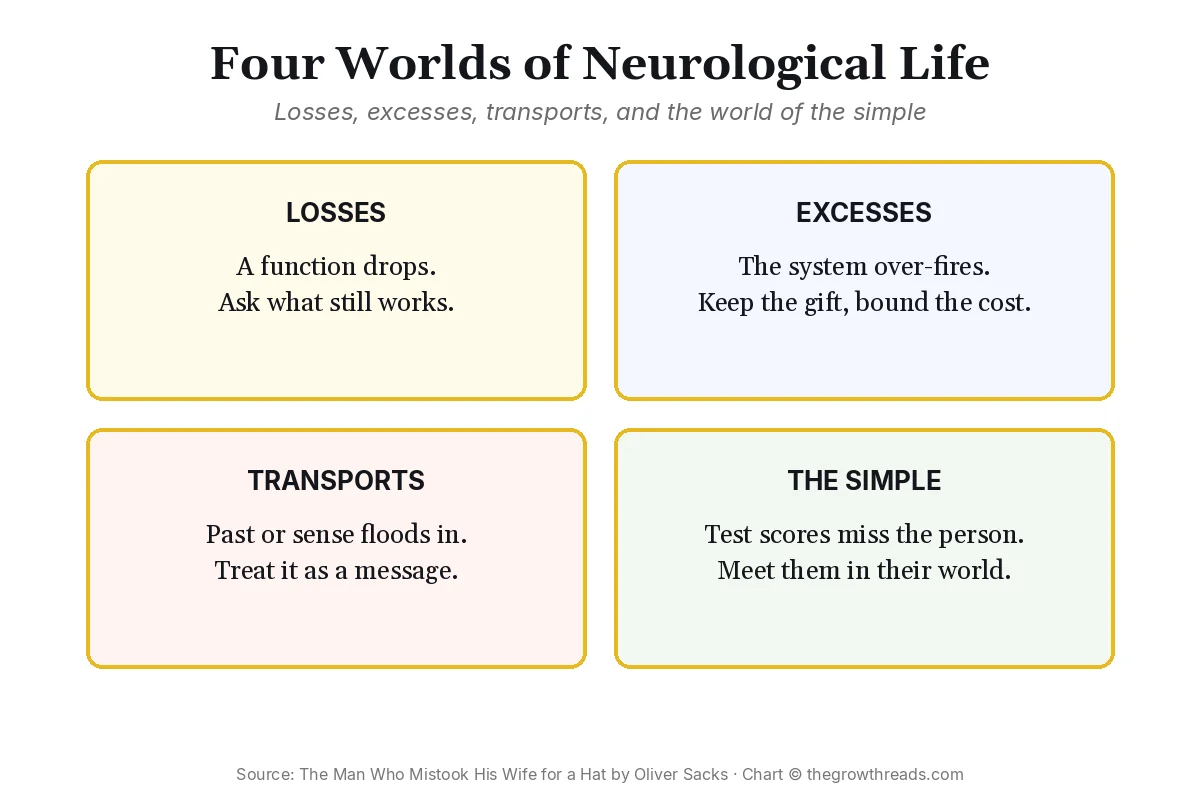
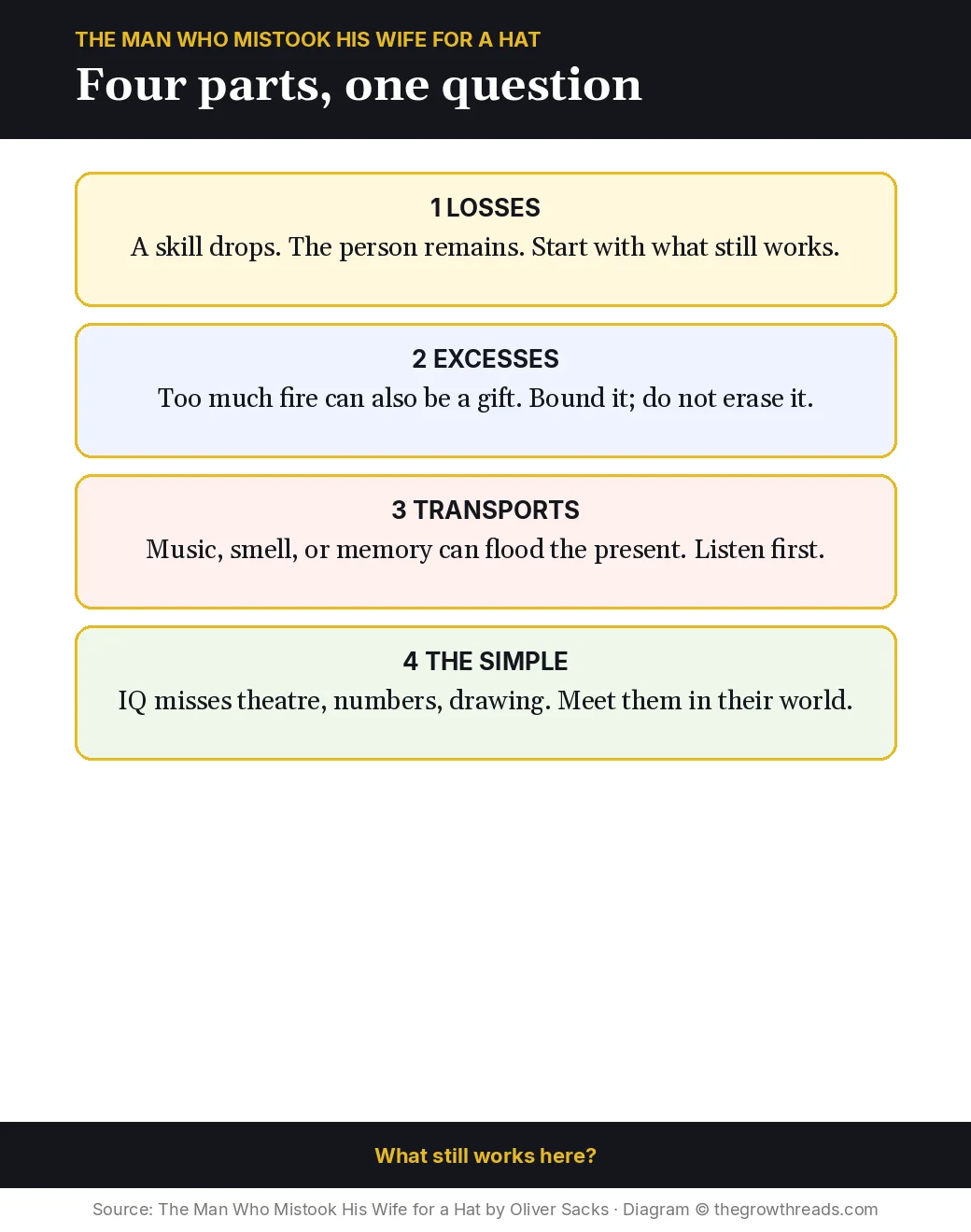
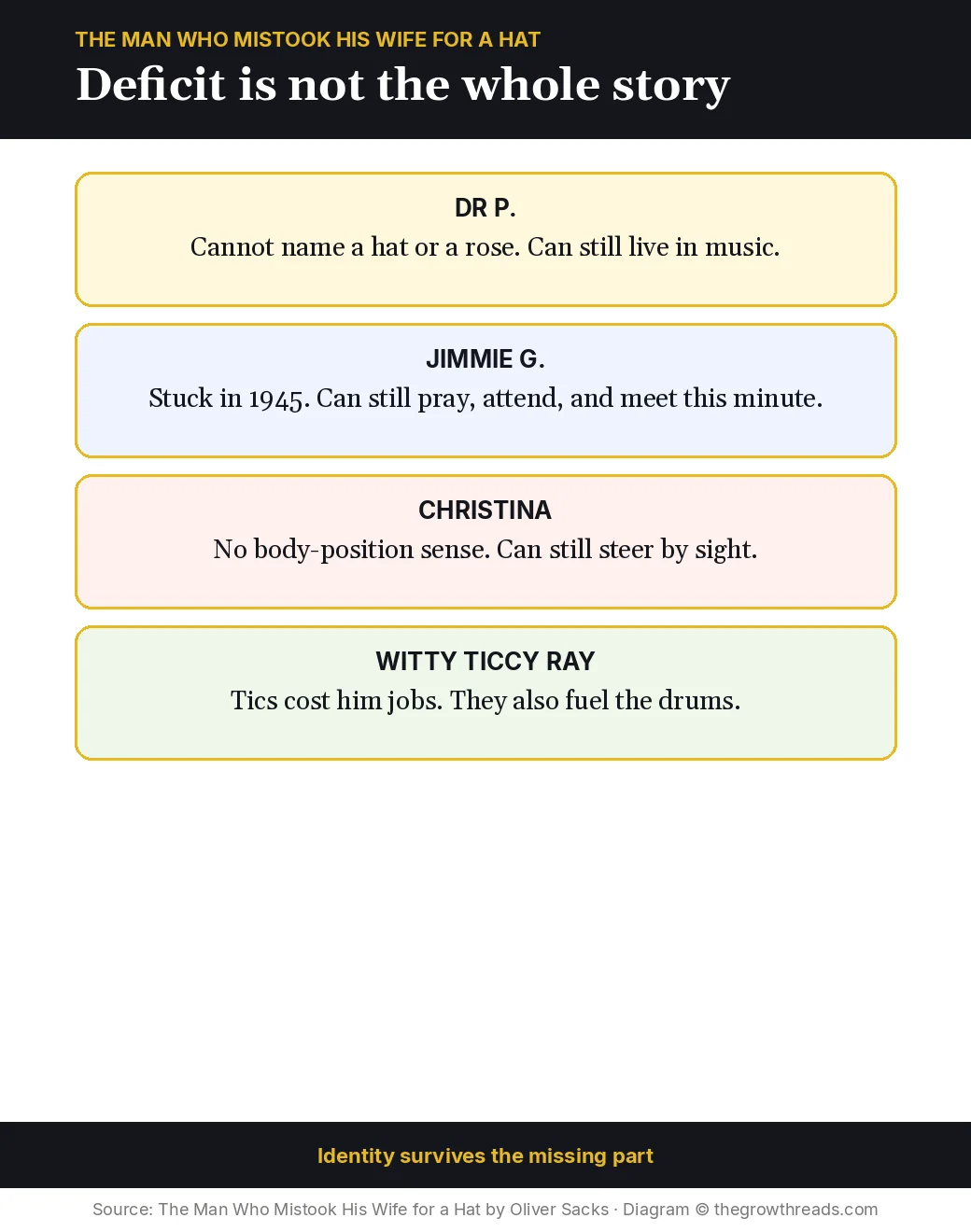
A missing function is not a missing person. Oliver Sacks’s 1985 collection is twenty-four clinical tales in four rooms: Losses, Excesses, Transports, and The World of the Simple. A music teacher cannot assemble a glove and still lives in music. A sailor stuck in 1945 can still inhabit a chapel. A woman with no body-map steers by sight. The steal is one question: what channel still works — and can you meet them there?
Key takeaways
- Person first, syndrome second: The title is a man, then a hat. Keep that order in the room.
- Deficit is a fact, not a verdict: Something dropped. The biography did not end.
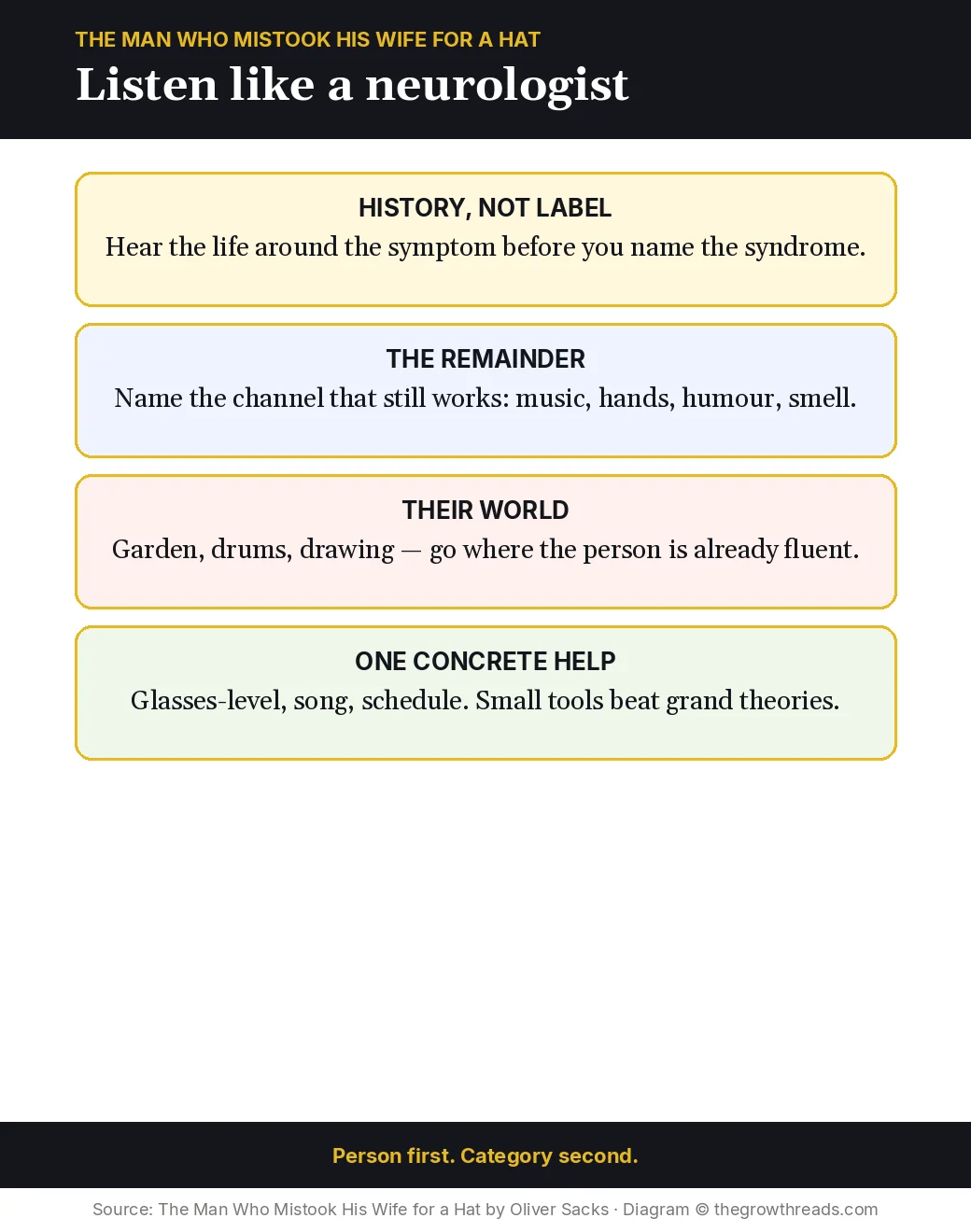
- Hunt the remainder: Music, prayer, drawing, humour, smell. Name the channel that still carries a self.
- Excess can be a gift with a cost: Tourette’s cost Ray jobs and fed the drums. Bound it; do not erase him.
- Identity needs a world, not only a memory: Jimmie G. cannot store today and can still meet this minute.
- The body is a story the brain tells: Phantom limbs, missing left sides, hands that were never invited to work.
- Transports are messages, not only symptoms: Old songs, old smells, a flood of the past. Ask what they belong to.
- Tests miss theatre: Rebecca, the twins, José. Scores can be low while a world is rich.
- One concrete tool beats a grand theory: A spirit-level in glasses, a song as a map, a garden instead of a worksheet.
What is The Man Who Mistook His Wife for a Hat about?
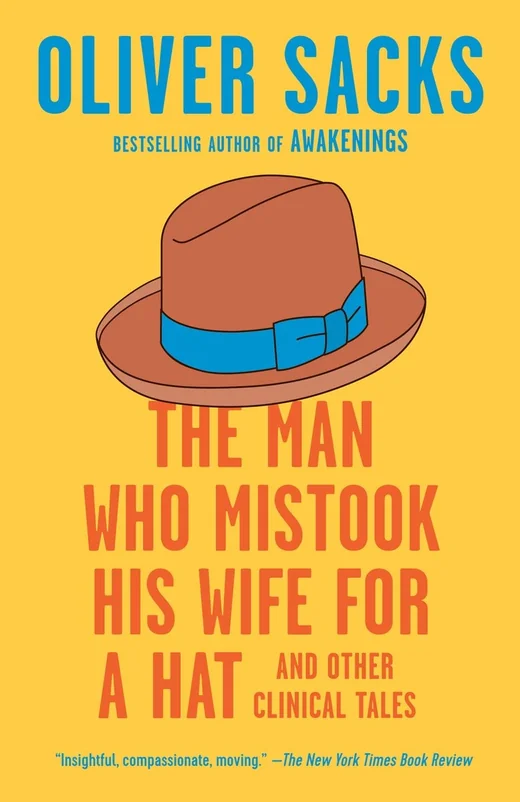
The Man Who Mistook His Wife for a Hat is Oliver Sacks’s 1985 book of twenty-four clinical tales. It shows people living after a function drops or floods, and trains one question: what still works, and how do we meet them there?
About the author
Oliver Wolf Sacks (1933–2015) was a British neurologist who took his degree at Queen’s College, Oxford, trained in California, and spent most of his career in New York. At Beth Abraham in the Bronx he sat with encephalitis lethargica survivors who had been still for decades — the clinic behind Awakenings (1973). The Man Who Mistook His Wife for a Hat (1985) made his stance public: person first, syndrome second. He later wrote Musicophilia, Hallucinations, and the memoir On the Move. The New York Times called him a poet laureate of contemporary medicine. The method is plainer than the praise: stay curious, name the remainder, keep the human subject at the centre. Explore all Oliver Sacks book summaries →
Key concepts at a glance
| Concept | What it means | Use it when |
|---|---|---|
| Deficit | A function that has dropped — naming, memory, the left side of space | You are about to treat the missing part as the whole person |
| Remainder | The channel that still carries a self: music, prayer, drawing, humour | The chart is full and you have not asked what still works |
| Visual agnosia | Seeing features without assembling a hat, a rose, a face | Someone “looks” and still cannot use the object |
| Korsakoff’s / lost mariner | A life that cannot store today; identity hunting a world minute by minute | Memory is broken and you assume the person is gone |
| Proprioception | The inner sense of limb position; without it the body must be steered by sight | Someone seems clumsy and you have only blamed willpower |
| Excess | A system on fire — tics, mania, disinhibition — that can also fuel a gift | You want to delete a trait that also makes the work possible |
| Transport | Music, smell, or seizure that floods the present with a past world | A “hallucination” might be a memory asking to be placed |
| World of the simple | Low scores, rich worlds — garden, primes, drawing | An IQ line is about to close a door |
Part 1: Losses — when a function disappears
The title tale is Dr P., a singer and teacher with visual agnosia. He can describe a brim or a stem and cannot assemble the object. A glove becomes a surface with five outpouchings. A rose is not a rose until he smells it. Leaving, he reaches for his hat and takes his wife’s head. Sacks cannot restore naming. He can notice that music still organises Dr P.’s day. The clinical move is a reroute: if the visual whole is gone, give the man a soundtrack that still holds a self together.
Jimmie G., the Lost Mariner, has a Korsakoff’s amnesia so dense that 1945 is still the present. He greets you brightly and cannot keep you. The temptation is to decide that without a timeline there is no person. Then he is at Mass, or at attention — inhabiting a minute that does not require yesterday. Christina loses proprioception: no inner map of her limbs, so she steers by sight. Other losses rhyme: a missing “left,” a stranger-leg, hands that never worked until someone asked. When a sense drops, hunt a remaining channel and build a small tool — a song, a glance, a spirit-level in glasses.
TGR Note: Thinking, Fast and Slow is the user’s manual for a brain that still has all its parts and still misreads a price. Sacks is the field guide for a brain missing a part. Kahneman teaches you not to trust the first story. Sacks teaches you not to let the missing part become the only story. Use Fast and Slow in a meeting. Use Losses at a bedside — or any room where a label is about to finish a biography.
Part 2: Excesses — when the nervous system over-fires
Losses are absences. Excesses are floods. Witty Ticcy Ray has Tourette’s: tics that cost him jobs, and a drum kit that needs the same fire. Medication calms the tics and flattens the music. Sacks’s useful compromise is a schedule — enough control for a weekday, enough Ray for the drums. “Make him normal” can mean “delete the gift.” Other excesses rhyme: an old neurosyphilis that lights an elderly woman with packed-away energy; a man who cannot store the room and invents one so he can keep being someone. Too much nervous system is still a person. The work is a boundary, not an erasure.
Caregivers know the costume: mania that looks like vitality until the bills arrive; bluntness sold as honesty; a child’s fire that school wants gone. Sacks is not asking you to romanticise harm. Separate the fire from the furniture it might burn. Name the cost. Keep a slot for the gift. Ray’s weekday/weekend split is a blunt tool and a better idea than a personality deletion.
TGR Note: Behave maps the biology under the impulse. Sacks meets the person after it has already rearranged a life. Use Sapolsky for why the system over-fires. Stay here for a schedule that lets Ray work Monday and play Saturday. Incognito tours the hidden machinery. Excesses is what you do when it will not go quiet.
Part 3: Transports — when memory and music flood the present
Transports are not losses and not exactly excesses. Something from elsewhere arrives: a childhood hymn, a hiss, a smell-world sharp enough to feel like another life. Two elderly women hear music that is not in the room. Temporal-lobe seizures can open a drawer of the past and leave it playing. Stephen D. — Sacks later said this was himself — wakes with a dog’s nose; the city becomes a map of scent. The scientific temptation is to tag every flood as a glitch. Sacks’s better move: treat it as a message. Whose song? Which year? What world is trying to get in?
You do not need a seizure clinic to steal this. A smell that drops you into a 1998 kitchen is a transport. A song that makes a parent briefly themselves again is a transport. Do not argue the visitor away until you have asked what it belongs to. Then bound it if it hurts, or use it if it helps — a playlist as a map, a hymn as a way back into a person who cannot do small talk. Watch what arrives. Name it. Then open a window or close one.
TGR Note: Flow is a chosen transport: attention so complete the self goes quiet on purpose. Sacks’s transports often arrive uninvited. Use Csikszentmihalyi when you want to design deep work. Use this section when the past barges in and you need a stance other than “ignore it.” When the Body Says No treats the body as a letter the life has been writing. Sacks treats a song or a smell the same way. Both refuse to call the signal nonsense just because it is inconvenient.
Part 4: The World of the Simple — dignity beyond the score
The last part is the one institutions still fail. Rebecca has an intellectual disability and a life tests cannot see. Worksheets crush her; theatre and a garden do not. The twins cannot multiply on paper and play a game of large primes. José, written off, draws a watch with a care that looks like attention itself. Sacks is not pretending scores are meaningless. He is refusing to let them be the person. Meet Rebecca only where she fails and you will write a small life. Meet her in a world she can inhabit and a self shows up that the file missed.
Steal this if you are about to close a door because a number is low. Change the room before you change the verdict: garden instead of worksheet, drums instead of a silence rule, drawing instead of a verbal quiz. The World of the Simple is not a caption. It is a design brief: find the world in which this person is not simple.
TGR Note: On the Move is Sacks’s own remainder — motorcycles, weights, writing, a clinic, a gay man who took decades to say so in public. Read it when you want the physician as a person. Stay with The World of the Simple when you are about to rank someone and call it kindness. The Happiness Trap is the other door: drop the war with the feeling and do the valued next action. Sacks drops the war with the score and does the valued next room.
Who is The Man Who Mistook His Wife for a Hat best for — and who should read something else first?
Best for readers who live near a label — medicine, caregiving, teaching, a family story that has become a diagnosis — and need a stance that keeps the person in the frame. Also for anyone who loves science writing that still has a pulse. Not a first book if you need a protocol for this week’s panic: start with Feeling Good. If you want Sacks the motorcyclist and physician, On the Move is the memoir. If family trauma is the live wire, Adult Children of Emotionally Immature Parents is more specific. If you want a method for deep work rather than clinical tales, Flow. Come here when the problem is a human being about to disappear inside a category.
Questions to reflect on
- Where did you last let a label finish someone’s sentence — including your own?
- What “deficit” in a person you live with has a remainder you have never named out loud?
- If this person is fluent in a world that tests ignore (garden, drums, drawing, jokes), when did you last meet them there?
- What one concrete tool — song, schedule, visual cue — would help more than a speech about trying harder?
- Where is an “excess” in you still funding a gift you are trying to delete?
🔥 Ready to see the person, not just the deficit?
Get The Man Who Mistook His Wife for a Hat and steal one clinical question this week.
How to apply The Man Who Mistook His Wife for a Hat (7-day plan)
- Day 1: Read the title tale. Write one sentence: what still worked for Dr P. when naming failed. Keep the sentence. Skip the dinner-party version.
- Day 2: Pick one person you usually summarise with a label. Listen for ten minutes without diagnosing. Note one remainder — a channel that still works.
- Day 3: Inventory a “deficit” you pin on yourself. Name the gift that travels with it. Do not turn this into a branding exercise.
- Day 4: Change one room. Meet someone in a world they can inhabit (walk, music, making) instead of the room where they fail.
- Day 5: Design one concrete tool the size of a spirit-level in glasses: a visual cue, a song as a map, a written prompt on a card.
- Day 6: Catch one “excess” you have been trying to erase in yourself or someone else. Bound the cost. Keep a slot for the gift.
- Day 7: Review. Keep the single question you will actually ask next week: what still works here? Put it on a card. Leave the rest of neurology on the shelf.
Frequently asked questions
What is The Man Who Mistook His Wife for a Hat about?
Oliver Sacks’s 1985 book is twenty-four clinical tales in four parts: Losses, Excesses, Transports, and The World of the Simple. Each tale is a person first and a syndrome second. A music teacher cannot name a hat and still lives in music. A sailor stuck in 1945 can still meet this minute. The steal is not a diagnosis quiz. It is one question for a ward, a kitchen, or a meeting: what still works here? This guide is the usable map, not a substitute for the book or for clinical care.
Who wrote The Man Who Mistook His Wife for a Hat?
Oliver Wolf Sacks (1933–2015) was a British neurologist who spent most of his career in New York, including Beth Abraham in the Bronx. Queen’s College, Oxford, then California training, then decades of clinic plus writing. Awakenings (1973) made his method public; this 1985 collection made it famous. He later wrote On the Move, Musicophilia, and Hallucinations. The New York Times called him a poet laureate of contemporary medicine. The method in these pages is older than the fame: sit with the person, name the remainder, and refuse to let a label finish the sentence.
What does Sacks mean by a “deficit”?
In this book a “deficit” is a function that has dropped — naming, memory, balance, the left side of space — not a verdict on the person. Sacks’s move is to treat the missing part as one fact and then hunt the remainder: music, prayer, drawing, humour, smell. The title tale is visual agnosia, not a joke about marriage. If you only collect strange symptoms, you have read the carnival version. If you leave with one question — what still works here? — you have read the book he meant. The word is clinical. The work is humane.
How is The Man Who Mistook His Wife for a Hat different from Thinking, Fast and Slow or Incognito?
Thinking, Fast and Slow maps two systems in a healthy mind that still misreads a price. Incognito maps the unconscious machinery under a normal day. Sacks maps what happens when one piece of that machinery is gone or on fire — and the person is still there. Kahneman gives you a checklist for judgment. Eagleman gives you a tour of the hidden brain. Sacks gives you a bedside stance: do not let the syndrome finish the biography. Use the others to understand error. Use this book when a label is about to erase someone you have to live or work with.
Is The Man Who Mistook His Wife for a Hat a textbook — or something you can apply this week?
It is clinical narrative, not a protocol manual and not a DSM. You will not get dosages or a seven-step therapy. You will get a stance you can use on Thursday: listen to the life around the symptom, name the channel that still works, meet the person in a world they can still inhabit, and invent one small tool — a song, a schedule, a visual level. That is application. If you need CBT worksheets this week, start with Feeling Good. If you need Sacks’s own life, start with On the Move. Come here when the live problem is a person being reduced to a category.
Are the case studies in The Man Who Mistook His Wife for a Hat literally true?
Sacks wrote from clinic notes and a storyteller’s ear. Later reporting, including a 2025 New Yorker account of his journals, showed some tales were embellished, and that he felt guilt about the success. A few set-pieces have been questioned in the scientific literature. The practical advice is uncontroversial: treat the person as a subject, not a curiosity. Read the tales as clinical parables with a real method. Do not cite a scene as a lab result. Steal the stance, not the footnotes.
How long does it take to read The Man Who Mistook His Wife for a Hat?
The Vintage 2021 paperback is 320 pages with a late preface; earlier Touchstone copies run closer to 250. Plan about seven to eight hours for every tale, less if you take Losses and one other part. This guide is about sixteen minutes. You finish a day when you have caught one label in your own mouth and asked what still works. Buy a readable paperback. Do not wait for a neurology course before you try the question on a living person.
Related summaries
- On the Move — Sacks’s own life when you want the physician as a person.
- Incognito — the hidden brain on a normal day, before a function drops.
- Behave — the biology under the impulse Sacks meets at the bedside.
- Thinking, Fast and Slow — judgment errors in a brain that still has all its parts.
Browse the full list on our Best Psychology Books pillar.
How we analyze books: our summaries are built from a full read of the source text, cross-referenced against the author’s published interviews and research where relevant, and structured around practical application rather than critique. We disclose our editorial process and affiliate relationships in full. Read our full methodology.