

★★★★★ 4.7/5 — A map of the call you keep renaming as busy: leave, change, and come back with something the village can use.
Best for: Anyone stuck before a threshold — career, craft, grief, a conversation — who needs a story-shape, not another productivity system
Reading time: ~9 hrs for the full book · ~14 min for this guide
Difficulty to apply: The three-act map is simple; living one stage this week is the work
The Hero with a Thousand Faces in one minute
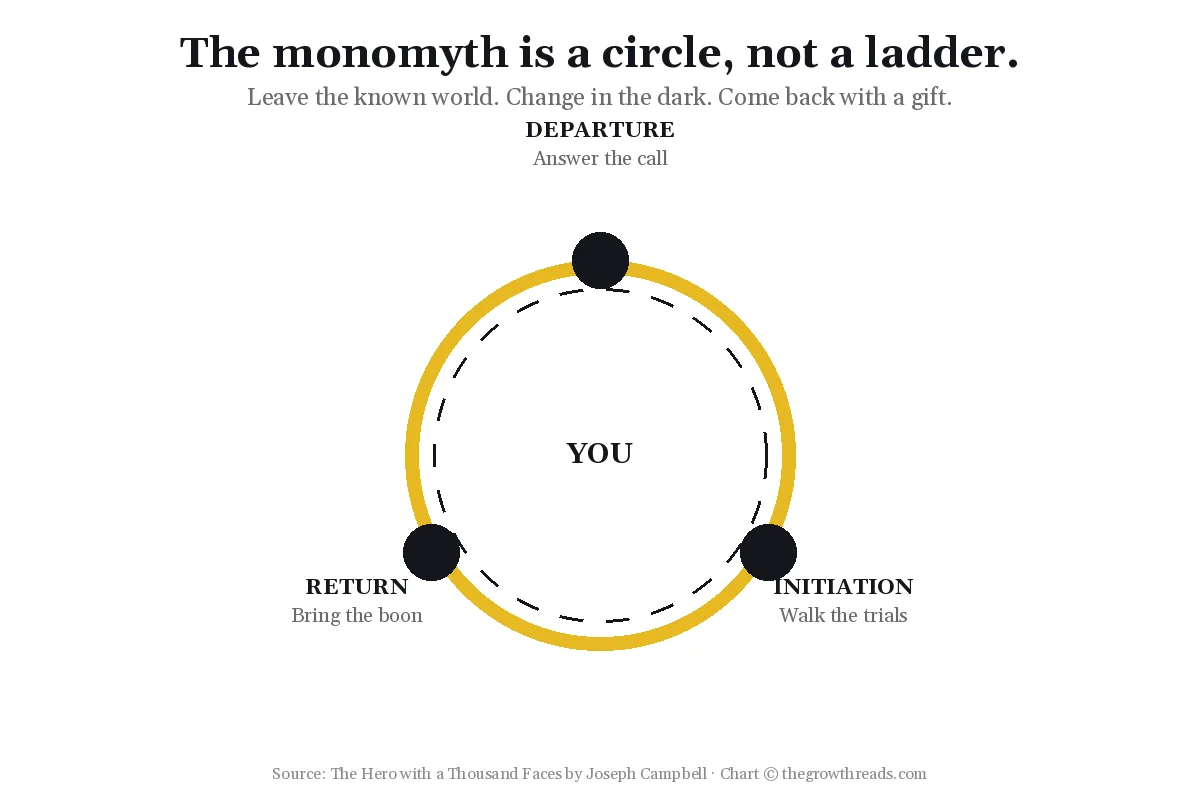
The life you keep calling ordinary is already a myth in progress. Joseph Campbell’s 1949 book argues that the world’s stories — Buddha leaving the palace, Odysseus leaving Ithaca, a thousand named and unnamed figures — share one plot he called the monomyth. A hero leaves the known world, suffers a change that cannot be faked, and returns with a gift other people can use. Hollywood later flattened it into a beat sheet. Campbell wrote a psychology of becoming: the call you refuse, the threshold you will not cross, the boon you hoard. The assignment is not to become a movie. It is to notice which act you are stalling in and take the next irreversible yes.
Key takeaways
- One journey, a thousand costumes: Cultures disagree on gods and costumes. They rhyme on leave / change / return.
- The call is rarely cinematic: It arrives as restlessness, a death, a job that no longer fits, a sentence you cannot un-hear.
- Refusal is the default: Prudence, busyness, and “after this quarter” are the first dragons.
- You do not cross alone: Aid shows up as a teacher, a book, a friend who will not let you rename the knock.
- The threshold is a one-way door: After the first public yes, the old self cannot fully commute home.
- Initiation is the middle you wanted to skip: Trials, atonement, and the belly of the whale are where the change is actually installed.
- The boon is for the village: Insight that stays private is a souvenir. A gift has to travel.
- Master of two worlds: Keep one foot in the cave and one in the kitchen. Wisdom that cannot survive a Tuesday is theatre.
- Freedom to live: After the ordeal, stop postponing the life it already paid for.
- The circle repeats: Finishing one journey is how the next call gets loud enough to hear.
What is The Hero with a Thousand Faces about?
The Hero with a Thousand Faces is Joseph Campbell’s 1949 map of the monomyth: leave the ordinary world, change in an ordeal, return with a gift the community can use. He reads world myths through Freud and Jung so a modern reader can lay the same shape on a life, not only on a legend.
About the author
Joseph John Campbell was born in White Plains, New York, in 1904 and learned stories in the American Museum of Natural History’s halls. He studied at Columbia, then read Joyce, Mann, Sanskrit, Freud, and Jung through a long self-education before teaching literature at Sarah Lawrence for nearly four decades. The Hero with a Thousand Faces (1949) made the monomyth a public tool. Later came The Masks of God and, with Bill Moyers, The Power of Myth, which put “follow your bliss” into living rooms. George Lucas credited the book with helping him find the spine of Star Wars. Campbell died in Honolulu in 1987. The through-line is practical: the old stories are instructions for a life that has to leave home and come back useful. Explore all Joseph Campbell book summaries →
Key concepts at a glance
| Concept | What it means | Use it when |
|---|---|---|
| Monomyth | One deep plot under many costumes: departure, initiation, return | Your week feels random and you need a shape |
| Call to adventure | The knock that ends the old equilibrium | You are restless and calling it a productivity problem |
| Refusal of the call | Delay dressed as wisdom, busyness, or “not yet” | You have known the next step for months |
| Supernatural aid | Help that arrives once you admit you cannot solo it | You keep researching instead of asking |
| Threshold / belly of the whale | A one-way crossing; the old self cannot fully return | You want a reversible version of a hard yes |
| Road of trials | The sequence of tests that installs the new capacity | You expected one brave moment to finish the change |
| Atonement / apotheosis / boon | Reconciliation with the source of power, then a gift worth carrying | You had an ordeal and still feel empty-handed |
| Return / master of two worlds | Bring the gift home and live in both the inner and outer life | The insight only works on retreats |
Part 1: The monomyth — one story under every story
Campbell’s opening move is a pattern drill. Costumes change; the spine holds: a known world, a disruption, a crossing, a death-and-rebirth in some register, a return meant to feed the people who stayed. He is not claiming every tale is identical. He is claiming the nervous system keeps telling a version of the same becoming. Freud and Jung gave him the language: the figures are inner functions wearing masks, not only other people’s gods.
The famous condensation is almost an equation. A hero leaves the common day, meets forces the old toolkit cannot handle, wins a change that costs something, and comes back able to give. Strip the swords and you still have a week: the job that used to fit, the conversation you will not start, the craft you research instead of practicing. Those are stages. Stages can be walked.
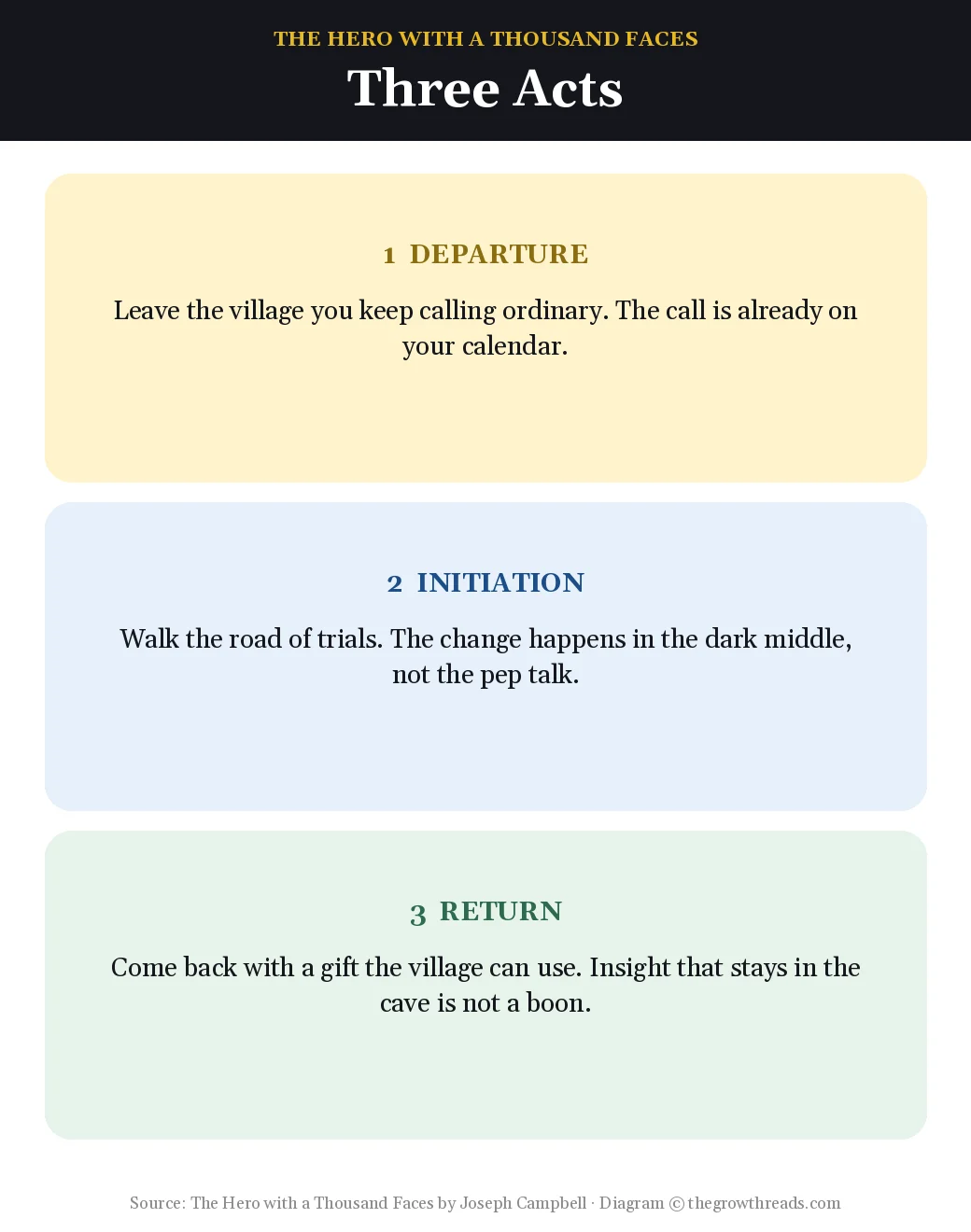
Film school is a legitimate door and a small one. Screenwriters stole a skeleton. Campbell wanted a psychology of initiation: how a person stops being only the child of a village and becomes someone who can feed it. Spotting tropes catalogues costumes. The live use is ruder. Which act are you in, and what would “return with a boon” look like on Friday?
TGR Note: The Alchemist is the fable version of the same spine — Personal Legend as a call you can walk. Sapiens is the wide shot: shared stories are how groups coordinate. Campbell zooms to one life. If the week feels plotless, start with the three acts, not a beat sheet of seventeen.
Part 2: Departure — answering the call
Departure is five movements modern life disguises as email. First, the call. Myths send a herald; yours is likelier a diagnosis, a layoff, a child, a sentence that will not leave. It ends the pretend that this equilibrium can last. Second, refusal — the honest chapter for a working adult. It looks like a calendar, like being needed, like waiting to feel ready, which the threshold does not sell.
Third, aid: a mentor, a therapist, a friend who will not accept fear rebranded as strategy. The crossing is not a solo sport. Fourth, the first threshold — an act that makes going back expensive: the application, the ticket, the true sentence said out loud. Fifth, the belly of the whale: you are in. The old self still has opinions. It no longer has a veto that restores yesterday.
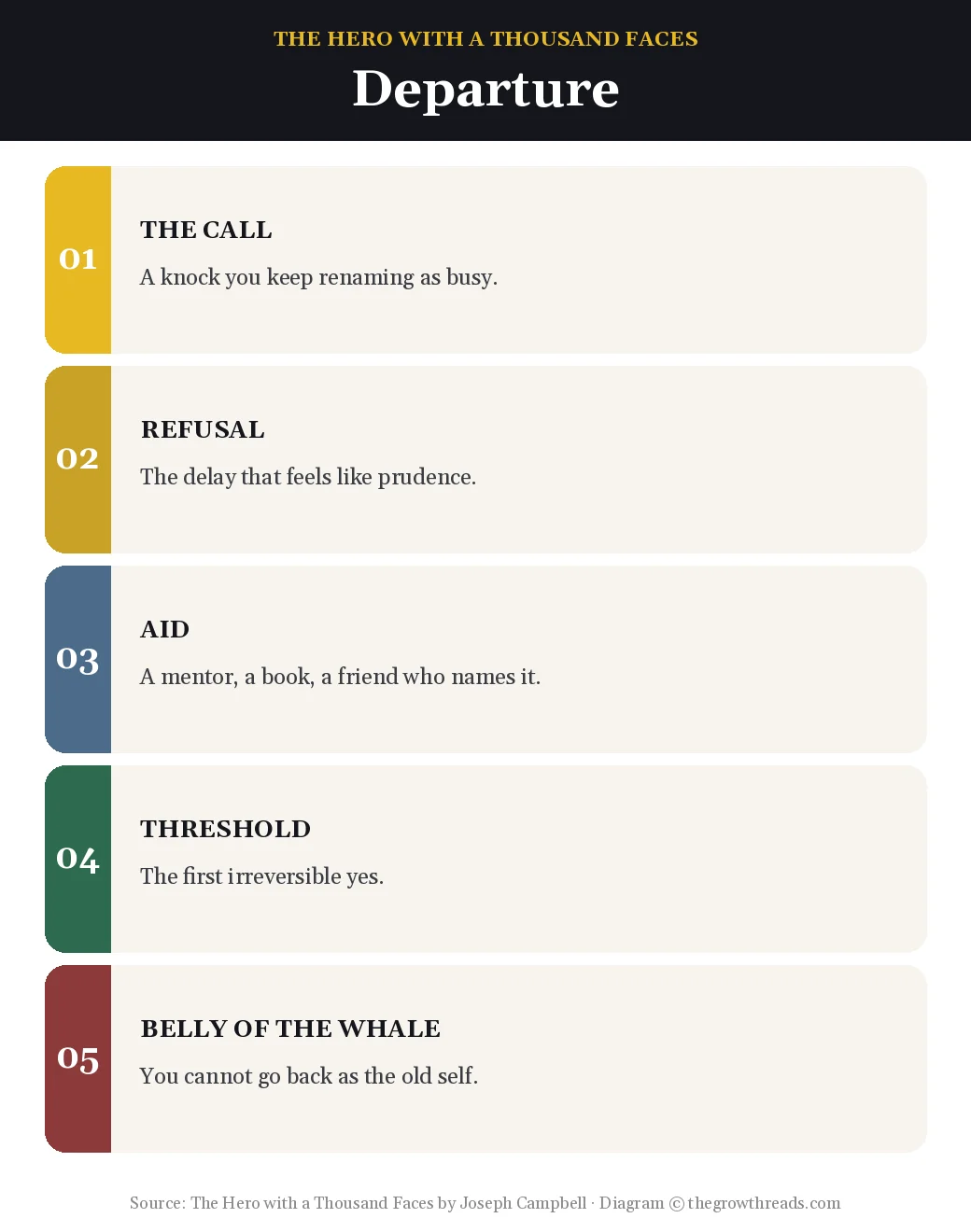
Name your stage in one line. “I am in refusal about X.” “I have aid and I will not use it.” Departure fails when the first yes is reversible at lunch. Pick a yes small enough to do this week and large enough that Thursday-you cannot fully pretend it did not happen.
TGR Note: Refusal is cousin to the stall in The Obstacle Is the Way: the block is the path, not a detour around your feelings. For a growth-language version of “the self that will not cross,” see Mindset. Campbell’s add is narrative: you are not broken. You are at a named gate.
Part 3: Initiation — the road of trials
Initiation is the part posters skip. The road of trials is a sequence. You are tested until a new capacity is a reflex, not a speech. Campbell’s meetings sound antique — goddess, temptress, atonement with the father, apotheosis, the ultimate boon — and the translation is psychological. You meet the part that nurtures, the comfort that would pull you off the path, the authority you have been fighting or fleeing. You get a wider view. You come away with something that can travel.
Atonement is not only family drama. It is confronting the power that seemed to own you: a parent, a profession, a scoreboard, an inner court. You do not have to win a debate. You have to stop letting that power run the map from offstage. Apotheosis is a glimpse, not a permanent upgrade. The boon is what you can carry when the view fades: a skill, a truth, a way of treating people, a piece of work. Stay in the trial until the default changes, then name the gift so a neighbour could use the sentence. If you cannot, you may still be in the whale, decorating the ribs.
TGR Note: 12 Rules for Life is a modern, blunt cousin: stand up, tell the truth, pick up the heaviest thing you can actually carry. Campbell supplies the mythic map; Peterson supplies kitchen-table rules. For meaning chosen under a harder constraint than a career threshold, Man’s Search for Meaning remains the sterner classroom.
Part 4: Return — bringing the boon home
Return is the chapter high achievers skip because the cave felt more special than the village. Campbell will not let that be the ending. You may refuse to return — enlightenment as a private club. Sometimes the community has to haul you back. The people at home did not take your journey. They still want the bins taken out. Master of two worlds is the adult skill: inner life and outer chores, neither used as a hiding place.
Freedom to live is the quiet climax: stop postponing aliveness until a future personality arrives. Inhabit the day on the calendar. Part II’s cosmogonic cycle — worlds made and unmade — can wait for a second pass. The usable piece is cyclical. Finishing a return is how you hear the next call without treating it as a personality disorder.
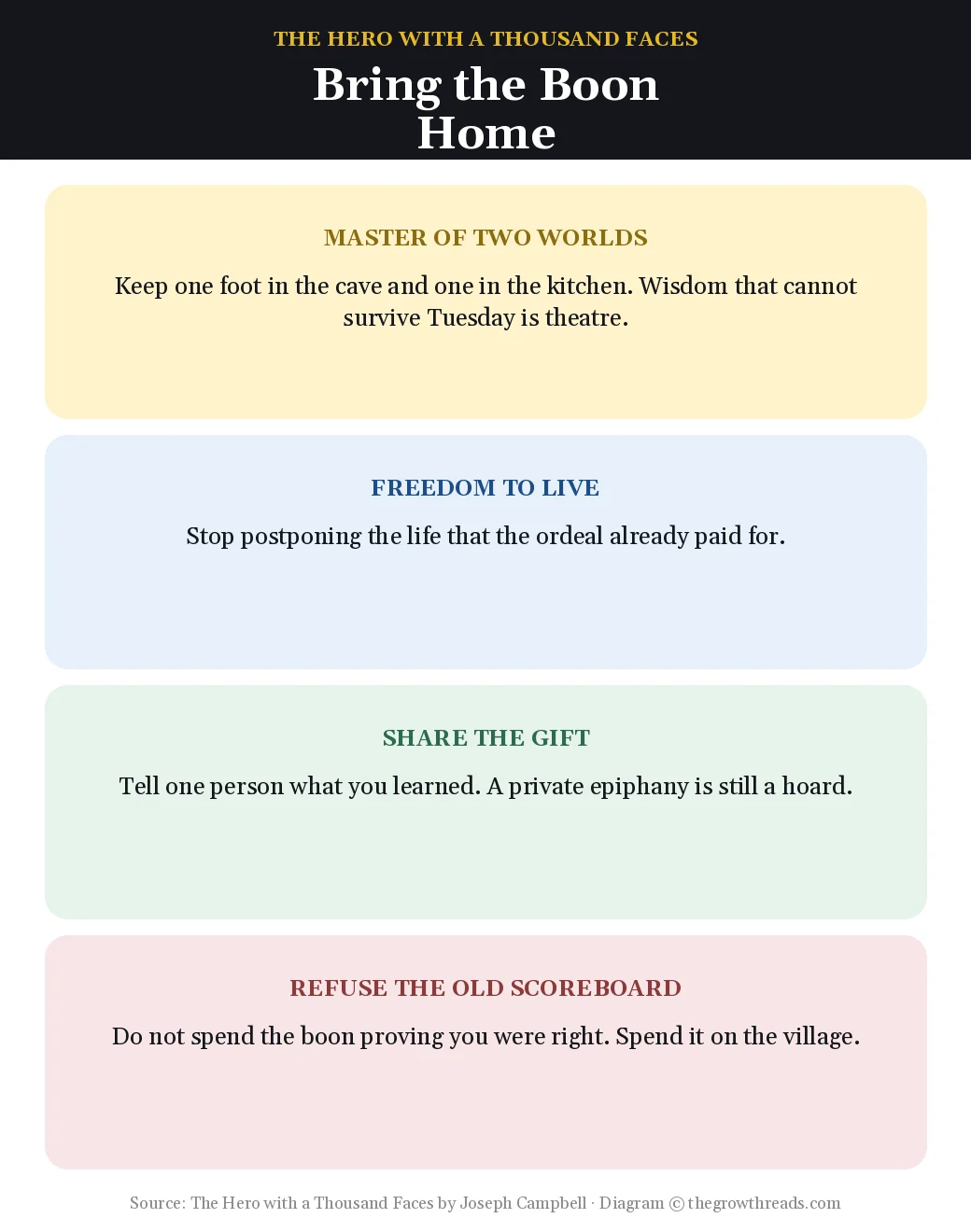
Application is local. Tell one person what the ordeal taught you. Put the gift into a behaviour this week — a boundary, a page, a visit, a no. Do not spend the boon proving you were right. Spend it on the village. “Follow your bliss” is the later poster from the Moyers interviews. The 1949 book is a circle. Follow the stage you are actually in. Then come back useful.
TGR Note: Return without presence is just a recap. The Power of Now is the practice of inhabiting the world you came back to. Meditations is the emperor’s version of two worlds: inner rule, outer duty, same morning. Campbell would recognise both as return work.
Who is The Hero with a Thousand Faces best for — and who should read something else first?
Best for the person whose life has a plot they will not admit: a career that expired, a calling they keep professionalising away, a grief that ended the old village. It is also for makers who sense that story-structure is psychology, not only entertainment. You do not need a mythology degree. You need a threshold you have been circling and a willingness to call it by its name.
Read something else first if you need a clinical protocol rather than a map — start with Feeling Good. If you want a short fable of the same spine, The Alchemist. If you want daily systems instead of a mythic week, Atomic Habits. If you want blunt modern rules from a psychologist steeped in the same Jungian well, 12 Rules for Life. Campbell is a companion for a crossing, not a treatment plan.
Questions to reflect on
- What call have you been renaming as busyness, and since when?
- Who is already offering aid that you keep “not wanting to bother”?
- What would a one-way threshold look like this week — small enough to do, expensive enough to count?
- If the ordeal already happened, what is the boon in one sentence a neighbour would understand?
- Who in your village should receive that gift before you spend it on being right?
🔥 Ready to walk the stage you are actually in?
Get The Hero with a Thousand Faces and map this week’s crossing.
How to apply The Hero with a Thousand Faces (7-day plan)
- Day 1: Write five lines on the ordinary world you are in — job, home, the story you tell about “how life is right now.”
- Day 2: Name the call in one sentence. No branding. What knock have you been translating into more work?
- Day 3: List three refusals (calendar, identity, other people’s needs). Circle the one that is actually fear.
- Day 4: Use aid. Send one honest message to a mentor, friend, or guide. Ask for a walk, not a TED talk.
- Day 5: Cross a small threshold: send the application, book the ticket, start the page, schedule the conversation. Make it expensive to undo by nightfall.
- Day 6: Draft the boon in plain speech. If you cannot, you are still in the whale — stay in the trial, skip the speech.
- Day 7: Return. Tell one person the sentence. Put one behaviour from it on next week’s calendar. Review: which act are you in now?
Frequently asked questions
What is The Hero with a Thousand Faces about?
It is Joseph Campbell’s 1949 argument that the world’s hero stories share a deep plot he named the monomyth. A figure leaves the ordinary world, is tested and changed in a region of ordeal, and returns with a boon the community can use. Campbell reads myths with Freud and Jung so the pattern is usable as a psychology of becoming, not only as folklore. You finish with a three-act map — departure, initiation, return — you can lay over a career, a grief, or a craft, plus a warning: insight that never comes home is not a gift yet.
What is the monomyth, or hero’s journey?
The monomyth is Campbell’s name for the recurring adventure: call, refusal, aid, threshold, trials, a decisive inner change, and a return with a gift. Hollywood later numbered beats for screenplays. Campbell’s version is a circle, not a ladder — finishing a return is how you hear the next call. In ordinary life the “supernatural” is often psychological: a truth you cannot un-know, a capacity you did not have in January. Use it as a diagnostic. If you are still refusing, do not skip to “boon.” If you already had the ordeal, do not skip the village.
How many stages are in the hero’s journey?
Campbell groups the adventure into three acts — departure, initiation, return — and describes about seventeen substages inside them, from the call to freedom to live. Later popular versions (especially screenwriting diagrams) often show twelve. Do not treat the count as a checklist you must complete in order like a game. Treat the three acts as the spine and the substages as names for moods you already recognise: refusal, the first irreversible yes, the long middle, the awkward homecoming. If you remember only three words, remember leave, change, give.
Did Star Wars use The Hero with a Thousand Faces?
George Lucas said Campbell’s work helped him find a spine for Star Wars, and the public conversation after The Power of Myth glued the two together. You can watch Luke leave Tatooine, train, die to an old self, and return with a gift for a rebellion, and see the monomyth without forcing every beat. That is a door into the book, not the whole house. Campbell wrote for readers of myth and psychology decades before the films. Use Star Wars as a trailer. Use the book as a map of the crossing you are actually on, which will not include a Death Star and will include a Tuesday.
How long does it take to read The Hero with a Thousand Faces?
The New World Library collected edition runs 432 pages, with sidebars and a long comparative middle. Most readers should budget eight to twelve hours, not a weekend paperback sprint. A sane approach is to read the prologue and the three-act adventure slowly, then skim Part II’s cosmogonic cycle on a first pass unless you want the full myth-cycle. This guide takes about fourteen minutes and gives you the map, the departure stages, the return job, and a 7-day plan. The book rewards a pencil. It does not reward speed-running examples from every tradition in one sitting.
How do you apply The Hero with a Thousand Faces in real life?
Name your act. Write the call in one unbranded sentence. Notice the refusal that looks like a full calendar. Use aid instead of another private research binge. Cross one small one-way threshold this week. If you are already in the middle, stay until a capacity is installed, then say the boon so a neighbour could use the sentence. Return by telling one person and putting one behaviour on the calendar. The book fails if it stays a film-theory hobby. It works if Friday includes a yes you cannot fully undo, or a gift you actually handed over.
Is The Hero with a Thousand Faces still worth reading in 2026?
Yes, if you want a map rather than a mood. Some examples and chapter titles are of 1949; the practical spine — call, ordeal, return — is what makers, therapists, and ordinary adults still steal. You do not have to accept every comparison Campbell makes across traditions. You do have to try the three acts on a real week. If the language of myth leaves you cold, start with The Alchemist or 12 Rules and come back. If you already live on story-structure, this is the source under the posters. “Follow your bliss” is the later slogan. The book is the circle.
Related summaries
- The Alchemist — a fable of the call you can actually walk.
- 12 Rules for Life — kitchen-table rules from a psychologist drinking from the same well.
- Man’s Search for Meaning — meaning chosen under a harder constraint than a career threshold.
- The Obstacle Is the Way — the trial as the path, without the masks.
Browse every title in our Best Psychology Books pillar page.
How we analyze books: our summaries are built from a full read of the source text, cross-referenced against the author’s published interviews and research where relevant, and structured around practical application rather than critique. We disclose our editorial process and affiliate relationships in full. Read our full methodology.