

★★★★★ 4.6/5 — An adventure that trains one humane habit: treat a coincidence as guidance, not luck.
Best for: Readers who keep calling chance meetings “weird,” and anyone tired of leaving conversations smaller
Reading time: ~5–6 hrs for the Grand Central paperback · ~16 min for this guide
Difficulty to apply: The insights are plain; refusing a control scene in a live room is the work
The Celestine Prophecy in one minute
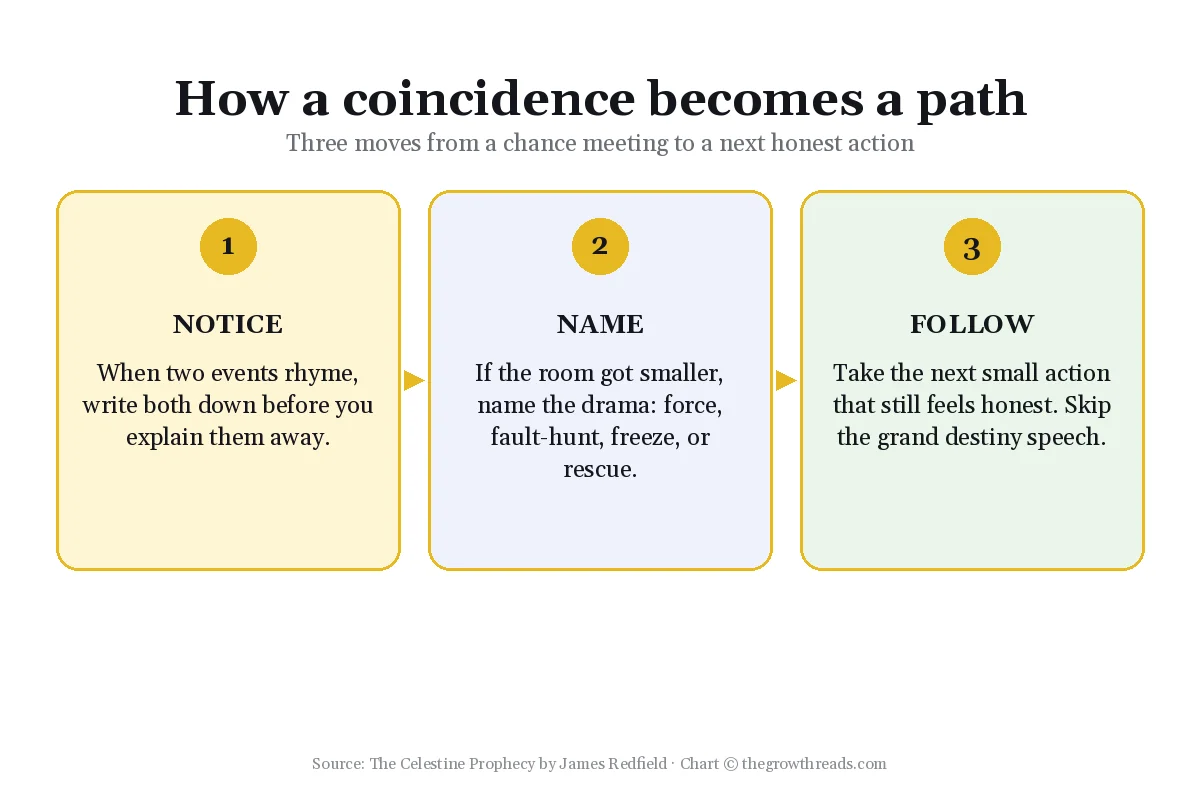
A coincidence is information you have been trained to ignore. James Redfield’s 1993 novel sends an American to Peru after a friend describes a manuscript of nine insights. Soldiers chase. Priests whisper. A scientist talks about energy. The steal is not the jungle. It is a weekly practice: when two events rhyme, write them down. When a room shrinks, name the drama — force, fault-hunt, freeze, or rescue. Fill yourself before you fill a conversation. Then take the next small action that still feels honest. Destiny speeches can wait.
Key takeaways
- Coincidences thicken on purpose: Treat a rhyme between events as a note, not a glitch.
- You are in a longer now: Your week sits on a longer human story; you are not the first to wake up mid-habit.
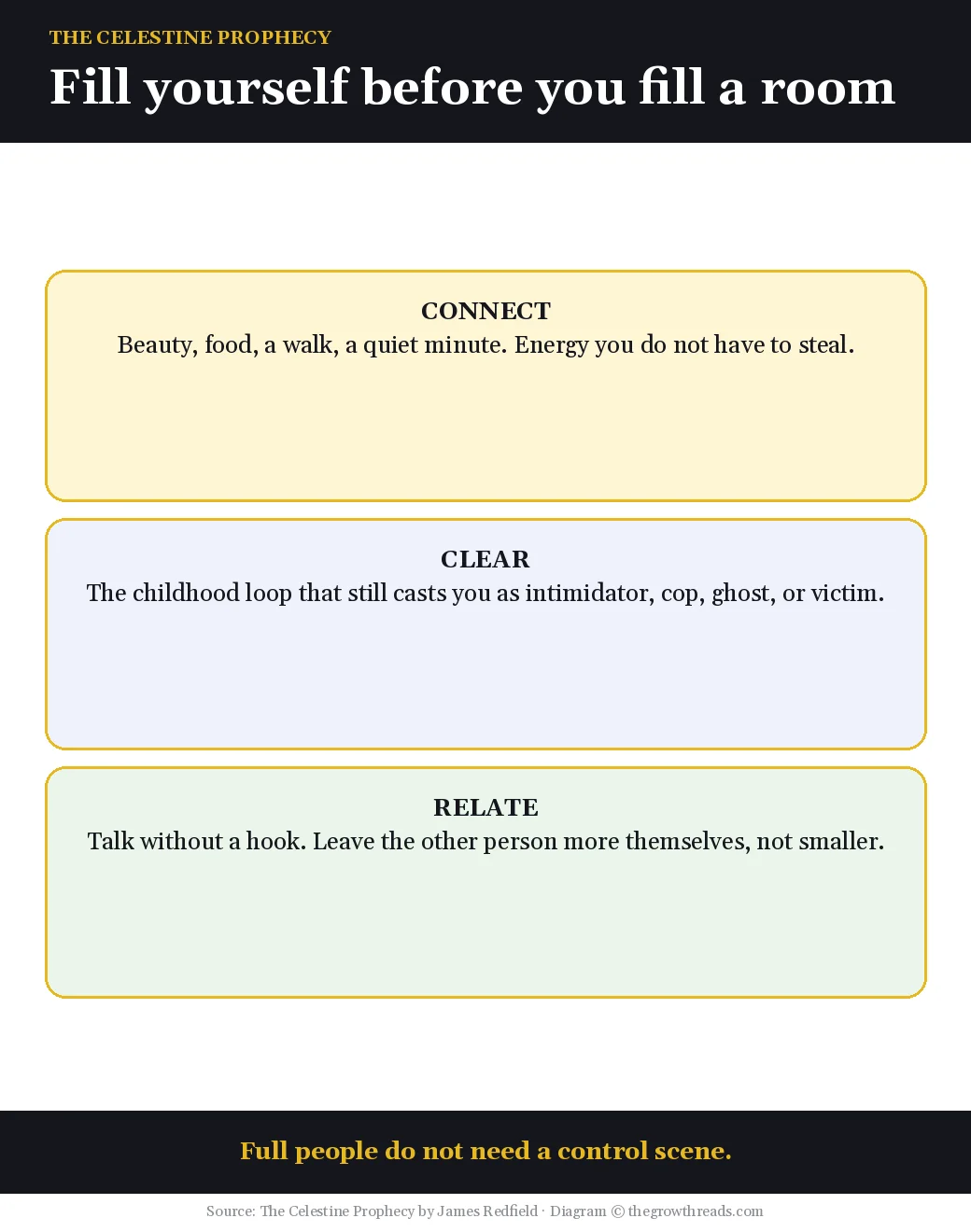
- The world is energy you can feel: Beauty, food, a walk, and quiet refill you so you stop borrowing other people.
- Empty people steal: Control is often hunger wearing a costume.
- Four dramas, one exit: Intimidator, interrogator, aloof, poor me. Name yours. Stop casting the other person.
- Clear the old loop: Childhood roles still run the meeting if you do not put them on the table.
- Follow one nudge: Dreams, hunches, and chance meetings are a queue. Take the next honest item, not all nine at once.
- Leave them more themselves: An ethic between people: no hook, no shrink, no rescue addiction.
- Culture is the last insight: A life that does not run on theft scales past one conversation.
What is The Celestine Prophecy about?
The Celestine Prophecy is James Redfield’s 1993 spiritual adventure about an American who follows a Peruvian manuscript of nine insights. It argues that coincidences are guidance, that people steal attention when they feel empty, and that you can refill yourself and follow the next honest nudge.
About the author
James Redfield was born 19 March 1950 in Alabama. He studied sociology, then spent years as a therapist working with abused adolescents — rooms where control, rescue, and silence were not theory. In 1989 he left the clinic to write. He self-published The Celestine Prophecy in 1993; Warner Books acquired it and the novel became a long-running New York Times bestseller, later a 2006 film he co-wrote. Sequels added more insights (The Tenth Insight, The Secret of Shambhala, The Twelfth Insight). The method in the first book is plainer than the phenomenon: treat chance as data, stop stealing aliveness, take the next honest step. He still lectures on that map. Explore all James Redfield book summaries →
Key concepts at a glance
| Concept | What it means | Use it when |
|---|---|---|
| Critical mass | More people noticing meaningful coincidences at once | You keep calling the same rhyme “random” |
| The longer now | Your week sits on a longer history of waking up | You think your stuckness is private and unprecedented |
| Energy | Attention and aliveness you can feel, spend, or steal | A conversation leaves you smaller and you cannot say why |
| Control drama | A childhood script that harvests other people’s attention | The room shrinks and you play along |
| Connecting | Refill from beauty, food, nature, quiet — not from a hook | You are about to pick a fight to feel real |
| Clearing the past | Seeing the family role you still cast | Every hard talk turns into the same scene |
| Engaging the flow | Hunches and chance meetings as a queue of next actions | You wait for a destiny billboard instead of one honest step |
| Interpersonal ethic | Relate without shrinking the other person | You “help” in a way that keeps them needing you |
Part 1: Coincidences are the curriculum
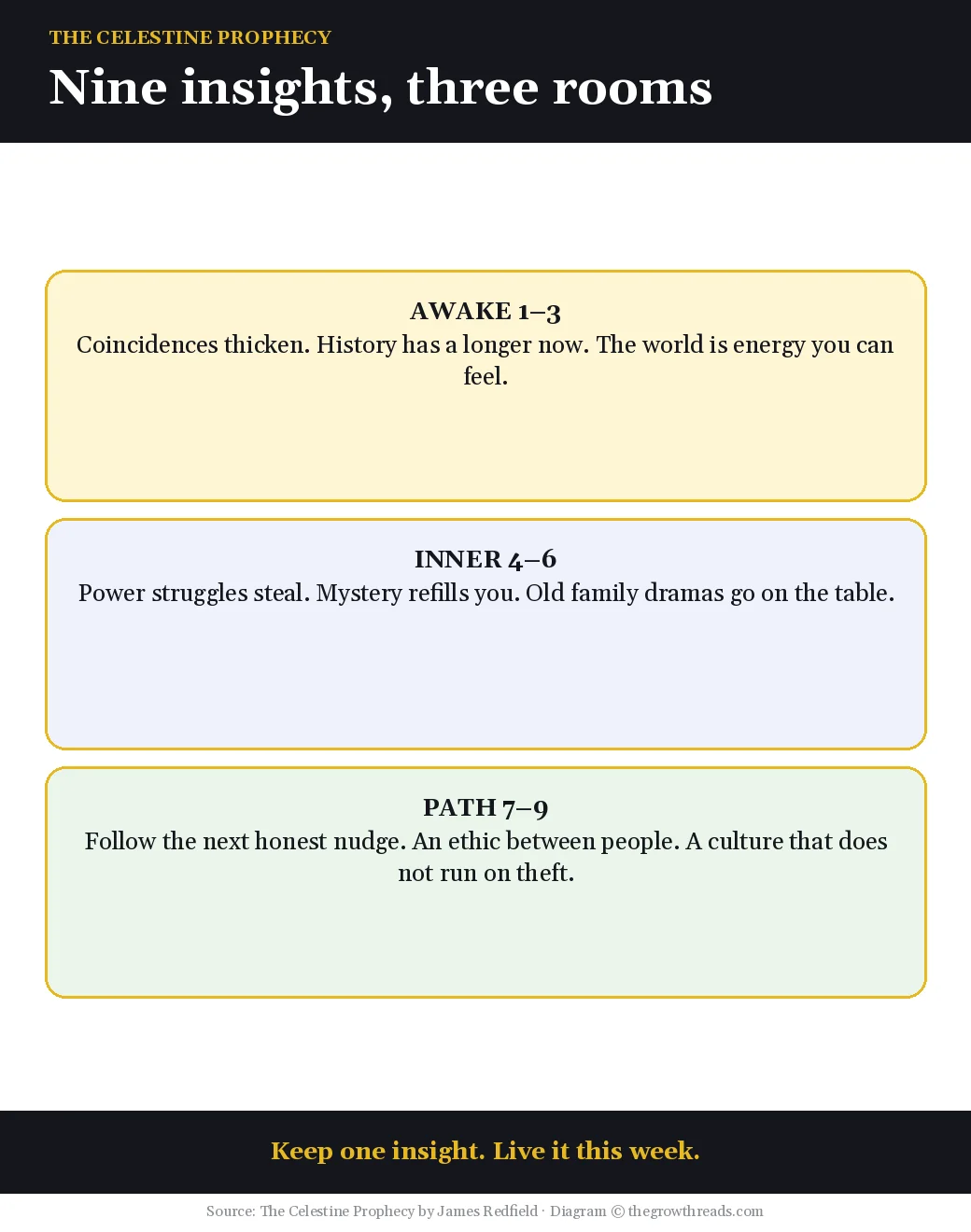
The book opens as a hunt for a manuscript, and the first insights are already the work. A friend mentions Peru. A priest appears. A scientist says the universe is not a pile of objects. Redfield’s claim is blunt: coincidences are becoming more frequent because more people are ready to notice them. Call that a “critical mass” if you like the phrase. The usable move is smaller. When two events rhyme — a name, a book, a street, a sentence you needed — write both down before you explain them away. Explanation is often how we stay asleep with our eyes open.
The second insight stretches the timeline. You are not a closed week. You sit on a longer human now: tribes, farms, machines, information, a restlessness that is not only yours. The third insight names the fuel. What you have been calling mood is often energy — the lift from a hillside, a meal, a piece of music, a face that is actually present. When that fuel is low, you will borrow it. When it is high, you can walk into a room without a hook. The adventure is a delivery system for those three sentences. Steal the sentences. Leave the soldiers on the page.
TGR Note: The Alchemist is the omen book: a Personal Legend and signs on a road. Redfield keeps the adventure and turns the omen into a notebook habit. Use Coelho when you need permission to leave. Use this section when the signs are already arriving and you keep calling them luck. The Hero with a Thousand Faces maps the same departure as myth. Celestine maps it as a Tuesday.
Part 2: The four dramas that steal the day
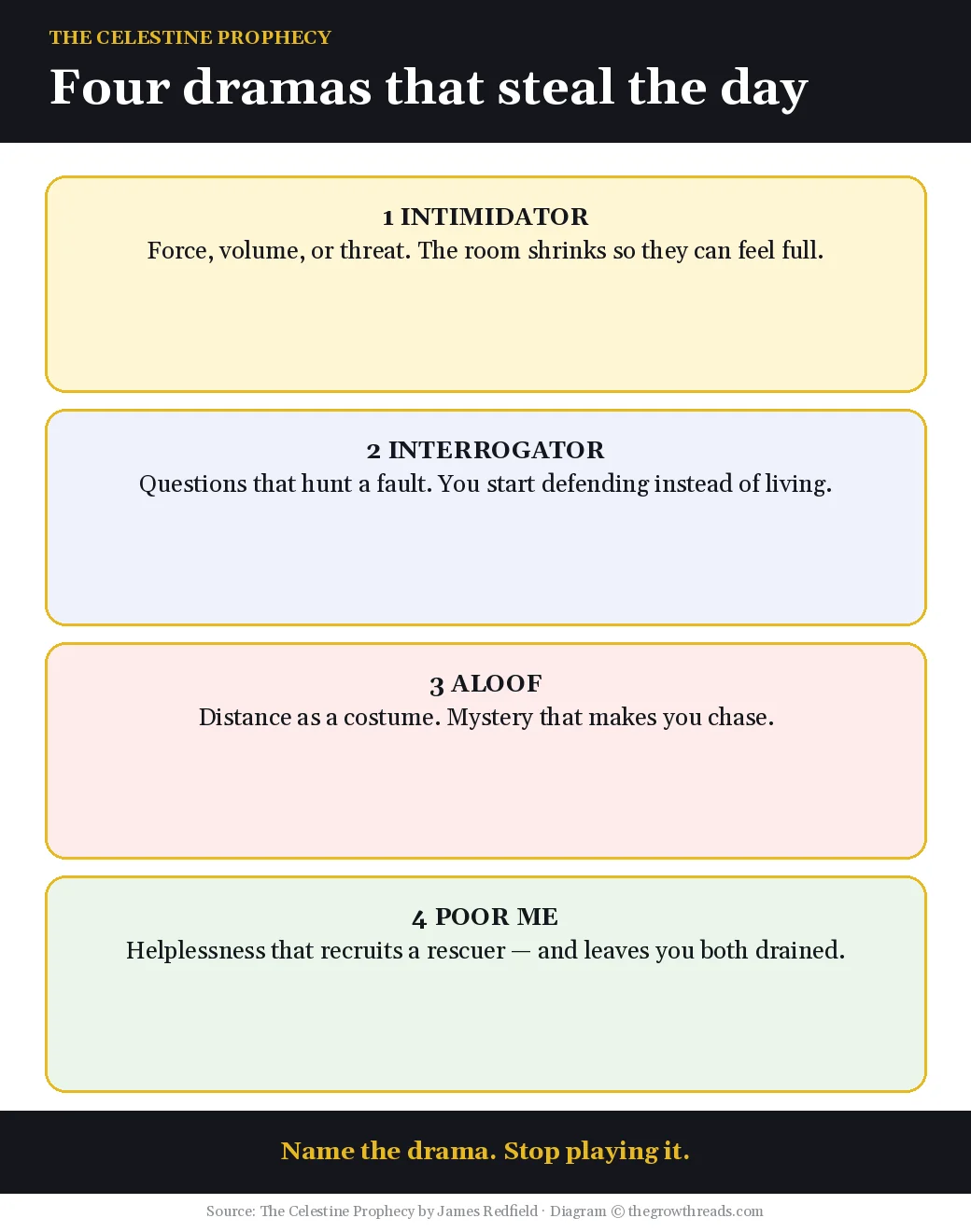
Once energy is real, the social world gets honest. People who feel empty do not always ask. They run a scene that makes you hand it over. Redfield names four control dramas, learned young, still running in offices and kitchens. The intimidator uses force, volume, or threat until the room shrinks and they feel full. The interrogator hunts a fault; you start defending your life instead of living it. The aloof performs distance and mystery so you chase. Poor me performs helplessness until someone becomes a rescuer — and both people leave drained. None of this requires a villain. It requires hunger.
The clinical-feeling move is the same one Sacks would recognise in another register: do not let the costume finish the person. Name the drama. Refuse the role you are being cast in. Then refill yourself so you are not hunting a scene of your own. The sixth insight says the drama is old. A parent’s intimidation becomes your interrogator. A household of silence becomes your aloof. You do not need a full family reconstruction this week. You need one sentence: “This is the loop,” spoken before you pick up the hook.
TGR Note: Adult Children of Emotionally Immature Parents is the family-systems version of the same loop. Redfield gives you four costumes and a refusal. Gibson gives you the childhood map. Use both when a hard talk turns into last decade. The Untethered Soul is the inner witness: the voice in your head is not you. Stay here when the problem is between two people, not only inside one skull.
Part 3: Fill yourself, then follow the next honest nudge
Insights five through seven are the refill and the follow. Connecting is not a slogan. It is a physical act: food that is actually tasted, a hillside, a painting, a minute without a screen, a conversation that does not have a job. When you are full, you do not need to intimidate, interrogate, vanish, or collapse. The interpersonal ethic (insight eight) is what fullness makes possible: talk without a hook. Ask a question that is not a trap. Leave the other person more themselves. Love, in this book, is energy that does not require a victim.
Engaging the flow is easier to misuse than the dramas, so keep it small. Hunches, dreams, and chance meetings are a queue, not a crystal ball. You do not need to know the ending. You need the next honest action that still feels clean after a meal and a walk — send the message, take the class, go to the place, stop the scene. If the nudge requires you to shrink someone, it is not flow. It is another drama in nicer clothes. The narrator’s Peru is a long example of following one meeting into the next. Your version can be a ten-minute errand you have been dressing up as fate.
TGR Note: The Power of Now drops the plot and sits. Redfield keeps the plot and asks you to follow it without stealing. Use Tolle when rumination is the fire. Use this section when the fire is a string of meetings you keep dismissing. Flow is a chosen deep-work transport. Celestine’s flow often arrives as a coincidence. Design a block with Csikszentmihalyi. Carry a notebook with Redfield.
Part 4: An ethic between people — and a culture that does not run on theft
The last insights zoom out. If enough people refill themselves, conversations change. If conversations change, groups change. Redfield’s ninth insight sketches a culture that uses less, notices more, and does not need to harvest attention to feel real. You do not have to buy a full utopia to steal the local version: a team that does not run on interrogation; a family dinner that does not require a victim; a feed you refuse to mine for a hit. The emerging culture is a name for “we stopped stealing.” Start in one room.
Sequels add more insights and more plot. This guide stays with the original nine because they already overflow a week. The adventure novel exists so the map is memorable. Keep the map. When you catch yourself waiting for a prophecy, you already have one: notice, name, refill, follow. That is enough Peru for a Thursday.
TGR Note: A New Earth is Tolle’s culture-scale chapter: ego as a collective habit. Redfield’s ninth insight is the same zoom with a novel wrapped around it. Use both when you are tempted to fix humanity before you fix lunch. The Secret turns feeling into a request. Celestine turns feeling into fuel so you stop stealing. Stay here if the live problem is a control scene, not a vision board. A Course in Miracles is the longer spiritual curriculum; this book is the travel edition.
Who is The Celestine Prophecy best for — and who should read something else first?
Best for readers who already feel the coincidences and need a practice, and for anyone who leaves conversations tired without knowing why. Also for people who will actually finish an adventure novel. Not a first book if you need a protocol for this week’s panic: start with Feeling Good. If you want presence without Peru, The Power of Now. If the live wire is family roles, Adult Children of Emotionally Immature Parents. If you want a fable of calling, The Alchemist. If you want lab psych, Thinking, Fast and Slow. Come here when luck and draining rooms are the same problem.
Questions to reflect on
- What coincidence did you explain away this month that still feels unfinished?
- Which of the four dramas do you reach for when you feel empty — force, fault-hunt, freeze, or rescue?
- Where did you last shrink someone in order to feel full?
- What refill (walk, meal, quiet, beauty) would make the next hard talk cleaner?
- What is the next honest action that still feels clean after you are fed and unhooked?
🔥 Ready to treat coincidences as guidance?
Get The Celestine Prophecy and steal one insight you can use this week.
How to apply The Celestine Prophecy (7-day plan)
- Day 1: Read insights 1–3. Write one coincidence from the last month. Two sentences. No destiny speech.
- Day 2: Watch one conversation. If the room shrinks, label the drama: intimidator, interrogator, aloof, or poor me.
- Day 3: Name the drama you run when you feel empty. Tell it to a notebook, not a jury.
- Day 4: Refill before a hard talk: a real meal, a walk, ten quiet minutes. Then have the talk without a hook.
- Day 5: Follow one small nudge that still feels honest after the refill. One errand. Not a life overhaul.
- Day 6: Leave one person more themselves. Ask a clean question. Skip the rescue and the cross-examination.
- Day 7: Review. Keep the single question you will actually ask next week: what still wants my honest next step? Put it on a card.
Frequently asked questions
What is The Celestine Prophecy about?
James Redfield’s 1993 adventure novel follows an American who goes to Peru after a friend describes an ancient manuscript of nine insights. The plot is a chase. The usable book is a map: coincidences are information, people steal attention when they feel empty, and you can refill yourself instead of running a control scene. Read it as a field guide you can try on Thursday, not as a lab paper. This summary is the steal — notice, name the drama, take the next honest action — not a substitute for the novel.
Who wrote The Celestine Prophecy?
James Redfield was born 19 March 1950 in Alabama. He trained in sociology, worked as a therapist with abused adolescents, then left in 1989 to write. He self-published The Celestine Prophecy in 1993; Warner Books picked it up and it spent years on the New York Times list. He later wrote The Tenth Insight, The Secret of Shambhala, The Twelfth Insight, and the nonfiction Celestine Vision. The stance in this book is older than the sequels: treat a chance meeting as data, and stop borrowing other people’s aliveness.
What is a “control drama” in The Celestine Prophecy?
A “control drama” is a childhood script you still run when you feel empty and want a hit of other people’s attention. Redfield names four: the intimidator (force), the interrogator (fault-hunting questions), the aloof (distance that makes you chase), and poor me (helplessness that recruits a rescuer). The point is not to diagnose your relatives at dinner. Name the one you slip into, refuse the role, and refill yourself — a walk, a meal, a quiet minute — so the scene has nothing to feed on.
How is The Celestine Prophecy different from The Power of Now or The Alchemist?
The Power of Now drops the story and sits in this minute. The Alchemist is a fable about a Personal Legend and omens on a road. The Celestine Prophecy keeps the adventure plot and turns coincidences plus social energy into a weekly practice: notice the rhyme, stop the steal, follow one honest nudge. Use Tolle when the problem is rumination. Use Coelho when you need permission to leave a life that does not fit. Use Redfield when the live problem is a room that keeps getting smaller and a string of chance meetings you keep calling luck.
Is The Celestine Prophecy a psychology textbook — or something you can apply this week?
It is a spiritual adventure novel, not a DSM and not a methods paper. You will not get p-values or a therapy protocol. You will get a stance you can use on Thursday: write down two events that rhymed, name the control scene if the room shrank, refill yourself before the next hard conversation, and take one small action that still feels honest. That is application. If you need CBT worksheets, start with Feeling Good. If you need presence without Peru, start with The Power of Now. Come here when coincidences and draining people are the live problem.
Are the nine insights in The Celestine Prophecy meant as literal history?
The manuscript-in-Peru frame is fiction. Some of the “longer now” history is a popular sketch, not a seminar. The practical advice is uncontroversial: treat chance meetings as information, notice when you steal attention, refill yourself, and take the next honest step instead of a destiny speech. Read the insights as a usable map. Do not cite a jungle chase as anthropology. Steal the practice, not the footnotes. Later sequels add more insights; this guide stays with the original nine.
How long does it take to read The Celestine Prophecy?
The Grand Central 2018 paperback is 288 pages; earlier Warner copies run closer to 246. Plan about five to six hours for the adventure, less if you read for the insights and skim the chase. This guide is about sixteen minutes. You finish a day when you have written down one coincidence and refused one control scene. Buy a readable paperback. One insight lived beats nine insights highlighted. Do not wait for a retreat in the Andes before you try the question on a living Tuesday.
Related summaries
- The Power of Now — presence without the adventure plot.
- The Alchemist — omens and a Personal Legend on a road.
- The Untethered Soul — the inner witness when the drama is a voice.
- The Hero with a Thousand Faces — the same departure, told as myth.
Browse the full list on our Best Psychology Books pillar.
How we analyze books: our summaries are built from a full read of the source text, cross-referenced against the author’s published interviews and research where relevant, and structured around practical application rather than critique. We disclose our editorial process and affiliate relationships in full. Read our full methodology.