

★★★★★ 4.6/5 — The most usable popular map of attention: stop broadcasting lack, ask with precision, then live from the feeling of the result.
Best for: Anyone stuck in a complaint loop who wants a daily practice for shifting state — not a physics textbook
Reading time: ~5 hrs for the full book · ~14 min for this guide
Difficulty to apply: Easy to read; the work is staying in the feeling when the inbox looks the opposite
The Secret in one minute
Your life is echoing the thoughts you refuse to drop. That is Rhonda Byrne’s starting claim. The law of attraction, as she presents it, is not a slogan about “being positive.” Thoughts are magnetic, feelings are the broadcast, and your circumstances are a delayed readout of what you have been dwelling on. The engine is Ask, Believe, Receive — plus a few processes that change the feeling before the evidence arrives. The book is short, repetitive on purpose, and built to use the same afternoon you finish it.
Key takeaways
- Like attracts like: What you hold in mind with feeling tends to reproduce itself.
- The feeling is the request: Words without emotion are a weak signal. The body-state you live in is the actual ask.
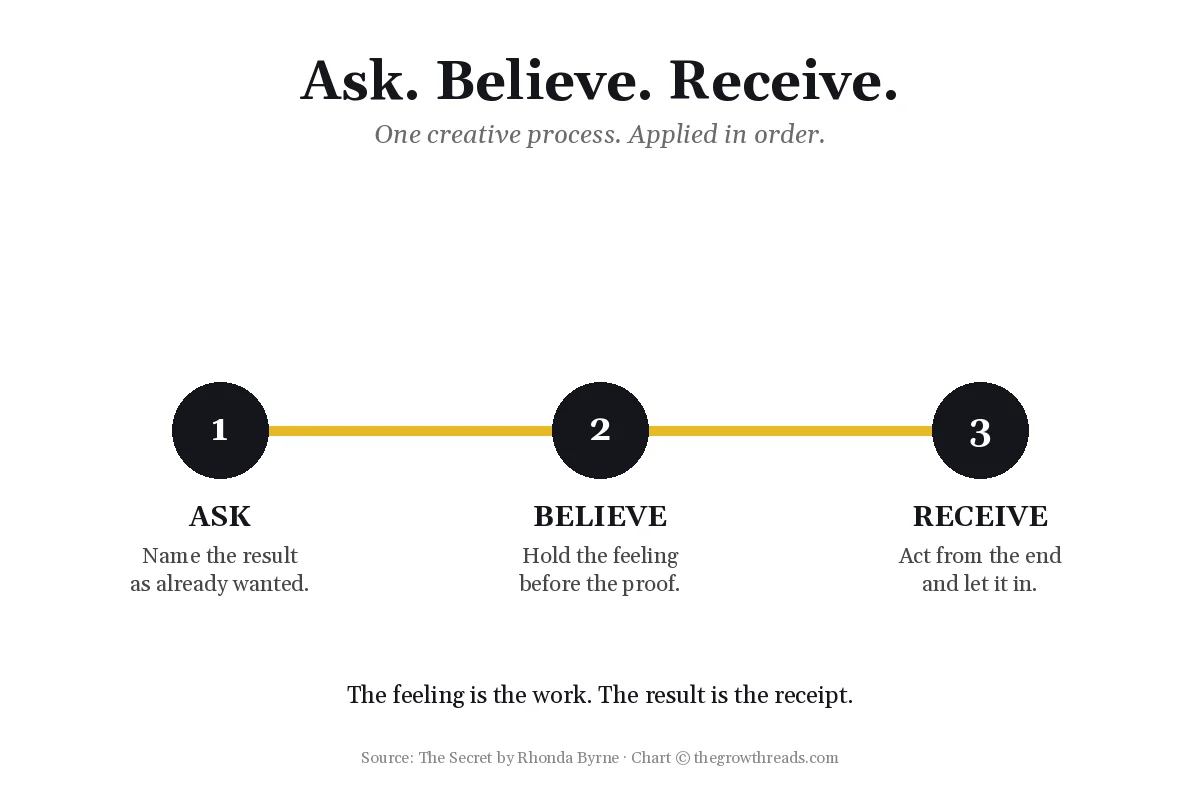
- Ask, Believe, Receive is one process: Name the result, occupy the feeling of it done, then act as that person.
- Gratitude is the fastest shift: A specific list of what is already working changes frequency faster than arguing with a problem.
- Complaining is a second order: Every “still not yet” is another instruction to the same scene.
- Visualization is rehearsal, not daydream: Five minutes seeing the scene as already true trains you to recognise it.
- The Secret Script writes the day backwards: Journal as a memory — “I am so happy now that…” — so the mind has a finished picture.
- Act as if is a behaviour, not a costume: One small action of the person who already has the result beats a mood board you never live.
- Money, health, and relationships use the same law: The domain changes; the broadcast does not. Pick one arena.

What is The Secret about?
The Secret is Rhonda Byrne’s 2006 map of the law of attraction: thoughts and feelings emit a frequency, like attracts like, and results change when the broadcast changes. It teaches Ask, Believe, Receive, then applies the same process to money, relationships, health, and daily life.
About the author
Rhonda Byrne was born Rhonda Izon in Melbourne in 1951 and spent two decades as a television writer and producer. In 2004, after her father’s sudden death, her daughter handed her Wallace Wattles’s The Science of Getting Rich. Byrne later described that week as the hinge of her life: she began tracing a single idea — that thought shapes circumstance — through religion, philosophy, and New Thought. She produced the film The Secret in 2006, then the book with Atria and Beyond Words that November. An Oprah appearance turned both into a global run: more than thirty million copies, fifty languages. She followed it with The Power, The Magic, Hero, and The Greatest Secret. Explore all Rhonda Byrne book summaries →
Key concepts at a glance
| Concept | What it means | Use it when |
|---|---|---|
| Law of Attraction | Like attracts like — the feeling you dwell in tends to recruit matching events | Your week keeps rhyming with a worry you cannot drop |
| Frequency / vibration | The emotional tone of your dominant thoughts, treated as a broadcast | You say the right words while feeling the opposite |
| Ask | Name a specific result as something you actually want, not a vague “better” | Your goals are a cloud of complaints |
| Believe | Occupy the feeling of the result before the proof arrives | You only feel hopeful after the email comes in |
| Receive | Stay open, take obvious action, stop arguing with the current scene | You ask, then immediately list why it cannot happen |
| Gratitude | Deliberate attention to what is already working — the fastest state change in the book | Your first thought in the morning is what is missing |
| Visualization | A short, sensory rehearsal of the scene as already true | You “want it” but cannot picture a single Tuesday of that life |
| Secret Script | A journal entry written as a memory of a day that already went well | Lists of goals leave you cold |
| Act as if | One behaviour of the person who already has the result | You wait to feel different before you move |
Part 1: The law of attraction — your results are a delayed readout
Byrne opens with a claim she wants to feel obvious once you look at a week of your own life. Thoughts are not private commentary. They are magnetic: whatever you give sustained feeling to, you tend to meet more of. The “secret” she gathers from the film’s teachers is this single law, restated across centuries — from ask-and-receive language to Wattles, Hill, and the New Thought writers she credits. She is offering a field guide for noticing what you have already been ordering.
You do not attract what you say you want. You attract the dominant feeling underneath the sentence. A person can repeat “I want more money” all month while living in shortage — scanning prices, rehearsing late invoices, telling the story of how nothing ever quite works. In Byrne’s terms that is not mixed messaging. It is a clear order: send more of this. The universe, as she personifies it, is not judging the request. It is matching it.
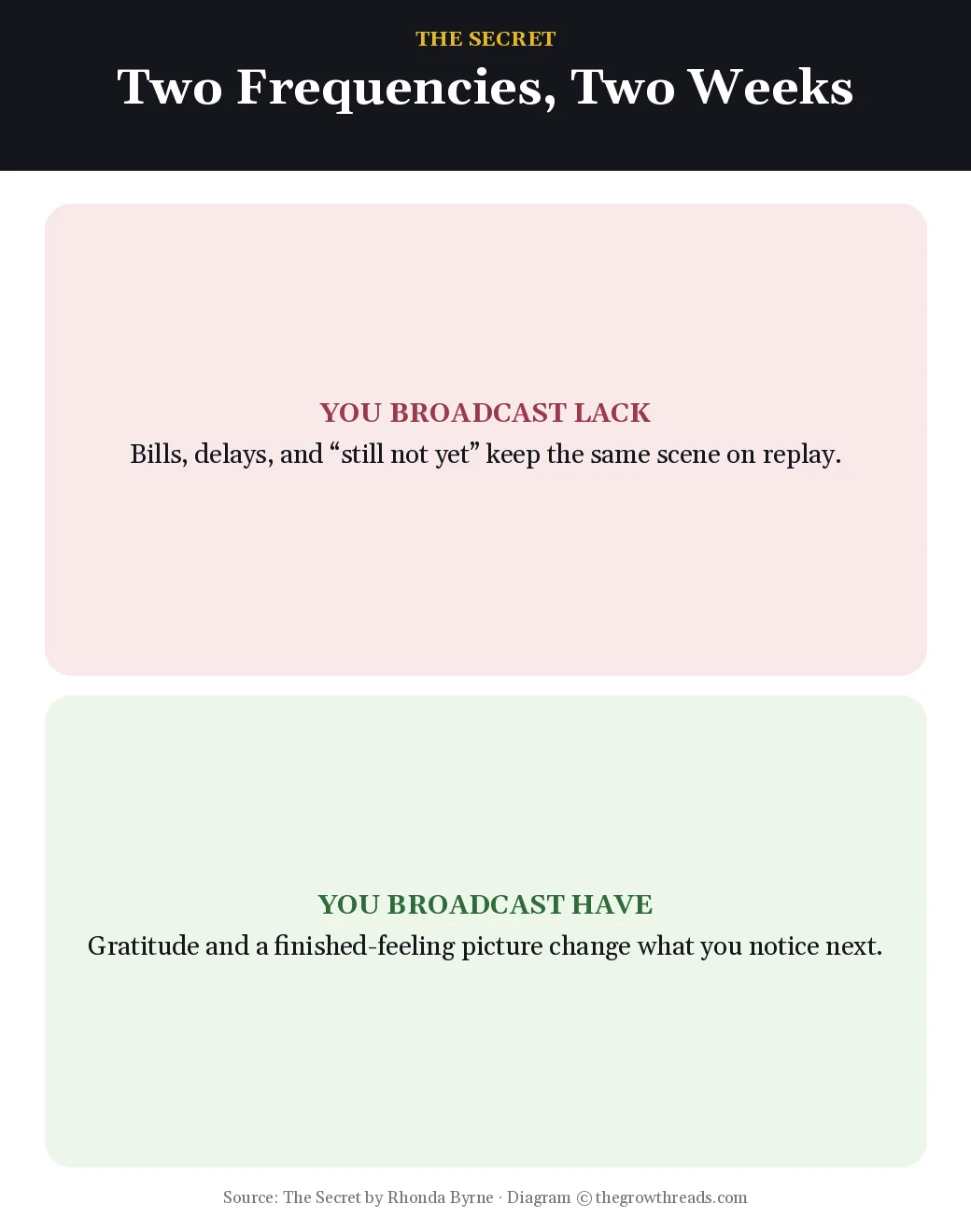
That is why she spends so much time on airtime. News, gossip, a running commentary on what is wrong with the office — each is practice. She is not asking you to pretend hardship is imaginary. She is asking you to stop using hardship as the only channel you live on. Name the feeling your last twenty thoughts were feeding. If it is lack, the week keeps offering scenes that justify it.
TGR Note: Byrne’s “broadcast” is the popular version of James Allen’s one-liner in As a Man Thinketh and of Joseph Murphy’s daily inner conversation in The Power of Your Subconscious Mind. The clinical cousin is attention bias: you find what you scan for.
Part 2: Ask, Believe, Receive — the creative process in order
Once the law is on the table, Byrne gives it a sequence she calls the Creative Process, and she is strict about order. First you Ask: decide with enough specificity that a stranger could recognise the result. “I want to feel better” is not an ask. “I want to close the month at X, in this role, with this kind of Tuesday” is. The teachers keep repeating that a blur cannot be delivered. Precision is kindness to yourself.
Believe is the step most readers skip. Belief here is not a personality trait. It is a felt sense that the result is already on its way — or, more strongly, that in some real way it is already done. You do not wait for the bank balance to give you permission to feel prosperous. You generate the feeling first, for minutes at a time, until it is easier to access than the old panic. Doubt is a second request that cancels the first. You asked for the job, then spent the afternoon explaining why people like you do not get it. The louder signal won.
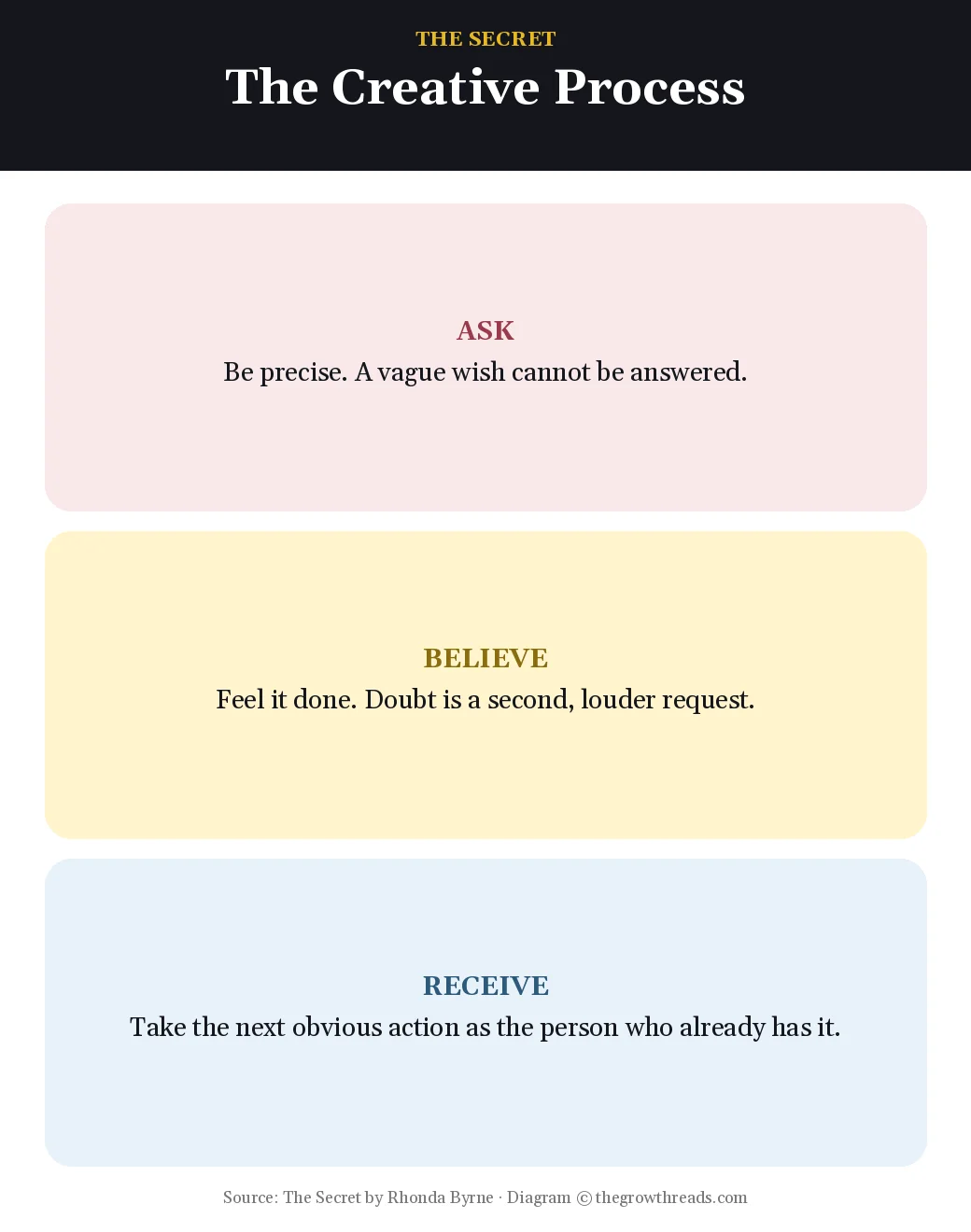
Receive is the least mystical of the three. Byrne is not telling you to sit on the sofa until a cheque levitates. Receiving is a posture: stop arguing with the current scene, stay alert for the next obvious action, and take it without the commentary that it will not be enough. An invitation, a number to call, a quieter idea at 7am — those are the deliveries. The person who “never receives” often asked, felt a flicker of belief, then spent ten days proving the flicker wrong. The process only works in order, and only if you do not immediately unsay it.
TGR Note: “Feel it done before the proof” is Santiago occupying the treasure before the chest in The Alchemist. Carol Dweck’s Mindset is the research cousin: a belief about what is possible changes what effort you spend.
Part 3: Powerful processes — gratitude, pictures, and the Secret Script
The middle of the book is a toolbox. Byrne knows most readers will not “hold a frequency” as an abstract skill, so she gives actions that change the feeling without a personality transplant. The first and most repeated is gratitude: not a generic “I’m grateful for my life,” which the mind can say while remaining tense, but a list of specifics — this coffee, this friend who answered, this skill you already have. Ten items, morning, out loud if you can. A body that has just named ten working things is in a different state than a body that has just named ten threats. From that state, the next thought is a better ask.
Visualization is the second process, and she wants it short and sensory. Close your eyes. See the room, the handshake, the number on the screen. Two to five minutes, not forty-five. The point is not a cinematic masterpiece. It is a finished picture so that, when a matching opportunity appears, it does not feel like a stranger. People who say visualization “doesn’t work” often watch themselves hoping. Byrne’s version is the opposite: you are in the scene as the person who already has it, feeling a Tuesday that already went well.
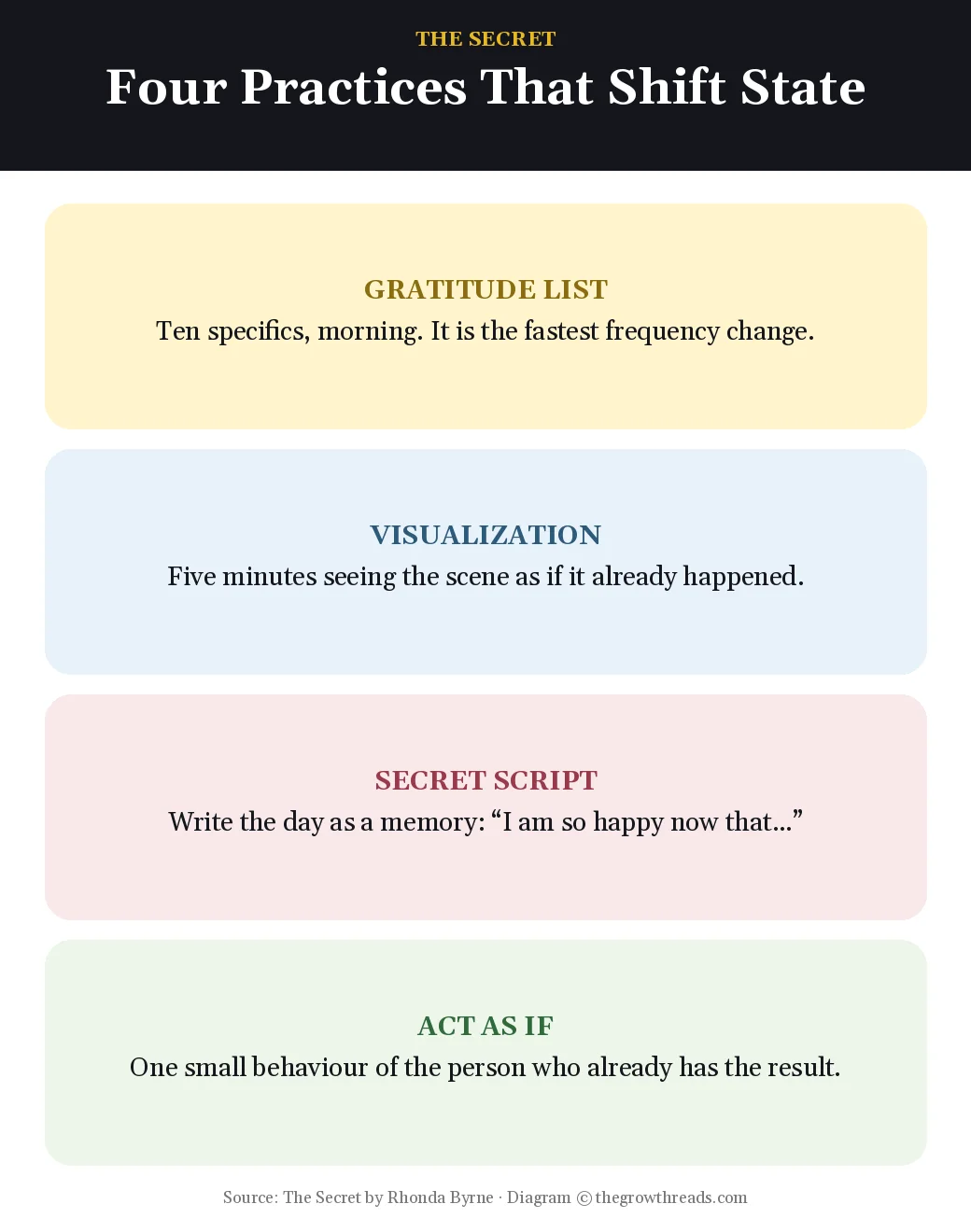
The Secret Script is the process many readers keep. Write the day as a memory: “I am so happy and grateful now that…” with enough detail that it could be next month’s journal. No hedges. Byrne also likes “act as if” in small doses: make the call the way the person who already has the result would make it. It is choosing, for one hour, not to be the old character.
TGR Note: Gratitude as a state-change overlaps with The Happiness Advantage. Visualization as rehearsal is closer to sports psychology than magic. If Byrne’s language feels too cosmic, run the four practices and skip the cosmology.
Part 4: Money, relationships, health — one law, four rooms
The later chapters apply the same process to the domains people bought the book for. Money first: if every conversation is prices and who has more, you are practising poverty with excellent vocabulary. Notice wealth that already exists, ask with a number, then take the next prosperous action from a body that is not braced for humiliation. People who treat The Secret as a substitute for skill-building miss Receive. The book’s own teachers keep working.
Relationships: you attract the frequency of the complaint, not the partner you describe. If the inner movie is “people always leave,” a delayed text becomes evidence. Become, in feeling, the person already in the relationship you want. Health needs the most care. Read her healing stories as reducing catastrophic rehearsal and cooperating with treatment, not as a replacement for it. This summary is not medical or financial advice.
The last move is identity-level. You have been using the law unconsciously. The book’s job is to make that use conscious, so you can choose the broadcast on a Tuesday instead of finding, in November, that you have been placing the same order all year.
TGR Note: For presence without manifestation language, start with The Power of Now or A New Earth. The Untethered Soul sits between them: watch the inner roommate, then choose not to obey it.
Who is The Secret best for — and who should read something else first?
Read it if you can hear your own narration turning every delay into a verdict, or if goal lists never changed how you felt at 8am. It is the right popular entry if you bounced off denser New Thought books and need processes you can run this week.
Read something else first if you are in a clinical depression or anxiety spiral — Feeling Good gives structured cognitive tools. For the evidence-based map of how the mind distorts, start with Thinking, Fast and Slow. If chasing a future self is the exhaustion, go to The Power of Now. The Secret is a feeling-practice, not a substitute for medical care or a financial plan.
Questions to reflect on
- What feeling did you rehearse most often yesterday — and what scenes did that feeling make easier to notice?
- If a stranger listened to your last ten complaints, what would they think you had ordered?
- What would “already done” feel like in your body for the one result you care about this month?
- Where do you ask clearly, then immediately unsay it with a story about why people like you do not get that?
- Which one process — gratitude list, visualization, Secret Script, or a single act-as-if — would actually fit a weekday morning?
🔥 Ready to change the feeling you broadcast?
Get The Secret and start the Creative Process this week.
How to apply The Secret (7-day plan)
- Day 1: Read the opening chapters. Write down the one result you are actually asking for this month, in one specific sentence.
- Day 2: Catch three complaints before they leave your mouth. Replace each with a fact, then one thing that is already working.
- Day 3: Morning gratitude list of ten specifics, spoken. Notice the body-state at item ten versus item one.
- Day 4: Five minutes of visualization: one scene of the result as already true. Stay with the feeling, not the hoping.
- Day 5: Write a Secret Script for tomorrow as a memory. No hedges. Read it once at night and once in the morning.
- Day 6: Take one action the “already has it” person would take — a message, a page, a walk into the room you have been avoiding.
- Day 7: Review the week. Where did you unsay the ask? Keep the one process you will run for the next seven days.
Frequently asked questions
What is the main message of The Secret?
The main message is that your dominant thoughts, charged with feeling, shape what you notice, attempt, and eventually meet. Byrne calls this the law of attraction: like attracts like. You are not asked to control every passing thought, only the ones you dwell in. Change the feeling you live from — through gratitude, a clear ask, and acting as the person who already has the result — and the week starts handing you different scenes. The book is a practice manual for that shift, not a theory of physics.
What is the Law of Attraction in The Secret?
In Byrne’s telling, the Law of Attraction is the claim that thoughts and feelings emit a frequency and that matching circumstances are drawn to that frequency, the way a radio picks up a station. Positive feeling is not a mood; it is the station you want. Negative feeling is also a request — it keeps the same kind of event on repeat. The practical test is simpler than the metaphor: watch what you rehearse all day, then watch what your week keeps offering. The law, as she uses it, is a name for that rhyme.
What does Ask, Believe, Receive mean?
Ask means name a specific result so clearly that you would recognise it if it arrived. Believe means occupy the feeling of that result before the evidence shows up — not as a performance, but as a state you can return to for a few minutes. Receive means stay open, take the next obvious action, and stop cancelling the request with a story about why it cannot happen. The three steps are one process. Skipping Believe turns the ask into a wish. Skipping Receive turns the feeling into a daydream.
How long does it take to read The Secret?
The current Atria/Beyond Words hardcover runs about 240 pages and most readers finish in four to five hours. It is deliberately repetitive: the same law returns through money, relationships, health, and daily life, with new stories and the same instruction. A common approach is two sittings, then a week of the processes rather than a reread. This guide takes about fourteen minutes and covers the Creative Process, the four practices, and a 7-day plan. The book is short enough to use the same day you buy it.
Is The Secret book the same as the movie?
They share the same core teaching and many of the same teachers, but they are not identical. The 2006 film is a montage of interviews; the book is Byrne’s written synthesis, with more space for processes, scripts, and the later chapters on money, relationships, and health. If you have only seen the film, the book is the version you can mark up and run as a week of practice. If you have only read the book, the film is useful as a feeling-state primer — it was designed to put you in the frequency, not to replace the exercises.
Does The Secret work if I only think positive thoughts?
Not if “positive” means repeating slogans while the body stays in panic. Byrne is explicit that the feeling is the request, and that action is part of Receive. A useful week looks like a clear ask, a daily gratitude list, a few minutes of visualization, and one behaviour of the person who already has the result — sending the invoice, making the call, walking into the room. Affirmations that you do not feel are just more noise. The test is whether your state, and then your next action, actually changed.
Is the science in The Secret supported by research?
Byrne writes as a popular teacher, not a scientist, and some of the book’s physics language has been debated. The practical core has closer cousins in psychology: attention bias, expectancy, visualization as rehearsal, and gratitude practices that shift mood and what you scan for. Read the cosmology as metaphor if you need to. Keep the processes, which do not require you to accept a theory of quantum mechanics. This is not medical or financial advice; it is a method for changing the feeling you bring to a week, then acting from there.
Related summaries
- The Power of Now — drop the story instead of replacing it with a better future.
- A New Earth — the ego and the pain-body, if manifestation language is not what you need.
- The Power of Your Subconscious Mind — the older daily method for inner conversation.
- The Untethered Soul — watching the inner roommate without obeying it.
Browse every title in our Best Psychology Books pillar page.
How we analyze books: our summaries are built from a full read of the source text, cross-referenced against the author’s published interviews and research where relevant, and structured around practical application rather than critique. We disclose our editorial process and affiliate relationships in full. Read our full methodology.