

★★★★½ 4.6/5 — Lead with the answer, then make the proof easy to check.
Best for: people who write memos, decks, and recommendations for busy readers
Reading time: ~4 hrs (guide: 240 min)
Difficulty to apply: Moderate
The Pyramid Principle in one minute
Stop writing the diary of your work. Put the answer in the first sentence, then stack only the reasons that prove it.
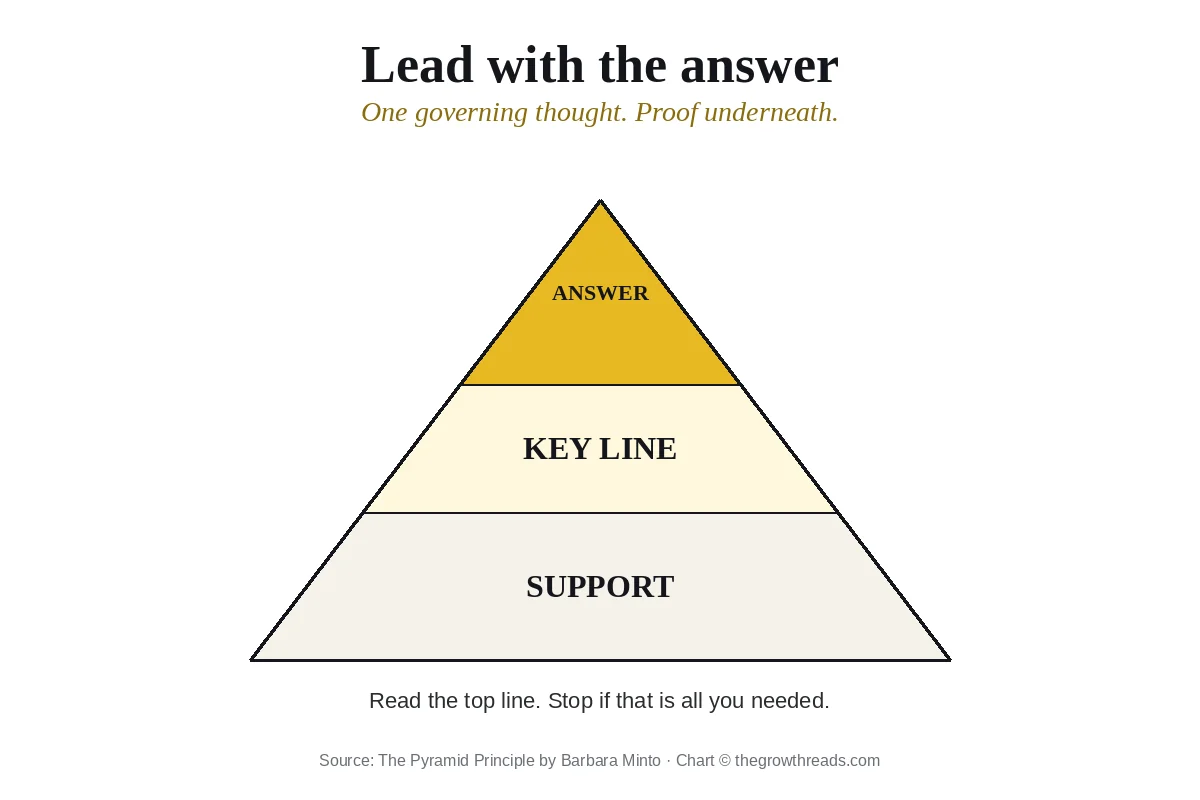
The top is one governing thought: the answer this reader needs. Under it, a handful of ideas of the same kind. Under each idea, the evidence that answers the question that idea raises. You gather facts from the bottom up and present from the top down, so a late reader can stop at sentence one and still know the ask.
The opening that earns that first sentence is SCQA: situation, complication, question, answer. Situation is what you both already accept. Complication is the change. Question is what the change forces. Answer is the top of the pyramid. Then you stop storytelling and start proving.
Key takeaways
- Answer first: the subject line and the first sentence carry the recommendation, not the tour of how you got there.
- One question: if the piece is trying to answer three questions, it is three pieces, or you have not chosen.
- SCQA opens: a short situation and one complication make the question obvious before you state the answer.
- Summaries are sentences: a heading that is only a topic label (background, update, context) fails the pyramid.
- Same kind of idea: do not mix a stage, a cause, and a wish in one group.
- Close the gaps: mutually exclusive and collectively exhaustive, or narrow the claim until the set is really complete.
- Induction for speed: give the pattern first. Save deduction for a proof that truly has to end on the implication.
- Order is a choice: time, structure, or degree. Alphabetical order means you never decided.
- Write top down: draft the answer, then the key line, then only the evidence that answers the line above it.
- Skim test: a colleague should be able to repeat your ask from the first sentence plus the headings alone.
What is The Pyramid Principle about?
The Pyramid Principle is Barbara Minto’s method for executive writing and thinking. You state the answer first, then support it with grouped ideas that are the same kind, complete, and in a logical order. A short situation-complication story makes the reader feel the question before you give that answer.
About the author
Barbara Minto is an American author and consultant who teaches executives how to structure a point so a busy reader can follow it. She began as a secretary at a railway company in the 1950s, then sat the Harvard Business School entry exam at a time when the school did not require an undergraduate degree. She graduated in 1963, one of eight women in a class of about 600, and became the first female MBA hired by McKinsey and Company. She started in the Cleveland office and moved to London in 1966. Explore all Barbara Minto book summaries →
After the 1973 oil crisis cut consulting staff, she left to train the method she had used inside the firm. The Pyramid Principle first appeared in 1985. This review uses the 2009 Financial Times Prentice Hall third edition, Logic in Writing and Thinking.
Key concepts at a glance
| Concept | What it means | Use it when |
|---|---|---|
| Governing thought | The one-sentence answer at the top. | You are about to bury the ask in paragraph four. |
| SCQA | Situation, complication, question, answer. | The opening is either abrupt or a history lecture. |
| Vertical question | The line above raises the question the line below answers. | A fact is interesting and still does not belong. |
| Key line | The few ideas directly under the answer. | You have seven bullets and no sentence that holds them. |
| Same-kind grouping | Every point in a group is one type of idea. | A list mixes steps, causes, and hopes. |
| No gaps or overlaps | The set is complete and the items do not duplicate each other. | A reader can name the missing piece in one breath. |
| Time, structure, degree | The three legal orders for a key line. | The bullets would make equal sense if you shuffled them. |
Start with the answer, not the diary of the work
The failure mode Minto writes against is the project diary. You walked the analysis in the order you did the work, so the memo walks the reader down the same hallway: background, interviews, tables, and a recommendation hiding in the last paragraph. The reader who is late has to hold every fact before learning why it matters. Most of them will not. They will skim, ask you to bottom-line it, and you will say in one sentence what the memo should have said first.
The pyramid flips that sequence. You think from the bottom up. You gather facts, notice a pattern, and only then know the point. You present from the top down. The first line is the governing thought: the answer to the question this reader is actually in. Under it sit the few ideas that prove that answer. Under those sit the facts that prove each idea. A reader can stop at any level and still have a true, if thinner, version of the piece.
That is why a heading that says Background or Market context fails the test. A heading has to be a sentence the level below can support. We should exit the pilot is a governing thought. Pilot update is a folder name. Executives do not pay for the tour of your process. They pay for a recommendation they can accept, reject, or question. Give them the recommendation while they are still looking at the page.
Before you send it, read only the first sentence and the headings. A colleague should be able to repeat the ask from that skim. If they cannot, the answer is still buried.
TGR Note: Minto assumes you already have a point. If the blank page is really an undecided call, structure will only polish the fog. Clear Thinking is the companion for choosing. The Effective Executive treats the executive’s real output as decisions and the words that carry them. Use those when you do not yet know the top box. Come back to Minto the hour you do.
SCQA makes the question obvious
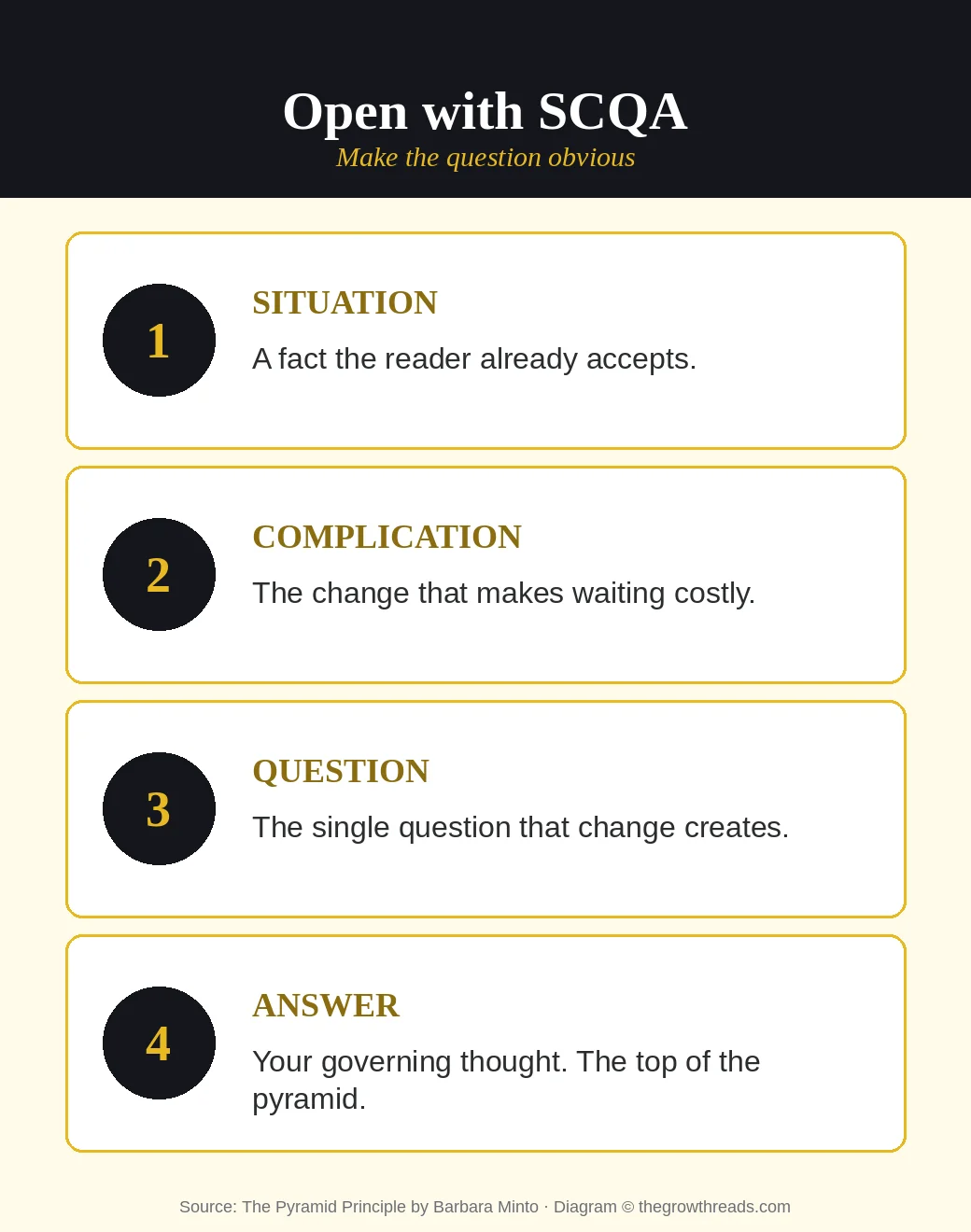
SCQA is how you earn the right to lead with the answer without sounding abrupt. Situation is a calm statement the reader will nod at. It is not a history of the industry. It is the stable picture you both already share. Complication is the change that makes that picture unstable: a missed number, a new constraint, a decision that can no longer wait. The question is the one the complication creates in the reader’s mind. The answer is your governing thought, and it is the top of the pyramid.
Write the four lines on a scrap of paper before you open the document. Situation: the renewal team has closed the last three enterprise deals on the existing offer. Complication: two of those customers stalled because setup took six weeks. Question: what should we change before the next renewal cycle? Answer: cut setup to ten days and make that the only promise on the first page of the proposal.
The situation does not include your interviews. The complication is one tension, not five. The question is singular. Three questions means three documents, or you have not chosen. A pyramid with two tops is a list. Once the answer is stated, stop storytelling and start proving. If the opening runs past half a page, you are teaching context the reader already has.
TGR Note: Presentation Zen makes the same demand of a slide: the title should be a glance, not a category. Minto gives you the sentence that belongs in that title. Pair them. A zen slide with a topic-label title is still a diary. A pyramid answer set in a noisy template still loses the room. Assertion first, then the quiet visual.
Group ideas so each line is a real summary
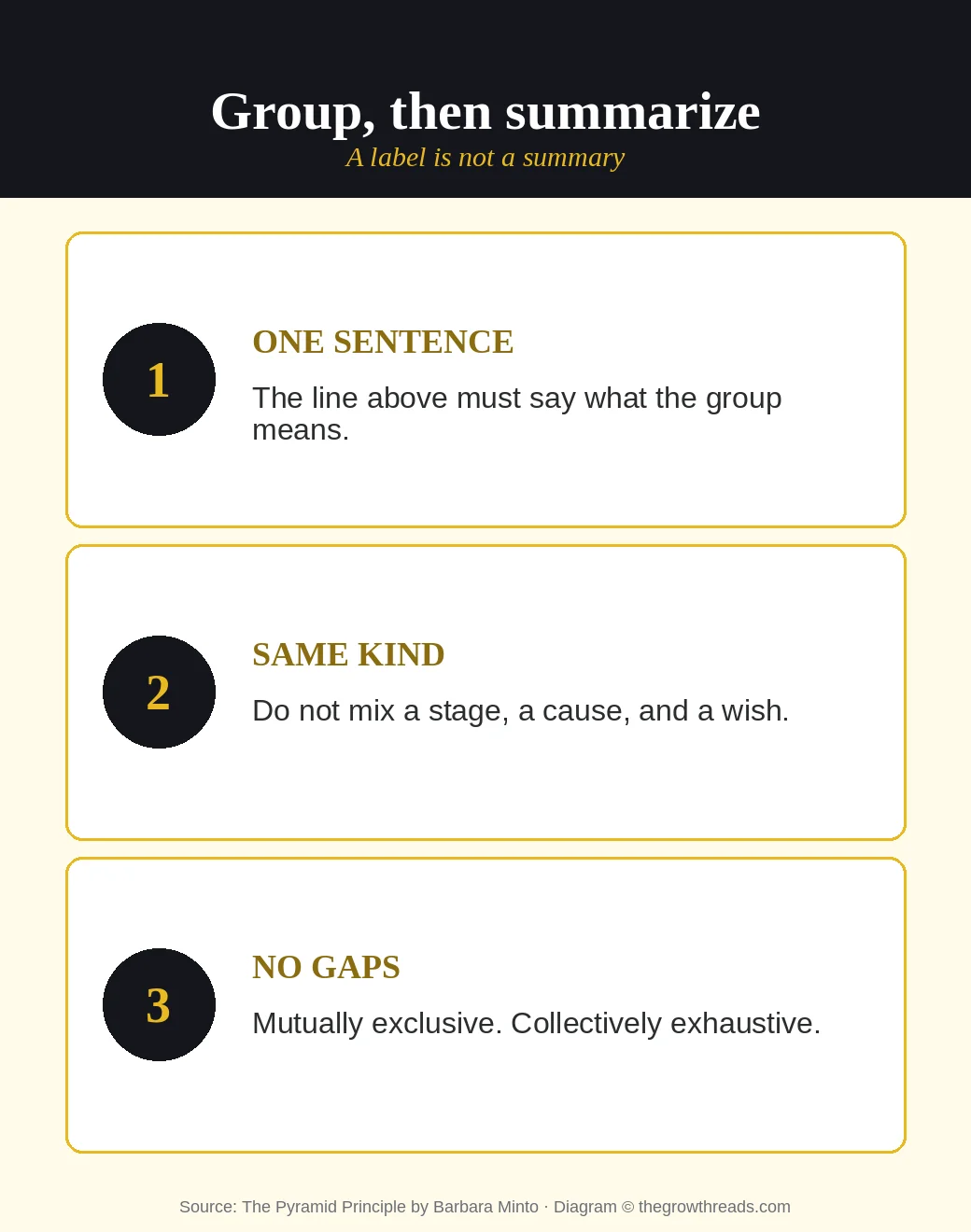
A grouping is not a pile of related words. Minto asks three questions of every set of points that sit under one idea. Do they summarize into one sentence that is more than a label? Are they the same kind of idea? Is the set complete, with no overlaps and no missing piece the reader will immediately name?
Improve onboarding is a label. The sentence underneath might be: onboarding fails in three places, access, training, and the first live task. Those three are the same kind of idea. They are stages of the first month. They do not overlap, and together they cover the path. If you add and leadership is busy, you have mixed a stage with a cause. The group breaks. Pull the odd idea out and ask which question it actually answers.
People shorthand the test as MECE: mutually exclusive, collectively exhaustive. If two bullets could be one bullet, they overlap. If a reader immediately names a missing piece, the set is not complete. Add the piece, or narrow the governing thought until the set really is finished. Narrowing is usually the better edit. Deduction is a chain that ends on the implication, and it is slow. Induction states the pattern first, then the examples. Use induction for most memos. Use deduction only when the point is a proof. Do not mix a chain and a list under one heading.
TGR Note: Once the groups are real sentences, the prose still has to be short. The Elements of Style is the cut pass. Everybody Writes is the habit that makes you practice the cut every week. On Writing Well is the reminder that clarity is a courtesy, not a decoration you add after the thinking. Minto builds the skeleton. Those books keep the sentences from growing back the diary.
Order the group, then write from the top down
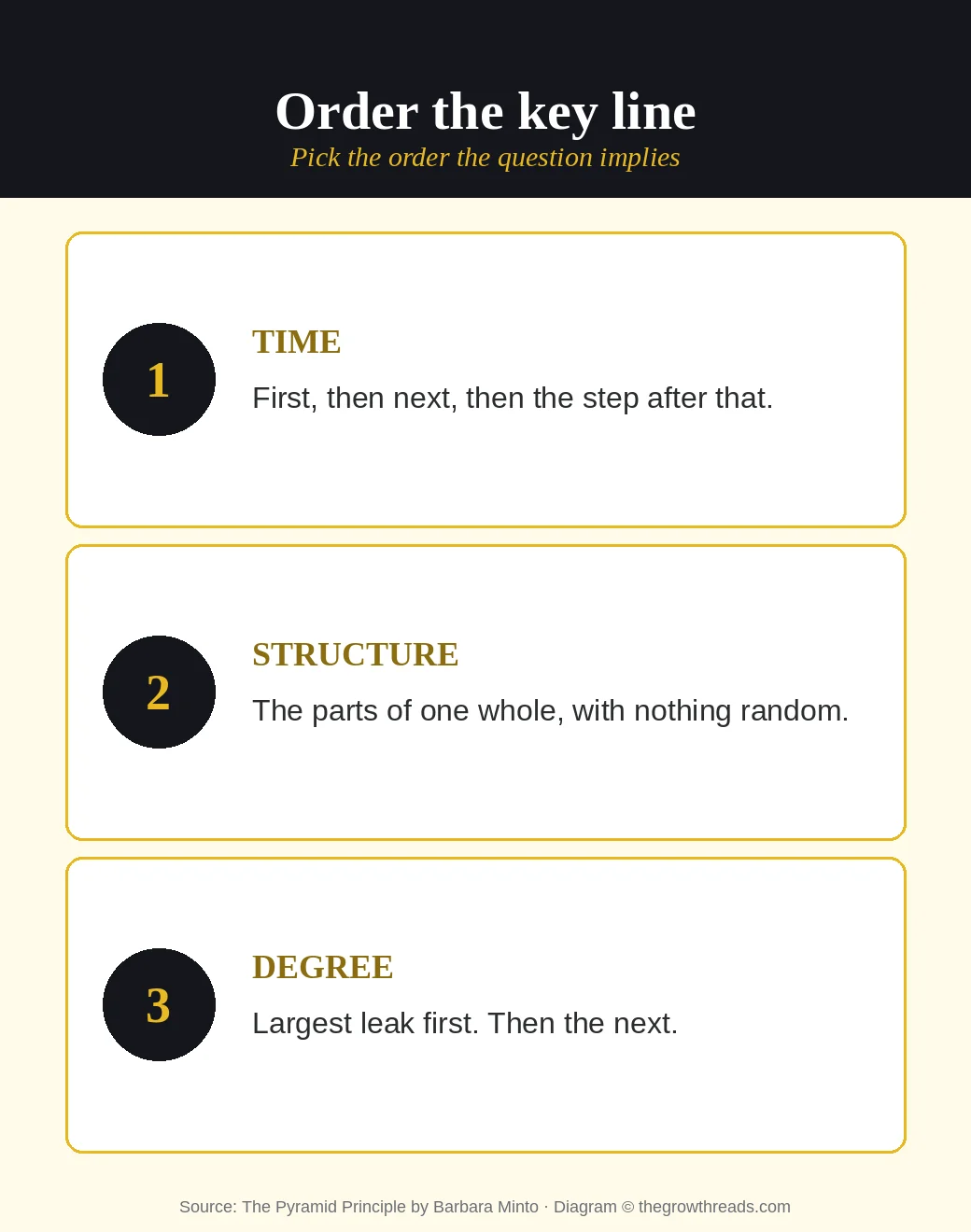
Order is the last structural choice, and it is not decoration. Points on the same line should be ordered in one of three ways. Time order is a sequence: diagnose, decide, implement. Structural order is the parts of a whole: product, price, and the handoff between them. Degree order is rank: the largest leak first, then the next. Pick the order the question implies. A what should we do on Monday question wants time. A where is the system breaking question wants structure or degree. An alphabetical list is a tell that you never chose.
Then write top down. Draft the answer, then the key-line sentences, then only the evidence that answers the sentence above it. Park every fact that belongs to a different question. The memo gets shorter, and it gets easier to trust, because the diary of the work is no longer the structure.
The same pyramid is how you think, not only how you edit. A fuzzy problem is usually a missing question, or several questions pretending to be one. If you cannot fill the top box, say so in the first sentence. We need one more fact before we can recommend a path is still a governing thought. Observations belong in the base, not the subject line. On slides, read only the titles in order. They should retell the pyramid. Overview, Findings, and Next steps are folder labels. Rewrite each title as the sentence that slide proves.
Who is The Pyramid Principle best for — and who should read something else first?
Read this if you regularly ask a busy person to approve, fund, or change something, and your drafts still sound like the order you did the work. Product managers, consultants, founders writing investor notes, operators sending Monday updates, and students who must defend a recommendation will use it the same week. The 2009 edition is compact and unsentimental. You do not need a consulting background. You do need a real document you are willing to rebuild.
Read something else first if you do not yet have the point. Clear Thinking helps you decide. If the order is already right and the sentences are fluffy, The Elements of Style is the faster cut. If you freeze before any framework, Everybody Writes will get pages out of you. Minto is for people who already produce words and suspect those words arrive in the wrong order.
Questions to reflect on
- Which email from the last ten days buried the ask under a diary of the work?
- If a reader saw only your first sentence, what would they think you want?
- How many questions is your current draft trying to answer? Which one is this reader’s?
- Which bullet in your key line is a different kind of idea from the others?
- If you deleted every fact that does not answer the sentence above it, what would be left?
🔥 Ready to put the answer first?
Use Minto’s pyramid on the next memo you actually have to send.
How to apply The Pyramid Principle (7-day plan)
- Day 1 — One sentence. Pick a note you owe. Before any background, write the answer in a single sentence a tired reader could repeat.
- Day 2 — Four lines. Draft SCQA on paper. Situation they accept. One complication. The question it creates. The answer you already wrote.
- Day 3 — Same kind. List the support. Group it into three points of one kind. Cross out anything that overlaps or belongs to a different question.
- Day 4 — Real summaries. Rewrite each group label as a sentence. If the sentence is only the topic noun, you do not have a summary yet.
- Day 5 — Pick an order. Time, structure, or degree. Reorder one group. If shuffling the bullets would not matter, you have not chosen.
- Day 6 — Titles only. Turn headings or slide titles into assertions. Read only those lines. They should tell the pyramid without the paragraphs.
- Day 7 — Send it. Ship the shorter version. Write down the one question the reader still asks. That question is the missing level. Fix it on the next piece, not with a postscript of new facts.
Frequently asked questions
What is the Pyramid Principle in one sentence?
State the answer first, then give only the grouped reasons a reader needs in order to trust it. Barbara Minto built the method for people who write recommendations, not essays. The top of the pyramid is one governing thought. Under it sits a short key line of matching ideas. Under those sits the evidence. A reader who stops early still leaves with a true, thinner version of the point. You think from the bottom up, while you gather the facts. You present from the top down, so nobody has to survive your process diary before learning what you want.
What does SCQA mean?
SCQA is the four-line opening Minto uses before the pyramid. Situation is a fact the reader already accepts. Complication is the change that makes the old picture unstable. Question is what that change forces the reader to ask, even if you never type a question mark. Answer is your governing thought, and it becomes the top of the pyramid. The opening is short on purpose. Its only job is to make one question feel obvious. If you have three questions, you have three documents, or you have not yet chosen the decision this reader must make today.
Is the Pyramid Principle the same as MECE?
MECE is the test Minto applies to a grouping, not a separate religion. Mutually exclusive means two bullets are not secretly the same idea. Collectively exhaustive means a careful reader will not immediately name a missing piece. You either add that piece or you narrow the governing thought until the set really is complete. Narrowing is usually the better edit. A pyramid that claims to cover the whole customer problem will sprawl. A pyramid that answers why implementation stalls in week one can be finished before the meeting ends.
Should I use deduction or induction?
Use induction for most business writing. Line up ideas of the same kind and state what they share, so the reader gets the summary before the examples. Use deduction when the point really is a proof: a rule, a fact about this case, and the implication that follows. Deduction is logical and slow, because the conclusion arrives last. Do not mix a chain and a list under one heading. If the reader has to decide which logic you meant, the grouping has already failed, and another adjective will not repair it.
Is The Pyramid Principle only for consultants?
Consultants made the book famous, and the method is not trapped inside a partner memo. Anyone who writes for a busy reader can use it: a product lead, a founder sending an update, a manager asking for a headcount, a student defending a recommendation. The third edition is dense and practical, not a story you read for pleasure. If you want memorable anecdotes, start with Made to Stick and come back when you need the structure under the story. If your real problem is choosing, read Clear Thinking first, then use Minto to explain the choice.
How long is The Pyramid Principle, and which edition is this?
This summary follows the 2009 third edition from Financial Times Prentice Hall, subtitled Logic in Writing and Thinking. Open Library lists it at 177 pages plus front matter, which is a short book and a slow one. Plan on about four hours if you stop to rewrite a real memo as you go. Minto first published the method in 1985. A 1996 edition expanded the same logic into problem solving and is often sold under her name. The buy links here point at the Prentice Hall third edition, ISBN 9780273710516.
What should I read after The Pyramid Principle?
Stay with the writing if the sentences are still muddy: The Elements of Style and On Writing Well will cut what the pyramid still left in. Read Everybody Writes if you need the weekly habit, not another framework. Read Presentation Zen when the pyramid has to live on slides and the titles should be assertions a person can skim. Read Clear Thinking or The Effective Executive if the blank page is really an undecided question. The pyramid cannot invent a point you do not have. It can only stop you from hiding the point you already earned.
Related summaries
- Everybody Writes — Ann Handley on the weekly writing habit behind clear recommendations.
- The Elements of Style — the sentence-level cut after the pyramid is standing.
- On Writing Well — Zinsser on clarity as a courtesy to the reader.
- Clear Thinking — Shane Parrish on deciding, before you explain the decision.
- Best productivity books — the silo shelf this summary sits on.
How we analyze books: we read the work, pull the ideas you can use on Monday, and pair the summary with a chart and a one-week plan. Read our full methodology.