

★★★★⅗ 4.6/5 — Cut until one meaning remains, then send it.
Best for: Anyone who writes for work — emails, docs, posts — and currently hides the point under extra words.
Reading time: ~2 hrs (guide: 12 min)
Difficulty to apply: Easy to cut twenty words from one paragraph today; hard to stay in the background when you want to sound clever.
The Elements of Style in one minute
Clear writing is rewritten writing. William Strunk Jr. printed a forty-three-page handbook for his Cornell students in 1918. His student E. B. White revived it, added a chapter on style, and the little book has sat on American desks ever since. Usage keeps the reader with you. Composition gets to the point. White’s reminders stop you decorating until the sentence means two things. If you take one move from this The Elements of Style summary, open one live paragraph, omit every word that does no work, and send the shorter version.
Key takeaways
- Omit needless words: If a word does no work, take it out. This is the whole method in four words.
- Active voice names the doer: “The team decided” beats “a decision was made.”
- Positive form: Say what is, not a pile of what is not.
- Be specific: A concrete noun beats a fog of abstracts.
- One idea, then stop: Related words stay together. The emphatic word sits at the end.
- Usage is trust: Agreement, commas, and a clean quote are how the reader stays.
- The misused list is a hygiene pass: Check the usual suspects before you publish.
- Place yourself in the background: Style is not a costume you put on the page.
- Nouns and verbs do the work: Adjectives are not the engine.
- Revise on purpose: The second pass is where the little book actually lives.
What is The Elements of Style about?
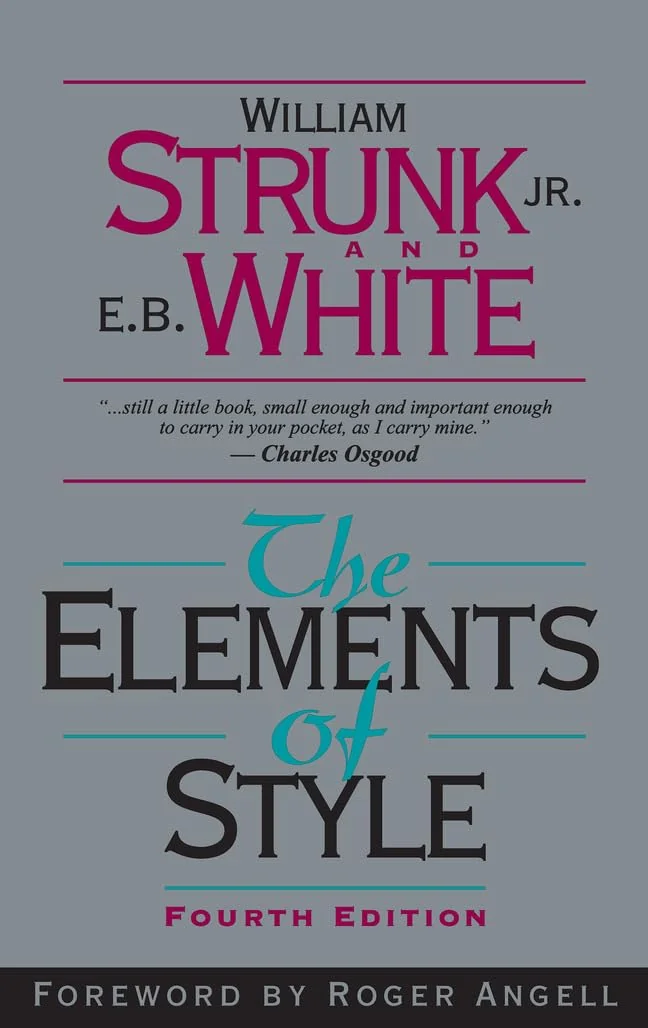
The Elements of Style is Strunk and White’s short handbook for English that has to be read: elementary rules of usage, principles of composition, a few matters of form, words commonly misused, and White’s approach to style — so a working sentence carries one meaning and no extra weight.
About the author
William Strunk Jr. taught English at Cornell and, in 1918, printed a slim handbook for his own students so they would stop wasting a reader’s time. E. B. White sat in that class in 1919, then spent decades at The New Yorker and wrote Stuart Little and Charlotte’s Web. In 1957 he wrote about the little book; Macmillan asked him to revise it. The 1959 edition — and the later fourth, with a foreword by Roger Angell — is Strunk’s classroom plus White’s chapter on style. The credential is the sentences they cut, not a stage persona. Explore all E. B. White book summaries →
Key concepts at a glance
| Concept | What it means | Use it when |
|---|---|---|
| Omit needless words | Every word must do a job | The paragraph is true and still unread |
| Active voice | Name who did the thing | The sentence hides the actor |
| Positive form | State what is, not a nest of nots | You are hedging instead of saying |
| Specific language | Concrete nouns over abstracts | The reader cannot see the thing |
| Design, then write | A suitable shape before a pile of clauses | You start typing with no outline |
| Usage rules | Agreement, commas, quotes, parallel form | The reader stumbles on mechanics |
| Misused words | A short list of usual traps | You are about to hit send |
| Place yourself in the background | The prose is not a costume | You are performing instead of informing |
| Revise and rewrite | Style arrives on the second pass | The first draft still sounds like you warming up |
Part 1 — The little book and the rules of usage
Strunk did not write a theory of literature. He wrote a classroom tool so a Cornell student would stop making the reader do extra work. The first section is usage: possessives, not joining independent clauses with a comma, a participial phrase that attaches to the grammatical subject. None of that is fashion. It is how a stranger stays with you. Break agreement or dump a dangling modifier on the wrong noun and the reader spends a second decoding you instead of using you.
White’s later editions keep that spine. The book is short on purpose. You can finish it in an evening and still miss it if you treat it as a quiz. Usage is a trust layer — what you check when the thought is already good and the sentence still trips. Run one live email through that layer before you hunt for a “voice.”
Pick one outgoing paragraph you have not sent. Circle every subject-verb pair. If a pair disagrees, fix it. If a comma is trying to do the work of a period, split the sentence. If an opening phrase points at the wrong noun, rewrite the opener. That is the little book’s first job: the reader should not have to repair you.
TGR Note: On Writing Well is Zinsser on clutter — the same fight, in a longer, warmer room. Use Strunk when you need a pocket checklist. Use Zinsser when you need to sit with a chapter and hear why clutter is unkind. How to Read a Book is Adler and Van Doren on getting more from a hard text. Stack them: read well, then write so the next person can. Do not skip the usage pass because you already “have a style.”
Part 2 — Principles of composition
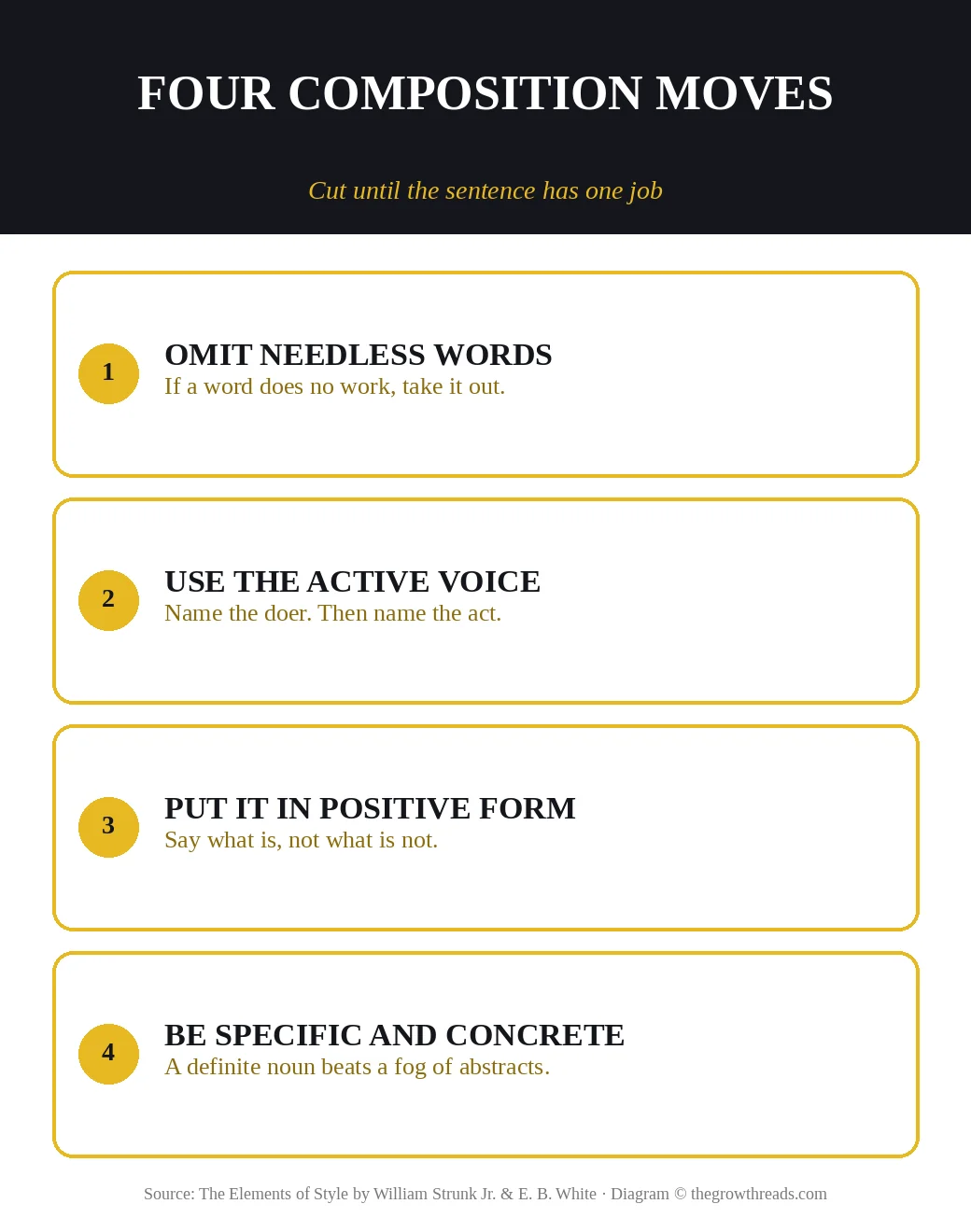
The composition chapter is why people still search for an Elements of Style summary. Choose a suitable design and hold to it. Make the paragraph the unit of composition. Use the active voice. Put statements in the positive form. Use definite, specific, concrete language. Omit needless words. Keep related words together. Put the emphatic words at the end. “Omit needless words” is the test you can run in thirty seconds. If a word does no work, it is not atmosphere. It is delay.
Active voice is not a crusade against every passive. It is a demand that the reader know who acted. “A decision was made” is a fog. “The team decided” is a fact. Positive form does the same kindness: name what matters instead of a nest of nots. Specific language is how a reader sees the thing. “A period of unfavorable weather” is weather. “It rained every day for a week” is a week you can feel. We hide in abstracts when we have not chosen.
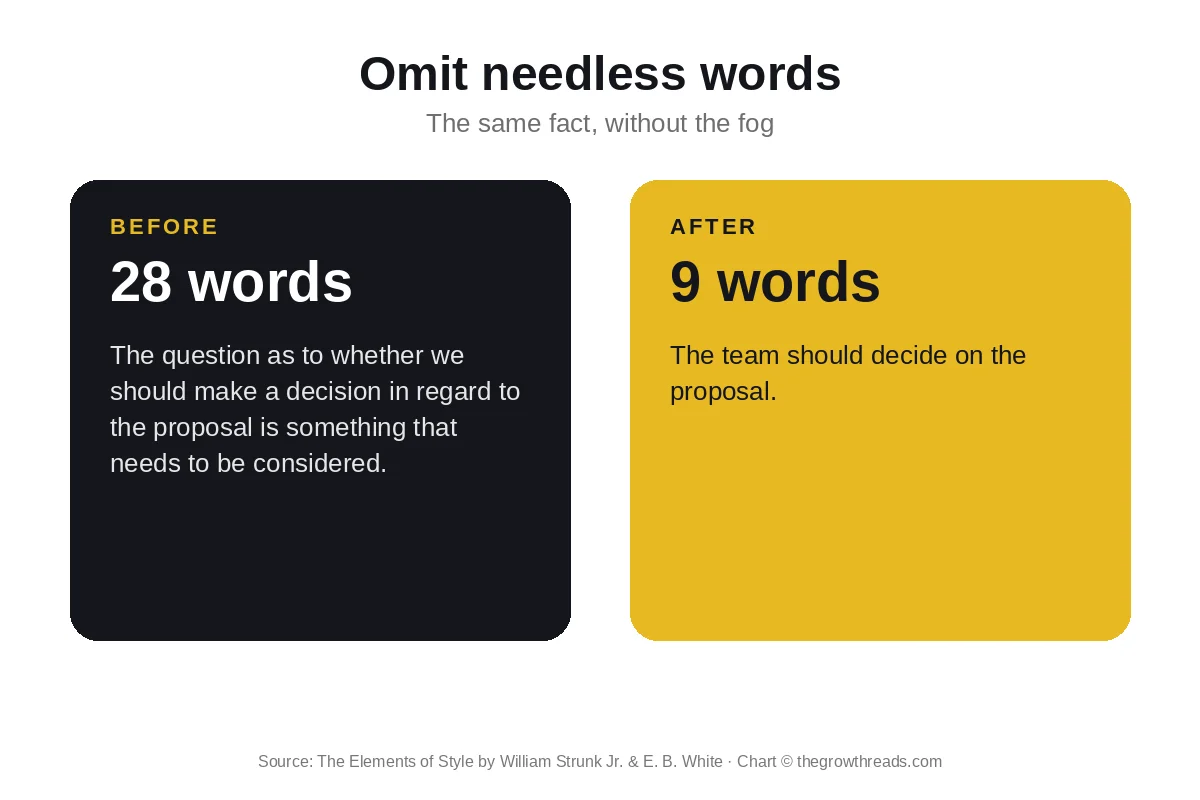
Take one bloated sentence from a doc you own. Write the fact in nine words or fewer. If you cannot, you do not yet know the fact. Then restore only the words that earn their place. Read both versions aloud. The shorter one is not dumber. It is finished. Strunk’s “omit needless words” is not a dare to sound terse for sport. It is respect for the person who has to act on what you wrote.
TGR Note: On Writing is King on the toolbox — nouns, verbs, a closed door, a daily count. Use King when you need courage to finish a draft. Use Strunk and White when the draft exists and you are still performing. Bird by Bird is Lamott on shitty first drafts and short assignments. Stack them in that order: Lamott to start, King to stay, Strunk to cut. The little book is a last mile, not a first sentence.
Part 3 — Form, and the words you keep misusing
The middle of the book is unglamorous on purpose: headings, numerals, parentheses, the punctuation of quotations, a clean list. Form is how a busy reader scans. If your headings are theater and your numbers mix words and digits, you are making them work for layout they did not ask for. Treat form as composition, not a later “design pass.”
Then comes the list of words and expressions commonly misused — the hygiene pass. Like and as, nauseous and nauseated, hopefully as a sentence adverb, the usual suspects. Some items are mid-century classroom English; the practical move is still the same. If a word has a precise job and you are using it as furniture, swap it. Do not memorize the whole list. Keep it next to send. When a sentence feels fancy, you are usually standing on one of those traps.
Print or paste the misused list beside one piece you will actually ship this week — a post, a memo, a landing page. Highlight three hits. Fix only those. That is enough. The book is a pocket referee, not a personality transplant. If you try to absorb every item in one sitting you will write nothing, which is the one outcome Strunk would not forgive.
TGR Note: Talk Like TED is Gallo on how an idea travels in eighteen minutes. Spoken rhythm is not the same job as Strunk’s page. Use Gallo when a room has to feel it. Use the little book when a reader has to act without you in the room. Presentation Zen is Reynolds on slides that can be glanced. Same family: cut until one meaning remains, then stop decorating. If your deck is a paragraph in disguise, you skipped both books.
Part 4 — White’s approach to style
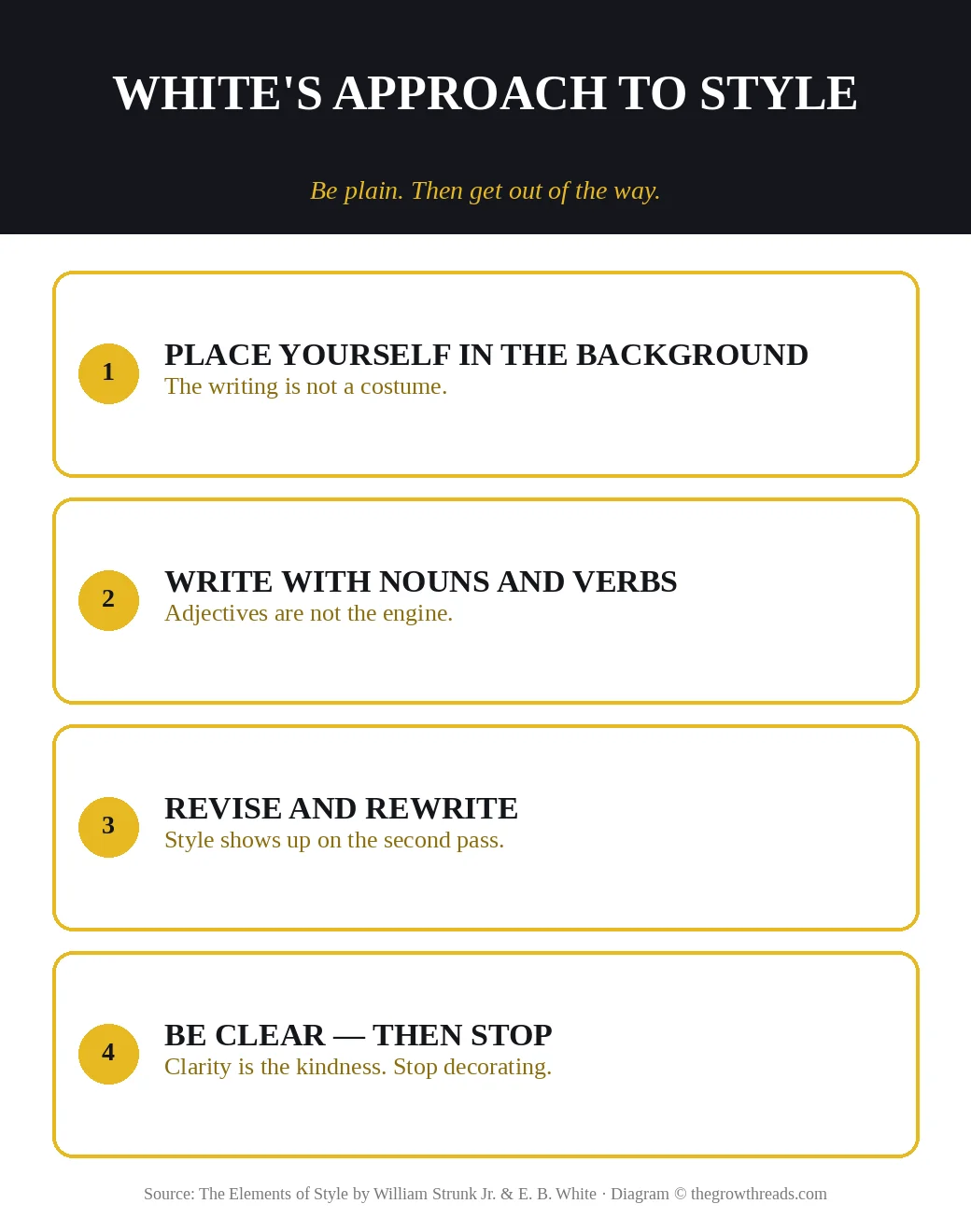
White’s chapter is the reason the book is still a companion and not only a grammar pamphlet. Place yourself in the background. Write in a way that comes naturally. Work from a suitable design. Write with nouns and verbs. Revise and rewrite. Do not overwrite. Do not overstate. Avoid the use of qualifiers. Do not affect a breezy manner. Be clear. Do not inject opinion where the job is to inform. Prefer the standard to the offbeat when the offbeat is just showing off. Twenty-one reminders, and they all point at the same kindness: the reader did not come to watch you perform.
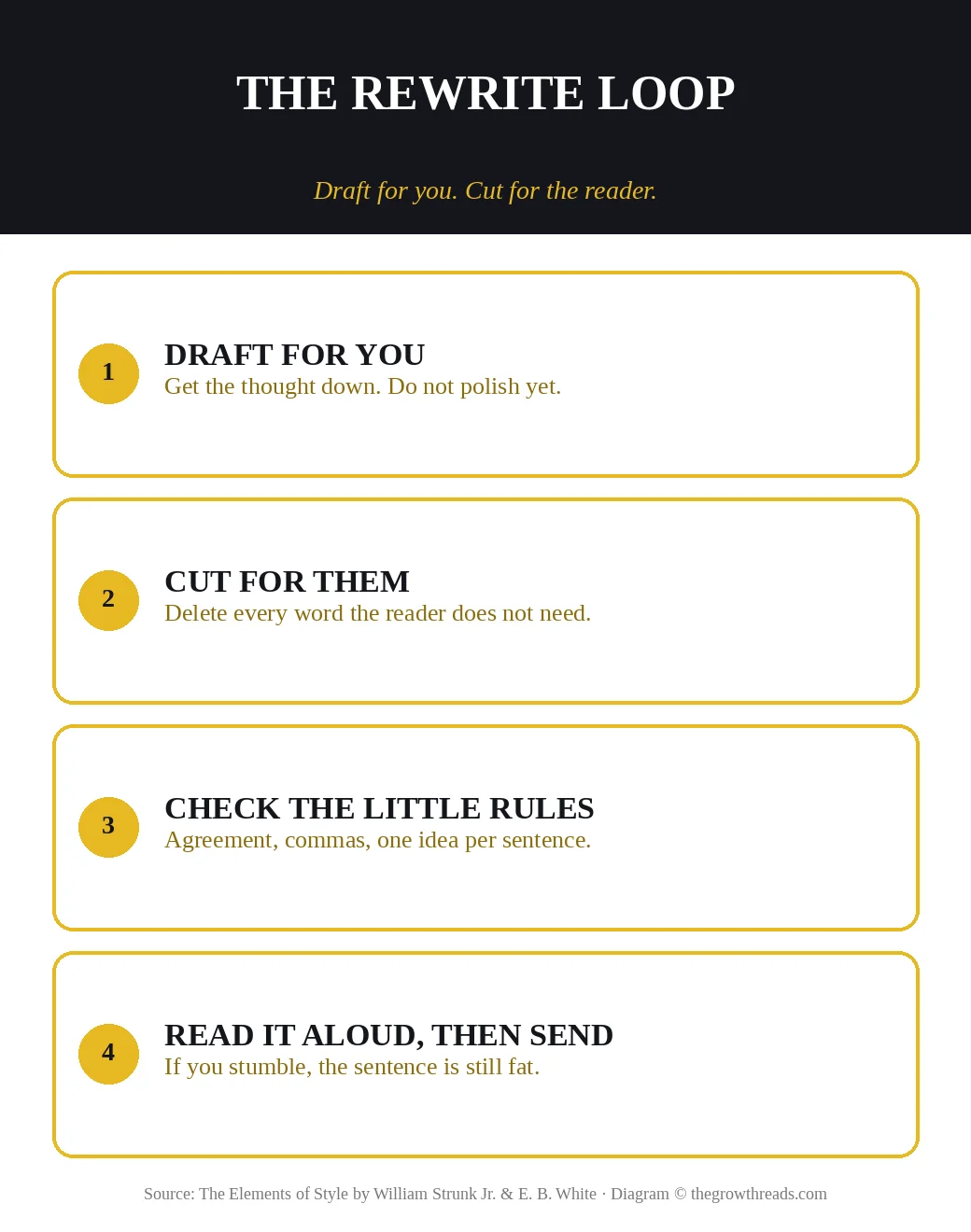
Style, here, is not a brand voice workshop. It is what is left when you have chosen a design, cut the extra words, and refused to costume the sentence. “Be clear” is the reminder White puts in italics in spirit even when the type is roman. If the reader has to guess, you failed the assignment, however pretty the guess-work looks. Revise is not optional. The first draft is you finding the thought. The second is you serving the person who was not in your head.
Take one finished piece. Cut every qualifier you do not need — very, rather, little, pretty. Replace two adjective stacks with a better noun or a better verb. Read it aloud once. If you hear yourself performing, take yourself out of the foreground and send the cleaner version. That is White’s chapter as a Tuesday.
TGR Note: Made to Stick is the Heath brothers on an idea that survives without you — simple, unexpected, concrete. White wants you simple and concrete too; he just starts from the sentence instead of the campaign. Use the Heaths when the idea has to travel to a room you will not enter. Use Strunk and White when the sentence in front of you is still wearing a costume. They stack. They are not a fight.
Who is The Elements of Style best for — and who should read something else first?
Best for people who already write every week — operators, founders, students, anyone whose work has to be read — and who currently bury the point under extra words, passives, and a voice they put on for the page.
If you cannot start a draft, start with Bird by Bird or On Writing. If you want a longer sit with clutter and audience, start with On Writing Well. If the job is a talk or a deck, Talk Like TED or Presentation Zen. Come here when the draft exists and you still will not cut.
Questions to reflect on
- Which paragraph did you send last week that was true — and still too long?
- Where did you hide the actor in a passive so nobody had to own the verb?
- What word did you keep because it sounded smart, not because it did work?
- Did you revise, or did you hit send on the warmup?
- If the reader kept only one sentence, which one should it have been?
🔥 Ready to cut until one meaning remains?
Open one live paragraph, omit every word that does no work, and send the shorter version today.
How to apply The Elements of Style (7-day plan)
- Day 1 — Pick the live page. Choose one email, memo, or post you still have to send. Print it or paste it into a blank doc.
- Day 2 — Circle the actors. Mark every subject. If a sentence has no doer, rewrite it in the active voice.
- Day 3 — Omit twenty words. Cut twenty words that do no work. Do not add anything back.
- Day 4 — Positive and specific. Flip one nested negative into a positive. Swap one abstract noun for a concrete one.
- Day 5 — Usage pass. Check agreement, commas, and quotes. Fix only what would make a stranger stumble.
- Day 6 — White’s reminders. Delete leftover qualifiers. If you hear a costume, take yourself out of the foreground.
- Day 7 — Read aloud and send. If you stumble, cut again. Then send the shorter version. Log what you removed.
Frequently asked questions
What is The Elements of Style about?
The Elements of Style is William Strunk Jr. and E. B. White’s short handbook for English that has to be read. Strunk wrote the classroom core in 1918: usage, composition, form, and words commonly misused. White, his student, revived the little book and added an approach to style — place yourself in the background, write with nouns and verbs, revise, be clear. The point is not to sound literary. It is to carry one meaning with no extra weight. If you take one move from this The Elements of Style summary, omit every word that does no work, then send the shorter version.
Who wrote The Elements of Style?
William Strunk Jr. taught English at Cornell and printed a forty-three-page handbook for his students in 1918. E. B. White sat in that class in 1919, wrote for The New Yorker, and later wrote Stuart Little and Charlotte’s Web. In 1957 White wrote about the little book; Macmillan asked him to revise it. The 1959 edition, and the later fourth with a foreword by Roger Angell, is Strunk’s rules plus White’s chapter on style. Read it as a collaboration across decades, not as a guru brand. The credential is the sentences they cut.
What does “omit needless words” mean?
It means every word must do a job. If it is atmosphere, hedging, or a costume, take it out. Strunk’s composition rule is a thirty-second test: write the fact in fewer words, then restore only what earns its place. “The question as to whether” becomes “whether.” “In regard to the proposal” becomes “the proposal.” The shorter line is not dumber. It is finished. Run it on one live paragraph today. If you cannot cut twenty words, you do not yet know which words are doing the work — and that is the assignment, not a personality trait.
Is The Elements of Style still relevant?
The examples are mid-century classroom English. The job is not. Emails, docs, posts, and decks still hide the actor, stack abstracts, and send a first draft as if it were a finished thought. Active voice still names who did the thing. Positive form still beats a nest of nots. Specific nouns still let a stranger see the fact. Some usage items in the misused list are dated; treat those as a hygiene pass, not as a purity test. Cut one live paragraph this week. If the reader moves faster, the little book is current. If they still have to decode you, you kept the extra words and called it voice.
Who should read The Elements of Style?
Anyone who writes for work and currently buries the point — operators, founders, students, specialists whose expertise never makes it through the sentence. Useful if you already draft and still will not cut. Skip it as a first book if you cannot start; begin with Bird by Bird or On Writing. If you want a longer sit with audience and clutter, On Writing Well will hold you longer. If the job is a talk or a slide, Talk Like TED or Presentation Zen. Come here when the draft exists and you are still performing on the page instead of informing.
How is The Elements of Style different from On Writing Well or On Writing?
On Writing is King on starting and finishing: the toolbox, the closed door, a daily count. On Writing Well is Zinsser on clutter and the human on the other side of the paragraph, at chapter length. The Elements of Style is the pocket referee: usage, composition, a misused-word list, and White’s reminders in a book you can reread in an evening. Use Lamott or King when the page is blank. Use Zinsser when you need to sit with why clutter is unkind. Use Strunk and White when the draft is in front of you and you still will not omit needless words. They stack. They are not the same job.
How do I apply The Elements of Style this week?
Pick one live email, memo, or post. Day one, paste it into a blank doc. Day two, mark every actor; rewrite hidden passives. Day three, omit twenty words that do no work. Day four, flip one nested negative and swap one abstract for a concrete noun. Day five, check agreement, commas, and quotes. Day six, delete leftover qualifiers and take yourself out of the foreground. Day seven, read it aloud and send the shorter version. Do not memorize the whole misused list. Keep the little book next to send. The method is a Tuesday, not a personality rebuild.
Related summaries
- On Writing Well — cut clutter until one meaning remains
- On Writing — King’s toolbox for finishing the draft
- Bird by Bird — start small when the page is still blank
- Made to Stick — make the idea survive without you
- More on the best productivity books pillar
How we analyze books: we read for application, not for a takedown — then we add a plan you can run this week. Read our full methodology.