

★★★★½ 4.5/5 — a practical map of if-onlys, not a pep talk to forget the past.
Best for: People who replay old choices and freeze on the next one
Reading time: ~5 hours (256 pages) · this guide ~14 min
Difficulty to apply: Easy to name the regret — harder to send the undone message
The Power of Regret in one minute
Looking backward is how you move forward. Daniel H. Pink’s claim is the opposite of the tattoo: a life with no regrets ignored its own compass. In The Power of Regret (2022) he treats the sting as information. Most lasting if-onlys fall into four buckets — foundation, boldness, moral, and connection. Name the bucket, undo what still can be undone, say it out loud, then use tomorrow’s regret as a filter on today’s choice. Convert one replay into a next action. Do not collect melancholy.
Key takeaways
- No-regrets is a bad strategy: The slogan denies a signal. Healthy people feel the gap between the life they want and the one they just chose.
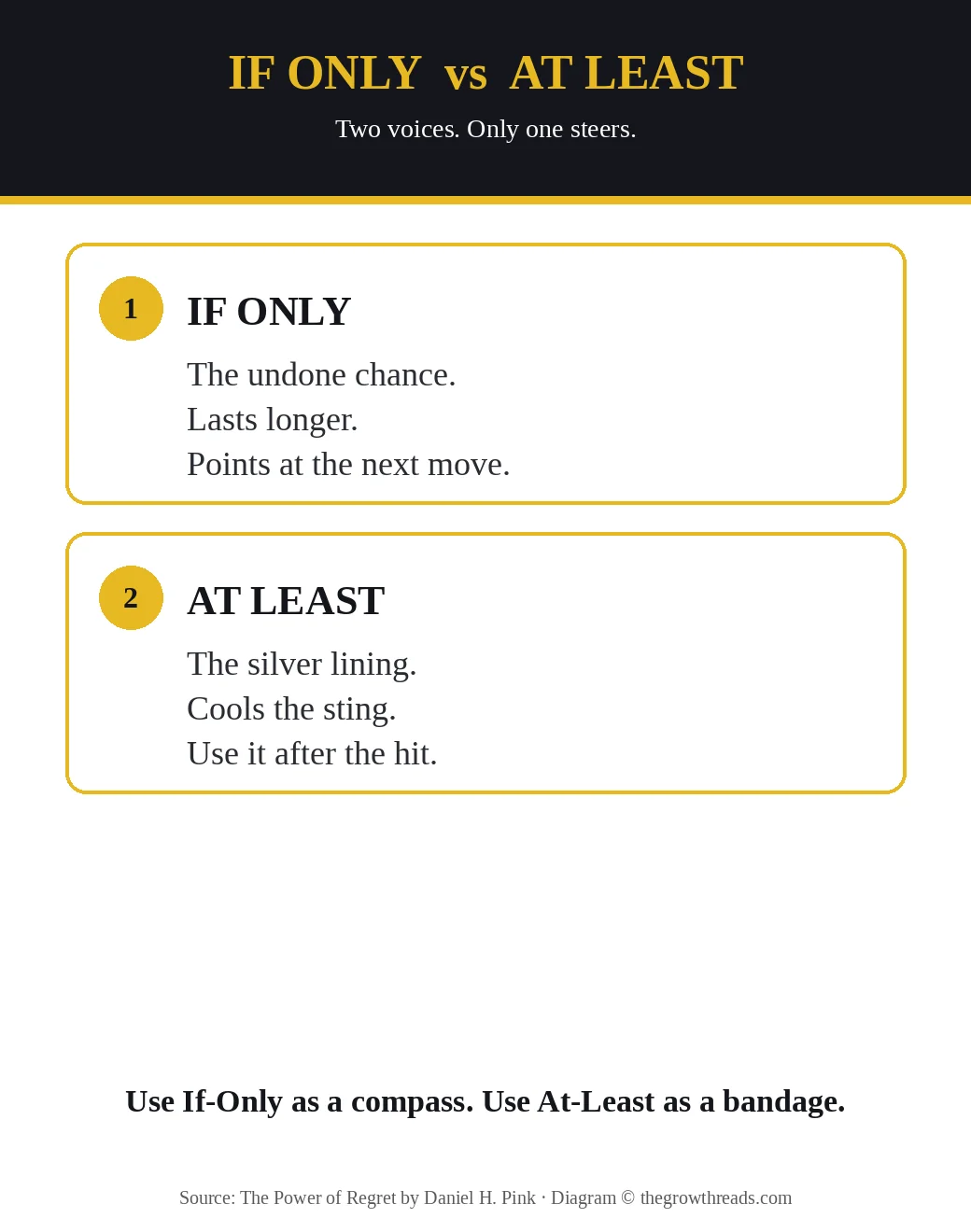
- If-only outlasts at-least: Silver linings cool the sting. The undone chance is what still talks at forty, fifty, eighty.
- Inactions linger: Over time, people regret the chance they did not take more than the messy try — Gilovich and Medvec’s finding, in Pink’s shop language.
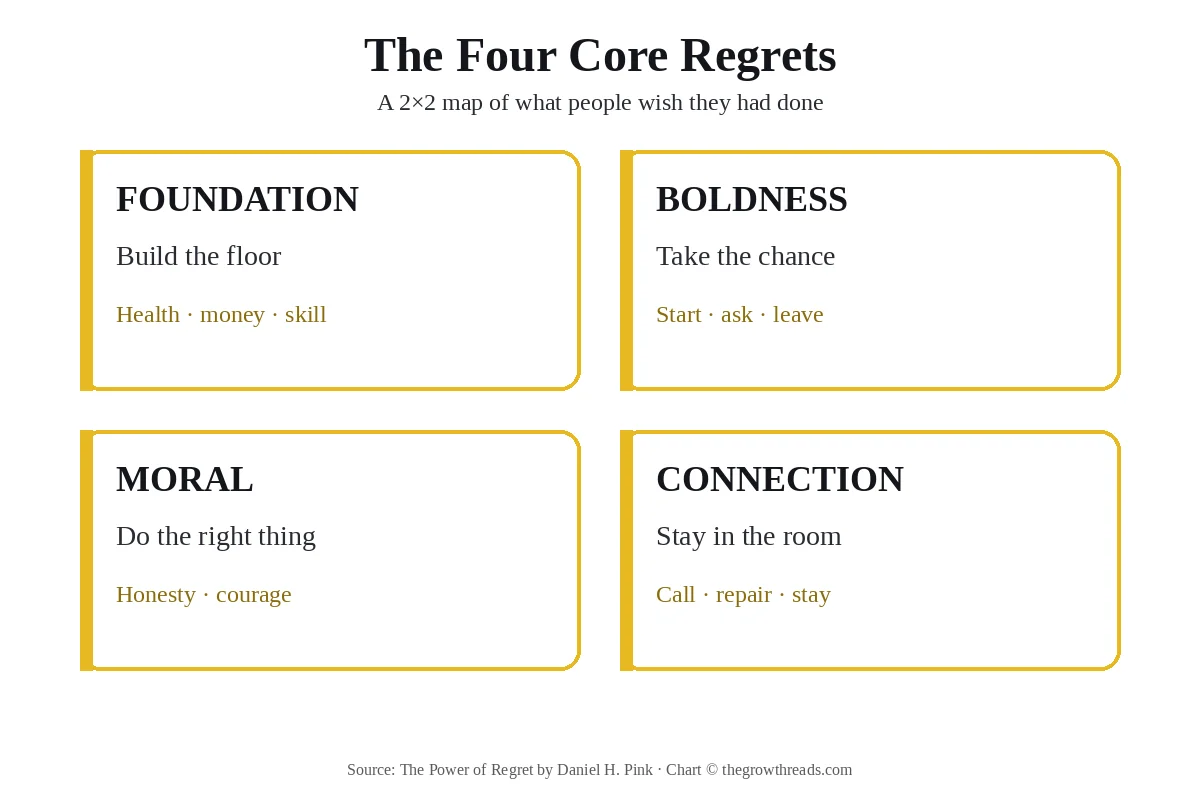
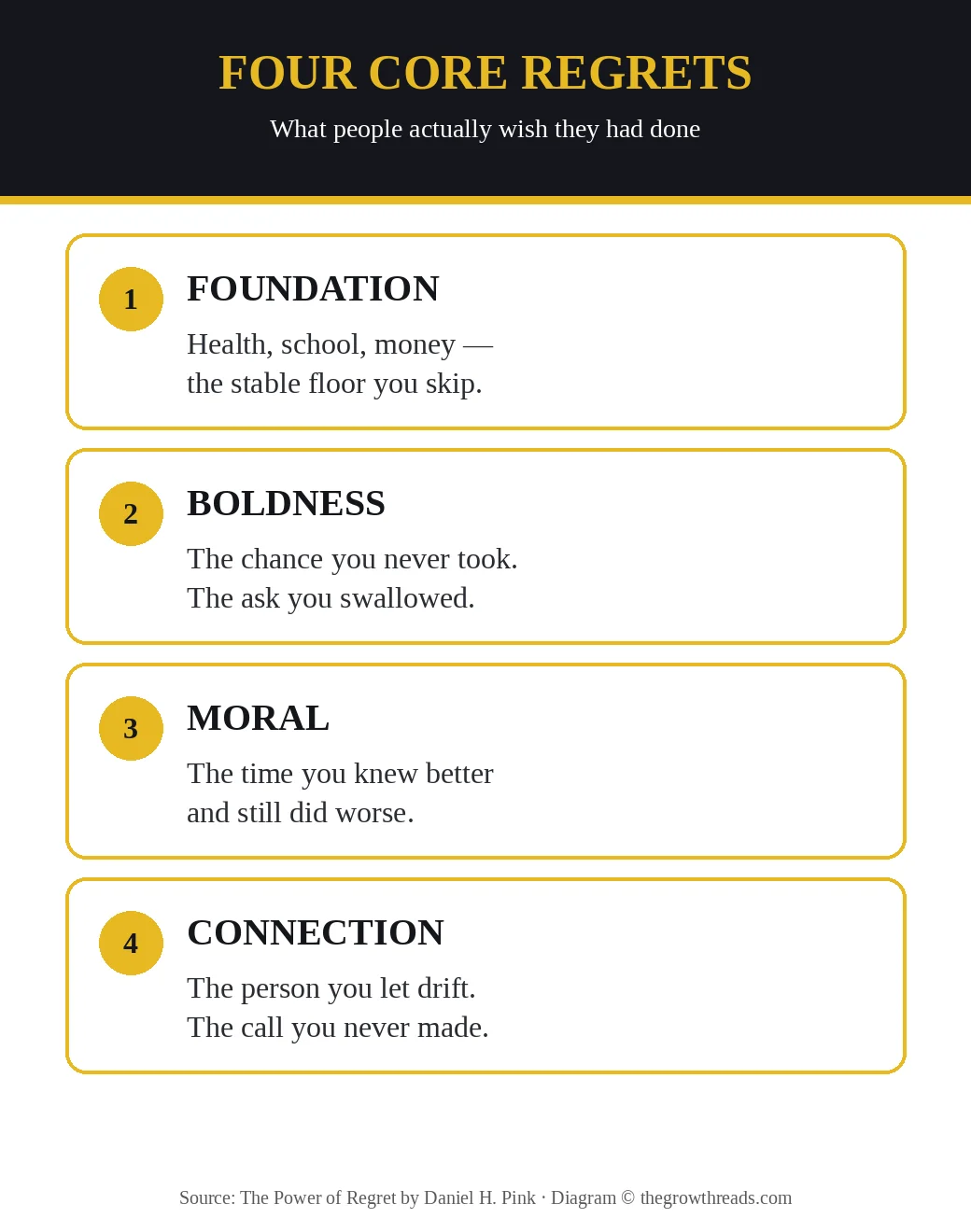
- Four core regrets: Foundation, boldness, moral, connection. Almost every deep replay sits in one of those rooms.
- Foundation is the floor: Health, skill, money, the homework. Skip the boring layer and later you pay compound interest.
- Boldness is the ask you swallowed: Start, leave, apply, speak. The fear was short. The if-only is long.
- Moral regrets are integrity debts: You knew better. Repair beats a speech about values.
- Connection regrets are usually one message: People overestimate how awkward the reach-out will be. Send it.
- Recast, don’t ruminate: Undo, disclose, self-compassion, then point the same tool forward — will future-you hate this skip?
- One living if-only: Do not write a memoir this week. Name one, sort it, take the smallest repair that still exists.
What is The Power of Regret about?
The Power of Regret is Daniel H. Pink’s 2022 field guide to using looking backward as a decision tool. He maps most deep if-onlys into four types, then recasts one into a repair — undo, talk, self-compassion, anticipatory regret — so next week is not a rerun.
About the author
Daniel H. Pink spent the late 1990s as a speechwriter in the White House, then left politics to write about work the way a translator writes: take a pile of studies, throw out the jargon, leave a tool. Drive made autonomy, mastery, and purpose a manager’s vocabulary. When asked when to start. To Sell Is Human argued that moving others is now everybody’s job. A Whole New Mind bet on right-brain skills as scripted work cheapens. The Power of Regret (Riverhead, 2022) is the backward glance in that sequence — a New York Times bestseller built on the World Regret Survey plus a representative American sample, written so you can sort one replay and move. Explore all Daniel H. Pink book summaries →
Key concepts at a glance
| Concept | What it means | Use it when |
|---|---|---|
| If-only vs at-least | The undone chance vs the silver lining | You are soothing the sting instead of steering |
| Opportunity regret | Pain from a path you never took | The replay is “I never even tried” |
| Four core regrets | Foundation, boldness, moral, connection | The rumination has no name and no next step |
| Foundation | The stable floor: health, skill, money | You keep skipping the boring hour |
| Boldness | The chance you did not take | Fear is writing your calendar |
| Moral | You knew the right move and declined it | The story you tell yourself is getting slippery |
| Connection | A person you let drift | You are waiting for a perfect opening |
| Disclosure | Say the regret out loud to a person | Shame is looping and nothing is moving |
| Anticipatory regret | Ask future-you what they will hate skipping | Today’s choice looks small and still feels stuck |
Part 1: “No regrets” is a slogan — the sting is a compass
Pink opens by picking a fight with a culture that treats regret like a stain. The pose of “no regrets” looks like toughness. The cost is blindness. If you never feel the gap between the person you meant to be and the person who just chose, you have no feedback loop. The feeling is a comparison engine. Denying it does not make you free. It makes you worse at steering.
People who can name a regret and extract a lesson tend to do better on the next task than people told to ignore the feeling. You do not smash the warning light. You look at the engine. Permission is the first skill: this sting is allowed, and it is trying to tell you which value you just betrayed. Rumination — the 1 a.m. rerun — is not the method. The method starts when the feeling becomes a sentence you could show a friend: I wish I had done X. Then you ask what X was protecting. Stability. Courage. Integrity. A person.
One short line to keep: Pink writes that regret is not dangerous or abnormal — it is healthy and universal, an integral part of being human. Treat that as a work rule. If the replay has no name, you cannot apply it. If it has a name, you can put a small action next to it by Friday.
TGR Note: If the stall is a life that looks fine on paper and still feels like a wrong room, pair this with our How Will You Measure Your Life summary. Christensen wants a strategy for the whole life. Pink wants the if-only that is currently eating Tuesday. Designing Your Life is the prototype cousin: build a small test instead of writing a eulogy.
Part 2: If-only lasts — and inaction is the long sting
Not every backward glance is the same animal. “At least” thinking finds the silver lining. That voice is useful after a shock. “If only” thinking points at the undone alternative. That voice is harsher, and it lasts. Over years, the if-only is the one that still has a job: it names the value you still hold.
Thomas Gilovich and Victoria Medvec found that in the short run people kick themselves for actions — the embarrassing try — and in the long run for inactions. The awkward conversation fades. The unsent message does not. If you are still talking about it five years later, it is probably something you did not do. Neal Roese’s split is the other hinge: outcome regret is a poor pick among options you had; opportunity regret is never generating the option. Most deep work-life replays are the second kind. The fix is a live option on this week’s list, not a better spreadsheet of the past.
The World Regret Survey makes this less abstract. Pink asked more than 16,000 people in more than 100 countries to write a regret in their own words. He also ran the American Regret Project, a representative U.S. sample of about 4,500 adults, so the four-core pattern is not only volunteers. You do not need their biographies. Force your sentence into a bucket before you try to “let it go.”
TGR Note: Chip and Dan Heath’s Decisive summary is the decision-process sibling. WRAP widens options and prepares to be wrong. Pink adds the if-only you will carry if you never generate the option. Use Decisive for sloppy choice architecture. Use this book when the architecture is fine and you still will not walk through the door. Clear Thinking is the ordinary-moment cousin for the hour before the if-only is born.
Part 3: Four core regrets — the filing system
Foundation regrets are the unglamorous floor: study, save, the body. The boring hour is cheap now and expensive later. At work that is the skill you never practiced and the sleep you treated as optional. The repair is a named recurring block, not an origin story. Boldness regrets are the chance not taken — the ask, the move, the draft. Fear is loud for twenty minutes. The if-only can last twenty years. Shrink the bravery to a twenty-minute ask that fits this week.
Moral regrets are the times you knew the right move and chose the easier wrong. Repair beats identity theater. Apologize where a person is owed. Change the next similar situation so you are not auditioning for the same miss. Connection regrets sound ordinary: I let it die; I never said it. We overestimate how unwelcome the reach-out will be. A message today is the undo. A perfect speech next year is another inaction. If the rumination has a name and a number, send the note before you reread the chapter.
TGR Note: Boldness regrets are cousin to our 5 Second Rule summary — start the body before the brain files a brief against the ask. Moral regrets sit next to Right Thing, Right Now. Connection regrets are the human half of To Sell Is Human. Use the four buckets to pick which tool you need this week. Do not collect all four as a personality.
Part 4: Recast it — undo, talk, be kind, aim the next one
Once the if-only has a bucket, recast it. First: undo what still can be undone. Many regrets are less dead than they feel. If a 20% repair exists, take it. Tragedy asks nothing of Tuesday. Second: disclose. Secrets grow in the dark. Say the sentence to a trusted person, or write it in a form you will reread. You are looking for air, not a tribunal. If you cannot say it out loud, you are not ready to strategize it.
Third: self-compassion, in Kristin Neff’s sense — talk to yourself as you would to a friend who made the same miss. Shame says you are the mistake. Kindness says the miss happened and you may still repair it. People who self-attack freeze. People who can hold the miss without becoming it send the email.
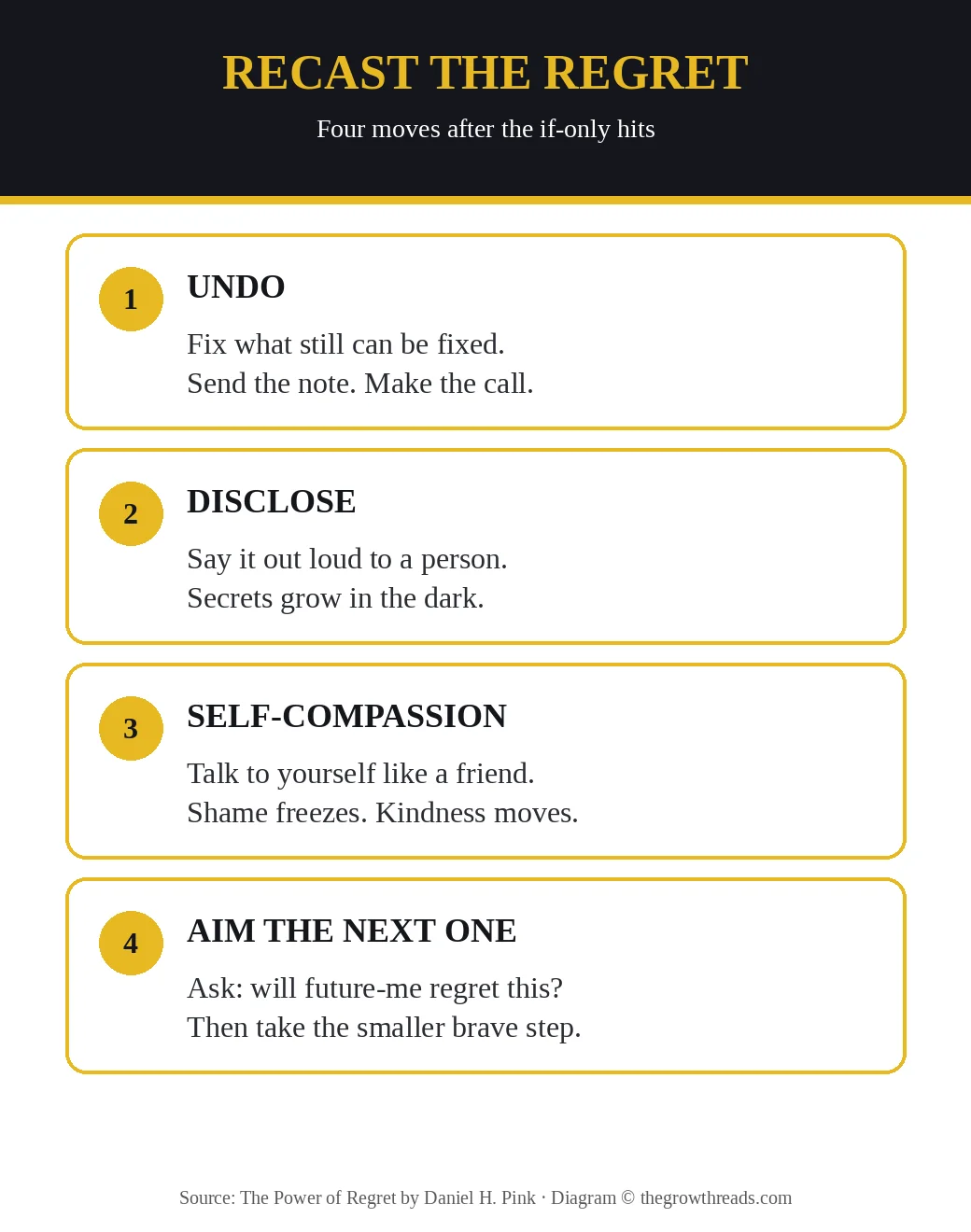
Fourth: point the same tool forward. Anticipatory regret asks “What will I regret at eighty if I skip this?” The inbox fire rarely survives that test. The unsent note and the skipped health hour often do. Borrow future-you as a consultant for a twenty-minute decision. A failure résumé — a written list of attempts that did not work — is the office version. Write the miss, then the next experiment, then put the experiment on the calendar. Feel it. Name it. Air it. Repair a slice. Do not mint a twin.
Who is The Power of Regret best for — and who should read something else first?
Best for people stuck in replay: the job not taken, the side project not shipped, the working relationship that went cold, anyone using “no regrets” as cover for not choosing. Pink gives a filing system and a bias toward the small undo.
Read something else first if you need a habit loop — start with Atomic Habits. If the stall is motivation while the work is already chosen, Drive. If you freeze at the start, The 5 Second Rule or Do Hard Things. If you need experiments instead of eulogies, Designing Your Life. Come back to Pink when you can name the if-only and spend it on a next move.
Questions to reflect on
- What if-only from the last five years still has a job in your head? Write the sentence in one line.
- Which bucket is it — foundation, boldness, moral, or connection? If it sits in two, pick the one that still has a repair.
- What 20% undo still exists? A message, a calendar block, an apology, an application. Name the smallest version.
- Who can you tell this to this week so it stops being a secret that masquerades as a strategy?
- On a choice you are avoiding today: what will you regret at eighty if you skip it? What will you not?
🔥 Ready to spend one if-only on a next move?
Get The Power of Regret, then name one living replay and take the smallest undo this week.
How to apply The Power of Regret (7-day plan)
- Day 1 — Write one living if-only. One sentence, present tense. Not a list of ten. If it has no repair possible, pick a different one that still does.
- Day 2 — Sort the bucket. Foundation, boldness, moral, or connection. Circle one. If you cannot choose, it is probably connection or boldness — those hide as “it’s complicated.”
- Day 3 — Name the 20% undo. A message, a 25-minute block, an apology, a form. Write it as a next physical action, not a vibe.
- Day 4 — Disclose. Tell one trusted person the sentence. If you freeze, write it by hand for fifteen minutes, then tell them anyway.
- Day 5 — Take the undo. Send, schedule, or show up. Do not wait for a speech. The repair can be small and still count.
- Day 6 — Anticipatory filter. On one pending choice, ask eighty-year-you what they will hate skipping. Act on that, not on inbox heat.
- Day 7 — Failure résumé line. Write the miss, the lesson, and the next experiment. Put the experiment on next week’s calendar. Stop decorating the wound.
Frequently asked questions
What is The Power of Regret about in one paragraph?
The Power of Regret is Daniel H. Pink’s 2022 argument that looking backward is a skill, not a character flaw. He kills the “no regrets” slogan, then uses a World Regret Survey and a U.S. sample to show that most lasting if-onlys fall into four buckets: foundation, boldness, moral, and connection. The second half is a shop method: undo what still can be undone, talk, treat yourself like a friend, and use anticipatory regret to steer the next choice. Read it to name one if-only and move, not to collect melancholy.
What are the four core regrets in The Power of Regret?
Pink’s four core regrets are the deep patterns that showed up again and again in the World Regret Survey. Foundation: you skipped the unglamorous floor — health, skill, money, the homework. Boldness: you did not take a chance you still think about. Moral: you knew the right move and chose the easier wrong. Connection: you let a person drift, or never said the true thing. These are not moods. They are a map of what you actually value. Name which bucket today’s rumination sits in before you try to “think positive.”
What is the World Regret Survey?
The World Regret Survey is Pink’s open collection of regrets from more than 16,000 people in more than 100 countries. People wrote, in their own words, the thing they still wish they had done differently. He also ran the American Regret Project, a representative U.S. sample of about 4,500 adults, so the four-core pattern is not only volunteers who like filling in forms. The useful output is not a ranking of famous failures. It is a short list of buckets you can sort your own replay into, then pick one repair this week.
How is The Power of Regret different from Drive?
Drive is about what pulls work forward: autonomy, mastery, and purpose instead of carrots and sticks. The Power of Regret is about the backward glance that tells you which of those values you abandoned. Drive answers “what should energize the next hour?” This book answers “what will I hate having skipped when I am eighty?” They stack. If the stall is a boring incentive system, start with Drive. If the stall is a loop of if-onlys that never becomes a calendar block, start here. When, in this silo, is the timing cousin — when to start, not what you will regret skipping.
What is the most useful idea in The Power of Regret to apply this week?
Pick one living if-only — not a museum of old mistakes. Write the sentence. Sort it: foundation, boldness, moral, or connection. Then take the smallest undo that still exists. Connection regrets often shrink to a message. Boldness regrets shrink to a twenty-minute ask. Foundation regrets shrink to one boring block on the calendar. Moral regrets shrink to a repair, not a speech. Do not write a memoir. Send the note, or schedule the hour, before the week ends. Anticipatory regret is the same tool pointed forward: will future-you hate that you stayed quiet today?
Is The Power of Regret still worth reading in 2026?
Yes, if you read it as a decision book rather than a mood book. The World Regret Survey is still a pile of human sentences, not a viral app. The four buckets have not expired. What dates fast is any promise that a slogan will delete the feeling. Skip it only if you already keep a failure résumé, already send the awkward note, and already use “will I regret this at eighty?” as a weekly filter. For everyone else, one named if-only plus one repair beats another week of pretending you are above looking back. Pair it with Designing Your Life if you need a prototype, not a eulogy.
Does Pink say we should dwell on the past?
No. He says we should stop wasting the signal. Rumination that restates the injury without a next action is not the method. The method is: feel it, name the bucket, disclose it if shame is freezing you, then convert it into a repair or a future rule. “At least” thinking is for cooling the sting after the hit. “If only” thinking is for steering. You do not live in the replay. You extract the value you actually hold — stability, courage, integrity, people — and you put one of those on this week’s list. That is looking backward so you can move, not so you can decorate the wound.
Related summaries
- To Sell Is Human — moving one person, including the one you owe a message
- Designing Your Life — prototype the path instead of eulogizing it
- Decisive — a cleaner choice process when the if-only is born from a sloppy decision
- When — Pink’s timing book, for when to start rather than what you will regret skipping
- Best productivity books — the silo list
How we analyze books: every book on The Growth Reads is read cover to cover, summarized in thousands of words of original analysis, and rated against our five-criteria rubric (lasting impact, evidence quality, practical application, writing & originality, external consensus). Read our full methodology.