

★★★★½ 4.6/5 — the most useful career book that refuses the “find your passion” trap and replaces it with prototypes you can run this week.
Best for: People mid-career or mid-degree who are competent, restless, and tired of waiting for a calling to announce itself
Reading time: ~6 hours (238 pages) · this guide ~15 min
Difficulty to apply: Medium — the exercises fit in a notebook; drawing three honest five-year lives is the work
Designing Your Life in one minute
You do not find a well-lived life. You design one — then you prototype it until the data is better than your anxiety. Bill Burnett and Dave Evans’s Designing Your Life (Knopf, 2016) is their Stanford course in book form: treat career and week as a design problem, not a treasure hunt. Passion is what shows up after a life is working, not a prerequisite. The sequence: start where you are, name gravity you cannot solve, draw three Odyssey Plans, then run conversations and tiny tests. This summary is that sequence plus a 7-day plan that starts with energy, not a new personality.
Key takeaways
- Passion is a lagging indicator: A life that fits produces interest. Waiting to “find it” is how people stall a decade.
- You are always in the building: Design from the job, degree, and constraints you already have.
- Workview + Lifeview is the compass: Why you work and what a good life is must be written down. If they fight, no title will feel coherent.
- Track energy, not just hours: The Good Time Journal logs engagement and energy on the actual week.
- Gravity problems are not puzzles: Name the facts you cannot change so you stop spending willpower on physics.
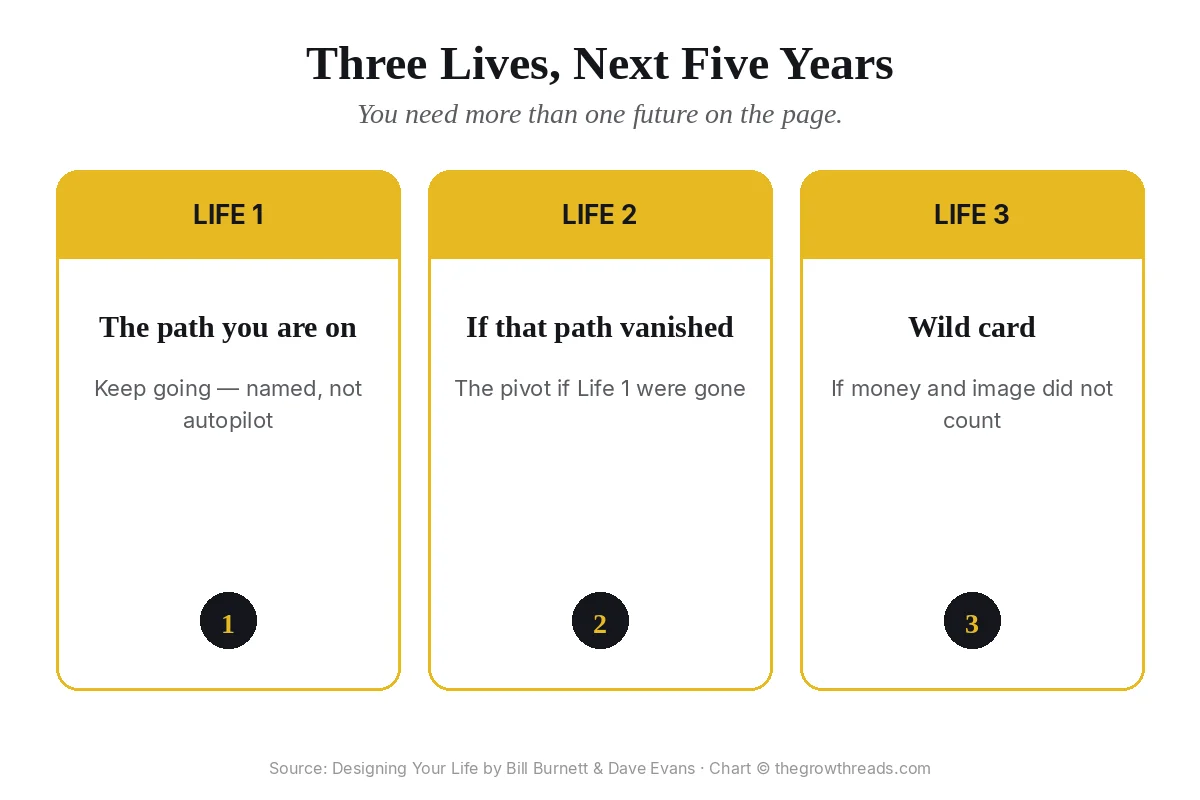
- You need three lives, not one true path: Plan A, a pivot if A vanished, and a wild card if money and image did not count.
- Talk before you quit: A conversation with someone living a version of the life is cheaper than a resignation letter.
- Experiences beat thought experiments: A two-hour shadow beats another list of pros and cons.
- Choosing includes letting unused lives die: Happiness is making the chosen version work, not keeping every option warm.
- Design with a team: A few honest people beat a private spreadsheet.
What is Designing Your Life about?
Designing Your Life is a 2016 method book that applies design thinking to career and everyday life. Burnett and Evans replace “find your passion” with a compass, three five-year Odyssey Plans, and small prototypes so you can build a life that fits instead of waiting for one true path.
About the author
Bill Burnett is a product designer who spent years at Apple and later became executive director of the Design Program at Stanford, where the life-design course began. Dave Evans was an early Apple designer (including work on the company’s first mouse), an early Electronic Arts employee, and a consulting professor at Stanford. Together they turned the studio habit — sketch many versions, test cheaply, iterate — into a book for people who will never enroll. Later they extended the method to the job you already have in Designing Your Work Life (2020). They write as practitioners. The exercises are built so a busy person can run them without a sabbatical. Explore all Bill Burnett book summaries →
Key concepts at a glance
| Concept | What it means | Use it when |
|---|---|---|
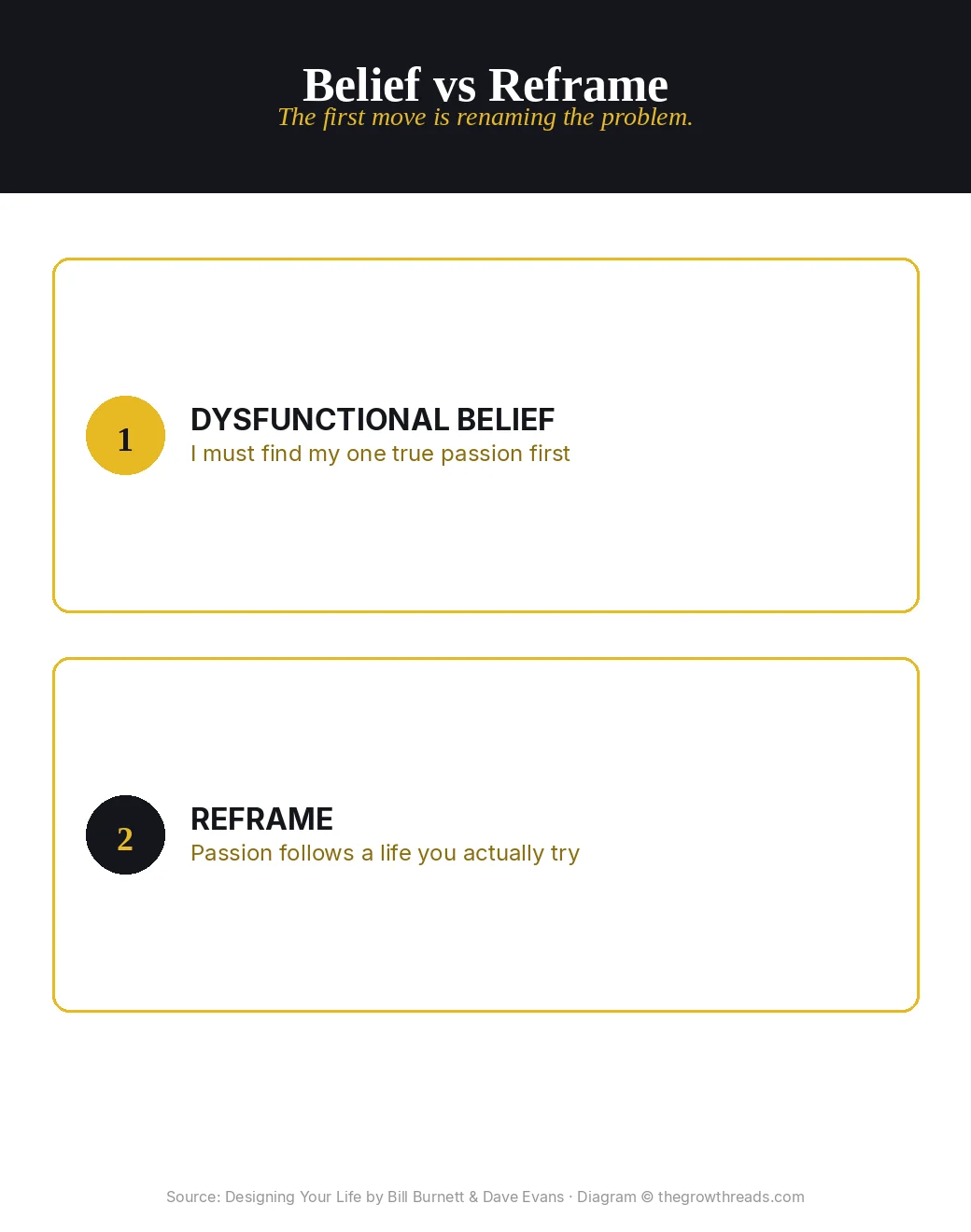
| Dysfunctional belief | A story that sounds mature and quietly forbids action (“I must find my passion first”) | You have been researching the next move for months |
| Workview / Lifeview | Written answers to why you work and what a good life is | A “great” job still feels like the wrong room |
| Good Time Journal | A log of activities plus engagement and energy | Your calendar looks full and your week feels empty |
| Gravity problem | A fact you cannot change; not a puzzle to crush with effort | You keep running the same argument with reality |
| Odyssey Plan | Three five-year lives on paper, including a wild card | You are trying to pick “the” plan and freezing |
| Prototype conversation | A short interview with someone living a version of the life | You are about to quit, apply, or spend money on a guess |
| Prototype experience | A tiny, cheap test you can feel in a week or a month | The idea only exists in your head |
| Failure immunity | Logging what broke, extracting the lesson, moving the next prototype | One rejected plan has become an identity |
Part 1: Start where you are — the compass, not the calling
The book opens by killing a polite story: that a well-lived life is waiting somewhere like a hidden object, and your job is to hunt until you recognize it. Burnett and Evans have watched too many smart people wait — students still asking what they are “supposed” to want, operators with a title talking as if the real life has not started. The dysfunctional belief is that passion is a prerequisite. The reframe: you design from the life you already have, and interest shows up after you try something that fits a compass, not before.
That compass is two short documents. A Workview is why work exists for you — money, craft, service, status, belonging. A Lifeview is the rest: what a good life is for, what you will not trade. If they fight, no promotion feels like arrival; you keep packing the same fight into new boxes. Before you rewrite the future, they want last Tuesday. The Good Time Journal logs what you did, whether you were engaged, and whether you had energy afterward. A life-design problem is often not “I need a new industry.” It is that the two hours after lunch already told the story, and you have been arguing with a fantasy calendar instead of reading it.
TGR Note: Cal Newport makes the same cut in So Good They Can’t Ignore You: skills first, passion later. Burnett and Evans add the studio method for people who already have skills and still feel misfiled. Newport tells you to get so good they cannot ignore you. This book tells you to stop needing the calling before you sketch a Tuesday that fits.
Part 2: Gravity problems, mind maps, and getting unstuck
Once the compass is on paper, some of the problems you have been “working on” are gravity. Gravity is not a puzzle. You cannot brainstorm your way out of a fact: you will not become twenty-two again, that industry will not reopen for a better cover letter, and a person who has shown you who they are is not a prototype. Name gravity out loud so you stop spending a good mind on physics. Next to it sits an actionable problem: given this weather, what can you test? A dysfunctional belief says “I must solve this.” A reframe says “this is the floor of the room; now design a walk.”
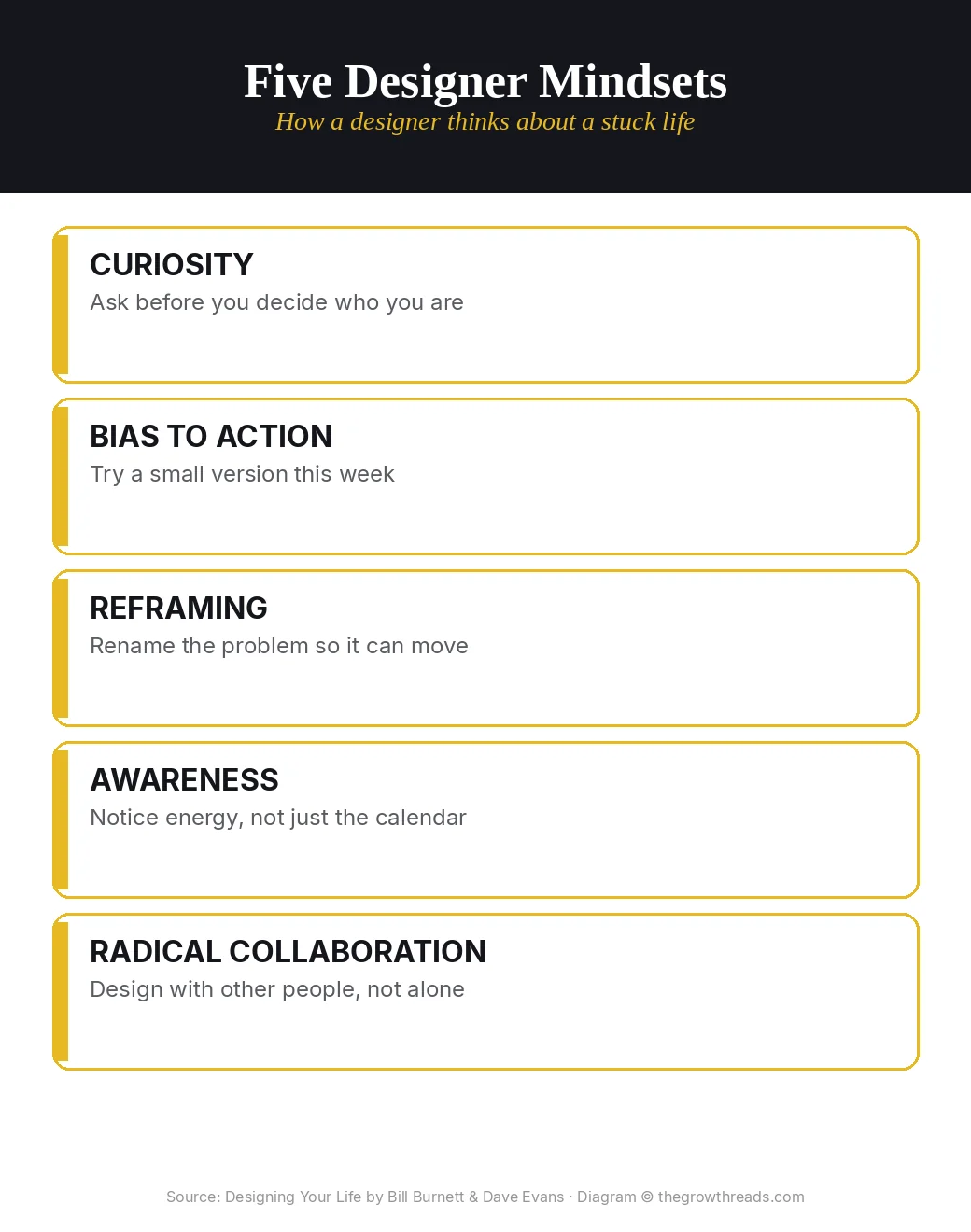
Getting unstuck is then a generation problem. Mind mapping, used the studio way, puts a topic in the middle, pushes three rings without editing, and hunts the third ring for ideas weird enough to be useful. Designers do not marry the first sketch. Stuck people often have one sketch they have defended for years, which is why it feels like a personality. Wayfinding is movement without a GPS pin: a direction true enough to take a step, then better data. Curiosity keeps the third-ring idea alive. Bias to action stops the map becoming another research project. Radical collaboration is the refusal to design a life in a locked room with only your fear as the critic.
TGR Note: If the stuckness is “I am not a natural,” read Hidden Potential next. Grant’s argument is that capacity is built in public. Burnett and Evans give you the design loop; Grant gives you permission to look like a beginner inside it. Do not use life design as a private IQ test.
Part 3: Odyssey Plans, then prototypes — conversation before leap
The signature tool is the Odyssey Plan: three versions of the next five years, concrete enough to stop being vibes. Life One is the path you are on — the Tuesday version, not the LinkedIn one. Life Two is what you would build if that path vanished. Life Three is the wild card if money and image were not allowed to run the meeting. Each plan gets a dashboard of resources, questions, and a gut check. People freeze because they are trying to pick the one true life in advance. Three lives on one table makes the freeze look like what it is: too few sketches.
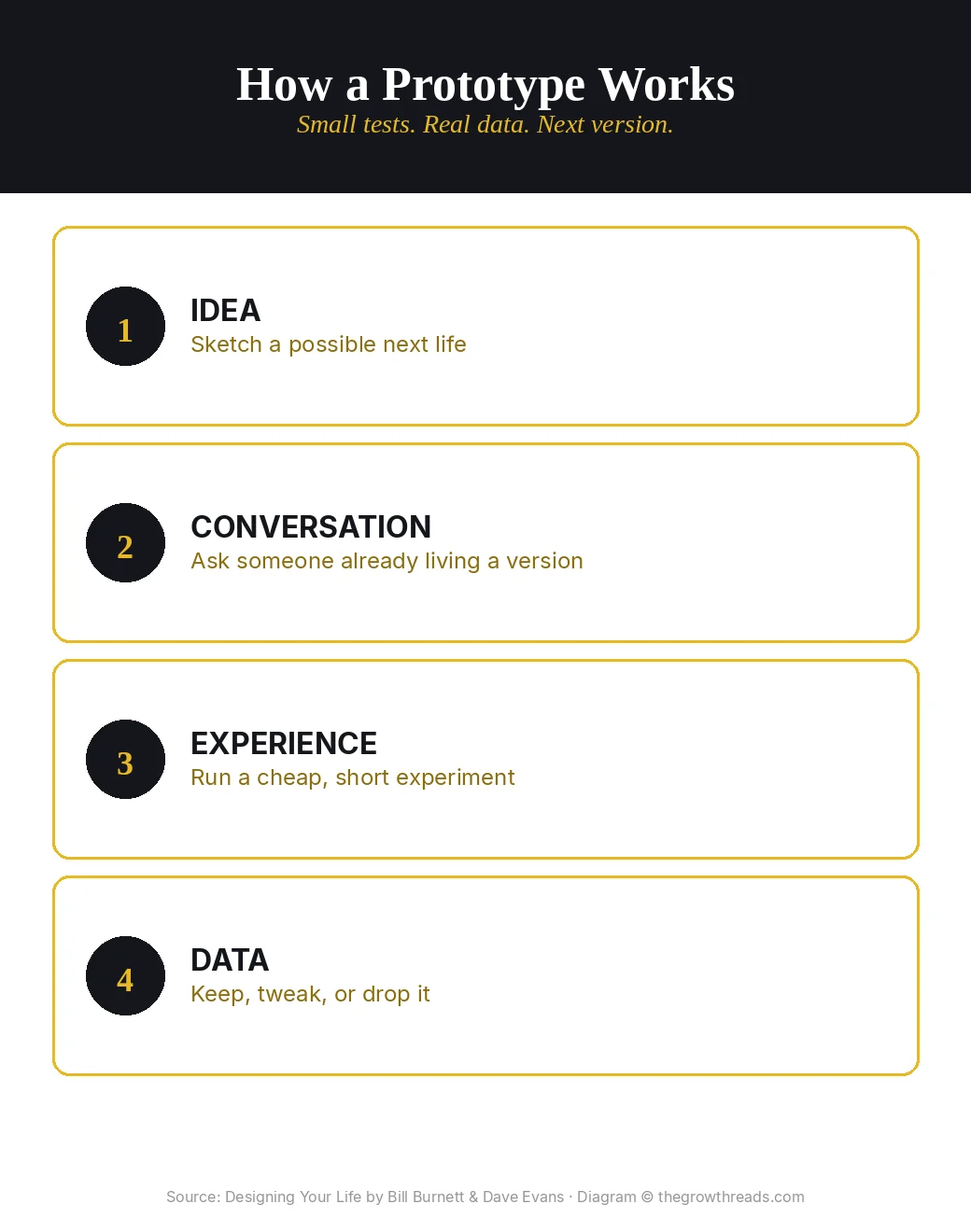
Then the book refuses the armchair. A prototype conversation is a short interview with someone already living a version of the life — what the days are made of, what they would not repeat — not a pitch for a job. A prototype experience is smaller still: a shadow, a weekend version, one class, one shipped piece. You want energy in the body, not a new slogan. That is also why spraying résumés into the void is a bad test. Designers talk to users. The users of a possible job are people already in that world. Prototype first. Apply from a conversation, not from silence you mistook for a verdict.
TGR Note: To keep interviews and energy notes out of chat history, use Building a Second Brain and The PARA Method. Burnett and Evans tell you what to generate. Forte tells you where it lives so the third Odyssey Plan is not a napkin you lose in November.
Part 4: Choose, let the unused lives die, build a team
Choosing is a skill. Endless optionality feels like freedom and behaves like a trap. Once you have enough prototype data, you pick — then you let the unchosen lives die. That does not ban a later wild card. It means you stop keeping five futures on life support so you never feel the loss of four. A good choice is one you then design into. Happiness is downstream of commitment plus iteration, not of every door staying cracked. Failure immunity is the log: what you tried, what broke, what you learned, what is next. Designers expect versions to die. If your identity is “I pick right the first time,” you will not run experiments. A two-line recon after a dead conversation keeps the week from becoming a referendum on you.
The last instruction is social. A small life-design team — a few people who will tell you the truth and will not confuse cheering with help — is part of the method. Radical collaboration is not networking theater. It is a standing hour with people who have seen your Odyssey Plans and will notice when you sneak back into a gravity problem. Three names, a monthly check-in, the same questions. Skip the team and you will design a very elegant private stall.
Who is Designing Your Life best for — and who should read something else first?
Read this now if you are competent and restless: a student without a calling, a mid-career operator whose title is fine and whose Tuesdays are not, a founder who can ship and cannot say what a good week is for. It is the right book when career quizzes have not moved you.
Read something else first if you cannot start. Use Mini Habits or Atomic Habits for a floor, then come back. If breadth is the shame, Range is the argument; this book is the workshop. If craft is fine and people flinch, use What Got You Here Won’t Get You There. This is not a first habit book.
Questions to reflect on
- If you could not use the word “passion,” what would you say your last good Tuesday was actually made of?
- Where are you treating a gravity problem as a puzzle you have failed to crush?
- What would Life Two be if your current path vanished on Monday?
- Who is already living a version of a life you keep researching in private — and have you asked them one specific question?
- Which unused future are you keeping on life support so you never have to choose?
🔥 Ready to prototype a life that actually fits?
Get Burnett and Evans’s full exercises, Odyssey Plan templates, and interview prompts — then run the 7-day plan below.
How to apply Designing Your Life (7-day plan)
- Day 1 — Log energy and engagement for one full day. Write what you did in blocks. Mark high/low energy and whether you were actually in it. No redesign yet. Just the Tuesday.
- Day 2 — Write a Workview and a Lifeview. About 250 words each. Why you work, and what you think a good life is for. Circle one place they clash.
- Day 3 — Name one gravity problem and one actionable problem. Put them on the same page. If you cannot change it this year, it is gravity. Write the smallest move next to the actionable one.
- Day 4 — Sketch three Odyssey Plans for the next five years. Life on the current path, the pivot if it vanished, and a wild card if money and image were quiet. Titles plus a few concrete years — not a vibe.
- Day 5 — Run one prototype conversation. Ask one person living a version of a plan two specific questions: what the days are made of, and what they would not repeat. Thank them. Do not pitch yourself.
- Day 6 — Run one tiny prototype experience. Two hours that resemble the life: a shadow, a sample class, a small shipped piece, a volunteer shift. Write the energy note afterward.
- Day 7 — Choose a next step and retire one unused life for the month. Pick the smallest follow-up from the data. Leave the other two plans on paper. Do not keep all three equally alive. Schedule the follow-up.
Frequently asked questions
What is Designing Your Life about in one paragraph?
Designing Your Life is Bill Burnett and Dave Evans’s field manual for people waiting to find a passion before they are allowed to move. The book applies design thinking to career and everyday life: write a Workview and Lifeview, log what gives you energy, name problems you cannot solve, draw three five-year Odyssey Plans, then run prototype conversations and tiny experiences until you have data. Passion, here, is what shows up after a life is working — not a hidden object you must locate first. The Stanford course is the origin; the book is the version you can run without enrolling.
How long does it take to read Designing Your Life?
The Knopf hardcover is about 238 pages and reads in five to seven hours. The first half is mindset, dysfunctional beliefs, the compass, and getting unstuck. The second half is Odyssey Plans, prototyping, job search as design, choosing, failure immunity, and building a team. You can finish a first pass in a weekend. The useful work is slower: a week of energy notes, three lives on paper, and one conversation. This summary is a fifteen-minute map of that sequence so you can start the journal before you reread the templates.
Who should read Designing Your Life?
Read it if you already do hard things and still cannot answer what a good week is for. It is built for students without a calling, mid-career people whose title is fine, and anyone who has turned career research into a hobby. Skip it as a first productivity book if you cannot keep a two-minute habit; use Mini Habits or Atomic Habits first. If you need permission to be a generalist, start with Range. If the leak is how you treat people while you do excellent work, start with What Got You Here Won’t Get You There.
What is an Odyssey Plan in Designing Your Life?
An Odyssey Plan is a five-year sketch of a possible life, and the method asks for three of them. Life One is the path you are on. Life Two is what you would do if that path disappeared. Life Three is the wild card you would try if money and image were not allowed to veto it. Each plan is concrete enough to include years, resources, and questions — not a mood. The point is to stop hunting for the one true future. Designers generate alternatives, then prototype. One plan on a page is how people freeze. Three plans on a table is how they start talking to humans.
What is a gravity problem in Designing Your Life?
A gravity problem is a fact you cannot change with effort, cleverness, or a better spreadsheet. Age, a closed door, a market that is gone, a person who will not become someone else — those are gravity. Burnett and Evans want you to name them so you stop treating physics as a personal failure. Next to gravity sits an actionable problem: given this weather, what can you actually test this month? The reframe is not resignation. It is a design constraint. Gravity tells you the floor of the room. The prototype is what you do inside the room instead of headbutting the walls.
How is Designing Your Life different from So Good They Can’t Ignore You or Range?
So Good They Can’t Ignore You argues that passion follows skill. Range is the case for breadth across domains. Designing Your Life is the studio manual for a Tuesday once you accept both. You still need skills, and you may still need breadth. This book tells you how to generate three possible lives, talk to people living them, and run a cheap test before you spend a year. Use Newport if you are waiting to feel called. Use Epstein if you are ashamed of a messy path. Use Burnett and Evans if you need a prototype this week.
Is Designing Your Life still relevant in 2026?
The “find your passion” trap has not aged out; it has moved into feeds and career quizzes. Remote work made prototype conversations easier and lonely research easier too. Odyssey Plans still fit a world where titles last less than five years: you need more than one future on the page. Some job-hunt chapters assume a more analog network than a 2026 inbox, and the book is lighter on money than on meaning. The practical advice is uncontroversial: write why you work, stop solving gravity, draw three lives, and talk to a human before you leap. That sequence still fits a week.
Related summaries
- So Good They Can’t Ignore You Summary & Review
- Range Summary & Review
- Hidden Potential Summary & Review
- Building a Second Brain Summary & Review
- Best Productivity Books
How we analyze books: every book on The Growth Reads is read cover to cover, summarized in thousands of words of original analysis, and rated against our five-criteria rubric (lasting impact, evidence quality, practical application, writing & originality, external consensus). Read our full methodology.