

★★★★☆ 4.4/5 — the finish is earned in the trough, not at the kickoff.
Best for: people six to eighteen months into a project that used to feel inevitable
Reading time: ~6 hours (Portfolio hardcover, 2018) · this guide ~12 min
Difficulty to apply: Medium — the curve is simple; staying in contact when belief drops is the work
The Messy Middle in one minute
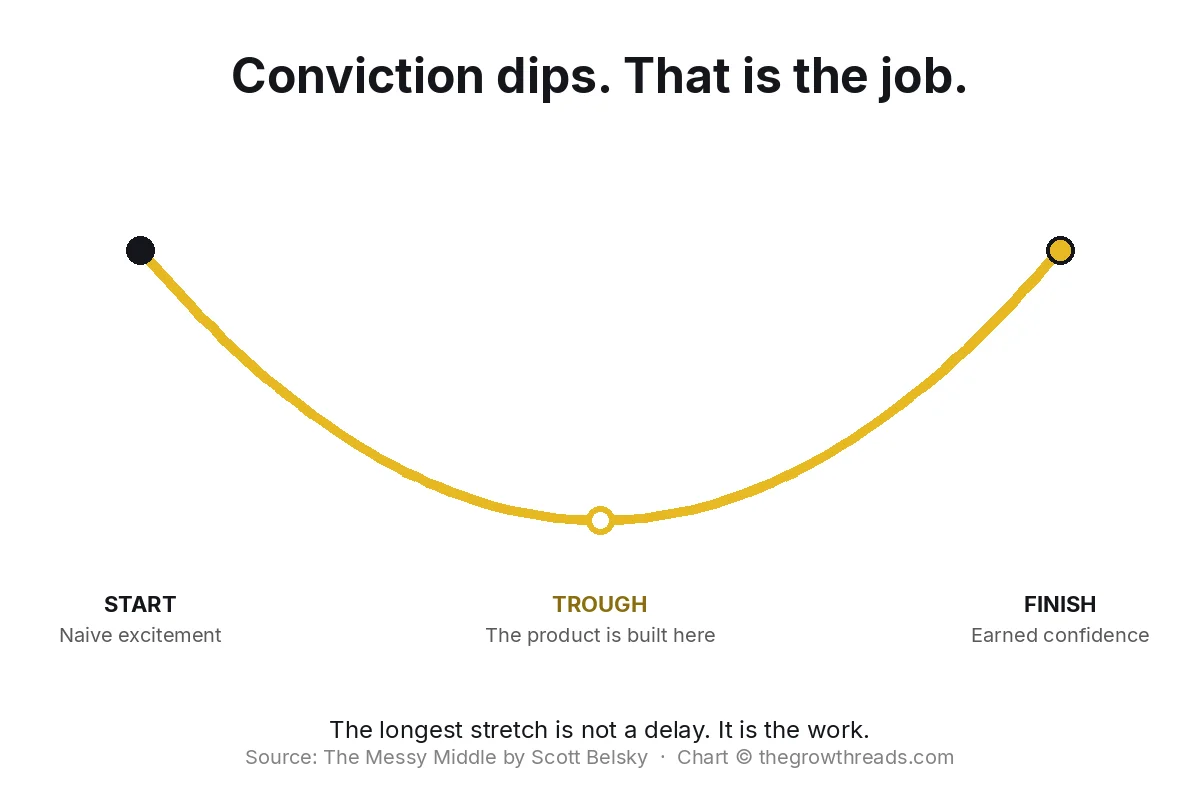
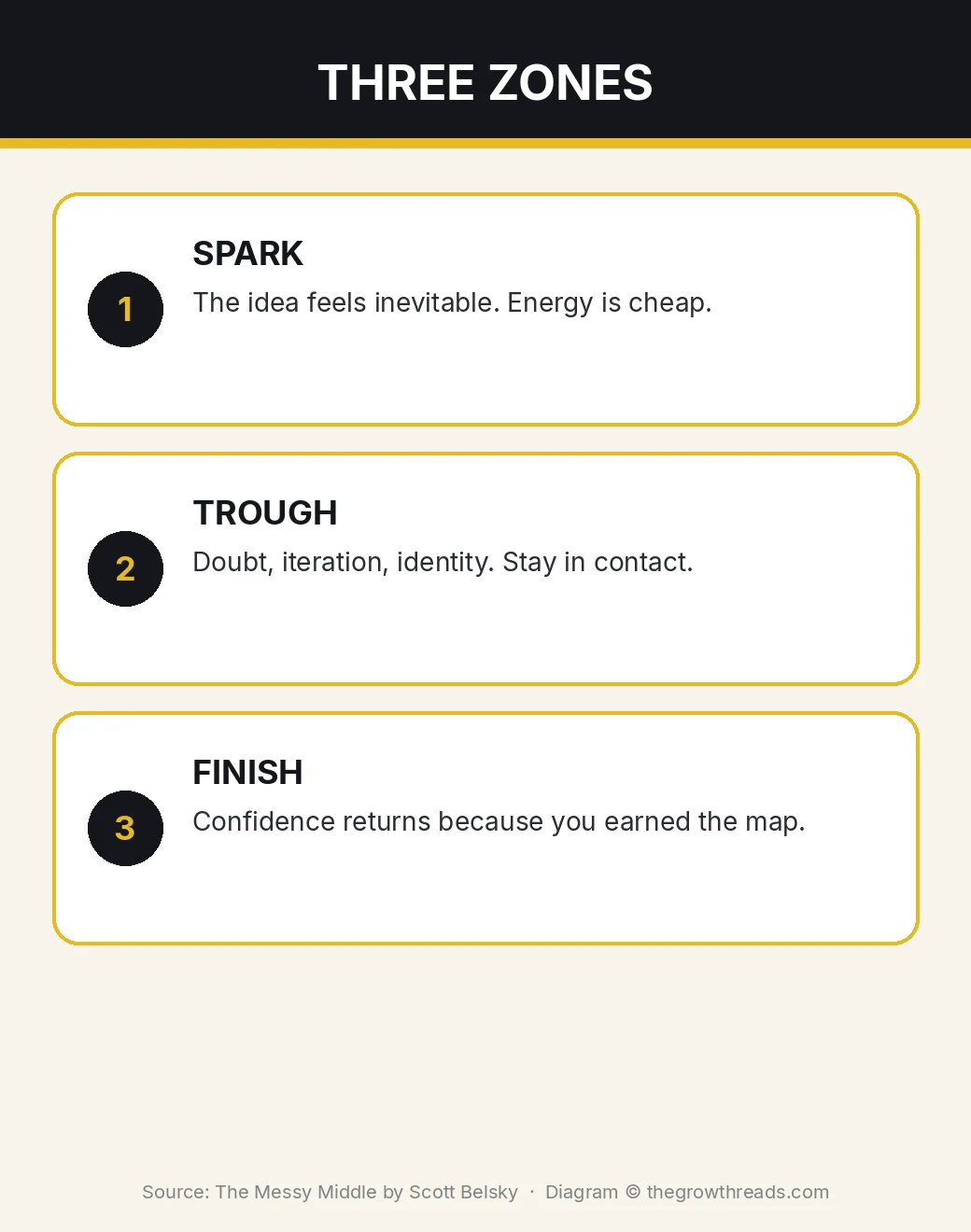
Most projects do not die at the start. They die in the long, quiet stretch when the idea is no longer new and the finish is not yet real. Scott Belsky calls that stretch the messy middle. Conviction follows a smile: naive excitement, a trough of doubt, then earned confidence. The trough is not a delay. It is where the product, the team, and your taste are actually built.
The book is a field kit for that trough. Keep talking to the people you serve. Watch the story you tell yourself. Optimize the current thesis until the evidence says the game itself must change. Protect energy so cynicism does not masquerade as wisdom. Finish a slice instead of waiting to feel like a founder again. Endurance, not the original spark, is the scarce skill.
Key takeaways
- The smile is the map. Belief starts high, falls, then rises because you earned a real picture of the work.
- The trough is the job. Treating it as a verdict is how you collect beginnings and never a finish.
- Resourcefulness beats resources. Constraint is information. A padded budget can hide a weak thesis.
- Self-awareness is a competitive advantage. You cannot steer a project you cannot see yourself distorting.
- Optimize, then transform. Tighten the current loop until evidence says the loop is the problem.
- Stay in contact. A week without a customer, a reader, or a user is a week you are arguing with a ghost.
- Energy is a strategy. Cynicism feels like intelligence. Curiosity is the cheaper fuel.
- Short essays, long application. Read it against one live project, not as a biography of Behance.
- Finishing is a practice. Ship a slice that a real person can use. Do not wait for the perfect last chapter.
What is The Messy Middle about?
The Messy Middle is Scott Belsky’s guide to the longest part of any bold venture: the trough between a spark and a finish. It shows how conviction dips, how to keep learning anyway, and how to choose between polishing the current thesis and changing the game.
About the author
Scott Belsky co-founded Behance in 2006 as a place for creative people to show work and get hired. Adobe acquired it. He later led product there, invested early in companies such as Pinterest and Uber, and wrote Making Ideas Happen — the Action Method notebook that still sits under this sequel. The Messy Middle (Portfolio, 2018) is the book he could not have written at the spark. It comes from the years when Behance was neither a toy nor a household name, and from watching teams generate more than they shipped. He writes as a builder who has sat in the trough, not as a keynote who skipped it. Wikipedia: Scott Belsky. Explore all Scott Belsky book summaries →
Key concepts at a glance
| Concept | What it means | Use it when |
|---|---|---|
| Conviction curve | Belief smiles: high, then low, then earned high | You are treating a dip as proof you should quit |
| The trough | The long middle where the product is actually built | The kickoff energy is gone and the finish is not in sight |
| Resourcefulness | Doing the next true thing with what you have | You are waiting on a hire, a round, or a perfect tool |
| Self-awareness | Seeing the story you are adding to the data | Every miss feels personal and every win feels like luck |
| Optimize | Keep the thesis; tighten the loop | Customers still want it and the craft is sloppy |
| Transform | Change the game, not the polish | The thesis is wrong and more effort will not save it |
| Stay in contact | Talk to the person the work is for, every week | The team is debating ghosts instead of users |
| Manufactured luck | Stay in the game long enough for a break to land | You want a lightning strike without the years of weather |
Part 1: The conviction curve — why the middle feels like failure
Belsky’s signature picture is a smile. At the start you over-weight the idea. You have not met the customer who shrugs, the hire who does not work out, or the feature that does not move the number. Belief is cheap because information is thin. Then the work starts telling the truth. Belief falls. That fall is so regular you can plan for it, and so personal it still feels like a unique collapse.
Near a real finish, belief rises again. Not because you became a different person. Because you now have a map you paid for: who it is for, what they actually do, which loops are worth tightening. Naive excitement and earned confidence can look the same from the outside. They are not. One is a story. The other is a scar that turned into taste.
The practical move is to name where you are on the smile for one live project this week. If you are in the trough, stop asking the kickoff question (“is this still exciting?”) and start asking the trough question (“are we still in contact with a real person, and are we still learning?”). Excitement is a poor compass in month nine. Contact is a better one.
TGR Note: Godin’s The Dip is the Sunday filter: stay in the hard stretch worth being best at, quit the cul-de-sac. Belsky’s trough is Wednesday. You already chose the hill. Now it feels like failure anyway. Pair them. If you need a name for the voice that wants you to clean the kitchen instead of open the file, The War of Art still does that job. This book is for after you sat down and the dashboard is still ugly.
Part 2: How to stay in the trough without going numb
Endurance here is not grinding until you hate the work. It is staying in a learning stance when the cheap fuel of novelty is gone. Belsky keeps returning to three interior skills: the story you tell yourself, the energy you protect, and the resourcefulness you practice when the budget is not the blocker.
The story is the silent partner. In the trough, a miss becomes “I was never the person.” A slow week becomes “the market moved.” Write the story down. Then write the boring version: one customer did not convert; one draft was unclear; one hire needs a tighter brief. Self-awareness is not journaling as a hobby. It is catching the extra meaning you glued onto a data point before you steer from it. Belsky’s line is short on purpose: self-awareness is the most underrated competitive advantage.
Energy is strategy because cynicism is cheap and contagious. A tired lead starts calling every new idea naive. Curiosity is the more expensive fuel, and it is the one that still finds the next experiment. Resourcefulness is the outside version of the same stance: do the next true thing with the people, tools, and hours you have, instead of pausing the venture until a perfect round or a perfect calendar arrives. Constraint is often the information you were avoiding.
TGR Note: If the stall is a streak of almost-done work, Acuff’s Finish is the last-mile companion — cut the goal in half and survive the day after perfect. If the stall is identity (“I am a person who starts”), Keep Going and The Practice put you back on a calendar. Belsky adds the missing layer: you can have a shipping habit and still be in a trough. The habit is necessary. It is not the whole map.
Part 3: Optimize, then transform
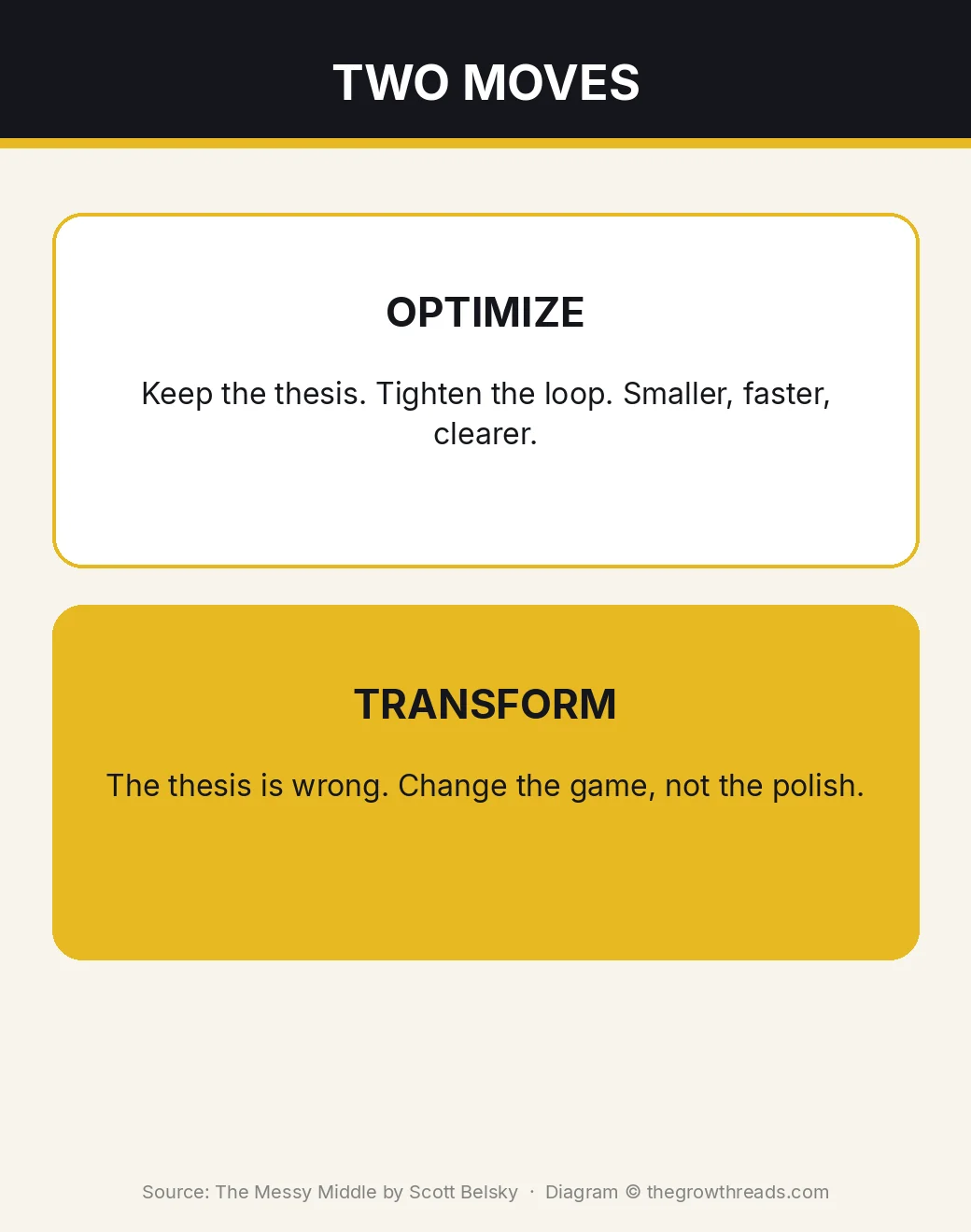
The middle tempts two bad moves. You polish a thesis that is already dead, or you blow up a thesis that only needed a tighter loop. Belsky splits the work into two modes. Optimize: keep the bet, make the next cycle smaller, faster, and clearer. Transform: the bet is wrong; change the game, not the sheen on the old one.
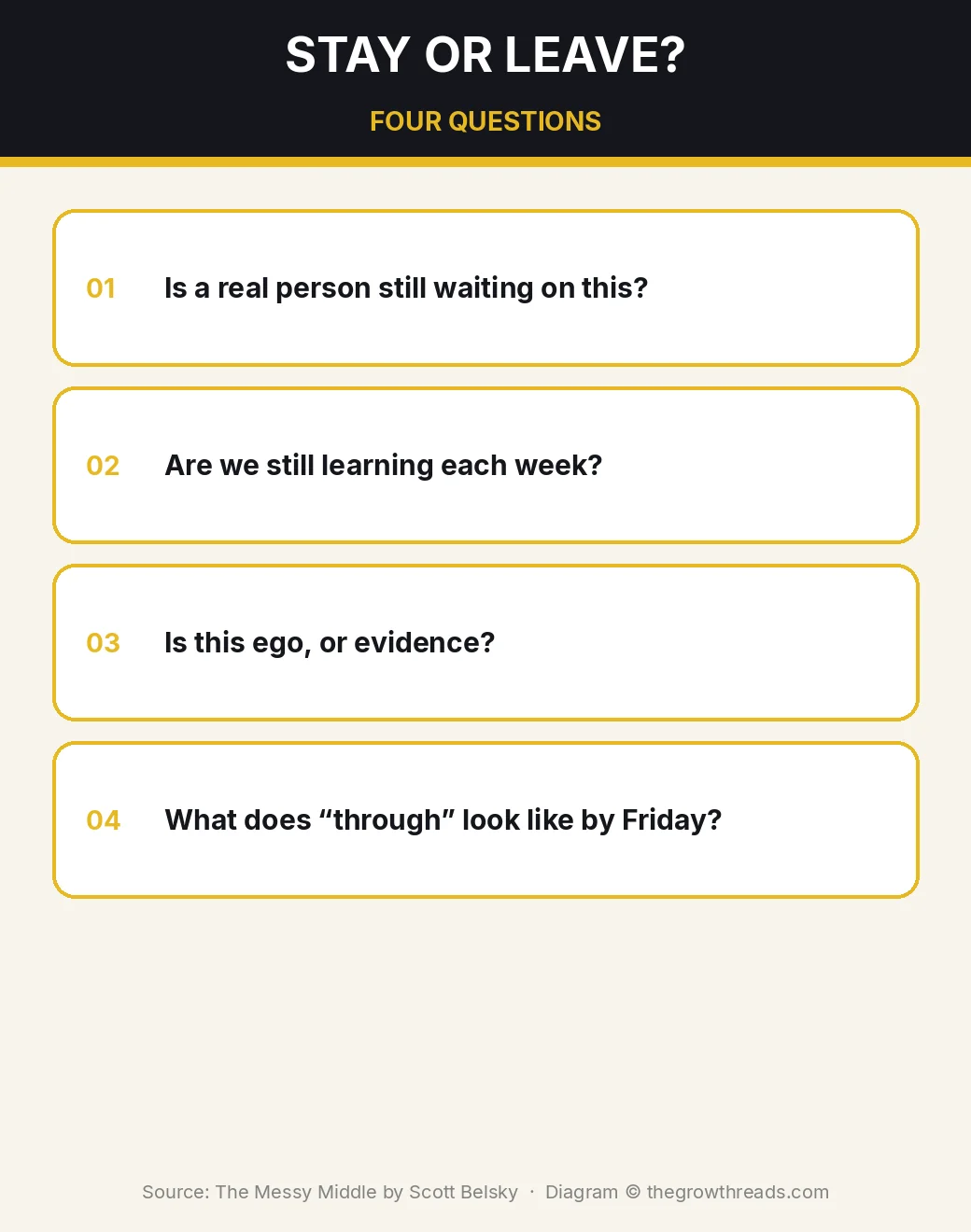
Teams mix them up because both feel like effort. A redesign of a page nobody asked for is optimization theater. A “pivot” every other week is transformation as a mood. The tell is evidence. If a real person still wants the outcome and the craft is sloppy, optimize. If you are getting better at making something nobody will miss, transform. The four stay-or-leave questions later in this summary are the weekly check: a waiting person, weekly learning, ego versus evidence, and a Friday-sized “through.”
This is also where Belsky’s first book earns its keep. The Action Method from Making Ideas Happen is the optimize engine: verbs, not references. The Messy Middle adds the courage to stop the engine when the road is wrong. You cannot optimize your way out of a thesis the customer already rejected. You also cannot transform your way out of a trough that only needed thirty honest conversations.
TGR Note: For the optimize loop, reuse Making Ideas Happen — dump the pile, keep three live, name the next action. For whether the thesis is even real, The Mom Test keeps you from interviewing compliments. Rework is the blunt cousin: ship smaller than your ego wants. Belsky’s split is the decision layer on top of those shipping habits.
Part 4: Leading through ambiguity, and knowing when you are done
If you lead in the trough, your job is not a pep talk. It is to keep the team in contact with reality without turning every miss into a personality trial. Belsky writes about culture as the residue of what you tolerate in the middle: politics, vagueness, and “we’ll know it when we see it” all get expensive when belief is already low. Truth-seeking beats performing leadership. Name the ugly dashboard. Name the experiment for this week. Protect the people who still bring curiosity.
Finishing is a separate skill from enduring. Some troughs should end because the thesis is dead. The four questions are how you tell the difference. If nobody is waiting, you are not learning, and the story is mostly ego, leaving is not a character flaw. If a real person is waiting and you are still learning, “through” this week is a shipped slice — a page, a call, a prototype in someone’s hands — not a fantasy of completion. Manufactured luck is the unromantic version of serendipity: you stay in the game long enough for a break to have a place to land.
You do not need a startup for this. A book, a certification, a team rewrite, a studio — anything with a spark and a slog will draw the same smile. Pick one. Draw the curve. Run the questions on Friday. Then either optimize, transform, or stop. Do not collect another beginning.
Who is The Messy Middle best for — and who should read something else first?
Best for founders, product leads, writers, and makers who are already in motion and have lost the cheap thrill of the kickoff. If you can point at one live project that is six months in and no longer exciting, this book is aimed at you.
Read something else first if you do not have a project yet — start with Poke the Box or Making Ideas Happen so you have a next action before you have a trough. If the problem is habits rather than a venture, Atomic Habits is the cleaner tool. If the problem is that you picked the wrong hill, The Dip is the filter. If you need a tiny daily craft more than a multi-year smile, Bird by Bird will get you to the next paragraph.
Questions to reflect on
- Which live project is actually in a trough, and which one is just under-resourced at the start?
- What story did you add to last week’s ugliest data point?
- When did you last speak to a person this work is for?
- Are you optimizing a thesis, or transforming because you are bored?
- What would “through” look like by Friday that a real person could use?
🔥 Ready to stay in the trough this week?
Get The Messy Middle, then use the 7-day plan to draw your curve and ship one Friday-sized slice.
How to apply The Messy Middle (7-day plan)
- Day 1 — Draw the smile. One live project. Mark start, trough, or finish with a date, not a vibe.
- Day 2 — Write the story. Two columns: the dramatic version of last week’s miss, and the boring version.
- Day 3 — One optimize pass. Tighten one loop. Smaller page, clearer ask, shorter demo. Do not redesign the company.
- Day 4 — Contact. One conversation with a person the work is for. Notes, not a pitch deck.
- Day 5 — Energy audit. Where did cynicism show up as “being realistic”? Replace one of those lines with a question.
- Day 6 — Optimize or transform. Using Day 4 evidence, pick a mode. Write it in one sentence the team can repeat.
- Day 7 — Ship a slice. Something a real person can use by Friday. Not the whole finish. Through, not complete.
Frequently asked questions
What is The Messy Middle about in one paragraph?
The Messy Middle is Scott Belsky's field guide for the longest stretch of any venture: the years between a spark and a finish. Ideas are cheap. Endurance is scarce. Conviction follows a smile — naive excitement at the start, a trough of doubt and iteration, then earned confidence near the end. The book is a set of practices for staying in contact with customers, managing the story you tell yourself, choosing when to optimize and when to transform, and finishing without waiting to feel like a founder again. It is not a launch checklist. It is a kit for month nine.
Is The Messy Middle worth reading if I already read Making Ideas Happen?
Yes, if you already ship and still stall. Making Ideas Happen is the Action Method: next verbs, references, a backburner. The Messy Middle is what happens after you have been running that method for a year and the thrill is gone. Belsky keeps the bias to action, then adds endurance, self-awareness, and the optimize-versus-transform choice. If you have never named a next action, start with Making Ideas Happen. If your calendar is full of next actions and your conviction is still dropping, this is the sequel you actually need.
How is the trough different from "The Dip"?
Godin's Dip is a filter: stay in the hard stretch that is worth being best at, and quit the cul-de-sac. Belsky's trough is the same calendar from the inside — the months when you have already chosen the hard stretch and it still feels like failure. The Dip helps you pick the hill. The Messy Middle helps you walk it without rewriting the story as proof you should never have started. Read them as a pair. Use The Dip on Sunday. Use this book on Wednesday, when the dashboard is ugly and the team is quiet.
What is the conviction curve in The Messy Middle?
The conviction curve is Belsky's smile of belief over the life of a project. At the start you over-index on the idea. In the middle, information arrives — customer shrugs, slow hiring, a feature that did not move the number — and belief falls. Near the finish, belief rises again because you have a map you earned. The point is not to flatten the curve. The point is to stop treating the dip as a verdict. If you quit at the bottom of every smile, you only ever experience beginnings.
Who is Scott Belsky and why listen to him on this?
Scott Belsky co-founded Behance, sold it to Adobe, and later led product there. He has also backed early companies and written Making Ideas Happen. The Messy Middle is not a memoir of a clean win. It is a notebook from watching creative teams generate more than they ship, and from sitting in the years when Behance was neither a toy nor a household name. You listen because he names the part of the work most productivity books skip: the long, unglamorous middle where identity, not just output, is under load.
How long is The Messy Middle and how should I read it?
The Portfolio hardcover runs a few hundred pages of short essays, not one climbing argument. Do not binge it like a thriller. Read it as a field manual: one section, one live project, one change to how you spend the week. The 7-day plan in this summary is the way in — draw the curve, name the story, run one optimize pass, talk to one customer, then decide whether you are polishing or changing the game. Skip the essays that are not about your current trough. Return when a new trough starts. They will.
How do I apply The Messy Middle if I am not running a startup?
A venture here is any piece of work with a spark, a slog, and a finish: a book, a certification, a team rewrite, a move, a studio. The same curve shows up. Naive excitement on day one. A trough when the first draft is ugly and nobody is clapping. Earned confidence when a small audience is using it. Apply the book by picking one live project, drawing its smile, and running the four stay-or-leave questions on Friday. If a real person is still waiting and you are still learning, stay. Ship a slice. Do not wait to feel like a founder.
Related summaries
- Making Ideas Happen — the Action Method sequel this book assumes you already need in the trough.
- The Dip — pick the hard stretch worth staying in before you endure it.
- Poke the Box — start before you have a middle to survive.
- Finish — last-mile tactics when the trough is mostly almost-done work.
More in this silo: best productivity books.
How we analyze books: every book on The Growth Reads is read cover to cover, summarized in thousands of words of original analysis, and rated against our five-criteria rubric (lasting impact, evidence quality, practical application, writing & originality, external consensus). Read our full methodology.